Revelation 9:1
And the fifth angel sounded, and I saw a star fall from heaven unto the earth: and to him was given the key of the bottomless pit.
Translations
American King James Version, Webster Bible
And the fifth angel sounded, and I saw a star fall from heaven to the earth: and to him was given the key of the bottomless pit.
King James Version, KJV Cambridge Paragraph Bible
And the fifth angel sounded, and I saw a star fall from heaven unto the earth: and to him was given the key of the bottomless pit.
Revised Version, American Standard Version
And the fifth angel sounded, and I saw a star from heaven fallen unto the earth: and there was given to him the key of the pit of the abyss.
And the fifth messenger did sound, and I saw a star out of the heaven having fallen to the earth, and there was given to it the key of the pit of the abyss,
And the fifth angel sounded [ his] trumpet: and I saw a star out of the heaven fallen to the earth; and there was given to it the key of the pit of the abyss.
And, the fifth messenger, sounded; and I saw a star, out of heaven, fallen unto the earth, and there was given unto him the key of the shaft of the abyss.
Berean Standard Bible, Majority Standard Bible
Then the fifth angel sounded his trumpet, and I saw a star that had fallen from heaven to earth, and it was given the key to the pit of the Abyss.
The fifth angel sounded, and I saw a star from the sky which had fallen to the earth. The key to the pit of the abyss was given to him.
And at the sounding of the fifth angel I saw a star falling from heaven to the earth: and there was given to him the key of the great deep.
And the fifth Angel blew the trumpet, and I saw a starre fall from heauen vnto the earth, and to him was giuen the key of the bottomlesse pit.
Douay-Rheims (Challoner revision)
And the fifth angel sounded the trumpet, and I saw a star fall from heaven upon the earth, and there was given to him the key of the bottomless pit.
Pictures
Cross-references
- Revelation 8:6-13
And the seven angels which had the seven trumpets prepared themselves to sound.
Introduces the trumpet series, whose fifth trumpet sounds in the following chapter.
- Revelation 20:1-3
And I saw an angel come down from heaven, having the key of the bottomless pit and a great chain in his hand.
Both texts place Satan’s confinement in the bottomless pit.
- Revelation 9:11
And they had a king over them, which is the angel of the bottomless pit, whose name in the Hebrew tongue is Abaddon, but in the Greek tongue hath his name Apollyon.
Names the king of the bottomless pit as Abaddon, or Apollyon, the destroyer.
- Revelation 8:2
And I saw the seven angels which stood before God; and to them were given seven trumpets.
Introduces the seven angels whose trumpet series includes the fifth angel.
- Revelation 8:13
And I beheld, and heard an angel flying through the midst of heaven, saying with a loud voice, Woe, woe, woe, to the inhabiters of the earth by reason of the other voices of the trumpet of the three angels, which are yet to sound!
Introduces the woes accompanying the final three trumpet blasts, including the fifth.
- Revelation 11:7
And when they shall have finished their testimony, the beast that ascendeth out of the bottomless pit shall make war against them, and shall overcome them, and kill them.
Both describe a beast ascending from the bottomless pit.
- Revelation 17:8
The beast that thou sawest was, and is not; and shall ascend out of the bottomless pit, and go into perdition: and they that dwell on the earth shall wonder, whose names were not written in the book of life from the foundation of the world, when they behold the beast that was, and is not, and yet is.
Both describe the beast ascending from the bottomless pit.
- Revelation 9:5
And to them it was given that they should not kill them, but that they should be tormented five months: and their torment was as the torment of a scorpion, when he striketh a man.
The five months of torment are reckoned as 150 prophetic years.
- Genesis 1:2
And the earth was without form, and void; and darkness was upon the face of the deep. And the Spirit of God moved upon the face of the waters.
Both describe the abyss or deep using the same term.
- Luke 8:31
And they besought him that he would not command them to go out into the deep.
Both texts use the Greek word for the abyss, rendered “the deep” in Luke.
- Revelation 9:10
And they had tails like unto scorpions, and there were stings in their tails: and their power was to hurt men five months.
It assigns the fifth trumpet’s torment a five-month period.
- Revelation 20:1
And I saw an angel come down from heaven, having the key of the bottomless pit and a great chain in his hand.
Uses the same term, “bottomless pit.”
- Revelation 8:7-12
The first angel sounded, and there followed hail and fire mingled with blood, and they were cast upon the earth: and the third part of trees was burnt up, and all green grass was burnt up.
The first four trumpet judgments precede the fifth.
- Revelation 9:7-9
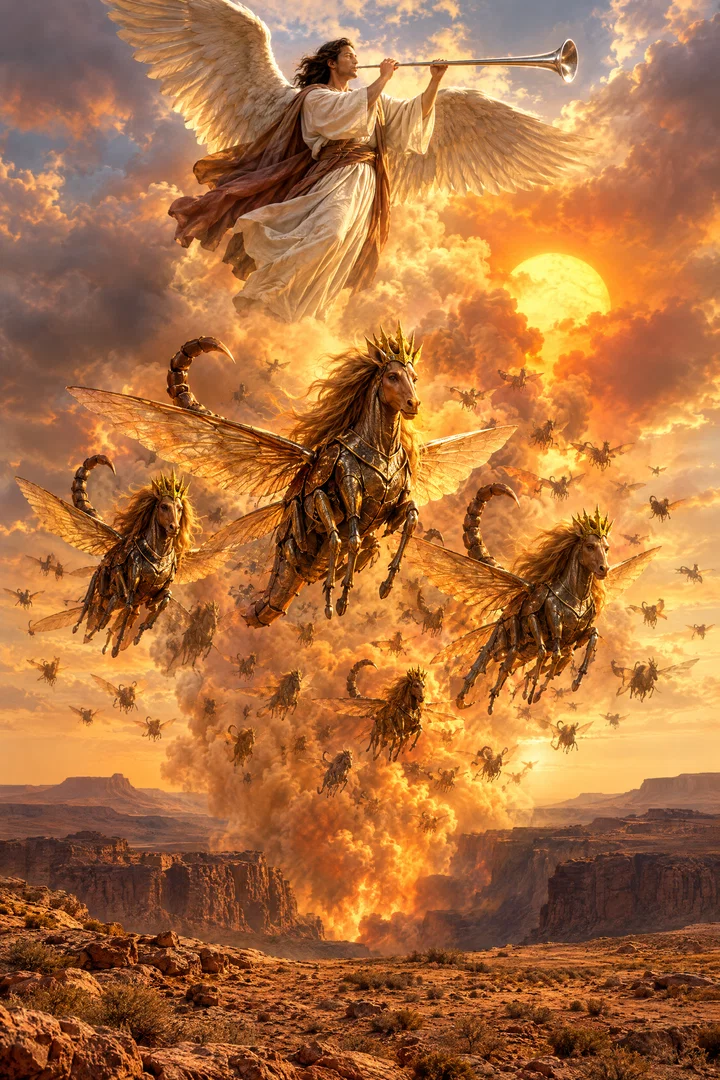
And the shapes of the locusts were like unto horses prepared unto battle; and on their heads were as it were crowns like gold, and their faces were as the faces of men.
The locust imagery is applied to the rise of Mohammedanism.
- Luke 10:18
And he said unto them, I beheld Satan as lightning fall from heaven.
Both texts describe a fall from heaven.
- Jude 1:6
And the angels which kept not their first estate, but left their own habitation, he hath reserved in everlasting chains under darkness unto the judgment of the great day.
Fallen angels are reserved for the great day of judgment.
- Revelation 11:15
And the seventh angel sounded; and there were great voices in heaven, saying, The kingdoms of this world are become the kingdoms of our Lord, and of his Christ; and he shall reign for ever and ever.
same trumpet series
Commentary
Each commentary is drawn from primary sources: the writings of Ellen G. White and Adventist pioneers and periodicals. Each commentary is separate. Its own words are not a quotation; follow the references to read the source passages.
Ellen G. White
1 source
The fifth trumpet belongs to the prophecy of Revelation 9, whose time periods were calculated to fix a date for the fall of the Ottoman Empire.GC88 334.4–5 That calculation pointed to August 11, 1840 as the appointed day.GC88 334.4–5 On that day Turkey was to surrender its independence by placing itself under the protection and control of the European powers.GC88 334.4–5 When the event took place exactly as predicted, it was taken as a precise fulfillment that confirmed confidence in the rules of prophetic interpretation and gave powerful impetus to the Advent movement.GC88 334.4–5
Sources
Pioneers and periodicals
122 sources
The verse opens the fifth trumpet, also called the first woe, in which a fallen star receives the key of the abyss and its opening brings darkening smoke and tormenting locusts under Abaddon or Apollyon.RH Jul 22, 1858ST Apr 8, 1886 The fallen star is Mohammed, the founder of a false religion and conquering power, while the key is the power given him to rouse the Arabian tribes from inaction to conquest.ST Oct 31, 1916RH Jul 22, 1858 The abyss is the waste desert land of Arabia from which his doctrines and armies issued, and its smoke is the darkness and deadly influence of that error spreading across Asia, Africa and Europe.RH Sep 4, 1900ST Jul 6, 1915RH Jul 30, 1861 The trumpet is God's scourge by Saracens and later Turks upon an idolatrous apostate church after the fall of Western Rome and the rise of papal supremacy.RH Jul 22, 1858ST Mar 21, 1911ST Oct 24, 1911 Its five months of torment are 150 prophetic years from Othman's organized rule beginning July 27, 1299 to July 27, 1449, when Turkish power gained virtual control of Constantinople.ST Jul 13, 1915ST Sep 9, 1886ST Dec 17, 1896
Trumpet Setting and Order
The verse opens the fifth trumpet, also called the first woe, in which a star fallen from heaven receives the key of the abyss, opens it, and smoke rises to darken the sun and the air while locusts come out with power to torment for five months only those who do not have God's seal, under the angel of the abyss named Abaddon in Hebrew and Apollyon in Greek.RH Jul 22, 1858RH Dec 29, 1868 The last three trumpets are woe trumpets bringing woe rather than blessing or peace, and the first woe is identified as past before the next woe comes, so the trumpet sequence reaches to the end of the age and portrays final perils and declining piety rather than a converted world or temporal millennium.ST Apr 8, 1886ST Sep 14, 1882 The ninth chapter as a whole explains the fifth and sixth trumpets sounded by the fifth and sixth angels.RH Dec 29, 1868
The verse belongs to the seven trumpets in Revelation 8 and 9, containing symbols to be expounded, and to the connected seven-trumpets prophecy of Revelation 8 to 11.ST May 1, 1884ST Dec 8, 1909RH May 13, 1862ST Dec 14, 1904RH Dec 27, 1870 That prophecy is one of twelve great lines of prophecy converging to the focal center of Christ's second coming, proving earthly rule is nearly over and His coming near.ST Dec 14, 1904 It is specifically the fifth trumpet within that account.RH May 13, 1862
The seven trumpets sound in succession as a complete prophetic outline of political events and wars from the breakup of the Roman Empire to Christ's return and the end of the age, signifying a call to battle in which the political heavens are darkened by Saracens and Turks.STST Oct 24, 1911ST Feb 7, 1906 They are mostly past and signify political events whose largely figurative imagery is interpreted in keeping with the historical record, though including literal elements, giving details about the kingdoms formed by division of the fourth universal empire and describing the plague of Mohammedanism.RH Sep 29, 1874 Within that succession chapter 9 belongs to the sixth-trumpet period connected with the passing of the Turkish Empire under control of the European allied powers on August 11, 1840.ST
The fifth and sixth angels sound in order in chapter 9 after the first four trumpets, and are not separate angels outside that ordered series of seven trumpet angels.RH May 7, 1867RH Oct 21, 1862 The events of that trumpet are recorded before the intervening events of chapter 10 and the next trumpet, and the events of the fifth and sixth soundings had been accomplished with the sixth ceasing in 1840.RH Oct 21, 1862ST Feb 7, 1884ST Apr 14, 1887
The first four trumpets fell upon the western divisions of Rome, and the fifth trumpet begun in the verse together with the sixth turns judgment to Eastern Rome and to Constantinople as the sole imperial city.RH Jul 8, 1858ST May 25, 1904ST May 18, 1904RH Jun 16, 1874 After Constantine the empire was divided into three parts so the judgments fall upon a third part, and under the first four the two western divisions fall while under the fifth and sixth the eastern empire is crushed and under the seventh great Babylon entire sinks to rise no more.RH Jul 8, 1858 The fifth trumpet shows Mohammedanism gathering strength in the century after the fourth trumpet extinguished Western Rome, with Mohammed recognized as prophet and entering Medina as prince in 622 and gathering nearly all Arabia by his death in 632, and fanatical warriors ready to burst from the Arabian deserts as locust clouds darkening the sky.ST May 25, 1904 The sixth trumpet then ceased in 1840 and the seventh or third woe commenced in 1844 at the termination of the 2300 days.RH Jun 16, 1874
That new phase follows the fall of the western empire and the rise of papal supremacy recognized by Justinian, when the emperorship, consulate and senate that shone like sun, moon and stars were abolished till Rome was without emperor, consul or senate, and the city enthroned a pope instead of a Caesar with political supremacy established in 538 over seven nations in Western Rome after the Heruli, Vandals and Ostrogoths were overthrown.RH Jul 22, 1858ST May 18, 1904 The fifth and sixth trumpets, also called woes, then fall on apostate Christendom and lead ultimately to subversion of the eastern empire.RH Jul 22, 1858
The trumpet judgments are past invasions of the Roman Empire by northern European barbarian tribes and by Saracen and Turkish forces over many centuries, distinct from the seven last plagues and not the plagues threatened for adding to John's record.RH May 4, 1869RH Dec 29, 1868 They are partial judgments of God upon the wicked, while the seven last plagues make no exemption and complete God's wrath.RH Dec 29, 1868 They belong with the plagues of Revelation contained in chapters 8, 9 and 16.ST Jun 23, 1898
The sounding of a trumpet in the verse is one example of the classes of work angels do in Revelation, alongside the angels of the seven churches in chapters 1-3 and the angels pouring out the vials in chapters 15-16, belonging to angels as ministering spirits sent forth to minister for heirs of salvation who encamp around those who fear God and deliver them.ST Jun 9, 1914
The seven trumpets present a prophetic sequence extending through successive periods to the end of time, given in overlapping trains rather than one continuous chronological order, reaching to the judgment, the day of wrath and the close of probation.RH Mar 26, 1861 The fifth and sixth angels' trumpet periods are spans of prophetic time measured in years, in which prophetic days mean years, providing the precedent for understanding the days of the seventh angel's voice as years devoted to finishing human probation and bringing it to its close.RH Dec 21, 1869RH Dec 21, 1869
No separate explanation of the star or the key is given beyond introducing the Mohammedan power and religion as arising from the bottomless pit.RH Jul 15, 1858 The falling-star interpretation set forth in connection with that exposition concerns the third trumpet, not the fifth.RH Jul 15, 1858
Star Fallen to Earth
The fallen star is Mohammed, the war leader who founded the Mohammedan power and a new religion, a false prophet and political conqueror opposing the Prince of princes.ST Oct 31, 1916RH Jul 22, 1858 His doctrine arose from the pit rather than heaven and spread like smoke darkening sun and air, from Arabia through much of Asia, Africa and Europe as shown by the extent of its conquests.ST Oct 31, 1916RH Jul 22, 1858 Unlike Attila, whose power passed like a meteor, these conquerors were to endure for the prophetic five months, understood as 150 years. The star's fall reached the earth broadly, not a single spot as in the comparison with Attila.RH Jul 22, 1858RH Jul 22, 1858
The fall stands amid the conflict between the Persian and Roman empires, amid the Persian conquest of Roman territories and severe weakening under Heraclius.RH Jul 22, 1858RH Jul 22, 1858 While those empires weakened one another, Mohammed watched their mutual destruction and foretold a Roman recovery.RH Jul 22, 1858 That time of widespread idolatry and religious corruption, when ordinances were changed and the everlasting covenant broken, prepared the way for the imposture of Mahometanism, whose mutual exhaustion of the empires opened the bottomless pit from which it spread through much of the world.RH Jul 22, 1858
The star is also taught to be Chosroes, king of Persia, whose defeat, overthrow and murder in 628 by Heraclius opened the way for the Mohammedans.ST Jan 10, 1878RH Jul 22, 1858 In 629 the conquest of Arabia and the first Mohammedan war against Rome began, after Persia and Rome had exhausted each other in war.ST Jan 10, 1878RH Jul 22, 1858RH Jun 25, 1872 His fall paved the way for Mahometan triumph, opening the symbolic pit as the Arabian desert from which arose the smoke of Mohammedan teachings and the Arabian horsemen, with Mahomet and his Arab hordes issuing as locusts from the obscurity of the desert to conquer Persia and overrun and scourge Rome.ST Jan 10, 1878RH Jul 22, 1858 In this telling the verse portrays the restored Persian Empire falling like a star before the Mohammedan hordes, leaving Persia and Eastern Rome, the two powers able to resist and crush Mohammedanism, virtually unable to do so.RH Dec 25, 1900ST Jan 10, 1878
The fallen star is Satan, already fallen when John saw the vision, not a human ruler or conqueror, who uses the key to open the abyss.ST Mar 21, 1911 The star represents a power that had been restraining another power, whose fall and death opened the pit.RH Dec 25, 1900 The star refers to Othman, the first king of Turkey and founder of the Ottoman Empire, whose tomb is in Brusa, the city that was capital for 150 years.RH Aug 23, 1906 The star fallen with the key means Islam had its origin in the Arabian desert and was given power to bring forth a terrible smoke that would darken sun and air, maintaining its position ever since.ST Aug 25, 1909 The opening of the pit released a spirit of fraud and religious enthusiasm as followers emerged from the desert while Roman strength was exhausted.RH Jul 22, 1858RH Jul 22, 1858
Key and Abyss Defined
The key is power given to Mohammed to awaken the Arabian tribes from their disorganized, inactive condition and lead them to conquest. The term rendered bottomless pit is the Greek abussos, meaning the deep, an immeasurable depth, abyss, very deep cavern, bottomless, profound.RH Jan 9, 1855RH Oct 31, 1854RH Dec 30, 1862 It is the same term used in the Septuagint in Genesis 1:2 for the earth in chaos, and this is the only place where abussos is joined to a word meaning pit or cavern.RH Oct 31, 1854ST Mar 11, 1875 Compared with Genesis 1:2, it describes the earth in a dark, empty, chaotic state.ST Mar 11, 1875
In this highly figurative prophecy the abyss denotes a waste, desert, void, uninhabited or desolate region, a place of darkness, desolation and death.ST May 25, 1904RH Aug 30, 1864RH Jul 7, 1874RH Dec 30, 1862ST Feb 28, 1884 It points to Arabia, the desolate region from which that power arose and from which Mohammed's doctrines and armies issued like locust clouds darkening the sky.RH Sep 4, 1900ST Jul 6, 1915RH Jul 30, 1861ST May 25, 1904 The trumpet marks judgment turning to Eastern Rome after the fourth trumpet extinguished Western Rome, with Mohammedanism gathering strength in the next century as a scourge upon the eastern division, Mohammed recognized as prophet and entering Medina as prince in 622, gathering nearly all Arabia by his death in 632, and fanatical warriors ready to burst forth from the Arabian deserts.ST May 25, 1904 The pit is on the earth, for the star falls from heaven to earth and receives the key, and smoke rising darkens sun and air while locusts come upon the earth, locating the pit on earth or part of the earth, not outside it and not an eternal burning hell.ST Aug 2, 1877RH Oct 18, 1864ST Mar 11, 1875RH Aug 30, 1864RH Jul 7, 1874 It is literally a desert waste, void, or land not inhabited, confined to the earth or a part of the earth.ST Feb 28, 1884
The abyss is pictured as a deep with an opening or shaft, closed until God permits its opening.ST Mar 21, 1911 Its opening releases a spirit of fraud and religious enthusiasm, as Mohammed's followers emerged from the desert and began a mighty revolution while Roman strength was exhausted.RH Jul 22, 1858 The smoke from the opened pit is the darkness, moral darkness and deadly influence of Mohammedan doctrine and error.RH Dec 25, 1900ST Jul 6, 1915ST May 25, 1904 It is a religion consisting of a great truth joined to a great lie, arising from the abyss of chaos and confusion rather than heaven, spreading from Arabia through much of Asia, Africa and Europe and shown by the extent of its conquests.RH Jul 22, 1858ST Aug 25, 1909 Islam had its origin in the Arabian desert and was given the key by which it was to bring forth a terrible smoke that would darken sun and air, and it has maintained its position ever since.ST Aug 25, 1909
The locusts from the pit symbolize Mohammedan fanatical warriors arising from Mohammedan errors, Saracen and Turkish earthly governments like horses, to torment but not politically kill.ST Sep 9, 1886RH Mar 26, 1867RH Apr 3, 1855RH May 19, 1851 Abaddon or Apollyon means destroyer, referring to the power's role in bringing about the final destruction of the Roman Empire's eastern remnant.ST Sep 9, 1886 In this vision the abyss also represents the desolate earth and the release of latter-day delusions, corresponding to the earth's final chaotic condition in Revelation 20:3 where Satan is bound for a thousand years after Christ's coming.ST Mar 11, 1875ST Mar 21, 1911 The abyss is also applied to chaos and disorder as the source of the unorganized hordes of Arabia and to the infidelity and Red-Republicanism of France, with a similar condition of rebellion and anarchy expected to follow a restoration of papal domination and to precede the rise of a European union of ten powers.ST Dec 17, 1896ST Jul 25, 1911
Islamic Historical Fulfillment
The fifth trumpet is a scourge upon the apostate church, and with the sixth it shows how a false religion punished an idolatrous Christendom.RH Jul 22, 1858ST Mar 21, 1911ST Jan 15, 1880 The fifth trumpet is applied to the Saracens and the sixth to the Turks, whose invasions over many centuries were judgments upon the Roman Empire distinct from the seven last plagues.RH Jul 22, 1858ST Oct 24, 1911ST Jan 15, 1880RH May 4, 1869 Within that sequence the political heavens were darkened by Saracen and Turkish power, permitted to fall upon professed Christians in Europe for idolatry.ST Mar 21, 1911ST Oct 24, 1911
The prophecy covers the rise and work of the Mohammedans, first Arabians and later Turks, from Arabia against Eastern Rome, beginning the ruin of the Eastern Empire.RH Sep 4, 1900RH Sep 4, 1900RH Apr 14, 1903 After the fourth trumpet extinguished Western Rome, judgment turned to the east, and in the next century Mohammedanism gathered strength as a scourge upon the eastern division.RH Sep 4, 1900ST May 25, 1904 The fallen star receiving the key marks power given to open the pit, and the pit as waste or desert region points to Arabia from which that power arose, with smoke and locusts picturing fanatical warriors swarming forth like darkening clouds.RH Sep 4, 1900ST May 25, 1904RH Sep 4, 1900
Mohammed was recognized as prophet and entered Medina as prince in 622, and by his death in 632 had gathered nearly all Arabia, with warriors ready to burst from the Arabian deserts.ST May 25, 1904 The first period after his death had no regular organization or general civil government, but tribes and hordes making sudden dashes upon the eastern portion of the Roman Empire and then as suddenly retiring.RH Mar 5, 1901ST Mar 2, 1904 Those early unorganized raids continued until Osman, afterward called Othman, became first king and organized the tribes into a government, from whose reign onward the Ottoman Empire fulfilled its mission as destroyer of the Greek or eastern portion ruled from Constantinople.RH Mar 5, 1901ST Mar 2, 1904
The conquest led by Mohammed and his followers symbolized here swept everything before it as a new religion spread from Arabia through the eastern, southern and southwestern parts of the Roman world.ST Oct 31, 1916ST Nov 7, 1916 Within about a century that power had swept across three continents from the Persian Gulf to the Atlantic and held territory in Europe and Asia.ST Oct 31, 1916ST Nov 7, 1916 The Saracenic hordes in repeated invasions from Arabia and Egypt attacked image-worshiping Christians, killing many, destroying images and turning churches into mosques.ST Oct 31, 1916ST Jan 2, 1912
The fifth trumpet covers A.D. 632 to 1449 and depicts Mohammedan vast armies as locusts, while the ninth chapter as a whole foretells the rise, progress and triumphs of Mohammedanism and the Turkish Empire.RH Nov 14, 1912RH Sep 4, 1900ST Dec 24, 1912 That power spread across much of Asia, captured Constantinople in 1453, advanced toward Italy and Vienna, and remained prominent in European affairs through the end of the seventeenth century.RH Nov 14, 1912ST Dec 24, 1912 Its destroyer work brought the last remains of the Roman Empire to ruin.RH Sep 4, 1900
The trumpets show one of the instrumentalities by which Rome, the last of the four great governments and the great persecuting universal monarchy, is overthrown and finally ruined.RH Jul 8, 1858 After Constantine the empire was divided into three parts so the judgments fall upon a third part, with the first four trumpets bringing down the two western divisions.RH Jul 8, 1858 Under the fifth trumpet begun here together with the sixth the eastern empire is crushed, while under the seventh great Babylon entire sinks to rise no more.RH Jul 8, 1858
The fifth and sixth trumpets mark the downfall of Eastern Rome and the rise of a power continuing to rule the territory of the king of the North, establishing an Eastern apostasy that remained influential.RH Apr 14, 1903 That Eastern apostasy, whose motto is that there is one God and Mahomet is his prophet, remained in the world alongside the Western papal apostasy, and the gospel answer to both is that there is one God and Jesus Christ is his prophet.RH Apr 14, 1903RH Apr 14, 1903
The chapter contains the most exact dates of any prophecy, giving the brief history of modern Persia's fall and of Mohammedanism to the close of its independence.RH Mar 5, 1901RH May 21, 1901 Its opening verses describe the first tribal period of sudden incursions, and its later portion the organized Ottoman mission as scourge of the corrupt empire.RH Mar 5, 1901ST Mar 2, 1904 The Moorish invasion of the Iberian Peninsula, recalled by the mosques left there, exemplifies those Mohammedan incursions into territories under papal rule.RH Jun 14, 1906 The angel of the bottomless pit connected with this opening is a messenger or minister, not necessarily a spiritual being, identified as the Sultan as the religion's chief minister.RH Jul 29, 1858
Prophetic Time Periods
The five months of torment are 150 prophetic years, a day standing for a year, counted from organized rule under a king established by Othman.ST Jul 13, 1915ST Sep 9, 1886ST Dec 17, 1896GSAM 128.2RH Jul 23, 1914 The reckoning begins with Othman’s invasion of Nicomedia on July 27, 1299, first against the Greeks, and ends July 27, 1449, when Constantinople came virtually under Turkish control and imperial power passed to Amurath.ST Jul 13, 1915ST Sep 9, 1886ST Dec 17, 1896GSAM 128.2 The siege work of that closing advance employed gunpowder and heavy cannon against Constantinople.GSAM 128.2 The torment weakened but did not politically kill the Eastern Empire, and Abaddon or Apollyon means destroyer of the eastern remnant of Rome rather than slayer of men.ST Sep 9, 1886RH Mar 26, 1867 The fifth trumpet is thus fulfilled by the Saracens and by the rise, progress and triumphs of Mohammedanism, especially the Ottoman power with its cloud of errors, tormenting the Eastern Empire for 150 years.ST Sep 9, 1886ST Jan 15, 1880GSAM 128.2
The 150 years of the fifth trumpet joined to the sixth trumpet’s hour, day, month and year, reckoned as 391 years and 15 days, make 541 years and 15 days.RH Mar 26, 1867 Together they span from the first Turkish invasion of the Eastern Empire on July 27, 1299, when Othman entered Nicomedia and the first woe began, to August 11, 1840, when Turkish independence ended under intervention of European powers and the second woe closed.RH Mar 26, 1867 The first 150 years end July 27, 1449, where the second period begins and runs to August 11, 1840.ST Jul 13, 1915
The periods were computed in 1838 to end August 11, 1840, when the predicted loss of Turkish independence occurred.RH Apr 5, 1864RH Jul 23, 1914ST Oct 29, 1912RH Sep 28, 1869RH May 2, 1907 The Sultan’s war with Mehemet Ali Pacha of Egypt had left him in weakness, for Mehemet in 1838 declared himself independent sovereign of Egypt, Arabia and Syria, and in 1839 destroyed the Sultan’s army and took his fleet, leaving only two first-rates and three frigates. In that weakness the Sultan voluntarily surrendered the question into the hands of England, Russia, Austria and Prussia, who agreed to settle it by the London conference of July 15, 1840.RH Apr 5, 1864 The Sultan offered Mehemet the hereditary government of Egypt and the part of Syria from the gulf of Suez to the lake of Tiberias with Acre for life, on condition of evacuating all other dominions and returning the fleet, with the four powers pledged to coerce him if he refused, and sent this ultimatum by Rifat Bey from Constantinople on August 5 to Alexandria, putting the continuance of his independence beyond his own control under allied protection and control.RH Jul 23, 1914ST Oct 29, 1912
That fulfillment in 1840 demonstrated the day-year principle, that prophetic days mean years, and showed that prophetic time could be understood and the sealed prophetic book opened.RH Mar 26, 1867RH Sep 28, 1869RH May 2, 1907ST Apr 18, 1878 It marked the time for the advent proclamation of judgment, giving impetus to the 1840–44 movement announcing that the hour of God’s judgment had come.RH Mar 26, 1867ST Jun 15, 1915 The sixth trumpet had completed its period and ceased to sound in 1840, and the seventh was about to begin, with Revelation 10 and part of Revelation 11 placed between, the seventh beginning in 1844 at the end of the 2300 days.RH Mar 26, 1867ST Feb 23, 1915ST Feb 7, 1884ST Apr 14, 1887 The prophetic time of the fifth trumpet is therefore fulfilled, its closing events having taken place in confirmation of the prediction, and the trumpet soundings of the fifth and sixth angels stand accomplished.RH Aug 2, 1864ST Feb 7, 1884ST Apr 14, 1887 Their force rests on the measured time periods and destructive power of the Saracen and Turkish Mohammedan scourge of Christendom, and the second-woe period is connected with the end of Ottoman political power on August 11, 1840.ST Jul 13, 1915ST Jan 15, 1880RH Feb 6, 1855
Judgment on Apostasy
God permitted the Mohammedans to fall upon professed Christians in Europe as a scourge to punish their idolatry and corruption.RH Jul 22, 1858 That chastening came in a time when people had changed God's ordinances and broken the everlasting covenant, and when the Roman and Persian empires had weakened each other by mutual destruction, opening the bottomless pit from which Mahometanism spread through much of the world.RH Jul 22, 1858 The followers of the false prophet thus became a chastening scourge on apostate Christianity, as Cyrus had been used against ancient Babylon, and the Turks were raised up to be the scourge of a fallen church because of papal oppressions.ST Jul 21, 1914 The trumpet brings calamities of such anguish that men desire to die and death flees from them, and the same kind of calamities will come again from the mighty Judge if the federated churches repeat the Dark Ages arrogance over conscience.ST Jul 21, 1914
The fifth trumpet belongs to the series of woe trumpets, for the last three trumpets bring woes rather than blessing or peace.ST Apr 8, 1886ST Sep 14, 1882 Revelation 9:12 identifies the first woe as past before the next woe comes, and the trumpet sequence reaches to the end of the age.ST Apr 8, 1886ST Sep 14, 1882 It therefore supports the picture of final perils and declining piety, not a world converted to righteousness or a temporal millennium of peace.ST Apr 8, 1886ST Sep 14, 1882
The fifth trumpet presents the rise and fall of Mahomedanism under a king identified as the angel of the bottomless pit, where John sees a star already fallen from heaven to earth and given the key to the abyss.RH Jun 4, 1857ST Mar 21, 1911 The fallen angel uses the key to open the abyss, from which smoke rises and darkens the sun and air, and locusts then emerge with power to torment people who do not have God's seal.ST Mar 21, 1911 God's people receive a mark on their foreheads as a token that saves them from the great slaughter that follows, the same kind of sign or seal described in Revelation 7.RH Mar 29, 1870 This sealing is God's seal in the forehead, a mark in the intellect by which the Holy Spirit seals His servants for the day of redemption so they will not fall, the same seal as the 144,000 of living Israel.RH Jun 4, 1857RH Mar 29, 1870
The seven trumpets in Revelation 8 and 9 and 11 show God's means of arousing mankind and the breaking up of the nations in the great controversy between the church and her foes from the first advent of Christ to the glorious consummation.ST Oct 20, 1909 With the seven churches, the seven seals, the two witnesses, the seven-headed dragon, the seven-headed and ten-horned beast and two-horned beast, and the scarlet beast bearing a woman, the trumpets form seven great time dramas whose last scene closes with the downfall of the false and the everlasting triumph of the true.ST Oct 20, 1909 The trumpet line is one of twelve great lines of prophecy from Daniel, Revelation, Matthew 24, Mark 13 and Luke 21 that begin in different and widespread periods in the past but gather their terminals in the time of the end and the second coming of Jesus the Messiah, showing the transitory nature of earthly dominion and bringing God's children through all earthly troubles to His eternal, unchangeable, glorious and happy kingdom of righteousness.ST Oct 20, 1909 Revelation 9 is cited as part of that prophetic history of the world and as a witness to the prophetic periods that support the proclamation that God's judgment hour has come, which belongs to the final work of salvation and the finishing of the gospel preached in the present dispensation before the end, where the judgment hour's arrival still leaves a brief space for mercy.RH Dec 9, 1851
Revelation 9 is named with Daniel 11 and Revelation 8 and 11 among the prophecies that show the significance of Turkey's downfall.ST Dec 24, 1896 Together these prophecies indicate that the final crisis and the time of trouble are near, leading to Christ's second coming, the resurrection of the dead, and the reward of the saints.ST Dec 24, 1896 The same prophecy is applied to the Ottoman Empire's growing weakness and disintegration, its eventual transfer of its capital from Constantinople to Jerusalem, and its final end without help.RH Jan 2, 1913
The sounding of the fifth trumpet is a starting point for determining when the message of Revelation 14:6 begins.ST Sep 9, 1886 The angel of Revelation 8:13 appears just before the fifth trumpet and is linked by the wording another to the angel of Revelation 14:6.ST Sep 9, 1886
Scriptural Connections Made
Joel 2:2-12 describes a literal plague of devouring pests, whereas the locusts of Revelation 9 are symbols in a highly figurative prophecy.ST Sep 23, 1913
The smoke rising from the bottomless pit belongs to the time when Constantine called himself a Christian, when riches, honor and power overwhelmed the church, especially the clergy, and gave Satan grave advantage over it.ST
The star falls from heaven to earth and is given the key of the pit, and smoke from it darkens the sun and air while locusts come upon the earth, placing the bottomless pit on the earth.RH Oct 18, 1864 That earthly pit is joined to the place where Satan is confined and to the earthly lake of fire where he is later cast.RH Oct 18, 1864 It is connected with a door that opens to hell and its horrors of damnation.RH May 15, 1900 It is evoked in the Valley of the Shadow of Death as the dreadful destination beneath the track, linked with Tophet, against the false explanation of the infernal cavern as a volcano and the denial that Tophet has even a metaphorical existence.RH Jul 10, 1855
The bottomless pit is the source of mesmerism, which is of the Devil, and it will soon go there with those who continue to use it.RH Jul 21, 1851 It is the source of the demons who work through modern Spiritualism.ST Nov 8, 1899 Mediums reveal true facts about the past and things unknown to the living, yet the revealers are neither the mediums themselves nor the spirits of the dead, for the dead know nothing.ST Nov 8, 1899 They are demons of the bottomless pit taking advantage of false belief in life after death and coming in the guise of the dead, continuing the first lie, Ye shall not surely die, on which idolatry, transmigration of soul, purgatory, mariolatry, adoration of saints and Spiritualism are built.ST Nov 8, 1899 Spiritualism in opening the bottomless pit opens a bottomless pit of corruption with no standard of appeal, taking the last restraint off the carnal heart, tearing away everything held sacred, dethroning God and His word, Christ and the Holy Spirit, and leading to the wildest anarchy that would bring society to ruin.RH Jun 20, 1871
Revelation 9 belongs to the message of Revelation 9-12 that calls out the true people of God and separates the churches.RH Oct 22, 1872 The churches now contain both good and bad, true believers loyal in heart to the King of kings and base hypocrites having only the form of godliness, and this message separates them.RH Oct 22, 1872 By the time the proposed sham union of denominations is consummated, the true and loyal who adhere to the Bible and keep its commandments will have been separated out from this Babel of confusion.RH Oct 22, 1872 What remains will be only the saltless mass from which the Spirit of God is totally withdrawn, and the separated loyal ones will be exposed to persecution by civil law.RH Oct 22, 1872
Moral and Final Applications
The turning of a key to open the pit and release smoke that darkens the sky shows how one wrong act can unleash lasting harm, cloud a person's life, and bring painful memories and regrets.RH Feb 17, 1863 The bottomless pit is the terrible end toward which children may wander when parents fail to watch over them, when they are led into sin and spiritual ruin, and when fathers and mothers sleep instead of guarding them.ST May 18, 1904ST Jul 24, 1884RH May 17, 1906 Its horrible, black, stinking smoke pictures tobacco smoke, and its artful corruption pictures harmful books for the young that carry vice in attractive form and are fashioned with cunning from the pit.RH Sep 22, 1910
The pit is the source of the destructive influence behind alcoholic drink and the ruin it brings, and it is the gulf of perdition into which infidelity and immorality carry people.ST May 24, 1905 Its gates should be opened before sinners' eyes as a place of torment so they recognize the danger of judgment and face the punishment awaiting them, for these terrifying warnings of judgment describe the punishment of those who reject Christ and show the gospel's sanctions founded on law.RH May 15, 1855RH Feb 14, 1854ST Aug 14, 1884 It presents a real, profound danger that illustrates the depth of human need and the reality of future punishment.ST Feb 3, 1881
The pit is the source of forces stirring people to madness and war in the demon-inspired drive to invent ever more destructive weapons.ST Nov 8, 1910 It is the source of a hellish spirit of anarchy against liberty, society, and humanity that breaks out in new virulence in evil times in deliberate public murder for anarchy without personal grievance, injustice, or oppression, as in the assassination of President McKinley in a time of profound peace and unprecedented prosperity, a crime against humanity and first overt blow of anarchy against the nation that will grow worse unless eradicated.RH Oct 22, 1901 A sinful minister as an instrument of the prince of darkness draws many toward death and hell by such destructive influence that he does not enter the pit alone.RH Jan 13, 1859
The pit supplies the image for describing the fire's furious, hellish rage and for portraying papal corruption as foul, destructive, and morally debasing.ST Apr 4, 1906 God raised up the Turks to be the scourge of a fallen church because of papal oppressions, bringing calamities of such anguish that men desire to die and death flees from them.ST Jul 21, 1914 The same kind of calamities will come again from the mighty Judge if federated churches repeat Dark Ages arrogance over conscience.ST Jul 21, 1914
Sources