Translations
American King James Version, King James Version, Webster Bible
And Amminadab begat Nahshon, and Nahshon begat Salmon,
KJV Cambridge Paragraph Bible, American Standard Version
and Amminadab begat Nahshon, and Nahshon begat Salmon,
and Amminadab begat Nahshon, and Nahshon begat Salmon;
and Amminidab begat Nahshon, and Nahshon begat Salmon,
and Amminadab begot Nahshon, and Nahshon begot Salmon,
And, Amminadab, begat Nahshon, and, Nahshon, begat, Salmon,
Berean Standard Bible, Majority Standard Bible
Amminadab was the father of Nahshon,
Nahshon was the father of Salmon,and Amminadab became the father of Nahshon, and Nahshon became the father of Salmon,
And Amminadab became the father of Nahshon, and Nahshon became the father of Salmon;
And Amminadab begate Nahshon, and Nahshon begate Salmah,
Douay-Rheims (Challoner revision)
Aminadab begot Nahasson, Nahasson begot Salmon,
Pictures
Cross-references
- Matthew 1:4-5
And Aram begat Aminadab; and Aminadab begat Naasson; and Naasson begat Salmon;
Lists Amminadab, Nahshon, and Salmon in Jesus’ genealogy.
- 1 Chronicles 2:10-15
And Ram begat Amminadab; and Amminadab begat Nahshon, prince of the children of Judah;
Lists the ancestral line that includes Amminadab, Nahshon, and David.
- 1 Samuel 16:1
And the LORD said unto Samuel, How long wilt thou mourn for Saul, seeing I have rejected him from reigning over Israel? fill thine horn with oil, and go, I will send thee to Jesse the Beth-lehemite: for I have provided me a king among his sons.
The genealogy leads to the LORD choosing David as king.
Commentary
Each commentary is drawn from primary sources: the writings of Ellen G. White and Adventist pioneers and periodicals. Each commentary is separate. Its own words are not a quotation; follow the references to read the source passages.
Pioneers and periodicals
10 sources
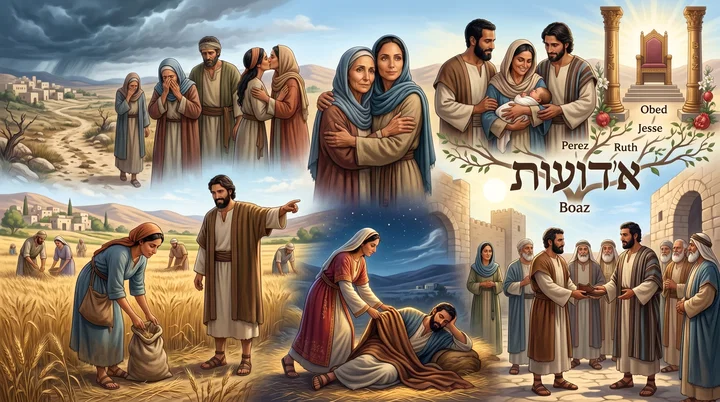
The verse records that Amminadab begat Nahshon and Nahshon begat Salmon, as part of the closing genealogy in Ruth that gives an abbreviated ancestry of David and links the story of Ruth with the history that follows in Samuel.ST Apr 8, 1913ST Apr 4, 1911 That genealogy belongs to the line through which Ruth, a Moabitess, became one of the ancestors of Jesus in His human descent.ST Apr 8, 1913 It places Amminadab, Nahshon, and Salmon in David's ancestry, connecting Ruth and Boaz to David and to the lineage of Israel's kings given through Ruth at Bethlehem.ST Jan 21, 1903RH Dec 18, 1913ST Feb 17, 1904 Ruth, the believing Moabite maiden, came to Bethlehem to leave a record of filial love and to give posterity this lineage, which leads to David.RH Dec 18, 1913
In this lineage David was Ruth's great-grandson; he was born at Bethlehem, where Samuel the prophet came to anoint him king of Israel in place of Saul.RH Dec 18, 1913ST Feb 17, 1904 Through this genealogy Ruth became an ancestress of the royal house, so that Moabite blood ran in David's line.ST Jan 21, 1903 The closing ancestry of the Lord Jesus in Ruth thus brings a Moabite woman into that ancestry.ST Apr 8, 1913ST Mar 31, 1909 The same genealogy makes the actors in the book part of the family line from which Jesus Christ Himself came in His human descent as Lord and Messiah.ST Apr 8, 1913ST Mar 31, 1909ST Apr 2, 1912
The verse belongs to the record of how the Lord rewarded Ruth's fidelity, faithfulness, virtue, and filial love in coming to Bethlehem and living faithfully there, by bringing her into the royal line continued through her son Obed, the grandfather of David.RH Dec 18, 1913ST Feb 17, 1904 That royal line is the line from which the Messiah came. Ruth the Moabitess was thus incorporated into Israel and became an ancestor of Christ, illustrating God's practice of gathering people from among the Gentiles into Israel.RH May 12, 1903
As domestic annals that belonged to David's Bible, the passage tells a tale of divine foreknowledge, love, and care converging on David himself and beyond him on David's Son and David's Lord.RH May 17, 1864 It is a wonderful love story that is literally true and full of type and promise for the future.ST Apr 2, 1912 The genealogy also shows that the sons born to Tamar by Judah under the duty of the nearest kinsman were reckoned as legitimate, and that one of them stands in the ancestry of Christ.RH Mar 12, 1908 Tamar merely used strategy to secure the rights guaranteed her by law and custom of which Judah had fraudulently deprived her, so her actions were not as reprehensible as they would have been under other circumstances.RH Mar 12, 1908
Sources