Titus 1:5
For this cause left I thee in Crete, that thou shouldest set in order the things that are wanting, and ordain elders in every city, as I had appointed thee:
Translations
For this cause left I you in Crete, that you should set in order the things that are wanting, and ordain elders in every city, as I had appointed you:
King James Version, KJV Cambridge Paragraph Bible
For this cause left I thee in Crete, that thou shouldest set in order the things that are wanting, and ordain elders in every city, as I had appointed thee:
For this cause I left thee in Crete, that thou shouldst set in order the things that are wanting, and ordain elders in every city, as I had appointed thee:
Revised Version, American Standard Version
For this cause left I thee in Crete, that thou shouldest set in order the things that were wanting, and appoint elders in every city, as I gave thee charge;
For this cause left I thee in Crete, that the things lacking thou mayest arrange, and mayest set down in every city elders, as I did appoint to thee;
For this cause I left thee in Crete, that thou mightest go on to set right what remained [unordered], and establish elders in each city, as I had ordered thee:
For this cause left I thee in Crete, that, the things remaining undone, thou mightest completely set in order, and mightest establish, in every city, elders, as, I, with thee arranged:—
Berean Standard Bible, Majority Standard Bible
The reason I left you in Crete was that you would set in order what was unfinished and appoint elders in every town, as I directed you.
I left you in Crete for this reason, that you would set in order the things that were lacking and appoint elders in every city, as I directed you—
I did not take you with me when I went away from Crete, so that you might do what was necessary to put things in order there, placing men in authority over the churches in every town, as I said to you;
For this cause left I thee in Creta, that thou shouldest continue to redresse the thinges that remaine, and shouldest ordeine Elders in euery citie, as I appointed thee,
Douay-Rheims (Challoner revision)
For this cause I left thee in Crete, that thou shouldest set in order the things that are wanting, and shouldest ordain priests in every city, as I also appointed thee:
Pictures
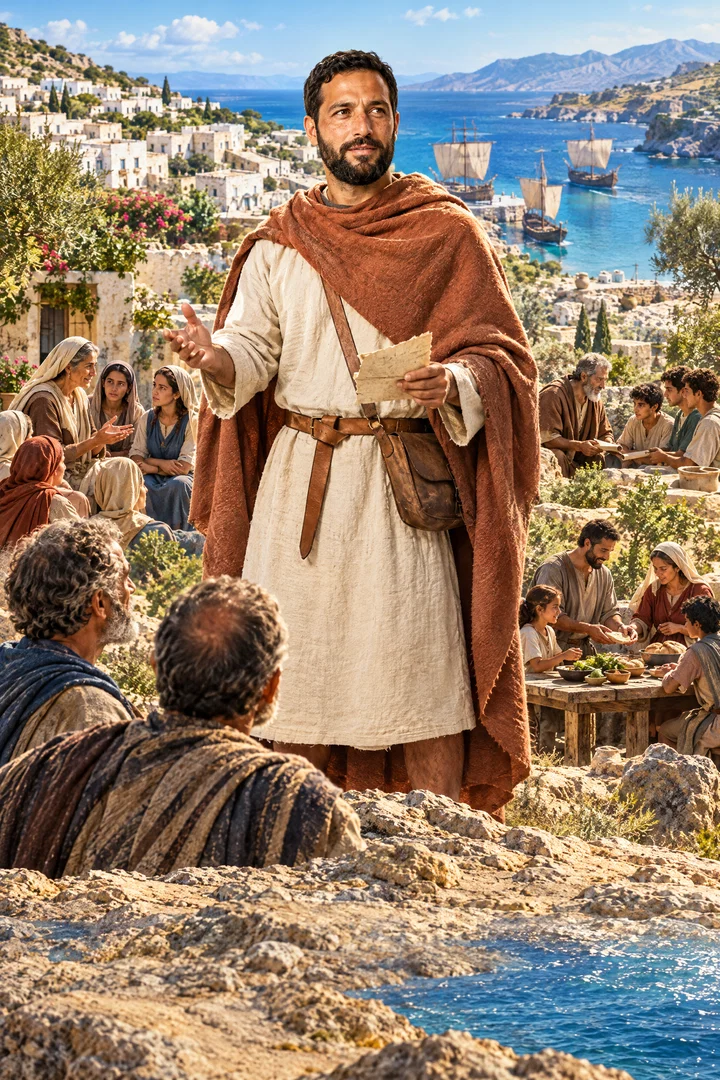
Cross-references 20 of 26
- 1 Timothy 3:1-7
This is a true saying, If a man desire the office of a bishop, he desireth a good work.
Gives qualifications for elders, alongside Titus’s instructions.
- Acts 14:23
And when they had ordained them elders in every church, and had prayed with fasting, they commended them to the Lord, on whom they believed.
Paul and Barnabas appointed elders in every church.
- Acts 20:28
Take heed therefore unto yourselves, and to all the flock, over the which the Holy Ghost hath made you overseers, to feed the church of God, which he hath purchased with his own blood.
Elders are called overseers and charged to feed and care for the church.
- 1 Peter 5:1-2
The elders which are among you I exhort, who am also an elder, and a witness of the sufferings of Christ, and also a partaker of the glory that shall be revealed:
Both texts describe elders’ appointment and responsibility to oversee and shepherd the flock.
- Acts 20:17
And from Miletus he sent to Ephesus, and called the elders of the church.
Paul calls the church’s leaders elders and overseers.
- 1 Timothy 5:17
Let the elders that rule well be counted worthy of double honour, especially they who labour in the word and doctrine.
Elders appointed to lead are honored for ruling well and laboring in teaching.
- 1 Peter 5:2-3
Feed the flock of God which is among you, taking the oversight thereof, not by constraint, but willingly; not for filthy lucre, but of a ready mind;
Elders oversee and shepherd the flock as examples, not as domineering rulers.
- 2 Corinthians 7:13-15
Therefore we were comforted in your comfort: yea, and exceedingly the more joyed we for the joy of Titus, because his spirit was refreshed by you all.
These verses recount Titus’s service and Paul’s confidence in him.
- 2 Corinthians 8:23
Whether any do enquire of Titus, he is my partner and fellowhelper concerning you: or our brethren be enquired of, they are the messengers of the churches, and the glory of Christ.
Titus is described as Paul’s partner and fellow worker.
- Acts 6:3
Wherefore, brethren, look ye out among you seven men of honest report, full of the Holy Ghost and wisdom, whom we may appoint over this business.
Both describe appointing church leaders to serve.
- 2 Corinthians 2:13
I had no rest in my spirit, because I found not Titus my brother: but taking my leave of them, I went from thence into Macedonia.
Titus serves alongside Paul in his ministry.
- 2 Corinthians 7:6
Nevertheless God, that comforteth those that are cast down, comforted us by the coming of Titus;
Titus’s ministry in Crete was part of his work alongside Paul.
- 2 Corinthians 8:6
Insomuch that we desired Titus, that as he had begun, so he would also finish in you the same grace also.
Paul sent Titus to carry out ministry among the churches.
- Galatians 2:1
Then fourteen years after I went up again to Jerusalem with Barnabas, and took Titus with me also.
Titus accompanied Paul to Jerusalem.
- 2 Corinthians 12:18
I desired Titus, and with him I sent a brother. Did Titus make a gain of you? walked we not in the same spirit? walked we not in the same steps?
Paul recalls sending Titus to serve the church.
- 2 Corinthians 8:16
But thanks be to God, which put the same earnest care into the heart of Titus for you.
Titus is commended for his concern and work.
- 1 Timothy 3:8-13
Likewise must the deacons be grave, not doubletongued, not given to much wine, not greedy of filthy lucre;
Both texts concern appointing church officers and their qualifications.
- James 5:14
Is any sick among you? let him call for the elders of the church; and let them pray over him, anointing him with oil in the name of the Lord:
Both texts describe elders serving in the church.
- Galatians 2:3
But neither Titus, who was with me, being a Greek, was compelled to be circumcised:
Titus is identified as a Gentile Christian.
- 1 Timothy 3:1
This is a true saying, If a man desire the office of a bishop, he desireth a good work.
Both texts concern appointing and serving as church officers.
Commentary
Each commentary is drawn from primary sources: the writings of Ellen G. White and Adventist pioneers and periodicals. Each commentary is separate. Its own words are not a quotation; follow the references to read the source passages.
Ellen G. White
13 sources
Paul left Titus in Crete to complete the organizing work there by setting right what was lacking and appointing elders in every city under Paul's direction.5T 617.1Lt 130, 1901, par. 4–5Ms 67, 1900, par. 2–3SLP 304.1–2 That setting in order meant proclaiming God's word in its purity so believers would become sound in the faith against deceivers, while correcting wrongs and restoring those who had strayed.Lt 130, 1901, par. 4–5Ms 8a, 1888, par. 18–21 The elders to be appointed were to be men of experience, blameless stewards of God who hold fast the faithful word to teach sound doctrine and refute error, faithful in marriage and with faithful, well-ordered children.5T 617.1Lt 130, 1901, par. 4–5Ms 67, 1900, par. 2–3Ms 67, 1900, par. 1 A man's home reveals his fitness for the church, for piety at home and well-trained children will be carried into the church, while neglect at home and a self-sufficient, unyielding, ruling spirit disqualify him and bring trouble upon the church.Ms 1, 1880, par. 31–3312MR 281.5–282.4 Ministers must therefore consider candidates carefully with much prayer and not ordain men hastily, and today they are to carry on the same work by training younger workers and putting things in order by the Holy Spirit as the end draws near.12MR 281.5–282.4Ms 1, 1878, par. 25–286T 436.4AA 367.2–368.2RCOC 48.4
Titus Left in Crete
Paul's charge belongs to his work in Crete, where the gospel was preached to the islanders.SLP 304.1–2 He trained young men for ministry by taking them with him on his missionary journeys so they would gain the experience that would enable them to fill positions of responsibility, then left them with the churches he had established to set in order the things that were wanting and ordain elders in every city, and when separated from them he still kept in touch with their work by letters showing his deep desire for their success.AA 367.2–368.2 Acting as a servant of God and not a master, he left Titus in Crete to set in order the things that were lacking and ordain elders in every city as he had appointed and directed him.5T 617.1Lt 130, 1901, par. 4–5Ms 67, 1900, par. 2–3Ms 1, 1880, par. 31–33Ms 1, 1878, par. 25–28
This organizing work was to provide preaching of the word of eternal life from God and not from any human fountain, so that many would be made sound in the faith.Lt 130, 1901, par. 4–5 It thus sets forth two classes: one whose work is to present the truth in its purity as contained in God's Word, and another of unconsecrated elements who bring in a spurious religion to counterwork what God said must be done.Lt 130, 1901, par. 4–5 Setting in order what was lacking includes correcting wrongs and helping restore those who have strayed.Ms 8a, 1888, par. 18–21
Setting in order the things that are wanting is the work of a qualified pastor over a large church, being apt to teach.Lt 95, 1892, par. 5–7 It means giving anxious believers definite instruction in what to do and how to seek the Lord in earnest and know a personal Saviour, bringing order to a disorganized people, and creating an interest and keeping things running in a lively, interested manner.Lt 95, 1892, par. 5–7 It includes putting forces into operation for well-planned, systematic labor in the great city and surrounding towns, so the church becomes a live, healthful church with men able to stand in defense of the truth.Lt 95, 1892, par. 5–7
Qualified Elders Appointed
The charge to ordain elders opens the list of qualifications for those placed in charge of the flock, requiring men of experience who have a knowledge of the truth and are sound in the faith.Ms 67, 1900, par. 2–3Ms 67, 1900, par. 1 An elder was to be blameless, faithful in marriage, and have faithful, well-behaved children, and a bishop as God's steward was also to be blameless.5T 617.1 Those ordained were to meet that standard of blameless stewards of God, holding fast the faithful word so as to exhort by sound doctrine and convince gainsayers.Lt 130, 1901, par. 4–5 This was set in opposition to the many unruly and vain talkers and deceivers, especially they of the circumcision.Lt 130, 1901, par. 4–5
The family of a man suggested for office must be considered, because his home influence reveals what his church influence will be.12MR 281.5–282.4 If he has shown piety at home and trained his children to be peaceable, kind, pure, respectful, obedient, reverent and courteous, he will carry that same influence into the church.12MR 281.5–282.4 But if he has felt no burden for the conversion of his children and has failed to train them aright, that same failure will be exerted in the church and bring much trouble upon it.12MR 281.5–282.4 A self-sufficient, unyielding, ruling spirit that will not endure control or contradiction disqualifies a man from office.12MR 281.5–282.4 The leader at Ligonier was judged unfit on this ground, in light of the required blameless character, self-control, and faithful family life.Ms 1, 1880, par. 31–33
Appointing elders in every place is a necessary part of organizing the church to put it in order.12MR 281.5–282.4Ms 1, 1878, par. 25–28 Ministers must take heed to the qualifications, consider candidates carefully, and pray much for God by His Spirit to designate whom He will accept.5T 617.112MR 281.5–282.4Ms 1, 1878, par. 25–28 They are not to hurry men into office.5T 617.112MR 281.5–282.4 Ordaining unqualified men too hastily disregards the Bible's rule and can bring serious trouble to the church.Ms 1, 1878, par. 25–28
Setting Things in Order Today
Paul's leaving of Titus in Crete reveals a practice of not forgetting established churches but educating young men for the ministry to carry the work forward.AA 367.2–368.2 He took men such as Titus with him on missionary journeys so that they gained an experience that enabled them to fill positions of responsibility.AA 367.2–368.2 He then left them with the churches to set in order the things that were wanting and ordain elders in every city, and when separated from them he still kept in touch with their work, his letters to Timothy and to Titus showing his deep desire for their success.AA 367.2–368.2 Ministers today are to learn from this not to try to carry all the burdens themselves but to do a noble work by training younger workers and placing burdens on their shoulders.AA 367.2–368.2
With the end near, the charge to set in order what remains applies to the church, which is to put things in order and work with God to bring others into the kingdom and save souls.6T 436.4 The Lord carries on this work of setting matters in order by the gift of the Holy Spirit, who will put right matters that are going wrong.RCOC 48.4
Sources
Pioneers and periodicals
122 sources
Paul left Titus in Crete to finish what remained undone in the churches there and to appoint elders in every city.STRH Oct 1, 1861GSAM 344.4 Elder and bishop are the same office, that of the local overseer charged with leading, feeding and guarding an individual church.RH May 7, 1901RH Jun 19, 1856ST Aug 24, 1888RH Jan 9, 1855RH Oct 15, 1861 Such an elder must be blameless, faithful in marriage and family, self-controlled and hospitable, and firmly grounded in the faithful word so as to teach sound doctrine and answer opponents.RH Jun 19, 1856CO 48.3RH Jan 9, 1855ST Nov 4, 1930CO 49.1 The church itself chooses by vote the men it trusts, and then authorized ministers set them apart by prayer and the laying on of hands.RH Jan 9, 1855RH Dec 20, 1853ST Aug 24, 1888RH Jul 3, 1856RH Oct 15, 1861 This setting in order goes beyond merely electing officers to establishing full gospel order, which guards the church against confusion and false teaching and keeps its work harmonious and prosperous.RH Jan 23, 1855RH Oct 1, 1861RH Oct 31, 1907RH Jun 26, 1913RH Aug 18, 1874
Words and Historical Setting
Paul left Titus in Crete to finish what remained undone in the churches and to appoint elders in every city as directed, several churches having already been established on the island.GSAM 344.4ST Dec 2, 1913 About A.D. 65 Titus was authorized to put those churches in order by supplying what was lacking and appointing elders in every city where there were believers.GSAM 344.4 Titus, a Gentile Christian and Paul's fellow worker, was thus given responsibility for organizing the churches and setting things in order, left there to continue the work.GSAM 344.4ST Nov 28, 1911 The island was a place where the truth had many adherents in the days of the apostles.RH Jul 25, 1907 The letter gives information about conditions in Crete and guidance on the instruction the church should receive.ST Dec 2, 1913
The things that are wanting are matters left undone, unfinished, or lacking in the churches, especially important matters of church organization.STRH Oct 1, 1861RH May 23, 1907 Setting them in order included organizing the local churches and appointing elders in every city or church.RH Oct 1, 1861RH May 23, 1907 That appointment of elders served as church leadership and as a safeguard against disorder and false teachers.RH Oct 1, 1861
Ordain means appoint or choose for church office, and in church service this appointment is a sacred act distinct from appointment to secular office, carried out with prayer and the laying on of hands.ST Jan 8, 1885RH Aug 29, 1854 The same word is used in Acts 6:3 for appointing the deacons, showing that the appointment of deacons has the same biblical evidence for ordination as the appointment of elders.ST Jul 28, 1881 Elders were among the church officers, also called bishops or overseers, and their appointment followed the apostles' practice.RH Aug 29, 1854 The word rendered elders is the Greek presbuteros, describing those appointed in every city.RH Jan 9, 1855 Read with verses 6-7, the office of elder is the same as the office of bishop, bishop being a rendering of the Greek episkopos.RH Nov 7, 1854
Paul entrusted this completing work to Titus rather than finishing it himself, allowing the church organization to be completed at the proper time instead of prematurely.ST The work was to be done at its proper time, with experienced workers trusting God and allowing less experienced people to take responsibility rather than settling important matters prematurely.ST
Titus's Charge and Authority
Titus was left in Crete to put in order what was lacking, to assess what the churches needed and to supply deficiencies so the gospel could be carried forward successfully.RH May 7, 1901RH Apr 9, 1901RH Mar 5, 1901ST Dec 9, 1908 The instruction was both broad and specific, covering successful management of the work and including the appointment of elders in every city.RH Apr 9, 1901RH Mar 5, 1901 Paul trusted him to put right what remained unfinished.ST Dec 9, 1908
His assignment was temporary oversight of the work throughout the province and of the churches grouped there, including care for the churches and counseling of workers.RH Sep 18, 1913RH Sep 7, 1916RH May 6, 1909RH May 23, 1907 It was like a conference president overseeing the churches in a region, organizing them for service.RH Sep 18, 1913 Appointing qualified officers was an important part of that ministerial oversight, helping to preserve unity, cohesion and organized service.RH May 6, 1909RH Sep 7, 1916
Paul placed authority upon a human being to do this work, not leaving everything to be managed by the Holy Ghost alone with no human authority.RH Oct 31, 1907 Setting in order what was wanting was work besides merely having elders and deacons elected.RH Oct 31, 1907 Local churches did not appoint their own elders independently but received ministers having authority to ordain them, showing the churches connected through a wider order.RH May 30, 1907 The one sent for this work was commissioned to visit the churches to perform or supervise ordinations and report on his mission.RH Aug 25, 1859 Capable workers for this ordering work are to be assigned by the responsible leadership of the church, young preachers are not considered suited to it, and ministers should not undertake it unless authorized.RH Dec 12, 1871
The work required both kindness and firmness and included giving the church the instruction it needed and appointing suitable officers in every city.ST Oct 27, 1909ST Oct 27, 1909 It supports ordaining church ministers without requiring an unbroken succession of ordainers from the apostles.RH Feb 13, 1879 The verse is an example of apostolic authority to arrange church affairs and appoint elders, but it provides no evidence that the apostles could change the Sabbath or any part of God's moral law.RH Nov 14, 1871
Elder and Bishop Office
Elder and bishop are the same office, seen in the move from ordaining elders in every city to the requirement that the bishop must be blameless.RH May 7, 1901RH Jun 19, 1856ST Aug 24, 1888RH Nov 7, 1854RH Oct 15, 1861 Bishop renders the Greek episkopos, while elders were also called presbyters or priests and were ordained by apostles.RH May 7, 1901RH Jun 19, 1856RH Nov 7, 1854RH Oct 15, 1861RH Aug 29, 1854 The identification rests on verses 6-7 following verse 5, where the qualifications for the bishop describe the elder just appointed.RH May 7, 1901RH Jun 19, 1856ST Aug 24, 1888RH Nov 7, 1854RH Aug 29, 1854
The office is that of local church leaders in every city or church, responsible for directing and overseeing an individual church.RH May 7, 1901RH Jan 9, 1855RH Oct 15, 1861ST Nov 28, 1900 It is not a leader over a diocese of many churches nor a superior rank in a chain of church authority, but an experienced person qualified by God's Spirit and recognized by fellow believers to care for the flock.RH May 7, 1901RH Oct 15, 1861ST Nov 28, 1900 Traveling evangelical elders or bishops such as Titus ordained these local preaching elders, who had pastoral care and oversight of one church and administered its ordinances, distinct from those with care of all the churches.RH Jan 9, 1855RH Nov 10, 1874 The church is organized with few officers and simple methods of work and worship, elders and deacons being its only officers.RH May 7, 1901RH Jan 9, 1855
The same office is also described as overseer, overlooker, shepherd, pastor, steward, and pilot steering the ship.RH May 7, 1901RH Aug 29, 1854RH Oct 2, 1856RH Dec 20, 1853ST Jun 4, 1894 Bishop means one who supervises and provides for others' welfare, and overseers care for and feed the church.RH May 7, 1901RH Aug 29, 1854RH Oct 2, 1856RH Aug 15, 1854ST Jun 4, 1894 The term applies both to those overseeing churches across broad regions and to local elders, whose work includes teaching and evangelism, shepherding and watching over the flock, administering gospel ordinances, and exhortation.RH May 7, 1901RH Aug 29, 1854RH Oct 2, 1856RH Dec 20, 1853RH Aug 15, 1854 An elder should have a gift of teaching and exhortation though an elder may not be a preacher.RH Aug 29, 1854RH Oct 2, 1856RH Dec 20, 1853
Elders feed the flock with spiritual food and the Word, serving willingly rather than for dishonest gain, and being humble faithful examples instead of lording authority over the church.RH Oct 2, 1856ST Sep 4, 1893ST Dec 22, 1898ST Nov 28, 1900RH Mar 5, 1901 They guide it like pilots steering a ship, following God's direction rather than dominating it, filled with the Spirit and able to give wise counsel and admonition.ST Sep 4, 1893ST Dec 22, 1898RH Mar 5, 1901 They have a rule in the church, exercised in connection and harmony with the church, with age and experience respected and with the members' confidence, judgment, wisdom, piety, and good household leadership.RH Jul 3, 1856ST Nov 28, 1900RH Nov 10, 1874 They arrange and lead meetings, exhort and admonish, watch over interests, comfort those in trouble, and minister with God-given gifts, being deeply grounded in experience of God and in personal, family, and social religion so they can guide safely and serve as examples.ST Sep 4, 1893ST Dec 22, 1898RH Jul 3, 1856RH Nov 10, 1874RH Mar 5, 1901
Qualifications Required of Elders
An elder must be blameless, the husband of one wife, having faithful children not accused of riot or being unruly, and blameless as the steward of God.RH Jun 19, 1856 He must not be self-willed, soon angry, given to wine, a striker, or given to filthy lucre, but must be a lover of hospitality, a lover of good men, sober, just, holy, temperate, and holding fast the faithful word as taught.RH Jun 19, 1856 He must be faithful in family life, hospitable, upright, self-controlled, gentle rather than violent or quarrelsome, not greedy or quick-tempered, and firmly grounded in the faithful word.RH Jun 19, 1856RH Jan 9, 1855 So grounded, he is able by sound doctrine both to exhort and to convince the gainsayers, to teach sound doctrine, encourage believers, and answer opponents.RH Jun 19, 1856CO 48.3RH Jan 9, 1855
Elders are to be ordained when they meet these qualifications, or are earnestly growing toward them with a pure heart.RH Jan 9, 1855 They must have irreproachable Christian character and meet the stated standards of consecration, being sound in the faith and holding firmly to the trustworthy message.CO 48.3ST Nov 4, 1930 Ordination to ministry or holding office in local churches is to be granted only to men sound on all points of the faith once delivered to the saints, now taught by the Seventh-day Adventist Church, as a divine requirement for the protection of God's work and the salvation of souls.CO 49.1 Appointing elders requires more than a man's confidence that God has called him, for he must meet the fitness test given in God's Word in teaching and life, and a man who will not meet that test is mistaken if he believes he is called.CO 33.6 The inspired instructions for the choice of church officers must always be carried out in faithfulness, meaning the ministry is to ordain none but men sound in the faith.CO 49.2–3
Because church officers are chosen from among the church members, the virtues required of elders are required of every church member, with each member responsible for those qualities being present in the church.ST Aug 31, 1888 Those scriptural qualifications for elders also apply in large measure to the work of a conference president.RH Jun 29, 1905 An elder is a licensed preacher who has been tested and ordained and is regarded as trustworthy and competent to exercise the gift of ministry, distinct from a licentiate.ST Jul 5, 1910
There is no risk in ordaining men who meet these qualifications, or men who are earnestly desiring to meet them out of a pure heart.RH Jun 19, 1856 The qualities need not be perfect in every respect, but a generally qualified man may be chosen by the church and set apart to the office with prayer and the laying on of hands.ST Jan 2, 1907 Such a man is marked by wisdom, good judgment, devotion to God, willingness to do God's will, honorable business, orderliness, and good household rule, being beyond reproach, honorable in business, temperate, sober-minded, orderly, hospitable, able to instruct others, not quarrelsome, quick-tempered, or covetous, and ruling his children well if possible.ST Jan 2, 1907 Church officers are to be examples of the flock, upholding the principles they represent and living in accord with those principles.RH Aug 13, 1914 Setting a church in order includes using judgment and the qualifications for church officers rather than choosing them by drawing names at random.RH Jul 16, 1901
The qualifications name the fitness for preaching and ordaining elders, so a man must first learn the truth well himself and then search those qualifications to see whether they are in him before receiving any impression that it is his duty to preach.RH Apr 28, 1859 No one should go out on feeling alone, but should consult with brethren of experience in the truth and the trials of the work, since if the Great Head of the church is really moving him to rescue souls the body will feel it.RH Apr 28, 1859 This care is required because perilous times and the third message involve solemn responsibilities and awful consequences, requiring those really called of God to go out, if possible with one of experience, and learn the ways of the Lord more perfectly.RH Apr 28, 1859 The charge to put the church in order by appointing elders in each city is thus connected with the qualifications of gospel ministers, the ordination of workers to ministry, and the orderly selection of church officers.RH Dec 22, 1904RH Oct 28, 1873
Ordination Practice Observed
Titus was to ordain elders in every city to complete what was lacking, and the brethren chose those elders from among themselves under delegated authority.ST Aug 24, 1888RH Jul 3, 1856 The church appointed its local elders and teachers by vote with the lifting of hands, under the direction of a traveling elder.RH Jul 3, 1856RH May 20, 1862 The church elected by vote men in whom it had confidence, then set the chosen elder and deacon apart by laying on of hands while seeking God's guidance with care.RH May 20, 1862ST Dec 17, 1874 The blessing felt by the congregation at the time was taken as evidence that the appointment pleased the Lord.RH May 20, 1862 An elder, also called bishop or pastor, is a local officer for a particular church and its spiritual interests, elected by the church and then ordained by an ordained evangelist.ST Dec 17, 1874RH Nov 10, 1874
Ordination was performed by proper persons, namely traveling evangelical elders or bishops such as Titus and other ordained traveling evangelists authorized to ordain local elders and deacons.RH Jan 9, 1855RH Oct 15, 1861RH Nov 10, 1874 After members selected qualified persons for elder and deacon, the minister ordained them, and churches were thus put into apostolic order by choosing men to act as elders and setting them apart by prayer and laying on of hands.RH Oct 15, 1861RH Dec 27, 1855 A local elder so ordained can administer the church ordinances when a higher officer is absent, so small distant churches need not wait for a visiting messenger.RH Oct 15, 1861 Local preaching elders had pastoral care and oversight of one church, distinct from traveling elders who had care of all the churches, and it was their duty to administer all the ordinances of the church of God on earth.RH Jan 9, 1855
Setting apart for ministry was by prayer and laying on of hands as part of New Testament order for putting right what was lacking and appointing elders in every city.RH May 30, 1854RH Mar 22, 1906RH Dec 27, 1855 Laying on of hands was practiced at ordination to ministry or holy office as a special ceremony signifying the conferring of spiritual blessings. It was not a requirement for every believer nor a condition of receiving the Holy Spirit or salvation. Those called to teach and baptize were to be set apart, with ordination following God's call rather than itself making a person a minister.RH Dec 20, 1853
Local preaching elders did not travel and give all their time to the work as did those set wholly apart to it, but remained with the church to feed it with knowledge and understanding as pastors and messengers.RH Jan 9, 1855RH Jul 3, 1856 An elder, the same as a bishop, is an overseer and ruler charged to feed the flock with spiritual food, having a gift of teaching and exhortation though not necessarily being a preacher.RH Oct 2, 1856 The local elder cares for the nearby congregation, helps arrange and lead meetings, exhorts and admonishes members, and watches over the church's interests, exercising rule in connection and harmony with the church.RH Jul 3, 1856 Such a person should have the members' confidence and show judgment, wisdom, piety, good household leadership, with age and experience respected in judgments affecting the church's peace and welfare.RH Jul 3, 1856 A traveling elder or evangelist like Titus went from place to place appointing leaders in each town and providing proper officers, but could not stay to administer ordinances in every church on every occasion.RH Oct 2, 1856 Once that ordering work was finished, the local church with its officers was prepared to keep the faith, celebrate Christ's death, shine as light, bring others into the fold, administer baptism, receive members, and uphold truth at home, while field laborers moved on to gather and order new churches.RH Oct 2, 1856
Elders are ordained for specific local work, so one chosen as elder in a different church should be ordained for that church even if previously ordained elsewhere.RH Aug 13, 1914 A newly elected elder may serve for a time before being ordained.ST Aug 28, 1884 A minister is to ordain an elder over each small company to care for the little flock and keep it in order, choosing one who for years has shown a Christian spirit in daily walk and work, such as a faithful blacksmith in common life.RH Feb 4, 1904 That ordaining belongs with uniting the company in brotherly love, breaking bread together, receiving newly baptized disciples into fellowship, and faithfulness in tithe.RH Feb 4, 1904 Ordaining a man to gospel ministry is to be done in order in a public Sabbath forenoon service in harmony with the General Conference Committee's recommendation, setting him apart to go to his field anew to labor for souls.
Order Taught and Applied
Church order remains as necessary now as ever, with still greater effort called for in the perilous last days while the church is being fitted for immortality.RH Jan 23, 1855 Coming out of Babylon and leaving the churches does not mean running into wild confusion or carrying a Babel of unscriptural notions, but leaving weak imperfect human systems to embrace the all-powerful perfect system of order set forth in the New Testament.RH Jan 23, 1855 That scriptural order saves from impostors and provides comfortable support for approved laborers in word and doctrine to go forth preaching, confirming disciples, and setting churches in order, so believers may regularly enjoy the ordinances and grow in grace and knowledge of the truth.RH Jan 23, 1855
Setting in order what is wanting is more than merely electing elders and deacons, for Paul placed authority upon a human being in Titus rather than leaving everything to the Holy Ghost alone with no human authority.RH Oct 31, 1907 It includes examining and ordaining those firm in the gospel so the work stays harmonious and guarded against heresy, becoming increasingly important as the work advances.RH Jun 26, 1913 Those caring for churches across wider regions are to attend to spiritual needs, teach the way of life and salvation, correct and encourage, and see that other officers are faithful, since their faithfulness affects prosperity and the character of officers shapes the character of churches.RH Aug 18, 1874 Selecting such New Testament officers is essential to the well-being of every church.RH Apr 11, 1907RH Sep 17, 1861
The order includes appointing elders in every city or church as leadership safeguarding against disorder and false teachers.RH Oct 1, 1861 Teachers are to be approved and recommended by leading ministers known to be sound in the faith.RH Nov 26, 1914 Organization helps bring order and protect from confusion and division, yet the work of elders depends on the church recognizing their office and submitting, since insubordination can prevent even qualified elders from acting.RH Dec 3, 1857RH Apr 26, 1864
The verse shows the church to be organized and to have elders, with organization and appointed officers belonging to the establishment of order.RH May 22, 1879 Elders are to be appointed in every church where number, talent and graces suffice, with the same rule for deacons, as the remedy for distracted discouraged little churches and neglected ordinances, the appointing to be done by proper persons including traveling brethren.RH Jan 23, 1855 Completing organization and ordaining elders in every church is part of setting affairs in order, giving a model of gospel order in which elders chosen from among the people govern with varied responsibilities within the unity of Christ.ST Nov 18, 1913RH Dec 6, 1870
Traveling ministers are to visit local churches to set things in order when organization is needed, and a church desiring gospel order should ask for such a visit to be fully organized.RH Jun 26, 1855 Deacons and elders are then to be chosen and set apart so ordinances are not neglected in a minister's absence and the church may work for the Lord and walk blameless in all commandments and ordinances.RH Jun 26, 1855 Setting things in order is an important and good ministerial work alongside preaching, building up churches and caring for the flock rather than relying only on polished repeated sermons, and it frees the minister to give himself wholly to preaching the word.RH Aug 15, 1865RH Dec 24, 1861RH Oct 27, 1863
That visiting work finishes what is lacking by steadying believers shaken on the Sabbath by divisive preachers, defending truth, confirming the flock, baptizing believers, and bringing new ones to keep God's commandments so the church is left thriving and firmly established.RH Jun 19, 1860 Where no one authorized to baptize is present, a preacher comes to organize the work so preaching and baptism can proceed, and where a small company begins to keep the Sabbath and desires to be counted among God's people a ministering brother comes to explain the way more fully so they may overcome and be ready to meet the Lord.RH Mar 17, 1859RH Apr 2, 1857 It includes strengthening and organizing where work has begun so new Sabbath keepers stand firmly, appointing elders in every city where messengers are needed, and encouraging isolated churches and helping them into a better place through preaching.RH Oct 24, 1885RH Jul 31, 1860
In practice this meant organizing Ohio churches with records of proceedings and membership, and choosing an overseer and a deacon and setting them apart by laying on of hands.RH May 21, 1861RH Nov 25, 1858 It meant organizing eleven-member, twelve-member and twenty-two-member churches with chosen elders and deacons, clerks and treasurers, ordained by laying on of hands, and bringing Tenhassen into more perfect organization.RH Oct 27, 1859 It meant choosing McCoy at Sigourney, Madsen at Hellum where twelve members formed a church, Higley at Casnovia with twelve members, Slown at Gridley with twenty-two members to watch over and strengthen it, an elder at Brookfield and at Dubuque, an elder and deacon at Avon, two leaders at Lisbon, and providing for a church at Ivahy that had gone three years without an ordained minister, with special need where churches lacked ordained elders and ordinances had been neglected for years, bringing closer union and plans to labor for fellow townsmen.RH Jun 2, 1859RH Mar 3, 1863
The same principle was applied to forming a missionary society to give structure and effectiveness to mission work, and to introducing a plain organ to lead and regulate singing when useful, not as inherently wrong in worship.ST Feb 5, 1880ST Jun 24, 1875 It was applied to teaching the duties of elders, deacons and wives including sobriety and cleanliness, to attending to troubles such as an apostatized elder who took several families away, and to organizing a church by ordaining a minister and choosing proper officers under Paul's direction to Titus.RH Nov 4, 1902ST Aug 29, 1878RH Mar 1, 1864
Setting churches in order was also used to address the proper sustaining of God's cause by a history of God's leading, in contrast to the extreme view that those expecting Christ should sell all property.RH Jun 30, 1863 It includes attending to lacking ministry, so that where a number have newly confessed the truth a messenger is needed to preach, baptize and organize what is lacking, as desired at Colon and looked for at Portland where the servants were expected to set in order what was lacking.RH Feb 19, 1857RH Dec 23, 1862RH Jul 16, 1861 This work brings order and supports ministry through addressing what is lacking and appointing elders in each city.RH Dec 23, 1862
Appointment was entrusted to Titus under received instructions, supporting careful orderly appointment of qualified elders and putting incomplete church affairs in order.CO 32.3–33.5 Paul's commission reflects the need for order and responsible leaders to care for the church by addressing what was lacking, including appointing elders in each city.RH Nov 7, 1907 Organizing believers, choosing officers by scriptural qualifications and ordaining them to their places, and ordaining a local elder illustrate this work, meeting the need for help in putting things in order at Avon, Block Island and elsewhere, including where people waited for baptism and needed messengers to establish order.ST Apr 10, 1884RH Jan 10, 1865ST Feb 1, 1877
Those holding one position taught that archbishops and bishops are laid under duty to oversee and correct what is deficient and wrong in doctrine and worship.RH Feb 25, 1858 That duty in their teaching requires reforming corruptions, putting down the Lord's-day Sabbath as a human idol of man's devising, and restoring God's ancient seventh-day Sabbath commanded in the moral law.RH Feb 25, 1858
Summary of Remaining Details
Titus was left in Crete to put the churches in order by finding what was lacking and supplying what successful management of the work required.RH Apr 9, 1901 That charge was both broad and specific, to assess the condition of the work and provide what was needed, including appointing elders in every city.RH Apr 9, 1901 The same principle of supplying what was needed for orderly organization is seen in arranging Israel for the march out of Egypt.RH Apr 9, 1901 Elders appointed in the churches in this ordering work are identified with bishops in Titus 1:7.ST Aug 3, 1915
The assignment to put right what remained unfinished and appoint elders in each city belonged to Paul's care for the churches and counseling of their workers.RH May 23, 1907 Newly organized churches needed such order and appointed elders, as when twelve members at Hellum formed a church and the one chosen was ordained elder. So also at Amot in Sweden the organization of the church was completed by ordaining its chosen elder.ST Apr 6, 1882 Setting things in order was a purpose of meetings held to assist the church.RH Oct 13, 1863
Sources