Zechariah 1:7
Upon the four and twentieth day of the eleventh month, which is the month Sebat, in the second year of Darius, came the word of the LORD unto Zechariah, the son of Berechiah, the son of Iddo the prophet, saying,
Translations
On the four and twentieth day of the eleventh month, which is the month Sebat, in the second year of Darius, came the word of the LORD to Zechariah, the son of Berechiah, the son of Iddo the prophet, saying,
Upon the four and twentieth day of the eleventh month, which is the month Sebat, in the second year of Darius, came the word of the LORD unto Zechariah, the son of Berechiah, the son of Iddo the prophet, saying,
Upon the four and twentieth day of the eleventh month, which is the month Sebat, in the second year of Darius, came the word of the Lord unto Zechariah, the son of Berechiah, the son of Iddo the prophet, saying,
Upon the four and twentieth day of the eleventh month, which is the month Sebat, in the second year of Darius, came the word of the LORD to Zechariah, the son of Barachiah, the son of Iddo the prophet, saying,
Upon the four and twentieth day of the eleventh month, which is the month Shebat, in the second year of Darius, came the word of the LORD unto Zechariah the son of Berechiah, the son of Iddo, the prophet, saying,
Upon the four and twentieth day of the eleventh month, which is the month Shebat, in the second year of Darius, came the word of Jehovah unto Zechariah the son of Berechiah, the son of Iddo, the prophet, saying,
On the twenty and fourth day of the eleventh month, (it [is] the month of Sebat,) in the second year of Darius, hath a word of Jehovah been unto Zechariah, son of Berechiah, son of Iddo, the prophet, saying:
Upon the four and twentieth day of the eleventh month, which is the month Shebat, in the second year of Darius, came the word of Jehovah unto Zechariah the prophet, the son of Berechiah, the son of Iddo, saying,
Upon the twenty-fourth day of the eleventh month, the same, is the month Shebat, in the second year of Darius, came the word of Yahweh unto Zechariah, son of Berechiah, son of Iddo, the prophet, as followeth:
Berean Standard Bible, Majority Standard Bible
On the twenty-fourth day of the eleventh month, the month of Shebat, in the second year of Darius, the word of the LORD came to the prophet Zechariah son of Berechiah, the son of Iddo.
On the twenty-fourth day of the eleventh month, which is the month Shebat, in the second year of Darius, the LORD’s word came to the prophet Zechariah the son of Berechiah, the son of Iddo, saying,
On the twenty-fourth day of the eleventh month, the month Shebat, in the second year of Darius, the word of the Lord came to Zechariah, the son of Berechiah, the son of Iddo the prophet, saying,
Vpon the foure and twentieth day of the eleuenth moneth, which is the moneth Shebat, in the second yeere of Darius, came the worde of the Lord vnto Zechariah the sonne of Berechiah, the sonne of Iddo the Prophet, saying,
Douay-Rheims (Challoner revision)
In the four and twentieth day of the eleventh month which is called Sabath, in the second year of Darius, the word of the Lord came to Zacharias the son of Barachias, the son of Addo, the prophet, saying:
Pictures
Cross-references
- Ezra 5:1-2
Then the prophets, Haggai the prophet, and Zechariah the son of Iddo, prophesied unto the Jews that were in Judah and Jerusalem in the name of the God of Israel, even unto them.
Zechariah’s prophecy accompanied the rebuilding of the temple.
- Haggai 1:1
In the second year of Darius the king, in the sixth month, in the first day of the month, came the word of the LORD by Haggai the prophet unto Zerubbabel the son of Shealtiel, governor of Judah, and to Joshua the son of Josedech, the high priest, saying,
Haggai and Zechariah began prophesying in the same year, within two months of each other.
- Ezra 6:14
And the elders of the Jews builded, and they prospered through the prophesying of Haggai the prophet and Zechariah the son of Iddo. And they builded, and finished it, according to the commandment of the God of Israel, and according to the commandment of Cyrus, and Darius, and Artaxerxes king of Persia.
Reports the prosperity that followed the prophets’ work.
- Haggai 2:10
In the four and twentieth day of the ninth month, in the second year of Darius, came the word of the LORD by Haggai the prophet, saying,
Compared to date when Haggai prophesied.
- Nehemiah 12:16
Of Iddo, Zechariah; of Ginnethon, Meshullam;
Identifies Zechariah as one of the priests.
- Zechariah 7:1
And it came to pass in the fourth year of king Darius, that the word of the LORD came unto Zechariah in the fourth day of the ninth month, even in Chisleu;
Marks a later point in Zechariah’s prophetic ministry.
- Ezra 6:2-13
And there was found at Achmetha, in the palace that is in the province of the Medes, a roll, and therein was a record thus written:
The account describes the renewed decree and support under Darius.
- Zechariah 1:1
In the eighth month, in the second year of Darius, came the word of the LORD unto Zechariah, the son of Berechiah, the son of Iddo the prophet, saying,
Used to place Zechariah’s prophecy in sequence with Haggai’s.
Commentary
Each commentary is drawn from primary sources: the writings of Ellen G. White and Adventist pioneers and periodicals. Each commentary is separate. Its own words are not a quotation; follow the references to read the source passages.
Ellen G. White
2 sources
The verse dates the Lord's message to Zechariah to the twenty-fourth day of Sebat, the eleventh month, in the second year of Darius.RH Dec 26, 1907 That dating places the beginning of Zechariah's series of symbolic visions two months after Haggai's last recorded message.RH Dec 26, 1907PK 579.4 The visions came amid anxiety and uncertainty among the Jews that permission to rebuild the temple might be lost or withdrawn.RH Dec 26, 1907PK 579.4 They were given to sustain and encourage God's people and workers by keeping God's purpose before them and revealing His compassion, care, and love for Jerusalem.RH Dec 26, 1907PK 579.4
Sources
Pioneers and periodicals
17 sources
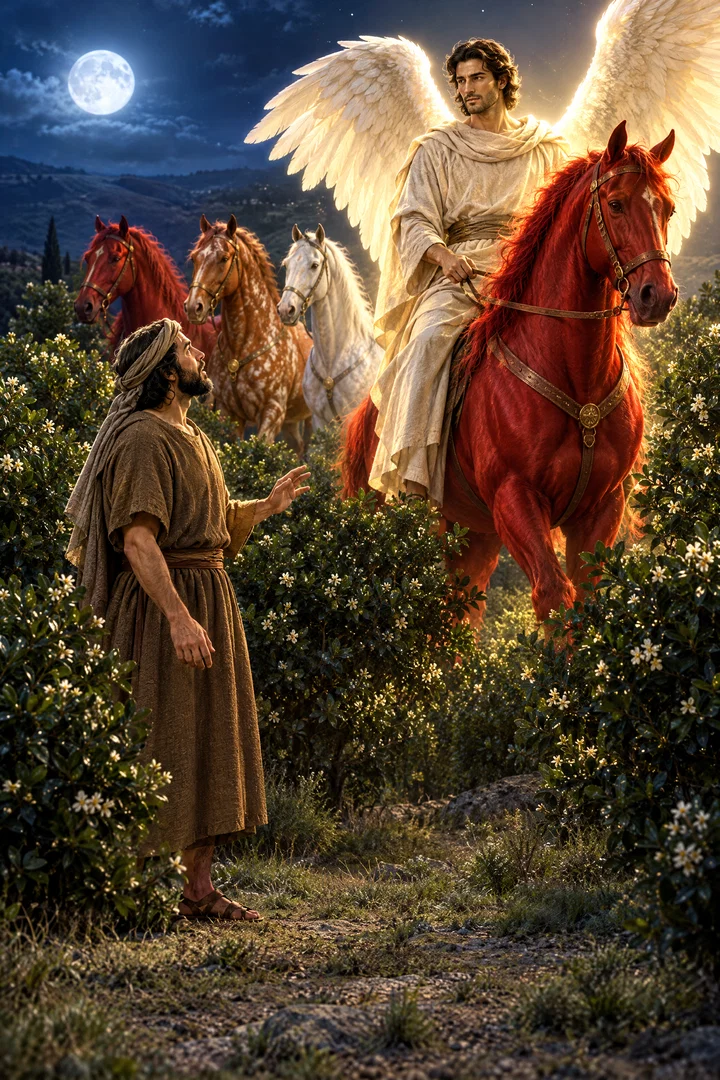
The word came to Zechariah the son of Berechiah, the son of Iddo the prophet, on the twenty-fourth day of the eleventh month called Sebat or Shebeth, in the second year of Darius.ST Sep 16, 1913ST Sep 24, 1902ST Apr 12, 1883 Sebat was the eleventh month of the Jewish sacred year, falling about February or the beginning of March, and this message came about the beginning of March 519 B.C. at Jerusalem after the return from Babylon, when the temple foundation had been laid and rebuilding under Zerubbabel had begun.RH Dec 26, 1907ST Apr 12, 1883ST Nov 29, 1910ST Oct 31, 1906ST Jan 9, 1893 It was his second message, three months after his words in the eighth month and two months after Haggai's last message, with the temple to be finished a little over four years later in the sixth year of Darius.ST Apr 12, 1883 It opens the night visions beginning with the rider among the myrtle trees and the horses and riders behind him, extending through verse 21 and distinct from the message by words alone in verses 1-6.ST Sep 24, 1902ST Apr 12, 1883ST Apr 12, 1883ST Apr 9, 1902 The horses and riders were angels sent as swift messengers through the earth, led by their commander, with four horns scattering Judah, Israel and Jerusalem and four carpenters breaking those powers, to reveal God's compassion for Jerusalem and encourage earnest rebuilding as a type of the final restoration from mystical Babylon in the latter days.RH Dec 26, 1907ST Apr 12, 1883ST Apr 9, 1902ST Apr 9, 1902ST Jul 12, 1910
Date and Historical Setting
The word of the Lord came to Zechariah, the son of Berechiah, the son of Iddo the prophet, on the twenty-fourth day of the eleventh month, Sebat or Shebeth, in the second year of Darius.RH Dec 26, 1907ST Sep 16, 1913ST Sep 24, 1902ST Apr 12, 1883ST Jan 23, 1893 Sebat or Shebeth is the eleventh month of the Jewish sacred year, placed approximately in February or around the beginning of March, since the Jewish months did not exactly match the English months.ST Nov 29, 1910ST Oct 31, 1906ST Jan 9, 1893 The prophecy as a whole belongs to 520 and 518 B.C., with this message given around the beginning of March 519 B.C. at Jerusalem.ST Sep 16, 1913ST Jan 9, 1893 Its date helps establish that the regnal years of Darius began after the twenty-fourth day of that month and before April 25, approximately in March.RH Apr 5, 1906
The verse belongs to the period after the return from Babylon and the Babylonian captivity and its aftermath, when the Jews had returned and begun rebuilding the temple at Jerusalem under Zerubbabel and its foundation had been laid.ST Apr 12, 1883ST Jul 12, 1910 It was the prophet's second message, coming three months after his first words in the eighth month.ST Jul 12, 1910 The visions that followed came two months after Haggai's last recorded message, amid uncertainty that the Jews might lose permission to rebuild.RH Dec 26, 1907 Construction of the temple had begun in 536 B.C. and lasted twenty years, though opposition and discouragement stopped most work for fifteen of them, and the temple was completed in the sixth year of Darius, a little over four years after this date.ST Jan 23, 1893
Zechariah was a prophet of the restoration, contemporary with Haggai, who encouraged the rebuilding of the temple and the restoration of Jerusalem.ST Sep 16, 1913ST Dec 15, 1909 His prophecy consists chiefly of visions that encourage confidence and earnest effort.ST Sep 16, 1913
Visions and Their Encouragement
The date introduces the first symbolic vision, which was seen at night.ST Sep 24, 1902 It is also reckoned as the beginning of the second vision, extending through verse 21, which was revealed by signs and by words and introduces the vision of the horsemen, distinct from the first vision in verses 1-6, which was revealed by words without signs.ST Apr 12, 1883ST Apr 12, 1883ST Apr 9, 1902ST Jul 12, 1910 On that date came the vision of a rider among the myrtle trees and of horses with riders behind him.ST Apr 12, 1883ST Apr 9, 1902 The horses and riders are angels sent by the Lord as swift, watchful messengers to travel through the earth and minister to his people, with the man among the myrtle trees as their commander, Michael the archangel.ST Apr 12, 1883ST Jul 12, 1910 Their report that the earth was at rest led to the angel's plea for mercy on Jerusalem and Judah after seventy years of indignation.ST Apr 9, 1902
The vision continuing from the verse presents four horns as the powers that scattered Judah, Israel, and Jerusalem, leaving the people unable to recover.ST Apr 9, 1902 It presents four carpenters as those who come to break down these powers and end the Gentile nations' domination of Judah.ST Apr 9, 1902 The symbolic messages were meant to sustain and encourage God's people by revealing his compassion and care for Jerusalem.RH Dec 26, 1907ST Sep 16, 1913 They use figures and symbols to show the nations and God's power to save.ST Nov 25, 1908 They concern the reformation among God's people under Zerubbabel and foreshadow future reformations.ST Sep 16, 1913ST Nov 25, 1908
The restoration from Babylonian captivity is presented as a type of the last reformation.ST Dec 15, 1909 It served as a type of God's people being restored in the latter days from mystical Babylon and the effects of her corrupting influence.ST Sep 17, 1902 Zechariah's prophecy consists chiefly of visions that encourage confidence and earnest effort in the rebuilding of the temple and the restoration of Jerusalem.ST Sep 16, 1913ST Dec 15, 1909
Sources