Zechariah 1:8
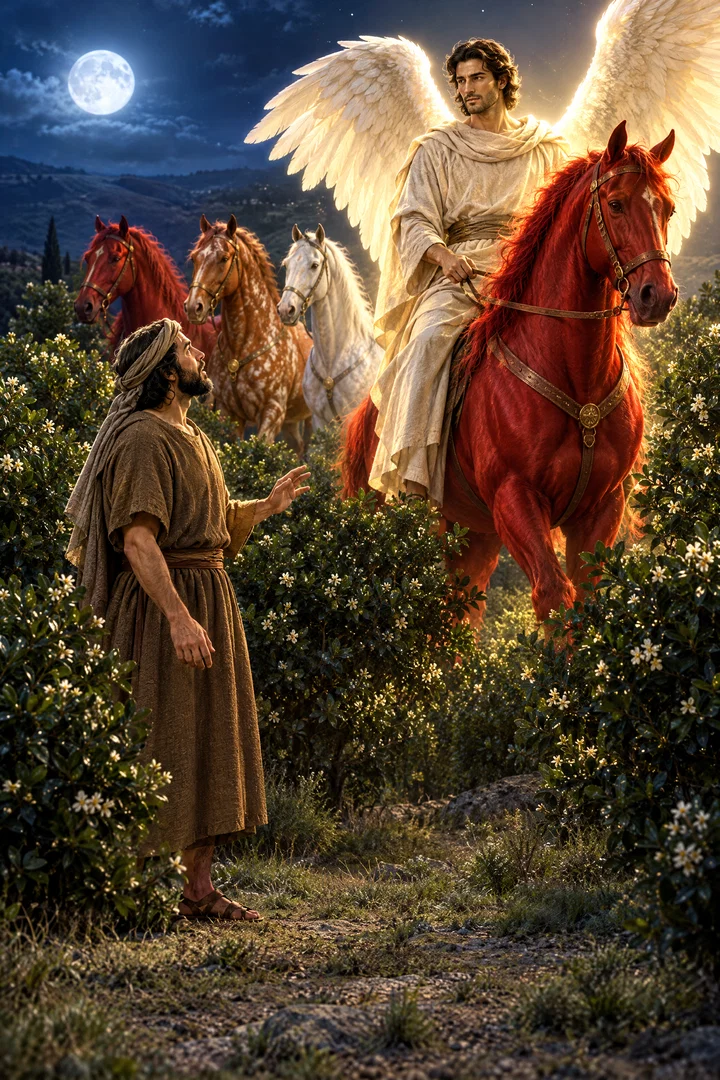
I saw by night, and behold a man riding upon a red horse, and he stood among the myrtle trees that were in the bottom; and behind him were there red horses, speckled, and white.
Translations
I saw by night, and behold a man riding on a red horse, and he stood among the myrtle trees that were in the bottom; and behind him were there red horses, speckled, and white.
King James Version, KJV Cambridge Paragraph Bible
I saw by night, and behold a man riding upon a red horse, and he stood among the myrtle trees that were in the bottom; and behind him were there red horses, speckled, and white.
I saw by night, and behold a man riding upon a red horse, and he stood among the myrtle-trees that were in the bottom; and behind him were there red horses, speckled, and white.
I saw in the night, and behold a man riding upon a red horse, and he stood among the myrtle trees that were in the bottom; and behind him there were horses, red, sorrel, and white.
I saw in the night, and, behold, a man riding upon a red horse, and he stood among the myrtle-trees that were in the bottom; and behind him there were horses, red, sorrel, and white.
I have seen by night, and lo, one riding on a red horse, and he is standing between the myrtles that [are] in the shade, and behind him [are] horses, red, bay, and white.
I saw by night, and behold, a man riding upon a red horse, and he stood among the myrtle-trees that were in the low valley; and behind him were red, bay, and white horses.
I looked by night, And lo! a man riding upon a red horse, and he was standing among the myrtle trees, in the shade; and, after him, were horses, red, bay, and white.
Berean Standard Bible, Majority Standard Bible
I looked out into the night and saw a man riding on a red horse. He was standing among the myrtle trees in the hollow, and behind him were red, sorrel, and white horses.
“ I had a vision in the night, and behold, a man riding on a red horse, and he stood among the myrtle trees that were in a ravine; and behind him there were red, brown, and white horses.
I saw in the night a man on a red horse, between the mountains in the valley, and at his back were horses, red, black, white, and of mixed colours.
I saw by night, and behold a man riding vpon a red horse, and hee stood among the mirre trees, that were in a bottome, and behinde him were there red horses speckeled and white.
Douay-Rheims (Challoner revision)
I saw by night, and behold a man riding upon a red horse, and he stood among the myrtle trees, that were in the bottom: and behind him were horses, red, speckled, and white.
Pictures
Cross-references
- Zechariah 6:2-3
In the first chariot were red horses; and in the second chariot black horses;
Both visions feature horses distinguished by color.
- Revelation 6:2-8
And I saw, and behold a white horse: and he that sat on him had a bow; and a crown was given unto him: and he went forth conquering, and to conquer.
Both texts use visionary horse imagery.
- Zechariah 1:12-17
Then the angel of the LORD answered and said, O LORD of hosts, how long wilt thou not have mercy on Jerusalem and on the cities of Judah, against which thou hast had indignation these threescore and ten years?
The angel’s appeal is followed by God’s comforting promise of mercy and restoration.
Commentary
Each commentary is drawn from primary sources: the writings of Ellen G. White and Adventist pioneers and periodicals. Each commentary is separate. Its own words are not a quotation; follow the references to read the source passages.
Ellen G. White
1 source
The vision of the man among the myrtle trees came as one of a series of symbolic visions given to Zechariah.RH Dec 26, 1907 At the time, the Jews were engaged in rebuilding Jerusalem, and the work went forward under uncertainty.RH Dec 26, 1907 They feared that the permission to rebuild would be withdrawn.RH Dec 26, 1907 The visions were given to encourage the builders in that anxious position.RH Dec 26, 1907 They did so by revealing God's compassion and His watchful care for His people.RH Dec 26, 1907
Sources
Pioneers and periodicals
21 sources
Zechariah received the vision by night on the twenty-fourth day of the eleventh month when he was a young prophet of the restoration alongside Haggai, after the Jews had returned from Babylon under Cyrus's decree and laid the temple foundation under Zerubbabel in the second year of their coming to Jerusalem.ST Sep 24, 1902ST Sep 16, 1913ST Apr 12, 1883ST Sep 24, 1902ST Sep 6, 1910 It pictures a man riding a red horse and standing among myrtle trees in the valley, with red, speckled, and white horses behind him, each with its own rider.ST Apr 12, 1883ST Sep 24, 1902ST Apr 9, 1902 The horses and their riders are angels sent to walk to and fro through the earth and patrol it, who report that the earth is at rest and prompt the plea for mercy on Jerusalem and Judah after seventy years of indignation, and the man at their head to whom they report is Michael the archangel, their commander.ST Apr 12, 1883ST Sep 24, 1902ST Apr 19, 1883ST Apr 12, 1883 The vision was given when the builders of Jerusalem feared that permission to rebuild would be withdrawn, to reveal God's compassion and care and give confidence for earnest effort, and it portrays both the experience of the returned exiles and the experience of God's people to the end of time when the restoration from mystical Babylon fulfills God's purpose.RH Dec 26, 1907ST Sep 24, 1902ST Sep 16, 1913ST Nov 25, 1908ST Dec 15, 1909 Those who held it taught that the one among the myrtles is Christ among His people in humiliation and sorrow giving security and peace, while others read the myrtles as kings of the earth and the horsemen as four universal kingdoms walking through the earth in dominion.ST Sep 24, 1902ST Jul 12, 1910
Setting and Symbolic Meaning
The prophecy was given in 520 and 518 B.C., when Zechariah was a young man, a prophet of the restoration and a contemporary of Haggai, after the Jews had returned from Babylon under the proclamation of Cyrus king of Persia authorizing them to rebuild the temple at Jerusalem, whose foundation Zerubbabel, otherwise called Sheshbazzar, laid in the second year of their coming to Jerusalem.ST Sep 16, 1913ST Apr 12, 1883 It begins the prophet's first vision, seen by night on the twenty-fourth day of the eleventh month, also called the first vision of the horsemen.ST Sep 24, 1902ST Sep 24, 1902ST Sep 6, 1910 Those who held it to be the opening of the second vision of the chapter understood it as revealed through signs and words.ST Apr 12, 1883
It pictures a man riding upon a red or bay horse and standing among the myrtle trees in the bottom or valley, with red or bay, speckled, and white horses behind him, each horse with its own rider.ST Apr 12, 1883ST Sep 24, 1902ST Apr 9, 1902 The horses and their riders are those whom the Lord sent to walk to and fro through the earth and patrol it, the angels of God who go everywhere to minister to His people, like the horses and chariot of fire seen with Elijah.ST Apr 12, 1883ST Sep 24, 1902ST Apr 12, 1883ST Apr 9, 1902 They report that the earth is at rest, which prompts the plea about how long the Lord will withhold mercy from Jerusalem and Judah after seventy years of indignation.ST Sep 24, 1902ST Apr 9, 1902
The man among the myrtle trees is their commander because he stands at their head and they make report to him, and he gives command to the angel overseeing Jerusalem's rebuilding.ST Apr 12, 1883ST Apr 19, 1883ST Apr 12, 1883 He is Michael the archangel, the prince of angels.ST Apr 12, 1883ST Apr 19, 1883ST Apr 12, 1883 Together the horsemen are God's angelic messengers and heavenly representatives who move throughout the earth and watch over the interests of His kingdom, and their work in the earth is practically the same as that of the horses in Zechariah's closing vision.ST Jul 12, 1910ST Sep 6, 1910 Their form as horsemen conveys speed and strength, since horsemen were swift messengers and formidable warriors, so the vision portrays God's unseen, invincible forces.ST Jul 12, 1910
On another reading, the myrtle trees represent the kings of the earth, the man on the first red horse represents another king taking his place among them, and the three bands of horses behind him represent three further powers.ST Sep 24, 1902 Their commission to walk throughout the earth signifies universal dominion, so the vision brings four universal kingdoms into view.ST Sep 24, 1902 On another reading, the one standing among the myrtle trees in the bottom is Christ among God's people in a time of humiliation and sorrow.ST Jul 12, 1910 As the myrtle's fragrance grows sweeter when its leaves are crushed, God's people can show the sweet character of a holy life under hardship, and His presence among them gives security, hope, and peace and assures them of His guidance and care even in the darkest experience.ST Jul 12, 1910 In its vision sequence about Jerusalem's restoration, the four horns are powers that scattered Judah, Israel, and Jerusalem and the carpenters come to overthrow those powers and repair the desolation, with no separate interpretation given to the rider or horses in this verse.ST Apr 9, 1902
Encouragement Prophecy and Connections
The vision was given in 520 and 518 B.C. when Zechariah stood as a prophet of the restoration alongside Haggai, and it belongs to a book made up chiefly of visions that supply motives for confidence and earnest effort.ST Sep 16, 1913 It came as one of a series of symbolic visions while the Jews rebuilding Jerusalem lived in uncertainty and feared that permission to rebuild would be withdrawn, and it encouraged them by revealing God's compassion and care for His people.RH Dec 26, 1907
Its symbols portray both the experience of the returned Jewish people and the experience of God's people to the end of time, when God's purpose will finally be fulfilled.ST Sep 24, 1902 The first eight chapters concern the reformation among God's people in the time of Zerubbabel and foreshadow future reformations, with figures and symbols indicating the nations and God's power to save.ST Nov 25, 1908 That restoration movement, encouraging Zerubbabel and Ezra in rebuilding the temple and restoring Jerusalem, is a type of the last reformation.ST Dec 15, 1909 The restoration from Babylonian captivity serves as a type of God's people being restored in the last days from mystical Babylon and the effects of her corrupting influence.ST Sep 17, 1902
The horse imagery and other prophetic imagery of the vision are also used in the symbolic prophecies and visions of Revelation.ST Nov 1, 1910ST Oct 22, 1902 It is an example of God using picture-like imagery in a prophetic vision to teach, and its horses and other visual details show how such imagery can make divine truth clearer and more forceful.ST Nov 14, 1900 Its strange horses among the myrtle trees are clarified by its immediate context, where a man stands beside the prophet and explains what they represent.ST Dec 10, 1885
Sources