Bāl'ance1, n.
n. [Fr. balance, Pr. balans, balansa, Sp. balanza, It. bilancia, from Lat. bilancis, bilancis, having two scales, from bis, twice, and lanx, plate, scale.]
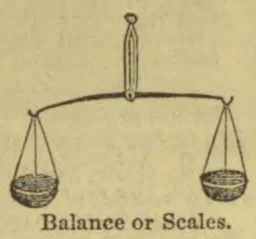
Sense 1. An apparatus for weighing bodies.
Balance or Scales.
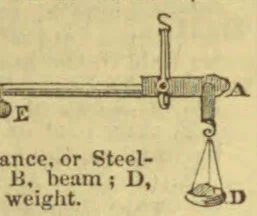
In its original and simplest form, it consists of a beam or lever suspended exactly in the middle, with a scale or basin of precisely equal weight, hung to each extremity. Another form is that of the Roman balance, our steelyard, consisting of a lever or beam, suspended near one of its extremities, on the longer arm of which a counterpoise slides. The name is also given to other forms of apparatus for weighing bodies, as to the combination of levers making up platform scales, and to the spring-balance in which the weight is measured by the elasticity of a spring.
Roman Balance, or Steelyard. A, B, beam; D, scale; E, weight.
Sense 2. Weight; ponderosity. [Obs.] Holland.
Sense 3. The excess on one side, or what added to the other makes equality; as, the balance of an account. “A balance at the banker’s.” Thackeray.
Sense 4. The act of comparing or weighing; estimate. “Upon a fair balance of the advantages on either side.” Atterbury.
Sense 5. An equipoise or just proportion, as of authority, power, feelings, and the like; a counterpoise; antithesis; as, the balance of power.
There is nothing of the artificial Johnsonian balance in his style. E. Everett.
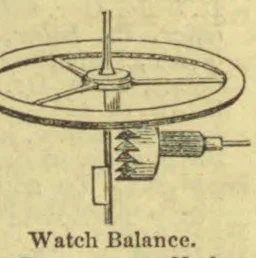
Sense 6. (Horology.) The wheel in a watch or chronometer which is kept in vibration by the action of the escapement, and which regulates the motion of the wheel-work.
Watch Balance.
Sense 7. (Astron.) A sign in the zodiac, called Libra, which the sun enters at the equinox in September.
Balance of torsion. See TORSION BALANCE.—Hydrostatic balance. See HYDROSTATIC.
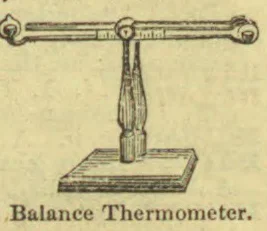
Balance thermometer, a contrivance for keeping up in apartments, green-houses, &c., an exact and even temperature.
Balance Thermometer.
Synonyms— BALANCE, REMAINDER. It is a peculiarity of many in this country, especially of those who are engaged in trade, to use the word balance in certain connections, as having the same sense with remainder. We may, indeed, properly speak of the balance of an account, because it is this which makes the two sides even. But to transfer this to the general concerns of life, and speak of “the balance of the week,” “the balance of the evening,” “the balance of the company,” &c., meaning remainder, is a gross vulgarism, to be avoided by every one who does not mean to “smell of the shop.”