3 entries under this word

Train

Train, v. t.

verbtransitive

[imp. & p. p. TRAINED; p. pr. & vb. n. TRAINING.] [O. Fr. trahiner, traîner, Fr. traîner, Pr. trahinar, It. trainare, L. Lat. trahinare, trainare, from trahina, from Lat. traha, a drag, sledge, from Lat. trahere, to draw.]

Sense 1. To draw along; to trail.

In hollow cube Training his devilish enginery. Milton.

Sense 2. To draw by persuasion, artifice, and the like; to entice; to allure.

If but twelve French Were there in arms, they would be as a call To train ten thousand English to their side. Shak.

O, train me not, sweet mermaid, with thy note. Shak.

This feast, I'll gage my life, Is but a plot to train you to your ruin. Ford.

Sense 3. To teach and form by practice; to exercise; to discipline; as, to train the militia to the manual exercise; to train soldiers to the use of arms. “Our trained bands, which are the trustiest and most proper strength of a free nation.” Milton.

The warrior horse here bred he's taught to train. Dryden.

Sense 4. To break, tame, and accustom to draw, as oxen.

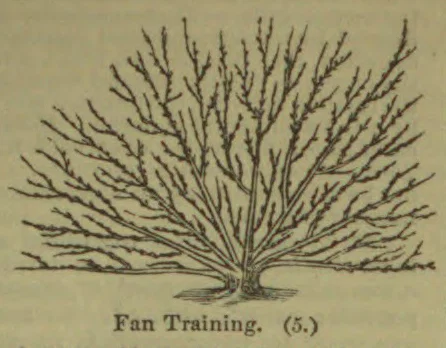
Sense 5. (Hort.) To lead or direct, and form to a wall or espalier; to form to a proper shape, by bending, lopping, or pruning; as, to train young trees.

He trains the young branches to the right hand or to the left. Jeffrey.

Sense 6. (Mining.) To trace, as a lode or any mineral appearance, to its head.

To train a gun (Mil.), to point it at some object either forward or else abaft the beam, that is, not directly on the side. Totten.—To train or train up, to educate; to teach; to form by instruction or practice; to bring up.

Train up a child in the way he should go, and when he is old he will not depart from it. Prov. xxii. 6.

The first Christians were, by great hardships, trained up for glory. Tillotson.
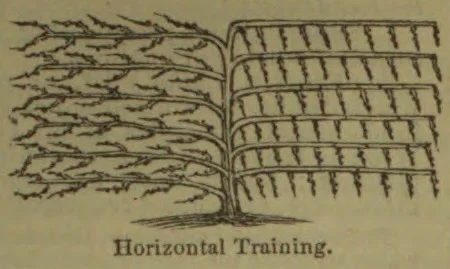
A tree is shown trained with its branches growing horizontally along a supporting framework.
Horizontal Training.
A tree trained with its branches radiating outward in a fan shape from a central trunk.
Fan Training. (5.)

Trāin, v. i.

verbintransitive

v. i. To be drilled in military exercises; to do duty in a military company. [Collog.]

Trāin, n.

noun

n. [Fr. train, O. Fr. train, trahin, Pr. trahi, Sp. train, tragin, trajin, traina, It. traino, treno. See supra.]

Sense 1. That which draws along; especially, persuasion, artifice, or enticement.

Now to my charms, And to my wily trains. Milton.

Sense 2. Hence, something tied to a lure to entice a hawk; also, a trap for an animal. Halliwell.

Sense 3. That which is drawn along in the rear of or after something; that which is in the hinder part or rear; as, (a.) That part of a gown which trails behind the wearer; as, a lady’s train. (b.) The after part of a gun-carriage; the trail. Totten. (c.) The tail of a bird.

The train steers their flight, and turns their bodies, like the rudder of a ship. Ray.

Sense 4. A number of followers; a body of attendants; a retinue. “The king’s daughter with a lovely train.” Addison.

My train are men of choice and rarest parts. Shak.

Sense 5. A consecution or succession of connected things; a series. “The train of ills our love would draw behind it.” Addison.

Rivers now stream and draw their humid train. Milton.

Other truths require a train of ideas placed in order. Locke.

Sense 6. Regular method; process; course; as, things are now in a train for settlement.

If things were once in this train, . . . our duty would take root in our nature. Swift.

Sense 7. The number of beats which a watch makes in any certain time.

Sense 8. A line of gunpowder, laid to lead fire to a charge, or to a quantity intended for execution.

Sense 9. A continuous or connected line of cars or carriages on a railroad.

Sense 10. A kind of sleigh used in Canada for transportation of merchandise, wood, and the like.

Train of artillery, any number of cannon, mortars, &c., with the attendants and carriages which follow them into the field. Campbell. — Train of machinery, a series of moving pieces, as wheels and pinions, each of which is follower to that which drives it, and driver to that which follows it.

Synonyms— Cars. — TRAIN, CARS. Train is the word universally used in England with reference to railway traveling; as, I came in the morning train, &c. In the United States, the phrase the cars has been extensively introduced in the room of train; as, the cars are late; I came in the cars, &c., though, in fact, a person travels in only one car. The English expression is obviously more appropriate, and is prevailing more and more among Americans, to the exclusion of the cars.