The Youth’s Instructor, Vol. 48, No. 49.

Knowing by Faith
Earlier text: Knowing by Faith

LITTLE TEACHERS

“Harry just listens to everything we say, and says it right over after us,” said Fred, proudly.
“He tries to do everything we do, too,” added May.
And yet—would you believe it?—in less than an hour I heard Fred use words that must have grieved all who loved him, and saw May sit as if she had not heard her mother call—once, twice, three times. When at last she threw down her pretty book with a bang, and went to “do” the dishes, it was with dragging footsteps, and an unlovely frown on her forehead.
But that was not the worst. Very soon the pretty, innocent baby lips were heard repeating brother Fred’s very words; and a little later, when mama called, he paid no attention to her repeated, “Come, Baby!” When at last he did go to her, it was with sister’s own manner.
Is this the way, dear little brothers and sisters, that it is in your home? If you are cross, and rude, and ill-mannered, be sure that the little child, who is beginning to learn how things may be done, is noticing you, and following your example. Of course you want him to be gentle, obedient, and lovable. Well, if you are these things, in work and play, all the time, he will be, too; for he thinks you are very wise and good, and will try his best to copy your words, your tone, even your manner. Watch the little one who lives in your home, and see.

THE SCHOOL THAT NEVER LETS OUT

“Hello, boys! What’s your hurry?” You may trust boys for seeing a joke, under the soberest manner. Sam and Irvine looked at each other a little sheepishly, and giggled. They were, in fact, lagging along like snails.
It was one of the very first spring days; there were a few patches of snow left in back yards where the sun never shone, and no green things had yet poked their noses up from the cold, wet earth; but the robins had come, and our boys had seen the flash of a bluebird’s wing that very morning. The sunshine was as sweet as distilled honey and dew, and a kittenish little breeze seemed to be saying, “Stay, and have a frolic with me.”
“You must be going to a picnic,” continued Mr. Pilson, seeing that the boys took kindly to the joke, “from the pace you have on.”
“Much picnic we’re goin’ to!” grumbled Sam. “Much!”
“You wouldn’t call it a picnic, Mr. Pilson,” protested Irvine, “if you had to sit at an old desk all day, and sweat over lessons.”
“Oh, school, is it?” said the farmer, in pretended innocence. “Well, I don’t have benches nor desks at my school; sometimes I wish I had.”
“Where is your school?” asked the boys, suspiciously, alert for another joke.
“Don’t you know where my schoolhouse is? You pass it every day of your lives.”
“What time does your school take up?”
“Take up? Why, it never lets out! It’s in all the time.”
“You’re playing truant then, Mr. Pilson,” said Sam, grinning. “I wouldn’t a’ thought it of you!”
The farmer laughed out big and loud. “Maybe I am, and maybe not,” he said. “I’m sort o’ waitin’ for some new books now. But if you boys don’t mend your hold on the road, you’ll have a lesson to learn that won’t be out of books, or I’m mistaken.”
Sam and Irvine glanced at the sun-clock, like the country boys they were, and set out on a trot, reaching the yellow schoolhouse by the roadside just in time to make a rush with the rest for seats, at the clang of the bell.
I don’t know how they pulled through lessons that lovely day, with whispers coming in at every open window of the delights outside. But the longest hours pass, even when they are clogged at every step with sums in arithmetic, and exercises in grammar, and mysterious events in United States history. At last four o’clock struck, and the steps that had dragged so slowly in the morning now danced on tiptoe, never two aground at one time, and oftenest both in the air!
This time it was their turn to be jocular:
“Hello, Mr. Pilson! your new books come yet?”
The farmer was ready for them; he left his harrow in the soft earth, and came over to the fence; as he came, he stooped, and took something out from under a bush in the fence-corner. It was a large glass jar, none of your half-gallon contrivances, fit only for jam, but a big, clear jar, that would hold two gallons at least.
Inside, secured by a thick perforated paper securely tied over the wide mouth, was a velvety black butterfly. He had bright yellow spots on his four wings, a double row of them, and on the hind wings some silvery blue spots besides; these hind wings had a funny little tail hanging from each.
“Oh, oh! who ever heard of a butterfly in March!” cried Sam.
Mr. Pilson looked pleased. “So,” he said, “you are a schoolmate of mine?”
“Sir?”
“Certainly you are. How else did you know that my Papilio Asterias was not to be found in March?”
“I don’t know anything about your papho steery, but any boy with two eyes knows that he doesn’t find beauties like that till the flowers come.”
“That’s so,” said the farmer, “it’s like another lesson in my class; a higher lesson, of which my great Teacher says a wayfaring man though a fool need not err therein.”
The boys almost forgot the butterfly, in trying to make out just what this queer farmer meant; for they had a glimmering.
“I see you have guessed my conundrum,” said Mr. Pilson; “my school is God’s big, green world; he gives me new books like this pretty Papilio constantly, but they are only new editions, you understand, of old works.”
Sam and Irvine chuckled; they saw through it now.
“Where did you get him, Mr. Pilson?” they asked.
“Why can’t you call a gentleman by his name?” asked the farmer, frowning; “didn’t I introduce him to you?” And not a word more would he say till both boys had learned the butterfly’s family name. Then, when they knew him for a Papilio Asterias, Mr. Pilson told with glee how he had found three caterpillars on a wild carrot plant last September; how he had brought them home, put them in this handsome jar, and fed them with fresh leaves until one day all three of them had tied themselves up in a curious fashion at the side of the jar, dropped off their outer skins, and left themselves in a chrysalid state,—pale, ugly, knobby things, that looked as if no life belonged to them.
Six months had passed, and here was Sir Papilio in his new body, ready to live his new life; far more beautiful, and free, and active than in the old days, when he was a dull caterpillar, knowing and seeing nothing but a little patch of earth under his wild carrot plant.
The boys were charmed with Mr. Pilson’s beautiful schoolbook; and still happier when he gave them each one of the brown chrysalises that had not yet opened their doors, from which they might see for themselves the dainty and gorgeous creatures come forth.
And you may be sure that this wise old schoolboy did not let these little preparatory pupils get away without telling them about the beautiful new bodies to be given to God’s children, “as it pleaseth him,” when they come up out of their grave chrysalises.—Elizabeth Preston Allen.

MAN-IN-THE-GROUND

Is the curious and decidedly Indian-sounding name of a plant growing on the Pacific Coast. It has a coarse-fibered, turnip-shaped root, often as large as a three-gallon bucket. From this root spring long vines, having at the leaf-axils little, curly tendrils, by means of which the vines climb over brush, up fences, and into bushes. The leaves resemble grape leaves, but are darker.
The blooms are small, white, and star-shaped, the points differing in number from five to seven, and are arranged in a loose raceme; they are followed by short, cucumber-shaped seed-pods, somewhat larger than an egg, and covered with soft spines. The seeds are brown disks, three quarters of an inch in diameter, and three eighths of an inch thick. They are full of meat of which Master Bunny is fond; and as he can not remember where he buries all of them, he helps spread the crop, which soon becomes a great pest.
MRS. ELIZABETH ROSSER.

THE PRINCE AND THE BEGGARS

Like a prince in an old-time story He sits at his palace gate; About him, bent and hoary, The ragged mendicants wait. The prince is a dashing fellow, Wears velvet and cloth-of-gold, A tunic and cap of yellow; Rags shelter them from the cold.
He quaffs from a crystal chalice, They stoop to the wayside spring; He dwells in a lordly palace, They hide beneath winter’s wing. They covet his royal splendor, His ease and his tunic gay; The bars of his cage are slender, They think him as free as they.
Then I open the study shutter, And scatter their daily bread; They come with a rush and flutter, Where the bountiful feast is spread; For the prince is my yellow canary, And the beggars, so gay and free, Are only the sparrows wary, That live in the old elm-tree.
My little gold bird is a poet, He pipes me a roundelay; A captive—he does not know it, And sings in a blithesome way. But at times in his prison narrow, He wishes that he might be A gay little beggar-sparrow Out in the old elm-tree.
— Dorothy Deane.

BEREAN LIBRARY STUDY

Revelation 7; “Thoughts on the Revelation,” Pages 435-451

NOTES ON LESSON 7

(December 9-15)
The Books of Daniel and Revelation.—“Those who eat the flesh and drink the blood of the Son of God will bring from the books of Daniel and Revelation truth that is inspired by the Holy Spirit. They will start into action forces that can not be repressed. The lips of children will be opened to proclaim the mysteries that have been hidden from the minds of men.”—*Review and Herald, Aug. 17, 1897.
The Light of His Countenance.—“His countenance was as the sun shineth in his strength.” Rev. 1:16. Not the sun half concealed by mist, but shining “in his strength.” The psalmist says: “Lord, lift thou up the light of thy countenance upon us. Thou hast put gladness in my heart, . . . I will both lay me down in peace, and sleep: for thou, Lord, only makest me dwell in safety.” Ps. 4:6. Again he says, “Thou hast made him exceeding glad with thy countenance.” Ps. 21:6. How often the appearance of the face of a dear friend has chased away perplexity, and made us free and happy. Have you been made exceeding glad with the countenance of your Saviour? Do you know what it is to walk in the light of his countenance day by day? No one who cherishes known sin can walk in the light of his countenance; for sin forms a cloud that hides the sunlight of his countenance from the pathway. If we ask God to search us, and take all our sins away, he will set our iniquities before him, and our secret sins in the light of his countenance (Ps. 90:8); and in that light they will vanish, as the dew before the sun. Then our hope will be in God, and we shall praise him for the help of his countenance. Ps. 42:5. It is the blessed privilege of every child of God ever to walk in the light of the Saviour’s countenance, and to praise him continually for the “help of his countenance.”
Consecrated Ears.—Seven times in the second and third chapters of Revelation we find the following words: “He that hath an ear, let him hear what the Spirit saith unto the churches.” God calls upon us to open our ears to the instruction given, to hear the gentle knock of the heavenly Merchantman as he stands at the door of our soul temple, and offers each of us his precious wares. Listen to his counsel: “Buy of me gold tried in the fire, that thou mayest be rich; and white raiment, that thou mayest be clothed.”
Anciently all the Hebrews who had been sold into bondage were allowed to go out free upon the seventh year. Ex. 21:1-6. But if the servant plainly said, I love my master, my wife, and my children, I will not go out free, then his master took him before the judges, and also unto the door or door-post, and bored his ear through with an awl, and he was to serve his master forever. Notice the condition—it was to be a freewill, lifelong service of love. As a sign of this service of love, the ear was bored upon the door-post. Why upon the door or door-post? Was it not that as he went in and out of the door day by day, the sight of it would remind him that his ears were consecrated to his master? They were to be shut against murmuring or complaining, and open to all that would advance the cause of his master.
Have you given yourself to your Master, Christ Jesus, for a lifelong service of love? Have your ears been consecrated upon the door? Christ says: “I am the door; by me if any man enter in, he shall be saved, and shall go in and out, and find pasture.” Have you given your ears to the Master? As you go in and out of doors in your daily work, do they remind you of your lifelong service of love, and that your ears are given to the living Door, to be used only to his glory? If so, then hear the Saviour’s call repeated seven times: “He that hath an ear, let him hear what the Spirit saith unto the churches.” Close your ears to all doubt and unbelief, and open them to the Saviour’s gracious word.

SEVEN PROMISES TO THE OVERCOMER

  1. Right to the tree of life in the paradise of God.
  2. Freedom from the second death.
  3. The hidden manna, and the secret name written on the white stone.
  4. Power over the nations, and to rule and reign with Christ.
  5. Name confessed before God and the angels, and retained in the book of life.
  6. To be made a pillar in the temple of God, with God’s new name and the name of the city written upon him.
  7. A seat with Christ in his throne.

THE SON ABIDETH EVER

(December 22)
LESSON TEXT.—Gal. 4:25-31; 5:1.
MEMORY VERSE.—John 8:35, 36.
It will be well to begin with the twenty-first verse, and study the whole subject of the covenants as here presented. Do not get the idea that this subject is too hard for you to understand thoroughly. It is full of most precious truth and encouragement. Read again the paragraphs referred to last week in Chapter XXXII of “Patriarchs and Prophets.”

QUESTIONS

1. What two women represent the two covenants? What was the social condition of each? V. 22. What is said of their sons? V. 23.
2. What was the character of the covenant represented by Agar? V. 24. At what mountain was this covenant made? What city represents the dwelling-place of those under this covenant? What is their condition? V. 25.
3. Who represented the other covenant? V. 22. What mountain represents this covenant? Heb. 12:19, 22. What city is the inheritance of those under this covenant? V. 22. What is the condition of the city? Gal. 4:26.
4. What prophecy of the heavenly city is here given? What is the cause of rejoicing? V. 27; note 1.
5. What kind of child was Isaac? How are we like him? V. 28.
6. How was the son of the bondwoman born? How was the son of promise born? How did the former treat the latter? What comparison is made with the present? V. 29; note 2.
7. What is the command concerning the bondwoman and her son? Why are they cast out? V. 30. What do they represent in our experience? Note 3.
8. Whose children are we not? Whose are we? V. 31. What, then, is our condition? Ps. 116:16. In what does this freedom consist? Note 4.
9. Since we are free, what are we admonished to do? What are we to be careful not to do? Gal. 5:1; note 5.

NOTES

1. The heavenly Jerusalem, the free city, is the mother of all the children of promise. This is the city that Abraham looked for (Heb. 11:10), and it is to be his home and the home of his seed. But the children of the covenant of promise are not yet gathered home; hence the city is represented as being barren and desolate. What rejoicing there will be when we all get home!
2. The persecution mentioned here is not to be regarded as wholly a calamity. Jesus says, “Blessed are ye, when men shall revile you, and persecute you.” Matt. 5:11, 12. Even our own flesh lusts against the Spirit, so that there is a strife between the two. Gal. 5:17. But God has provided deliverance and peace.
3. “Every one that committeth sin is the bond-servant of sin.” John 8:34, R. V. Then the bondwoman and her son represent the works of the flesh and the bondage of sin. Then their casting out means freedom from sin and from the curse of the law. “The servant abideth not in the house forever: but the son abideth ever.” Then if we are sons, we shall abide forever in our Father’s house.
4. The freedom that Christ brings to us is freedom from sin. See the whole sixth chapter of Romans, and especially verses 11-14, 18, 22. Sin brings bondage because it brings us under the condemnation of the law. Besides this, sinful habits are like ropes that tie our hands, so that we can not do the things that we would, but are compelled to do the things that we hate. Prov. 5:22; Rom. 7:14, 15. Jesus sets us free from these sinful habits, and gives us the victory over them, so that we are able to do the things that please him. If you have not this experience, seek for him until you find him and the freedom he offers you. “Seek, and ye shall find.” “Him that cometh to me I will in no wise cast out.”
5. Our only freedom from the bondage of sin is in Christ. Then any departure from him will bring us again into bondage. Any effort on our part to go alone, to make ourselves righteous by our own works, will leave us weak and helpless, to fall again under the power of sin. Then let us “stand fast in the liberty.”

Simplicity and the Crushing Machinery of Living

It is possible so to duplicate the machinery of living that the very life itself is crushed among the wheels. We may wrap ourselves in comfort until our breath is smothered in the folds. The man whose wants are few is the man most likely to be found carrying a light heart.— W. R. Huntington.

CHICAGO & GRAND TRUNK R’Y

E. W. Meddaugh and Henry B. Joy, Receivers.

CHICAGO & GRAND TRUNK R’Y.

Trains leave Battle Creek.

WEST-BOUND FROM BATTLE CREEK.

No. 9, Mail and Express, to Chicago ............................ 12.15 P. M.
No. 1, Chicago Express, to Chicago ............................ 8.30 A. M.
No. 3, Lehigh Valley Express, to Chicago ....................... 3.50 P. M.
No. 5, International Express .................................. 2.15 A. M.
No. 75, Mixed, to South Bend .................................. 8.30 A. M.
Nos. 9 and 75, daily, except Sunday.
Nos. 1, 3, and 5, daily.

EAST-BOUND FROM BATTLE CREEK.

No. 8, Mail and Express, East and Detroit ...................... 3.45 P. M.
No. 4, Lehigh Express, East and Canada ......................... 8.27 P. M.
No. 6, Atlantic Express, East and Detroit ..................... 2.25 A. M.
No. 2, Express, East and Detroit .............................. 6.00 A. M.
No. 74, Mixed (starts from Nichols) ........................... 7.15 A. M.
Nos. 8 and 74, daily, except Sunday.
Nos. 4, 6, and 2, daily.
W. C. CUNLIFFE, Agent,
G. W. VAUX, BATTLE CREEK.
G. P. A., CHICAGO.

Our Premium Testament

As an aid to daily Bible study, and to memorizing the Scriptures, there is nothing better than a pocket-edition. We have secured a beautiful Vest-pocket New Testament, size 4 x 2¾ in., that we offer, postpaid, with the INSTRUCTOR one year, for only $1.00. Well printed, in ruby type, as shown; Flexible Covers, Round Corners, Red under Gold Edges,—a splendid little book.

ST. MATTHEW, 13.

42 The queen of the south shall rise up in the judgment with this generation, and shall condemn it: for she came from the uttermost parts of the earth to hear the wisdom of Solomon; and, behold, a greater than Solomon is here. 43 When the unclean spirit is gone out of a man, he walketh through dry places, seeking rest, and findeth none. 44 Then he saith, I will return into my house from whence I came out; and when he is come, he findeth it empty, swept, and garnished. 45 Then goeth he, and tak-
50 For whosoever shall do the will of my Father which is in heaven, the same is my brother, and sister, and mother.

CHAPTER 13.

3 The parable of the sower and the seed, is the explanation. 24 The parable of the tares, 31 of the mustard seed, 33 of the leaven, 44 of the hid treasure, 45 of the pearl, 47 of the dragnet. 53 Christ is contemned of his own countrymen.
THE same day went Jesus out of the house, and sat by the sea side. 2 And great multitudes were gathered together unto him, so that he went into a ship, and sat; and the whole multitude stood on the shore.
This offer is made to both renewals and new subscribers. Address—
THE YOUTH'S INSTRUCTOR,
BATTLE CREEK, MICH.

SELF-PRONOUNCING S.S. Teachers' Reference Bible
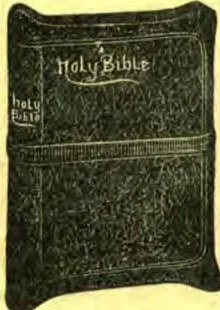
Contains the Celebrated Teachers' Helps,
Comprising nearly 400 pages. Also a complete series of fifteen new maps.

DESCRIPTION

Imperial Seal Binding, Tuck Edges, known as “Divinity Circuit,” Rounded Corners, Full Red Under Gilt Edges.
We offer this Bible, postpaid, for only six new yearly subscriptions at 75 cents; or twelve new six months' subscriptions at 40 cents.
We will also send it, postpaid, with the INSTRUCTOR one year for $2.25. For 20 cents extra we will stamp your name in gold upon the cover. Address—
THE YOUTH'S INSTRUCTOR, Battle Creek, Mich.

THE HOUSE WE LIVE IN.

By Vesta J. Farnsworth.
This book tells how the human body is made, by comparing its parts to the different parts of a house. It also tells how to care for the body. In doing so, many other interesting things are told in a pleasing way. It is printed in large, clear type, with many instructive pictures. It contains 218 pages, and is nicely bound in cloth, with a home scene on the front cover. Price, 75c.
We offer the YOUTH'S INSTRUCTOR for one year and this beautiful book, postpaid, for $1.15; or, we will send the book, postpaid, for five new subscriptions at 75 cents each. Address—
The Youth's Instructor, Battle Creek, Mich.

A VALUABLE WORK OF REFERENCE

SMITH-PELOUBET'S DICTIONARY OF THE BIBLE
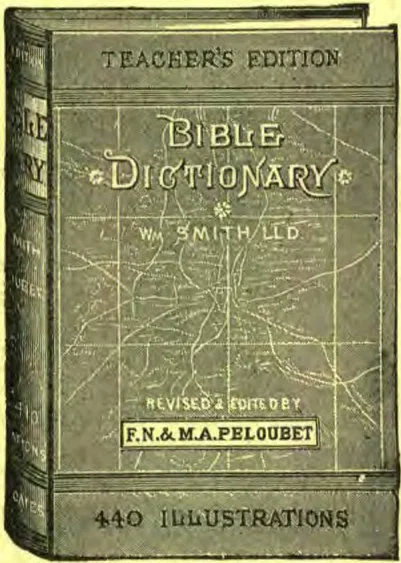
(Teachers' Edition),
COMPRISING ITS
ANTIQUITIES, BIOGRAPHY, GEOGRAPHY, NATURAL HISTORY AND LITERATURE
WITH THE
Latest Researches and References to the Revised Version of the New Testament.
OVER 800 PAGES, WITH EIGHT COLORED MAPS AND 440 ILLUSTRATIONS.
..BY..
WILLIAM SMITH, LL.D.
REVISED AND EDITED BY
Rev. F. N. and M. A. PELOUBET
AUTHORS OF “SELECT NOTES ON THE INTERNATIONAL LESSONS.”
Large 12mo., Cloth, very Unique Binding in Black and Gold.
Every one acknowledges the great value of Dr. William Smith's Bible Dictionary as containing the “fruit of the ripest biblical scholarship of England.” In revising, editing and bringing down to date this estimable work the Revs. F. N. and M. A. Peloubet have accomplished a wonderful task and have made this book an invaluable one.
Besides their innumerable notes, they have added the proper names used in the New Version, together with their pronunciation, the signification of proper names has been inserted, the results of the latest research in regard to the topography of Palestine are embodied, the dates at which persons lived and events took place have been inserted, Chronological tables, a harmony of the Gospels and an outline of the “Apostles and Their History” are also added, all in all making this book of inestimable value to any one interested in the Bible.
The subscription price of the YOUTH'S INSTRUCTOR is 75 cents a year, and the regular price of the “Smith-Peloubet Bible Dictionary” is $2.00. We will send the paper one year, and the book, postpaid, both for $2.00. This offer is for both new and old subscriptions. Address—
THE YOUTH'S INSTRUCTOR, Battle Creek, Mich.

Current Events

England Making Chinese Gods.—Much of the good that foreign missionaries might accomplish is counterbalanced by the many antichristian practices of the so-called “Christian” nations. For instance, a reliable exchange declares that “one of the quaintest of the industries in Birmingham, England,—the home of Joseph Chamberlain, Great Britain’s colonial secretary,—is the manufacture of Chinese idols. Looking around the interior of one of the factories in which the deities are made, one is struck with the incongruity of the surroundings. Arranged about in all sorts of attitudes are a number of gods, of all sorts and sizes. Some are gods of war—so at least one would conclude from their stern looks and murderous swords. Others are gods of peace, and look extremely agreeable fellows. An enterprising Birmingham manufacturer is prepared to supply to order all sorts of gods, and at the most reasonable prices. The cost of a god is usually determined by its size, weight, and workmanship. You may have one as low as twelve dollars. On the other hand, you may, where expense is no object, have one of superior workmanship and size costing five hundred dollars or more. Owing, however, to the present outbreak in China, the manufacture of gods will, it is feared, undergo a slump.” Can the term “Christian” possibly be applied to a nation whose subjects manufacture and sell idols,—a practice directly contrary to the first commandment of the decalogue?
A New Long-Distance Gun.—The sixteen-inch United States coast-defense gun nearing completion at the Watervliet Arsenal gun factory, New York, will weigh, when finished, about three hundred thousand pounds. The total weight of the forgings of the gun, as received from the steel works, was three hundred and sixty-eight thousand pounds, the amount of steel to be removed in the process of manufacture being about sixty-eight thousand pounds. The length of the gun will be forty-nine feet, two and nine-tenths inches; diameter of breech, five feet; of muzzle, two feet, four inches; and the bore is sixteen inches. Its range is something enormous, being estimated to be about twenty-one miles. Something of an idea of the great distance this monster gun will hurl its projectile, may be grasped when it is stated that the trajectory of the projectile shows that in ranging to 20.978 miles, the shell would reach the maximum elevation of 30,516 feet. This is much greater than the maximum range hitherto obtained by any other gun. If this gun were mounted in the city of New York and pointed to the north, it would throw its shells “far beyond New Rochelle on the Sound, and Tuckahoe would be easily within range, as would be Hastings-on-the-Hudson,” and “the circle inclosing its zone of fire would pass through Hempstead and Long Beach on Long Island, and its shells would pass far above Sandy Hook, and fall half a mile beyond the Atlantic Highlands; Keyport and Perth Amboy would be open to attack, as would Westfield and Millburn in Jersey; while the residents at Orange could hear the huge projectiles roaring high overhead, to fall nearly seven miles distant in the valley beyond; Paterson would be within reach, with four miles to spare, and Ridgewood would be an easy mark.” If Mt. Blanc could be placed on top of Pike’s Peak, making a combined height of 29,928 feet, the gun projectile would still rise higher than the combined height of the two mountains, by 588 feet, the extreme height of the trajectory being 30,516 feet, or over five and three-quarters miles.
AUGUSTIN J. BOURDEAU.

HAVE YOU SAID IT?

“Our leader is so poor it discourages me from attending the review of the Berean Library studies”—I wonder if any one who reads the INSTRUCTOR has allowed himself to say anything like this! If there should be even one, I would like to remind him that the blessing promised upon those who study this book is given to individuals. It makes no difference with your receiving the blessing whether your leader is especially gifted or otherwise; but it makes all the difference in the world whether you bring to your study a humble, teachable heart, that is willing to be taught in God’s own way, and by whatever instrument he may see fit to send his word to you. If you come to the general review with the blessing that you have gained in your own study, and earnestly looking for even crumbs of truth, you will not be disappointed if you do not find a feast; for you will know that even crumbs may become a feast by the blessing of Him who once fed five thousand hungry persons with five barley loaves and two small fishes, and who is able to do the same for his people in a spiritual sense to-day. Prepare the lessons thoroughly, ask the Lord to meet with your little company by his Spirit, take with you a receptive mind, and you will not fail to receive help and blessing, even if you have no leader at all. And remember that the most brilliant, consecrated, and earnest leader can not gain this blessing for any one of you, but that it must come to the individual heart as the result of personal, faithful study.
Continue reading: FOR EVERY DAY OF THE WEEK