The Youth’s Instructor, Vol. 35, No. 40.

THE SMOKING MOUNTAIN

The Youth’s Instructor

Oct 5, 1887

S. D. A. Publishing Association · Battle Creek, Mich. · Oct 5, 1887

THE SMOKING MOUNTAIN.
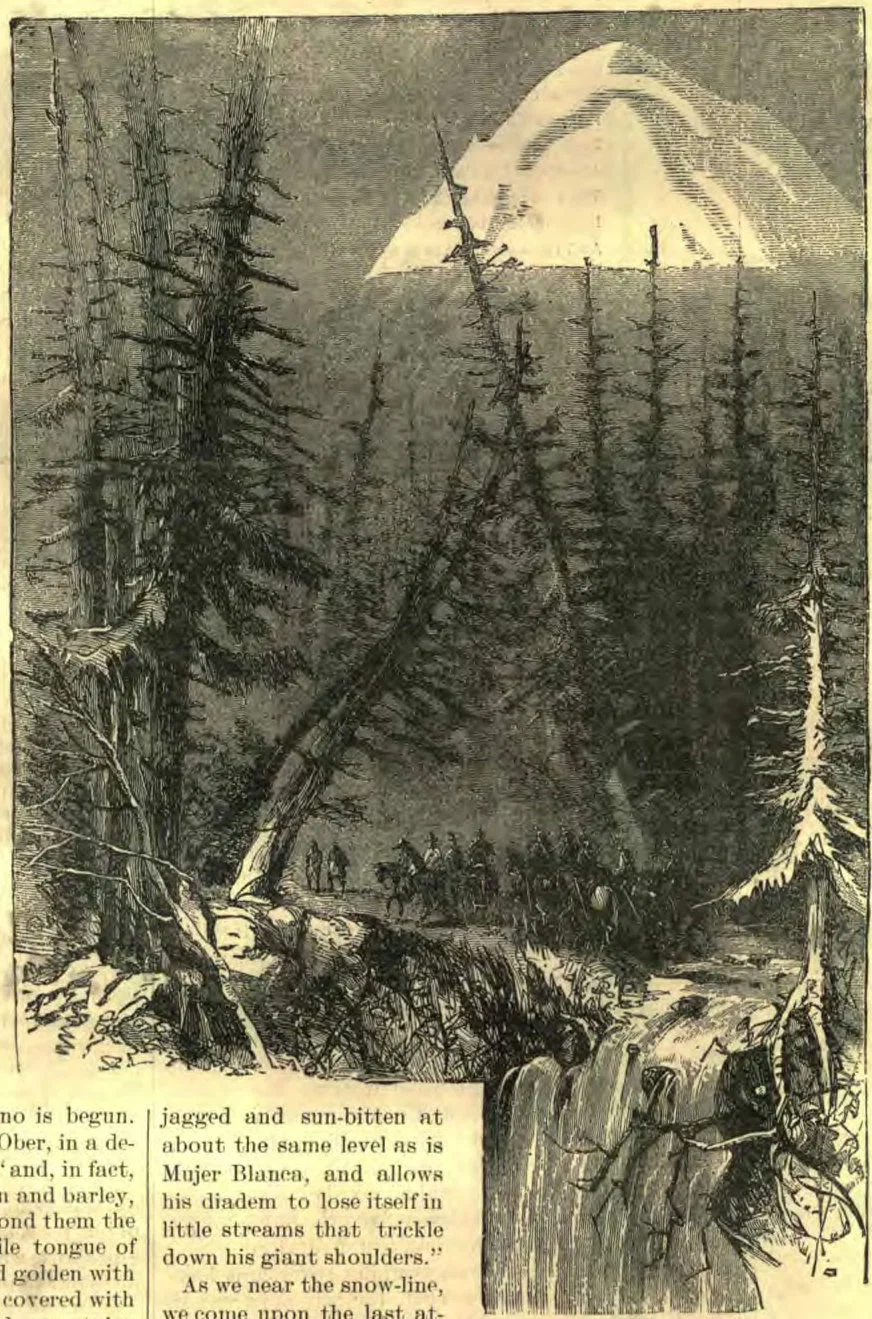
In the heart of southern Mexico rises a wonderful mountain,—wonderful not so much because it is the second highest peak in North America, but because, though nearly 2000 feet higher than the famous Mont Blanc, it can be ascended to the top, and the journey, so far as high mountains go, is a comparatively easy one. Popocatepetl, or as the name signifies, the “mountain that smokes,” is called an active volcano, yet the lazy old giant seems at present to be enjoying a prolonged rest; for it has not had an eruption within the memory of man.
A fine view of this mountain and its companion Ixtaccihuatl, is obtained from Ameca-ameca, a town some forty miles from the city of Mexico, and the point whence the ascent of the volcano is begun. “East of the town,” says Mr. Frederick Ober, in a description of his ascent of the mountain, “and, in fact, all around, stretch immense fields of corn and barley, parted by hedges of manguey; and beyond them the foot hills commence, with many a fertile tongue of land running up among them, green and golden with grain. Then they rise higher and higher, covered with black forests of pine, until the grand old mountains are fairly reached, which shake off their garments of trees, and tower above them all, brown and barren; next comes the border of the snow-line, its white robe ragged and patched with brown on its skirts; but, finally, triumphing over all below, it drapes the peaked summit in a glistening garment of spotless white. Facing the east, Ixtaccihuatl—La Mujer Blanca (‘the white woman’)—lies above, and apparently nearer the town than Popocatepetl. She covers a long portion of the ridge with her white shroud, and is really suggestive, by her shape, of a dead giantess robed in white for her burial. Far and near this volcano is known as the ‘White Woman,’ and from the plains of Ameca-ameca and from the city of Mexico the resemblance to a dead woman lying on her bier, and covered with a white sheet, is most perfect. The neck is a trifle too long, but the dead face is perfect, and the hair streams in silvery locks from the snowy forehead back over the head and down the sides of the bier. Her feet are turned towards her companion giant, grim old Popocatepetl, and between the two lies a long uneven ridge, mainly below the snow-line, brown, and for the most part treeless. Popocatepetl is a solid cone of glittering snow, which appears jagged and sun-bitten at about the same level as is Mujer Blanca, and allows his diadem to lose itself in little streams that trickle down his giant shoulders.”
As we near the snow-line, we come upon the last attempts at civilization,— the rancho of Tlamacas, 12,500 feet above the sea, the highest habitation, perhaps, in North America. This is the home of the Indian guides and purifiers of sulphur; for the crater forms one vast bed of sulphur deposit. “The ‘volcaneros,’ or volcano men, are a hardy race of Indians who toil day after day, gaining a living by picking up the sulphur and conveying it to the rancho, where it is sublimed and taken to the towns for sale.”
“From the snow-line to the crater,” says another traveler, “the ascent was decidedly laborious, but there is no danger—we found no crevasses, no clefts, no chasms, and no avalanches. The smooth, cone-like summit of the mountain is covered with a cake of snow, which, by alternate freezing at night and thawing at noon, is as slippery as glass, were it not that where the guide takes you it is thickly covered over with upright blocks or small columns of snow-ice. When you slip, you only slide a foot or two till you are brought to a stand by one or more of these pillars of ice. The edges of these pillars, large and small, are sharp as razors. I luckily had on a thick pair of woolen gloves, and escaped scathless, but the gloveless hands of my companions were so badly cut that our ascent might have been traced by their blood on the snow.”
But at length the crater is reached. This is said to be about three times the size of Vesuvius, and of similar shape. “The lip of the crater,” says Mr. Ober, “is a narrow rim of sand, lying above the black abyss, and at the edge of the sea of snow, like the coral ledge composing an atoll of the southern sea. . . . The snow stopped abruptly at this wreath of sand, rising to a height of from six to eight feet, and curling over it, but prevented from advancing further by the heat from the crater.”
Out of the vents in the dark depths below ascends a sulphurous cloud, suggestive of the infernal regions. Here, the volcaneros work in gangs alternate weeks, and live in the crater, beneath rough sheds. For twenty years this dangerous sulphur mine has been worked. At first, there was the accumulation of centuries to be removed, but now the principal supply is obtained from the vents and fissures in this yawning abyss.
However long a traveler may be in making the ascent, it is but short work to come down. “Down the ice cone,” says our traveler, “the laborers of last month had dug a long straight trench, leading from crater to volcanic sand, down which they used to slide sulphur. Had they been working now, I should have borrowed a kind of straw mat, and slid down on that, as they were wont to do; but as they were not, I stood upon my broad-soled shoes, and, guiding my course with the alpenstock, sped downward with the swiftness of the wind, . . . over the snow, and out upon the sand, and finally reached La Cruz.
“At sunset, old Popocatepetl seemed on fire, his peak took on a rosy glow that soon suffused the whole cone; and later, as the sun sank down and spread its warm coloring over the eastern sky, he seemed encased in burnished gold; but, as old Sol disappeared entirely, he relapsed into cold, dead white, standing out like a mountain of marble against the steel-blue sky. “The White Woman” did not share this afterglow of the sun, but remained resting on her bier, a slight mist draping her, and giving her the livid hue of a corpse, as she is. But when daylight had just faded, and the stars began to twinkle one by one, both the dead giant and the dead giantess were wrapped in the serene white calm of this upper atmosphere.” W. E. L.

AFTERWARD

Ah, soon the flowers will fall asleep, And chilling winds begin to blow; And brown and still and buried deep The earth will lie beneath the snow. But in her breast the seeds will dream Of April skies and summer rain; They'll fancy they can see the gleam Of sunbeams over hill and plain. They'll hear the happy song of birds And music of the dancing rill, And through the snow, too sweet for words, The voice of Spring their hearts will thrill; They'll ope their eyes, and lo! the earth Will spread around them, bathed in light, And fair as at creation's birth.— A triumph over death and blight.
So sorrow comes, but passes on And leaves fair Hope to sing her song; And e'er we know, the night is gone Which we had thought would last so long; And Faith looks up with smiling eyes, Her forehead bright with fadeless youth, And sees beyond the shining skies The Source of endless joy and truth. —Christian Weekly

Memory Like a Net

MEMORY is a net. One finds it full of fish when he takes it from the brook, but a dozen miles of water have run through without sticking.

WHAT STANLEY THINKS OF THE USE OF LIQUOR.

HENRY M. STANLEY is a hero after the boys’ own hearts. He has traveled over the greater part of the earth’s surface; he has fought with elephants, tigers, boa-constrictors, and the wild tribes of Africa. He has opened up a country to civilization, and done many things that will leave his name a shining one in history. No fairy brought this about. Stanley was a poor boy, and by sheer perseverance and a willingness to work, he made a place for himself. He kept his eyes and ears open, and used his brains. He has done one thing more that has enabled him to accomplish his work. He said, in an interview with a reporter of The Herald of Health:—
“At Zanzibar I formed an expedition for the finding and relief of Dr. Livingstone. I employed two white men and two hundred natives. One of the white men, Shaw, had been mate of an American ship, and the other, Farquhar, mate of an English ship. Both had been accustomed to hardship, but were fond of liquor. It was the awful consequences attending their indulgence in it that first aroused my attention to the effect of alcoholic stimulants in Africa. I sent Farquhar forward a few miles to form camp, and when paying up the hotel and other bills, found that he had drunk eighteen bottles of brandy before starting. The effect upon him was still visible after we had journeyed one hundred and fifty miles. He then became dropsical and died.
“Shaw had been helping him to consume the brandy at Zanzibar. He was morose, and when he could get no more, left me at Unyanyembe, five hundred miles’ march. His object was to find an opportunity to drink to his heart’s content at the stale beer obtainable there. I heard that he, in delirium, I suppose, put an end to his life. I continued my journey with the natives until I found Livingstone, a few weeks afterward. He was lodged at a place within nine hundred miles of Zanzibar, to reach which it took me eight months.”
“Was Dr. Livingstone a teetotaler?”
“In Africa he never touched liquor of any kind.”
“What was the nature of the fare you were able to procure on your way through the country?”
“Goat meat, Indian corncake, bananas, and milk.”
It does not take a wise boy long to decide what life pays best—one that is clean and wholesome, devoted to honest work, or one that gives pleasures that end in pain and suffering and disgrace; that takes as its motto: “A short life and a merry one.”
No boy ever became a great man except as he kept faith with cleanliness, good morals, and devotion to the work he felt was to be done in the world by him.—The Christian Union.

ROYAL VISITORS.

The visit to this country of Queen Kapiolani, of the Hawaiian Islands, the past summer, recalls the fact that on many previous occasions have members of royal families set foot on our shores. More than once the free soil of our republic has been sought by princes as a refuge in exile. Louis Philippe, afterward King of the French, fled from France when his father, Philippe Egalite, was guillotined, and for some time wandered from place to place in this country, at one time teaching for a living. After the failure of Louis Napoleon's attempt on Strasburg, he was released on condition that he would come to the United States. He landed in New York, and lived for some time, almost in poverty, in that city and Brooklyn, meanwhile making a visit to Washington Irving, at Sunnyside on the Hudson. Those who saw him at that time little imagined that he would one day be Emperor of the French. No European sovereign, however, has visited the United States while wearing the crown; but Joseph Bonaparte found a home and refuge in New Jersey, after he had worn successively the crowns of Naples and Spain. It is probable, indeed, that the great Napoleon himself would have come to this country had he been able to escape from the hands of his enemies after the crushing defeat of Waterloo.
But though no European reigning sovereigns have paid the United States a visit, the heir apparent to the English crown, and the present head of the royal family of France—if France should ever again become a monarchy—have done so. The Prince of Wales made a tour of this country in 1860, when he was eighteen years of age; and the Count of Paris, the grandson and heir of Louis Philippe, with his brother, the Count of Chartres, came here and served for awhile in the Union army, in the early part of our civil war. We are indebted to the Count of Paris, indeed, for one of the best narratives of the war which has been written. The younger sons and daughters of several European potentates have been in the United States. The Grand Duke Alexis, brother of the present Czar of Russia, visited us with a Russian fleet many years ago, and two of the three brothers of the Prince of Wales, Prince Arthur, Duke of Connaught, and the late Prince Leopold, Duke of Albany, as well as the Princess Louise, have made a tour through the United States. Two crowned heads, moreover, not European, have been guests of the republic. The most important of these was the enlightened Don Pedro, Emperor of Brazil, who took a deep interest in the evidences of our national progress and power. The other was King Kalakaua of the Hawaiian Islands, the husband of the queen who has just visited us, who came to the country some twelve years ago.
Queen Kapiolani has been welcomed as the royal representative of the group of islands which, situated in the midst of the Pacific, has long had close relations with the United States in many ways. There is a large number of Americans resident on the Islands of Hawaii, for the most part engaged in trade. Many natives of the islands, of the higher class, come to the United States to receive their education. Americans have often occupied high posts of honor and responsibility in Kalakaua's councils. The commerce of Hawaii with the United States, moreover, has been more profitable than with any other nation; it amounts to 90 per cent. of its whole trade. The present population of the islands is about 80,000, only about one-half of whom are pure-blooded Hawaiians, and the native race has long been decreasing in number; but Hawaii is said to be the only tropical soil on which white men can work without injury. The intelligence and good character of the Hawaiians are undoubtedly due to the work of the American missionaries, who have long made the islands a special field of labor.—Youth's Companion.

DORA’S LESSON.

“Now, Dora, be careful, or you will upset the ink on your new dress. I never like to have you put your ink on a book. I am afraid, Dora, you will have to pay a very dear price some day for your careless habit.”
“Oh, no, mamma. I will be careful,” and Dora went on with her writing.
Everything went very well for about half an hour, and Dora had forgotten her mother’s warning about the ink.
“Dora! Dora!” came a loud and exacting call. “Come, hurry; we are waiting; the pony is saddled all ready for you to ride.”
Dora gave a quick jump, when, lo! a crash, and she looked in dismay, to see one breadth of the fine linen lawn all covered with black ink-stains.
Poor Dora! She first looked and looked, and then she said very pitifully, “O mamma! what shall I do?”
“You know, Dora, what you will have to do. Before any enjoyment or pleasure, that breadth must be ripped out and another put in.”
“Can’t Ann do that?”
“Was not Ann going on a picnic to-day, Dora?”
“Yes, mamma; but so was I, and if I have to do this, I will have to stay at home.”
“Dora,” said mamma, “I am ashamed of you! You have, by your carelessness, caused this mishap to your dress. Who should suffer for it—you or Ann?”
“Mamma, will you make me miss all of that beautiful picnic for this old ink?”
“Dora, I will leave you to decide the matter,” said Mrs. Gilbert, as she turned away.
Poor Dora had been well trained, and Mrs. Gilbert knew what she would do. For a few minutes Dora stood looking after her mother; then she went upstairs very slowly and sadly, and changed her dress. All the rest of that day was spent in putting in a new breadth in the place of the ink-stained material. As she sewed and sewed, and thought of the good times the young people were having at the picnic, she also thought what a good time she would have had if it had not been for that one act of carelessness.
It is needless to say that Dora grew up to be a careful woman, and the lesson of that day’s sewing taught her that one sin will bring suffering, and that he who sins must reap the consequences of sin. The one little act was never forgotten, and Dora centered her whole future life on endeavoring to do right in the little things. When we knew her, she was doing as much work as three ordinary women; and when we questioned her about her wonderful power, she told us the story of the inky breadth, and how her mother’s wisdom taught her that she must endeavor to be careful in the smallest matters if she would be fitted for greater ones.
You remember how Cain allowed sin to grow and grow until he became a murderer, and had to suffer all the remainder of his life. Try at once to put out all the little ugly traits of character, whether they be sins of carelessness or little jealousies, etc.; and if you start in life trying to overcome evil, you will soon be called to fill wider spheres of action; for He who rules over all, watches very carefully the growing character, and he takes for his great works those who can do all the every-day things carefully.—S. S. Herald.

BOOKS OF THE OLD TESTAMENT.

THE great Jehovah speaks to us In Genesis and Exodus. Leviticus and Numbers see Followed by Deuteronomy. Joshua and Judges sway the land; Ruth gleans a sheaf with trembling hand. Samuel and numerous Kings appear. Whose Chronicles we wonder here? Ezra and Nehemiah now, Esther the beauteous mourner show. Job speaks in sighs, David in Psalms. The Proverbs teach to scatter alms. Ecclesiastes then comes on And the sweet Songs of Solomon. Isaiah, Jeremiah then With Lamentations, takes his pen. Ezekiel, Daniel, Hosea's lyre, Swell Joel, Amos, Obadiah. Next Jonah, Micah, Nahum come; And lofty Habakkuk finds room. While Zephaniah, Haggai calls, Rapt Zechariah builds his walls; And Malachi, with garments rent, Concludes the ancient Testament. —Anon.

THE FAR-OFF LEAVES.

WHEN the spring comes, the oak tree, with its thousands upon thousands of leaves, blossoms all over. The great heart of the oak tree remembers every remotest tip of every farthest branch, and sends to each the message and the power of new life. And yet we do not think of the heart of the oak-tree as if it were burdened with such multitudinous remembrance, or as if it were any harder work for it to make a million leaves than it would be to make one. It is simply the thrill of the common life translated into these million forms. The great heart beats, and wherever the channels of a common life are standing open, the rich blood flows, and out on every tip the green leaf springs. Somewhat in that way it seems to me that we may think of God’s remembrance of his million children. In some hut to-day, some poor, sick sufferer is wearing the hours out in agony, longing for the evening, as last night he longed for the morning, which seemed as if it would never come. Or, in some obscure shop to-day, some insignificant workman is doing some bit of faithful and useful, but unnoticed, work. They are the far-off leaves on the great tree of His life; far off, and yet as near to the beating of His heart as any leaf on all the tree. He remembers them.—Phillips Brooks.

NECESSARY GIRLISH QUALITIES.

Patience and gentleness are necessary qualities in every girl's life. Patience aids in extinguishing envy, overcoming anger, and crushing pride. How much good may be done and joy brought by a gentle word or look! Truly “a soft answer turneth away wrath!” Girls are not called upon to do great things, except in rare instances; but the every-day trials of life in the ordinary and appointed exercise of the Christian graces afford ample scope for practicing that virtue of mankind which has become proverbial. The best exercises of patience and self-denial—and the better because not chosen by ourselves—are those in which we have to bear with the failings of those about us, to endure neglect when we deserved attention, and ingratitude when we expected thanks—to bear with disappointment in our expectations, with interruptions of our retirement, with folly, intrusion, or disturbance—in short, with whatever opposes our will or contradicts our humor.—Ex.

SOWING A NAME.

WE have seen a young child express the greatest surprise and delight on discovering in a flower-bed its name written in the green of young plants, the seed of which had been sown in that form by a fond father or mother. But by-and-by, dear children, you will see your name or character as it has been planted by yourself springing up in the opinion people entertain of you, and it will be exactly as you have sown it. Be careful, then, how you sow. Do not spoil your own name by sowing foolishly or wrongly. Remember, every word and action is a seed put in, which will surely spring up and constitute your name in the world.

Thoughts Written on the Heart

WHEN you think, you really write your thought on your heart, and God reads it there.

DON'T BE AFRAID OF HARD WORK.

Many people have a dread of mental effort. Anything that comes hard they never want to touch. Their first question concerning any subject seems to be, “Is it easy to understand?” and no lesson is a good one unless it is easy to learn. Such people forget that the mind as well as the body is made strong by vigorous action, and can become strong in no other way. True, there can be excess in either bodily or mental exertion; but where one mind is injured by over-exertion, thousands are ruined for want of proper exercise. A subject that does not require hard thinking is scarcely worthy of an examination, and time is wasted on a lesson that requires but a passing notice, or that can be learned without serious thought and careful reflection.
Easy lessons make but a slight impression, and one that soon wears away. Many lessons leave a mark scarcely more permanent than footprints on the wave-washed sand of the sea-beach.
Again: there is a law of compensation running through all things,—a law that is as inexorable as the fiat of the great Creator. Whatever costs little is worth little. That which can be obtained without effort is not worth acquiring. It may be said that salvation, the most precious of all things, is free; but it has cost the life of the Son of God, and the watch-care and attendance of myriads of angels from the fall of Adam until now; and we shall all find, too, that if we ever secure the priceless boon, it will cost us the anguish of dying unto self and sin, as well as a vast amount of self-denial and persevering effort in the path of duty.
Instead of being a curse, hard work is a blessing. It strengthens not only mind but character. It gives a healthy tone to the whole being. Before the fall, God gave man work to do. Adam was to dress the garden and to keep it; and almost at the very outset he was called upon to name all the creatures which God had made,—a mental task which some of us would scarcely wish to undertake.
But there is one feature of the subject which is seldom thought of. An observing clergyman once said, “People are endeared to us more by what we do for them than by what they do for us. Thus, parents have greater affection for their children than their children have for them. Maternal love is apt to be deeper than paternal. Even the nurse comes to have the same love for the child she cares for that she would have for her own offspring. An invalid or crippled child has double affection placed upon him mainly because he has required more loving attention.” On the same principle, we usually think most of what costs us most. Hard-earned money is carefully economized. The home that has cost half a lifetime of toil is dear to its owner. How one rejoices over an invention that has cost him long years of thought and experiment! On the same principle, the value we set upon a truth depends largely upon the effort we have to put forth in discovering it. Thus it is, that one who is rejoicing over some hard-found truth is astonished that others cannot share his enthusiasm.
Now we do not believe in hedging up the way of truth in order to make it difficult of access, but it is well to give every learner some vigorous work to do, either in discovering truth, or in tracing the relation of truths to one another. The learner will not prize what he does not have to work for, neither will he retain it long enough to have it affect his heart and life.
Now if you have a hard lesson to learn, do not find fault with it on that account, but think whether or not the study required to learn it is not just what you need. Would the lesson be worth so much to you if it were made as easy as you would like to have it? Would it strengthen your mind as much? Would it make as deep an impression? and would it give you as much heart culture? What if you have to study it many times over? How precious passages of Scripture become that have been conned again and again with prayerful attention!
If you are a teacher, and have an inattentive or wayward pupil, do not grudge time and effort in reforming him. The more loving work you do for him, the dearer he will become to you, and the more likely you will be to win him. Do not be afraid of giving time and thought enough to a lesson to become thoroughly imbued with it. It is not enough to know a lesson and be able to recite it; you must catch the spirit of it. It must actually do upon your own heart the work that it ought to do, and the work that you would like to have it do upon the hearts of your pupils. This is the very best of preparation for teaching. Nothing else can equal it or compare with it.
Do not undertake any work that is not worthy of you; and when you have undertaken the work, do not be afraid of giving time and thought to it, of putting hard work into it. The more you do so, the more you will love your work, and the less burdensome it will seem. An intelligent man once said to a teacher, “It has been a mystery to me how you could endure so much hard work in your teaching. But I have thought it out. You love your work, and so it does not tire you.”
We put plenty of hard work into other things. Why not into the work of God? You spend years of time and pay out much money in studying what men have written. Why not take the same pains in studying the Bible? Is not the study of God’s word as important as other studies? Are not the truths it reveals as important as those revealed by science? Is it not worth as much in practical life? and will it not bring as profitable results in the end? Is the wisdom of men greater than the wisdom of God? or does it require more time and thought because it is so much more profound? We sacrifice to pride, to fashion, to self-gratification, and to the whims and caprices of others. Shall we not sacrifice something to so noble an end as learning the way of life eternal, and the mysteries of the world to come? But it is no sacrifice; it is a delight, or may be; and it surely will be if we study with a prayerful mind and a loving heart. G. H. B.

THE TEACHER’S DUTY TO THE SUPERINTENDENT.

THE following article is taken from the manuscript of the “S. S. Manual,” now in course of preparation. We hope to be able before long to announce this much-needed volume as ready for sale.]
A great deal is said about the duty of the superintendent to the teachers and the school, and perhaps still more about the duties of the teacher to his class. But the duties of the teacher to the superintendent are sometimes overlooked, though they are none the less important. Prominent among these are punctuality, respect, attention, and obedience. In the matter of punctuality we are apt to think of the scholars who will miss their teacher; we do not think of the superintendent, who notes the empty place, and knows how hard it is to fill it. If each teacher would notify the superintendent of an expected absence in time for him to obtain a substitute, it would greatly lighten his burdens. Indeed, the teacher should consider this one of his duties.
Teachers often fail to show proper respect for the superintendent of the school. They do not hesitate to criticise his ways and methods of doing, and that in the presence of other teachers, and often even before their scholars. If the superintendent chances to make some remark or suggestion to the school that does not exactly please them, the scornful curl of the lip or glance of the eye to some fellow-teacher show all too plainly what they think, though no word is uttered. The scholars are not slow to notice these manifestations, nor to act upon the suggestions of their teachers. Cases are by no means unheard of where such a spirit, started by some one or two teachers, has spread through the school to such an extent as to organize a down-right persecution against a superintendent who is really conscientious, and trying to do his duty. Let us guard against the first uprisings in our hearts of any such spirit. Our superintendent may not be a perfect man—such are rather scarce—and he may make some mistakes in his work; but he will not be helped to do better by having his teachers continually criticising him. In most cases, if a teacher will go to a superintendent with any grievance he may have against his management, and speak of it in the right spirit, he will be received kindly. While the superintendent cannot change his course to suit the whim of every fault-finding teacher, he will often receive valuable suggestions from those whose interest in the school is as real as his own.
Of course it will sometimes happen that a man entirely unsuited for the work is put into the office of superintendent. It is not always possible to judge how well a man can fill a place till he has been tried. He may be a good man, but incapable of filling his present office. Now the best way for the teachers is not to sneer at and make the most of his failures, but by their own faithfulness and interest try to make up for the lack in him. It is one of the things in favor of our present system of elections that the time for a new election will soon roll around; when it will be entirely proper for all who feel dissatisfied with any of the officers who have been serving to lay the case frankly before some member of the nominating committee. This is the true way to adjust any such difficulty; but while any man holds the office, it is the place of the teacher to show him the respect due to the superintendent of the school.
It is the duty of every teacher to co-operate with the superintendent in carrying out his plans for the good of the school. He should not feel that he as teacher has the sole control of the class which has been given him, but should rather consult with the superintendent in regard to the best interests of the class, and be willing to act upon the advice and suggestions which he may offer. Many a school has been almost ruined by dissension arising from this feeling of class superiority and class independence. The teacher wishes to govern his class to suit his own ideas, makes his own plans for class work, arranges for entertainments, meetings, schemes of benevolence, and the like, without any regard to what the superintendent or the other teachers may have in mind. Indeed, he makes of his own class a sort of “absolute monarchy,” on a small scale; and woe to that superintendent who undertakes to add to that class, take therefrom, or in any way interfere with its management! The teacher who will persist in this course, after having been shown the folly of it, would better be asked to resign, even though he takes his whole class with him. The school is better off without him, notwithstanding the fact that he be a person of some talent; for the contagion will spread from one class to another till the superintendent has virtually no voice in the school.
We, as teachers, should sympathize with our superintendent,—not only in our hearts, but by outward expression in word and in act. He has many burdens to bear, and has much fault found with him, even though he tries to do his best. Do we utter words of encouragement when he seems depressed, or the outlook is gloomy? or are we so wrapped up in ourselves and in our own classes that we have no care about the rest of the school or our perhaps overworked officers? Some one has said, “Kind looks, kind words, kind acts, and warm hand-shakes—these are the secondary means of grace when men are in trouble and are fighting their unseen battles.” Let us not forget to show our superintendent in these little ways, which cost us nothing, that we appreciate his difficulties, and his efforts for the school.

THE DUTY OF REFUSING TO DO.

No man can do all the good there is to be done in this world. No warm-hearted, earnest lover of God and of his fellows can do all the good he would like to do in this world. No well-known, active, and efficient worker for God and for his fellows can do all the good he is asked to do in this world. Hence it is obvious that the most active and efficient and warm-hearted and earnest worker for God and for his fellows in this world, must choose among the good things which need doing, and which he is asked to do, and which he would like to do, deciding for himself what to do and what to leave undone; and it is equally clear that in deciding what good it is his duty to do, a man practically decides what good it is his duty to refuse to do, even though he be urgently pressed to do it. Thus it is that the duty of refusing to do comes into prominence as one of the positive duties in the life of every man who is doing his best in this world, and who would be glad to do more—if he had any right to do it.
It shows no lack of warmth of heart, or of tender and generous sympathies, for a man to refuse to do the good which he could do, but which he ought not to do. It simply exhibits that trustful fidelity to duty which prompts a true soldier to obey the commands of his commander, regardless of any personal impulses or promptings of his own; moving forward steadily under fire in the face of every obstacle, when ordered to advance; and remaining inactive while the battle rages before and on either hand, when ordered to wait in reserve. There was never a human heart so warm, so tender, so loving, so generous, as the heart of Jesus Christ; yet Jesus Christ waited here on earth for thirty long years without lifting a hand in the line of the work which was waiting for him on every side, and which, to all appearance, he could have entered on.
Even when he had begun that work, and all men sought for his healing power, Jesus could turn aside into a desert place to rest awhile, or he could go by himself into a mountain to pray, or he could lie down to sleep while there was suffering unrelieved within the possibility of his reach. He knew just what good he ought to do, and he did it all. He knew just what good he ought to leave unattempted, and he refused to attempt any portion of that. When, again, he sent out his disciples on a special mission, Jesus enjoined them to refuse to do any good outside of that mission, even to the extent of stopping for a personal salutation—which means so much in the Oriental world. Similarly, in the present day, the disciple of Jesus ought not to be weary in the well-doing that he ought to attempt, nor make haste to the attempting of good which it is not for him to be doing.
If, indeed, it were not for the privilege of resting on the conviction that God is over all, and that every child of God has his own good work to do in this world, and all other good work to refuse to do, life would be a hopeless struggle, and death would be despair. But as it is, every child of God can be sure that he has the time and the strength and the ability to do all the good that it is for him to do, in the plan of God; and that he is called to have the courage and the firmness and the faith to refuse to do any good that, in the plan of God, it is not for him to undertake. Nor will God's cause suffer, nor will men's truest welfare lack, through any failure or refusal of a child of God to do the good which he could do, but which he ought not to do.
God's plans never pivot on any man's work outside of that man's sphere of positive personal duty. Nor are any of God's plans limited for their finishing to any one man's fullest activities. Even when a true man's part in the world's work is finished, the work at which that man toiled is not finished. It is given to no man to do all that he would like to do, nor to finish all that he attempts to do. Yet no work of God shall fail, nor be ultimately incomplete. The good which one man ought to refuse to do, another man ought to undertake; and the good which one man has rightly begun, another man shall rightly carry forward. “Herein is the saying true, One soweth and another reapeth;” and so God's work goes on. This is the thought which comforted a poet who has recently finished his part in life's unfinished work, when he wrote for us all:—
“Fret not that thy day is gone, And the task is still undone. 'Twas not thine, it seems, at all; Near to thee it chanced to fall, Close enough to stir thy brain, And to vex thy heart in vain.
“Somewhere in a nook forlorn, Yesterday a babe was born: He shall do thy waiting task; All thy questions he shall ask, And the answers will be given, Whispered lightly out of heaven.
“His shall be no stumbling feet, Falling when they should be fleet; He shall hold no broken clue; Friends shall unto him be true; Men shall love him; falsehood's aim Shall not shatter his good name.
“Day shall nerve his arm with light, Slumber soothe him all the night; Summer's peace and winter's storm Help him all his will perform. 'Tis enough of joy for thee His high service to foresee.”
And “here is the patience and the faith of the saints.” In doing all the good that one has a right to do, one must trustfully refuse to do the good which it belongs to some one else to do.—S. S. Times.
Continue reading: THE BLACKBOARD IN PRIMARY WORK