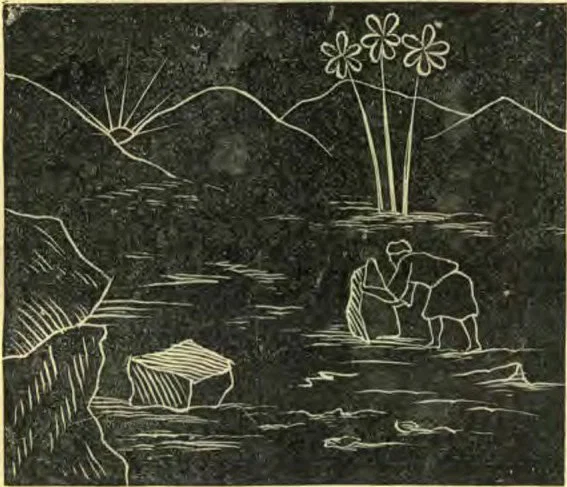
As a means of gaining the attention and promoting a lively interest in the lesson, we fear the blackboard has been greatly undervalued. No other Sabbath-school help has been so little appreciated as this one. This no doubt arises from a misconception of the true use of the blackboard. It is a mistaken notion that elaborate or highly artistic pictures are necessary. The immediate object of the Sabbath-school is to teach the lesson; when, therefore, the drawing or the lesson help becomes so elaborate or so complicated as to divert the mind of the pupil from the thought of the lesson to the skill or ingenuity of the artist, the lesson help may be counted a lesson hindrance. Whenever your scholars exclaim, “Oh, what a beautiful picture!” you may know that your effort is a lamentable failure. Elaborate pictures may do some good; but we believe there is a more excellent way, whereby a teacher of little skill in artistic work can attain results that would at first seem improbable.
“Curiosity and imagination,” remarks one who has had long experience in training the minds of children, “are especially active in childhood; and whoever would hold the attention of a child, must give room for the exercise of those faculties on the subject he is presenting, or they will immediately fall into employment on some other subject.” It is, therefore, by exciting the curiosity and thus gaining the attention of the child, that the blackboard is mainly useful.
Since first impressions are lasting, and with most children difficult to efface, it would seem best for the teacher to spend a portion of the time each Sabbath in going over the next week’s lesson with the class. “Teaching a lesson,” says one, “is very different from hearing a lesson. In teaching a lesson, the first thing is to get the lead of the minds in your class, to get them all to think and talk about some one thing.” In this work of concentrating thought, the blackboard is mainly useful. As an illustration of how this may be done, let us take the lesson on Jacob’s departure from home.
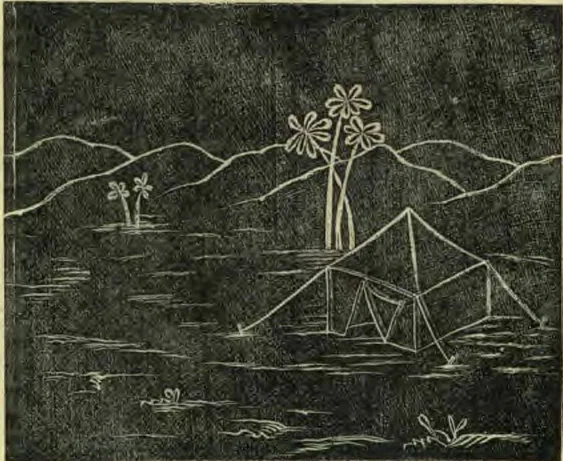
We will suppose that you have illustrated the preceding lesson while teaching it the Sabbath before, and have made Isaac’s tent, and Jacob’s home, in Beersheba. You will now, while asking a few general questions, that all can answer together, rapidly sketch the tent, with the palm trees and the low-lying hills of Judea in the distance, something like the following:—
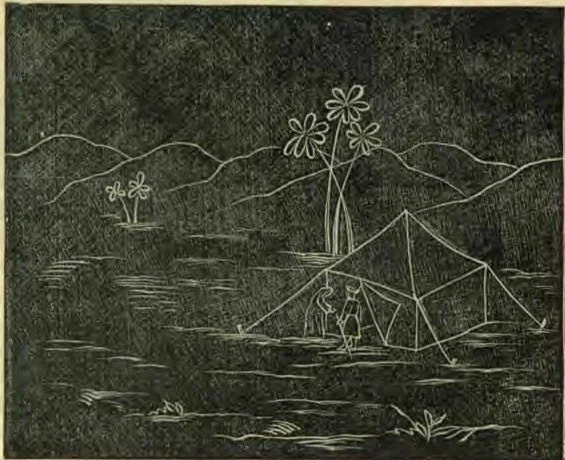
In questioning, you might say: “What did Isaac live in,—a house or a tent? What was the name of the place where he lived? How many sons had Isaac? What was their mother’s name? Which of the sons did she like best? What did Isaac ask Esau to do for him? Why did Jacob deceive his father? Who put him up to do this? Was it right? What did Esau threaten to do?” (And having thus connected the last lessons with what you wish to teach to-day, begin to take advance steps into the lesson of the next Sabbath, having a care to go no faster in your drawing than you do with your word picture.) “Rebecca was very much afraid Esau would really kill Jacob, just as he said he would do. She felt so worried about their quarrel that she hurried him off to his Uncle Laban’s; for Isaac was so old and feeble that he might die any day, and she did not dare to wait. She must have felt sad at this parting from her best-loved son; for she was old herself, and might not live to see him again.” (While talking, you may add, to the picture you have already made, Jacob and his mother at the door of the tent.)
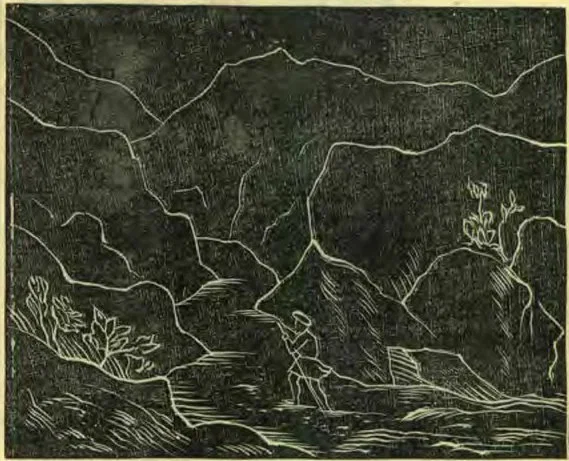
Laban’s home was away to the northwest of where Jacob lived, in Haran. Do you remember the name of a good man we once learned about, who lived for awhile in this town? Yes; Abraham stopped here while on his way to Canaan. (Here complete your first picture, and while talking about the road, make a mountain pass, with a man hurrying swiftly along, as seen in the next picture.)
“The road from Beersheba to Haran was rough and crooked, as it is now, and it passed through many wild places in the mountains. Do you not think Jacob had a lonesome journey? I suppose he thought about his quarrel with Esau, and may be he wondered whether his Uncle Laban would be glad to have him come and live with him or not.”
“Jacob must have traveled very fast; for when night came he was as much as sixty miles from home, near a little city called Luz. He did not know anybody near here, and so he lay down in a lonely place, and took a stone for his pillow.” (By this time you should have nearly completed a drawing like the following:—) “How do you suppose he felt when he thought of his father’s comfortable home in Beersheba, and how he himself now had no place he could call home?”
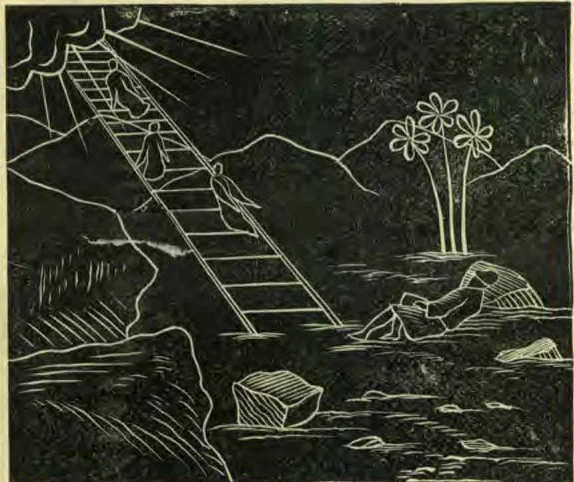
“But Jacob was not alone. God was watching him all the time, though he did not seem to remember it. When Jacob had fallen asleep, the Lord sent him a wonderful dream. (Here begin to make your ladder and the angels as in the following:—) He thought he saw a ladder reaching from earth to heaven, and that angels were going up and down on it. At the top was the Lord of glory (add to the picture the clouds with the light shining out), and he talked with Jacob. He made him the same promises that had been made to Abraham and to Isaac. God told Jacob not to be afraid; for he would give him all the land whereon he was now lying, and promised to be with him in all places, and bring him back to that spot again.
“Do you think Jacob felt lonesome after that? or that he dreaded so much to go to live with strangers? When Jacob woke up, he said, ‘Surely the Lord is in this place, and I knew it not.’ And he set up the stone he had used for a pillow as a pillar to mark the place where he had had this wonderful dream. (While you have told this, you will have made changes in your picture, like those in the one on the next page.) Jacob named this place Bethel, which means ‘the house of God.’”
It would be a good plan if, after teaching the lesson in this manner, you should ask a few questions on what you have just been talking about, so that the story may become more firmly fastened in the children’s minds.
In the few minutes usually allotted to teaching the lesson,193nothing elaborate in the line of illustrations can be attempted; the drawings will of necessity be rude, but a child’s quick imagination will fill up all deficiencies. A teacher who was illustrating this lesson to a class of children was perplexed when she came to that part of the story about the angels. Not having any natural skill in drawing, it seemed beyond her power to picture an angel; so she said, “I don’t know how we shall put all the angels on this ladder.” “Oh,” replied an interesting listener, “you couldn’t make them go up and down anyhow.” So the angels were omitted, to the great relief of the teacher.
A clear distinction should exist in the teacher’s mind between hearing the recitation and teaching the lesson. In hearing the recitation, you are to test your pupil’s knowledge of the things he has been taught. He is to tell you what he remembers, and you are to supply merely what you cannot bring out of the class. It will therefore be readily seen that the blackboard work described above has no place in the recitation.
But when you teach the lesson, you should make the narrative so vivid that the whole story will be given a life-like reality; you should make the Bible characters live men and women, and their actions should be pictured as things that really occurred; and as you proceed Sabbath after Sabbath, and lesson after lesson, in this manner, the Bible will open up to your pupils as one vast panorama; its characters will come to seem like people we have personally known in by-gone days; and the solemn warnings and injunctions, and the bitter lessons, and the tender entreaties, which were sent to them, will come with tenfold weight to a mind thus prepared to receive them as the lively oracles of God.
But do not make the grievous mistake of drawing your pictures beforehand. No picture, however elaborately drawn, can take the place of this off-hand work. Should you do so, you will lose that co-operation on the part of the child that is so essential to any success in teaching. Capture his curiosity by legitimate means, and fasten it on the lesson. It is a temptation, to be sure, to leave your picture on the board when you have succeeded in making one with which you are comparatively suited. But put this temptation behind your back. Rub your pictures out. Remember you are not working to secure a reputation as an artist.
But you say you could never learn to draw. Perhaps you could not be even a tolerably good artist; but I am satisfied that the majority of our teachers could do efficient work in off hand drawing if they would put pride and ambition aside, and resolutely set themselves to the task.
You will see by examining the pictures on this page, that it is not necessary to make many lines to tell your story. If you are troubled to give natural positions to your figures, select from some picture book a figure that suits your purpose, and placing it against the window pane, put over it a thin piece of paper, and carefully trace the outline. Study this outline, and draw it on paper without holding it to the light. Use your eyes when you look at a picture. Notice where the light and shade fall, and make yours in the same place. Watch objects in nature closely, and learn from them. When you have trained your eyes to see things as they are,—and this no one can do for you,—you have gained half the victory.
But among other things do not neglect to study diligently Bible manners and customs, and conform your pictures to them. Do not make the mistake that one young teacher of my acquaintance made, and deck your Rebecca and Rachels out in a hat with feathers, and in a dress with an overskirt, ruffles, and other feminine furbelows; and your gentlemen in dress-coats, rattan canes, and plug hats. But make it as much a reality of the Bible times as you can. This teacher knew better; but instead of leading the children, she allowed them to lead her, and yielded to their importunities to “fix Rebecca up.” It may be well to let them occasionally suggest in regard to the pictures, but while seeming to let them tell you, hold the reins firmly in your own hands and guide them instead of being guided by them.
Do not give up if you fail once or twice, seven times, or seventy times seven. The race is not to the swift, nor the battle to the strong, but to those who are willing to work. May you succeed, dear teachers, in making the Bible a living reality to your pupils, so that they will love to study it because it is a delight to them. W. E. L.
HOW TO STUDY.
By G. H. B.
We should study deliberately, prayerfully, happily, and hopefully.
Many earnest students make a comparative failure because they always study in a hurry. They are so afraid they will not be able to master the lesson in time, that their very anxiety unbalances the mind and unfits it for doing its best work. But would you not have us anxious about the result of our study? Not by any means. Be earnest and thoughtful, but do not worry.
Be calm. Ask God to help you in quieting your mind, in shutting out thoughts of other things, in perceiving the scope and bearing of what you are to learn, and especially in helping you to so appreciate and receive it as to have it do you all the good it is designed to do; but do not hurry; in nothing else is it so true that haste makes waste. We do not ask any one to learn a whole lesson “by heart,” in the common acceptation of the phrase; but it would be well for many if the heart were more deeply enlisted in their study.
But there is scarcely anything more important than to study happily. By this we mean that every one should so appreciate the truth he is learning as to feel a delight in the very study of it. This frame of mind is the most favorable for understanding and retaining what we study. A happy heart, like the sunlight, photographs upon the mind whatever image is placed there. Look back over your past life, and see what things are most distinctly remembered. Whatever gave you joy and filled your heart with happiness, is as clear and fresh in memory now as when it happened, while thousands of other circumstances and incidents have long since grown dim, or faded out entirely. A happy, thankful state of mind, accompanied by proper humility, is also the most favorable condition for understanding the character of God, the beauty of holiness, and the precious nature of the Sacred Word.
We should study hopefully. The mind should not be disturbed by any fear of not being able to master the lesson. There should be no dread of the recitation. As far as possible, there should be no thought of the recitation whatever. Every moment of worrying cuts off the mind from the subject it ought to pursue, and perplexes it in its legitimate work. Be hopeful. Trust in God to help you. Remember that the recitation is not the chief thing for which you study. You have a nobler end in view,—one that you are sure of accomplishing if you pursue it for its own sake.
When the course herein recommended is carefully followed, it may seem, even after going through the lesson several times, and conning the scriptures lovingly over and over again, that, much as you enjoy it, no progress has been made in really learning the lesson; but keep right on in the same way, and by and by you will find to your surprise and joy that the lesson is yours,—that you can repeat the scriptures as though you had always known them, and answer the questions with the greatest ease.
With many, the worst difficulty is that they are not willing to give a lesson the time it deserves. They will not pay the price of a good lesson, and are vexed because the market does not afford a cheaper one. Again, it is scarcely possible to learn a lesson at one sitting, and learn it as it ought to be learned. The mind needs time for reflection. Like the making of good bread, the most excellent way of learning a lesson requires several processes, with some time intervening between them. To this end, if for no other reason, the study of the lesson should begin very early in the week. Every day should afford some time for the direct study of the lesson, if not more than enough to read it over once, or to look out a few passages of Scripture; and between times the meditation on those scriptures may be both sweet and profitable.
In preparing a lesson, do not go outside of it, unless there is something in it that really needs explanation. A point that is already plain is not made stronger, but rather weakened, by illustration. Master the lesson completely before trying to see how far you can possibly make it reach in every conceivable direction. The way some people handle a lesson is like the telling of a story by some aged grandmother who wanders off upon one connected incident after another, till the original subject is entirely forgotten, and the story itself is never told. The process of diluting is often carried on to such an extent that the whole subject becomes insipid.
Do not belabor the mind in study by continually saying to it, “Be sure to remember this, now.” Let all the effort be to understand, to appreciate, to enjoy, to drink in of the true spirit of the lesson, and be benefited by it. In no other way can a lesson be truly learned. G. H. B.
NEW ENGLAND SABBATH-SCHOOL ASSOCIATION PROCEEDINGS.
By Chas. C. Ramsey; Ella M. Graham
The ninth annual session of the New England Sabbath-school Association was held at New Bedford, Mass., in connection with the camp-meeting, Aug. 12-25, 1887.
FIRST MEETING, AUG. 17, AT 9 A. M.—President in the chair. The report of the last annual session was read and approved, also a financial report, showing a balance of $118.45 in favor of the Association.
Interesting remarks were made by the chairman; and Eld. Olsen gave an account of Sabbath-school work in Scandinavia. The Chair, having been authorized to appoint the usual committees, named the following: On Nominations, J. B. Goodrich, E. P. Farnsworth, W. J. Boynton; on Resolutions, E. E. Miles, A. T. Robinson, W. E. Stillman.
Adjourned to call of Chair.
SECOND MEETING, AUG. 18, AT 9 A. M.—After the report had been read, the President spoke for a short time upon the subject of “Our Material.” He introduced his remarks by comparing the development of the child’s mind to the formation of a potter’s vessel, constant care being necessary in each case, only no figure can fully illustrate the value of a human mind. The speaker then discussed the four things essential to success in teaching; viz., a knowledge of material; a clear view of the result to be attained; a thorough acquaintance with the instruments to be used; and a clearly defined knowledge of the best way to use these instruments.
Adjourned to call of Chair.
THIRD MEETING, AUG. 21, AT 9 A. M.—The Committee on Nominations presented the following names for officers for the coming year: For President, Prof. C. C. Ramsey; Secretary and Treasurer, Ella M. Graham; Executive Committee, C. C. Ramsey, O. O. Farnsworth, A. L. Wright. The report was accepted, and the nominees duly elected.
The Committee on Resolutions then submitted the following:—
Resolved, That more interest should be taken in the truth contained in the Sabbath-school lessons for its own sake, and that a fervent love for souls should give character to all our efforts.
Resolved, That all of our Sabbath-schools, however small, should keep up the interest in their work by having exercises every Sabbath.
Resolved, That these exercises be conducted according to a regular program.
Resolved, That officers and teachers should constantly put forth efforts better to qualify themselves for efficient work.
Resolved, That the place where the school is held, should be made as pleasant and attractive as possible, especially the room devoted to the children.
Resolved, That no pains should be spared to make all the exercises of the school interesting and attractive, so that the Sabbath may be, indeed, a delight to all who attend.
Resolved, That teachers’-meetings are indispensable to the highest interests of the school, and that we will endeavor to establish and maintain them wherever possible.
Whereas, A true spirit of reverence for God and his inspired word lies at the foundation of all true education in the Scriptures; therefore—
Resolved, That we will as parents and teachers endeavor, both by precept and example, to develop this spirit in the hearts and minds of the young whom God has committed to our care.
Whereas, The Sabbath-school work is an important branch of the work of God, and—
Whereas, This part of the message is crippled and hindered for want of men of talent who will give themselves to this work; therefore—
Resolved, That we will as members of the N. E. Conference of Seventh-day Adventists, seek out among us men of ability who will give their best efforts to this work; and further—
Resolved, That we recommend such persons to attend if possible, the So. Lancaster Academy, in order that they may there become acquainted with the underlying principles of the Sabbath-school work, and receive training in the best methods of applying them.
Resolved, That we show a still greater interest in the South African Mission, by increasing our Sabbath-school offerings.
Many excellent thoughts were advanced in the discussion of the resolutions. All were adopted unanimously.
Meeting adjourned sine die.
CHAS. C. RAMSEY, Pres.
ELLA M. GRAHAM, Sec.
REPORT OF ILLINOIS SABBATH-SCHOOL ASSOCIATION.
By A. O. Tait; Agnes B. Tait
The ninth annual session of the Illinois Association was held in connection with the camp-meeting at Springfield, August 23-30.
FIRST MEETING, AUG. 24, AT 10:30 A. M. After the usual opening exercises a motion was made that the Chair appoint the usual committees, whereupon the following were named: On nominations, John M. Green, R. M. Huffington, and O. W. Pearson; On resolutions, G. H. Rogers, F. E. Belden, and Geo. B. Starr. Meeting adjourned to call of Chair.
SECOND MEETING, AUG. 29.—The committee on nominations reported as follows: For Pres., Eld. A. O. Tait; Vice-Pres., A. F. Ballenger; Sec. and Treas., Mrs. Agnes B. Tait; Executive Com., A. O. Tait, G. A. Droll, and J. M. Green. The Constitution recommended by the General Association at its last session was considered and adopted as the Constitution of this Association.
The committee on resolutions presented the following report, which was duly considered and adopted:—
1. Resolved, That we urge all Sabbath-school secretaries to send their reports to the State secretary promptly on the first Monday after the quarterly elections.
2. Whereas, The present plan of S. S. contributions, not only provides means for the support of an important mission, but also tends to cultivate the missionary spirit; therefore—
Resolved, That the members of our Sabbath-schools be invited to contribute still more liberally to this worthy enterprise.
3. Whereas, We regard the Sabbath-school as a prominent factor in the Christian education of our children; and—
Whereas, They are influenced largely by the example of those who are older; therefore—
Resolved, That it is the sense of this Association that all Seventh-day Adventist church members ought to become members of the Sabbath-school.
4. Resolved, That all the papers used in our schools be carefully preserved, and placed in the hands of the secretary after the date of lesson, and that the officers of the school select the proper person or persons, who shall distribute the same in Sabbath-school missionary work in the neighborhood or elsewhere.
5. Resolved, That we urge officers and teachers to labor, not only for good recitations, but the conversion of all their pupils.
Meeting adjourned sine die.
A. O. TAIT, Pres.
AGNES B. TAIT, Sec.
Maine S. S. Association.
By S. J. Hersum; Mrs. A. K. Hersum
The Maine Sabbath-school Association convened on the camp-ground at Bangor, August 25–30, 1887.
First Meeting, Aug. 25, at 5:15 P. M.—President in the chair. On motion, the Chair appointed the usual committees, which were as follows: On nominations, Timothy Bryant, S. H. Linscott, and Samuel Leighton; on resolutions, Eld. P. B. Osborn, Henry C. Giles, and Wm. Dunscomb.
Second Meeting, Aug. 25, at 9:30 A. M.—The report of the previous meeting was read, and also that of last year’s session. The nominating committee then presented the following report: For Pres., Eld. S. J. Hersum, Richmond; Sec., Carrie R. Linscott, Bangor; Executive Committee, Elds. R. S. Webber and S. H. Linscott.
The report was adopted.
The attention of the Association was then called to the fact that there was money in the treasury not needed by the Association, and a motion was made that $44.00 of the same be donated to the Maine State Conference. After brief remarks by Eld. J. B. Goodrich and others, the motion was carried.
Third Meeting, Aug. 25, at 5 P. M.—The committee on resolutions presented the following:—
Whereas, We believe the time has fully come when we should have our faith firmly grounded on the word of God; and—
Whereas, We believe that constant study of the Scriptures, with earnest prayer, is essential to a growth in grace; and—
Whereas, We believe the time is near when we shall be deprived of the free access of the Bible, which we now enjoy; therefore—
Resolved, That we solemnly believe it to be not only the duty but also the privilege, of every lover of present truth to study the word of God constantly and prayerfully, and treasure up its truths for the trials of the last days.
Whereas, We believe the Sabbath-school to be an important auxiliary in connection with the work of the Third Angel’s Message, and an efficient means of adding to the church; therefore—
Resolved, That we make every possible effort for the establishment of new schools among our people, and to insure the interest and usefulness of those already established.
These resolutions were considered separately, and adopted.
Meeting adjourned sine die.
S. J. Hersum, Pres.
Mrs. A. K. Hersum, Sec.
VERMONT S. S. ASSOCIATION.
By Mrs. F. S. Porter; F. S. Porter
The ninth annual session of the Vermont Sabbath-school Association was held in connection with the camp-meeting at Vergennes, Aug. 23-31, 1887.
First Meeting, Aug. 24, at 6 P. M.—President in the chair. The minutes of the last yearly session were read. The Chair being empowered to appoint the usual committees, announced the following: On nominations, C. M. Nichols, A. A. Cross, F. P. Mann; on resolutions, H. J. Farman, Edwin R. Palmer, and S. Edith Pierce.
The State Constitution, as recommended by the General S. S. Association at its last annual session, was then read and adopted as the Constitution of the Vermont Association.
Second Meeting, Aug. 29, at 9:30 A. M.—The committee on nominations presented the following report: Executive Committee, F. S. Porter, President, 409 South Union Street, Burlington; W. C. Walston, Vice-President, Vergennes; Mrs. F. S. Porter, Secretary and Treasurer, N. Fayston; C. L. Kellogg, and S. Edith Pierce.
These names were acted upon separately and duly elected.
The committee on resolutions next presented their report, which drew forth a spirited discussion on several points, and after some amendments, and the total loss of two resolutions (one concerning the non-use of the lesson paper by the teacher during the class recitation, and the other concerning the contributions in the schools), were adopted as follows:—
1. Resolved, That throughout our Association, the officers and teachers of each Sabbath-school meet once a month to consider its wants, to look after the spiritual welfare of each member, and to visit those who would be benefited by so doing.
2. Whereas, It is evident that our officers and teachers have not enlightened themselves sufficiently upon the best methods of doing Sabbath-school work, therefore,—
Resolved, That each officer and teacher study the Sabbath-school Worker more, so as to know better how to perform his work.
3. Resolved, That in our Sabbath-schools more attention be given to the interests of the primary division, by making their place of recitation pleasant and attractive, and by the teachers simplifying the lesson of that division in such a manner that the children can comprehend and apply to themselves the practical lessons therein taught.
4. Resolved, That we recommend every family of our people in the State to be provided with the Youth’s Instructor.
5. Resolved, That the former resolutions, recommending the use of the necessary lesson helps, such as the Bible Dictionary, Bible Geography, Bible Manners and Customs, blackboards, and maps, be more fully carried out in all our schools.
6. Resolved, That the foregoing resolutions be read in all our schools the first Sabbath of each month during the ensuing year.
The President urged all secretaries to be prompt in filling out and sending in their reports to the State secretary, to insure their publication in the Worker. Eld. Hutchins and others made a few brief remarks on the importance of S. S. work, donations, etc.
Meeting adjourned sine die.
Besides the regular meetings of the Association, as reported above, there was also held Friday Morning, Aug. 26, at 9 A. M., an extra meeting, consisting of the reading of several essays, written by some of the younger members of our Conference. Among the subjects written upon was The Importance of the S. S. Lesson and How to Study It, the Sabbath-school the Church Nursery, Primary Teaching, Donations, Importance of Reviews, etc. We hope that some permanent good may be seen as a result of this exercise.—Two hundred and twenty-five pupils entered the Sabbath-school on Sabbath morning. The thirty-one class envelopes yielded $13.50. The president of the New England Association was present, and made a few remarks on the preparation of the lesson, the power of example, and kindred topics, urging the necessity of doing as well as being.
Mrs. F. S. Porter, Sec.
F. S. Porter, Pres.
VIRGINIA SABBATH-SCHOOL ASSOCIATION.
By Amy A. Neff
The fourth annual session of this Association was held near Harrisonburg, in connection with the recent camp-meeting.
FIRST MEETING, AUG. 4, AT 5:00 P. M.—After the usual opening exercises, the Chair was empowered to appoint the usual committees, which were as follows: On resolutions, R. D. Hottel, Wm. Covert, G. A. Stillwell; on nominations, A. C. Neff, T. H. Painter, E. H. Gates. Remarks were made by the members of different schools upon the interest of their Sabbath-school, also remarks by Brn. E. H. Gates and T. H. Painter in regard to conducting a Sabbath-school.
SECOND MEETING, AUG. 8, AT 9:00 A. M.—The committee on nominations presented the following report: For President, R. D. Hottel; Vice President, M. G. Huffman; Secretary and Treasurer, Amy A. Neff; Executive Committee, R. D. Hottel, M. G. Huffman, R. T. Fultz. R. D. Hottel offered as amendment that T. H. Painter be President in place of R. D. Hottel. Carried.
The nominees were elected to their respective offices.
Meeting adjourned sine die.
AMY A. NEFF, Sec.
NOTICE TO PENNSYLVANIA SABBATH-SCHOOLS.
By L. C. Chadwick
As Sister E. C. Oviatt, who has faithfully served as secretary of the Pennsylvania Sabbath-school Association for several years, is soon to move from the limits of our Association, it has become necessary to appoint a secretary for the balance of this Conference year. After consultation with all the members of the executive committee, we have unanimously decided to appoint Miss Mary E. Simkin, of Wellsville, N. Y., to act in this capacity until our next camp-meeting. Sister Simkin will send the reports for this quarter promptly to the secretaries of the different schools, and if any school fails to receive a blank report by the first Monday in October, let the secretary write to her at once, and she will supply her. A short secular letter will be sent to each secretary with the report blank this quarter, which we ask you to consider carefully. We shall all regret to have Sister Oviatt leave the Sabbath-school work in our Association, but trust that our schools will unite in giving their support to the new secretary in her work, and try to be prompt in reporting and free to consult with her in reference to Sabbath-school matters.