"THREE RUNAWAY BOYS IN THE POTRERO ARRESTED ON A CHARGE OF BURGLARY."
By T.
UNDER the above heading there appeared the following picture in a recent daily paper.
Concerning these runaway boys the paper, among other things, said, "The small boy is becoming quite a factor in crime, and recently he has been accused of train-wrecking, burglary, and other offenses of a like character."
What are your reflections as you look upon the pictures of such little boys as those given in the foregoing cut, and think that they are confirmed criminals at such a tender age? And what are your further reflections when you consider that it is a very common thing to read of daring and vicious crimes committed by mere children? There are those who tell us that the world is growing better all the time, but where is the evidence of it? With the rising generation so full of vice and criminality that the little boys, and the little girls as well, are given to the work of daring desperadoes and border ruffians, what, and what alone, can the immediate future bring forth? The Bible plainly says that evil men and seducers shall wax worse and worse, and any one who has his eyes open to the situation must see that the Bible tells the true story.
The seed has been sown. The children of this age have had their minds filled with pernicious stories about robbers and criminals of all classes, in which the outlaw is made to appear as a sort of hero. And with many of these children such stories as fill the vilest and trashiest literature that could be invented, are all that they know anything about. When they are but little more than mere babies, they are taught to steal, either by their companions on the street, or, as is often the case, by their own parents, and how could we expect them to be anything else but desperate characters when they grow up?
All of our cities are filled with these criminally vile children. And the children can not be said to be to blame. They have never come in contact with anything else. And it is altogether too true that the professed Christian people are so taken up with the cares of this life and its follies and pleasures that they do not even know of this appalling evil that exists right at their doors. And while they are saying, "Peace and safety," and that the world is growing better all the time, there is a generation coming up around them that will soon join in filling the world with the most horrible terrors of the most abandoned violence.
These vile and criminal children are objects of pity. They need our help. They do not need to be sent to penal institutions, but they need to be gathered into Christian homes, and Christian people need to go among them to teach them the pure and the good. Hundreds of them can be saved from ruin if the proper efforts are put forth in their behalf.
This is no time for the Christian professor to be dreaming of peace and a good time in this life. The dark shadows of the most terrible time the world has ever known are now to be seen about us. And there is earnest work to be done to save as many as possible from the wreck into which this world has been driven by its course in sin. T.
Press Restriction
By Editor
Press Restriction.—Following is the new law of California regarding the publication of personal caricature:—
SECTION 1. A new section is hereby added to the Penal Code, to be known as section two hundred and fifty-eight, and to read as follows:—
SEC. 258. It shall be unlawful to publish in any newspaper, handbill, poster, book, or serial publication, or supplement thereto, the portrait of any living person a resident of California other than that of a person holding a public office in this State, without the written consent of such person first had and obtained; provided, that it shall be lawful to publish the portrait of a person convicted of a crime. It shall likewise be unlawful to publish in any newspaper, handbill, poster, book, or serial publication, or supplement thereto, any caricature of any person residing in this State, which caricature will in any manner reflect upon the honor, integrity, manhood, virtue, reputation, or business, or political motives of the person so caricatured, or which tends to expose the individual so caricatured to public hatred, ridicule, or contempt.
A violation of this section shall be a misdemeanor, and shall be punished by a fine of not less than one hundred dollars, nor more than five hundred dollars, or by imprisonment in the county jail for not less than one month, nor more than six months, or by both such fine and imprisonment.
All persons concerned in said publication, either as owner or manager, editor or publisher or engraver, are each liable for said publication. Actions for the violation of this section shall be tried in the county where such newspaper, handbill, poster, book, or serial publication or supplement is printed or has its publication office, or in the county where the person whose portrait or caricature is published, resides at the time of the alleged publication.
NEARLY A BILLION IN A NEW TRUST.
By Editor
IN the current news the report is given of a new trust that has just been effected that combines the principal part of all the Eastern coal interests of the country. Eight railroads have joined in the combine, and it is capitalized at $889,108,736.
Elsewhere in this paper we mention the fact that the trusts formed last year aggregated upward of a billion dollars. When the fact was announced toward the close of 1898 that such a vast sum of money had been cornered by a few men in that one year, it seemed incredible. Men were loath to believe it, even tho it was a demonstrated fact. But here comes one great trust which alone assumes control of one of the principal commodities of daily consumption, and combines nearly a billion dollars in a single organization. It would seem as if the men of this age were being swept before a wild, stormy craze to amass great piles of wealth that they can never hope to have any possible use for. And while a few men have more money than they can ever use, there are millions who are in the chains of hopeless poverty. Such a condition is one of the sure precursors of a social storm the awful terrors of which can not be described. This world is driving at a breakneck speed into the jaws of revolution, that will end in its destruction. But any one who desires to be saved from it can find the Shelter.
Protestant Restrictions in Ponce
The Roman Catholic priests at Ponce, Porto Rico, have issued a proclamation directing their people not to go near Protestants, nor to receive presents from them, and forbidding them to enter the houses of Protestants. The priests denounce as illegal marriages performed by others than themselves. General Henry, the military commander of the island, has notified the alcalde, or mayor, of Ponce, to inform the priests that they must stop issuing such disquieting proclamations, and that the denouncing of religious denominations will not be tolerated. The mayor is further instructed to tell the priests that if the action complained of is persisted in the military will put an end to it.—Exchange.
WHO CALLS FOR THE CHILDREN?
By J. W. Daniels
WHO calls for our youth?
Lo, they pass in review,
With black eyes and brown eyes,
Gray, hazel, and blue.
See our rosy-cheeked boys,
With profusion of curls,
And this group of affectionate,
Dear little girls.
For the orphans and homeless
In earnest we come,
Persistently seeking
For each a good home—
God's family home—
The best of all schools;
May no want of this gift
Rear vagrants and fools.
Who calls, who calls for the children?
When the mother's fond heart
So oft will recall
The glee of lost Robbie,
His shout in the hall,
Why not let another
Love enter thy heart
And bid the deep grief
Of bereavement depart?
One rough block of marble
An angel became:
That boy so uncomely
May win the best name.
This girlie your comfort
In age may become,
Your pride, and the joy
And the song of your home.
Come, give us a call;
Speak out, let us hear;
We listen and wait for
Your words full of cheer.
In fostering youth
Brightest jewels unfold
And vast the reward
In the city of gold.
Who calls, who calls for the children?
—Rev. J. W. Daniels.
FOR CHILDHOOD'S SAKE.
By Mrs. E. A. Chapman
BEAUTIFUL baby,
Adrift on life's sea,
What is thy future?
Where shalt thou be?
Whose hand is to guide,
Whose home shelter thee?
Beautiful baby,
Our Lord loveth thee;
His hand guides thy bark
O'er the borderless sea
To His bosom, where shelter
Is waiting for thee.
Beautiful baby,
What faith in thine eye!
What trust and repose,
Since Jesus is nigh!
Safe rest in His hand,
In His bosom safe lie.
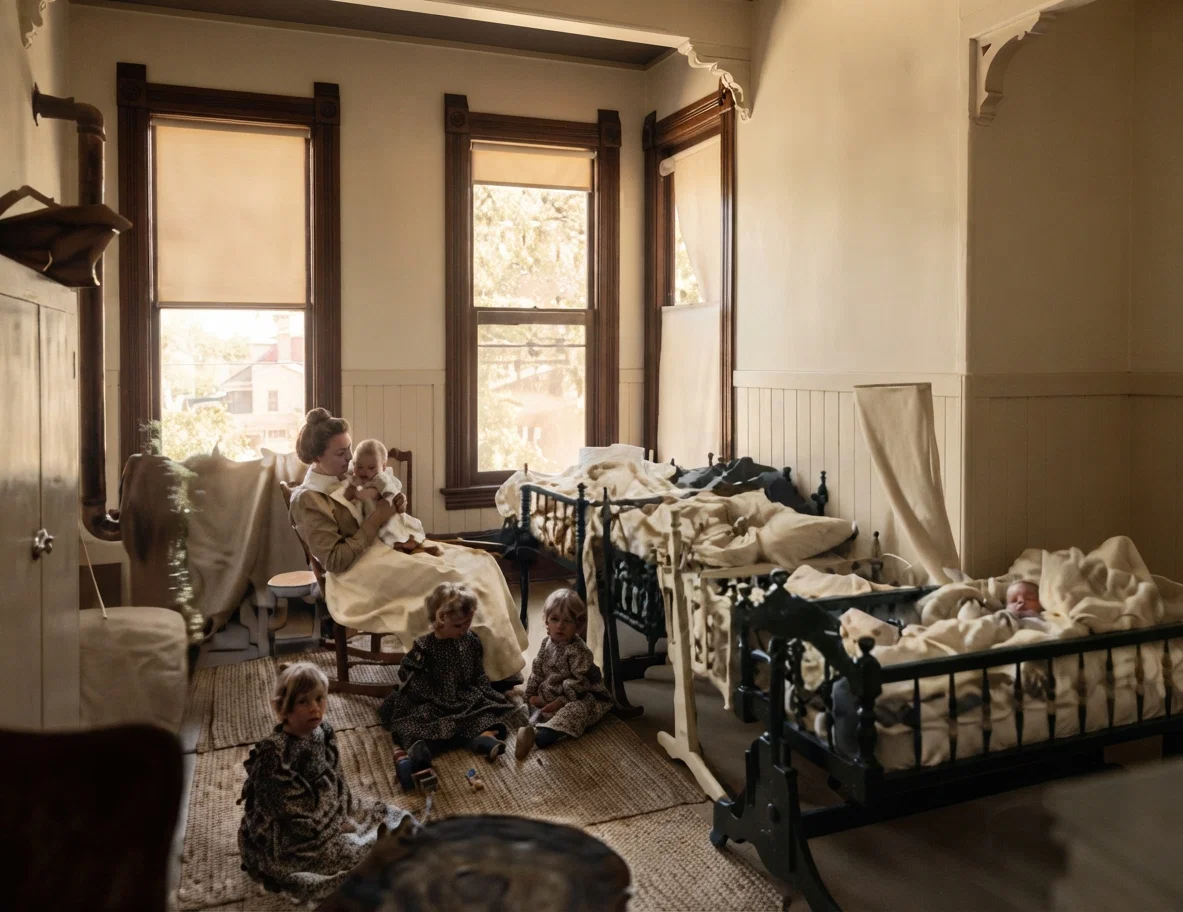
The readers of the SIGNS will perhaps remember an article a few months ago giving the origin and work, as well as a picture, of our orphans' home in Alameda, California; and a few jottings from the home may again prove of interest. I quote a few lines from those whose firesides have been blessed by an adopted member from our family.
From the new mother: "In regard to little Doris, we could never get along without her, and we take more comfort with her than anything we have ever had in our lives, and love her more dearly every day."
Another line: "Little Harry is the dearest thing on earth. I never knew what it was to live and enjoy life before."
A letter from two little sisters: "We are so happy! Mama says we may have a baby brother from the Home of the Friendless, for adoption, and we can hardly wait till he may be sent to us." I will say the little brother is going soon.
Another heart that has been gladdened, having taken a child after the loss of her own, writes: "Our little one is doing as nicely as a baby could, and seems so happy and contented! She looks into my face with those large blue eyes as if saying, 'Love me;' yes, pleadingly, 'Only love me, and let me be your baby.' Love her? I do, every inch of her precious body. If she is only a jewel in Christ's kingdom, I shall be more than repaid; and this is my hope, this is my aim."
A Peep into the Nursery of the Home of the Friendless, Alameda, Cal.
Many such words are received, but this is quite enough to demonstrate that "a babe in the home is a wellspring of pleasure." "Save the nation of to-morrow by saving the children of to-day."
It is estimated that there are between seventy and one hundred thousand dependent and homeless children in the United States, and six thousand of that number in California.
The primary object of our home is to seek and shelter these homeless ones until a permanent home and mother's love may be secured for them. We pity the orphans and half orphans, but their condition is not so sad as that of the deserted child. After having been cruelly treated, abandoned, and ofttimes reared in shame by its legal parents, it is not always an easy matter to place the deserted children. But be assured they appreciate the change, and very readily adapt themselves, and it has been well said that "environment shapes the destiny of the child."
Many of our children are for adoption, but orphans and half orphans are temporarily boarded or permanently cared for. Altho the work is comparatively new, nearly two hundred children have been under observation, and a good per cent. of that number have been in the home at some time, and some sixty bright boys and girls have cheered as many mother hearts.
The Home of the Friendless is supported entirely by donations and collections from the churches in California and Nevada on the first Sabbath in April and October of each year. The home family are, indeed, grateful, and ever remember that their friends are many, from the dear grandma, that makes the quilts, to the wee tot that sends her frock or a treasured toy.
"There is nothing more pure in heaven,
And nothing on earth more mild,
More full of the light that is all divine,
Than the smile of a little child."
MRS. E. A. CHAPMAN,
Corresponding Secretary.
GOSPEL OPENINGS FROM LOVING MINISTRY.
By David Paulson, M.D.
WE often meet men in our sanitariums and hospitals who have been here only a few days, and who are all bowed down with pain in almost every joint in their bodies, and who are, as a result of their bad habits, discouraged and depressed. In that situation, after some God-fearing medical missionary has found such a man, and has whispered to him the hopes of a better life, and told him that it is the Divine Power that has still kept his heart going, and that has enabled him to breathe, and this same Power is anxious to save him from his evil habits, to help him over them, and to lift him into a better life, he will often say, "My case seems hopeful to me if the Divine Strength is helping me."
Some time ago a gentleman who had attained eminence and had been educating others for many years, was attacked in an unexpected manner. His condition was such that he fell into a fainting fit. As he was recovering from it, one of our nurses who was applying some simple remedies to him, saw that he was discouraged and downhearted, and read him a few precious words from the Bible. 'The Lord10God hath given me the tongue of the learned, that I should know how to speak a word in season to him that is weary; he wakeneth morning by morning, he wakeneth mine ear to hear as the learned.' Isa. 50:4. He talked with this man, quoted some of these texts, and prayed with him, and the tears came streaming down his cheeks. He had not thought of these things before. He became a converted man, and to-day he is rejoicing in a Saviour's love. He even rejoices that God allowed him to become crushed and bruised, that he might get an insight into a higher and better life than he had ever known before.
It is a privilege to live so near to God that he can suggest to us, just at the proper time, the right words to pass to others that will be as a healing balm to them.
That is the foundation of all success in accidents and emergencies, for if we are all Spirit-filled men and women, God has promised that when the occasion demands it, he will flash into our minds what we shall say or do. We can let this promise be a stay and guide to us, for we will not be placed in a situation so difficult and so perplexing but we may realize that God has placed us there, and will take care of us and lead us by His Spirit. It is a grand privilege to be engaged in a work where such opportunities come to us over and over again, if only we are faithful. DAVID PAULSON, M.D.
Arabia in Brief
By George E. Stone
Arabia in Brief.—Arabia is a land of possibilities. (a) A country much more fertile and populous than generally supposed. (b) The people are largely town people, not ignorant Bedouin. (2) Arabia is a land of opportunity. (a) Politically, only partially under Turks. The interior is independent. The eastern and southern coasts, under British influence. (b) People not as bigoted as in Turkey. Preaching in streets and bazaars at Bahrein. (c) Opportunity because everything is yet to be done. Only three missionaries at present on east coast, and one on the southern coast, with the reenforcements going out this year only nine or ten missionaries for ten million people.—Rev. G. E. Stone.
OUR WORK AND WORKERS.
By Editor
THE church at Fresno, Cal., has a flourishing church school of thirty-five members.
AT St. Clair, Nev., twenty-two persons were recently baptized by Brother S. Thurston.
THE Reaper reports the baptism of three candidates at Lennville, Idaho, by Brother W. F. Martin.
A LETTER from Brother Edwin Kirkconnell, Bonacco Island, says: "We were visited by a severe northwest gale on the 12th ult., lasting twenty-four hours. Eleven lives and three boats were lost. Half of the lives were those of Seventh-day Adventists, members of our church—all drowned."
It has been recommended by the General Conference that Brother N. W. Kauble, late superintendent of General Conference district No. 4, and president of Union College, take the presidency of Illinois Conference.
THE General Conference has made some important calls on California—Brother N. C. McClure to take charge of Arizona mission field, and Brother E. E. Andross to go to England. But the number is made up by sending Brother C. N. Martin, of Montana, and C. M. Gardner, of Utah, to California.
A CORRESPONDENT in Fresno, Cal., writes: "A little girl went out the other day to sell the SIGNS. Rather timidly she knocked at a door, and when a gentleman opened it she asked, 'Would you like to buy a SIGNS, sir?' No, he didn't wish one; but, thinking to please her, he asked, 'What does your paper tell about?' 'About Jesus,' she answered sweetly. The gentleman's manner quickly changed, and in a different tone he said, 'O, if it tells about Jesus, I'll take one!' This little girl was doing what the children did in the temple at Jerusalem on the day when Christ rode into that city in triumph—she was sounding the praise of Jesus. And He says, 'I, if I be lifted up from the earth, will draw all men unto Me.' John 12:32. Our work is to lift up the name of Jesus."
Officers of S. D. A. Societies and Boards.
THE various associations and boards of the Seventh-day Adventist Church, recently assembled in General Conference at South Lancaster, Mass., elected the following officers:—
GENERAL CONFERENCE.—President, G. A. Irwin; general secretary, L. A. Hoopes; treasurer, A. G. Adams; executive committee—G. A. Irwin, O. A. Olsen, A. G. Daniells, J. H. Morrison, A. J. Breed, A. T. Jones, R. M. Kilgore, I. H. Evans, N. W. Allee, Allen Moon, J. N. Loughborough, S. H. Lane, H. W. Cottrell.
DISTRICT SUPERINTENDENTS.—No. 1, H. W. Cottrell; No. 2, N. W. Allee; No. 3, A. J. Breed; No. 4, J. H. Morrison; No. 5, R. M. Kilgore; No. 7, A. G. Daniells; No. 8, O. A. Olsen; No. 6 was referred to the General Conference Committee. A. J. Breed to attend the spring camp-meetings in the district before going to his new field.
GENERAL CONFERENCE ASSOCIATION.—S. H. Lane, A. G. Adams, G. A. Irwin, J. H. Morrison, A. J. Breed, R. M. Kilgore, C. H. Jones, C. M. Christiansen, N. W. Allee, W. C. Sisley, J. S. Comins, G. A. Nichols, C. F. Stevens, J. Sutherland, H. W. Decker, J. W. Westphal, H. W. Cottrell, C. McReynolds, C. Santee, A. E. Place.
MISSION BOARD.—I. H. Evans, Allen Moon, J. E. Jayne, G. A. Irwin, C. H. Jones, William Covert, H. W. Cottrell, A. E. Place, G. B. Thompson.
SABBATH-SCHOOL ASSOCIATION.—President, M. C. Wilcox; vice-president, C. C. Lewis; recording secretary and treasurer, M. H. Brown; corresponding secretary, Alberta L. Little; executive committee—M. C. Wilcox, C. C. Lewis, M. H. Brown, W. N. Glenn, C. H. Jones, Alberta L. Little, C. L. Taylor, C. P. Bollman, P. T. Magan.
RELIGIOUS LIBERTY ASSOCIATION.—President, Allen Moon; Vice-President, A. T. Jones; secretary, D. W. Reavis; executive board—Allen Moon, A. T. Jones, N. W. Kauble, A. J. Breed, W. D. Curtiss, D. W. Reavis, W. N. Glenn, Geo. B. Wheeler, J. O. Corliss.
INTERNATIONAL TRACT SOCIETY.—President, G. A. Irwin; secretary and treasurer, L. T. Nicola; executive board—G. A. Irwin, I. H. Evans, Allen Moon, L. T. Nicola, W. W. Prescott, H. P. Holser, C. H. Jones, Wm. Covert, S. H. Lane.
LOCAL BOARD OF DISTRICT No. 2.—N. W. Allee, R. D. Hottel, S. M. Jacobs. Corresponding secretary, Margaret E. Kessler; district secretary of Sabbath-school Association, Mrs. A. F. Harrison; district canvassing agent, A. F. Harrison.
ELECTORS AT LARGE FOR MEDICAL MISSIONARY AND BENEVOLENT ASSOCIATION.—J. S. Comins, A. B. Olsen, A. R. Henry, J. M. Craig, W. H. Riley, A. N. Loper, A. J. Sanderson, J. A. Burden, J. Sutherland, N. H. Druillard.
HINDU LIFE AND CHARACTER.
WRITING on this subject to the Missionary Review, Rev. Henry Rice, of Madras, says:—
“The national life of the Hindus presents an almost perfect contrast to that of Europeans. They differ in social usages, in religious feelings, and in almost every particular affecting the habits and inner condition of a people. For ages the Hindu has been unprogressive, and it is only in modern times that he has experienced the quickening influences of the civilization and Christianity brought to him from Western countries. But even now the institutions of the past still retain a powerful hold on the affections of all classes of the community. In the fields you see the same kind of plow scratching the soil as was employed two thousand years ago; oxen tread out the corn as they did when David was king over Israel; and all the methods pursued in agriculture are much the same as those which existed in the patriarchal period of the world. You enter a village, and on either side of the narrow streets you see women sitting on the floors of their houses grinding small stone hand-mills, as was the fashion in Judea in the time of Christ.
“The Hindu is an ancient personage, stereotyped in all his ways. He can direct you to a distant past when sages filled the land, whose words of wisdom have become the rule of life to all succeeding generations. He can point you to the sacred books which they wrote on philosophy, poetry, astrology, and religion, and which are read by multitudes, and consequently he says: ‘Why should I change my ways? I prefer the old ones.’”
FROM TURKEY.
REV. J. W. BAIRD writes as follows to the Missionary Review about some of the prospects in Turkey:
"Sadder than the sway of the Turk over the holy places of Christianity is the reign of spiritual death over the Eastern Church of Salonica. Tho a thriving city, it is not now 'the faithful city,' nor, as a thousand years ago, do missionaries of the Gospel take the light of the Gospel to surrounding peoples. There is no preaching or other means of spiritual enlightenment. Education is coming in very rapidly. The Gospel can find an entrance. To the west of Macedonia are the Albanians, a most promising people, entirely without the Gospel. Servia and Bosnia, too, need missionary work at once."
Chinese Deities
Chinese Deities.—At the last annual meeting of the International Missionary Union, Rev. C. C. Baldwin, D.D., a missionary to China, said: "We naturally like to look on the bright side, but it is well sometimes to look on the dark side also. It will be at least a good topic for faith. There are about a million temples in China, containing, say, from five to ten millions of idol gods. Besides these we have five hundred million manes, or spirits of dead ancestors and others which are worshiped in or without the wooden tablets. The Chinese may give up the idols, but not so easily the ancestral worship. To do so is a grand test and climax of sincere faith in God, so far as a true heart surrender is concerned; for the whole practise seems to rest mainly on the beautiful doctrine of filial piety, which is dearer to them than aught else, unless we except the living family and worldly success."
Missionary Work in Brazil
Brazil.—Christianity is always in conflict with error, and missionary work must ever be an aggressive work, because the enemy is everywhere throwing up barriers before it.
Rev. J. L. Bruce, a missionary in Brazil, says: "The greatest hindrance to the work here is the fact that we have a strongly-organized Roman Catholic Church opposed to us. The Roman Catholics do not hold the simple truth nor the simple error, but the truth mixed with the error, or the truth perverted. Also, religion and morality have been thoroughly divorced, so that gross immorality and thorough devotion may exist in the same person. They think they have just what we wish to give them. On the other hand, our great difficulty is that we will undertake to combat a church by a church."
PERIODICALS WANTED.
W. D. Beeby, 118 W. Sixth Street, Leadville, Colo., can use "a large number" of the SIGNS and Sentinel in missionary work. Please send post-paid.
Mrs. Nellie M. Gifford, Onaway, Presque Isle County, Mich., returns thanks for past favors, and earnestly solicits more late copies of the SIGNS for missionary work. Please send post-paid.
SIGNS, Review, Sentinel, and tracts, for missionary work. Address, post-paid, W. C. McBrayer, Dallas, Paulding County, Ga.
12 “NOW WHEN He heard that John was delivered up, He
13 withdrew into Galilee; and leaving Nazareth, He came and
14 dwelt in Capernaum, which is by the sea, in the borders of
15 Zebulun and Naphtali; that it might be fulfilled which was
spoken by Isaiah the prophet, saying,
15 The land of Zebulun and the land of Naphtali,
Toward the sea, beyond Jordan,
16 Galilee of the Gentiles,
16 The people which sat in darkness
17 Saw a great light,
And to them which sat in the region and shadow of death,
To them did light spring up.
17 “From that time began Jesus to preach, and to say, Repent
ye; for the kingdom of heaven is at hand.”
14 “And Jesus returned in the power of the Spirit into Galilee;
15 and a fame went out concerning Him through all the re-
16 gion round about. And He taught in their synagogues, being
glorified of all.
16 “And He came to Nazareth, where He had been brought
17 up; and He entered, as His custom was, into the synagogue on
18 the Sabbath day, and stood up to read. And there was deliv-
19 ered unto Him the book of the prophet Isaiah. And He
20 opened the book, and found the place where it was written,
21 The Spirit of the Lord is upon Me,
Because He anointed Me to preach good tidings to the
poor;
He hath sent Me to proclaim release to the captives,
And recovering of sight to the blind,
To set at liberty them that are bruised,
19 To proclaim the acceptable year of the Lord.
20 And He closed the book, and gave it back to the attendant,
21 and sat down; and the eyes of all in the synagogue were
22 fastened on Him. And He began to say unto them, To-day
hath this scripture been fulfilled in your ears. And all bare
Him witness, and wondered at the words of grace which pro-
ceeded out of His mouth; and they said, Is not this Joseph’s
23 son? And He said unto them, Doubtless ye will say unto Me
this parable, Physician, heal Thyself; whatsoever we have
heard done at Capernaum, do also here in Thine own country.
24 And He said, Verily I say unto you, No prophet is acceptable
25 in his own country. But of a truth I say unto you, There
were many widows in Israel in the days of Elijah, when the
heaven was shut up three years and six months, when there
26 came a great famine over all the land; and unto none of them
was Elijah sent, but only to Zarephath, in the land of Sidon,
27 unto a woman that was a widow. And there were many
lepers in Israel in the time of Elisha the prophet; and none of
28 them was cleansed, but only Naaman the Syrian. And they
29 were all filled with wrath in the synagogue, as they heard these
things; and they rose up, and cast Him forth out of the city,
30 and led Him unto the brow of the hill whereon their city was
built, that they might throw Him down headlong. But He
passing through the midst of them went His way.
31 “And He came down to Capernaum, a city of Galilee. And
32 He was teaching them on the Sabbath day; and they were
astonished at His teaching; for His word was with authority.”
NOTE.—The texts inclosed in marks of parentheses, while not essential to the lesson study, will be found to throw much light upon the lesson, and are suggested for those who wish to study further.
SUGGESTIVE QUESTIONS.
What befell John the Baptist shortly after the events studied in the last lesson? Matt. 4:12. See note 1. (Luke 3:19, 20.)
Upon hearing of this, where did Jesus go? See note 2. (Luke 4:14.)
From that time, what message did Jesus emphatically proclaim? Verse 17. (Luke 4:43.)
How did His doctrine affect the people? Why? Luke 4:32.
Side Lights.—“Desire of Ages,” pp. 52, 214-235, 253.
NOTES.
1. OUR last lesson left the Saviour in Jerusalem, where the Jews were seeking to kill Him. John 5:18. The place of John’s imprisonment, according to Josephus, was in the strong fortress of Machærus, nearly northeast of Jerusalem, on the frontiers of Arabia. Later, at the time of the Baptist’s death, Herod had his court in a mansion adjoining the prison.
2. IT is difficult to determine how long after Christ’s baptism this tour of Galilee began. We know, however, that a great part of that interval was spent in Judea. The purpose of this is easily perceived. It seemed necessary to spend much time at first in the vicinity of Jerusalem, in order to give the leading Jews an opportunity to decide concerning His Messiahship. John having been rejected and cast into prison, Jesus proceeded to Galilee, there to call the twelve disciples, and to enter more fully upon His ministry. There is no record of His being much in Judea after this, except at the annual feasts, where He appeared, in harmony with the requirements of the Levitical law.
3. AT the scene of His childhood, youth, and young manhood,—at the very point where He was best known,—He gave His personal acquaintances the same opportunity that had been afforded the people of Judea.
4. “CAPERNAUM” means the village of Nahum. It was on the west shore of the Sea of Galilee, near its head, or northern end, and was the boundary town between the territory of Philip and Antipas, hence contained a custom-house and garrison. Luke 5:27; 7:2.