The Youth’s Instructor, Vol. 33, No. 11.

THE CONSCIENCE BOOK

The Youth’s Instructor

Apr 1, 1885

S. D. A. Publishing Association · Battle Creek, Mich. · Apr 1, 1885

THE CONSCIENCE BOOK.
Aunt Annie had been almost dozing. The fire crackled on the wide hearth, and threw a pleasant, cheerful light over the room. Everything but the fire was so still that none would have guessed there was a boy looking into the fire, with his elbows resting on his knees, and his face resting on his hands, “dreaming a dream.”
Suddenly Aunt Annie felt a hand on hers, and roused up to see Herbert looking intently in her face. She looked up drowsily, and then smiled one of her own inquiring smiles. She knew Herbert wished to make some request.
“Auntie,” said he softly, “if I thought it would be a bit of use, I would try something.”
“If the something is worth trying, you could tell more about the use of it afterward, perhaps,” she replied.
“But”—Herbert seemed to be very undecided.
“Could I help you in any way?” she inquired.
“You might help about the book; but do you think, Auntie, a boy like me ever could be good?”
Aunt Annie only said she was sure he never intended to be anything else, and inquired as to the kind of book needed to help in making him “good.”
“It is a queer book,” explained Herbert; “the less it gets in it the better, and it must have nothing at all in it to begin with.”
“Certainly an odd kind of book. Will it have any name?”
Herbert looked confused. “It is my very own notion. You know, Auntie, you never were a boy, and never were bad in your whole life; but boys will keep doing things.”
“Girls make mistakes, and get wrong sometimes, too. I know all about trying and failing and beginning over again.”
“Do you?—oh, yes, about Stanley and me and the rest; but you do not know by your own self. I get tired beginning over forever.”
“I know enough about beginning over to sympathize with you, and Sidney, and everybody else who is trying. But you did not tell me the name of the book.”
“I shall call it my Conscience Book; and every time I do a mean or a bad thing, down must go a black mark; you see it will be a kind of score as to how God is marking me, and every night I shall scratch down all the marks, and try to get less and less every day.”
“You will get less of them, dear,” said Auntie, with deep gladness in her heart.
“I am not so sure that they will get less and less,” replied Herbert, disconsolately. “I think, in the morning, I have it all fixed to be a kind of saint all day; and then, sometimes before breakfast, I upset Sidney, and make Dorothy cry, and vex half the house.”
“No one ever became good in a single day. It takes but one moment to decide to be good, but it takes more than a lifetime to become perfect. If the faults grow less and less each day, that is all you can hope for at present; and the longer you try, the easier it will be to do right.”
“Do you like my plan about the conscience book, Auntie? do you think it will be of any use?”
“I can think of nothing which could help you more, except asking God often, very often, in the playtimes, and in the lesson hours, to help you keep the heart and the book white, not waiting to kneel down or even to be alone, but just a thought prayer, which brings us close to God in the midst of the duties or pleasures of life.”
“Auntie, can you think how many horrible marks I have for to-day? I thought them all out, looking into the fire—sixteen! This miserable, black, uncomfortable day has made me think of the conscience book; for really, Auntie, you would hardly think it, but I do not want to be bad.”
“Then you will be good; for depend upon it, what we want to be we can be; and I think you not only wish to do right, but have decided that however often you may be overcome by evil, you will in the end overcome the evil by the help of our tender Father.”—N. Y. Observer.

THE BIRDS OF HEAVEN.

Mark to Nature’s lesson, given By the blessed birds of heaven! Every bush and tufted tree Warbles sweet philosophy: “Mortal, fly from doubt and sorrow; God provideth for the morrow.
“Say, have kings more wholesome fare Than we, poor citizens of air? Barns nor hoarded grain have we, Yet we carol merrily. “Mortal, fly from doubt and sorrow; God provideth for the morrow.
“One there lives, who, Lord of all, Keeps our feathers lest they fall. Pass we blithely, then, the time, Fearless of the snare and lime, Free from doubt and faithless sorrow; God provideth for the morrow.”
—Bishop Heber.

HOW LEAD PENCILS ARE MADE.

Many persons, who have not been informed to the contrary, think that lead pencils are made of lead. They are not made of lead, but of graphite, which doesn't resemble lead much more than chalk.
Graphite is the softest mineral dug from the earth; it will not melt, but gradually wastes away if placed in great heat for some time. In preparing it for pencils, the material is sent from the mine to the reducing or grinding mill, where it is pulverized under water, and the particles float off through a series of tanks. This process is continued until the powder is finer than flour; indeed, it is so very fine that it eludes the grasp like so much water.
The first step in converting this dust into pencil leads is to separate the finer qualities from the coarser. This is accomplished by the floating process, in which the dust is mixed with sufficient water to run freely, and is then poured into a hopper, from which it courses through a number of tubs connected with each other by tubes. The coarsest particles are the heaviest, and consequently settle to the bottom of the first tub; the next coarsest in the next, and so on. The water moves very gently; and when the last tub is reached, it runs nearly clear, as it contains only the finest particles. After sufficient time has elapsed for complete settling, the water is carefully drawn off so as not to agitate the sediment at the bottom. The deposit in the last tub is used for making fine pencils; but that from the two before will answer for the cheaper grades.
The graphite is now ready to be mixed with a peculiar kind of clay, that comes from Germany. The clay is also subjected to the floating process, and the finest mixed with the graphite in proportion to the hardness required.
The clay and graphite are then mixed with water to the consistency of thick cream, and fed to the grinding mill (two flat stones placed horizontally to each other, with only the upper one running.) Between these the mixture is ground and re-ground, often twenty or more times, which gives strength and freeness from grit. After grinding, it is placed in canvas bags, and pressed until the clear water is forced out, and the mass becomes like dough. It now goes to the forming press. This is a vertical cylinder, having a plate with an opening the size and shape of the desired lead at the bottom, through which the mixture is slowly forced. At intervals, this coil is separated into lengths sufficient for three leads, which are finally placed in a crucible, and hardened by baking in a kiln.
The leads are now ready to be covered with wood. For the cheaper pencils, pine is used; for the common grades, ordinary cedar; but the finest qualities require the Florida Keys’ cedar, which is soft and close grained, and is so superior for the purpose, that even European manufacturers are obliged to use it for casing their pencils. The wood is sawed in strips that will hold six pencils, and sent to the shaping machines, where they are passed under a cutter which makes six little grooves for the leads.
Now comes filling in the leads; and this is done by girls sitting at a table. The first takes a strip of wood in her left hand, a bunch of leads in her right, and quickly places them in the grooves. She then passes the slip to a girl at her left, who puts over it another slip of wood freshly glued by a third girl. After being pressed together with an iron screw, the ends and projecting leads are ground smooth by holding them against a wheel covered with sandpaper.
Now comes the most interesting process of all—that of shaping and separating. The slips of six pencils are placed under a revolving cutter, which separates and rounds them on one side; as they come from the machine, they are turned and passed under another cutter, which accomplishes the same work on the other side, and the pencils fall into a basket in a continuous stream, ready for use.
The standard grades of pencils are nearly always colored. After being dyed, the pencils are put into varnishing machines. They settle sideways from a hopper, and are seized by two wheels which thrust them endwise, one at a time, through a tube wet with varnish; each pencil emerges from the tube, and dropping on a horizontal belt, moves slowly with it about thirty feet, drying as it goes, and drops into a basket. They are then packed and sent all over the world to market. Nearly all of the work described is done by girls.—Selected.

SOUTHERN CALIFORNIA.

San Diego, or St. James, lies on the east coast of San Diego Bay, and is the seat of San Diego County. This is the most southerly county in California, and extends entirely across the State, from the Pacific Ocean on the west to Arizona on the east. Much of the county is uninhabited, and some of it uninhabitable. The finest honey in the world is produced in immense quantities in this county, and is shipped by thousands of pounds from San Diego to San Francisco, and thence to other points. The bees gather the finest honey, of almost snowy whiteness, from the flowers of the wild sage. This sage is very abundant, and resembles the eastern garden sage; but it is much larger, growing to the height of a man.
The climate here is very fine. When I arrived, January 22, it was as pleasant almost as midsummer. There were ripe watermelons, strawberries, and new potatoes. Orange, lemon, and olive trees could be seen, loaded with blossoms and fruit. Peach trees were in bloom, and on every hand were evidences of summer. Mocking birds, meadow-larks, and other birds were singing cheerily in the fields and along the streams.
If it were not for the long, dry summers, this would indeed be a delightsome land. The rain-fall during the so-called winter season, is only from six to ten inches. No rain falls in the summer, so that little can be raised without irrigation. Fruit trees even, thrive better if watered.
There are some things here that are not so charming. Centipedes, tarantulas, and rattlesnakes are quite numerous. One lady said that while sleeping in a tent, she was awakened by a kind of crackling noise near her pillow. She aroused her husband, who soon destroyed a large tarantula with his boot. Another lady told me yesterday, that their workman, while plowing the garden only a day or two before, unearthed, a few feet from the door, a large rattlesnake with six rattles. It is remarkable that so few persons ever get bitten by these venomous creatures.
Out on the sunny plains in the immediate vicinity of San Diego are encamped, in little squads, a number of Indians of the lowest grade. They remain here the year round. Their hovels are not tents, nor wigwams, only in shape. They are made of old pieces of carpet, sacks, canvas, and brush, and are put together in the most distressing manner possible. Squaws and children, barefooted, bareheaded, and miserably clad, sit around upon the ground, or hunt worms, bugs, and the like for the next meal. Their appetites seem to crave anything that would be palatable to a beast, and some things that a beast would spurn; for instance, whisky and tobacco.
How glad we should be that soon the curse will be removed off the earth, and nothing but beauty and loveliness will reign everywhere!
H. A. St. John.

WALKS ABOUT BOSTON.—2.

The first blood of the Revolutionary war was shed here in Boston, on King’s Street, one hundred years ago. It happened on March 5, 1770. The British soldiers killed five persons, and wounded others. This is known as the “Boston Massacre.” I have been all over the ground where it occurred. The excitement was great. The soldiers had to leave the city. In 1775 the struggle for independence began in earnest. In April the memorable fight at Lexington and Concord occurred. Can you tell where these places are? Every American child ought to be familiar with these places, as here is where the first blow was struck for independence. They are only a little way from Boston. Then on June 17 came the battle of Bunker Hill, at Charlestown, now a part of Boston. Gen. Warren and other noble patriots fell here, and our people were driven back. The British soldiers occupied Boston, and did much mischief.
Dorchester Heights is a prominent place in Boston. It is in the southern part of the city, and is now called South Boston. Here was a very sharp, high hill, overlooking the city and the harbor. I have climbed it many a time. It is hard work even now, with its fine, graded walks and granite steps. Here, one dark night in March, 1776, while the British were all quiet in their ships in the harbor and in their quarters in the city, Washington’s men stealthily and noiselessly stole up these heights, with bales of hay and other material, and built fortifications right on top of the hill. Behind these they put their cannon and the soldiers. When the British awoke in the morning, they saw the American cannon pointing down upon them! So they had to leave as quickly as possible. This was the “Evacuation of Boston,” March 17, 1776. That was a proud day for Washington, and a glad day for Boston. This event gave courage to the patriots everywhere. July 18 the Declaration of Independence was read from the Old State House.
This brings to our notice one of the most historic and renowned buildings on our continent—the Old State House. It is in the heart of Boston, on what was then called King’s street, but is now known as State street. As far back as 1657, the first town house of Boston was built on this spot. In 1713 was erected on the same spot the second town house. In 1747 this building was repaired, and it stands at the present day as the Old State House. Here the loyal assemblies obeyed the king of England. From the east window the coronation of George the Third was announced. From this window the British officer commanded the American patriots to disperse. Here the first blood was shed. In these old halls were poured forth the eloquent appeals of Otis, Adams, Warren, and Hancock. I have stood there where they stood, sat in the same old chairs which they occupied, by the same tables they used, with the same books and manuscripts before me which they used, and have seen the old, yellow newspaper containing a record of their doings at the time. What deep emotions such surroundings inspire! Here, in this very same old hall, the child of Independence was born, in those times which tried men’s souls. Here, after the war, Washington received the tribute of an enfranchised people. What a hallowed spot to a lover of his country! The very walls seem sacred. In every corner and on every side are relics of those old Revolutionary times, of more than one hundred years ago.
D. M. CANRIGHT.

A RULING FAMILY.

PRINCE ALBERT VICTOR, son of Prince Albert of England, who, it is reported, is coming to visit this country in the spring, is a manly lad of twenty-one, and the heir, after his father, to the English throne. He is German in descent from both the Houses of Guelph and Holstein, his grandfathers on both sides being pure German, and his grandmother, Victoria, the present queen of England, but half English.
It is singular to notice how this family has placed itself on all the principal thrones of Europe. The grandmother of this young prince, for example, is queen of Great Britain and empress of India; his grandfather is king of Denmark; one of his aunts is empress of Russia; another, on the death of Wilhelm, will be empress of Germany; one uncle is king of Greece; a great-uncle, king of Sweden and Norway; another, king of Belgium; a cousin will be empress of Austria on Franz Josef's death; and the dukedoms and principalities in Germany are ruled over by other cousins, while still others sit upon the thrones of Portugal and Italy.
It is singular to notice that of the Bonaparte family, raised by the ambition of Napoleon to the control of Europe, not one occupies a throne or even a position of influence. The Houses of Plantagenet, Stuart, and Bourbon are almost extinct and powerless; while this German family of quiet bourgeois character wears the great crowns of the world.
Abraham Lincoln is said to have declared that a nation which was ruled by a commonplace man should thank God; for it only was safe. Most of these rulers are sensible, respectable folk, with the kind of virtues which would be admirable in private life.—Youth's Companion.

IMPORTANT BIBLE SUBJECTS.

LESSON 38.—INHERITANCE OF THE SAINTS.

CONTINUED.

A RESTORATION FORETOLD.

[NOTE TO THE STUDENT.—Do not consider the lesson learned until you can give at least the substance of every text, with the correct reference for each. The references in black letters indicate those texts that should be committed to memory. A little diligent application each day will enable you to do this.]
1. What was the nature and extent of the dominion given to Adam?
2. By what means did he forfeit it?
3. Who usurped the dominion?
4. Who is the serpent?
5. Since Satan obtained the dominion by conquest, what would take place should he, in turn, be conquered by another? Luke 11:21, 22.
6. Immediately after the fall of Adam, what did the Lord say to the serpent? Gen. 3:14.
7. In this address to the serpent, how was Satan’s final overthrow announced? Verse 15.
8. By what means is the destruction of Satan accomplished? Heb. 2:14.
9. Who is the one here spoken of, whose death results in the destruction of the devil? Verse 9.
10. Then who is the “seed” referred to in Gen. 3:15?
11. When Christ destroys Satan, what will he gain?
12. What prophet foretold this winning back of the dominion which Adam lost? Micah 4:8.
13. How extensive was “the first dominion”? Gen. 1:26.
14. How extensive is the dominion over which Christ shall rule? Ps. 2:7, 8.

NOTES.

Peter says, “of whom a man is overcome, of the same is he brought in bondage.” 2 Pet. 2:19. Therefore our first parents, being overcome by Satan, were by him brought into bondage, and, as a consequence, all that they possessed passed into his hands. If Satan were unmolested, he might forever retain the dominion; but if a stronger than he shall overcome him, the stronger one will of course wrest from him the usurped dominion. Luke 11:21, 22. Christ, the “seed” referred to in Gen. 3:15, has, by means of his death, acquired the power to bruise Satan’s head, or, in other words, to destroy him. When this is done, Christ will recover the dominion which Adam lost.

OPENING THE GATE.

The following article contains a hint which many boys may profit by. There are too many youths who sit down and wait for others to “open the gate” for them when they meet with any difficulty, instead of using their own strength to remove the obstacles.
“I wish you would send a boy to open the gate for me,” said a well-grown boy of ten to his mother, as he paused with his satchel upon his back, and surveyed its clasped fastenings.
“Why, John, can’t you open the gate for yourself?” said Mrs. Easy. “A boy of your age and strength ought certainly to be able to do that.”
“I could do it, I suppose,” said he; “but it’s heavy, and I don’t like the trouble. The servant can open it for me, just as well. Pray, what is the use of having servants, if they are not to wait upon us?”
The servant was sent to open the gate. The boy passed out, and went whistling on his way to school. When he reached his seat in the academy, he drew from his satchel his arithmetic, and began to work his sums.
“I can’t do these,” he whispered to his seat-mate; “they are too hard.”
“But you can try,” replied his companion.
“I know that I can try,” said John, “but it’s too much trouble. What are teachers for, if not to help us out of difficulties? I shall carry my slate to Professor Helpwell.”
Alas, poor John! He had come to another closed gate—a gate leading into a beautiful science. He could have opened the gate, and entered alone, and explored the riches of the realm; but his mother had injudiciously let him rest with the idea that it is as well to have the gates opened for us as to exert our strength. The result was, her son, like the young hopeful sent to Mr Wiseman, soon concluded that he had no “genius” for mathematics, and threw up the study.
The same was true with Latin. He could have learned the declensions of the nouns, and the conjugations of the verbs, as well as other boys of his age; but his seat-mate kindly volunteered to “tell him in class,” and what was the use in opening the gate into the Latin language when another would do it for him? Oh, no; John Easy had no idea of taxing his mental or physical strength when he could avoid it, and the consequence was that numerous gates remained closed to him all of his life to come—gates to honor, gates to riches, gates to happiness! Children ought to be early taught that it is always best to help themselves.—Ec.

Tom and His Arrow.

Tom was made very happy, not long ago, by the gift of a bow and arrow. It was a beauty, and he at once began to practice, hoping and expecting that he would some day be a fine marksman.
Tom’s sister Mina could see no enjoyment in it.
“What good does it do?” she asked. “I should think you’d get tired of shooting your arrow over and over again and never hitting anything.”
“O, but I do hit sometimes; and when I don’t, you know, I am aiming at the mark.”
Tom was right, and his cheery words hold a lesson for us all; it is the lesson of perseverance in well-doing. Tom found satisfaction in trying again and again, because he felt sure that he was gaining all the time.

THE BENEVOLENCE OF GOLDSMITH.

A poor woman, understanding that Goldsmith, the poet, had studied medicine, and hearing of his kindness of heart, appealed to him in a letter to send her something for her husband, who had lost his appetite and was sinking into a very despondent state. The good-natured poet called upon her at once, and, upon conversing with the patient, found that poverty as well as sickness depressed him. The Doctor told him they would hear from him in an hour, when he would send them some pills, which he hoped would prove beneficial. He immediately went home, and put ten guineas into a chip box, with the following label: “These must be used as necessities require; be patient and of good heart.” He sent his servant with this prescription to the afflicted man, who found in it a remedy which greatly aided his complete restoration.

OLD TIMES

In the reign of Edward III., there were at Bristol three brothers who were eminent clothiers and woolen weavers, whose family name was Blanket.
They were the first persons who manufactured that comfortable material which has ever since been called by their name, and which was then used for peasants’ clothing.
At the same period, all the brewers and bakers were women; and, when men first began to engage in these occupations, it was thought strange that they were called men brewers and men bakers.

Growth Is Essential for Every Teacher

The teacher who would grow, must bestir himself, must learn what others have done, and are now doing; must not be above learning from every available source; must attend teacher’s meetings, and brighten up by associating with fellow-workers; in short, must be determined to improve; then, and only then, will success be sure. One who has resolved to go forward in this work cannot be held back. The same perseverance that makes great artists, famous singers, or giants in any profession, will make powerful teachers. The most essential element of success is an earnest, prayerful determination to succeed. Resolve that you will not be a satisfied dwarf, and from that hour you will begin to grow. You may never be a giant teacher, a Moody or a Spurgeon, but you will no longer be a babe. You may not have a great talent for teaching, but you probably have some gift.
Growing skill in any labor brings pleasure. What work can compare with that of influencing young minds and hearts? And what satisfaction equals that of knowing that one is steadily growing in this power of leading others? The teacher who neglects any help in his growth proclaims that he does not need to grow; says by his conduct that he has reached the full stature of manhood. As a teacher, Jesus grew. We read that he increased in wisdom. Then do not we need to grow? And, most important of all, the growing teacher must also be a growing Christian. The culture of the mind is a grand and noble work, but the growth is stunted if there is not a deep soil of heart to sustain the roots. And over all growth must shine the Sun of Righteousness. Teacher, are you growing?—S. S. Times.

THE FIRST ROBIN.

Oh! I saw a robin dear In a tree; And he sang a little song All for me! Oh! he sang a little song! But he did not sing it long; For the wind was blowing strong As could be;
And it blew him far away Out of sight, And the snow was falling down Thick and white. Oh! it blew him far away! And I did not care to play Any more at all that day; But at night When I said my little prayer By the bed, I remembered what mamma Once had said, How God listens to each word; So I told him of the bird; And I'm very sure he heard What I said;
For the snow it did not stay, And at dawn Little robin hopped about On the lawn; And he sang a jubilee In the crooked apple-tree; For the winter, don't you see? It was gone.
—The Independent.

SPIDERS

Most people dislike spiders very much. Many think them as poisonous as snakes; but this is not so, though the bite of an angry spider is often very painful.
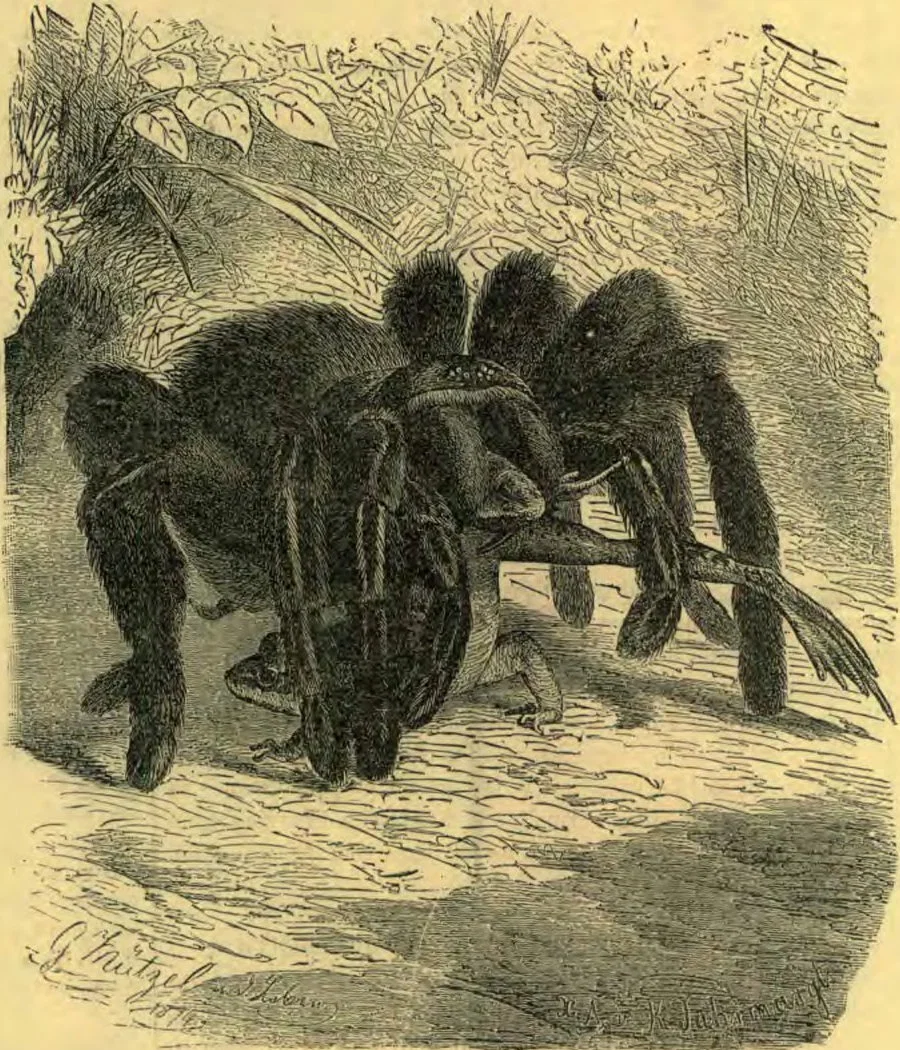
The spider in our picture could make a very bad wound. Do you see near his mouth a sharp claw? All spiders’ jaws have two of these claws in them. At the end of the claw is a little opening, through which the spider forces the poison. This poison is just like that of the rattlesnake; but there is so little of it that the bite does not often cause death.
This great spider in our picture is the largest in this family. When spread out, he is as large as a man’s hand.
He does not spin beautiful silk web houses, and live in them. He has a burrow in the ground, shaped like a pointed tube, and lined with a firm white tissue.
He lives on humming birds and tree-lizards. The one in the picture has a small frog to eat. These great crab spiders have a very bitter enemy. It is the red ant.
Spiders are very neat. They spend a great deal of time in brushing and combing the dust and dirt from their long, hairy legs.
They do not love each other very well. Often the larger spiders eat up the weaker ones. The mother spider, however, thinks a great deal of her little ones, who often eat her up. They are all fond of fighting.
But if they have some bad qualities, they have good ones as well. Did you ever brush down a spider’s web, and after a few hours find that he had spun another right where the old one was? He is a very persevering little fellow, and does not give up with once trying. You have seen spiders’ threads strung across the path on a dewy morning. These threads are little rope bridges, on which the spider can travel long distances without touching the ground.
Spiders have been tamed. A French prisoner once had a tame spider that would come every day for his meal of flies, when the prisoner played on his musical instrument.
Another Frenchman, who raised spiders for their silk, had eight hundred tame ones. The silk is sometimes used in making very delicate instruments. It takes four million spider’s threads to make a cord as large as one hair on your head. These are very fine threads, are they not?
W. E. L.

MAKING IT UP.

“I am real mad at Jenny Harris. I won’t speak to her again as long as I live; you see if I do!”
Grandpa laid his newspaper down on his lap, and peering at the little flushed, angry girl over the top of his spectacles, said,—
“So you are going to sit up all night! You’ll be pretty sleepy before morning.”
“What does grandpa mean?” said Mary, as she followed her mother into the pantry.
“What do you think he means, Mary? What do you do just before you go to bed?”
“Undress, and fold my clothes away.”
“What else?”
“Say my prayers.”
“Would you be willing to go to bed to-night without bending your knees in prayer?”
“Why, mamma, how can you ask me such a question? I wouldn’t for anything. I could not sleep a wink if I did.”
“Then I am afraid grandpa is right, and you will have to sit up all night.”
The wondering eyes began to grow anxious and tearful as mamma went on.
“If you can’t go to sleep without saying your prayers, you will have to leave out the prayer for forgiveness. Can you say, ‘Forgive us our debts as we forgive our debtors;’ or, in other words, would you dare ask your heavenly Father to feel toward you as you do toward Jenny?”
Mary’s face flushed, and she opened her blue eyes in affright, as she began to understand what grandpa meant.
“Should this prayer be answered, you could never live in heaven with Christ and the angels, for our sins must be forgiven before we can live there. What was your verse yesterday morning?”
“‘Be ye kind one to another, tender-hearted, forgiving one another, even as God for Christ’s sake hath forgiven you,’” was faintly repeated by Mary, in a tone quite unlike her usual ringing voice.
“Why, mamma, I never knew what that meant before. I will have to make it up with Jenny. I did tell her that I would never speak to her again as long as I lived and breathed; but I won’t dare go to bed mad, and I don’t want to make it up, for she was real mean at recess when we played ‘I spy!’ and told where I was hiding.”
“‘Let not the sun go down upon your wrath,’” said her mother.
“Mamma, I wonder if God said that so that folks might learn to get over being mad before they said the Lord’s prayer.”
Mrs. Davis smiled, but Mary looked troubled. Swallowing her last mouthful of bread and butter, she looked out of the window, and exclaimed,—
“There, I see Jenny’s pink sun-bonnet! They are playing tag! I’ll go and make it up right away, because I can’t go to bed without saying my prayers; and besides, mamma, it’s so lonesome to be mad.”
In about five minutes, Mary’s white sun-bonnet could be seen moving about with Jenny’s pink one, as their merry shouts rang out on the still summer air.
As grandpa pushed back the soft brown curls from little Mary’s face to give her a good-night kiss, he said, with a slight twinkle in his eye,—
“I hope my little granddaughter will never again run the risk of being obliged to sit up all night because she cannot say her prayers.”—The Youth’s World.

Be willing to do the little, every-day things.

You have reached the end of this edition.

The Youth’s Instructor · Apr 1, 1885