The Youth’s Instructor, Vol. 29, No. 32.

THE BOY WHO MEASURED THE STARS

The Youth’s Instructor

Aug 10, 1881

S. D. A. Publishing Association · Battle Creek, Mich. · Aug 10, 1881

THE BOY WHO MEASURED THE STARS.
In a humble cottage in Scotland, a little boy sat eagerly listening while his father taught an elder brother to read from his catechism, parts of which he often repeated, in order to commit them to memory. In this way Jamie, who was thought too young to read, learned a great part of the catechism, as well as the spelling of words. This was James Ferguson, the celebrated astronomer, who was born near Keith, in Banffshire, in 1710.
After each lesson learned, as above mentioned, he might be seen trudging off to the cottage of a neighbor, where an old woman kindly listened to his tale, which was that he wanted to learn to read, but could not bear to tax his overworked father, who was obliged to labor on a farm, and also to teach his large family of children, for which task he had scarcely time, in addition to his out-door labors; for there were no free schools in those days. So the dame helped her little friend in learning to read, and he advanced rapidly,—very far beyond her expectations.
Greatly surprised was his father, one day, as he entered a room, to behold Jamie correctly reading a book which was thought to be far above his comprehension. “Can it be possible? Is that my boy?” thought the gratified man. As a reward for this achievement, his father soon taught him the use of the pen, and, finding him so apt a scholar, he contrived to raise means sufficient to pay for his tuition for a few months at a school in a neighboring town.
About this time Jamie employed the hours given by other children to play, in making models of various objects which came under his notice—mills, spinning-wheels, etc. With no other tools than the turning-lathe and knife belonging to his father, and with no instruction whatever, he made almost incredible advancement in the knowledge of mechanics. The discoveries which he made he thought were original, and committed the results of his study to paper. It was, in reality, a treatise upon the principles of mechanics; nor did he know till some time after, that any book upon the subject had ever been written. When, however, through the kindness of a gentleman to whom he had been introduced, he obtained a book upon these themes, he compared his paper with it, and had the satisfaction to find it entirely correct as far as it went.
His father's circumstances were such that his talented boy was obliged to be placed in a situation to earn his own living. He was therefore apprenticed to a farmer at some distance from his home. It was here that, the day's duties being over, he would employ his evening hours in studying the heavens, committing to paper the result of his observations relative to the comparative distances of the stars from each other. He measured these distances by means of beads strung upon a piece of thread. His master at first laughed at the young astronomer's star-gazing; but upon seeing his papers and hearing him talk, he greatly encouraged him, and would even sometimes relieve him of a part of his farm work in order to give him more time for these studies. “I shall always have respect for the memory of that man,” said Ferguson, in after years.
One day, being at the minister's, Jamie showed his papers, and was kindly encouraged by commendations of his work. Some maps were loan'd to him, of which the boy made excellent copies. They were so well done as to elicit great praise from a gentleman whom he afterward met at the minister's. He was a squire who lived a short distance from the manse. He invited young Ferguson to reside at his house for a time, in order to receive suitable instruction from a person competent to give it. James thanked him for this offer, and said he would gladly avail himself of it as soon as his term of engagement with his master had expired. “I will obtain a lad to fill your place there,” said the squire; but the boy's gratitude to his kind master would not admit of this. “I will serve out my term,” said he, “for he has often taken the flail from my hand to enable me to go on with my studies and drawings.” Was not this noble in James?
At the appointed time he went to the house of his newly-found friend, and there made rapid progress in scientific studies, under the direction of a master. About this time he made a globe, from a description contained in a book, although he had never seen one. He made the sphere of proper form with his turning-lathe, and, covering it with paper, drew upon it a map of the world. He also made and graduated the ring and the horizon of the globe. But he could not always continue to give his whole time to pursuits so congenial, for his circumstances required that he should earn money to support himself and enable him to prosecute his studies. It is worthy of note that, while laboring for this, he studied diligently, improving every moment; and so well did he succeed that, while yet in early manhood, he became a Fellow of the Royal Society. He was also greatly esteemed, and had the deserved reputation of being a good as well as a great man.—Christian Union.

THE GOLDEN GRAIN.

The grain! the grain! the beautiful grain! How it laughs to the breeze with a glad refrain, Blessing the famishing earth in her pain, Making her smile with glee,
Lifting in praise each bright, golden crown, As it drinks the dew the Father sends down, Courting the sun’s warm, lover-like frown, Returning it smilingly.
The grain! the grain! the beautiful sheaves! A song of joy their rustling weaves, For the gracious gift that the earth receives, Given most royally.
From every hill-side, every plain, Comes the farmer’s song as he reaps the grain; And the gentle breeze wafts on the strain, In wildest harmony.
He pours o’er the earth his brimming horn, That the valleys may laugh and sing with corn, While hope, from her death-trance rises newborn, The brighter days to see. —Selected.

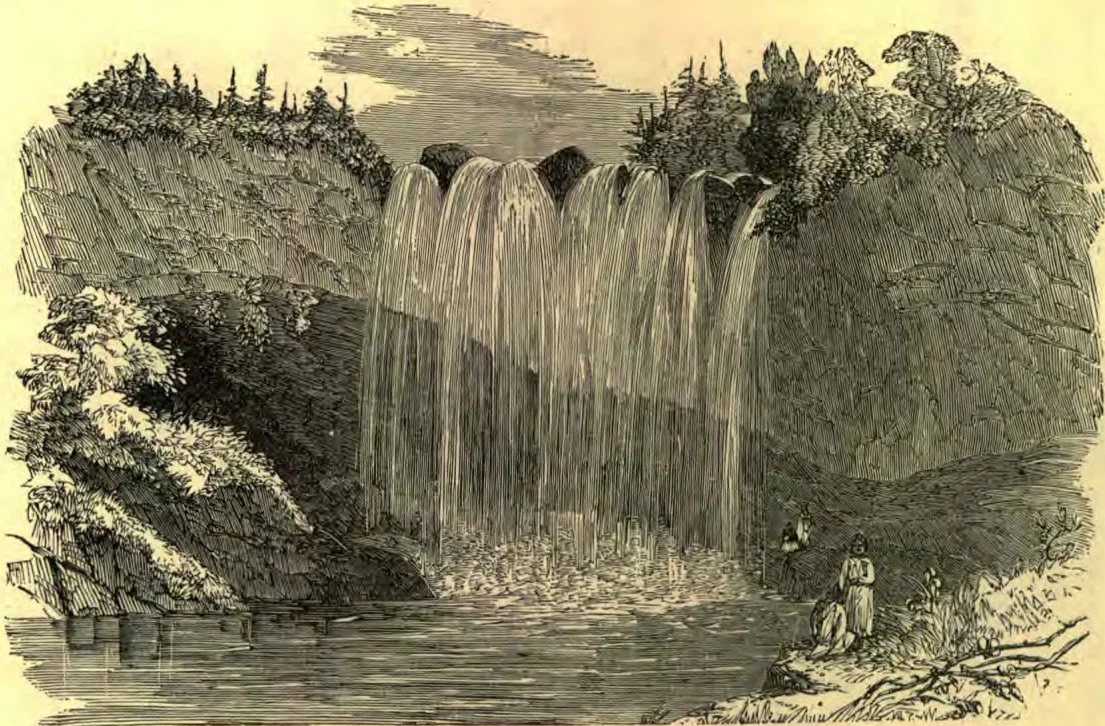
A WATERFALL IN NEW ZEALAND.

The waterfall in the picture partly conceals a cave, where once, in by-gone days, a cannibal feast was held by the great and cruel New Zealand chief, Hongi. Three hundred Wangaroa natives were here killed and eaten. The water falls like a beautiful veil over the gloomy face of the cave, as if to hide it from view. New Zealand was once like the dark cave, full of gloom and horror; but blessed changes have taken place in that land. “There is a river, the streams whereof shall make glad the city of God,” and it falls in a stream of mercy and light, like a veil over the past, to hide it from view. We would not desire to conduct our readers into the cave, but merely to catch a glimpse of it through the water as it falls, and just so far to remember what New Zealand was, as to thank God for what it has become. The natives no longer believe in a false God of merciless character, whose cruelty to them was reflected in their conduct to each other; but the acknowledgment of the true God is almost universal.

Toil as the Law of Life

If you want knowledge, you must toil for it; if food, you must toil for it; and if pleasure, you must toil for it. Toil is the law. Pleasure comes through toil, and not by self-indulgence and indolence. When one gets to love work, his life is a happy one. —Ruskin.

WHAT THE FLOWERS SAID.

Tom and his father were long since tired of the dusty city, whose streets they had traversed for some hours, endeavoring to find employment for the younger of the two. They lived in a pleasant country village several miles from the city, where flowers in the summer-time were very abundant, and where even in early spring-time their home had beauty and fragrance. All the morning they had been upon the hunt, calling upon acquaintances as well as upon strangers to whom they bore letters of introduction, and calling nowhere save with a view to find the desired employment for Tom. After many disappointments the young man was fortunate enough to secure a position in a large warehouse, and arrangements were made for him to commence work almost immediately. This settled, father and son were hurrying to the depot to take the earliest possible train home. The wind and the dust had added greatly to their discomfort, and tired and weary as they were, the din and roar of the city's busy thoroughfares and the jostling of the crowd, were very disagreeable. “Oh, how delicious!” suddenly exclaimed Tom, as he caught the fragrance of lilies, roses, violets and pinks, “and see, father, here is the secret of it,” he continued, as he directed his father's attention to a small glass case on a street corner, filled and covered with flowers. These were all put up in button-hole bouquets and offered for sale by a young woman, who seemed quite anxious to dispose of them. True enough, amid the dirt and dust, amid the hurrying, bustling crowd, these little bouquets were shedding their delightful aroma, and feasting and fascinating with their beauty the eyes of many a passer-by.
The walk seemed less disagreeable after that, Tom thought, and he hoped that when he came to the city every day to attend to his newly-arranged labors, he should often pass those pretty flowers and take a peep at them and inhale their delicious fragrance.
“I think we may learn a lesson from them,” suggested his father. “They seem to preserve their fragrance and beauty in spite of uninviting surroundings; and here, in the very heart of the city, to speak of the country and to bear witness, amid the abounding works of man, to the fairer and purer works of God. I think the Christian young man should seek to shed about him the fragrance and to show the beauty of true piety. The quiet, consistent Christian life, amid uninviting surroundings and associations, is undoubtedly an acceptable service to God, and is as reasonable as it is acceptable. Surely the servants of him who is called the Rose of Sharon and the Lily of the Valley should thus, by their actions, speak eloquently of their Master.”
Tom had but recently made public confession of his interest in the Lord Jesus Christ, and he did most heartily desire to adorn the doctrine of God, his Saviour, in all things. Thus his father's seasonable words were not lost upon him, and many a day after, when upon errands for his employers, as he passed the flowers, they preached to him the same suggestive sermon.—New York Observer.

TRUE AS STEEL.

“Oh, I can never trust anybody again!” exclaimed Effie Hart bitterly. “I thought Lutie Brown a real friend; but I find she says one thing to my face, and another at my back.” And the tearful eye and quivering lip told how keenly Effie felt the loss of her friend.
“If I could tell my daughter of a friend who would always prove true, would she choose such a one for a bosom companion?” asked Mrs. Hart.
“Yes, mamma, I would, although she might be as plain-faced as old aunt Hannah,” said Effie quickly.
“And you would be true to her?” asked grandpa, putting on his glasses, and looking steadily at the little girl.
“As true as steel, grandpa. I wouldn’t prove false to a real friend,” she added somewhat disdainfully; “I wouldn’t be so mean. But what is her name?” she asked, turning toward her mother.
“Her name is Truth,” replied Mrs. Hart quickly.
Effie looked a little disappointed at this announcement, but soon said,— “I think I shall like Truth for a companion very much; for I shall know she will never deceive me, at least.”
“Remember, my daughter, Truth will not like to be trifled with. She is a sensitive little lady,” reminded grandpa.
“Why, grandpa, do you think I would quarrel with Truth?” asked Effie, very much astonished. “No one but those who tell lies have any difficulty with her.”
Mrs. Hart and grandpa exchanged glances, but said nothing more.
The next morning Effie was late to breakfast; and then the untidy appearance of the little miss attracted the attention of Mrs. Hart.
“Effie, dear, why do you come down before brushing your hair properly?” asked her mother.
“I had no time, mamma. Martha must have rung the second bell too soon.” But Effie caught grandpa’s eye, and was silent.
Now, Effie knew she had failed to rise at the sound of the first bell, and that ample time would have been given her, if she had done so; yet she had unfairly laid the blame on some one else, when she alone was at fault. This fact made her very unhappy all the morning, until she resolved to be more careful of her words, and let none slip from her tongue but those strictly true.
“Effie, dear, will you put the dining-room in order?” said her mother soon after. “Martha is getting dinner, and I have been called away. Many of those things belong to you and your brother; and you will see that they are in their proper places before papa comes.”
Effie was reading a very interesting story, and did not wish to leave it then.
Soon Zip, her little black kitten, which had found its way into the dining-room, began playing with a string, and it was such fun to watch its antics, that a full half-hour elapsed ere Effie thought of the work waiting to be done.
“Effie, come and see a nest of young robins!” exclaimed her brother James, putting his head in at the open door.
“Mother said I must clear up the dining-room,” returned Effie regretfully. “And here are all my books and the contents of your tool-chest to be put away before dinner.”
“Put them away in a jiffy!” exclaimed Jamie. “I’ll help,” he added good-naturedly. And the books and other things were hustled together, and tumbled into the closet with very little ceremony.
“But mamma said they must be put in their proper places,” said Effie, conscious that this was not the clearing-up intended by her mother.
“Oh, well! you can put them in apple-pie order at your leisure,” observed Jamie. And, with brush and duster, the dining-room was soon in a presentable condition.
As they hurried away, neither saw or thought of the quiet body lying upon the lounge in an adjoining room, an observer of all that had been said and done by the youthful couple.
Effie really thought she should be back in time to put everything in its proper place before dinner; but it was so delightful watching the mother-bird feed her young, that the bell rang just as she entered the door.
“Thank you, little daughter!” exclaimed mamma, coming into the dining-room just after Effie. “You have done your work in season, and so nicely too,” she added, glancing around the room. “Haven’t we a nice little housekeeper, papa?” continued Mrs. Hart, addressing her husband, and giving an account of her being called away, and leaving the care with Effie.
Nothing was more grateful to Effie’s ears than the praises of father and mother; but somehow their approving words failed to make her happy this time. It was a very red face which turned away from grandpa when the old gentleman asked her after dinner how she was getting along with friend Truth.
“I don’t like her one bit,” pettishly returned Effie. “She isn’t a pleasant friend at all.”
“Tut, tut!” exclaimed grandpa. “Then it must be your fault, my child; for Truth was never a disagreeable companion when properly treated. Do you know, little daughter, that Truth was born in Heaven, and was sent to earth to rescue us from the father of lies? This she can never do, unless we listen to all her admonitions, and heed them too,” he added thoughtfully. “Without the closest companionship with Truth in heart and life, we cannot be prepared to go back with her to those mansions into which can never enter any thing that defileth, or maketh a lie.”
Effie confessed she never thought that any one could be untruthful in so many ways, until she attempted to take Truth as a bosom companion, and found she looked at the thoughts which sent out the words, and the motives which put forth the actions.
“Just what the good Book says!” exclaimed grandpa, opening his Bible, and reading, “Behold, thou desirest truth in the inward parts, and in the hidden part thou shalt make me to know wisdom.”—Well Spring.

There Is a Wideness in God's Mercy

THERE is a wideness in God's mercy, There's a kindness in his justice, Which is more than liberty. For the love of God is broader Than the measure of man's mind; And the heart of the Eternal Is most wonderfully kind. If our love were but more simple, We should take him at his word; And our lives would be all sunshine In the sweetness of our Lord. —F. W. Faber.

Rise from Your Dreams of the Future

Rise from your dreams of the future,— Of gaining some hard-fought field, Of storming some airy fortress, Or bidding some giant yield: Your future has deeds of glory, Of honor (God grant it may)! But your arm will never be stronger Or the need so great as to-day. —Adelaide A. Proctor.

A TIMELY CAUTION.

In a narrative of his personal history, Sir Walter Scott gives the following caution to the youth:— “If it should ever fall to the lot of youth to peruse these pages, let such readers remember that it is with the deepest regret that I recollect in my manhood the opportunities of learning which I neglected in my youth; that through every part of my literary career I have felt pinched and hampered by my own ignorance; and I would this moment give half of the reputation I have had the good fortune to acquire, if by so doing I could rest the remaining part upon a sound foundation of learning and science.”
How many idle, frolicsome boys and girls are wasting time and shirking lessons, and preparing themselves for just such reflections and regrets in days to come, if they are permitted to see them?—Little Christian.

Nature as a Revelation of God's Goodness

NATURE is a book of sweet and glowing purity, and on every illuminated page the excellence and goodness of God are divinely portrayed.

NEW-TESTAMENT HISTORY.

LESSON 42.—JESUS THE BREAD OF LIFE.

“And straightway he constrained his disciples to get into the ship, and to go to the other side before unto Bethsaida, while he sent away the people. And when he had sent them away, he departed into a mountain to pray. And when even was come, the ship was in the midst of the sea, and he alone on the land. And he saw them toiling in rowing; for the wind was contrary unto them; and about the fourth watch of the night, he cometh unto them, walking upon the sea, and would have passed by them. But when they saw him walking upon the sea, they supposed it had been a spirit, and cried out; for they all saw him, and were troubled. And immediately he talked with them, and saith unto them, “Be of good cheer; it is I; be not afraid.”
“And Peter answered him and said, Lord, if it be thou, bid me come unto thee on the water. And he said, Come. And when Peter was come down out of the ship, he walked on the water, to go to Jesus. But when he saw the wind boisterous, he was afraid; and beginning to sink, he cried, saying, Lord, save me. And immediately Jesus stretched forth his hand, and caught him, and said unto him, O thou of little faith, wherefore didst thou doubt? And when they were come into the ship, the wind ceased. Then they that were in the ship came and worshiped him, saying, Of a truth thou art the Son of God.”
“And when they had passed over, they came into the land of Gennesaret, and drew to the shore. And when they were come out of the ship, straightway they knew him, and ran through that whole region round about, and began to carry about in beds those that were sick, where they heard he was. And whithersoever he entered, into villages, or cities, or country, they laid their sick in the streets, and besought him that they might touch if it were but the border of his garment; and as many as touched him were made whole.”
On the day following the one when Jesus miraculously fed the five thousand, the people who were on that side of the sea where the miracle was performed wondered what had become of Jesus; for they knew that he did not go in the boat with his disciples, and that he had no opportunity for taking any other boat. But when they could not find Jesus, they took boats and crossed the sea. As they approached Jesus, he said, “Ye seek me, not because ye saw the miracles, but because ye did eat of the loaves and were filled. Labor not for the meat which perisheth, but for that meat which endureth unto everlasting life, which the Son of man shall give unto you.” Then they asked him what they should do in order to work the works of God. And Jesus told them that if they would work the works of God, they must believe on him whom God had sent. “They said therefore unto him, What sign showest thou then, that we may see, and believe thee? What dost thou work? Our Fathers did eat manna in the desert: as it is written, He gave them bread from heaven to eat. Then Jesus said unto them, Verily, verily I say unto you, Moses gave you not that bread from heaven, but my Father giveth you the true bread from heaven. For the bread of God is he which cometh down from heaven, and giveth life unto the world. Then said they unto him, Lord, evermore give us this bread. And Jesus said unto them, I am the bread of life; he that cometh to me shall never hunger; and he that believeth on me shall never thirst. But I said unto you, That ye also have seen me, and believe not. All that the Father giveth me shall come to me; and him that cometh to me I will in no wise cast out. For I came down from heaven, not to do mine own will, but the will of Him that sent me. And this is the Father's will which hath sent me, that of all which he hath given me I should lose nothing, but should raise it up again at the last day. And this is the will of him that sent me, that every one which seeth the Son, and believeth on him, may have everlasting life; and I will raise him up at the last day.”

QUESTIONS.

1. After teaching and feeding the five thousand, what did Jesus ask his disciples to do? Mark 6:45.
  1. Why did he remain behind?
  2. When he had accomplished his work, where did he go?
  3. Why did he seek such a solitary place?
  4. Was he in the habit of doing so?
  5. What other instances can you give?
  6. As Jesus came down to the shore at evening, what did he behold?
  7. Why were the disciples still toiling at the oars?
  8. What did Jesus do about the fourth watch of the night?
  9. What did the disciples think when they saw him?
  10. What did he say to them?
  11. What request did Peter then make? Matt. 14:28.
  12. How did he succeed in walking on the water?
  13. How was his faith tested?
  14. Did Jesus allow him to perish?
  15. How is the Christian's faith often tested somewhat as Peter’s was?
  16. Will Jesus come to our rescue as truly as he did to Peter’s?
  17. What wonderful miracle took place when Jesus came into the boat?
  18. What evidence did the disciples give of their faith?
  19. Where did they land? Mark 6:53.
  20. Where is this land, or plain?
  21. Why did they not land at Bethsaida as they had intended?
  22. What did the people do as soon as they knew that Jesus had returned?
  23. What took place wherever he traveled?
  24. Where were the five thousand miraculously fed?
  25. What caused the people who were on that side of the sea to wonder, on the next day after the miracle? John 6:22.
  26. What did they do when they were unable to find Jesus on that side of the lake?
  27. What did he say to them when they approached him?
  28. For what did he say they should labor?
  29. What is meant by the meat which perisheth?—Worldly advantages which pass away with this life, such as wealth, station, power, etc.
  30. What is meant by the meat which endureth unto everlasting life?—Those Christian graces and perfection of character which will fit us to enjoy the company of angels, and that knowledge of heavenly things which will be valuable in the life to come.
  31. How can Christ be said to give this meat?—It is through his teaching that we gain heavenly wisdom, and through his merits that we obtain that pardon which makes us pure in the sight of Heaven.
  32. What question did they then ask?
  33. What did he say they must first do if they would work the works of God?
  34. Why would this be necessary?—To work the works of God would be to follow the instructions of Jesus, and this they could not do unless they believed in him.
  35. For what did they then ask?
  36. To what wonderful manifestation of God's power did they then call attention?
  37. What did Jesus then say to them?
  38. Why is the true bread of heaven better than the manna?—The manna sustained temporal life only, but Christ, the true bread, gives us life eternal.
  39. What encouragement is given to those who come to Jesus? John 6:37.
  40. What encouraging promise has the Christian believer who lies down in death? Verse 40.
NOTE.—The Bethsaida to which Jesus urged his disciples to return was the one on the western shore of the lake, a little way northeast from Capernaum.

THE SEA OF GALILEE.

Mr. Porter, so renowned as a traveler in the Holy Land, in his book entitled, “The Giant Cities of Bashan, and Syria’s Holy Places,” speaks as follows of his impressions of the hallowed lake, as he was encamped at its northern end, close to where the Jordan enters it:—
“It is a lovely spot. I sat there in my tent-door, and looked long and eagerly over one of the most interesting panoramas in the world. There was nothing to disturb me,—no din of human life, no jarring sound of human toil or struggle. The silence was profound. Even nature seemed to have fallen asleep. The river glided noiselessly past, and the sea was spread out before me like a polished mirror, reflecting from its glassy bosom the gorgeous tints of the evening sky; and both sea and river were fringed with a bright border of oleander trees. East of the lake, the side of Bashan’s lofty plateau rose as a mountain chain; and at its northern end my eye rested on the very scene of that miracle of mercy, where thousands were fed; and at its southern end, on that miracle of judgment, where ‘the whole herd of swine ran violently down a steep place, and perished in the waters.’ Away on the west the shattered ramparts of Tiberias seemed to rise out of the bosom of the lake, and behind them a dark mountain, in whose caverned cliffs repose the ashes of many a learned rabbin, while over all, appeared the graceful, rounded top of Tabor. Farther to the right, on the white strand, I saw the huts of Magdala, with the coast of Gennesaret, extending from it northward to Capernaum,—Christ’s own city. Far on into the night I sat by the silent shore of Galilee, gazing now on the dark outlines of hill and mountain, now on the crescent moon, as she rose in her splendor, and now on the bright stars, as they hung trembling in the deep, dark vault of heaven.”
“Before the morning sun o’ertopped the hills of Bashan, I was in the saddle. A ride for three miles westward along the shore brought me to the ruins of a large town. It was encompassed by such a dense jungle of thorns, thistles, and rank weeds, that I had to employ some shepherds to open a passage for me. Clambering to the top of a shattered wall, I was able to overlook the whole site. What a scene of desolation was that! Not a house, not a wall, not a solitary pillar remains standing. Broken columns, hewn stones, sculptured slabs of marble, and great shapeless heaps of rubbish, half concealed by thorns and briers, alone serve to mark the site of a great and rich city. The Arabian does not pitch his tent there, the shepherd does not feed his flock there,—not a sound fell upon my ear as I stood amid those ruins save the gentle murmur of each wave as it broke upon the pebbly beach, and the mournful sighing of the summer breeze through sun-scorched branches; yet that is the place where Chorazin once stood! Chorazin heard but rejected the words of mercy from the lips of its Lord, and he pronounced its doom,—‘Woe unto thee, Chorazin!’ (Matt. 11:21.)”
“After riding some three miles farther along the lake, I reached a little retired bay, with a pebbly strand,—just such a place as fishermen would delight to draw up their boats and spread out their nets upon. Here were numerous fountains, several old tanks and aqueducts, great heaps of rubbish, and fields of ruin. Two Arab tents were pitched a little way up on the hillside, but I saw no other trace there of human habitation or human life; and yet that is the site of Bethsaida,—the city of Andrew and Peter, James and John (John 1:44; Matt. 4:8; Luke 5:10). Upon this strand Jesus called his first disciples. Like Chorazin, this city heard and rejected his words, and like Chorazin, it has been left desolate. ‘Woe unto thee, Bethsaida!’”
“A few minutes more and I reached the brow of the bluff promontory, which dips into the bosom of the lake. Before me now opened up the fertile plain of Gennesaret. At my feet, beneath the western brow of the cliff, a little fountain burst from a rocky basin. A fig-tree spreads its branches over it, and gives it a name,—Ain-et-Tin, ‘the fountain of the fig.’ Beside it are some massive foundations, scarcely distinguishable amid the rank weeds, and away beyond it, almost covered with thickets of thorns, briers, and gigantic thistles, I saw large heaps of ruins and rubbish. These are all that now mark the supposed site of Capernaum. Christ’s words are fulfilled to the letter,—‘And thou, Capernaum, which art exalted unto heaven, shall be brought down to hell.’ (Matt. 11:23.)”
“On that day I climbed a peak which commands the lake, and the Jordan valley up to the waters of Merom. The principal scene of Christ’s public labors lay around me—a region some thirty miles long by ten wide. When he had his home at Capernaum, the whole country was teeming with life, and bustle, and industry. No less than ten large cities, with numerous villages, studded the shores of the lake and the plains and the hill-sides around. The water was all speckled with the dark boats and the white sails of Galilee’s fishermen. Eager multitudes followed the footsteps of Jesus, through the city streets, over the flower-strewn fields, along the pebbly beach. What a woeful change has passed over the land since that time! The Angel of destruction has been there. From that commanding height, through the clear Syrian atmosphere, I was able to distinguish, by the aid of my glass, every spot in that wide region, celebrated in sacred history, or hallowed by sacred association. My eye swept the lake from north to south, from east to west; not a single sail, not a solitary boat was there. My eye swept the great Jordan valley, the little plains, the glens, the mountain sides from base to summit—not a city, not a village, not a house, not a sign of settled habitation was there, except a few huts of Magdala, and the shattered houses of Tiberias. A mournful and solitary silence reigned triumphant. Desolation keeps unbroken Sabbath in Galilee now. Nature has lavished on the country some of her choicest gifts,—a rich soil, a genial climate; but the curse of heaven has come upon it because of the sin of man. I saw how wondrously time has changed a prophetic sentence into a graphic reality. ‘I will make your cities waste, saith the Lord: I will bring the land into desolation. I will scatter you among the heathen. Upon the land shall come up thorns and briers; yea, upon all the houses of joy in the joyous city. So that the generation to come of your children that shall rise up after you, and the stranger that shall come from a far land, shall say, when they see the plagues of that land, Wherefore hath the Lord done thus unto this land? What meaneth the heat of this great anger?’ (Lev. 26; Deut. 29; Isa. 32.)”

SCENES IN THE LIFE OF CHRIST.

LESSON 29.—REVIEW.
1. What pool was in Jerusalem, not far from the temple?
2. What caused a great crowd of people to gather at this pool at the time of the feasts in Jerusalem?
3. Tell how, at the passover, Jesus performed a miracle at this pool.
4. On what day was this miracle done?
5. What did the Jews say to the man when they saw him carrying his bed?
6. How did he defend himself?
7. Could he tell who had healed him?
8. What did Jesus say to the man when he afterward found him in the temple?
9. What did the Jews do when they found out who had healed the man?
10. Whose example did Jesus say he had followed in healing this man?
11. How does God work for the good of men on the Sabbath-day?—He causes the sun to shine, the rain and dew to fall, the streams to flow, the grains and fruits and vegetables to grow, the flowers to bloom, the birds to sing, and all the works of nature to go on.
12. What does God forbid us to do on the Sabbath?—To do our own common work, to carry on our plays, to talk or think of improper things; for doing these things would not be keeping the Sabbath holy.
13. Why does he forbid these things?—Because he wants us to have time to think of him and his works, and of what he has told us in the Bible.
14. What does he permit us to do?—To feed and care for our animals, to take care of the sick, and to do what needs to be done for our comfort on that day.
15. Did the people seem to realize what power Jesus had?
16. How did he say his power would yet be seen?
17. What cause had the Jews for believing on Jesus as the Son of God?
18. Did the Jews at other times accuse Jesus of breaking the Sabbath?
19. Tell what occurred as Jesus and his disciples were passing through a field of grain.
20. How did Jesus show the complaining Pharisees that God approves actions which would be a breaking of the Sabbath as much as plucking and eating the grain as the disciples had done?
21. What did Jesus say in regard to the design of the Sabbath?
22. What did he say of his own relation to the Sabbath?
23. Tell how Jesus healed the man that had the withered hand.
24. With what evil intent did the Jews watch him?
25. What did he say when they asked him if it was lawful to heal on the Sabbath-days?
26. What evil did the Pharisees then try to bring upon Jesus?
27. What wrong notions did the Jews have about keeping the Sabbath?
28. Tell how the fame of Jesus spread abroad.
29. From what parts did people come to him?
30. Why did they come so far?
31. How were they rewarded for their pains?
32. What did the pressure of the crowd finally compel them to do?
33. What charge did he give the unclean spirits?
34. What prophecy was thus fulfilled?
35. Tell how the twelve disciples were appointed?

CROSSING THE RED SEA.

The children have all read in their Bibles and many of you have learned at Sabbath-school of how the children of Israel were kept for so long in cruel bondage in Egypt, and how at last the Lord hearkened to their cries and sent his servant Moses to bring them out of that land into the land of Canaan. When the Egyptian king refused to let the children of Israel go with Moses, the Lord brought terrible plagues upon him and his people, until he was very glad to have them go, and urged them with so much haste that they started off in the night.
It was a very great multitude that thus went up out of Egypt; and by day the Lord led them by a pillar of cloud, and at night by a pillar of fire. Their third encampment was by the Red Sea, in a narrow place where the mountains were on both sides of them, and the sea before them. Now after the king of Egypt had got over his fright a little, he began to be sorry he had let the children of Israel go from serving him; so he made ready his horses and chariots and pursued after them. He overtook them as they were camped here by the sea; and the people were greatly afraid, for they could see no way to escape from him, and thought they should all have to be slain or go back into bondage.
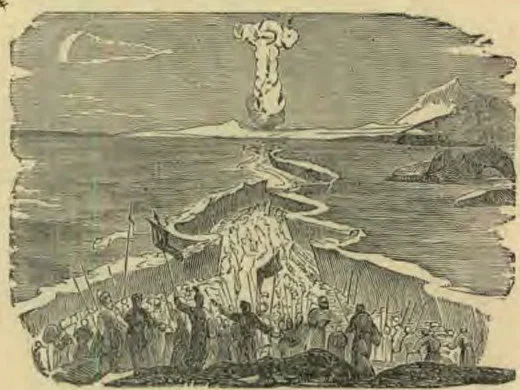
But the Lord spoke to his servant Moses, and told him to tell the people to fear not, but to stand still and see the salvation of the Lord, for he would fight for them. Then the Lord told Moses to stretch his hand out over the sea; and when he had done so, “the Lord caused the sea to go back by a strong east wind all that night, and made the sea dry land; and the waters were divided. And the children of Israel went into the midst of the sea upon dry ground; and the waters were a wall unto them on their right hand and on their left.”
By the picture you can see very plainly how it was, and how the water must have looked standing as a wall on both sides of them. The sea at the place where it is supposed they crossed is about ten miles wide, and the passage-way opened through it must have been several miles wide, or such a host of people could not have passed through in one night, as they must have done; for it was in the morning watch, which would be somewhere between two o’clock in the morning and sunrise, that the Egyptians followed after them into the sea. The Lord’s people must all have been through the sea by this time, or he would not have let the waters return, as he did, to destroy the Egyptians. Thus we see how the Lord is stronger than all the armies of earth, and that he is able to care for his people at all times and in every danger. And just so kindly will he care for every little child that tries to love and obey him.
E. B.
Continue reading: FAULT-FINDING