S. D. A. Publishing Association · Battle Creek, Mich. · Dec 1879
CHRISTMAS EVE.
It was the eve before Christmas; “Good night” had been said,
And Annie and Willie had crept into bed;
There were tears on their pillow, and tears in their eyes,
And each little bosom was heaving with sighs,
For to-night their stern father’s command had been given,
That they should retire precisely at seven,
Instead of at eight; for they troubled him more
With questions unheard of than ever before;
He had told them he thought this delusion a sin,
No such being as “Santa Claus” ever had been,
And he hoped, after this, he should nevermore hear
How he scrambled down chimneys with presents each year.
And this was the reason why each little head
So restlessly tossed on the soft, downy bed.
Eight, nine, and the clock on the steeple tolled ten;
Not a word had been spoken by either till then,
When Willie’s sad face from the blanket did peep,
And he whispered, “Dear Annie, is you fast asleep?”
“Why no, brother Willie,” a sweet voice replies,
“I’ve tried all in vain, but I can’t shut my eyes,
For somehow it makes me so sorry because
Dear papa has said there is no Santa Claus.
Now we know there is, and it can’t be denied,
For he came every year before mamma died;
But then I’ve been thinking that she used to pray,
And God would hear everything mamma would say,
And perhaps she asked him to send Santa Claus here
With the sack full of presents he brought every year.”
“Well, why tan’t we p’ay dest as mamma did then,
And ask God to send him with presents aden?”
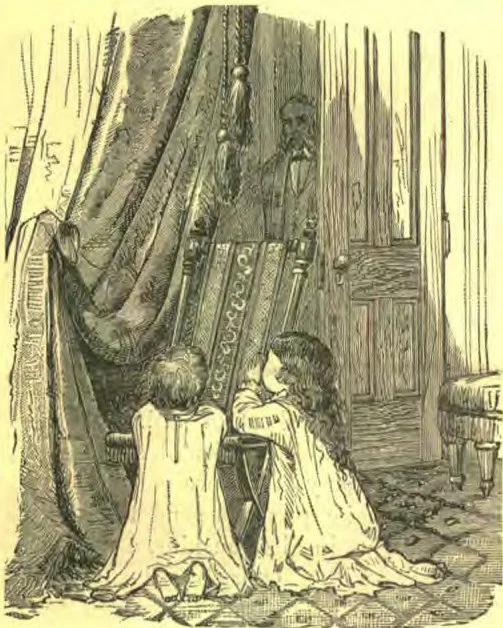
“I’ve been thinking so, too.” And without a word more,
Four little bare feet bounded out on the floor,
And four little knees the soft carpet pressed,
And two tiny hands clasped close to each breast.
“Now, Willie, you know we must firmly believe
That the presents we ask for, we’re sure to receive.
You must wait just as still, till I say the ‘Amen,’
And by this you will know that your turn has come then.
Dear Jesus, look down on my brother and me,
And grant us the favors we’re asking of thee.
I want a wax dolly, a tea-set, and ring,
And an ebony work-box that shuts with a spring;
Bless papa, dear Jesus, and cause him to see
That Santa Claus loves us far better than he;
Don’t let him get fretful and angry again
At dear brother Willie and Annie. Amen.”
“Please, Desus, ’et Santa Taus tum down to-night,
And b’ing us some p’esents before it is light.
I want he sood dive me a nice ’ittle s’ed
With b’ight shinin’ ’unners, and all painted ’ed;
A box full of tandy, a book, and a toy.
Amen, and den, Desus, I’ll be a dood boy.”
Their prayers being ended, they raised up their heads,
And with hearts light and cheerful, again sought their beds.
They were soon lost in slumber both peaceful and deep,
And with fairies in dreamland were roaming in sleep.
Eight, nine, and the little French clock had struck ten,
Ere the father had thought of his children.
He seems now to hear Annie’s half-suppressed sighs,
And to see the big tears stand in Willie’s blue eyes;
“I was harsh with my darlings,” he mentally said,
“And should not have sent them so early to bed.
But then I was troubled; my feelings found vent,
For bank-stock to-day has gone down ten per cent.
But of course they’ve forgotten their troubles ere this,
And that I denied them the thrice-asked-for kiss;
But just to make sure, I’ll steal up to the door,
For I never spoke harsh to my darlings before.”
So saying, he softly ascended the stairs,
And arrived at the door to hear both of their prayers.
His Annie’s “bless papa” draws forth the big tears,
And Willie’s grave promise falls sweet on his ears.
“Strange, strange I’d forgotten,” said he, with a sigh,
“How I longed, when a child, to have Christmas draw nigh.
I’ll atone for my harshness,” he inwardly said,
“By answering their prayers ere I sleep in my bed.”
Then he turned to the stairs, and softly went down,
Threw off velvet slippers and silk dressing-gown,
Donned hat, coat, and boots, and was out in the street,
A millionaire facing the cold, driving sleet.
Nor stopped he until he had bought everything,
From a box full of candy to a tiny gold ring.
Indeed, he kept adding so much to his store,
That the various presents outnumbered a score.218
Then homeward he turned with his holiday load,
And with Aunt Mary’s help in the nursery ’t was stowed.
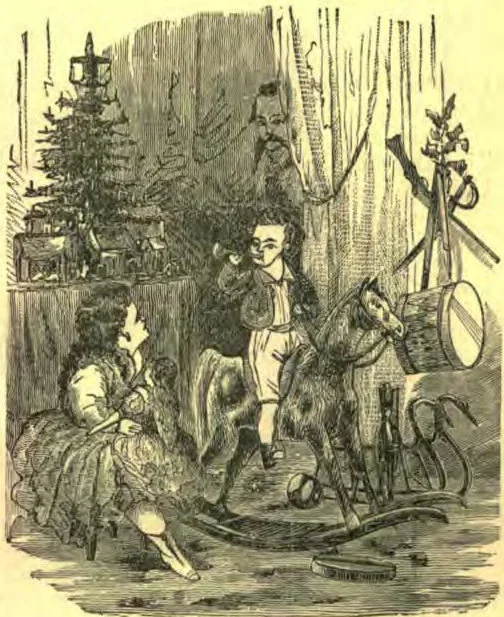
Miss Dolly was seated beneath a pine tree,
By the side of a table spread out for her tea.
A work-box, well filled, in the center was laid,
And on it the ring for which Annie had prayed.
A soldier in uniform stood by a sled,
“With bright shining runners, and all painted red.”
There were balls, dogs, and horses, books pleasing to see,
And birds of all colors were perched in the tree,
While Santa Claus, laughing, stood up in the top,
As if getting ready more presents to drop.
And as the fond father the picture surveyed,
He thought, for his trouble, he’d amply been paid,
And he said to himself as he brushed off a tear,
“I’m happier to-night than I’ve been for a year;
I’ve enjoyed more true pleasure than ever before;
What care I if bank-stock fall ten per cent more?
Hereafter I’ll make it a rule, I believe,
To have Santa Claus visit us each Christmas Eve.”
So thinking, he gently extinguished the light,
And tripped down the stairs to retire for the night.
As soon as the beams of the bright morning sun
Put the darkness to flight, and the stars, one by one,
Four little blue eyes out of sleep opened wide,
And at the same moment the presents espied.
Then out of their beds they sprang with a bound,
And the very gifts prayed for were all of them found.
They laughed and they cried in their innocent glee,
And shouted for “papa” to come quick and see
What presents old Santa Claus brought in the night,
(Just the things that we wanted) and left before light.
“And now,” added Annie, in a voice soft and low,
“You’ll believe there’s a Santa Claus, papa, I know.”
While dear little Willie climbed up on his knee,
Determined no secret between them should be,
And told in soft whispers, how Annie had said,
That their blessed mamma, so long ago dead,
Used to kneel down and pray by the side of her chair,
And that God, up in Heaven, had answered her prayer.
“Then we dot up and prayed dest as well as we tould,
And Dod answered our prayers. Now wasn’t he dood?”
“I should think that he was, if he sent you all these,
And knew just what presents my children would please.
Well, well, let him think so, the dear little elf,
’T would be cruel to tell him I did it myself.”
Blind father! Who caused your stern heart to relent,
And the hasty words spoken so soon to repent?
’T was the Being who bade you steal softly up stairs,
And made you His agent to answer their prayers.
CHRISTMAS TIME.
By M. K. W.
THE twenty-fifth of December, as all know, is celebrated as the birthday of our Saviour. The first traces of the anniversary of this event are found about one hundred years after Christ's death. At first, it was the most movable of all Christian festivals, being at one time celebrated in April or May. But in the 4th century it was agreed that December 25 was nearer the correct date.
The practice of making presents on Christmas is derived from an old heathen practice at the feast of Sol. Formerly, and in some of the smaller villages of North Germany at the present day, all who wish to make presents send them to one person, who, in high buskins, a white robe, a mask, and an enormous flax wig, goes from house to house, is received by the parents with great pomp and reverence, calls for the children, and after severe inquiries, bestows the intended gifts upon them according to the character which he hears from the parents.
From this practice probably arose the story of Santa Claus, that celebrated but mysterious personage, who, as children are often taught, comes with his bells and reindeers to the top of the chimney, and climbs down with all manner of nice presents for them. But this fabulous tale, we are happy to say, is not taught by as many as formerly.
Christmas day, if properly observed, will carry our minds back to Bethlehem, where in imagination we see Joseph and Mary, and the infant Saviour in a stable among the cattle. And why was he there? Simply because there was no room for him elsewhere. Perhaps if the people had known him they would have made room for him. But we inquire, Are there not some at the present time who know that this infant child was their Saviour, but who even now give him no room in their hearts or homes? We fear that for such Jesus will have no room in his kingdom.
M. K. W.
TIME IS FAST PASSING AWAY.
By Delia E. Walker
How often we are reminded that time is fast passing away, and yet how little we realize it. As we see the sun setting in the west, we are reminded that another day has passed; as we see the earth robing herself in her snowy mantle, we are reminded that another year has flown; and so each closing day, month, and year, reminds us in some way that time is fast passing. Still, how many find their hearts answering to the pleadings of the Holy Spirit, “Time enough yet. Some future time I will listen to your voice.”
As we look upon the grass, the trees, and all the beauties of nature that so recently greeted our sight, and see them fading, we realize for a moment that time is fast passing away. As we see men, women, and children, going down into the grave, again we realize that on the wings of the wind the precious moments are passing, silently, but swiftly. Soon, ah, soon, the harvest will be past, and let me ask, Shall we be saved? If we wisely improve each passing moment, giving ourselves entirely to God, we shall be saved.
Young man, young woman, pause amid the pleasures of this world, and examine the path in which you are walking. Does it lead your thoughts and desires higher? Do you feel a deep satisfaction, a calm trust, a holy peace pervading your being? If not, your path is a dangerous one; the pleasures that you are seeking for so eagerly are but false lights that will lead you, like an “ignis fatuus,” into the mire of sin and woe, and there leave you to perish with no hope of rescue.
There is a light whose rays are brighter than the noonday sun, that will lead you to a blessed land of rest and peace. That light is Jesus, the “light of the world.” Seek for that light, seek with all your heart; remember that to-day is the day of salvation. Don’t linger doubting; don’t wait until to-morrow. God does not say to-morrow, he says “To-day, if ye will hear my voice, harden not your hearts.” Turn now, before the accepted time be forever past. God says that his Spirit shall not always strive with man. May God help you to seek your soul’s salvation while it is yet to-day.
DELIA E. WALKER.
INTERESTING ELECTRICAL EXPERIMENT.
TAKE a sheet of coarse, brown paper, and, after holding it before the fire until it is perfectly dry, fold it up into a long strip, of about two inches wide. The magnet is now complete. To exhibit its attractive power, cut some strips of writing-paper, about three inches long, and about as wide as half these lines; place them upon the table, three or four together. Now take the magnet, and draw it briskly under the arm two or three times; its electro-magnetism is instantly developed, and becomes apparent when held over the small strips of writing-paper, for they fly up toward the paper-magnet, veritably, “by the wings of lightning.”—Young Reaper.
THE SNOW.
Over the earth the snow lies deep—
The white snow-feathers so fair and soft—
How strange that the black clouds’ swarthy wings
Should scatter in their dark flights aloft
Such beautiful plumes,—such wonderful things,—
When the world is hushed in sleep!
Under the shelving banks of ice,
Like a glittering serpent black and white,
The river crawls and moans with cold;
The waterfall is a castle bright,
With gleaming domes and turrets bold,
And spires of rare device.
Silent the snow falls from the sky,
And dumb is the earth, no warmth, no breath;
For the mystic weight of the ghostly snow
Lies on her face like the pallor of death;
But the warm heart beats through her trance below,
Throbs ever and will not die.
—Ladies’ Repository.
BIBLE LESSONS FOR YOUTH.
LESSON LXXVIII.—REVIEW OF LESSONS LXXV-LXXVII.
1. NAME the kings of Israel from Jeroboam to Ahab.
2. How long did each of them reign?
3. How many different dynasties, or families, were represented by these kings?
4. How did the house of Jeroboam come to an end?
5. Are we to suppose that the Lord brought this about on account of the sinful course of these kings?
6. What proof have we of this?
7. What were the chief crimes of which Jeroboam was guilty?
8. What kings belonged to the family of Baasha?
9. How was this family exterminated?
10. What sins did Ahab add to those of Jeroboam?
11. What prophet bears a prominent part in the history of Ahab’s reign?
12. Enumerate and describe the chief miracles of this prophet.
13. Mention the leading events of Ahab’s reign.
14. What judgments were denounced against him when he took unlawful possession of Naboth’s vineyard?
15. How were these predictions fulfilled?
16. What kings belonged to this dynasty?
17. Why is it called the house of Ahab, since he was not the first king?—Because he was the most noted king of this line.
18. Relate the circumstances of Ahaziah’s sickness and death.
19. By whose miracles was the kingdom sustained during the reign of Jehoram?
20. Give a brief account of the miracles of Elisha.
21. Name the kings from Jehu to Jeroboam the Second.
22. How long did each reign?
23. What was the character of each?
24. For what was the reign of each noted?
25. How did Jeroboam the Second conduct the affairs of the kingdom?
26. What was the condition of the kingdom for the first eleven years after his death?
27. Who was the last king of the dynasty of Jehu?
28. Name all the kings of this dynasty.
29. How long did each reign?
30. How was Menahem deposed?
31. Give a history of the kings of Israel from Menahem to Hoshea.
32. How was the kingdom of Israel brought to an end?
33. Have we any evidence that this was a judgment from God on account of the wickedness of this nation?
34. What reasons are given for the extirpation of this nation?
GENERAL S. S. ASSOCIATION.
By C. W. Stone
Seventh Meeting, Monday, Dec. 1.—The following resolution which was pending at the close of last meeting was discussed and adopted:—
Whereas, there are many companies of Sabbath-keepers in our various mission fields and elsewhere, that have no organized Sabbath-school; or, if they have, are not connected with, and do not report to, any Sabbath-school Association, therefore,
Resolved, That we request Sabbath-school Associations to take under their watchcare such mission fields as shall be assigned to them by this Association, and by correspondence and otherwise, to secure their co-operation in the S. S. work.
Eld. A. C. Spicer spoke upon the subject of illustrating the S. S. lessons on the board. He would not advise elaborate illustrations that amuse rather than instruct. It is better to let the illustration grow up under the teacher’s hand before the class, that the mind of the pupil may be lead along more logically.
The committee appointed to draw up a blank report suitable for family Sabbath-schools reported, recommending a blank which calls for answers to the following questions:—
What is the membership of your school?
How many new members have been enrolled during the quarter?
How many members have been dropped from your record?
How many classes in your school?
Do your teachers keep a record of attendance and scholarship?
How many copies of the Weekly INSTRUCTOR do you take?
What was the amount of contributions received during the quarter.
How much do you donate to your State S. S. Association?
At what time do you hold your school?
How long does it continue?
How many times have you failed to hold your school on time.
How much time do you give to recitations?
Report of the committee adopted.
Voted, That the committee be continued, that the President be added to their number, and that they be authorized to prepare a programme for family Sabbath-schools.
Bro. W. C. White then made some suggestions upon the plan of conducting Camp-meeting Sabbath-schools, and annual S. S. Conventions, after which the meeting adjourned sine die.
C. W. STONE, Sec.
LESSONS FOR CHILDREN.
LESSON LII.—REVIEW OF LESSONS XLIX-LI.
1. WHOM had the Lord appointed to reign in David’s place when he should die?
2. What had the Lord promised that Solomon should do?
3. Who tried to take the kingdom, before David died?
4. How was he prevented from doing it?
5. Before David died, what charge did he give to Solomon?
6. What was to be the consequence of keeping this charge? 1 Kings 2: 3.
7. What choice did Solomon make when the Lord said, “Ask what I shall give thee?”
8. What more did the Lord promise to do for him?
9. Why did he do more for Solomon than he had asked?
10. Tell how Solomon settled the difficulty between the two women who both claimed the child.
11. How great was Solomon’s kingdom?
12. How many were the people that he ruled over?
13. How great was his wisdom?
14. What did he speak?
15. What did he compose?
16. Of what works of God was he able to talk?
17. Where did he get stone and timber for the temple?
18. How large was the temple?
19. What were its principal rooms called?
20. What holy vessels did each contain?
21. What was placed in the court?
22. What may be said of the size and beauty of the temple?
ELECTIONS AND REPORTS.
By W. C. W.
On the last Sabbath in December, officers should be elected for the ensuing quarter. During the following week, the secretary should fill out a report and mail it, with a tithe of the contributions received, to the secretary of the State Association. Whenever a new secretary is elected, let the one who has been acting in that capacity carefully examine the books, seeing that all the records and registers are properly written up. Then he should write the report of the last school, and fill out the quarterly report blank, giving the names of the officers just elected, and hand all to the newly elected secretary, except the Quarterly Report which should be mailed to the State Secretary at once.
W. C. W.
PUBLISHERS INSTRUCTOR
By Editor
LESSONS FOR LITTLE ONES.—NO. 2.
THIS book, covering the Bible history from Moses to Joshua, will be printed and ready for our schools some time in February. This book will take up the Bible history at the death of Joseph, just where it closed in No. 1, and will contain one year’s study of fifty-two lessons, which will reach to the time of Joshua, thus connecting with the Lessons for Children in the INSTRUCTOR.
Some of our schools began to use Lessons for Little Ones, No. 1, a year or more ago, while many others began its study some time during the spring or summer. It is desirable that our schools as far as possible should begin the use of No. 2 at the same time, and thus many would be studying the same lesson each Sabbath.
We therefore recommend that this series of lessons be entered upon either the first of January or the first of April. Those schools whose beginning classes have completed No. 1, and who are ready to begin No. 2 with January, 1880, will be furnished the first ten lessons in sheets, free of cost, on application to the YOUTH’S INSTRUCTOR. These ten lessons will be enough to keep them at work till the book is published, and all have time to procure it. The book will be the same size and price as No. 1.
Those not ready to begin No. 2 the first of January, should plan as far as possible to commence it the first of April. Thus each class using this book will be in one or the other of two places. If they complete No. 1 before that time, it will be found profitable to review it as suggested in INSTRUCTOR, No. 44.
Let those schools that wish to begin No. 2 with January send in their orders at once, for the sheets containing the first ten lessons, that we may send them in time for the first Sabbath in the new year.
PUBLISHERS INSTRUCTOR
THE TEACHING SPIRIT.
By S. S. Teacher
Said a most successful Sabbath-school teacher, when inquired of, “The true secret of success is the teaching spirit. By this I mean the spirit that must teach,—that dies if it don’t teach.” Here is the secret,—not in a temporary burst of passion, but in a steadfast devotion to the work of teaching. Such a spirit is one of love to the truths of the Bible. It is one that realizes these truths in the teacher’s own experience and life. To such a teacher these truths are so precious that he must communicate them,—so excellent that he cannot speak of them in a style of empty cant,—so personal to him that he cannot speak of them without true feeling.—S. S. Teacher.
Why Children Need Intelligent Teachers
CHILDREN hunger perpetually for new ideas. They will learn with pleasure from the lips of people what would be drudgery to learn from books; and even if they have the misfortune to be deprived of many educational advantages, they will grow up intelligent if in childhood they hear daily the conversation of intelligent people. Hence the importance that the teacher should be an intelligent person. The child comes home and says, “What do you think my teacher told us to-day?” The daily effort of the teacher should be to render himself fresh and bright, to meet the young minds that form the class; not to think, “How shall I repress and bottle up all the energy?”—Baptist Teacher.
LETTER BUDGET.
Noblesville, Ind.
Dear Editors: I have been keeping the Sabbath with my parents ever since Eld. Lane had his tent here over one year ago. I did have a dear little sister two years old, but she died the 6th of last April. We miss her sweet, smiling face very much, but we expect to meet her when Christ comes. Brother and I get the Instructor at Sabbath-school; we like it very much. We are trying to live Christian lives, and hope to be saved in God’s kingdom at last.
Yours with much love,
Nora. P. Harman.
Clyde, Ohio.
Dear Editors: I am eight years old. To-day is my birthday. I take the Instructor and read it to some of my schoolmates and to my little sister. I keep the Sabbath with my parents, and go to Sabbath-school every Sabbath. I want to be a good boy, and meet all the Instructor family on the beautiful shore. Please pray for me.
Yours truly,
Rolland Stone.
Nevada, Iowa.
Dear Editors: We have had your paper in our Sabbath-school some time. I am twelve years of age. We live a mile and a half out of town, but we walk in to Sabbath-school every Sabbath. I go to day school every day. Please pray for me that I may meet you all in Heaven.
Bennie Smith.
A FORTUNE-TELLING BOOK.
“I wish that I had a fortune-book,” said one of three boys, as they walked together down to the river to skate. “I want to know what my luck is to be. I’ve tried to buy one; but there’s none to sell.”
“I have got one,” said the barber’s son. “Got one!” cried William eagerly. “Why did you not tell us about it before? Where is it?”
“Down at the shop,” answered the barber’s son.
“And it does tell what’s coming to pass, does it?” asked the third boy.
“Yes, it does.”
“But how do you know?” asked the third boy. “You have not lived long enough to know if it has told your fortune right.”
“Why, you see it is a very old book,” said the barber’s son. “My grandfather had it, and it told his fortune; then my father had it, and it told his; and it all came to pass.”
“It beats all,” cried William. “What a prize! Why don’t you go round telling fortunes? You would make lots of money.”
“I am afraid nobody would believe me,” said the barber’s son, humbly.
“Well, show it to us,” said they.
“Come down to the shop, then, to-night,” he said; “come just after we shut up.”
“Sell it to me,” cried William.
“I can not part with mine,” the barber’s son answered; “but you can get one where mine came from.”
“I will have one. But we will come and try our luck with yours.”
“Agreed,” said they all.
The two boys were before time, and hung around the shop until every customer had gone, and the shutters were put up; then in they went. The barber’s son asked them to be seated, and drew a little table out, and placed a lamp on it. Then he went to the back part of the shop, and opening a little trunk, took the book out, and laid it upon the table, the boys narrowly eying him all the time.
“There,” he said in a very sober tone, when he laid the book on the table; “there, boys, that is my fortune-telling book. What it says is sure.”
The two boys eagerly gazed on the table.
“The Bible!” they exclaimed at once, shrinking back.
“Yes,” said the barber’s son, “that was my father’s Bible; and it says there are but just two ways for you and for me to try our chances in this world. One is called the ‘broad way,’ and the other the ‘strait and narrow way.’”
Such a fortune-telling book the boys were not thinking of; but it is the only kind that does not deceive us.—Chatter-box.