Your ShelfYour Projects

Signs of the Times, Vol. 28, No. 23.

SAINT PETER'S AND THE VATICAN
Earlier text: THE VATICAN IS DISAPPOINTED

A TALE OF TWO BOYS.

The inexcusable folly of allowing young children to be ground through the merciless mill of modern educational methods, regardless of the consequences to them, is well illustrated by the following article from a Western mother in the February Ladies' Home Journal. There are teachers who seemingly forget that a child's health is of more value to it than any amount of learning it may acquire. And yet oftentimes the teacher is an unwilling partner in the wrong. The fault lies farther back. It is in the system which the teacher is required to carry through. The article speaks for itself:—
“When I was first married, we lived in a Western city. Another young couple occupied the next house to ours. Both husband and wife taught in a public school. Education, they declared, was almost dead in C——. Certainly they spared no effort to bring it to life again. They set a high standard in their school, and drove and dragged and goaded the children on to reach it. It did not matter how dull by nature a boy was, or how sickly, he was given the same tasks as the cleverest pupils in the school. All day long this cramming process went on: commit and recite, commit and recite. There was too much to learn to explain anything to the poor little wretches. No time for understanding. Commit and recite, day in and day out. When school was over, they carried home a load of books and pored over them half the night.
“They had a boy, Johnnie, just the age of our Godfrey. He was a lean, bloodless child, with a curved back, and weak, light eyes, staring through spectacles. His father determined that he should be an example to the school. He worked him mercilessly. He could read at four, was in Algebra at nine, and construing Cicero at eleven. The boy had a big active brain, and loved the work. His father coached him every night. ‘Work never hurt any brain,’ the father would brag. I don't know about that, but it is certain that it hurt the rest of Johnnie's neglected body. Stomach, muscles, heart, and nerves all broke down. He dwindled every year. At fourteen he looked like a boy of ten. But his father drove the harder. ‘I mean him to enter the junior class of Princeton at fifteen,’ he would say. ‘John never disappointed me. He has been a leader in the school for three years.’
“And poor Johnnie, with his watery eyes and white cheeks, went to work harder than ever. One day he fainted in school. He was ill for months, and then the doctors ordered him to go to a farm, live out of doors, and not open a book for two years. His brain gave way first. He lost his memory, and what grieved the father most, he loathed the sight of a book. At the mention of lessons, he would cry and mutter for hours; and in two years the poor child went to his grave.
“I meant to tell you about our Godfrey. He wasn't bright with books, and we would not urge him. Johnnie's father scolded. But we made a farmer of him, and he is now a big, jolly fellow, with boys of his own, and clever enough to be in the legislature. He knows neither Greek nor mathematics. But he is here.”

Natural Sleep Restores Better Than Medicine

It is better to skip an occasional dose of medicine than to disturb the sick one when sleeping quietly. Natural sleep is a greater restorer than medicine.

WHY HE SIGNED THE PLEDGE.

“My reasons for taking the temperance pledge were partly general and partly special,” says Dean Farrar.
“1. I became convinced that the use of alcohol in any form was not a necessity. I saw that whole nations have lived and flourished without it. I believed that the whole race of man had existed for centuries previous to its discovery.
“2. I was struck by the indisputable fact that in England fifty thousand inhabitants of our prisons, accustomed to strong drink all their lives, and the majority of them brought into prison directly or indirectly by it, could be, and were, from the moment of their imprisonment, absolutely deprived of it, not only without loss, but with entire gain to their personal health.
“3. I derived from the recorded testimony of our most eminent physicians that the use of alcohol is a subtle and manifold source of disease even to thousands who use it in quantities conveniently deemed moderate; also that all the young, and all the healthy, and all who eat well and sleep well, do not require it, and are better without it.
“4. Then, the carefully drawn statistics of many insurance societies convinced me that total abstinence, so far from shortening life, distinctly and indisputably conduced to longevity.
“5. Then I accumulated proof that drink is so far from requisite to physical strength or intellectual force that many of our greatest athletes, from the days of Samson onward, ‘whose drink was only of the crystal brook,’ have achieved without alcohol mightier feats than have ever been achieved with it.
“6. And besides all this, I knew that the life of man always gains by abolishing needless expenses and avoiding artificial wants. Benjamin Franklin said, a hundred years ago, ‘Temperance puts wood on the fire, meat in the barrel, flour in the tub, money in the purse, credit in the country, clothes on the bairns, intelligence in the brain, and spirit in the constitution.’”

BOYS, HELP YOURSELVES.

The following is taken from the Christian Observer: “I once saw an auction sign, and (being a woman) crossed the street to investigate what manner of bargains were there to be obtained. I was not tempted to go in, for it proved to be a fire sale of cigars and tobacco. But I did stand for many minutes looking through the big plate-glass window at a large dry goods box in the center of the room, into which had been thrown promiscuously all broken packages of tobacco and cigars. Above the box was a card which bore the inscription: ‘Boys under fourteen, help yourselves.’ And the proprietor was walking back and forth, smiling and rubbing his hands and saying, ‘Help yourselves, boys; help yourselves; put some in your pockets,’ and fifteen or twenty boys, all well dressed and just out of a neighboring school, were following his suggestions. Some were trying to smoke, some only trying to fill their pockets, all in a shame-faced way that showed them to be new at the business. And the dealer was well satisfied. He knew that he was planting seed, and he knew that his harvest was sure.”—National Advocate.

Question Corner

[From time to time we will reply under this head, if deemed advisable, to such candid inquiries as may be sent us. Correspondents wishing a reply to their questions must give their full name and address, not for publication unless they wish, but as an evidence of good faith on their part, and to give us opportunity to reply by letter if deemed best. It is always well to inclose stamp. Let the questions be short and pointed, and such as may be answered in limited space. The questions will be numbered continuously.]

1244.—The Resurrection of the Body.

If when a person dies his body is scattered, as is so often the case, to various parts of the earth, where will the body be raised? One is drowned and eaten by fishes, another is dissected, and flesh and skeleton scattered.
The resurrection is not a matter of knowledge, but of the power of God. It is not a mere bringing back of the same particles, but a new creation. The body goes back to dust. God calls it again from the dust. See Gen. 3: 19; Isa. 26: 19, and many others. Read especially 1 Cor. 15: 35-38. There the Lord answers the question, “How are the dead raised?” We can never understand all God’s ways of working; but we may know and apprehend His power. He can call back from earth anywhere the dead ones, stamped each with his own character, “to every seed his own body.”

1245.—First and Seventh and Eighth Days of What?

Please explain Lev. 23: 1-39. What is meant by these days and sabbaths? S. D. C.
Read the entire chapter carefully. Most of its instruction pertains to several feasts. In these feasts certain days were pre-eminent. But these days, called “the first day,” the seventh day, “the eighth day,” were not the first, the seventh, the eighth days of the week, but of the feast concerned. These sabbath days of these feasts came but once a year, the same as New Year’s day, Thanksgiving, etc. They were yearly feasts, fasts, and sabbaths of the Jews, and were “beside the Sabbaths of the Lord,” which were weekly. Verse 38.

SUMMER ASSEMBLY FOR TEACHERS.

SEVENTH-DAY ADVENTISTS have, as a denomination, committed themselves to a system of Christian education which, to fulfil its purpose, offers to every child a training which begins in infancy and continues until the individual is prepared to act a part in the evangelization of the world. So to educate the children, the youth, and men and women of greater maturity, requires an army of consecrated teachers. For the children alone, there should be at least one teacher in every church. Teachers for these schools—church-schools, intermediate industrial schools, and training schools or colleges—themselves require an education which will fit them for the positions to which they are called.
In view of the present demands there has been added to the church organization within a year, a new department—the Department of Education. This department is now devising plans for the thorough equipment of hundreds of teachers. The course of instruction offered in teachers' institutes and State normals can not be utilized; for instructors in Christian schools are called upon to deal with principles vitally different from those underlying public-school work. Moreover, with the Bible as a basis of all education, the methods employed by Christian teachers necessarily differ from those followed in the State schools.
If, then, the church demands teachers who are missionaries, those who are competent to teach the children to become missionaries,—if this is the demand made by the church, some means must be provided for their training. This duty devolves upon the Department of Education, and as a means of discharging its duty toward the children, toward parents, and toward the men and women who are to fill the position of teachers, arrangements have been made to conduct a summer school at Berrien Springs, Mich., from June 12 to August 20.
Summer schools have been held in past years, but in many respects the one for this season will surpass all others. Owing to the great demand for teachers, a general call is issued for people from all parts of the country to take the training offered at Berrien Springs.
Because hundreds of teachers are needed in foreign countries, the Foreign Mission Board has offered to help bear the expense of the summer school. That body hopes to choose 100 persons for foreign work from the body of student teachers assembled at Berrien Springs this summer.
It is because of the interest taken in the training of teachers by the Foreign Mission Board, the Lake Union Conference, and Emmanuel Missionary College, that students qualified to take the training of the summer are given free tuition, free rent, and board at the most reasonable rates, served on the European plan.
This offer is not made to a promiscuous class of students. The work of the summer school is arranged to meet the demands of two classes of students. The first class is composed of teachers from State schools, teachers from Christian schools, and other persons having educational qualifications which would enable them to obtain a county certificate.
The second class of students will be composed of individuals especially adapted to Christian business work. For such the course will be complete and thorough. This is the first effort that has been made to give a brief yet comprehensive course to men and women with the idea of fitting them speedily for actual business work as bookkeepers, business managers, stenographers, etc. Those classified in this department will be carefully selected. In fact, all who contemplate taking any work offered during the assembly are requested to make definite arrangements by correspondence with the president of Emmanuel Missionary College.
The Announcement is an artistic 16-page pamphlet, full of information, which will be sent free upon request. Address— E. A. SUTHERLAND. Berrien Springs, Mich.
Stone Lanterns or Towers About Eight Feet High, Seen on Buddhist Grounds in Great Numbers. Formerly Used for Holding Lights.

Christianity in Japan.

(Continued.)
When Japan fought with China, and conquered, civilized nations claimed that each victory was stained with some act of barbarity or brutality on the part of the Japanese soldiers. Japan was much chagrined, and watched for an opportunity to clear away all blame. And the opportunity came in the war to suppress the Chinese rebellion. The Japanese soldiers fought side by side with European soldiers, and everywhere they stood in the front rank. They showed excellent discipline and noble behavior in the sight of the civilized nations, while the soldiers of some nations that blamed Japan most in the Chino-Japanese war committed abominations unspeakable. “What are Christian nations, after all?” Perhaps this is the question that arose in every Japanese mind.
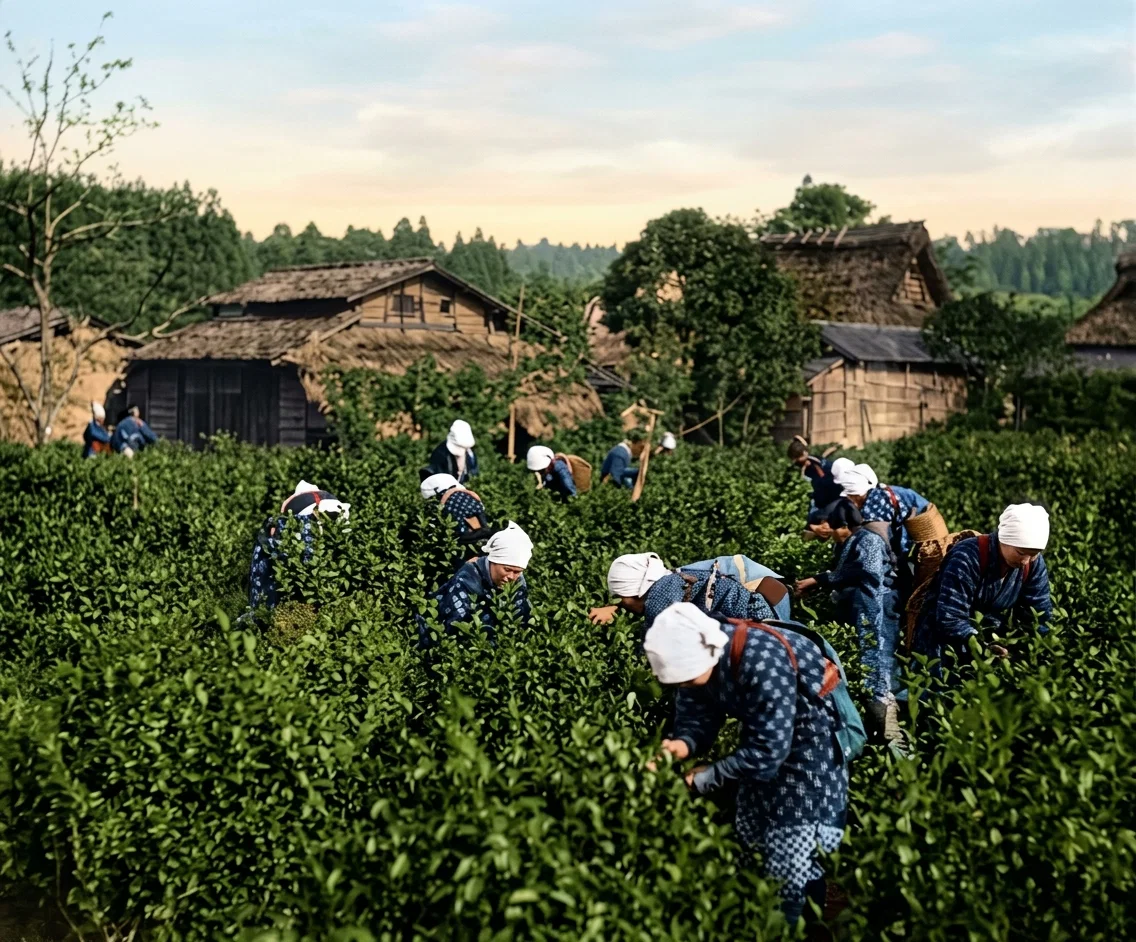
Gathering Tea.
Gathering Tea.

A Buddhist View of Christianity.

Some months ago I happened to pass by a Buddhist temple when a priest was preaching. Pausing to listen, I heard him say:—
Do you like to know what Christianity is, my friends? I have here its book, called the Bible, and I will show you what Christ says, for He is the foundation of that religion: “Think not that I am come to send peace on earth; I came not to send peace, but a sword.” Are you astonished? But this is what He really says. I am not accusing Him. I acknowledge that He was a very great man, and taught many good things, as Buddha did. I do not take His word in a shallow sense. I just show you that His religion is very different from that of Buddha. He intended to spread His doctrines with the power of the sword.
Look at the nations taught and influenced by His religion. Christian England took India and Hongkong, and now she is waging war with the small Boer republic, intending to make that country her own. But the liberty-loving Boers will not yield till they are all dead. Christian Germany snatched a portion of Chinese territory in redress for the killing of two missionaries, who ventured too far into the interior, against the advice of the government officials. Christian America occupied the Philippine Islands under pretense of delivering the people from oppression.
Another object-lesson is before our eyes. What did the soldiers of these Christian nations do in China, in the late war? Houses were pillaged, and women were violated; and the Chinese fled from those who came to save them. But how our soldiers were welcomed. Women and children hailed them everywhere with small Japanese flags in their hands and with tears of joy and gratitude. You all know this. Then we might well boast of our Buddhist country. “The tree is known by its fruit,” Christ said. What these nations do is in accordance with what Christ said. Christianity may be well adapted to the spirit of our age; but Buddha taught mercy, not to kill even an insect, for there is a soul struggling for a higher life. I prefer to live and die a Buddhist.
“Aye, aye,” was the response of some in the audience. I admired the priest’s shrewd eloquence, and felt ashamed that there are so many things in nations and individuals called “Christian” to cast a stumbling-block in the way of the truth.

Japanese Loyalty.

The Japanese are very loyal to the throne. Their reverence for the emperor and faithfulness to him can not be comprehended by other nations.
“A thousand years of happy reign be thine. Rule on, my lord, till what are pebbles now, By age united, to mighty rocks shall grow, Whose venerable sides the moss doth line.”
This is the national song, and it is sung by the school children with great heartiness. The government looks upon Christianity as a very good religion in itself; but as it is [thought to be] a product of other nations, it is feared that it will alienate the Japanese heart and destroy the spirit of loyalty; and so the policy of keeping religion out of education has been adopted. Students and scholars sent abroad by the government, come back with skeptical sciences and learned infidelity; and these take part in the educational work. So education is carried on without the fear of God. The president of one of our schools took pains to ascertain what ideas his teachers entertained of Christianity. One said that he would dismiss his students if they went to a Christian church; another said he would discourage their going; and the third said he would leave them alone in this matter. Perhaps this instance will illustrate the general idea of teachers.
I will here state briefly what the Japanese loyalty is, for it occupies the Japanese mind more than does religion. The relations between the emperor and his subjects have grown, as do those between parents and sons. While other nations have had long fights with their kings to free themselves from oppression and to secure their rights, and the history of their parliaments is one of much bloodshed, the present Japanese emperor proclaimed that “all should be done by public discussion” when the people themselves did not know their rights; and the revolution which in other nations has been accomplished by blood and fire, in Japan has been brought about peaceably. This is why the relations between the emperor and his subjects are so different from those between other rulers and their people.

The Emperor and His People.

An emperor in the ancient times ascended his tower one day, and saw that no cheerful smoke curled up from the houses of his subjects. He judged that their hearts were desolate, and his heart was touched. He released his subjects from taxes for three years, and then again ascended his tower. Everywhere cheerful smoke curled up from the houses, telling of prosperity and happiness. Exultantly he turned to his queen, who had followed him, and said, “I am rich; I am happy now.” The queen, wondering, replied, “Our garments are torn, and our palace is leaking; and how can you call us rich?” With pride and joy he pointed to the houses of the people, and said, “See my people. Are they not rich and happy? and are they not our own?” And his feelings found expression in a burst of song which every Japanese remembers with grateful heart.
As an example of a loyal subject, there lived a famous warrior, Masasige, and his son Masatsura, who were martyrs to the cause of loyalty. When Masasige was going to battle, determined to die, he gave instruction to his little boy, encouraging him to grow up brave and to succeed to his father’s spirit. This instruction, sung by the school-children, is the inspiration of their lives.
Masasige died, and when Masatsura, his son, received the news, he was so sorrow-stricken that he intended to commit suicide. But his mother snatched the sword away, and encouraged him to be brave. He was brought up by his wise mother, and died a loyal soldier, as renowned as his father had been. When I was a boy and read the mother’s words, “Was it your father’s will, my son, that you should kill yourself? Was it not rather that you should kill the enemy?” and heard them explained by the teacher, my heart was very much moved, and I cried, “O Masatsura, Masatsura,” and I could not refrain from tears.
Loyalty is the life of the Japanese, and at one word from the emperor any Japanese will plunge into fire or water. This loyal spirit is not antagonistic to Christianity; but, on the contrary, it will make very good Christians when the hearts of the people are fully turned to the Maker of all, and God and the emperor each has his proper place. It is a great pity that the idea still prevails that Christianity is inconsistent with the spirit of loyalty.
S. HASEGAWA.
(To be continued.)

IF I CAN LIVE.

If I can live To make some pale face brighter, and to give A second luster to some tear-dimmed eye, Or e’en impart One throb of comfort to an aching heart, Or cheer some wayworn soul in passing by;
If I can lend A strong hand to the fallen, or defend The right against a single envious strain, My life, tho’ bare Perhaps of much that seemeth dear and fair To us on earth, will not have been in vain.
The purest joy, Most near to heaven, far from earth’s alloy, Is bidding clouds give way to sun and shine, And ’twill be well If on that day of days the angels tell— Of me, “She did her best for one of Thine.” —Helen Hunt Jackson.

OUR WORK AND WORKERS.

The Bethel (Wis.) Academy shows an enrolment of 176 students during the school year.
A church has been organized at Kulp, Columbia Co., Pa., with a membership of fifteen.
Twelve graduates received diplomas at the close of the school year of the Graysville, Tenn., Academy.
Work in Washington, D. C., is being carried on by Brothers J. S. Washburn and L. C. Sheafe. The former has recently returned from England.
The Oakwood Industrial School, Huntsville, Ala., is to be in charge of Brother C. H. Rogers and his sister, Mrs. Estelle Graham, for the coming year.
Nine are keeping the Sabbath at Orlando, Florida, as a result of a tent-meeting held last November, and of Bible-work since done by Brother C. P. Whitford.
The first general meetings for the Balkan States were held in March, one in Roumania, the other in Hungary. Our first canvasser entered Bucharest April 1.
A sanitarium for colored people is in operation at Nashville, Tenn. C. P. Bollman, editor of the Gospel Herald, is president of the board of management.
The name of the union conference which embraces the States of Nebraska, Iowa, Missouri, Kansas, and Colorado, has been changed from the Southwestern to the Central Union Conference.
Writing from Valparaiso, Chile, Mrs. H. F. Ketring says that she has taken orders for, and delivered, about two dollars’ worth of books for every hour she has been out canvassing.
A parcel of literature on present truth was sent to General Cronje, who is a prisoner of war on the island of St. Helena; and after thanking the donors, he added, “This literature I can recommend to our people.”
Elder W. J. Stone, president of the Tennessee River Conference, has been elected treasurer of the Southern Union Conference vice Elder Irving Keck, who has resigned all official positions on account of poor health.
The branch office of the Echo Publishing Co., Australia, which Brother Harry Camp expects to establish in Durban, S. Africa, will carry a good stock of books, and will be an aid to the canvassing work by enabling agents to get their books promptly.
At the session of the Northwestern Union Conference held in Des Moines, Ia., April 3–13, it was voted to recommend to the Mission Board Edwin H. Wilbur for service in China, Brother B. E. Fullmer and wife for India, and Brother C. J. Buhalts and wife for the African field.
Of meetings held on Eland’s River, twenty miles from Utenhage, S. Africa, Pastor Edmed says: “I had a Kaffir preacher in the congregation, and he was very much interested. One young man began to keep the Sabbath, and has given up smoking, swearing, and the use of liquors.”
“The Lord imparts a fitness for the work to every man and woman who will co-operate with divine power. All the requisite talent, courage, perseverance, faith, and tact will come as they put the armor on. A great work is to be done in our world, and human agencies will surely respond to the demand.”
A report in the Welcome Visitor, from Prof. F. W. Field, who went from Ohio to labor in Japan, states that from Monday to Friday he has two Bible classes daily, attended mostly by students from the high school and the Imperial University. When he speaks in the Sunday-evening service, Brother Hasegawa interprets for him.
The Minnesota Worker of May 14 contains a letter from Pastor W. A. Sweany, who is laboring in Barbados, B. W. I. He reports the workers well, and fully and happily employed. Since Sister Sweany took charge of the school, nearly all the students have been baptized. This paragraph gives some idea of conditions on this distant island:—
I baptized five at the recent quarterly meeting, and one last Sabbath, the latter in the sea at the northern end of the island, where we have a small company. To-day this person, an old black woman, walked all the way here, eighteen miles, as she has frequently done, to get Bibles and other of our books, for which she canvasses with quite good success. At the December quarterly meeting, nearly the entire company walked here, and I baptized four of them. These are earnest, honest, intelligent, precious souls, as well worth laboring for as any in this world. They love and obey the truth at the cost of such sacrifice as most of you know nothing of in that land of plenty.
As a result of meetings recently held at Kaycee, Wyoming, nine persons decided to walk in the Gospel light, and a working company was organized.
The corner-stone of the new sanitarium building was laid May 11, with appropriate ceremonies. Dr. Kellogg has since left to attend the European General Conference.
The work for “Christ’s Object Lessons” is eliciting a great deal of enthusiasm. In Wisconsin one lady whose home duties prevent her going out to canvass has taken ten orders. Two aged sisters, one eighty-two years old and the other in her eighty-fourth year, have each sold, or taken orders for, four books. Many in different States are having excellent success, and are receiving rich blessings in the work.
Writing from Kenilworth, South Africa, Pastor W. A. Ruble says:—
The work here is onward. The war that is still in progress is a great drawback in some ways, but the good Lord helps us marvelously. We are much encouraged in our school work. The college closed last year with the largest attendance in several years. The attendance was not quite so large at the beginning of this year, but we have over eighty in the school and about fifty in the home.
The Life Boat for June will be devoted to the cigaret and tobacco question in pointing out the evils especially to the rising generation. It will contain extracts from letters from prison officials all over the country, and from prisoners also, respecting the good work of the prison number of the Life Boat. The price is only 25 cents a year, and copies of this issue will be furnished at one and one half cents a copy. It ought to have a tremendous circulation. Its address is 28 thirty-third place, Chicago.
Of work in the French field Brethren Arnold and Oscar Roth say, in the Review and Herald, “One who has not lived among the people, who has not seen the incredulity, the indifference, the lightness, the immorality, displayed everywhere and in everything, can not comprehend the difficulties to be met in overcoming the obstacles by which the prince of darkness has surrounded this great nation. But the arm of God is not too short, and we have firm assurance that He has prepared a way through which France can be reached.”
A lady tells this incident of her work while out selling the (South African) Sentinel in Wynberg:—
I met a man as he came in the door [of the bar-room], and offered him a Sentinel. He asked me if it would help him to keep away from the canteen. He went on to say that he was the son of a wealthy man; that he had wasted ten thousand pounds [about $50,000] during the past two years; and that he was so wicked the Lord could not save him. I told him that Christ came to save those who were lost, and he promised to read his Bible and pray. I sold him a Sentinel and Journal of Health, and went on. About half an hour afterward I met him on the street, and he said he left the bar without drinking. Will you not pray for this man?”

THE PETALUMA CAMP-MEETING.

Reduction of fare for the Petaluma camp-meeting (June 5 to 15) has been secured over the California Northwestern Railway on the certificate plan. The certificate is to be presented to the ticket agent at your station, or at San Francisco, or Santa Rosa, if you go over the Southern Pacific, when you buy your ticket, for him to sign and stamp.
Reduction of fare over the Southern Pacific will be granted, provided fifty persons purchase tickets over that road in attending the meeting. In order to secure the reduction, ask your ticket agent for a receipt certificate with his signature and stamp when you buy your ticket.
The certificates for securing reduction of fare over the California Northwestern Railway are furnished by the conference secretary, M. H. Brown, 301 San Pablo Ave., Oakland, Cal.
All will pay full fare in going, and secure the reduction in returning, provided a certificate is obtained, and signed and stamped by the ticket agent and by the secretary on the camp-ground.
The fare returning will be one-third the regular rate. Be sure to obtain certificates, as no reduction can be secured without them. M. H. BROWN.

PUBLICATIONS WANTED.

LATE clean copies of our periodicals. Send, post-paid, to B. F. Noble, 167 Thomas Street, Seattle, Washington.
CLEAN copies of our various publications, and any other literature relative to the third angel’s message, will be gratefully received, and used for missionary purposes. Address, postpaid, Mrs. Amanda Camp, Farmington, San Juan Co., New Mexico.
CAPT. J. L. JOHNSON and wife, Sta. C, South Brooklyn, N. Y., who are conducting the ship missionary work in that port, are very anxious for clean back copies of the SIGNS and Sentinel to put on the ships. Send, post-paid, to above address.

WHO KNOWS?

PERHAPS there are readers of this paper whose heart God has touched concerning the question of giving their lives to the work of missions in a foreign land.
It may be that they have not spoken to any one about the matter.
It is a privilege to say that Mrs. Lucy D. Osborn, for years a missionary in India, and now at the head of the Union Missionary Training Institute of 131 and 133 Waverly Avenue, Brooklyn, New York, would be glad to correspond with any such in answer to any questions which may arise concerning the work and training of a foreign missionary. The institute is undenominational.

NOTICE OF ANNUAL MEETING.

THE Fifth Annual Meeting of the California Medical Missionary and Benevolent Association, for the purpose of electing four or more members of the Board of Directors, and transacting such other business as may properly come before the meeting, will be held at Sanitarium, Napa County, California, Wednesday, June 18, 1902, at the hour of 12 o’clock M.
ALONZO T. JONES, President.
E. E. PARLIN, Secretary.

LESSON 11.—JUNE 15.—PAUL CROSSES TO EUROPE.

Lesson Scripture, Acts 16:6-15, R.V.
“6 And they went through the region of Phrygia and Galatia, having been forbidden of the Holy Ghost to speak the Word in Asia; and when they were come over against Mysia, they assayed to go into Bithynia; and the Spirit of Jesus suffered them not; and passing by Mysia, they came down to Troas. 9 And a vision appeared to Paul in the night: There was a man of Macedonia standing, beseeching him, and saying, 10 Come over into Macedonia, and help us. And when he had seen the vision, straightway we sought to go forth into Macedonia, concluding that God had called us for to preach the Gospel unto them. 11 Setting sail therefore from Troas, we made a straight course to Samothrace, and the day following to Neapolis; and 12 from thence to Philippi, which is a city of Macedonia, the first of the district, a Roman colony; and we were in this city tarrying certain days. 13 And on the Sabbath day we went forth without the gate by a river-side, where we supposed there was a place of prayer; and we sat down, and spake unto the women which were come together. And a certain woman named Lydia, a seller of purple, of the city of Thyatira, one that worshiped God, heard us; whose heart the Lord opened to give heed unto the things which were spoken by Paul. 15 And when she was baptized, and her household, she besought us, saying, If ye have judged me to be faithful to the Lord, come into my house, and abide there. And she constrained us.”
Golden Text.—“Thou shalt be His witness unto all men.” Acts 22:15.

SUGGESTIVE QUESTIONS.

(1) Mention the circumstances which lead up to this lesson. Note 1. (2) After leaving Lystra, where did the apostle and his company go? Verse 6. (3) Where were they forbidden to go? (4) To what other place did they go? Verse 7. Note 2. (5) How were they prevented from going into Bithynia? (6) To what place did they next come? Verse 8. (7) What experience did Paul have at Troas? Verse 9. (8) What did he see? (9) What was said to Paul? (10) What did the apostle endeavor immediately to do, and why? Verse 10. Note 3. (11) Whence did they sail from Troas? Verse 11. (12) What was the first place reached in Macedonia? (13) To what place did the apostle then journey? Verse 12. What is said of the city and the sojourn of Paul there? (14) What did they do on the Sabbath day? Note 4. (15) Why did they go out of the city? (16) How did Paul use the occasion? (17) What certain woman was there? (18) What was her business? Note 5. (19) How did the talk of the apostle affect her? (20) How did she and her household show their faith? Verse 15. (21) What invitation did she extend to the apostle and his co-workers, and what was the result?
Besides the notes, read the article of the same title as the lesson, in the fore part of paper.

NOTES.

1. After the council in Jerusalem, Paul, Barnabas, and Silas went to Antioch, where they preached the Word of the Lord. After a while Paul and Barnabas concluded to visit again the churches raised up by them, but could not agree over the question of taking Mark, the nephew of Barnabas. They therefore divided, Barnabas and Mark going to Cyprus, and Paul took Silas and went throughout Syria and Cilicia. They visited Derbe and Lystra, finding Timothy, a young disciple, and with him passed through the various churches, delivering the conclusions of the council, to the great blessing of the churches.
2. Over against Mysia.—They designed to pass through this province to Bithynia on the east. The language of this verse and the next would show that this part of the journey was by water.
3. Concluding.—So God would lead His people now by sure ways, if they did not quench the Spirit. Expediency could have found a way to reason around the vision, but the apostle was not in that business. Troas was a city on the coast of Mysia, a little south of the ruins of ancient Troy. The ruins are now called Eski-Stamboul (old Constantinople). Samothracia (the height of Thrace), a lofty and conspicuous island of the coast of Thrace. Neapolis (new city), the place where Paul first landed in Europe, the port of Philippi, on the site of the present town called Kavalla. It is about ten miles from Philippi. To the Christians of this city the epistle of the Philippians was addressed.
4. On the Sabbath day. The obvious reading shows that these servants of God were desirous of finding above all else a place of worship, and true worshipers with whom they could join. The day, too, is called by its sacred, God-given name.
5. Purple. Philippi was famed for its dyes. Heard us. A conversation on the Gospel; not a set discourse. Paul talked to and with them. Lydia was a proselyte of the Jewish faith.
Continue reading: LESSON 12.—JUNE 21.—BUILDING THE HOUSE OF DAVID