Your ShelfYour Projects

Signs of the Times, Vol. 26, No. 47.

BE YE DOERS

Signs of the Times

Nov 21, 1900

Pacific Press Publishing Company · Oakland, California · Nov 21, 1900

BE YE DOERS.
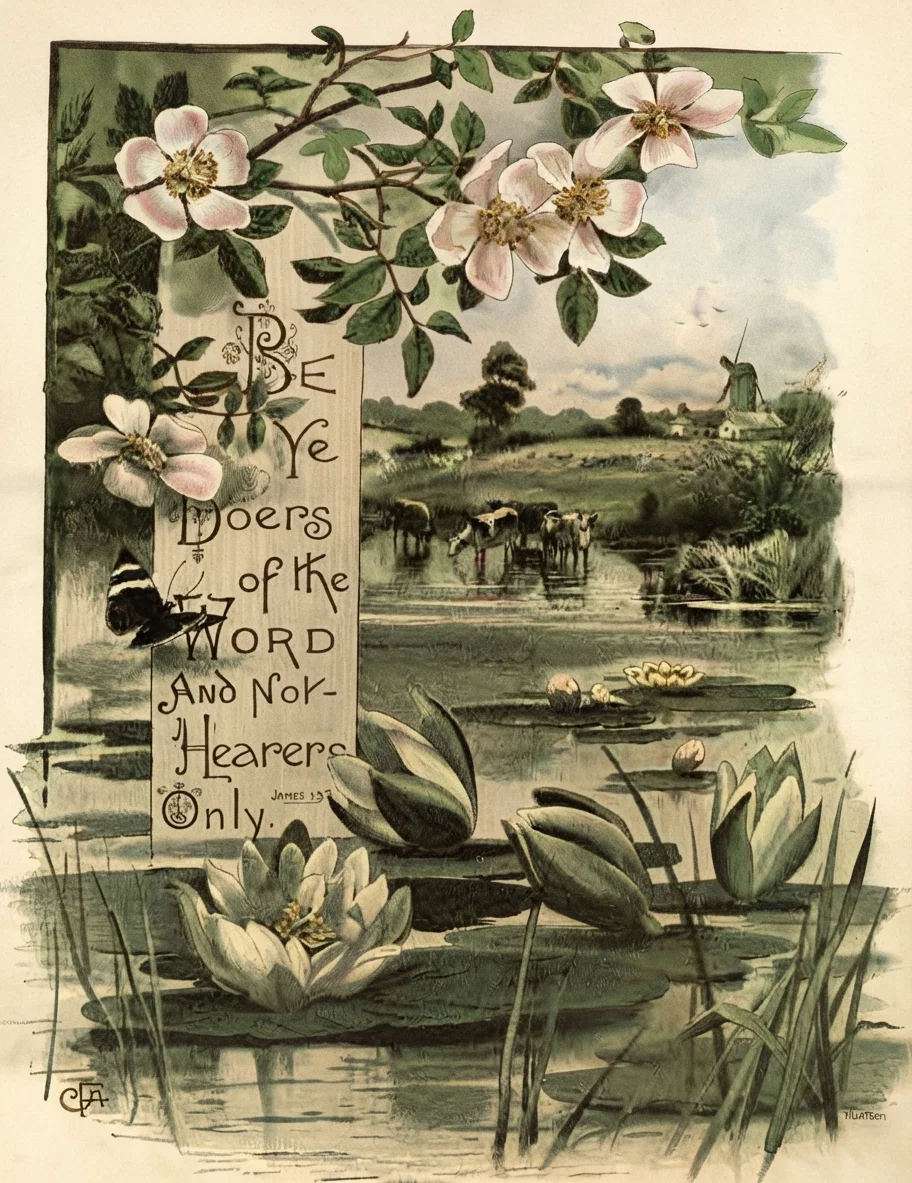
GOD asks of the sinner more than the sinner can do; but He is not thereby unjust.
THERE is no power in sinful man to do God's Word. In the language of the apostle Paul, we are "without strength." Again he tells us: "I know that in me (that is, in my flesh), dwelleth no good thing; for to will is present with me; but how to perform that which is good I find not." "What I would, that do I not." And every other soul has had the same experience.
THE reason?—Man is "carnal, sold under sin." He is a slave to do the will of the flesh. Sin is incarnate; and the mind is the mind of the flesh. One stronger must come in, in order that the strong man of sin may be destroyed.
THE "Stronger One" is Christ Jesus. He took our flesh, our condition, that He might meet sin as we meet it. He Himself said, "I can of Mine own self do nothing." But by living, momentary, constant faith He grasped the throne of the Infinite, appropriated by faith the Spirit of God, emptied Himself, and God, by His life, power, and wisdom, filled Him with "all the fulness of God."
GOD became incarnate in Jesus of Nazareth, united by Christ's own glorious renunciation of self and simple trust. And Jesus is our Example. He came to this earth and conquered sin in the flesh, that we in Him might conquer. "He was made of the seed of David according to the flesh," but conquered all sin, and was declared the Son of God with power by the resurrection. It was all accomplished through Him and in Him. He was the Doer of the Word for all.
FOR him who believes, Christ's righteous obedience covers all the sin of the past, and the power of His life, His resurrection life, fills the present. He comes to us in that glorious life in every providence we meet, in the beneficent gifts of nature, in His Holy Word. His life fills it; nay, more, the Word is itself life; for did He not say, "The words that I speak unto you, they are spirit, and they are life"?
HE, therefore, commands nothing which can not be obeyed. He does not command that we may endeavor and fail; but the command is itself an "enabling act" for the doing. When He says, "Be ye," there is power in the word to make us what He desires us to be, it we will let the word work out its life in us. When He says, "Be ye doers of the Word,"
there is power there for the doing. To the evil-disposed it is an impossible command, and his fleshly mind rebels against it; but to the heart which will yield and accept, it is a blessed promise, cast in "precept mold." It is cold law to the unbeliever; it is the blessed Gospel of power to the believer. God's law
was terror to unbelieving Israel; it was God's blessed glory to Moses, of which he desired a greater revelation. That law is hated by the carnal heart; "O how love I Thy law!" is the expression of the heart of faith. "Be ye doers," then, in the gladness of the Gospel of Christ. You will find a life unfolding in sunshine, even as the lily from the cool stream.
THE Gospel does not stop short of doing. True faith "worketh by love." "With the heart man believeth unto righteousness." The belief which stops short of this is that which demons share and tremble. We may count as ours apostolic succession, or the Nicene creed, or membership in some great church, or a blessing some time ago, or a happy feeling now, as excuses for not doing the plain Word of God. We may make one or all excuses avail for us, but they will not avail with God. "Be ye doers of the Word, and not hearers only, deceiving your own selves." "God is not
mocked." No act of man will change His immutable Word. No money of man will buy the Court of Last Resort. No influence of man will pervert the Judge. Why then be deceived? Why deceive ourselves? Why come up to the judgment-bar of God and say, "Lord, Lord," and hear Him say, "I know you not;" "why call ye Me, Lord, Lord, and do not the things which I say"? Why not, dear soul, why not look upon all God's precepts as blessed, Gospel-enablingacts, precious promises, full of the life and blessing and power of their Giver. Then, indeed, will you be glad “doers of the Word,” and will hear from His lips, “Well done, good and faithful servant.” “Blessed are they that do His commandments, that they may have right to the tree of life, and may enter in through the gates into the city.”

THE TRIUMPH OF THE SABBATH.

WE have seen that the Sabbath was ordained as a memorial of the Creator's perfect work before sin existed in the human heart, and that the reason assigned for Sabbath observance was that God's creative power might be thus continually kept before the minds of His creatures. We have also seen that after sin is eradicated from the heart by creative power, we have additional reason for observing the Sabbath, because we know more about the working of creative power than we did before. The more we know of God's power to create within us new hearts, the greater reason we have for keeping the Sabbath as a memorial of that power.
From this it is evident that when creative power shall have finally triumphed over all sin, and the plague-spot of a polluted earth shall have been purified by fire and re-created in the beauty of holiness, the reason for Sabbath observance will be stronger than ever. When the great Shepherd shall bring back this wandering world and restore it to the fold, and we shall behold a perfect creation, untarnished by the touch of sin, we will “remember the Sabbath day, to keep it holy,” as it returns each week on the wings of eternity, because we shall recognize that throughout the vast domain of the Creator His power is unquestioned; that planets, suns, and systems wheel on forever, unobstructed by the shadow of evil. “For as the new heavens and the new earth, which I will make, shall remain before Me, saith the Lord, so shall your seed and your name remain. And it shall come to pass, that from one new moon to another, and from one Sabbath to another, shall all flesh come to worship before Me, saith the Lord.” Isa. 66: 22, 23.
The Sabbath, like the Lord of the Sabbath, has been maligned, betrayed, and crucified, and like Him it rises again, “the same yesterday, and to-day, and forever.” We will love our Saviour more throughout eternity when we see the print of the nails in His hands, and remember the awful agony that rent His soul on Calvary. So the Sabbath will shine all the brighter in the sunlight of eternity because of the very storms of satanic wrath it has withstood while passing through the shadows of time.
Once when the destiny of a nation was in the balance, a brave officer gathered his shattered company into a gap that had been torn in the midst of the fortifications, and stood in a rain of fire until re-enforcements turned the tide of battle, and the long lines of the enemy, surging higher and higher up the slopes of the ridge, were seen to break like the waves on the beach. Where are the brave men who will stand in the gap that has been torn in the heart of God's holy law, until the Master comes with re-enforcements?
“Ye have not gone up into the gaps, neither made up the hedge for the house of Israel to stand in the battle in the day of the Lord.” “Her priests have violated My law, and have profaned Mine holy things, . . . and have hid their eyes from My Sabbaths, and I am profaned among them. . . . And I sought for a man among them, that should make up the hedge, and stand in the gap before Me for the land, that I should not destroy it; but I found none.” Eze. 13:5; 22:26-30.
The battle of the day of the Lord is on. Thousands are refusing to stand in the gap, and are trampling upon God's holy day. A few are heeding the call, and turning their feet away from trampling on the Sabbath. To such the Lord says: “Thou shalt be called, The repairer of the breach, The restorer of paths to dwell in. If thou turn away thy foot from the Sabbath, from doing thy pleasure on My holy day; and call the Sabbath a delight; . . . then shalt thou delight thyself in the Lord; and I will cause thee to ride upon the high places of the earth; . . . for the mouth of the Lord hath spoken it.”
GEO. A. SNYDER.

STONES CRYING OUT.

Thoughts from the Babylonian Section of the Museum, Pennsylvania University.

A SENSE of awe steals over the mind familiar with Bible prophecies, as one enters the Babylonian and General Semitic Department of the museum of the Pennsylvania University, said to be the best collection of these antiquities in the United States. They have been resurrected from the grave where God buried them twenty-five hundred years ago, and as we gaze upon the stony faces of "the Chaldeans, that bitter and hasty nation," and listen to the translation of their inscriptions, it is as if one rose from the dead to bear God’s message to the living, "that the living may know that the Most High ruleth in the kingdom of men." Dan. 4:17.
Opening my Bible at the first chapter of Daniel, I read of the conquest of Jerusalem by Nebuchadnezzar, king of Babylon, in the third year of Jehoiakim, king of Judah, B.C. 606: "And the Lord gave Jehoiakim king of Judah into his hand, with part of the vessels of the house of God; which he carried into the land of Shinar to the house of his god; and he brought the vessels into the treasure-house of his god." Daniel was among the captives.
All this seems but as of yesterday, as current history, while looking upon the numerous bricks, inscribed by Nebuchadnezzar himself, brought from the ruins of his temple at Babylon, probably the very temple where these vessels were treasured. In another case near by are the images of his gods.
Before me also as I write is an inscribed cylinder of Nebuchadnezzar, recording his repairs upon the tower of Babel, that most ancient monument of Babylon. The inscriptions upon the clay cylinders and tablets are in very finely-executed characters. Here are the seals with which they stamped their bricks, and a variety of smaller ones of lapis lazuli, and other beautiful stones for smaller documents.
Could these bricks talk, would they tell of the toil of the Jewish slaves? Did Daniel ever look upon these bas-reliefs in the halls of the palaces of Babylon? Did they echo the triumphal shouts of the returning armies that had conquered the world? and was the cry of suffering captives mingled with the shouts of victory?
Did these stony eyes of sculpture look down upon the scenes described in the book of Daniel? Did they see Nebuchadnezzar when his heart was lifted up in pride, deposed from his kingly throne, until he learned that "the Most High ruleth in the kingdom of men, and giveth it to whomsoever He will"? Did they see that hand that wrote upon the wall the awful sentence, "God hath numbered thy kingdom, and finished it"?
In this show-case are Babylonian jewels of finely-wrought gold, set with stones; pieces of golden chain perhaps similar to that which Belshazzar had put about the neck of Daniel for interpreting the fatal writing. Here is the crumbled fabric of a vail woven of threads of gold, which I am told was found covering the spot where once was a face in one of the sarcophagi.
The figures in alabaster also show this people to have been proud and haughty, dressing in garments fringed and richly ornamented. They were fierce, and luxuriated in the wealth of plundered nations, and exulted in their power to oppress.
Said Nebuchadnezzar to the three Hebrews, when he threatened them, "And who is that God that shall deliver you out of my hands?" Yet at length he learned to say, "Now I Nebuchadnezzar praise and extol and honor the King of heaven, all whose works are truth, and His ways judgment; and those that walk in pride He is able to abase."
Interesting among the objects is an inscribed Hebrew tombstone from the banks of the Euphrates. It recalls the captivity of this people, their servitude, and that touching psalm which says: "By the rivers of Babylon, there we sat down; yea, we wept, when we remembered Zion. We hanged our harps upon the willows in the midst thereof. For there they that carried us away captive required of us a song; and they that wasted us required of us mirth, saying, Sing us one of the songs of Zion." Ps. 137:1-3.
Thither also Seraiah came, and read the roll of Jeremiah’s prophecies, which foretold the utter desolation of Babylon, that it should become "heaps," "without inhabitant," etc. Chapters 50 and 51. And when he had read it he tied a stone to it, and cast it into the Euphrates, saying in the words of the Lord, "Thus shall Babylon sink, and shall not rise from the evil that I will bring upon her."
They no doubt also there read the prophecies of Habakkuk, given before the captivity, foretelling God’s visitations upon the works of the Chaldeans, "because of men’s blood, and for the violence of the land, of the city, and of all that dwell therein." Chapter 2:8. He declared of their city, "built with blood," that their stones should "cry out of the wall, and the fastening out of the timber witness against it." Verse 11, margin. They may even then have looked upon the buildings containingthese very stones and bricks. But could they have dreamed that in this far-off day men from England and the United States, with that same Bible as a guide-book, containing these very prophecies, would wander over the heaps of these buried cities by the Euphrates, and, digging up these stones, sculptured slabs, and broken inscriptions, bricks, necklaces worn by their proud and rich, pottery, sarcophagi, winged lions, and bulls, from the mounds of more than twenty centuries, would float them off to the other side of the world to London and Philadelphia?
But what does all this strange fulfilment of prophecy mean? Has it some connection with God's words to Daniel, "But thou, O Daniel, shut up the words, and seal the book, even to the time of the end; many shall run to and fro, and knowledge shall be increased"? And, again, "The words are closed up and sealed till the time of the end. Many shall be purified, and made white, and tried; but the wicked shall do wickedly; and none of the wicked shall understand; but the wise shall understand."
Are not these stones crying out a warning to the nations whither God has brought them? Are they not opening up to men's attention the wonderful experiences of the book of Daniel? "All flesh is grass," "but the word of our God shall stand forever."

A THANKSGIVING HYMN.

[S. E. Adams, in the Century.]
For bud and for bloom and for balm-laden breeze, For the singing of birds from the hills to the seas, For the beauty of dawn and the brightness of noon, For the light in the night of the stars and the moon, We praise Thee, gracious God.
For the sun-ripened fruit and the billowy grain, For the orange and apple, the corn and the cane, For the bountiful harvests now gathered and stored, That by Thee in the lap of the nations were poured, We praise Thee, gracious God.
For the blessing of friends, for the old and the new, For the hearts that are trusted and trusting and true, For the tones that we love, for the light of the eye, That warms with a welcome and glooms with good-by, We praise Thee, gracious God.
That the desolate poor may find shelter and bread, That the sick may be comforted, nourished, and fed, That the sorrow may cease of the sighing and sad, That the spirit bowed down may be lifted and glad, We pray Thee, pitying Lord.
For the blessings of earth and of air and of sky, That fall on us all from the Father on high, For the crown of all blessings since blessings begun, For the gift, “the unspeakable gift,” of Thy Son, We praise Thee, gracious God.

THE LIFE OF THE CHURCH.

"They continued steadfastly in the apostles' doctrine and fellowship, and in breaking of bread, and in prayers." Acts 2:42.
THIS verse brings to view four great characteristics of the early church, four great pillars on which the church in its pristine purity and simplicity rested,—love of the truth, love of one another, frequent remembrance of Christ, and constant prayer. Now, when we think how the primitive church lived on these truths with joy and gladness, and died for them in triumph, and when by way of contrast we consider how formal and spiritless a thing modern church life frequently is, we can not but be impressed that there has been a departure from the divine ideal. Evidently it will only be by an intense, earnest struggle that the church will ever get back the power of the truth which inspired those lowly disciples, whose daily life made such an impression upon the community that fear came upon every soul. The power of the truth must be measured by its effects, which show it to be almighty.
That was a time when all God's people were God's priests, when there was no proxy service of one for another, when all—men, women, and children—held themselves under personal obligation to sacrifice all for Christ. The spirit of sacrifice was not the privilege of the few, but the common heritage of all. "They loved not their lives unto the death." Rev. 12:11. As this refers to the remnant church, it is evident that there must be a returning to those early principles of sacrifice, if need be even unto death.
If the church be loyal to these principles, she will be a light to the world—not a glimmering, unsteady, flickering taper, but the glorious search-light of God, shining through the lives of her members, with all its penetrating intensity, into the darkest recesses of the human heart, not only revealing to itself its own misery and darkness, but revealing the tender, pitiful, loving Saviour, who said, "Ye are the light of the world." Matt. 5:14.
"Let your light so shine before men," etc. Verse 16.
Then if the church is a lighthouse, her light should be burning every day; if a rescue home, her boats should be manned every day; if a temple, her altars should be accessible every day. Has she healing power, let her go to the sick; if comforting power, let her be as an angel, ministering consolation to the sorrowing. If lifting power is hers, let her find those who have fallen, and reach far down into the lowest depths of misery and degradation with the omnipotent arm of love, and lift the wretched victims, and place their feet on the Rock, and establish their goings.
The church must not stand and beckon. She must go. Her ministry should be as penetrating as human misery and wretchedness, and as comprehensive as the pity of God. Her members should be swift to seek and to save that which was lost—lost anywhere and in any sense. The church which would be true to the principles announced by Christ, and exemplified in His life, must ferret out human sin, misery, and ignorance, and bring them to the light of the truth which she possesses. There must be a purpose to apply the whole Gospel to the whole man, to meet the people at every point of need—physical, intellectual, moral, and spiritual.
Christ's sacrifice for us necessitates a sacrificing church, whose ways of working adjust themselves to every new occasion, but whose spirit is as changeless as the Spirit of Christ. The mission of the church is to save the souls of men. It is her only mission, and should be her only thought. The good of doing is not felt by the recipient alone; it reacts upon the doer. The curse of men has been, and is now, to do for others by proxy. Let the church go and do as Christ did, and she will soon find that loving deeds are as potent as ever, that hard hearts are melted by the Christ-Spirit of love.
The true church does not wait for the people to come to her; she goes to the people, following the command of her Master, "Go out into the highways and hedges, and compel them to come in." Only as the church comes into personal touch with the people will she know what is best to do for them, and how best to do it. Should not more time be given to studying ways and means of winning souls? Every member of the church must do something personally to win souls; those who do not will rust out from inaction. The law which obtains in the physical world, that exercise is necessary to growth, is just as potent in the spiritual world. So if the church would grow, she must work. GEO. S. KNIGHT.

The Church’s Danger From Society

THE danger of the church to-day is from "society." The savage beasts of the arena may not be ready to leap from their dens upon the loyal followers of Jesus Christ, who would meet death rather than deny their Master, but the scorn, the hiss, the social "cut," are the means sometimes now employed by the same tempting and malicious spirit of the world, to compel Christians to surrender their convictions and principles at the demand of the prince of the power of the air. Let us stand by our principles. Let us follow conscience and not fashion, Christ and not the world.—J. H. Vincent.

Trouble’s Many Avenues

TROUBLE seems to have more than a thousand avenues through which to reach the heart.

Rich Toward God

"The only man who is really rich is he who is rich toward God."

BETWEEN STATIONS.

"Vanity Fair."

"WHAT did you get?" "We got a gold medal. What did you get?" "We only received a silver medal, but it was the highest award in our class." "And we received two silver medals, a diploma, and a twenty-five-dollar cash prize; but then you know we exhibited a number of things."
The above conversation took place in the pavilion of the State Fair at S., among the representatives of three commercial houses who had exhibited the different articles of their manufacture. The slight eagerness of the voice, the rapidly-uttered words, the dilated eye, and the flushed cheek all combined to show the satisfaction at having received the prizes for which all had worked so hard. Who knows of the hours and days of anxious thought and study spent in getting up the exhibit; and then of the long, weary days which followed during the fair, when they had stood explaining the merits of their different articles to the crowds of visitors each afternoon and evening? What a stimulus the announcement of the awards gave to tired eyes and aching heads, for the last night, which was to be the crowning event! How eagerly each awaited the coming of night, that he might announce to his friends and patrons the honors conferred on the house! They had won—O, wonderful little word of three letters!
How it has made the heart of warrior, politician, business man, student, lover, and even the little child hurrying home from school with a "reward of merit," beat faster at the thought of having done better than his fellows!
A little farther down the aisle stood the competitor of the man who had received the gold medal. How different was the drooping head, the dull eye, the pale cheeks of the man who had lost! He had worked just as hard as the other; he had stood just as many hours talking to the crowds; but only one could win the medal. He had lost. Another little word of four letters. How different the sentiments stirred by that word!
Such is the life we are now living. In all its battles, races, and competitions, only one can win; and even after it is won, others only await an opportunity to snatch the trophy from us.
But we are all entered in another contest, another race, another competition, where it is not only possible but certain that all may win; and the conditions are so easy!
"I am the way, the truth, and the life." John 14:6. "Believe on the Lord Jesus Christ, and thou shalt be saved." Acts 16:31. "And this is life eternal, that they might know Thee the only true God, and Jesus Christ, whom Thou hast sent." John 17:3. "All that the Father giveth Me shall come to Me; and him that cometh to Me I will in nowise cast out." John 6:37. "If ye then, being evil, know how to give good gifts unto your children, how much more shall your Father which is in heaven give good things to them that ask Him?" Matt. 7:11. "Ask, and it shall be given you; seek, and ye shall find; knock, and it shall be opened unto you." Matt. 7:7.
How incomparably greater is the prize offered the Christian to any offered by any worldly competition! The battle has already been won by Another; we simply go over the same battle-field, under the guidance of "Him who has trod the way before us." Victory is sure; the prize is within the reach of all. H. H. HAYNES.

LESSONS FROM MATTHEW 24

THE DESTRUCTION OF JERUSALEM—ITS MEANING TO-DAY.

As to the destruction of Jerusalem, we have seen that it was false ideas of the Sabbath, set against the true, that caused the nation of the Jews to reject, to persecute, and to seek to kill Jesus, and that it was this rejection of Him that caused that destruction. They rejected and slew Him, lest the Romans should come and take away both their place and nation; and their rejection and slaying of Him resulted in the Romans coming and taking away both their place and nation. Their rejection of the Sabbath of the Lord, and in that rejection, the rejection of Him who was and is the Lord of the Sabbath, caused the ruin of that nation.
It is not necessary here to enter into the details of the destruction of Jerusalem and that nation; that is well known; and, besides, our study here is to discover what bearing that has on the great subject of the second coming of the Lord and the end of the world. Let us follow this subject to its conclusion.

An Instrument of Destruction.

The instrument of the destruction of Jerusalem and the nation of the Jews, was the Roman armies: "When ye therefore shall see Jerusalem encompassed with armies, then know that the desolation is nigh." The only armies that there were at that time were the Roman armies; for "the empire of the Romans filled the world."
And the Roman armies encompassing Jerusalem in fulfilment of the words of Jesus recorded by Luke (Luke 21:20), was "the abomination of desolation, spoken of by Daniel the prophet, standing in the holy place," in fulfilment of the words of Jesus recorded by Matthew. Matt. 24:15.
Now the abomination of desolation—the Roman power—spoken of by Daniel the prophet, when once it enters upon the scene of history and prophecy, continues unto the coming of the Lord and the end of the world.
Notice that in Dan. 7:7-11 he beheld in the vision a fourth beast, a fourth kingdom, which is Rome, "dreadful and terrible;" "the beast had also ten horns." As Daniel considered the horns, there came up "another little horn, before whom there were three of the first horns plucked up by the roots; and, behold, in this horn were eyes like the eyes of man, and a mouth speaking great things."
Daniel beheld this "little horn" in its working and its speaking, "until the Ancient of Days come," and "the judgment was set, and the books were opened." And at the time of the judgment says he, "I beheld then because of the great words which the HORN SPAKE; I beheld even till the BEAST was slain, and his body destroyed, and given to the burning flame."
Note that he was beholding the "little horn." He was considering the "little horn." At the time of the judgment he beheld especially because of the great words which the "horn spake." And he beheld even till—the horn was destroyed?—No, but till "the beast was slain, and his body destroyed, and given to the burning flame." This makes it perfectly plain that the "little horn" is but the continuation of the beast, in another form; so fully is the "little horn" a continuation of the spirit and characteristics and power of "the beast," that when comes the time of the destruction of the horn, instead of saying that the horn was destroyed, he says THE BEAST was slain and destroyed. And this makes it perfectly plain that when the beast enters upon the scene, he continues, only under another phase, until the coming of the Lord and the end of the world.
Again: In Dan. 8:9-12, 23-25, this same power is again symbolized by a "little horn which waxed exceeding great;" and it continues clear through till the end of the world, when it is "broken without hand" in the setting up of the kingdom of God, when the stone cut out without hand breaks in pieces and consumes all kingdoms of earth, and it stands forever. And in this prophecy of Daniel 8 this power is directly referred to as "the transgression of desolation;" while in Dan. 11:31; 12:11 the same power is definitely called "the abomination that maketh desolate." And in all these places the connection shows that it continues unto "the time of the end," and even unto the end.
And again: In Dan. 11:14 there is marked the concurrence of events which calls into the field of prophecy and history the Roman power. And when the Roman power does enter the field, the Word says that it is done "to establish the vision"—"the children of robbers shall exalt themselves to establish the vision." This shows that the Roman power was the great object of the vision; that whatever was given preceding the rise of that power, was given only as certain stepping-stones unto the time when that power should rise; and that when this power was met, in its rise, the object of the vision was met—the vision was established. And when that power is once entered upon the scene, it continues, if not in one phase then just as certainly in another, till the time of the coming of the Lord and the end of the world.
Therefore, when Jesus cited "the abomination of desolation spoken of by Daniel the prophet," in that very thing He brought to mind that which would continue unto the coming of the Lord and the end of the world. And when Jesus cited this power in His discourse upon the sign of His coming and of the end of the world, this certifies that in the career of that power there is that which is instructive as to His coming and the end of the world. And when He cited this power as the one which would betray Jerusalem, then this certifies that in the destruction of Jerusalem there is that which is instructive as to His coming and the end of the world.
Now it was their rejection of the Lord Jesus that brought upon that people the destruction of their city and nation by the Roman power—the abomination of desolation. And by the plain showing of the Gospels we have seen that it was in rejecting the divine idea of the Sabbath of the Lord that they rejected the Lord of the Sabbath, and persecuted Him, and sought to kill Him, until they had killed Him, to save the nation from the Romans, but which only caused the nation to be destroyed by the Romans.
And then, at a later date in its history, this Roman power, this abomination of desolation, at the time of the development of the "little horn" of Dan. 7:8—this power itself rejected God's idea of the Sabbath, and set up wholly man's idea of it; rejected the true Sabbath and set up a wholly false one, even to the substituting of another day—Sunday—for the Lord's day, the Sabbath day which God had established and appointed. It was said by those who did it, "All things whatsoever that was duty to do on the Sabbath day, these we have transferred to the Sunday." Laws were enacted by the Roman power to compel all to accept the false idea of the Sabbath instead of the true. All who would observe the Sabbath of the Lord were "accursed from Christ," and whosoever did not accept the false, was held guilty of sacrilege and subject to penalties from the Roman power—the abomination of desolation.
And what was the consequence of this second course of rejecting the Sabbath of the Lord, and in that the Lord of the Sabbath? What came upon this second nation that did that thing?—It likewise was brought to ruin, and was swept from the earth as completely as was the nation of the Jews that first did that heaven-daring thing. The Roman Empire was as utterly ruined as was the Jewish nation.

A Lesson to the United States.

And now, in these last days, in these days when we know that the coming of the Lord "is near, even at the doors"—in these days "the abomination of desolation," the Roman power, exists in a different phase from that of the days of the destruction of Jerusalem, and also in a somewhat different phase from that of the days of the destruction of the Roman Empire. And in these days this abomination of desolation still insists upon the rejection of God's idea of the Sabbath, and the substitution of man's; the rejection of the true, and the acceptance, even by force, of the false. And in this heaven-daring thing, in this thing which has twice wrought, as a world-example, the ruin of nations, the abomination of desolation has gained the support of THE UNITED STATES.
The United States, as certainly as ever did Jerusalem, or as ever did Rome, has rejected God's idea of the Sabbath, and has accepted man's—"the man of sin;" it has rejected the true, and has set up the false, to be forced upon all people by the power of the State. In her legislation of 1893, God's idea of the Sabbath was read in His own words from His own Word, and then that was deliberately set aside and rejected, and one utterly false in every respect was accepted and established here by governmental recognition. This nation, as really as did Jerusalem, or as did Rome, in thus rejecting the Sabbath of the Lord, has in this rejected the Lord of the Sabbath.
And what must be the consequence? What only can be the consequence? Can this nation now fare any better than fared Jerusalem and Rome in doing the same thing? Can it be fairly hoped that she can fare as well as did they, since she has done this thing in the face of these two world-warning destructions? But how shall destruction come here for this heaven-daring offense? It came to Jerusalem by the Roman power. It came to the Roman Empire by the barbarians of the North. Whence can it come next in punishment of this last offense of the kind?—It comes in the brightness of the consuming glory of the coming of the Lord, and the armies of heaven following Him upon white horses, when out of His mouth goeth the sharp sword with which He shall smite the nations. Rev. 19:11-21; Joel 2:1-11. And this is why it is that the destruction of Jerusalem is a sign to the people of the United States to-day, and why it is a sign of the coming of the Lord and of the end of the world.
And when the "abomination of desolation," as it is to-day, Rome, as it is in its latest phase, shall have gathered to her principles and under her influence all the nations; and when, by theexample, and power, and influence of the United States the abomination of desolation shall have done this only the more effectually; and when by the power thus regained the abomination of desolation shall have accomplished once more and finally for her, to scatter the power of the holy people, and shall have made as effectual as possible the rejection of the Sabbath of the Lord, and in that the Lord of the Sabbath; then it is written, "All these things shall be finished." Dan. 12:7. And as that power will be universal, so the destruction will be universal—and this at the coming of the Lord; for this "abomination of desolation," this "man of sin," this "mystery of iniquity," is to be consumed "with the spirit of His mouth," and is to be destroyed "with the brightness of His coming."
And this is why it is that the destruction of Jerusalem is instructive of warning to all the people of the world to-day. And this is why it is that the destruction of Jerusalem is a sign, amongst the other "signs," of the coming of the Lord and the end of the world.
And now, is the time. "Get ready! get ready! get ready!"
ALONZO T. JONES.

THE GOSPEL.

1. WHAT is the Gospel?

"Good tidings of great joy . . . to all the people." Luke 2:10.
"The power of God unto salvation to every one that believeth." Rom. 1:16.

2. In what are the glory and power of God especially manifest?

"The heavens declare the glory of God; and the firmament showeth His handiwork." Ps. 19:1.

3. How did these things come into existence?

"By the word of the Lord were the heavens made; and all the host of them by the breath of His mouth."
"For He spake and it was; He commanded, and it stood fast." Ps. 33:6, 9.
"And God said, Let there be light; and there was light." Gen. 1:3.

4. In what person is manifest the power and wisdom of God?

"Christ the power of God, and the wisdom of God." 1 Cor. 1:24.
"For it was the good pleasure of the Father that in Him should all the fulness dwell." Col. 1:19, R.V.

5. In whom only are sinful men saved?

"For in Him [Christ] dwelleth all the fulness of the Godhead bodily, and in Him are ye made full." Col. 2:9, 10, R.V.
"Neither is there salvation in any other; for there is none other name under heaven given among men, whereby we must be saved." Acts 4:12.

6. How is He able to save us?

"For in Him were all things created, in the heavens, and upon the earth; . . . all things were created through Him, and unto Him." Col. 1:16, R.V.
"Without Him was not anything made that was made." John 1:3.

7. By what process does He save us?

"Wherefore if any man is in Christ, he is a new creature [a new creation]; the old things are passed away; behold, they are become new." 2 Cor. 5:17, R.V. See margin.
"For we are His workmanship, created in Christ Jesus for good works." Eph. 2:10, R.V.

8. By what agency does He make this new creation?

"For God, who commanded the light to shine out of darkness, hath shined in our hearts." 2 Cor. 4:6.
"Now ye are clean through the word which I have spoken unto you." John 15:3.
"The words that I speak unto you, they are Spirit, and they are life." John 6:63.

9. What illustration may be noted as an example of God's creative power in regeneration?

"And behold, there came to Him a leper and worshiped Him, saying, Lord, if Thou wilt, Thou canst make me clean. And He stretched forth His hand, and touched him, saying, I will; be thou made clean. And straightway his leprosy was cleansed." Matt. 8:2, 3, R.V.
He is as able to save now, and to "keep from falling," as He ever was.
"JESUS CHRIST THE SAME YESTERDAY, AND TO-DAY, AND FOREVER."
Continue reading: THE NEEDS OF THE HOUR