Your ShelfYour Projects

Signs of the Times, Vol. 26, No. 47.

BE YE DOERS
Earlier text: MILITARISM, IMPERIALISM, AND THE PAPACY

ALCOHOL; ITS HISTORY, AND ITS EFFECTS UPON SOCIETY.

By W. H. Riley, M.D., Superintendent of Colorado Sanitarium, Boulder, Colo.
[All rights reserved.]

Consumption of Alcohol.

(Concluded.)
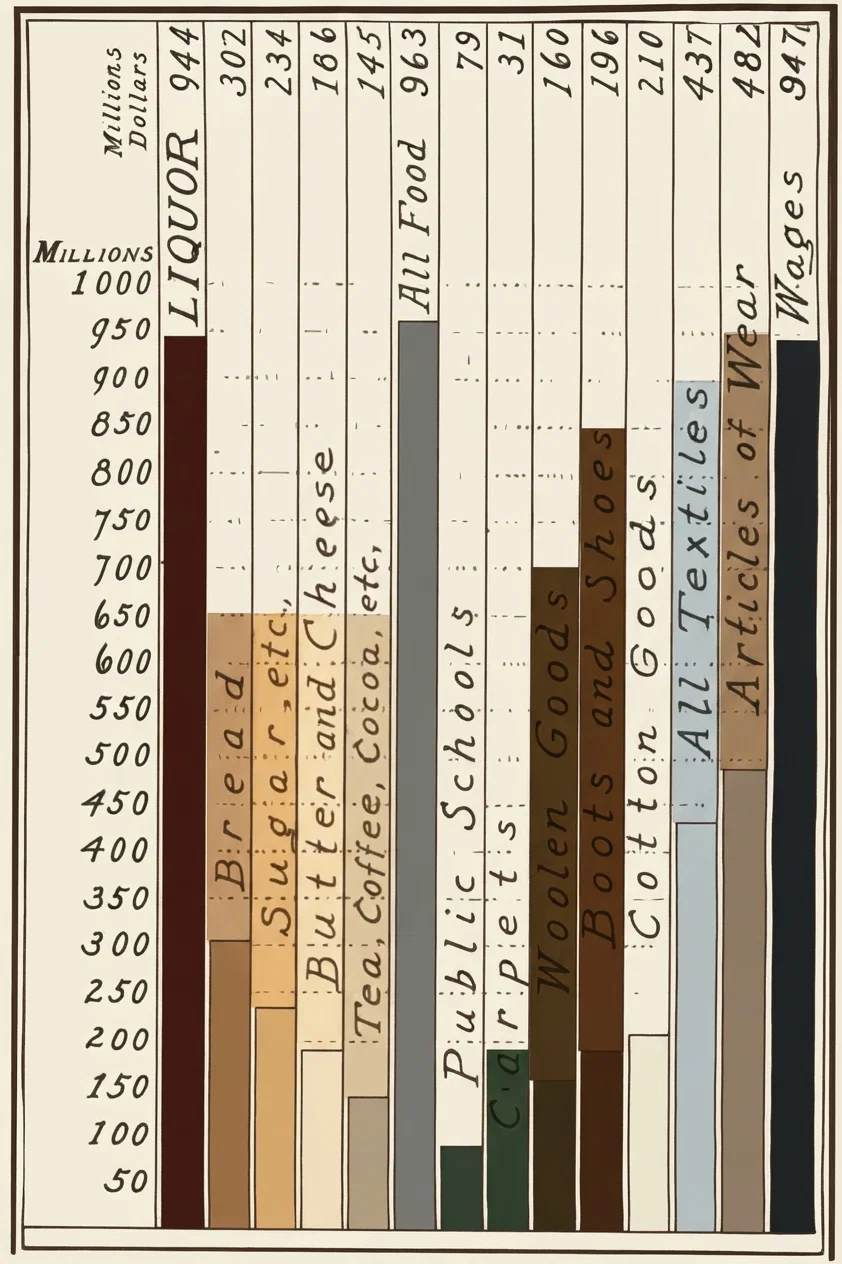
WE here give a diagram of Dr. Hargreaves, comparing expenditures for intoxicating drinks in 1883 with the chief items of expenditure for necessaries of life and wages paid for mechanical and manufacturing industries in 1880.
The following is a diagram for 1895, by Geo. B. Waldron, statistical editor of the Voice.

How We Spend Our Money.

This is in our own country alone; and as alcoholic beverages are known and used throughout the world, the consumption is something prodigious. According to an estimate by Mr. William Hoyle, of London, there was spent in Great Britain in 1882 the sum of $614,000,000, or $85 per family. He computes the wealth which would have accrued, if the money spent for liquor from 1830 to 1882 had been saved and invested at 5 per cent. interest, at $71,000,000,000. This is twenty times the national debt of Great Britain, forty-seven times more than our own, and four times the amount of the national debts of all Europe and America. For 1896 the national drink bill was $714,000,000.
In France, the land of wines, the consumption of distilled liquors averages 1.24 gallons per capita, as in the United States, while the amount of wine is 23.92 gallons, and the drink habit is increasing. Mr. Rochard, at a meeting of the Acadamie de Médecine in 1887, reported that the consumption of alcohol had doubled in forty years, and that alcoholism had increased enormously. The population of the country seems stationary, and the French army gives evidence of great national physical deterioration. So grave is the situation that the government has appointed a national commission of inquiry with a view to the removal of the national curse.
The German people average 23 gallons of beer per capita. Sweden has consumed as much as 30,000,000 gallons of ardent spirits annually, and the tax on brandy is the principal item in the revenue of Russia. Other nations do not use as much as these more "civilized." Yet if we count the entire world as using twice as much as Great Britain, France, Germany, and the United States, with a combined population of about one-eighth that of the globe, the cost in one year is $7,000,000,000, which sum, in twenty-dollar bills, would reach once around the earth, with enough left to go around again in ten-dollar bills.

LITTLE WORRIES.

WE have read of a battle against cannibals gained by the use of tacks. They had taken possession of a whaling vessel, and bound the man who was left in care of it. The crew, on returning, saw the situation, and scattered upon the deck of the vessel a lot of tacks, which penetrated the bare feet of the savages, and sent them howling into the sea.
We brace ourselves up against great calamities; but the little tacks of life, scattered along our way, piercing our feet and giving us pain, are hard to bear.
A gentleman was once absorbed in studying the question of socialism, when his wife came in, with despair in her face, and wanted advice about the servants.
"O, my dear," he replied, "I can not give my time to little matters like domestic service! I am trying to solve the social problem of the universe."
"Well," replied the wife, "you solve the problem of the kitchen, and I will promise you to solve the problem of the universe in twenty-four hours."
Really it is much easier to dispose of those great questions which cover the world than it is to meet and successfully overcome the little worries which present themselves day by day. —A. C. Dixon.

Suffering Before Glory

"We must taste the gall if we want to taste the glory; if justified by faith we must suffer tribulation. When God so saves a soul, He tries it. Some believers are much surprised when they are called to suffer. They thought to do some great thing for God, but all He permits them is to suffer for His sake."

GOLD STANDARD

NO. 27.

This pen is made from the best pen steel by the most experienced workmen. The coating with real gold prevents rusting, gives a smoothness to the points, and can easily be kept clean and bright, as the ink does not adhere to the metal as with plain steel pens.
Sample box, 12 Pens, sent post-paid on receipt of 10 cts. Ask for No. 27.
SPENCERIAN PEN CO.
349 Broadway, New York.

Santa Fe Route

Only line with its own tracks from San Francisco to Chicago. Through Pullman Palace and Tourist Cars leave every morning at nine o'clock.
PERSONALLY CONDUCTED Tourist Excursions every Monday, Thursday, and Saturday, in Vestibuled Tourist Cars.
The service on these Personally Conducted Excursions, in all that counts for comfort and convenience, is equal to the Palace Cars, and for elegance in finish and interior furnishings they are very pleasing. The wood-work is finished in imitation of mahogany, the seats are upholstered with clean, cool rattan with extension backs, as in the Palace Cars. A porter is in charge of each car to attend the wants of passengers. Clean linen and bedding, the proper lavatory and toilet accommodations are provided. These cars are built on the same plan as the Palace Cars and in the day the beds become comfortable seats. The aisles are carpeted and the windows double, to keep out the dust, and wide to allow an unobstructed view of the scenery en route.
Full information regarding the Santa Fe Route, with handsome folder and correct map of the section through which it runs, may be had at the Company's offices. Call or write 1118 Broadway, Oakland 641 Market Street, San Francisco

The Effects of Eating Flesh Meat

Dr. Alexander Haig, the eminent specialist, of London, England, says: "The less animal flesh that people take, the better they come out in trials of force production, and especially in endurance;" and medical authorities everywhere are agreed that the eating of flesh meats is a prolific source of cancer, chronic rheumatism, and gout.

SANITAS NUT FOODS

The Most Remarkable Dietetic Discoveries of the Century

Do away with the risks incurred by meat-eating. They are not substitutes for anything, but are nature's original foods, imparting vigor, health, and mental activity, and making life worth living. For 10 cents in stamps to pay postage, we will send you free, samples, recipe book, and a copy of the Nut Cracker. Ask your grocer for our foods.

SANITAS NUT FOOD CO., Ltd.

110 WASHINGTON AVE., N. Battle Creek, Mich.
AGENTS FOR THE PACIFIC COAST
St. Helena Sanitarium Health Food Co.
St. Helena, Cal. 1422 Market St., San Francisco, Cal.

Poultry Extra Quality

Barred Plymouth Rocks, Black Langshans, Fancy White Wyandottes—three best breeds, Poultry Extra Quality. Prices reasonable, satisfaction guaranteed, circular free.

C. H. Tyrrell

SIOUX RAPIDS, IOWA

A New Collar

Send 25 cents for a sample of our New Composition Rubber Collars, ladies' or gentlemen's. State size and style desired.
Be sure to send a 2-cent stamp for our

Buyers' Guide and General Merchandise Catalogue

Our prices on Strictly High-grade Guaranteed Goods will induce you to investigate

The Life Boat Supply Dept.

1926 WABASH AVE.
CHICAGO ILLINOIS

VIRGINIA HOMES.

You learn all about Virginia lands, soil, water, climate, resources, products, fruits, berries, mode of cultivation, prices, etc., by reading the Virginia Farmer. Send 10 cents, for three months' subscription, to FARMER CO., Emporia, Va.

Wanted: Lady Agents and Men

Wanted.—Lady agents at once. Credit given to those that furnish references. Good men wanted also. New article—sells fast—pays big profit. W. S. Dann, 1509 Burt St., Omaha, Neb.

Wanted: A Man Teacher

Wanted.—A man teacher at once, in a private school in the East. Must have good recommendations from a reliable source as to Christian character and scholarship. Must observe the seventh day as Sabbath. Fine opportunity for an advanced student to fit himself for something higher. Address, Post Office Box 56, Princeton, Worcester Co., Mass.

THE ATONEMENT.

AN EXAMINATION OF A REMEDIAL SYSTEM, IN THE LIGHT OF NATURE AND OF REVELATION.

BY ELD. J. H. WAGGONER.
THIRD EDITION, REVISED AND GREATLY ENLARGED.
THIS work is a critical and exhaustive treatise on the plan of salvation as revealed in the Scriptures, showing its harmony with the principles of justice and mercy, its consistency with reason, and its final results as affecting the destiny of the human race. 368 pp.; cloth, $1.00.
Address. PACIFIC PRESS, Oakland, Cal.

Wonders OF THE 19TH CENTURY

Is a 32-page tract. Its object is to recount and describe some of the principal inventions of this closing century, and to show their significance.
It contains fifteen illustrations. Is an easy seller. Price, 5c each or $2.00 per 100.
PACIFIC PRESS PUBLISHING CO., Oakland, Cal. New York City Kansas City, Mo.

The Winning of Margaret

How Margaret and her skeptical friend Ralph were converted. A well-told story.
Price, $1.00 per 100.
PACIFIC PRESS PUBLISHING CO.
New York City Oakland, Cal. Kansas City, Mo.

Living by Faith

"Living by Faith." (Spanish.) A translation of Bible Students' Library No. 75; 16 pp.; price, 2 cents. Address, PACIFIC PRESS PUBLISHING CO., Oakland, Cal.

Don't Say

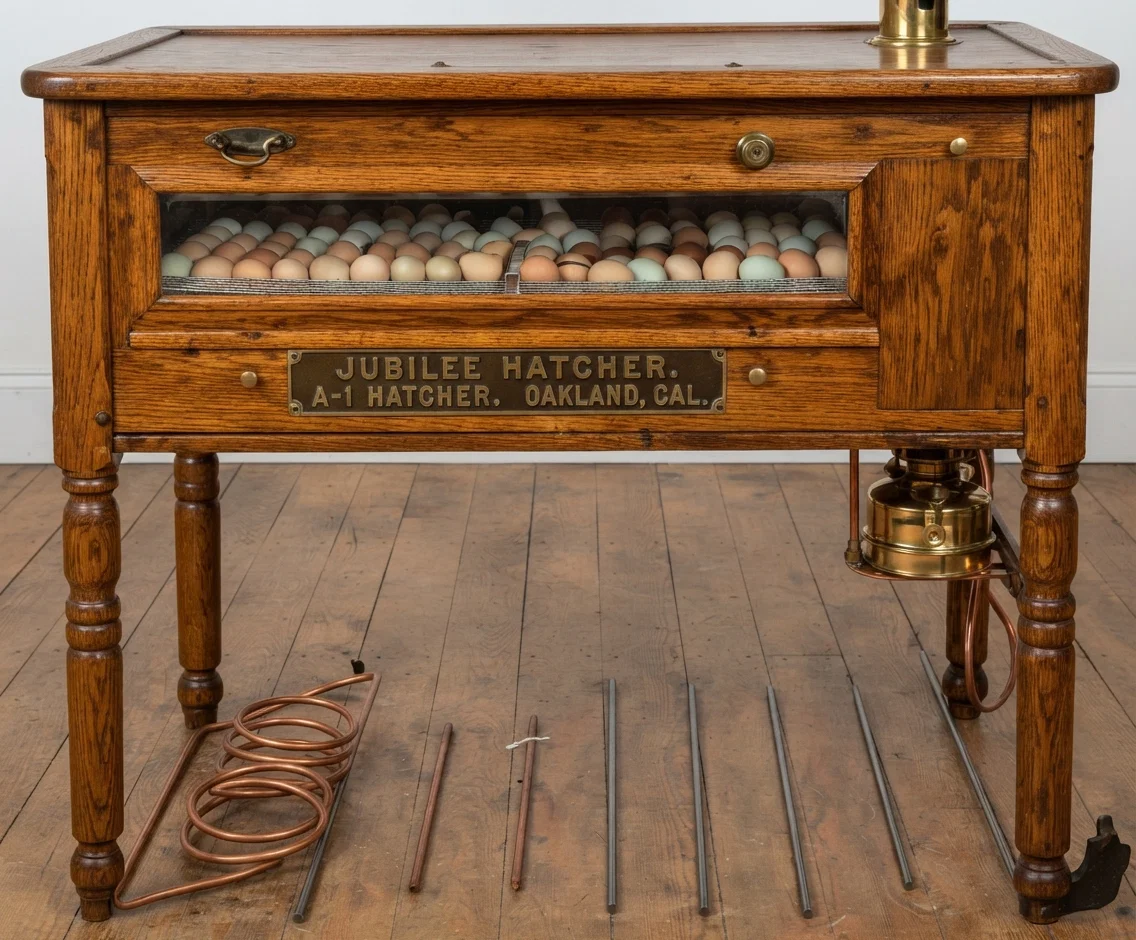
Incubators are a fraud just because you bought a cheap-john machine that was absolutely no good. Ninety per cent. of our customers are dissatisfied users of other makes. We make a specialty of repairing the hurt feelings of those who were afflicted with "Non-Hatchers." The results of the first hatch with a Jubilee will act as a powerful tonic on your system, and you will champion the cause of the best of incubators. The treatment is not as expensive as patent medicine, and you will not regret the expenditure. If you are ailing on the incubator question and desire a remedy, write for our catalogue.
JUBILEE INCUBATOR CO. 517 Thirty-second Street – Oakland, Cal.

ROMANISM AS SEEN IN ROME.

We naturally look to Rome for both the head and the heart of the Roman Catholic religion. Logically we would expect to find both in the city of the pope and the propaganda; for to this head center all Catholics look and point as the court of last resort. On the rule that the tree is known by its fruit, we look to Rome for that which Rome itself would exhibit as the best results of the system. Then, as showing the fruit raised in the home garden, we give the following article, contributed to the Missionary Review by Miss M. E. Vickery, of the Methodist Young Ladies' College of Rome:—
"I have to do with children and young people, but I find that all that they have ever known of religious life has been a mumbling over of beads and bowing low before shrines and images. What tho these statues of marble and painted plaster be called the Virgin Mary, the Child Jesus, or by the name of some saint! The people are ignorant of Bible history, know nothing of the life and doctrine of Christ, and would pray with as much ardor to any idol put before them. In fact, the great miracle-working Madonna of Rome, worshiped in the Church of St. Augustina, is only a pagan statue of the wicked Agrippina with her infant Nero in her arms. Covered with jewels and votive offerings, her foot encased in gold, because the constant kissing has worn away the stone, this haughty and evil-minded Roman matron bears no possible resemblance to the pure Virgin Mary; yet crowds are always at her foot worshiping her. The celebrated bronze statue of St. Peter, which is adored in the great Church of St. Peter, and whose foot is entirely kissed away by the lips of devotees, is but an antique statue of Jupiter, an idol of paganism; all that was necessary to make the pagan god a Christian saint, was to turn the thunderbolt in his uplifted right hand to two keys, and put a gilded halo around his head. Yet, on any church holiday, you will see thousands passing solemnly before this image (arrayed in gorgeous robes, with the pope's miter on its head), and, after bowing before it, rise on their toes and repeatedly kiss its foot.
"How can there be any spiritual life in a religion that consists only in hearing mass in a language not understood by the common people, in repeating prayers learned by rote, as children, and attending confessional, where the priest's questions are only a prying into private life? The Bible has ever been a forbidden book, and a good Roman Catholic dare not even think for himself on religious questions; he must accept what the priest says as the final and only truth. He dare not approach God directly, but only through saints, and he thinks of God as an angry judge, that only, Mary can command to be clement and merciful to weak men.
"How often, after talking with some of the women, have I despaired of ever making them understand spiritual things! They think the saints, the Blessed Virgin, and even the infant Christ (they are taught that the Virgin ascended to heaven with the infant Jesus in her arms), like the pagan gods, can be deceived by outward devotion or their favor bought by some sacrifice.
THE MAUSOLEUM OF THE ROMAN EMPEROR HADRIAN,
"In one of the three hundred and eighty-five Roman churches is an image of St. Anthony, the great saint of Padua. On one side of the statue is an iron box for offerings in money, and on the other side is a letter-box. Last Easter eve I saw the monks empty the money-box, and it required three of them to drag away the heavy sack of coin. There are always many young women to be seen before this image; for St. Anthony is the patron of marriages, and many a timid confession of love is dropped into the letter-box, and it often happens that a marriage is arranged as a result. The superstitious maiden believes that her letter goes directly to the saint in his heavenly mansion, and she has no suspicion that it is read by the parish priest.
"Yesterday I watched the Sacro Bambino (holy baby) being carried in a pompous procession to its carriage, and then hastily driven—to the bedside of some ignorant Roman woman?—No, to the bedside of a prince of the church, one of its boasted intellectual lights, Cardinal Jacobini, the cardinal vicar of Rome, only second to the pope in spiritual authority. Does it seem possible that such things could occur in Rome in this the last year of the nineteenth century?
"It is claimed that the bambino, the wooden doll, was carved and painted by the angels in the exact image of the infant Jesus, and that its mere presence in a sick-room will heal the most desperate cases. A large sum of money, however, must be given to the monks before it is allowed to leave its iron safe to visit a dying person, and guards go with it, for fear that it might be robbed of the earthly treasures, the diamonds, rubies, necklaces, rings, and bracelets with which it is completely covered. When taken into the sick-room, if its face glows, it is a sign that the patient will get well; if it turns pale, it means that God does not will the person to live. It turned pale for the cardinal, so to-day we hear of his death. When the highest spiritual authority puts all his faith in a gaudily-painted doll, what can we expect from the ignorant people, who get all their light from him?
"A dense cloud of paganism and immorality cuts off the vision of the Sun of Righteousness from the Italian people. One must begin with tearing down and destroying superstitious and base ideals of divinity, before he can hope to reach the hearts of these people, and lead them into the true light.
"The so-called 'holy year' has brought crowds of these ignorant, superstitious pilgrims to Rome. One has only to look into their faces, full of worry, fear, and superstition, to see what the Roman Church does for the masses—not a gleam of hope or intelligence in their eyes. They crowd into the churches to see pagan ceremonies. They kneel before the priest, and are touched with a rod, thus having their petty sins forgiven. They crowd into St. Peter to see the pope and his gorgeous court, devoutly kneeling as the procession passes. They crawl up the holy stairs on their knees (the same stairs that Martin Luther was ascending when the Spirit told him, 'The just shall live by faith'), but nothing brings a ray of joy or smile of peace to their troubled faces. Patiently they go through the allotted duties of this jubilee year, repeat the prayers over and over, and confess 'every day—all for the vague hope of shortening by several thousand years the long, long time they must pass in purgatory."
MISSIONS
MISSIONS

THE MORAL WARFARE.

Our fathers to their graves have gone; Their strife is past, their triumph won; But sterner trials wait the race Which rises in their honored place,— A moral warfare with the crime And folly of an evil time.
So let it be. In God's own might We gird us for the coming fight, And, strong in Him whose cause is ours, In conflict with unholy powers, We grasp the weapons He has given,— The Light, and Truth, and Love of heaven. —J. G. Whittier.

THE SABBATH SCHOOL

LESSON X.—SABBATH, DECEMBER 8, 1900.

THE BLESSEDNESS LOST.

Lesson Scripture, Gal. 4: 8-18, R.V.
8 "At that time, not knowing God, ye were in bondage to them which by nature are no gods; but now that ye have come to know God, or rather to be known of God, how turn ye back again to the weak and beggarly rudiments, whereunto ye desire to be in bondage over again? Ye observe days, and months, and seasons, and years. I am afraid of you, lest by any means I have bestowed labor upon you in vain. 12 I beseech you, brethren, be as I am, for I am as ye are. 13 Ye did me no wrong; but ye know that because of an infirmity of the flesh I preached the Gospel unto you the first time; 14 and that which was a temptation to you in my flesh ye despised not, nor rejected, but ye received me as an angel of God, even as Christ Jesus. Where then is that gratulation of yourselves? for I bear you witness, that, if possible, ye would have plucked out your eyes and given them to me. 16 So then am I become your enemy, because I tell you the truth? 17 They zealously seek you in no good way; nay, they desire to shut you out, that ye may seek them. But it is good to be zealously sought in a good matter at all times, and not only when I am present with you."

SUGGESTIVE QUESTIONS.

(1) In what state were the Galatians before their conversion? Compare verse 8 with Eph. 2: 11, 12. (2) What did they at that time serve? (3) With whom had they become acquainted? (4) Yet to what were they turning again?—Compare the apostle's questions, "How turn ye again," etc., with Jer. 2: 11-13. (5) What words in verse 9 indicate that the Galatians were taking up some of their old idolatrous customs? (6) What were some of them? (7) Where do we find any of these things spoken against? (8) What fear did the apostle express? (9) How did he appeal to them? (10) What did he say they had not done to him? (11) To what experience did he refer them? (12) Under what circumstance did Paul first preach the Gospel to the Galatians? (13) How did they receive him at that time? (14) How did they regard his infirmity? (15) How devoted were they to him? (16) Yet how did they now seem to be regarding him? Verse 16. (17) Who had changed, he or they? (18) What did the new teachers desire to do to them? (19) Where is zeal a good thing? (20) At what time?

NOTES.

1. THE apostle did not feel personally affronted because the Galatian brethren had turned away from that which he had taught them. It was wholly a matter between them and God, and he was solicitous only for their welfare. They were departing from God, not from Paul. They were injuring only themselves. The true servant of God will not feel elated when men accept the Gospel at his mouth, nor cast down when they reject it. Truth does not belong to any man, and therefore no man has any business to have personal feelings over the way in which people regard it. The failure to recognize this fact has led to untold persecution. Men have felt as tho they were personally insulted if people did not believe what they taught; and the most of the persecution that has existed in the world has been the resentment of offended dignity.
2. ALL the best translations have "because," or its equivalent, in verse 13, instead of "through," as in our ordinary version. What a flood of light upon Paul's labor among the Galatians we get from these few sentences! He was in great bodily affliction and physical pain when he first preached the Gospel in Galatia. Not only so, but that infirmity was the cause of his preaching the Gospel at that place. It is evident from his statement that he was obliged to stop in Galatia on account of physical infirmity, but instead of spending the time looking after his own comfort, he took advantage of the circumstance to preach the Gospel; and he evidently did it with the more vigor because of his infirmity. See 2 Cor. 11: 23-30; 12: 7-10. What a marvel of the power of Christ in man that can use even his times of greatest physical weakness as an occasion for accomplishing the greatest work! Here, also, we see another proof that the Gospel does not depend upon man, but on God. It is not of the flesh, but of the Spirit.
3. COMPARING these verses with Gal. 3: 1-5, we shall see that the Galatians had had no ordinary experience. Paul's preaching was "in demonstration of the Spirit and power" (1 Cor. 2: 2-4), just because he had no power of his own. Christ was set before them so vividly that they could see Him crucified; the Spirit was administered to them, and received, miracles were wrought among them, expressions of rejoicing in God were heard from all, and they had suffered persecution for their faith. All these things are distinctly stated in this Epistle; see if you can recall them.
4. WHILE the Galatians received the truth directly from Christ crucified, they did not despise the humble instrument that the Lord used. They received him as an angel of God, even as they would have received the Lord. Christ said, "He that receiveth you, receiveth Me." Paul's affliction was evidently such that it made him personally very unattractive. Compare verse 14 with 2 Cor. 10: 10. That the seat of the difficulty was the eyes, is apparent. But this made no difference with the Galatians. The blessed Gospel he brought to them transfigured him in their eyes, and so it did in reality; for real beauty is of the soul, not of the body. "The beauty of the Lord" was in Paul. The gracious words that he spoke more than made up for his unsightly appearance. No sacrifice was too great for the Galatians to make, and this they would do as unto the Lord.
5. BY the memory of all the blessedness and joy of their first faith, Paul appeals to the Galatians. He contrasts their former experience with the present. Where is now the blessedness? Where are their joyful testimonies of praise? Ah, the new teaching has changed all that! They could tell by their own experience that there was a vast difference between the Gospel which they received through Paul and the false gospel which they were now receiving.
6. THE kingdom of God is "righteousness, and peace, and joy in the Holy Ghost." Rom. 14: 17. Persons who have been truly converted know what joy and peace filled them at that time. But most people seem to have the idea that that joy can not last; that it must necessarily pass away, as they take up the monotonous round of daily duties, and these stretch out into years. Their Christian life becomes a sort of treadmill experience. That is a great mistake. Jesus said, "These things have I spoken unto you, that My joy might remain in you, and that your joy might be full." John 15: 11. The path of the just shines more and more until the perfect day. Christ never leaves us nor forsakes us; He abides with us to the end, and in His presence there are rest and fulness of joy. Ex. 33: 14; Ps. 16: 11. The giving of the Holy Spirit is the anointing with "the oil of gladness." God gives "the oil of joy" in place of mourning, the garment of praise for the spirit of heaviness. Isa. 61: 1-3, 10. The fountain of life from God never runs low. If, therefore, you find that your joy in God is growing less in your experience, do not rest content in any such condition. Know that any teaching, any doctrine, that does not bring gladness into your heart, and give you strength and courage for daily life, is not the good news of Jesus.

LESSON XI.—SABBATH, DECEMBER 15, 1900.

BONDAGE AND FREEDOM.

Lesson Scripture, Gal. 4:19-26, R.V.
19 "My little children, of whom I am again in travail until 20 Christ be formed in you, yea, I could wish to be present with you now, and to change my voice; for I am perplexed about you. 21 "Tell me, ye that desire to be under the law, do ye not hear 22 the law? For it is written, that Abraham had two sons, one 23 by the handmaid, and one by the freewoman. Howbeit the son by the handmaid is born after the flesh; but the son by the 24 freewoman is born through promise. Which things contain an allegory; for these women are two covenants; one from Mount Sinai, bearing children unto bondage, which is Hagar. 25 Now this Hagar is Mount Sinai in Arabia, and answereth to the Jerusalem that now is; for she is in bondage with her 26 children. But the Jerusalem that is above is free, which is our mother."
NOTE.—This much-discussed portion of Scripture is really the simplest and most direct of any part of this Epistle. There is no possibility of misunderstanding it, if we but give heed to what is said, and hold ourselves to it. Of course it is necessary to be familiar with the incident in Abraham's life, to which the apostle refers; so we should refresh our minds by reading Gen. 16; 17:15-21; Heb. 11:11. We have this week only a part of the lesson that the apostle draws from the life of Abraham, and so must wait until next week to get the complete view; but if the verses that we have before us are thoroughly mastered, we shall find no trouble. See that not a thought escapes you.

SUGGESTIVE QUESTIONS.

(1) In what affectionate manner does the apostle address his hearers? (2) In what words does he show his intense anxiety for them? (3) For what was he so burdened in their behalf? (4) What did he desire? (5) In what state was he concerning them? (6) What direct question does he ask? (7) What were some desiring? (8) This being so, what is intimated that they were not hearing? (9) What is written concerning Abraham? (10) Of whom were these two sons born? (11) How was the son of the bondwoman born? (12) How was it with the son of the freewoman? (13) What does this history contain for us? (14) What are these two women? (15) For which covenant does Hagar stand? (16) To what does that covenant bring forth? (17) What is Hagar? (18) To what does Hagar, or Mount Sinai, answer? (19) In what state is old Jerusalem? (20) Who are in the same condition with her? (21) What about the Jerusalem which is above? (22) Whose mother is she? (23) Being free, to what must she bring forth?

NOTES.

1. "My little children." Very affectionately does the apostle deal with the erring Galatians, not as a matter of policy, but because he loves them as a mother loves the children whom she has brought forth in pain. In his labor in the Gospel, the apostle Paul gave himself, his own life, for souls, even as Christ did. Whoever labors in that way, will never deal harshly with any wanderer.
2. THE Galatians were in a doubtful position. They wanted salvation, yet they were choosing destruction. They were deliberately putting themselves under the law, in a state of condemnation, and that because they were ignorant of the law. Compare Gal. 3:10. The man who sets himself to get righteousness by the law, places himself under the curse, just as surely as the man who deliberately rejects it and tramples upon it.
3. "Do you not hear the law?" The law certainly speaks loud enough. Read Ex. 19:16-24. It spoke only death. By itself, outside of Christ, it is only the ministration of death. Every feature of the giving of the law from Sinai, every word, every lightning flash, and every thunderbolt, together with the fire and the earthquake, said most plainly, "There is no righteousness, but only condemnation and death, to be obtained by the works of the law." The inheritance of righteousness is not by the law, but by promise. Compare Gal. 3:18.
4. THIS was demonstrated in the case of Abraham. He made a great mistake and attempted to fulfil God's promise. A son had been promised him,—a true free-born son who could be his heir. It had been expressly stated that a servant could not be his heir. Gen. 15:2-4. Nevertheless, he hearkened to the voice of Sarai, instead of to the Lord, and took Hagar, Sarai's Egyptian bondmaid, by whom he had Ishmael. But since Hagar was a bond-servant, a slave, Ishmael could be nothing else. So Abraham had gained nothing. Afterwards Isaac, the child of promise, was born. He was free, and could inherit all that Abraham had. The history is so plain that no one can misunderstand it. The application is equally plain.
5. THESE two women, Hagar and Sarah, represent two covenants, known respectively as the first and the second, the old and the new. One originates at Mount Sinai, the other in the New Jerusalem above. In the first one the people promise to keep the law; in the second one God promised to write the law in their hearts by His Spirit. The first one can give nothing but bondage, condemnation, and death. The other gives pardon, justification, and life. The old Jerusalem is in bondage, together with all that look to it for help. Mount Sinai itself—the law for which it stood as the emblem—could never give freedom. It only, with thunder tones, warns people not to depend on works for righteousness, and drives them back to the promise and the oath of God.
6. JERUSALEM above is free, and is the mother of all who are of the faith of Abraham: "for he looked for a city which hath foundations, whose builder and maker is God." Heb. 11:10. Here we may come and be adopted as free-born citizens. "For ye are not come unto the mount that might be touched, and that burned with fire, nor unto blackness, and darkness, and tempest, and the sound of a trumpet, and the voice of words; which voice they that heard entreated that the word should not be spoken to them any more; for they could not endure that which was commanded. And if so much as a beast touch the mountain, it shall be stoned, or thrust through with a dart; and so terrible was the sight, that Moses said, I exceedingly fear and quake). But ye are come unto Mount Sion, and unto the city of the living God, the heavenly Jerusalem, and to an innumerable company of angels, to the general assembly and church of the first-born, which are written in heaven, and to God the Judge of all, and to the spirits of just men made perfect, and to Jesus the mediator of the new covenant, and to the blood of sprinkling, that speaketh better things than that of Abel." Heb. 12:18-24.
Continue reading: OUR WORK AND WORKERS