“The Continual” and “The Transgression of Desolation”
By E. J. Hibbard
That antichrist should “think to change times and the law” of the Most High, as revealed in Dan. 7:25, is quite commonly known.
But that the same power should pervert the entire Gospel, as outlined in Dan. 8:9-12, is not so generally known. It therefore seems fitting that this subject receive its share of attention.
But before we begin the consideration of the verses above mentioned, let us note briefly what precedes, and then we shall know how and where to apply the prophecy.
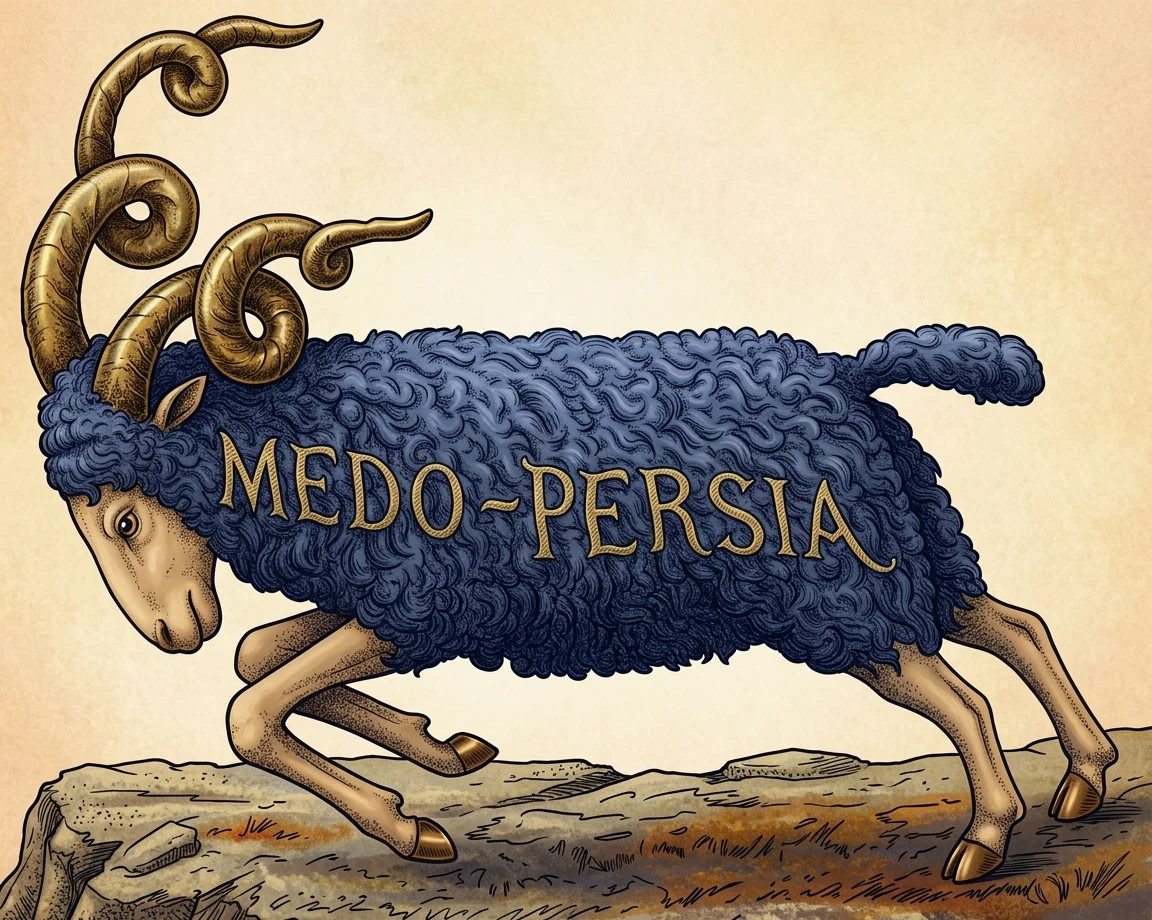
Verses one to eight narrate a vision which appeared to the prophet Daniel, in which he beheld a ram pushing westward, northward, and southward, so that no beast could stand before it. But presently he beholds a he goat coming from the west, and so rapidly that he seems not to touch the earth. The goat had a notable horn between his eyes. This goat smote the ram and stamped him under his feet. Then the goat became greater than the ram had been; and in the height of his power, the great horn was broken, and for it came up four notable ones toward the four winds of heaven. And out of one of these came forth a “little horn;” and this is the symbol with which we have to deal.
Now verse 16 states that the angel Gabriel was commissioned to “make this man to understand the vision.” And Gabriel proceeded to say: “The ram which thou sawest, that had the two horns, they are the kings of Media and Persia. And the rough he goat is the king of Greece; and the great horn that is between his eyes is the first king. And as for that which was broken, in the place whereof four stood up, four kingdoms shall stand up out of the nation, but not with his power. And in the latter time of their kingdom, when the transgressors are come to the full, a king of fierce countenance, and understanding dark sentences, shall stand up.” And this is the power we seek.
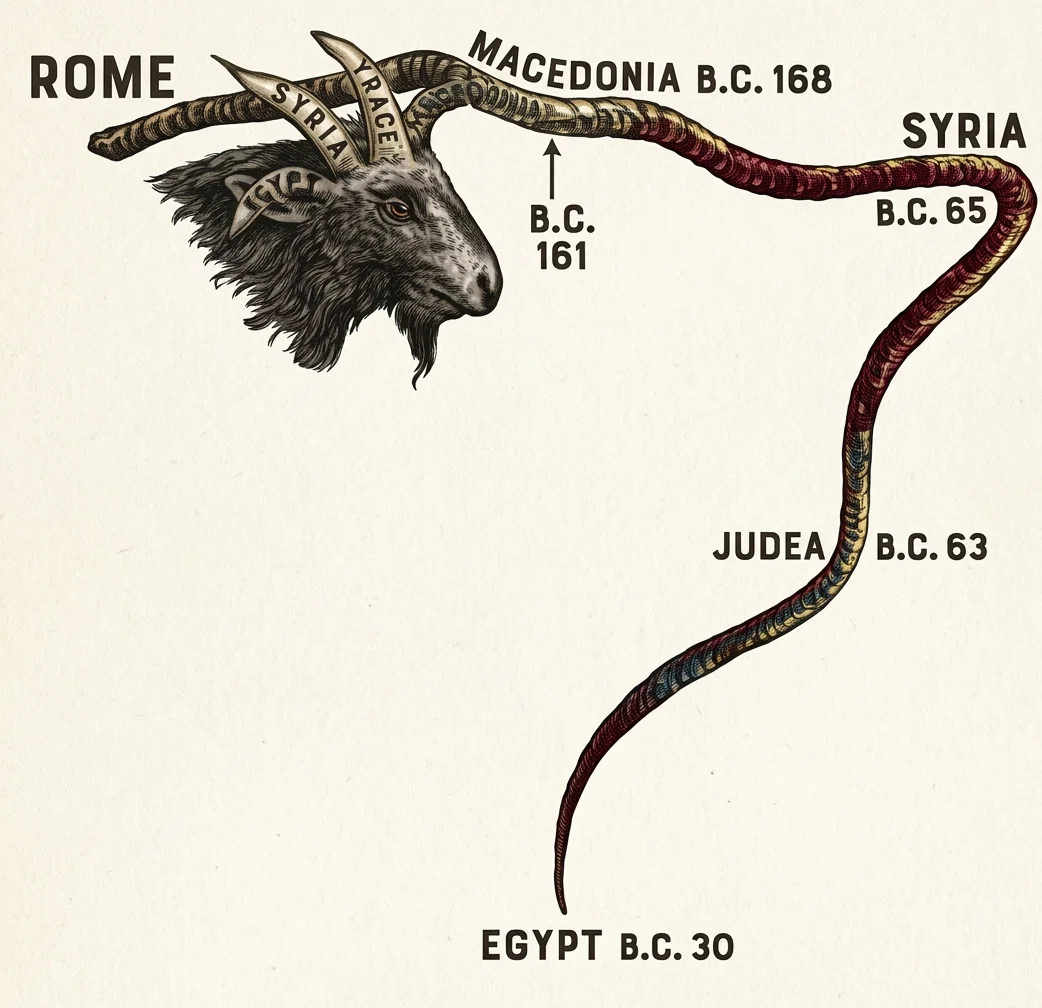
Alexander, called “great,” being the first king of Greece, and the one who conquered Persia, is the king symbolized by the “notable horn” between the eyes of the goat. After his death, the many contended for the kingdom, yet it was divided between just four, as Gabriel had stated. This divided kingdom was then allowed to run its course, until “the transgressors” were “come to the full,” which is the signal for the collapse of any and every nation; and then followed—Rome.
And here is the prophecy concerning Rome: “And out of one of them came forth a little horn, which waxed exceeding great, toward the south, and toward the east, and toward the glorious land.” Verse 9, A.R.V. This was the exact way in which Rome, the nation, pushed her conquest. As the ram, Medo-Persia, pushed westward, northward, and southward; the goat, Alexander and his bands, came from the west and proceeded eastward; so Rome conquered Carthage and absorbed Egypt, to her south; absorbed the little territory of original Greece, and conquered Macedonia and Asia Minor, to her east; and then absorbed the “glorious land.”
“And it waxed great, even to the host of heaven; and some of the host and of the stars it cast down to the ground, and trampled upon them. Yea, it magnified itself, even to the Prince of the host; and it took away FROM HIM the continual burnt offering, and the place of HIS SANCTUARY was cast down. And [margin] a host was given to it against the continual burnt offering through transgression; and it CAST DOWN TRUTH TO THE GROUND, and it did its pleasure and prospered.” Verses 10-12, A.R.V.
Here we have described the invasion of a new domain. Not content, as were the powers before it, with the subjection of the nations of earth, he invades the host of heaven, conquers them, physically, and treads them under foot. He magnifies himself to the Prince of the host of heaven, even the Lord Jesus Christ, and takes away from Him the “continual” (“burnt offering” is a supplied word, and does not express all that the text implies), and the place of His (Christ’s) sanctuary is cast down.
But it was ecclesiastical, and not civil Rome which did all this. But the policy, the spirit, and the genius of both are so nearly the same that inspiration considers them together. Note this in the interpretation given by the angel:7
“And in the latter time of their [the Grecians’] kingdom, when the transgressors are come to the full, a king of fierce countenance, and understanding dark sentences, shall stand up. And his power shall be mighty, but not by his own power; and he shall destroy wonderfully, and shall prosper and do his pleasure; and he shall destroy [corrupt, margin] the mighty ones and the holy people [Hebrew people or the saints]. And through his policy he shall cause craft to prosper in his hand; and he shall magnify himself in his heart, and in their security shall he destroy many: he shall also stand up [reign] against the Prince of Princes; but—he—shall—be—broken—without—hand.” Thank the Lord.
All who have read the entire prophecy of Daniel, will remember that in chapter 2, verses 34, 44, and 45, a stone was cut out without hands, which smote the image of four parts, and broke it in pieces. This the verses declare to be the kingdom of God, which smites all earthly kingdoms and breaks them in pieces, while it shall stand forever. But if anything were lacking to show that this power will meet its end at the time and by the Power just referred to, that is abundantly found in Dan. 7:21, 22, and 2 Thess. 2:8. The former states that this power continues and persecutes the saints until the time comes that the saints possess the kingdom, while the latter text declares that “the Lord Jesus shall slay [him] with the breath of His mouth, and bring [him] to naught by the manifestation of His coming.” This is ecclesiastical Rome, “broken without hand.”
THE EARTHLY SANCTUARY, THE SHADOW OF THE HEAVENLY
Has this “system” cast “some of the host [of heaven] and of the stars to the ground, and trampled upon them”?—We think so. “And he shall destroy wonderfully, and shall prosper and do his pleasure; and he shall destroy the mighty ones and the holy people.” This is “the host of heaven” referred to—the people on earth who belong in heaven. Phil. 3:20, 21; Eph. 3:14, 15.
He magnified himself even to the Prince of the Host; stood up, or reigned, against the Prince of Princes. His whole reign being against Christ, he can be nothing short of antichrist, for that is what the word means.
But putting to death the saints, and reigning against Christ, is not all. For “through his policy he shall cause craft to prosper in his hand; . . . and in their security shall he corrupt [margin] many.” “And such as do wickedly against the covenant shall he corrupt by flatteries; but the people that do know their God shall be strong, and do exploits.” Dan. 11:32. And besides all this, “It cast down truth to the ground, and it did its pleasure and prospered.” Dan. 8:12.
And all this corrupting influence, I believe, is comprehended in the fact that “it took away from Him [from the Prince of the host of heaven] the continual, and the place of His [Christ’s] sanctuary was cast down.”
Both the “way” of the Lord, and the “end” of the wicked, David found revealed in the sanctuary. Ps. 77:13; 73:1-17.
But there are two sanctuaries revealed in the Scriptures, an earthly and a heavenly; the former, with all its services, a type or figure of the latter; and the latter the “pattern” of the former. This is plainly read in Ex. 25:9, 40; and Heb. 8:1-5.
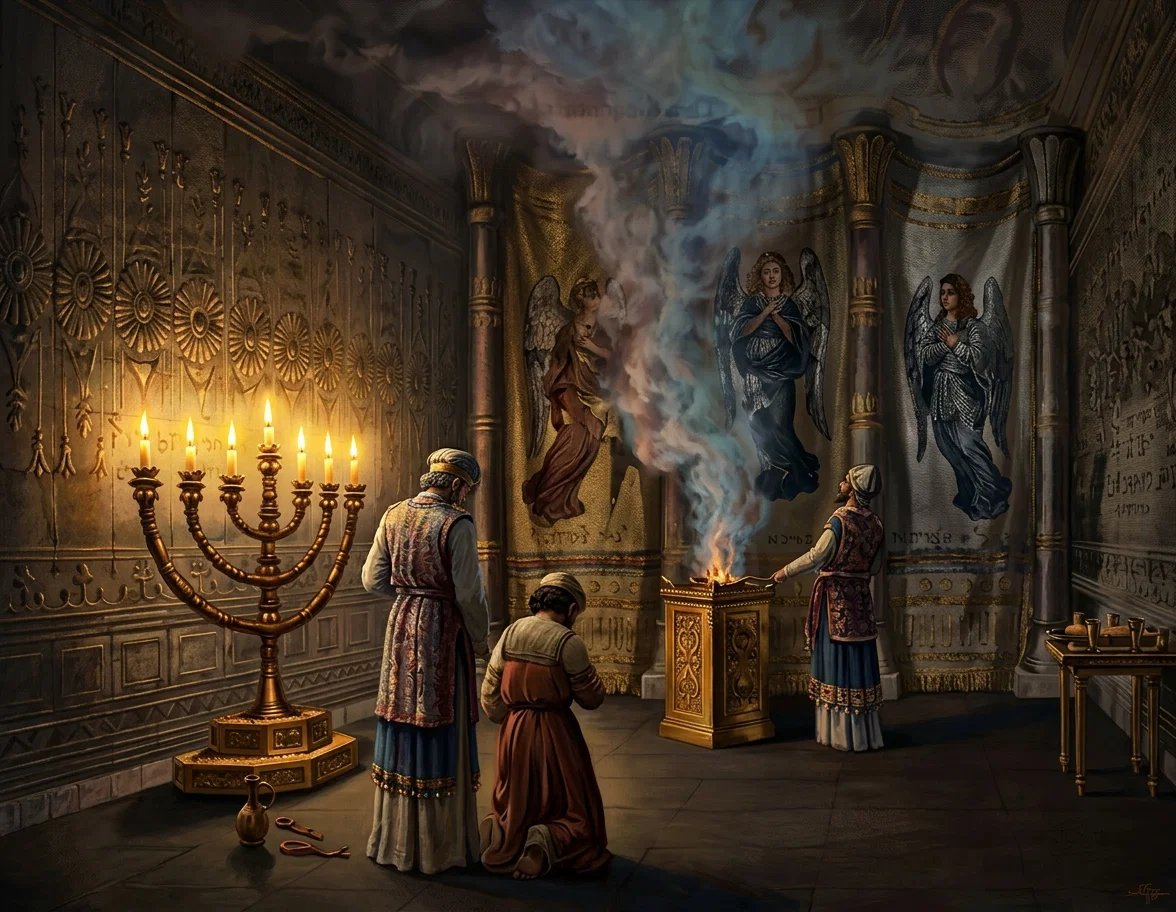
Before the first advent of our Lord, there was nothing, after the establishment of the “sanctuary” in the wilderness—nothing pertaining to sin and its cleansing—which did not meet its solution in and through the “sanctuary.” To accomplish this, its services were “continual.” In chapters 28 and 29 of the book of Numbers, the morning and evening sacrifices, which were offered for the entire congregation every day of the year, and never omitted in consequence of any other offerings, is about sixteen times called, “the continual burnt offering.” But that was not all. The showbread was likewise “continual.” Num. 4:7; 2 Chron. 2:4. Then the lamps were to burn “continually” (Lev. 24:2); the incense was “perpetual,” which is the same as “continual;” and the high priest, “Aaron,” said the Lord, “shall bear the judgment of the children of Israel upon his heart before the Lord continually.” Ex. 28:30. Thus we see that the “continual” under consideration in Daniel 8, comprehended the entire service of the earthly sanctuary, as ordained of God; and this in turn being but a figure, in all its appointments and services, of the heavenly sanctuary, the term “continual” applies with equal force to the sanctuary above. And indeed, the entire force of the prophecy applies there; because the earthly sanctuary, with its priesthood, had ended its operations, and time therefor, before this power under consideration had begun its operations.
But how, you say, could this “man of sin,” as Paul calls him, take away from Christ the “continual” service of the heavenly sanctuary?—Easily enough; and that is exactly what was done.
In Hebrews seven and eight, we repeatedly8read that “perfection” did not come through the Levitical priesthood and service; that because of this, another Priest had to arise, and that Priest was Christ. The priesthood was therefore changed (Heb. 7:12); and they who had never served except as an example and shadow of the heavenly service, now gave way to Christ, the real Priest, “after the order of Melchizedek.” David predicted this priesthood of Christ in Ps. 110:1, 4; and Paul records its fulfilment in Heb. 2:17; 3:1; 4:14-16; 5:5, 6; 6:19, 20; 7:1-28; 8:1-5; 9:1-28; 10:1-22, and so on.
The principal reason for this change was because “perfection” did not come by the Levitical priesthood (Heb. 7:11), while Christ, “by one offering . . . hath perfected forever them that are sanctified.” Heb. 10:14. It is also true that the Levitical priesthood and offerings were never intended to perfect any one, but were “shadows of good things to come.” But from this, it does not follow that no sin was forgiven, nor iniquity washed away, during the years that the Levitical priesthood continued; for Christ is the “Lamb slain from the foundation of the world.” Through faith, the ancients grasped the promise of the “Lamb of God, who taketh away the sin of the world.”
Now when this priesthood changed, it changed from the Levitical order to that of Melchizedek. It changed from “many priests” who were subject to death, to one Priest, who ever lives to make intercession for us. Heb. 7:23-25. It also changed its base of operations, from the sanctuary on earth, to the one in heaven; so that now, if even Christ were on earth, He should not be a priest. Heb. 8:4. And if Christ Himself could not be a priest if He were now on earth, and He is declared to be THE High Priest since the day He ascended, pray who could be a priest on earth since Christ ascended on high?
But in the face of this, and during the early stages of that apostasy mentioned by Paul, the “mystery of iniquity” did insinuate and ordain an earthly priesthood, and made the claim that it was by right the legitimate and proper succession of the Levitical order.
“The bishops now [the latter part of the second century] wished to be thought to correspond with the high priest of the Jews; the presbyters were said to come in place of the priests; and the deacons were made parallel with the Levites. In like manner the comparison of the Christian OBLATIONS with the Jewish VICTIMS AND SACRIFICES produced many unnecessary rites, and by degrees corrupted the very doctrine of the holy supper; which was converted, sooner, in fact, than one would think, into a SACRIFICE.”—“Mosheim’s Ecclesiastical History, Cent. II, part II, par. 4; chap. IV, par. 4.
From this beginning, grew the entire priesthood and ceremonial of the apostate church; and this priesthood and ceremonial did so completely eclipse and shut away from men the sanctuary and service of Christ in heaven, that the priesthood and ministry of Christ was “taken away” from the knowledge of men, and the very “place of His sanctuary was cast down.” And so fully was this done, that, at the expiration of a certain definite prophecy in A.D. 1844, having sole reference to the sanctuary in heaven, the most enlightened Christians on earth were unaware of any such sanctuary or of its services. This shows how completely this matter had been hidden, when three centuries of Gospel light, after the rise of Protestantism, had failed to reveal the least thing in reference thereto.
Christ’s priesthood and service to the end of probation is in the “temple of God” (Rev. 11:19; 15:8); and when an earthly priesthood claiming to have succeeded the Levitical, usurped His place, it is easy to understand Paul’s words describing the “man of sin” as sitting “in the temple of God, setting himself forth as God.” 2 Thess. 2:4, A.R.V.
But the judgment was to sit, and this dominion of the antichrist was to be taken away, “to consume and to destroy unto the end.” Dan. 7:26. And this truth concerning the sanctuary and work of Christ, has already come out, and that at the time specified. And with this truth all the sophistries of that most crafty system are being exposed, and will continue to be exposed to the end of the Gospel race.
The Scriptures reveal a brief return of the civil dominion of this “mystery of iniquity,” but his day for obscuring the Gospel is past. The many will not heed it, yet the Gospel message will close in power, the entire earth being lightened with its glory. Rev. 18:1.
Babylon Still
But the evil principle still continues. This potently evil wine the nations have quaffed. This perversion of vision the nations have inherited. As Nebuchadnezzar saw only Babylon, so with the earth-worshipers; each sees his own kingdom.
The patriots of Medo-Persia felt that that empire was allied with the gods, and would stand forever. So thought the Grecian; so thought the Roman.
The loyal Chinese believes the “Celestial” empire is heaven-born and must stand forever. The devotee of the “Sunrise Island Empire” believes that it is Japan forever. So also the devotee of Europe’s great northern empire; he believes that the Russian bear will prowl and growl till all the world shall own his sway.
The Briton believes in “rule Britannia,” and that for aye. His idea of ardent patriotism is, England always, whatever her moral right. And in England’s oldest child, the great, wealthy, strong, virile Columbia, it is a popular toast, “Our country; may she always be right; but right or wrong, always our country.” The ultra patriots of every nation would heartily drink to the same toast.
But all this is modernized Babylonian worship of the golden image, the exaltation of the human, the losing sight of the divine.
All the governments of earth, founded because of the selfishness of man, are more and more constant developments and crystallizations of that selfishness as the nation ages. That selfishness may be checked by the interfusion of some truly religious movement from without, but only checked. Sooner or later the selfishness which in the beginning restrained men becomes a tyranny, and the end is destruction.
Reader, why not take God’s view of earthly powers, and build your hope within and upon the everlasting kingdom?
Learning Truth Through Affliction
Most of the grand truths of God have to be learned by trouble; they must be burned into us by the hot iron of affliction, otherwise we shall not truly receive them.—C. H. Spurgeon.
The Kingdom Which Abides
By H. W. Cottrell
By H. W. Cottrell
The Kingdom of Grace
THERE is in the Book of God, altho hidden from the view and experience of the doubting soul, a revelation of true Christian happiness as real to the child of faith, as perceptible, as experimental, as the bright shining of the sun at midday; and if men seek for that pearl of great price, for that knowledge of God, for that experience in divine things in Christ, as they seek for gold and silver, yes, as some men seek for worldly honor, which corrupts with the using, and in many instances corrupts the possessor, it shall be found, known, experienced, in the kingdom of God throughout eternity. True Christian happiness is in Christ, in His way, His will; and the pearl will be found only at Christ’s feet.
Despite the Biblical prophetic revelation of the Father’s love, of the Christ, of the certainty of the plan of redemption, men continued to grope their way in heathen darkness. Christ spoke to the unregenerated man, “Saying, The time is fulfilled, and the kingdom of God is at hand: repent ye, and believe the Gospel.” Mark 1:15. In this utterance He assures them that there is placed within their reach the kingdom of favor—grace. He said there is opportunity to receive God’s favor through Christ, for “the kingdom of God is at hand.”
Christ is the King of the kingdom of grace; penitent sinners and Christians, His subjects; and their hearts and lives, His territory. “Christ in you, the hope of glory.” Col. 1:27. To the repentant sinner He says, “Behold, I stand at the door, and knock: if any man hear My voice, and open the door, I will come in to him, and will sup with him, and he with Me.” Rev. 3:20. As an earthly king is seated upon his throne and rules over his subjects, so Christ, after His ascension, seated Himself with His-Father upon the throne of grace, while He abides spiritually in the hearts of His children to reign in each life, and thus conquer therein every tendency to do evil. Rev. 3:21.
The Kingdom of Glory
But “He will not always chide; neither will He keep His anger forever.” Ps. 103:9. Probation will close; Christ will deliver up the kingdom of grace to the Father, that He may establish the kingdom which abideth forever. For we read, “Then cometh the end, when He [Christ] shall have delivered up the kingdom [of grace] to God, even the Father; when He [the Father] shall have put down all rule, and all authority, and power. For He [Christ] must reign, till He [the Father] hath put all enemies under His [Christ’s] feet. The last enemy that shall be destroyed is death. For He [the Father] hath put all things under His [Christ’s] feet. But when He [the Father] saith all things are put under Him [Christ], it is manifest that He [the Father] is excepted which did put all things under Him [Christ]. And when all things shall be subdued unto Him [Christ], then shall the Son also Himself be subject unto Him [the Father] that put all things under Him [Christ], that God may be all in all.” 1 Cor. 15:24-28.
The purpose of Christ’s reign in the kingdom of grace is to condemn sin in the flesh, and gather out a people from the kingdoms of earth to reign with Him in His kingdom of glory.
Christ taught His disciples to pray, “Thy kingdom come. Thy will be done in earth as it is in heaven.” Matt. 6:10. The kingdom herein referred to was not then set up. It was, therefore, not the kingdom of grace for which He taught them to pray. John, while on the lonely Patmos, saw the eternal kingdom of God set up. Said he, “And the seventh angel sounded; and there were great voices in heaven, saying, The kingdoms of this world are become the kingdoms of our Lord, and of His Christ, and He shall reign forever and ever.” Rev. 11:15.
Daniel also saw the things of time crumble, and “the God of heaven set up a kingdom, which shall never be destroyed; and the kingdom shall not be left to other people, . . . and it shall stand forever.” When the court of heaven speaks the word, that9the time has come to establish the everlasting kingdom, “a stone” of prophetic origin, “cut out without hands,” was seen preparing the way. The citizens of this kingdom are unlike the subjects of any kingdom that ever antedated it, for their inheritance shall not be left to other people. Dan. 2:34, 44.
When at last, humanly speaking, the fatal word is spoken, then “the kingdom and dominion, and the greatness of the kingdom under the whole heaven, shall be given to the people of the saints of the Most High, whose kingdom is an everlasting kingdom, and all dominions shall serve and obey Him.” Dan. 7:27.
There can be no further question in the mind of the Bible student in regard to the nature of the kingdom mentioned in Christ’s prayer. It is to be “everlasting;” “the kingdom shall not be left to other people, . . . and it shall stand forever.” Dan. 2:44. Neither can there be misunderstanding as to its location, for “the greatness of the kingdom [is] under the whole heaven.” No one should question further as to who are the only citizens, for we read that it “shall be given to the people of the saints of the Most High.” Dan. 7:27.
Every man’s case will have been decided for good or for ill, and all things unalterably fixed. King Jesus will come, in harmony with His promise. We read, “He that is unjust, let him be unjust still: and he which is filthy, let him be filthy still: and he that is righteous, let him be righteous still: and he that is holy, let him be holy still. And behold, I come quickly; and My reward is with Me, to give every man according as his work shall be.” Rev. 22:11, 12.
The Glory of That Kingdom
Sin will have been blotted out of God’s fair universe. He will have spoken the world into a new existence. “The wilderness and the solitary place shall be glad for them; and the desert shall rejoice, and blossom as the rose.” Isa. 35:1.
The blind shall see; the deaf shall hear; the lame shall run to and fro; the dumb shall sing the eternal praises of God. Isa. 35:5, 6. “And God shall wipe away all tears from their eyes; and there shall be no more death, neither sorrow, nor crying, neither shall there be any more pain: for the former things are passed away.” Rev. 21:4.
Jehovah our God, and Christ our Redeemer, have in heavenly preparation the metropolis of “The Kingdom Which Abides.” The seer, who saw the kingdom established, said, “And I John saw the holy city, New Jerusalem, coming down from God out of heaven, prepared as a bride adorned for her husband. And I heard a great voice out of heaven saying, Behold, the tabernacle of God is with men, and He will dwell with them, and they shall be His people, and God Himself shall be with them, and be their God. . . . And the city was pure gold. . . . And the street of the city was pure gold.” Rev. 21:2, 3, 18, 21.
But more glorious yet, the subjects of that ever-abiding kingdom have been tested, tried as gold, and found to be loyal—faithful, true. The apostle Luke informs us that they can not die any more. Luke 20:36. They can not be tempted more. They can sin no more forever. They sorrow no more. No death-knell will ever be sounded there. No funeral trains will be seen. Furrowed brows and care-worn features will not be there. All the subjects of that immortal kingdom will live in the vigor of immortal youth. The highest type of liberty is theirs. They are freed from sin; yes, from the possibility of temptation to sin, forevermore.
Friend, you are at liberty to be one of the citizens of “The Kingdom Which Abides,” the kingdom of eternal liberty, and follow the Lamb (the King) whithersoever He goeth.
The Everlasting Kingdom of Glory
By Mrs. H. W. Cottrell
By Mrs. H. W. Cottrell
1. What do the prophecies say will be the final culmination of all earthly kingdoms?
“And in the days of these kings shall the God of heaven set up a kingdom, which shall never be destroyed: and the kingdom shall not be left to other people, BUT IT SHALL BREAK IN PIECES AND CONSUME ALL THESE KINGDOMS, and it shall stand forever.” Dan. 2:44.
“And the seventh angel sounded; and there were great voices in heaven, saying, THE KINGDOMS OF THIS WORLD ARE BECOME THE KINGDOMS OF OUR LORD, AND OF HIS CHRIST; and He shall reign forever and ever.” Rev. 11:15.
2. When Christ sets up His kingdom, who will be His subjects?
“And the kingdom and dominion, and the greatness of the kingdom under the whole heaven, SHALL BE GIVEN TO THE PEOPLE OF THE SAINTS OF THE MOST HIGH, whose kingdom is an everlasting kingdom, and all dominions shall serve and obey Him.” Dan. 7:27.
3. What does the prophet call this kingdom?
“Whose kingdom is an EVERLASTING KINGDOM.” Last part of verse 27.
4. Did Christ set up His everlasting kingdom at His first advent?
It is evident He did not, for He taught His disciples to pray, “Thy kingdom come;” He was Himself poorer than the foxes or the birds, with “not where to lay His head.” He traveled from the manger to the cross, “a man of sorrows, and acquainted with grief.” Instead of being crowned King of Kings, He was crowned with thorns.
5. Is man in his present condition a fit subject for this kingdom?
“Now this I say, brethren, that FLESH AND BLOOD CAN NOT INHERIT THE KINGDOM OF GOD.” 1 Cor. 15:50.
NOTE.— Corruptible (flesh and blood) subjects can not inherit an incorruptible (everlasting) kingdom.
6. To whom only is it promised?
“Harken, my beloved brethren, HATH NOT GOD CHOSEN THE POOR OF THIS WORLD RICH IN FAITH, AND HEIRS OF THE KINGDOM WHICH HE HATH PROMISED TO THEM THAT LOVE HIM?” James 2:5.
7. When will Christ establish His kingdom and verify His promise?
“I charge thee therefore before God, and the Lord Jesus Christ, WHO SHALL JUDGE THE QUICK AND THE DEAD AT HIS APPEARING AND HIS KINGDOM.” 2 Tim. 4:1.
NOTE.— The kingdom will be set up when Christ comes to judge the quick (living) and the dead.
8. Read His own description of that eventful occasion.
“WHEN THE SON OF MAN SHALL COME IN HIS GLORY, AND ALL THE HOLY ANGELS WITH HIM, THEN shall He sit upon the throne of His glory: and before Him shall be gathered all nations; and He shall separate them one from another, as a shepherd divideth his sheep from the goats. . . . THEN SHALL THE KING SAY UNTO THEM ON HIS RIGHT HAND, COME, YE BLESSED OF MY FATHER, INHERIT THE KINGDOM PREPARED FOR YOU from the foundation of the world.” Matt. 25:31-34.
9. Will that kingdom be in heaven, or on earth?
“And the kingdom and dominion, and the greatness of the kingdom UNDER THE WHOLE HEAVEN, shall be given to the people of the saints of the Most High.” Dan. 7:27.
10. What will be the metropolis of the kingdom?
“And I saw a new heaven and a new earth: for the first heaven and the first earth were passed away; and there was no more sea. AND I JOHN SAW THE HOLY CITY, NEW JERUSALEM, COMING DOWN FROM GOD OUT OF HEAVEN, prepared as a bride adorned for her husband. AND I HEARD A GREAT VOICE OUT OF HEAVEN SAYING, BEHOLD, THE TABERNACLE OF GOD IS WITH MEN, AND HE WILL DWELL WITH THEM, and they shall be His people, and God Himself shall be with them, and be their God.” Rev. 21:1-3.
11. What did the patriarch Abraham look for?
“By faith he [Abraham] sojourned in the land of promise, as in a strange country, . . . FOR HE LOOKED FOR A CITY WHICH HATH FOUNDATIONS, WHOSE BUILDER AND MAKER IS GOD.” Heb. 11:9, 10.
12. Does the city John describes have foundations?
“And the wall of the city had twelve foundations.” Rev. 21:14.
13. What will be the character of the subjects of this city?
“BLESSED ARE THEY THAT DO HIS COMMANDMENTS, that they may have right to the Tree of Life, and may enter in through the gates into the city.” Rev. 22:14.
“And there shall in no wise enter into it anything that defileth, neither whatsoever worketh abomination, or maketh a lie: but they which are written in the Lamb’s book of life.” Rev. 21:27.
Afflictions Beneath God’s Wings
AFFLICTIONS are but the shadow of God’s wings.— Geo. Macdonald.
Letters from Egypt
By Louis V. Ledoux
MEMPHIS and Karnak, Luxor, Thebes, the Nile:
Of these your letters told; and I who read,
Saw loom on dim horizons Egypt's dead
In march across the desert, mile on mile;—
A ghostly caravan in slow defile
Between the sand and stars; and at their head
From unmapped darkness into darkness fled
The gods that all men feared a little while.
There black against the night I saw them loom,
With captive kings and armies in array,
Remembered only by their sculptured doom;
And thought: What Egypt was are we to-day.
Time's vanguard marched through the sombre gloom;
The rearguard gathers; let us watch and pray.
—Louis V. Ledoux, in "The Pathfinder."
The Spirit of Adoption
By G. D. Boardman
We need a spirit of adoption to take us out of the foundling hospital of the world, and to put us into the celestial family.— G. D. Boardman.