The Youth’s Instructor, Vol. 34, No. 18.

THE SEASON THAT IS COMING

The Youth’s Instructor

May 4, 1886

S. D. A. Publishing Association · Battle Creek, Mich. · May 4, 1886

THE SEASON THAT IS COMING.

SWEET, sweet, sweet is the season that is coming; Sweet the way-side wild rose and the wild bee’s humming; Sweet the pink azalia in the woods’ recesses, Sweet the nodding barberry buds, wearing yellow dresses, Sweet the scarlet columbine climbing up the ledges, Sweet the pale anemone in the forest edges, Sweet the rosy apple blooms, sweet the birds among them, Sweet the petals in the grass, where the winds have flung them.
Sweet, sweet, sweet are the gardens overflowing With pinks and yellow marigolds, and mignonette a-blowing, With four-o’clocks and London-pride, and pretty pansy faces, With honeysuckle by the wall, and roses in all places; And sweet the happy children who come from days of duty To find the fair earth all a-bloom, a place of perfect beauty; Books thrown away, they laugh and play, with sun and sweet winds blowing.
A rose blooms out on every cheek, and pinks in the lips are growing.
Sweet the breeze-blown pastures with violets running over; Sweet the meadows stretching wide crowded with white clover; Sweet the thickets starred with flowers and flushed with growing berries, And pretty dinners set for birds of rose-hips and wild cherries; Sweet the corners dim and deep where floating boughs are meeting, And little children come and go with songs of happy greeting; Sweet the fronds of fairy fern in hidden nooks unfolding; Sweet the thoughts in loving hearts these lovely things beholding. —Wide-Awake.

GENERAL U. S. GRANT.

GENERALLY, when a man attains world-wide fame, it is expected that in his boyhood he will foreshadow his coming greatness; that he will, by some unusual actions, manifest those qualities that enabled him to stand head and shoulders above his countrymen. But in the boyhood of America’s great general, nothing can be found by which any one could possibly predict the great service he would render to his country. He was simply an energetic, honest-hearted, modest boy.
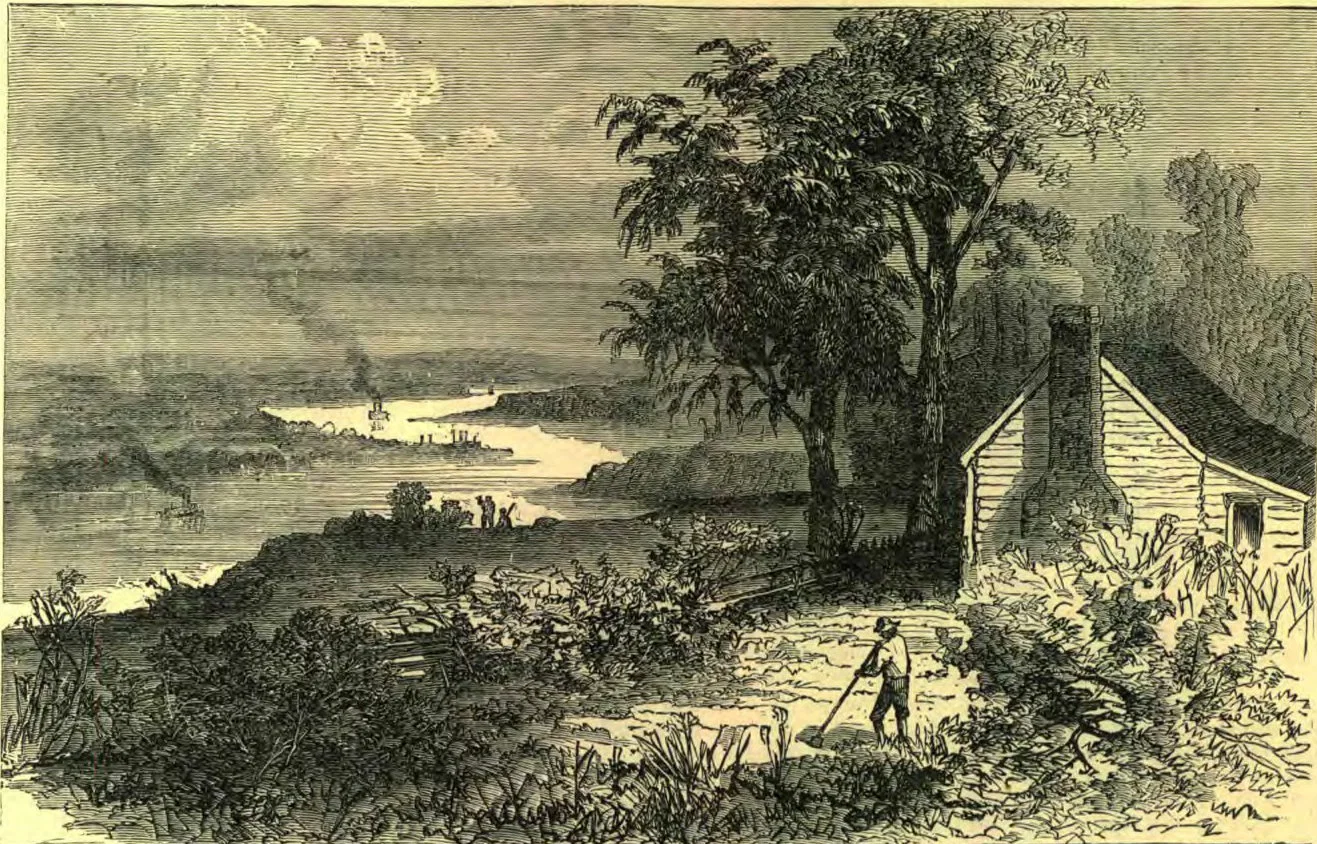
On the banks of the Ohio River, in a humble home, shown in the picture on this page, Grant passed his boyhood. Of these uneventful days, he says in his “Personal Memoirs: “My father was, from my earliest recollection, in comfortable circumstances, considering the times, his place of residence, and the community in which he lived. Mindful of his own lack of facilities for acquiring an education, his greatest desire in maturer years was for the education of his children. Consequently, as stated before, I never missed a quarter from school from the time I was old enough to attend till the time of leaving home. This did not exempt me from labor. In my early days every one labored more or less, in the region where my youth was spent, and more in proportion to their private means. It was only the very poor who were exempt.”
“While my father carried on the manufacture of leather, and carried on the trade himself, he owned and tilled considerable land. I detested the trade, preferring almost any other labor, but I was fond of agriculture and of all employment in which horses were used. We had, among other lands, fifty acres of forest within a mile of the village. In the fall of the year, choppers were employed to cut wood enough to last a twelvemonth. When I was seven or eight years of age, I began hauling all the wood used in the house and shops. I could not load it on the wagons, of course, at that time, but I could drive, and the choppers would load, and some one at the house unload. When about eleven years old, I was strong enough to hold a plow. From that age until seventeen I did all the work done with horses, such as breaking up the land, furrowing, plowing corn and potatoes, bringing in the crops when harvested, hauling all the wood, besides tending two or three horses, a cow or two, and sawing wood for stoves, etc., while still attending school. For this I was compensated by the fact that there was never any scolding or punishing by my parents; no objection to rational enjoyments, such as fishing, going to the creek a mile away to swim in summer, taking a horse and visiting my grandparents in the adjoining county, fifteen miles off, skating on the ice in the winter, or taking a horse and sleigh when there was snow on the ground.”
Perhaps his leading characteristic,—undaunted perseverance, manifested itself in his boyhood. When he made up his mind to do a thing, it was usually done, as is illustrated in a case of colt buying that took place when he was eight years old. “There was a Mr. Ralston living within a few miles of the village,” relates Grant, “who owned a colt which I very much wanted. My father had offered twenty dollars for it, but Ralston wanted twenty-five. I was so anxious to have the colt, that after Ralston left, I begged to be allowed to take him at the price demanded. My father yielded, but said twenty dollars was all the horse was worth, and told me to offer that price; if it was not accepted, to offer twenty-two and a half; and if that would not get him, to give the twenty-five. I at once mounted a horse and went for the colt. When I got to Mr. Ralston’s house, I said to him: ‘Papa says I am to offer you twenty dollars for the colt; but if you won’t take that, I am to offer twenty-two and a half; and if you won’t take that, to give you twenty-five.’ It would not require a Connecticut man to guess the price finally agreed upon. I certainly showed that I came for the colt, and meant to have him. I certainly could not have been over eight years old at the time. This transaction caused me great heart-burning. The story got out among the boys of the village, and it was a long time before I heard the last of it. Boys enjoy the misery of their companions, at least village boys in that day did, and in later life I have found that all adults are not free from the peculiarity.”
When Grant was seventeen, he entered the military academy at West Point, and in 1843 graduated at the middle of his class. He served in the army for fifteen years, but at length resigned and went to farming. Here he would doubtless have remained for the rest of his life, had not the war of the Rebellion called into action those latent talents which made him world-renowned. The history of the late war is perhaps so familiar to the readers of the INSTRUCTOR that it would not be necessary to enter in to the engagements under General Grant’s command. In the most trying and difficult circumstances under which he could be placed, no thought of defeat seems ever to have entered his mind. In the siege of Vicksburg, when some one asked him if he thought he could take the place, he replied, “Certainly. I cannot tell exactly when I shall take the town; but I mean to stay here till I do, if it takes me thirty years.” It was this dogged determination in the face of seemingly insurmountable difficulties that, more than anything else, gave him the victory.
“It is wonderful,” writes an army correspondent, “how entirely the army confides in General Grant. Every soldier’s tongue is full of his praises. They will tell you stories of his watchfulness and care; the fearlessness and intrepidity of this man whose plume they delight to follow; how he is everywhere, night and day, looking after the comfort of his men, and quietly prosecuting the strategic work of the campaign; how he rides unexpectedly to the remote outposts, speaking a pleasant word to the pickets if faithfully on duty, and administering reprimands if not vigilant and watchful; how he avoids fuss and show, going often about with only an orderly; how his staff, plain earnest men like himself, get down from their horses that sick and wounded men, struggling hospital-ward, may rest their weariness by riding to their destination; how, in a word, he is a thoughtful, resolute, kind man, sympathizing with the humblest soldier in his ranks, penetrated with a solemn appreciation of the work given him to do, and determined by Heaven’s help to do it right on the line he has occupied.”
Such was the man raised up by a kind Providence to bring the long, cruel war to a close. It would be needless here to relate the history of his later life; for this you know well. In his perseverance, his freedom from love of display, his quiet attention to his business, and his kindness to his men and to his enemies, our boys may find much that is worthy of imitation.
W. E. L.

Blessed Are the Pure in Heart

BLESSED are the pure in heart; for they shall see God.

SOME-TIME

“Some-time’s come! Hurry up! Some-time’s come!”
“Some-time! What do you mean? Where are you, anyway? and who’s speaking to me? I don’t see any one,” and Rose Murray rubbed her eyes, shrugged her shoulders, and pinched her hand a little, just to find out if she were awake, or if she were dreaming. She wasn’t dreaming, that she knew; for the same voice, with no apparent owner, kept on talking. And such queer things it said in that unpleasant way!
“Some-time! That’s next door to in-a-minute, a close neighbor to after-a-while and going-to-do-it. Pretty-soon, to-morrow, one-of-these-days,—they can all be found together. And you don’t know where some-time is? Well, I never heard any girl of your age talk more about it. But come along; you’ll soon find out where it is.”
“Come along! Where? How can I go anywhere with only a voice?”
“How did you go to Paris last week, and to that strange party the other night, where the girls all wore their school dresses, and the boys forgot to stand by themselves on one side of the room?”
“Those places! I didn’t go to either of those. I was only dreaming then. But I am not asleep now. Where are you going to take me?”
“Never mind, just come,” replied the voice, and added, as Rose moved slowly in the direction from which it came, “Now you’re in Some-time, and I hope you’ll enjoy yourself. I’ll come back for you one-of-these-days,—one-of-these-days,” and the voice died away as it repeated these words in a malicious tone.
“What a queer dream I’ve had!” thought Rose; “this is my own room, and it’s almost dinner-time by the clock. I’d better go and make the dessert I told mother I would after awhile.”
“No, no! Me first! Me first!” called out voices all around her,—some close by her, some far away, some loud, some so faint she could just catch the words,—but so many! The room was full of them, and each one belonged to something. The loudest of all came from the algebra at her feet, which had fallen from her lap as she looked over the last St. Nicholas, saying, “I’ll do that old problem in a minute.”
The problem spoke now. “You can’t get away, you must do me first.”
“Very well,” answered Rose; “you’re a great bother to me, but I’ll soon settle you;” and she took a pencil from the table in preparation for hard work.
“No, no! Give me back to my owner. You said you would in an hour or so, when you borrowed me this morning.”
“I want to be sewed up,” demanded a great rent in her dress. “You promised to do me some-time, and it’s some-time now.”
“Put me in order, then,” came from the work-basket.
“Find me first,” cried out the thimble from—where?
Poor Rose looked around despairingly. It was her own room truly, but it was so full of voices, so crowded with things that ought to be done, and so many more were pushing in through the doors and windows! What should she do? Books wanted to be returned to their owners, the newspaper must be read to her grandmother, pictures must be hung straight, the table drawer must be put in order, even the dust on the furniture insisted that it should be taken off immediately.
Where should she begin? Be done they must; and she went to work in good earnest, trying to quiet some of the voices nearest her. But what was the use? for everything done, a dozen others crowded around her. Promises she had made long ago kept calling to her; and, worst of all, little, still voices in her heart reminded her of her broken promise to amuse the baby while her mother took a nap before dinner, of the visit she had meant to make a sick friend, of the little quarrel she had been going to make right with her cousin, of the bundle of warm clothes she had promised to give Tommy Brown, the washer-woman’s son, early in the winter.
Rose had been called a little procrastinator long before she knew what the word meant; and only last week one of her best friends had written to her, and begun the letter, “My dear Going-to-do-it!” But now what was to be done? She never could do all those things. It seemed as if everything she had meant to do and didn’t do, everything she had promised to do and had forgotten to do since the time she was five years old, was here now, pushing against her, and crying to her with tormenting voices: “It’s some-time now, Rose. O Rose! it’s some-time.”
What did she do? Well, what any other fifteen-year-old girl would have done. She said, “I can’t, I can’t, I can’t!” and then sat down and burst into tears. Still came the dreadful chorus: “Some-time! some-time!”
“Why, Rose, it’s dinner-time! Don’t you hear the bell?” and some one touched her shoulder.
Rose started, opened her eyes, and there stood her little brother, laughing, and ringing the bell in her ears. “How funny you look when you’re asleep!” he said. “I almost thought you were going to cry before I shook you.”
They wondered, at dinner, why Rose looked so solemn; and when dessert-time came, and her mother asked, “Rose, dear, did you forget again?” something very like tears filled her eyes as she answered; and she felt her face grow red and hot when grandma said, “No one ever expects Rose to do as she says she will.”
But for a month, or for a year,—yes, longer, even yet,—she remembers,—and Rose is a grown-up woman now,— those ten minutes of misery spent in some-time. So strong an impression did the dream make on her, that she has ever since followed the only plan by which one can conquer the little thief, Going-to-do-it. This is to attend to each thing as it comes, and not to wait for a convenient season.—S. S. Times.

THE RAG PICKERS OF NEW YORK.

THERE are three nationalities engaged in this business,—the Italians, Germans, and Irish. Each forms a colony, and they occupy widely separated localities. The first-named are the ones I have especially in view while writing this article.
The rag pickers are not to be confounded with the rag buyers. They do not go from door to door, bargaining for the housewife’s savings, but search the gutters and the ash barrels which have been put out on the curb-stone awaiting the ash carts. Their stock in trade consists of a bag which they throw over the shoulder, and an iron about two feet long, with a hook at the end to heave up things from the bottom of barrels or boxes.
Sometimes thimbles, jewelry, and other articles of value are accidentally thrown in with the sweepings; but no one has ever heard that an owner was afterward inquired for by the finder. They do not scorn to take anything that comes to hand, no matter how worthless it may seem. What one leaves, another more thrifty comes along and takes. Rags, paper, old boots and shoes, bones, tin cans, bottles of all descriptions, bits of iron, brass, nails, etc., form part of their collection, which is eventually turned into money.
They work from earliest dawn till night-fall, traveling miles through the great city, and then with their load on their backs trudge wearily homeward, to spend the evening in assorting and classifying the day’s gathering. In the pile of shoes collected, some will be found good enough to mend for the “second hand” trade; some suitable only to be made over into cheap shoes, and the poorest of the lot good for nothing but to be converted by chemical process into imitation gutta-percha, from which buttons, combs, and similar things are made. The bones are sold, to be manufactured into various articles of bone ware, or to be ground up for fertilizers.
Many of the tin cans are newly topped, and used again for cheap canned fruit; while others, too battered for use, are heated, and the resin saved and run into bars for use again in making cans. The bottles are cleaned and find their way back into commerce. The rags and paper go to paper mills to be made into writing paper, wall paper, etc.
The whole family, men, women, and children, join in the work of assorting, which is done in the garret, or hovel, that they call home. It is not an occupation calculated to make a room look pleasant; but in some of these poorly lighted, and more poorly furnished apartments, one will often see a pot of growing flowers standing on the window sill, placed there to remind some home-sick heart of sunny Italy, to which they all hope to return some day, to spend the rest of their years in comparative ease. These Italians do not belong to the begging class, by any means; neither do they or their neighbors consider this trade more degrading than that of their brethren, the organ grinders or fruit sellers. They are laying up money all the time. They are attentive to business, and content with small profits, making a fair living out of American wastefulness. One rag picker, who has been here twelve years, has bought, out of his savings alone, a house large enough to rent to several families. They are, as a class, industrious and full of resources. Cleanliness is not, however, one of their prime virtues. I suppose nothing short of a ship-wreck, would induce one of them to take a bath. The health ispezione (inspector) has more terror for them than the police. They seem to cling to dirty clothes as to an old friend. But a sharp look-out by the health authorities keeps off any outbreak of malignant disease in the Italian quarter of the city.
Connected with the rag-picking class, is the army of small boys who are sent out by their parents or guardians before it is fairly light in the morning to gather cigar stubs. Up and down the street, in the gutter, their stooping forms may be seen, creeping here and there, ever and anon darting into some open saloon to pick from the floor and out of the spittoons the cigar ends from which “choice cigarettes” and snuff are made. They are kept at work for hours, until the streets begin to fill with people, never daring to answer the questions of passers-by, or to speak to each other; for the eye of the taskmaster, as cruel as the Egyptians over ancient Israel, is upon them, and the lash is as ready to be applied, if any shirking is observed. They early learn the hard side of life. Jollity and pleasure are words unknown to them. My heart aches whenever I see them,—old in childhood; and to my memory comes a picture of the care-free, well-fed country boy, who in such a spring morning as this, goes whistling down the dewy lane where the spider webs glisten on the grass, under the fragrant apple-blossoms when the honey-bees are gathering their sweets, and amid the songs of robin and blue bird, driving to pasture the cows who stop now and then to snip the buttercup or dandelion as they go peacefully along; or later, with shining tin pail, and just as shining a face, goes cheerily to school. I wonder if he ever stops to think how his cup of blessing runs over? His lot seems almost Elysium compared with the lives of these neglected, half-starved, stunted waifs of the city streets.
L. E. ORTON.

ETERNITY WILL TELL.

Have I spread the dear mantle of charity O'er the frail and weak, my God? Have I striven to strengthen the tired and faint, And helped them to bear their load? Have the sick and the poor ever blest my name, For kindness my hands bestowed?
As I backward look, my heart beats low, For the years that are to be, And solemn and earnest as life and death, This truth comes home to me— That eternity's morning must surely tell What I have done for Thee. —Selected.

THE JOY OVER THE SHEEP FOUND.

“God so loved the world that he gave his only begotten Son, that whosoever believeth in him should not perish, but have everlasting life.” This is the true Shepherd, who gave his life for the sheep he loved. This love that God has manifested to fallen man has called forth and aroused in human hearts intense opposition; for it is not an acceptable truth that all is lost unless the heart be changed. Imagined goodness, self-esteem, or self-righteousness are of no avail with God. The Scribes and Pharisees sought for flattery; they cultivated pride, and carefully cherished everything that would increase their importance; and they became the bitterest enemies of Christ because he did not fall in with their ideas. If he had, he would have left the lost sheep to perish, excluding himself in self-righteousness from those who needed light and knowledge, sympathy and help,—who needed it as much as the lost sheep needed the good shepherd to lift him tenderly out of the peril which would have been his sure death.
The very same interest shown for the lost sheep must be shown for deceived, sin-bound souls. You must not be satisfied with enjoying the society of those who think as you think, and who believe as you believe. In the souls of the impenitent you may see those for whom the Chief Shepherd has given his life. Your life, which you have given to Jesus, you are to employ in his work. You are to live humbly, not becoming self-important, but remembering that you are wholly dependent upon the mercy and pardon of Jesus for the salvation of your souls.
Jesus so loved man that at the cost of his own life he gave him another trial. There are many ways in which you can work to come close to hearts. If you ask the Saviour to give you the meekness and lowliness of his character, and teach you to work with wisdom, he will hear your prayers, and will answer them. Souls may be reclaimed, blinded and stubborn though they may now be. There is too little persevering, self-denying effort made to awaken their interest in their eternal welfare. Will the INSTRUCTOR family examine themselves to see if they feel the necessity of increased knowledge of the Scriptures and of increased wisdom and spiritual discernment that they may be able to bring souls to Jesus?
Life is serious. You have a large field in which to work; and persevering search for the lost sheep will be the most successful way in which you can employ your time. The Son of man came to seek and to save that which was lost. Doth not the shepherd “leave the ninety and nine in the wilderness, and go after that which was lost until he find it?” If you can exert a saving influence over one soul, remember there is joy in heaven over the one that repented. You must guard against any indifference on your part. There may be things which you would prefer to do to please yourself; but remember that you may, by judicious effort, be the means of bringing back the lost sheep to Jesus’ fold. Although you may be young, you must work with Christ; with his spirit in your heart, you can do much more than it now seems possible for you to do.
The lives of some are without peace or gladness because they never get out of the range of self. They are ever reaching out for sympathy from others. If they would go to work to see how helpful they could be, and would speak words of love and courage, their souls, now dry and sorrowful, would become like a watered garden.
You must learn in the school of Christ precious lessons of patience. Do not become discouraged, but keep at the work in all humility. It will drive you to Jesus; it will lead you to study the Pattern. You want to work as Jesus worked. Do not neglect to lay the whole matter before him; in humble, earnest prayer, plead for his grace to co-operate with your efforts. Jesus will surely hear you; and when that soul yields to the influence of the Spirit of God, you may rejoice, for you have gained that which is of more value to you than silver or gold,—an experience in bringing souls to Christ.
MRS. E. G. WHITE.

Polish the Dark Side

A LADY was once lamenting the ill luck which attended her affairs, when a friend, wishing to console her, bade her “look upon the bright side.” “Oh,” she sighed, “there seems to be no bright side!” “Then polish up the dark one,” was the quick reply.

On the Folly of Ridiculing Others

THE talent of turning men into ridicule, and exposing to laughter those one converses with, is the qualification of little minds and ungenerous tempers. A young man with this cast of mind cuts himself off from all manner of improvement.—Addison.

IMPORTANT BIBLE SUBJECTS.

LESSON 5.—EXTENT OF THE LAW’S JURISDICTION.

[NOTE TO THE STUDENT.—Do not consider the lesson learned until you can give at least the substance of every text, with the correct reference for each. The references in black letters indicate those texts that should be committed to memory. A little diligent application each day will enable you to learn them, although this need not be considered a test of scholarship.]
1. What is sin? 1 John 3:4.
2. Is everything that is wrong a violation of the law? 1 John 5:17.
3. Is sin ever imputed where there is no law? Rom. 4:15.
4. Then when we find sin imputed to any people, of what may we be sure?
5. What does the Bible say of Cain? Gen. 4:7, 8; 1 John 3:12.
6. What is said of the men of Sodom? Gen. 13:13.
7. Then, according to Rom. 4:15, what must we conclude concerning Cain and the men of Sodom?
8. Why would not God allow Abraham and his family to occupy the land of Canaan as soon as the promise was made? Gen. 15:13, 16.
9. What was the particular sin of the Amorites? 1 Kings 21:26.
10. What law forbids idolatry?
11. What other positive proof have we that the people in the time of Abraham had the law? Gen. 26:5.
12. By whom did sin enter into the world? Rom. 5:12.
13. Then what did Adam violate?
14. What particular period does the apostle specify, during which death reigned? Rom. 5:14.
15. What alone causes death? Rom. 5:12; James 1:15.
16. And what is necessary in order that sin may be imputed? Rom. 5:13.
17. Then what besides sin and death must also have existed from Adam to Moses?
18. What does Paul say of the condition of both Jews and Gentiles? Rom. 3:9.
19. If one is charged with sin, of what is he certainly in possession? Rom. 4:15; 5:13.
20. To whom alone can a law speak? Rom. 3:19.
21. As a consequence of what the law says, how do all the world stand? Ib.
22. Then who are under obligation to keep the law?—The whole world.
23. If the law existed from the beginning, why was it necessary to give the law from Sinai? Rom. 5:20.

NOTES.

SINCE “sin is the transgression of the law,” “and sin is not imputed when there is no law,” it follows that the fact that sin is imputed to any people is evidence that they had the law and were amenable to it. Therefore since sin is imputed to the Amorites, the Sodomites, Cain, Adam, etc., all those people knew, and were answerable to, the law of God.
“The law entered that the offense might abound.” Rom. 5:20. An offense is a violation of law, a transgression, a sin. Therefore the text means, the law entered that the sin might abound. Then there was sin before the time spoken of when the law “entered.” But as there can be no sin without law, it follows that the law existed before the time when “the law entered,” which was at Sinai. The “entering” of the law was the formal giving of it from Sinai. Before that time, people knew the law only as portions of it remained written in their hearts (Rom. 2:15), or as they were taught by the servants of God, like Enoch, Noah, and Abraham, who had direct communication with Heaven. But after the giving of the law from Sinai, each person could at all times carefully examine the whole law for himself, and consequently sins which before might have seemed trivial, or might have passed unnoticed, were made to stand out in their true character. Thus the offense was made to “abound.” As Paul elsewhere says, sin, by the commandment, became “exceeding sinful.” Rom. 7:13.

THE ANGEL IN THE BLOCK.

Nearly four hundred years ago lived the great Italian painter and sculptor, Michael Angelo. He was an artist of rare power. Many of the statues and paintings in the great Vatican palace at Rome are the creations of his genius. It is said that on a certain occasion he was seen gazing into a pool of dirty water in which lay a mass of rough, unsightly marble. When asked why he looked so earnestly on a great unpolished stone, he replied, “I see an angel in the block.” He had the marble conveyed to his workshop, where, by patient toil, the shapeless and hard rock was wrought out into the image of a beautiful angel, radiant with the glory of heaven.
Here is a lesson for us, dear teachers. Have we not many blocks, hard, shapeless, and unpromising, that try our skill and test our patience and dull the tools of our best endeavor? In this unhewn material from the quarry of nature we may bring out a beautiful and well-balanced character.
Who among the moral artists in the workshop of the Sabbath-school will bring the angel out? It will take patient work and more than mortal skill. Let us hold the tools we use in the fear of God. Let us look well that we shape it after the Divine model. Will it stand when the Master Artist examines it? Let us carefully and earnestly study the best methods of work.
N. J. Bowers.

MONSTER TURTLES.

In the Pacific Ocean, directly under the equator, and several hundred miles west of South America, is a group of about fifteen islands which were discovered by the Spaniards nearly three hundred years ago, and named Galapago, the name in Spanish meaning tortoise, or turtle. It is said that there are five different kinds of turtles on the several islands, and there are so many of them that their tracks form a complete network over some of the islands. These, in size, do not much resemble the turtles the readers of the INSTRUCTOR have seen; for some of them measure ten and twelve feet in length, from head to tail, with a shell six feet long, and weigh six or seven hundred pounds.
India was once the home of the great land-turtle, a specimen of the remains of one now being in the British Museum. It “represents the shell of a young land-turtle ten feet in length, twenty-five feet in horizontal circumference, and fifteen feet in girth in a vertical direction.”
A party of English naturalists were once exploring a tract of new country in India, and while digging a cellar in which to deposit their supplies during their stay in that vicinity, they struck something which seemed like bone, but which proved to be the shell of a huge land-turtle. They succeeded, with much effort, in unearthing it, and setting it up in shape, when it was found large enough to hold several of the men, the party at one time taking refuge in it during a storm. It was afterward destroyed by a severe storm. The species in India are now extinct, and it is supposed that they lived many hundred years before.
And there has been found in our own country recently, in the western part of Kansas, the remains of a giant sea-turtle. This one, from the tip of one extended flipper to another, measures about seventeen feet. It has been carefully removed from the bluff in which it was imbedded, and taken to Philadelphia. Geologists are busy speculating as to how a marine animal could have been buried in Kansas soil.
Skeletons of other animals of vast proportions are frequently discovered in various parts of the earth, but why they have become extinct, man is left to conjecture.

HOW SOME INDIAN TRIBES MEMORIZE.

Do you ever tie a string on your finger to remind you of things you wish to attend to afterward? or do you have some other way of jogging the memory? The unlettered Indian, who writes by pictures, has ways for bringing to mind things which he wishes to recall in the future; and a writer in the St. Nicholas tells of the Ynca, or Inca Indians of Peru, South America, that they used knots tied in wooden strings as memorizers. — He says further:—
“The only books in the royal libraries and treasuries of the Yncas were flimsy pieces of worsted-work! The wooden strings, made from the fleeces of the llamas and alpacas, were dyed with different colors, and the knots were of several different kinds, so that the system was not easy to use, and special chiefs or historians were employed to make and read them. It was their duty to commit to memory the facts and figures to which the knots and colors referred. Men were chosen who had great memories naturally, and constant practice made them marvels of exactness. A simple glance at such strings would enable them to rattle off long accounts of taxes paid and taxes due, of tribute from conquered tribes given and still to come, of embassies from other nations, and of wars made and treaties concluded. Although used chiefly in affairs of taxes, we can hardly doubt that now and then great pieces of news, like an earthquake, or an invasion of pirates, or the death of a Ynca, etc., would be tied into these curious memorials. They were called quippus, and it is said they are still in use among tribes of the Andes Mountains.”
“The North American Indian’s system was similar to the quippu, only they used wampum, or strings of colored shells and beads to jog the memories of their chiefs. And some wampum belts are used to this day by Indians who speak, read, and write English as well as you. Once a year they meet in a grand council as their forefathers and they have always done. The belts are brought solemnly out, and the speeches and hymns which they recall are recited exactly as they have been for hundreds of years.”
“Only last year, when the bones of the great orator Red Jacket were buried under a monument in Buffalo, N. Y., the chiefs who chanted songs over his new resting place, used belts of wampum to remind them what verses should be sung.”
“The beads of wampum remind them in what order to place the words, and recite the sentences they already know by heart. By this means the great Indian Confederation of New York State, called the Iroquois, or Six Nations, has kept its records of the founding of the league by Hiawatha and other great chiefs, word for word, during many centuries. As the great chief, to whose family belongs the right to pronounce the words, utters the solemn sentences, each chief present listens carefully; and should he vary the words or the order of the words, each would be able to correct him. They are so exact that certain words which used to be employed in their language, but are no longer in use, still keep their place in these old hymns. Often chiefs do not know their meaning, but pronounce them they must.”

BADGES OF THE APOSTLES.

The painters of the Middle Ages used to represent the apostles with special badges which were generally symbolical of some incident in their lives. Andrew was depicted with a cross, because he was crucified; Bartholomew with a knife, because he was flayed; James the Greater with a pilgrim’s staff and gourd bottle, because he was the patron saint of pilgrims; James the Less with a fuller’s pole, because he was slain by Simeon the fuller with a blow on the head with his pole; John with a cup and a winged serpent flying out of it, in allusion to the tradition that the apostle was challenged by a priest of Diana to drink a cup of poison. John made the sign of the cross on the cup, whereupon Satan, like a dragon, flew from it, and the apostle drank the cup with safety. Judas was represented with a bag, because he bare the bag and “what was put therein;” Jude, with a club, because he was killed by that weapon; Matthew, with a hatchet, because he was slain by one; Matthias, with a battle-ax, because after having been stoned, he was beheaded; Paul, with a sword, because his head was cut off with one; Peter, with a bunch of keys and also with a cock, in reference to the familiar episodes; Philip, with a long staff surmounted by a cross, because he died by being hung by the neck to a tall pillar; Simon, with a saw, because he was sawn to death; Thomas, with a lance, because his body was pierced with a lance.

THE CROCODILE’S DENTIST.

WHAT think you it is? F. P. Chaplin, in Our Little Ones, says that “gnats and other small insects have a fashion of crowding themselves together in the crocodile’s mouth, while he is lazily sleeping. They do so in such numbers that the broad palate and ample jaws are covered by them, forming a dark, heavy coating. It is then that the little black-headed plover comes to the rescue. He has all he can do to keep the teeth and palate of this large Saurian in order. With his sharp beak he rids his burly patron of these uncomfortable foes. This beak is his only tool; but with it he picks away in every corner and crevice. He loosens and throws off the closely packed mass of insect life, and the cruel monster is again ready for work.
“When or how he gets his pay, the plover never reveals. I have heard that a great friendship exists between the friendly plover and this giant of the waters. The plumy benefactor can, at any time, journey without cost, perched upon the crocodile’s head; and many trips are taken in this way. He has been named ‘Pluvianus Ægyptius,’ because Egypt is his native place.”
Continue reading: LIFE-CARS