Your ShelfYour Projects

Review and Herald, Vol. 85, No. 8.

The Significance of Suffering
Earlier text: Doing for Others

Into Tibet with the Scriptures

I LEFT Tachienlu on April 15, armed with three passports, including one from the mandarin and the military officer at Tachienlu. These two officials together rule all the country, south to the Jents'ang Valley, west to the Lhasa territory, and north to Chin-hai or the Shining District. I was in doubt about the real value of this passport, and consulted several as to its worth. It spoke of Luh-ho-t'en, which was explained to mean the six border territories into which the Tachienlu prefecture was divided, and stated that in all these I had freedom to travel.
I had, moreover, the mandarin's promise that the passport would be renewed at Drango, where there was an official, the custom being to send travelers from one official to another. So I left content with my success in procuring ula (that is, relays of animals supplied by government order) and official protection. The ula included two riding and six pack animals supplied by the Tibetan king of Chia-lag. The six poor beasts carried our scanty supply of food, bedding, clothing, and about fifteen hundred Gospels.
I had three men (two Tibetan and one Chinese), and my escort, with the ula drivers numbering about thirteen persons.
Everything, after leaving Tachienlu, is Tibetan—people, animals, and houses. The cold, dirt, and darkness seem unpleasant till one gets used to them.
We crossed Jee-la Pass, fifteen thousand feet above sea-level, in a blinding snow-storm, and wended our way northward to Tram-bai-trong. Several of the pack animals nearly succumbed en route.
At Tram-bai-trong we entered the chief's house, which was a stone building, three stories high, the first for animals, the second and third for people, grain, straw, etc. We searched the house for a suitable room, but had at last to settle down in a dark room, smoked by argol (manure fuel) for ages. There was no exit for the smoke, except the door and two holes in the wall, which were shut at night to keep out the cold.

A Tibetan Conference

The house was full of people, who ran in all directions on our approach. They soon became quieter, and told me most politely that they were holding a conference to consider the question of forced labor—carriage of rice for the Chinese troops from Tachienlu to Batang, and elsewhere—which task had taxed them greatly of late, owing to the rebellion.
At first sight it seems almost impossible that people can continue to live in houses so full of smoke; but they do, and they grow up into strong, well-built men and women. They are extremely polite to a guest traveling as I do “in official style.”
They wish me a peaceful sleep on retiring, and ask in the morning whether my sleep has been calm. On arrival they generally bring me an earthen pot of salted tea, and a wooden bowl of tsamba (barley flour).
They live almost entirely on tsamba and tea, with now and again a little wheat flour and meat boiled together. Butter is not always to be had for the tea. The native dress is a grey wool gown, or sheepskin with the wool inside.
For several days we traveled over undulating grass country, over small passes and streams at an altitude of 13,000 to 14,000 feet, with a long, snowy range to the east, here and there rising 17,000 to 18,000 feet above sea-level. The ula was changed every day as a rule, and not without some waiting and commotion in the mornings.
At Tram-bai-trong I began the circulation of the Scriptures. I decided to pursue the Tibetan custom, and asked no fixed price for the books, leaving it to the people to offer anything (tsamba, butter, milk, etc.), or nothing, just as they pleased. After some jostling, a few accepted Gospels, but I got nothing in return. In most places I have been able to leave behind me a few books, but there is no talk of getting anything for them. Many refuse point blank to accept the books, and I give only to such as evince a desire to have them.
On the fourth day I got to Bahmeh, the place where I had the misfortune to fall in with a gang of robbers in 1898.
Our ula consisted generally of yak for pack animals, and they do not go very fast. It was hard work to cover twenty-five miles a day. We had hail and snow almost every day, and we crossed Heh-ka-la Pass in a blinding snow-storm.

In the Dawo Valley

The population from Tram-bai-trong to the Dawo Valley is scant, about one house in three miles. The valley is more populous, and has a warmer climate.
At an elevation of about ten thousand feet there is built a lamasery, capable of housing three thousand monks, and there is a street of Chinese merchants at the north side of the lamasery. But the Chinese have been so Tibetanized in dress, language, and life that they are hardly distinguishable from the Tibetans.
We found lodgings in a Chinese house. Soon the Chinese military official called on me in a most friendly way. He has a hard time trying to govern this place, or rather to vindicate the Chinese name. His cudgels and chains, so prominent in Chinese yamens, he hangs on the inner side of the posts. He laughed and said he did not dare to display them too conspicuously, explaining that the people of Dawo were very wicked, and even the lamas are very riotous at times.
I took Injong and some soldiers with me to the lamasery, thinking I might dispose of some books; but the lamas simply crowded round us in a rude fashion, and would not accept them even as gifts. Later on, one of the lamas asked Injong for a book; thus that monastery possesses at least one copy of the Gospel.
Another three days took us to Hor Drango. At one time my Tibetan escort numbered nine men mounted on horses.
The people were accordingly extremely friendly all through; even young lamas pulled off their caps when they saw the cavalcade approaching. Those riding dismounted, and women and men took down their long, heavy plaits of hair and let them hang down their backs till we had passed.
In the Dawo Valley a peculiar local dialect is spoken, totally different from Tibetan. It is more like “Ming-Kia” and “Miao” in Yunnan.

The Ubiquitous Lama

At Drango there is a big lamasery, accommodating three thousand odd lamas, and built in a style similar to Dawo monastery, only bigger. The secular town is half a mile lower down.
Altogether there are five lamaseries on the road from Tachienlu to Hor Drango, with a total of between six and seven thousand lamas. There is also another lamasery at Tailiu, or Gata, ten miles off the road. One small lamasery of about thirty monks, asked me to supply them with books. I accordingly did so.
I was taken into the yamen, and welcomed by Wu, the mandarin of Drango. Now came the revelation and disappointment! The name Luh-ho-t'en is the name lately given by the Chinese to Drango, and all my papers spoke of Luh-ho-t'en only, and not beyond. The mandarin said, moreover, that he was under the Tachienlu official, and had no power beyond Drango, and he could not therefore renew my passport without sanction from Tachienlu.

No Opening into Tibet

I tried my utmost to induce him to send me a further stage on the road, or at least to help me to hire animals and men to take me to Chiamdo, which is on the main route to Lhasa from Batang. I assured him I would take all the responsibility; but he said the country beyond was so unsettled that he would not sanction my proceeding without instructions from a higher authority. He invited me to remain as his guest at the yamen, while he dispatched a messenger to Tachienlu for instructions regarding me, but I decided to return to Tachienlu and interview the mandarin myself. I remained a day in Drango and visited the lamasery, but though the official sent his man with me, the lamas simply locked the doors to some of the halls on our approach. They would scarcely speak to us, and flatly refused to accept any books.
Retracing my steps to Tachienlu, I saw the mandarin again, but in spite of much talk could get no further assistance.
The Society wants me to find out where work is possible rather than attempt to push through strongly anti-foreign regions simply to explore, and possibly add somewhat to the annals of suffering and murder in east Tibet.
Tao Chow (my northern objective) is, I am told, in the grip of rebellion, and infested with robbers.
As to the country to the northwest of Tachienlu, it may be said to be open as far as Hor Drango, but no farther. And as a field for Bible Society operations I think I am right in saying that the results would not justify a foreigner's spending his time among the scanty population at present approachable from Tachienlu. A Tibetan or Chinese Christian might be more successful than a foreigner in doing some Bible and evangelistic work among them, that is, if a man with an ocean of patience and tact could be found.
The only part of the Tibetan-Chinese frontier with which we are not acquainted is the Yunnan Tibetan frontier. I am therefore leaving at once for Batang and southeast Tibet.—E. Amundsen, in The Bible in the World.

The Work in Ecuador

GEO. W. CASEBEER
UNTIL recent years the doors of Ecuador were securely closed to the entrance of the gospel, but for the short time it has been open, I suppose there is no other country in South America that has made such rapid strides toward liberty and the complete severing of Rome’s shackles, at least as to the government. There is considerable fanaticism among the people yet, especially in the interior of the country. For some time we have made our home in one of these interior towns, and we note considerable change in the attitude of the people toward us. At first many did not care to have anything to do with us, and seemed very suspicious of all our movements, but now there are few places where we are not cordially received, and many like to inquire about our belief. We have made no public effort yet, but the seed is being sown, of which we are assured that some will fall into good ground.
The people of the coast are much more liberal minded, giving a better chance to present to them the truth, but we have noticed that, if possible, they are more corrupt, and the same mighty power must work, or no real change will appear in the life.
Not long since Brother T. H. Davis and I made a trip on the coast where we had never been before. We had many interesting experiences in getting our literature before the people. On starting out from our home in Ambato, we had very little means, but, better than money, we had God’s precious truth in books and papers, and a determination to place them in the hands of the people. We took a third-class passenger-coach in the train, leaving behind my wife and baby girl with Brother Davis’s three little motherless girls, and thus we went out to the battle. But those who stay by the stuff will receive the same reward as those who are at the front.
We spent most of the night going around Mt. Chimborazo, and although we are almost on the equator, the tropical sun does not seem to have much effect at an elevation of nearly twelve thousand feet, with a strong wind blowing off the snow-capped mountain. Our third-class coach, being even more open than a stock-car, did not offer much protection from the elements, but as we were in the Lord’s work, we were of good courage, knowing that we shall reap if we faint not. The next morning we crossed the division between the Atlantic and Pacific Oceans, and were soon descending the west slope of the Andes. In a few hours we had descended from about eleven thousand feet to the valley only a few feet above sea-level. In this transit there are many examples in engineering skill. One mountain called “El Nariz del Diablo”—the nose of the devil—is passed by a zigzag in which three tracks, one almost directly above the other, may be seen at the same time hanging on the edge of the rocky precipice. We have many opportunities here to see the grandeur of God’s works, as we are surrounded by the lofty Andean peaks, many of which are volcanoes some extinct and some active. From our place in Ambato, smoke and fire can be seen almost constantly escaping from the crater of the awful Cotopaxi. But the missionary has more to do than contemplate these scenes, for there are souls in the darkness, scattered over mountain and valley, for whom he has the message of salvation.
Brother Davis was very busy selling books and papers to the passengers, while I took care of our baggage, for sometimes people in these countries take what does not belong to them. Our trip to the new province had to be taken by steamers, and as the fare is considerable for third-class, we had to be up and at work for the few days before the ship left, in order to get the needed means for the journey; so we traveled at night in the small river steamers, and during the day canvassed the towns along the banks. After a pleasant trip of several days we landed at Bahia, the principal port of Ecuador, excepting Guayaquil. The next morning we went to work, I going in a log canoe to a small town across the river, to sell small books and papers, while Brother Davis stayed in Bahia, taking orders for “Patriarchs and Prophets.” By night he had taken thirty-one orders, besides selling a number of small books. The next day we finished the town together, and at midnight embarked in a river steamer for our next point,—Chone,—which is a large, flourishing town.
In this country each town has its annual church festival, and as the feast of Chone was drawing near, where many thousands gather from all over the country, we decided to stay a few days to see what we could do. When the feast had well begun, we put up a stand near the market, with our papers and books on exhibition. Here we sold almost all the small books we had taken for the whole province. In this way the truth was scattered throughout a range of territory it would have taken weeks to travel through.
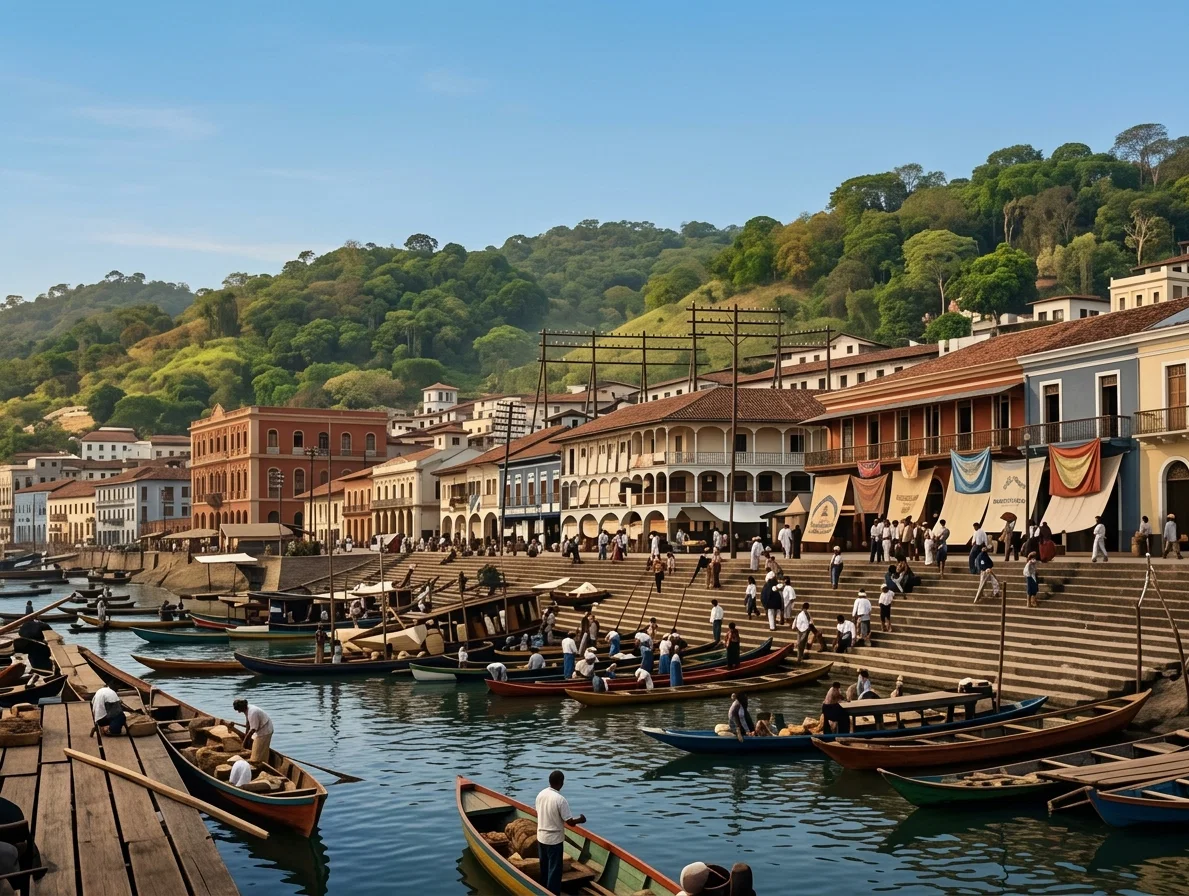
GUAYAQUIL, ECUADOR
GUAYAQUIL, ECUADOR
We hired a room at twenty cents a day right alongside the cathedral. The priest did not trouble us, nor did he manifest much concern about our “stealing his sheep,” for he declared “they were most all goats anyway.” The people on the coast in general have little to do with the priest, and we find many church buildings in ruins. They told me that the priest is needed only three times during their lives—at their baptism as infants, at marriage, and at the time of their death. We were requested to hold meetings at various places, and with the Lord’s help we shall answer these calls as soon as possible.
At Chone there is an opening for a self-supporting missionary. The government school offers one hundred sucres a month, including a house, for some one to take their English classes. This would occupy about an hour a day. At the same place there is a Spaniard who offers sixty sucres a month, with board and room, to teach his children English. These positions could both be filled by one person. Is there any one among our young people whose heart is consecrated to the Lord, who would like to step into this opening before it closes to us? Our Mission Board is taxed to its utmost to keep the work moving that is already started, besides answering the many calls that come from such lands as China and India, where self-supporting missionary work is not so easy. Why can not some of our energetic young people step into these openings, thus advancing the cause we love, without adding materially to its financial burdens? This would also help solve the problem we have in these countries of how to hold the people together after they accept the truth. They have been so accustomed to look to some one else as leader in religious matters that some one is needed to help them become established in the Christian life. Such workers, stationed at different places, would do much to strengthen the work. There are also openings in the colporteur work. During the two months in this new province there was sold about eight hundred dollars’ worth of literature, and then the territory was but touched.
We also have in our territory many thousands of poor, down-trodden, ignorant Indians, who can not read; but they must receive the gospel. I wish that all would read Señor Forga’s appeal for the descendants of the ancient Incas, in the Signs of the Times of Nov. 27, 1907. To work acceptably for this people we must master two new languages,—the Spanish and Quechua, and of the latter there are several dialects. This is no small task, and we have no time to delay. In these closing days the Lord will stir up many hearts to answer these calls. Let us not turn a deaf ear. As I shall be away a few months at our South American Union meeting, Brother Davis will be glad to give information to those who are interested in answering these calls. Enclose a five-cent United States stamp, as its value is easily obtained here.
Ambato.

Mission Notes

RECENTLY a complete Bible was presented, by the American Bible Society, to Pastor F. S. Atwood, of Lamberton, Minn., who is blind. This is printed in raised letters for the blind; bound in eleven large volumes, each measuring fourteen inches long, twelve inches wide, and three and one-fourth inches thick; and, complete, weighs nearly one hundred pounds.
THE school at Sunan, Korea, has been started, with eleven students. More are expected very soon. Brother Field, of Japan, says of this: “As we learn more of the conditions among the Koreans in general, and among the believers in particular, we realize more the need of educational work that will build them up in the faith, and help them to a higher standard of Christian living.”

California

LONG BEACH.—We have come to this place, where Mrs. Cardey will be under treatment for a time. In a few days I shall be on my way back to British Honduras.
While here I have not been inactive, and am glad to report many blessings from the Lord in working for souls. At Pomona the brethren urged that I hold a revival effort. This I did for ten days. The Lord blessed, and the church was thoroughly aroused. At the close of the meeting, Sunday, January 12, I baptized eight souls at this place, three of whom are new in the faith, the other five being young people. I feel very thankful to my Heavenly Father, and give all praise to him. E. L. CARDEY.

_The Colon Meeting_

In company with Elder U. Bender, president of the West Indian Union Conference, it was my privilege to attend the second session of the West Caribbean Conference, Jan. 1-6, 1908. The territory embraced in this conference is the Isthmus of Panama, Costa Rica, and St. Andrew's Island.
The brethren had just completed the erection of a neat little chapel, located at Mt. Hope, about two miles out from the heart of the city of Colon, in which the meetings were held.
There were gathered together representatives from nearly all the churches in the conference, together with the brethren who were living in the vicinity, making a congregation of from one hundred fifty to one hundred fifty people day by day. All Seventh-day Adventists in good standing with their home churches were seated as delegates.
The meeting lasted six days, and was full of interest from beginning to end. Three new churches were taken into the conference. Elder H. C. Goodrich was re-elected president of the West Caribbean Conference.
The book business in this territory the last year has been very successful, and there seems hardly any limit to the number of books that could be sold, especially in the Canal Zone district. About forty-five thousand workmen are there, most of them away from their homes and families, anxious to get anything in the line of reading-matter.
The brethren were very desirous that some earnest, God-fearing man should take up the book work, and push it with vigor. Life and Health, Liberty, and the Caribbean Watchman were also freely discussed, and an effort was put forth to place these periodicals in the hands of the working people on the Zone.
Every day there was preaching service, and studies on church work, the duties of church officers, etc.
Our hearts were made sad as we shook hands with these dear brethren, and bade them good-by. All went to their fields of labor with good courage, and we look for good fruitage, and a large ingathering of souls from this conference.
Brother U. Bender and I sailed, January 6, from Colon for Kingston, Jamaica.
I. H. EVANS.

Bermuda

HAMILTON.—We had profitable meetings during the week of prayer. Most of the brethren entered heartily into seeking the Lord. Our annual offering was $41.22.
During the month of December, in addition to other work, I sold three hundred fifty of the Missions Signs, bringing a profit of twenty dollars to the mission.
In November I held some meetings in the tent at Port Royal. There were no visible results.
There seems to be a very good interest in the school. Sixteen children are attending now whose parents are Sabbath-keepers. The total enrolment is twenty-six.
Very cheering reports are received from Brother Newberg, who embraced the message here last year. He is now settled on a small farm at Fitch Bay, Quebec. He was a staff sergeant, and would have been made a warrant officer in June, had he remained in the service. In a letter which recently came to hand, he says: “I am trying to do all I can for the Master. I trust he has directed me to this place to help.” This brother was in the island only a few months. Our work in Bermuda is much like that of a lighthouse-keeper. Although the people seem slow to step out in obedience to the message, and the results of our labor seem very small at times, yet if in eternity we can see that some few souls have been guided into the haven of truth by our being here, we shall be glad.
JAS. A. MORROW.

Seed Sowing in Manila

WHEN we came to Manila, we began sending literature to the American school-teachers scattered among all the islands. We were able to do this only because many sent us literature of various kinds, and we heartily thank those who have helped us in this way. There are about eight hundred American school-teachers here at the present time. You can readily see that to reach such a number of people, it would require a large supply of literature. We felt very anxious to make a systematic effort in setting the truth before these people, and we prayed earnestly that some way might be opened whereby this could be done.
We know you will rejoice with us, when I tell you that we received a letter from Elder E. W. Farnsworth, telling us that he had laid our need before the General Conference, and as a result five hundred copies weekly of the Special Series of the Signs of the Times are coming to us for use among these teachers. We had never told Elder Farnsworth anything about our needs, but the Lord impressed his mind to do this. This was a direct answer to our prayers. A few of these papers we are sending to the Filipino teachers, and other kind friends are sending us clubs of American and Australasian Signs, and these also we are using among this class.
There are a great many Filipino teachers, and as they are familiar with English, we are very anxious to carry on a systematic work among them. These teachers belong to the different tribes, and so speak their native languages in addition to English. Does this not seem to you to be a wonderful opportunity to reach with the truth many who speak these languages? We believe that it is, and if we can reach some of these teachers through English literature, they in turn will become channels of light to their own people.
We feel deeply in earnest over these matters: they mean so much to the work here. We post a letter to every person to whom we have sent literature, calling his attention to the papers, and asking him to give them a careful reading. We have received a number of letters in reply expressing appreciation. These have been received from both American and Filipino teachers. One of the latter writes that he had translated some of the articles in the papers into his native language for the benefit of his family, and that they were pleased at hearing such good articles. Praise the Lord for that! The Lord can carry the truth to those to whom we can not speak. This man wanted more literature, and we have sent it to him.
I wish we had time and space to copy some of the good letters we have received, but I must give you a few sentences from another Filipino's letter. He says: “This paper, especially in its Bible department, meets one of our needs—the reading and study of the Bible, of which we have been deprived for the last three hundred years. It might be a further indication of my interest in your paper, to say that an association is being organized by the teachers of the province, and one of the features to be pursued by it is the reading of magazines for the purpose of cultivating the habit of reading among its members. Your paper will be given place in our reading club.” We are in the seed-sowing stage of the work here, and we want to scatter the printed page as the leaves of autumn.
We are holding studies here in Manila with a young man, a Filipino, who is secretary to Archbishop Aglipay, the head of the Filipino Independent Church. This young man is an Ilocano, from the north of Luzon. He speaks two native languages, and Spanish and English. We have a study almost every day, and he is becoming greatly interested in the truth. The teachings of his church are mostly from evolution and higher criticism, with a very little from the Bible. As we have studied the truth, he can see that their teaching is error, and he told me that he could no longer teach their doctrines. We believe this young man will take his stand for the truth. It will mean much for him to cut loose from his present church connection, especially in a country like this. We want you to unite with us in prayer for this young man. His name is Santiago Fonacier.
I may say he has already helped us in correcting a translation into Tagalog of some matter on the second coming of Christ. He has started to translate the same into Ilocano. He wants us to take his sister into our home, and train her. We would gladly do this if we had room for her; but rent is very high here, and we have only a small place. I believe it will be necessary to have a place large enough to enable us to take young people into our home, and teach them how to live, physically as well as spiritually, that they in turn may become workers for their own people.
J. L. McELHANEY.

Church Organized at Merced

MERCED.—During the tent-meetings held at Merced last summer a Sabbath-school was organized of some twenty-five or thirty members, and by the close of the meeting about fifteen had promised to keep the Sabbath.
Our tent was moved to a small place not far away, and we continued to meet with this company every Sabbath. December 9 we organized a church of twenty-two members. Others are keeping the Sabbath and promise to unite with the church in the near future.
We are of good courage in the Lord, and are thankful to have a part in his glorious gospel message.
C. M. GARDNER, A. J. STEVENS.

Arkansas

LITTLE ROCK AND HOT SPRINGS.—Recognizing the necessity of doing a quick work in the South, and especially in the cities, and also having learned the difficulty of doing this work with no abiding church home, the believers in Little Rock, and also the believers in and near Hot Springs, have decided to build plain but neat churches. Steps are now being taken in both places to accomplish this end. The church in Little Rock will be in the suburbs. The one in Hot Springs will be out of the city a short distance. We do not desire to draw means from other needy fields, but being few in number and of the poor of this world, we have decided to ask our brethren to aid us in this good work as the Spirit of God may direct. Even small amounts will be thankfully received. All contributions may be sent to Mrs. A. P. Heacock, treasurer of the Little Rock church, 1203 Wolfe St., Little Rock, Ark.
A. P. HEACOCK.

Pennsylvania

PITTSBURG.—The Second Seventh-day Adventist church of Pittsburg is now twenty-seven months old, and has grown from a membership of ten to a membership of thirty. One of those has died, and the names of three have been dropped from the roll. The number of members could have been largely increased had we taken in all who have applied for fellowship.
The money collected for the several funds, including tithes and offerings, has amounted to $4,279.68. More than six hundred fifty dollars' worth of books, papers, and other literature has been sold and given away. Many homes have been reached with Bible readings.
While we are fully aware that we have come far short of what we could and should have done, yet we are glad that in spite of our shortcomings God has blessed the cause and us. Our work here is especially to reach the many thousands of colored people in this city and its vicinity, although the message is free to all who will be reached and are willing to do service for the truth.
W. H. GREEN.

British Guiana

TAPPACOOMA CREEK, ESSEQUIBO.—March 23 of the past year, Elder J. B. Beckner and I sailed from the shores of Jamaica on the steamship “Tagus;” and after a very pleasant voyage of sixteen days over the blue waters of the Caribbean (stopping at different places), we finally reached Guiana on the morning of April 8. A few days after arriving I began my work as school-teacher and general worker among the Indians (“Arawaks” and “Caribs”) of Tappacooma Creek, situated about sixty miles northwest of Georgetown, at the mouth of the great river, Essequibo. Although isolated,—I am almost in the heart of the forest, away from friends and relatives, and among a strange people,—I feel confident that our Heavenly Father, who is protecting his servants in other dark lands of the earth, will extend his guidance and protection to me also. I feel happy, although alone, in my work here.
During the year my heart has been cheered by the progress resulting from the feeble efforts put forth to teach this truth. The Lord has indeed richly blessed the work. During the year seven were baptized, three who apostatized over nine years ago were reclaimed, and there are two others now awaiting baptism, making a total of twelve. There are others who believe and are observing the Sabbath, but whose lives are not yet in harmony with the Word; for these I am still praying, trusting that by the help of God, they may lay aside every weight and be able to run successfully the race set before them.
As there is but a limited number of Indians living in this place, the number of children at school is very small, amounting to about twelve at present, yet it is encouraging to teach them; they are bright and very intelligent.
Elder Beckner having secured twenty-five acres of land from the government, we felt free to begin building a mission house. I am glad to say that our plans are progressing favorably. While there are many things to cause discouragement at times, yet on the other hand there is everything to encourage, and I have every reason to praise the Lord as I see these poor, benighted sons and daughters of the forest giving heed to the great message that is to prepare a people to stand ready to meet the Lord when he comes.
I sincerely ask the united prayers of all God's faithful children for the development of the work here.
THOS. J. KENNEDY.

Colorado

DENVER.—Never before in the history of our work have we had such an interest in this city as now. Open doors for the message are being found in all parts of the city, and the Lord is moving on hearts to accept the truth. Since the close of our camp-meeting in September fifty persons have been added to the church, making our membership at the present time four hundred ninety-nine. To God be all the praise. The good spirit of the Master prevails in the church. Love and unity exist among us as a result. We enjoy in a marked manner the presence of the Lord in our Sabbath services, and the hearts of many are being revived. Sinners respond to the call to give their hearts and lives to God. The attendance in our Sunday evening meetings has increased until we have almost a full house.
G. W. ANGLEBARGER.

North Carolina

CAN the canvasser make a living in North Carolina? That is an easy question to answer. Just combine your forces with hustle and you are sure to win. I do not mean that you are to go on the run, getting up at four o’clock in the morning, and working till nine or ten o’clock at night. The one who follows that method will not take time to show his book properly. He will rattle over three times as much of it as he should, and when he has finished, the one he has been canvassing wonders what kind of book he is selling. Result: no order. A hustler will, if possible, find every house in his field, missing none of the people, but hunting till he finds them. He will show enough of his book to interest them. He will speak distinctly, and be so enthusiastic in presenting his word that they will become interested. Result: an order. This kind of canvasser can make a living in North Carolina, or in any other part of the South.
Last year one of our North Carolina canvassers, out of nine months, put in not quite eight months actual field work. During this time he took orders for our books to the amount of $1,083, the delivery of which was $983.50, or ninety per cent. A ninety-per-cent delivery is good in any field. Many who at the present time have no active part in the work, could do as well as this brother has done.
We have a field inhabited by a sociable, hospitable people, who, when dealt with properly, become as lovable Christians as any in the world. Who will come and assist us in interesting them in the third angel’s message? Now is the opportune time. Soon the last invitation for help will have been given.
I shall be glad to correspond with any who may be thinking of coming to this part of the Lord’s harvest-field to engage in the canvassing work. My address is 276 Boulevard St., Winston-Salem, N. C. H. B. TILDEN, State Agent.

Field Notes and Gleanings

Brother Theo. G. Lewis, who has been holding meetings at Merrill, Wis., reports that five or six have recently begun keeping the Sabbath, and are reading our good books.
Of her work at Capitol Hill, Okla., Sister Sophia V. Parker, a Bible worker, gives this summary: “Since the first of September, I have given two hundred fifty readings, and made two hundred twenty visits; I have held twenty meetings, and have written forty missionary letters. Five persons belong to the church to-day who were not members then, and six others are keeping the Sabbath who were not keeping it then.”

Notes of Progress

THIS summary is not large, but it is good, considering the time of year, and the many general meetings and conventions which are being held.
In this summary, Scandinavia appears for the first time. We hope soon to be able to furnish reports from many foreign fields; for during 1908 we shall send out blanks for reports from all the foreign conferences and missions.
A successful canvassers' institute has recently been held in the Central New England Conference. Brother R. J. Bryant, the general agent, reports having trained twenty-five canvassers in this institute, twelve of whom are to work for “Great Controversy.”
It appears that a conference president may be very successful as State agent pro tem. A call comes from West Virginia for a State agent to take charge of thirty prospective canvassers in that conference. The president, Elder J. M. Rees, in harmony with his usual custom, has been working up a lively interest in the sale of our publications, with this good result.
Last year at Union College there were sixty-nine students in the canvassers’ band. When we heard of the great interest there, we thanked God and took courage. A letter from Prof. M. E. Kern, who has recently visited Union College, states that there are now two hundred members in the canvassers’ band. We thank God again, and take fresh courage.
A letter from South Lancaster Academy states that sixty-five students there have joined the canvassers’ band.
Brother Carl Weeks, general agent of the North Pacific Union Conference, writes that interest in the scholarship plan, and in the sale of books, is at white heat in all the schools of the North Pacific Union.
We are informed that the Watchman has doubled its circulation during the past year.
We note from the address of the manager of the Pacific Press before the stockholders, at their recent meeting, the following interesting facts concerning the circulation of the Signs of the Times: Two years ago the subscription list stood at 14,000 copies a week. During 1907 the circulation stood from 34,000 to 50,000 copies a week, besides a sale of nearly 200,000 copies of the World’s Missions Number.
Life and Health and Liberty have greatly increased their circulation since the size and price were increased. Thirty-five thousand copies of the January number of Life and Health were printed, and they were sold before the fifteenth day of the month. Forty thousand copies were printed of the February number, and they were all sold before the first day of February; and another edition of 10,000 copies was printed to supply the demand. There are between twenty and thirty agents working for these journals, and they are selling from one thousand to three thousand copies each, a month, at ten cents a copy.
What do these things mean? Is the work of God disintegrating and falling to pieces, as some of its enemies seem to suppose? This is a mere handful of items among hundreds of encouraging reports which give the truth of the triumph and onward march of the message.
Let those who have a tendency toward mental and spiritual dyspepsia, who are groaning because of the alleged weakness of the work and organization of the third angel’s message, be admonished, and cheered, and blessed by the great array of encouraging facts, instead of moping under the pains of their own soul’s sickness.
Let the men and women, and the boys and girls, who have been circulating the literature so actively during 1907, take fresh courage and join the rapidly increasing ranks.
E. R. PALMER. Sec. Gen. Conf. Publishing Dept.
Continue reading: Canvassers’ Summary for December, 1907