The Youth’s Instructor, Vol. 33, No. 22.

TO BLOSSOMS
Earlier text: TO BLOSSOMS

ALWAYS AT SCHOOL.

In making their plans, boys and girls frequently calculate that their education is finished when their studies in the school-room are done. But the truth is, that if their lives are spared to the common age of man, their education is really but just begun. “The world is a school,” and in our intercourse with it, we should learn something new and useful every day. We should keep up the habit of reading and study, gathering, in the meantime, knowledge from men and things as well as from books. In our desire for wisdom, we might do well to pattern after one of the great artists of Italy, Michael Angelo. It is said of him:—
“One day, when old and feeble, he was found walking among the ruins of Rome.
“‘Where are you going?’ he was asked.
“‘To school,’ said the old artist, ‘to try to learn something.’
“This brief reply showed the nature of the man and the secret of his great success. Though he lived to old age, yet he was never too old to learn. His great genius was linked to industry, and therefore he was enabled to enrich the world with so many works of art. His mind was active, and his hand busy, until death closed his long and useful career.”

Follow the Example of the Locomotive

FOLLOW the example of the locomotive. He runs along, whistles over his work, and never takes anything but water to wet his whistle.

On Admitting One's Mistakes Gracefully

A MAN should never be ashamed to own that he has been in the wrong, which is but saying in other words, that he is wiser to-day than he was yesterday.

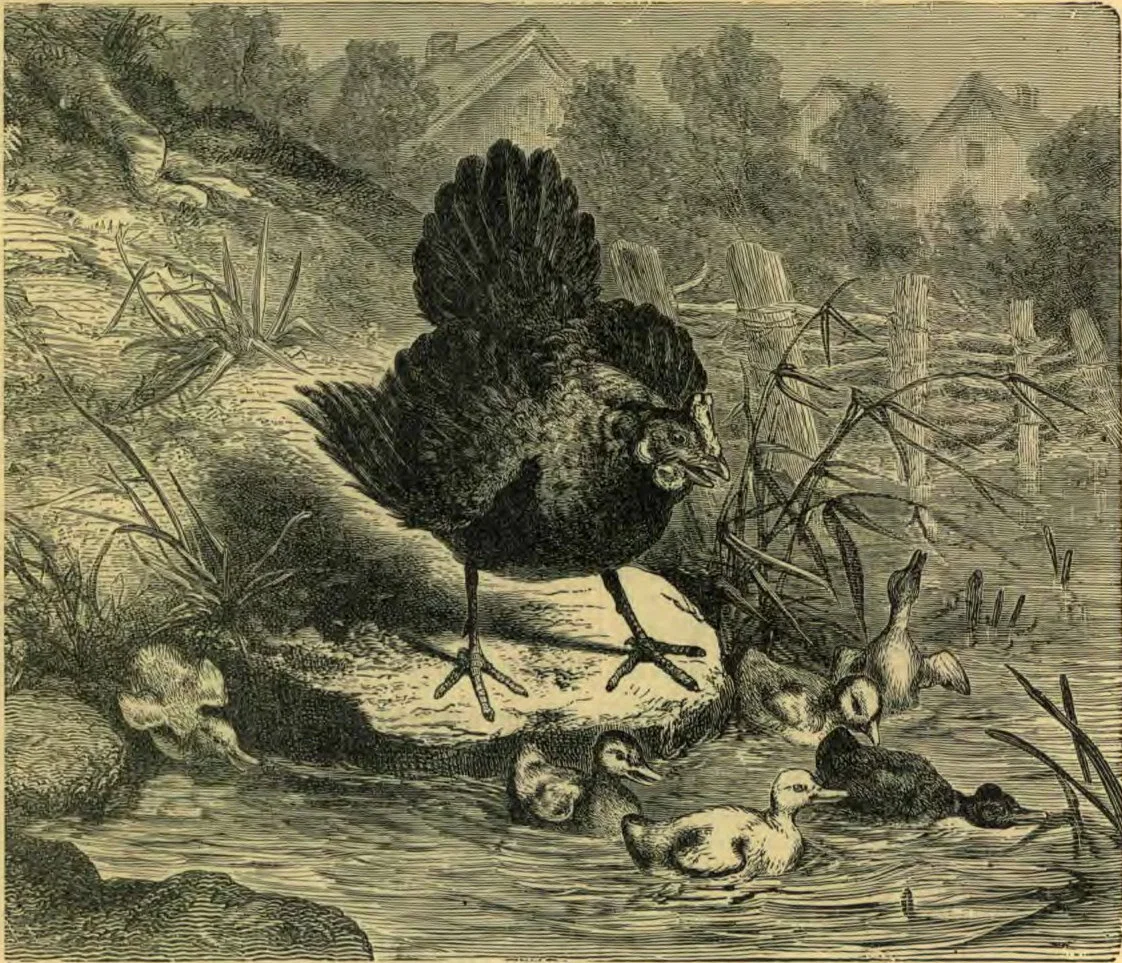
THE CHICKEN'S MISTAKE.

A LITTLE, downy chicken one day Asked leave to go on the water, Where she saw a duck with her brood at play, Swimming and splashing about her.
Indeed, she began to peep and cry, When her mother wouldn't let her; "If ducks can swim there, why can't I? Are they any bigger or better?"
Then the old hen answered, "Listen to me, And hush your foolish talking; Just look at your feet, and you will see They were only made for walking."
But chickey wistfully eyed the brook, And didn't half believe her, For she seemed to say, by a knowing look, "Such stories couldn't deceive her."
And as her mother was scratching the ground, She muttered lower and lower, "I know I can go there and not be drowned, And so I think I'll show her."
Then she made a plunge, where the stream was deep, And saw too late her blunder; For she had not hardly time to peep, Till her foolish head went under.
And now I hope her fate will show The child, my story reading, That those who are older sometimes know What you will do well in heeding; That each content in his place should dwell, And envy not his brother; And any part that is acted well Is just as good as another.
For we all have our proper sphere below, And this is a truth worth knowing; You'll come to grief if you try to go Where you never were made for going. —Phoebe Cory.

My Stolen Ride.

Two or three years ago, when I was a littler boy than I am now, I thought nothing was much nicer than a ride on the horse-cars, especially if I was sent off somewhere alone on an errand. That made me feel very large and old.
One day, when I was sent down to Aunt Phœbe's, to get a pattern for mamma, the conductor forgot to take my five cents. I had it all ready in my hand, but he never looked my way at all.
I didn't get five cents to spend, as often as I wanted it, and it came into my head that I could have that money for candy.
“The conductor ought to look out for his fare, and if he doesn't, I guess I've a good right to keep it,” I said to myself. Of course I knew better, but I wanted the candy so!
There was a boy I knew on the car. At least, I knew him a little. He had just come to live on our street. His name was Willy Loring. He was some larger than I, a nice boy. I wondered if he saw the conductor pass me by, and what he would think about it.
Pretty soon I got off the car. Willy got off at the same place. I wanted to get acquainted and be good friends with him, so I said, “Come into the store with me, and I'll treat. I got my ride for nothing this time.”
“You did? How's that?” Willy asked, staring hard at me.
“The conductor didn't see me. Come on, and we'll have some candy.”
I did not forget very soon how Willy looked at me.
“Sold yourself cheap, didn't you? I wouldn't be a thief for only five cents. No, thank you, I don't care for any of your candy,” he said.
He turned and ran down the next street, and left me standing there, oh, how ashamed!
“A thief for only five cents!” “Sold myself cheap!” Who bought me? It couldn't be anybody but Satan. I kept thinking it over all the way home, and all the evening till I went to bed, so that I couldn't play at all.
“Mamma, what is stealing?” I asked, as she was tucking me up in bed.
“Don't you know?” she asked.
“But I want you to tell me just what you think it is,” I said.
“I think it is taking what doesn't belong to you,” mamma said.
The ride on the horse-car certainly didn't belong to me till I paid for it. I didn't put down the track, nor buy the horses, nor make the car. Then I stole. I was just what Willy Loring said: “A thief for only five cents.”
I thought I should never get to sleep. I lay awake, tumbling and tossing about five or six hours. At any rate, it seemed as long as that. But I dropped off at last, and slept till broad daylight.
I woke with a bad feeling. I hated to meet papa at breakfast, though I knew he didn't think of such a thing as my being a thief. I did not get rid of my miserable feelings that day nor the next. I was sick every time I thought of what Willy Loring said.
Thursday night, papa got home early, and we were sitting alone by the parlor fire. He looked so kind and good, that I gathered up all my courage, and asked,—
“Papa, what would you do, if you wanted to find a car-conductor, and didn't know his name, nor anything about him only that he had a scar on his face close to the corner of his eye?”
Of course papa asked what I wanted to see the conductor for, and finally got the whole story. I was rather glad to tell him, for I thought he would help me out of my trouble.
And he did. He didn't scold, nor even stare at me, as Willy Loring did, as if he'd never think of me as a decent kind of a boy again. He put his arm around me, and wiped my tears, for I couldn't keep from crying some, and just said, “I'm very sure my dear boy will never do such a thing again.”
Then he gave me ten cents, and told me to ride down next day at just the same hour I did that other day, and most likely I should see the same conductor, and then I could give him the five cents (for I had kept it; I didn't buy any candy after all). If I didn't see that conductor, he told me to go on to the station at the end of the road, and give it to the man in the little office there, for that conductor. He said the office man would know which was the right man by the scar.
So I rode down next day, and the conductor was the very same; so I didn't have to go to the office. I was glad of that.
But Willy Loring never saw me when I passed him, for a good many days after that. At last I went up to him one day, and said, “You needn't keep thinking I'm a thief, Willy Loring. I carried that five cents and paid it to the conductor, and I am never going to steal a ride again.”
Willy didn't speak for a minute. Then he said, “Let's go down by the park and have a game of hop-scotch. Will you?”
And ever since then we've been ever so good friends.— Youth's Companion.

Letter Budget.

SAMUEL A. HOFF, of Ritchie Co., W. Va., writes: “I shall be eleven years old next August. I am trying to be a Christian. I have two brothers and two sisters. We go to Sabbath-school every Sabbath, and I study in Book No. 1. We are all trying to learn Eld. Canright’s little girl’s rules, which I think are nice.”
Vieve Canright’s rules are nice for boys and girls to put in practice. Of course, that is what you are learning them for,—to be governed by them. Have you ever tried to make any good rules for little boys and girls? May be you might make other important ones.
EULALIA ARMSTRONG and DELIA WATT, two little girls ten years old, both write from Vernon Co., Mo. Eulalia says: “I do not take the INSTRUCTOR, but Mrs. Watt gives me papers to read. I like them very much. My brother and sisters go to Sunday-school every Sunday; but I am not able to go, and so I stay at home and read the INSTRUCTOR. I am reading the Bible through. I have read to the fifth chapter of Acts. I am trying to be a good girl.”
Della says: “I keep the Sabbath with my papa and mamma, two brothers and one sister. We live three miles from our place of Sabbath-school, and cannot always go, on account of bad weather. We all study in Book No. 1. My papa is away most of the time preaching. I am always glad when he returns. I want to gain a home in the kingdom of God.”
We hope these little girls may be blessed with health, and with a desire to do all of Jesus’ will.
FRANK HOWARD, of Humboldt Co., Cal., says: “I haven’t noticed any letter from this place in so long I thought I would write. A Sabbath-school was organized here last September; and at present we have about twenty-five members. I attend with my father, mother, and younger brother. I have an older brother, who is studying for the ministry at the Healdsburg College. I love to go to Sabbath-school, and to read the INSTRUCTOR. I hope to meet you all in the new earth.”
Are we all putting forth our best efforts to gain an inheritance in the new earth? Are we striving for eternal life? This we must do, or we shall never obtain it.
LILLY MAY COMBS sends money from Greenwood Co., Kansas, to renew her subscription to the INSTRUCTOR, and says: “I wouldn’t do without the paper for anything. I have taken it one year. I am ten years old, and have a brother six years of age. We both go to day school and Sabbath-school, and we are both trying to keep all the commandments, so we can meet mamma, who died last November, in the new kingdom. We send love to the INSTRUCTOR family.”
You are “trying to keep the commandments,” Lilly, but sometimes when you do wrong, what then? Do you ask to be forgiven, for Jesus’ sake? You must keep in mind that it is for Jesus’ sake, who died for you, that you are trying to do right; then Jesus will help you.
LETTIE THOMPSON writes from Wise Co., Texas. She says: “I go to public school and Sabbath-school. Our Sabbath-school numbers about thirty members. We have a church here at last. Six have received baptism. We have a tract and missionary society also. I keep the Sabbath with papa, mamma, one sister, and two brothers. I love the INSTRUCTOR, especially the children’s letters. Pray for me, that I may walk in all the light God may send me.”
If you walk in all the light given you, Lettie, you will let it shine on others, by your good works and good influence. We pray that you may be a shining light in that newly organized church and tract and missionary society.
MOLLIE D. JONES sends a letter from Benton Co., Ark. She says: “I keep the Sabbath with my parents, three brothers, and one sister. We began to keep the Sabbath ten years ago, in Kansas; but we have lived in Arkansas most of the time since, where we have had no preaching or Sabbath-school until last January. At that time a minister came and preached in our school-house six weeks, and now fourteen are keeping the Sabbath, and we have Sabbath-school. Will not the INSTRUCTOR family pray that we may be faithful?”
Let us all remember the dear friends in Arkansas, and the good work that is going on there.

You have reached the end of this edition.

The Youth’s Instructor · Jun 1885