The Youth’s Instructor, Vol. 33, No. 22.

TO BLOSSOMS

The Youth’s Instructor

Jun 1885

S. D. A. Publishing Association · Battle Creek, Mich. · Jun 1885

TO BLOSSOMS.

FAIR pledges of a fruitful tree, Why do you fall so fast? Your date is not so past. But you may stay yet here awhile To blush and gently smile, And go at last.
What! were you born to be An hour or half's delight, And so to bid good-night? 'Tis pity Nature brought you forth, Merely to show your worth, And lose you quite.
But you are lovely leaves, where we May read how soon things have Their end, though ne'er so brave; And after they have shown their pride Like you awhile, they glide Into the grave.
—Robert Herrick.

THE STORY OF JOSEPH.

A LONG, long time ago there lived in Hebron a lad named Joseph, who was greatly beloved by his father on account of his many virtues. The boy's mother was dead, and this dutiful, affectionate child comforted his father very much in his loneliness. Because he was a favorite, however, he was not allowed to grow up in idleness; and at the age of seventeen years, he was placed with his ten older brothers to care for his father's flocks.
At one time it seems that Joseph was not with his brethren; and no tidings had come from them in a long time, which made the father fear some terrible thing had happened to them; and so he sent Joseph to Shechem, where he supposed they were, to see if they were safe. Joseph directed his course to Shechem; but his brethren had gone to Dothan, several miles farther from home, where he at last found them. They were very glad when they saw him coming; but not for the reason one would naturally suppose,—because he was their own father's son, and would bring them news from home. They were jealous of him, and hoped they would now have an opportunity to put him out of the way. Joseph had too pure a mind to look upon their evil actions without a word of reproof, or without making their faults known to the father for correction; and thus it was they hated him. And when they saw the lad away in the distance coming toward them, they planned to kill him; and to hide their crime from their father, they meant to throw his lifeless body into a pit, and say an evil beast had eaten him up.
How unnatural that these brethren could wish to destroy a young and innocent brother, knowing, too, the distress it would bring upon their aged parent. And how more unnatural still that they could resist his earnest entreaties to do him no harm.
Two of the brethren, Reuben and Judah, were opposed to taking the lad's life. Reuben begged them not to do so wicked a thing, but to cast him into the pit alive. He meant to deliver him, if possible, and to restore him to his father.
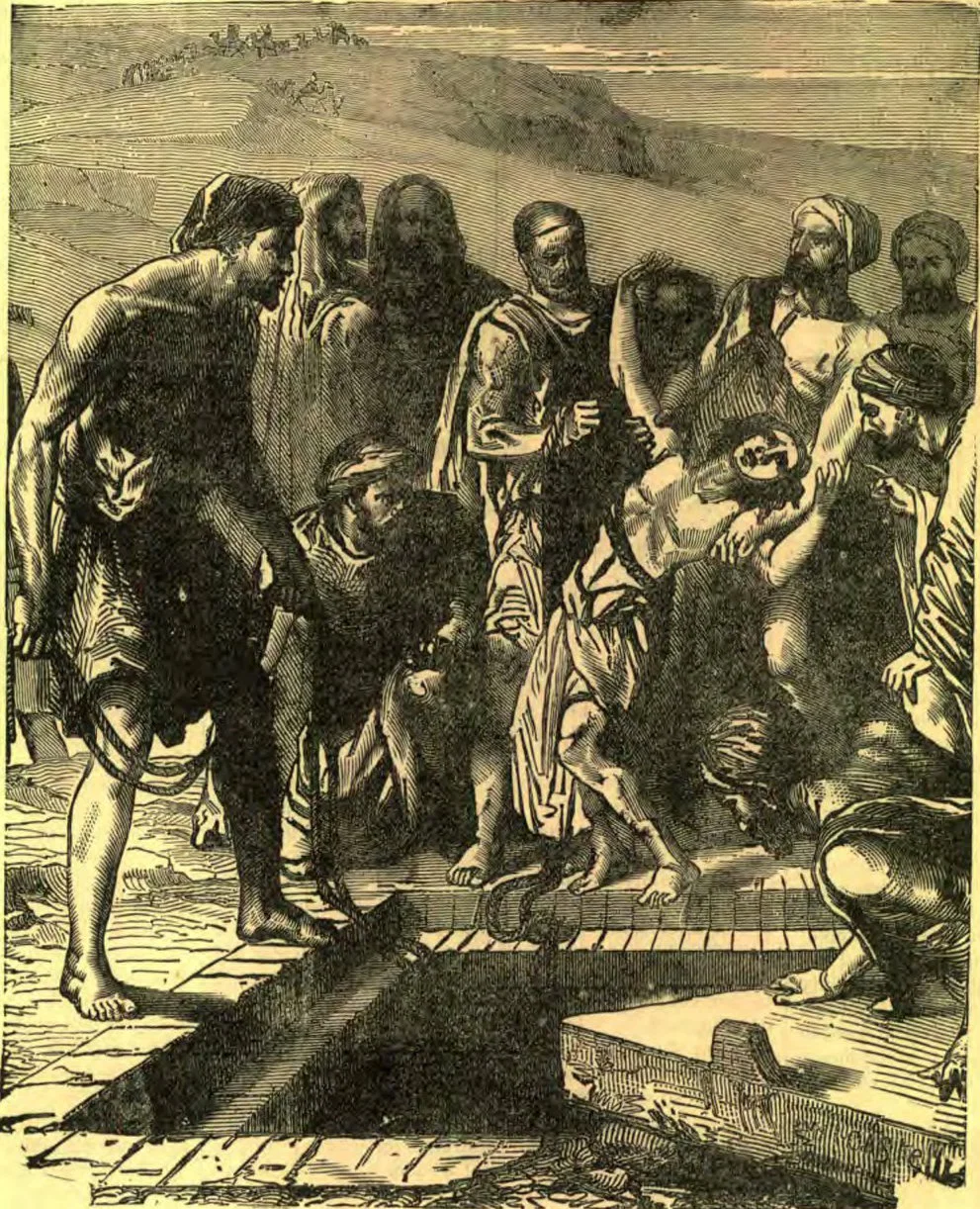
Having agreed among themselves that Joseph should not be killed, they stripped off his coat of many colors, and lowered him into his prison, and with the exception of Reuben, sat down to eat bread. While they were eating, a company of Arabian traders happened along; and Judah, not wishing to leave Joseph in his prison-house to perish of cold and hunger, proposed selling him to these merchantmen. Judah thought he would become a slave in Egypt, and so be likely never to receive any honor above them. They all readily assented to his proposition, with the exception of Reuben, who was not present; and the lad was sold for twenty pieces of silver, or about fifteen of our dollars, and was taken to Egypt.
Reuben, supposing the lad was yet in the pit, after awhile came a round-about way for the purpose of releasing him. But to his surprise he was not there; and his grief was so great he rent his clothes; and some of the burden of his father's grief coming upon him, he cried out, “The child is not; and I, whither shall I go?”
Having disposed of Joseph, these cruel brothers went deliberately to work at making a lie to hide their guilt from the bereaved parent. They dipped the coat of many colors into the blood of a kid, to give it the appearance of having been stained with Joseph's blood, and then took the soiled garment to the father, saying, “This have we found; know now whether it be thy son's coat or no.” Jacob knew the coat, and said, “An evil beast hath devoured him. Joseph is without doubt rent in pieces.” His friends all rose up to comfort him, but he refused to be comforted, and he said, “For I will go down into the grave” unto my son mourning.”
Joseph's history did not close when he was taken to Egypt by the Ishmaelites. He was bought of them by Potiphar, captain of King Pharaoh's guard. In his new home the lad feared God, and performed his several duties so faithfully that his master took a great liking to him, and made him overseer over all that he had. God prospered him; and although he suffered a great wrong at the hand of his mistress, which resulted in his imprisonment, yet he endured the trial, and came forth as gold.
While Joseph was in prison, Pharaoh had strange dreams, which none could be found to interpret until God gave the interpretation through Joseph. Pharaoh's attention was now directed to this young man whom the Lord so highly favored, and he said unto his servants, “Can we find such a one as this is, a man in whom the Spirit of God is?” “And Pharaoh said unto Joseph, Forasmuch as God hath show'd thee all this, there is none so discreet and wise as thou art.” And from that time, Joseph was placed in authority next to the king. And thus the lad who was sold into slavery, was highly exalted; while his brothers, who treated him so cruelly, were greatly humbled.
M. J. C.

THE SHELF IN THE ATTIC.

WHEN Kate Holden entered the sitting-room to greet a caller, a very disorderly room met her eye. Three pairs of overshoes lay before the polished grate; a waterproof covered the best chair; slates and books nearly concealed the pretty table-cover; several dolls, with their ample wardrobe, occupied the sofa; while fragments of bread, doughnuts, and apples, told of a lunch suddenly interrupted. Kate could not conceal her annoyance, and the cloud that rested upon her usually sunny face, deepened as she parted from her friend, and returned to her mother’s room. It was not a new trial. Kate’s wisdom and patience had been sorely taxed during the long illness of her mother; and the five active children, missing the mother’s restraining hand, were rapidly getting beyond Kate’s control.
Mrs. Holden listened patiently to Kate’s oft-repeated story of thoughtlessness on the part of the children, and saw that something must be done to help her in enforcing habits of order. Kate thought of a plan, and the decree went forth that all mislaid articles would be speedily transferred to a certain broad shelf in the attic, from which none but the owner might remove them. The novelty of the plan interested the children; while father, Kate, and even Bridget, promised to submit to its conditions; Kate, sanguine of success, made haste to appoint a place for everything, and to put everything in its place.
For a few days, order reigned in the house. Mary’s dolls were carefully returned to their drawer; the boys’ hats hung upon their allotted pegs; Jenny’s aprons and ribbons were no longer strewn broadcast throughout the house; and even little Charlie’s blocks and toys were carefully guarded from threatened exile. But careless habits had too long prevailed to be overcome at once, and the first rainy day sent a waterproof and umbrella to the broad shelf. The same evening, as the children gathered about the table to prepare lessons, Harry’s books could not be found.
“Where did you leave them?” asked one.
“I know where you will find them,” said Jenny; and amid peals of laughter, Harry ascended the attic stairs. This was a valuable reminder to the other children; but soon Mary’s dolls disappeared from the sofa, Jenny’s paint box from the dining-table, and Charlie’s soldiers exchanged their camping ground in mamma’s room for the greater seclusion of the broad shelf in the attic. The children usually submitted cheerfully. Jenny sometimes pettishly complained of the inconvenience of a dressing room at the top of the house; and John, when time pressed, preferred to do without cuffs and gloves.
“It isn’t all fun,” said Mary one evening, as she timidly entered the dusky room in search of her composition book; “but if we can only catch Kate, I’ll not complain.”
An opportunity occurred at length. Kate, preparing for a drive, sought in vain for her muff. She hurried from closet to drawer in search of the missing article that no one had seen, while her father restrained the impatient horses at the gate.
“Charlie must have taken it,” she said fretfully; and finding him in the kitchen, she repeated her question.
“Yes,” said the little rogue, “I found it on mamma’s bed, and Bridget and I put it away up on the attic shelf, where she found my blocks.”
Bridget suddenly disappeared, and Kate sought the attic shelf, followed by the children’s shouts of triumph.
Mr. Holden’s turn came at last.
“Children,” he asked hurriedly, one morning, “have any of you seen my driving gloves?”
“Yes, papa dear,” replied Mary, “I saw them last night in the attic on the broad shelf.”
A look of astonishment, not unmingled with displeasure, passed over his face, as he repeated, “In the attic?”
Mary saw the half-frightened looks of the children, the cloud upon her father’s face; and fearing she had ventured too far, quickly sprang up, saying, “Forgive me, papa. I’ll go and get them.”
“No, no,” said Mr. Holden. “I had quite forgotten the new law; but if I have broken it, I’ll pay the penalty.”
As his heavy steps ascended the stairs, the repressed mirth gave way to merry laughter, in which he heartily joined. Quiet was scarcely restored, when Bridget was heard anxiously inquiring for a lost broom.
“You’ll find it on the broad shelf in the attic,” shouted Harry; “the piazza is not the proper place for a broom.”
Bridget also mounted the attic stairs.
“She’s the very last,” said Jenny; “it’s doing us lots of good, and I don’t mind going every day, for the fun of seeing others go.”
She did not go every day, however; for orderly habits were becoming fixed in the Holden family. Kate’s tasks were greatly lightened; and when Mrs. Holden was able to resume her place in the family, she found the law, like many another, unnecessary, because seldom transgressed.—Sel

A TRIP TO THE MOUNTAINS.

On a bright and beautiful morning in early February we left San Diego Bay and National City for a forty-five mile trip in a south-easterly direction into the country. Our way lay through canyons and mountain passes, and over mountains and high table-lands. Hundreds of cattle and sheep, attended by herdsmen, were grazing upon the mesas. Our route was so serpentine that I think we had scarcely four rods of straight road in the entire distance.
In these parts there is scarcely a tree to be seen, aside from a few scrubby specimens along the streams. The mountain surface is mostly barren and rocky, covered when not too rocky, with chamisal brush, sage, and the like. Occasionally, however, we see a mountain side literally and almost impenetrably incased in a cactus coat of mail. In my mother's garden, on the old Ohio homestead, used to grow a scented herb called the “old man.” On the mesas and in the valleys of San Diego County may be seen thousands of acres of “old man.”
We saw but few houses on our way. About six miles from National City stood a beautiful mansion, nestled in a little, sunny valley among the mountains, and surrounded by fruit-trees and flowers. We were informed that it was the residence of W. W. Whitney, of Toledo, Ohio, a man of some note in the musical world. About ten miles farther on, we came to the beautiful lemon and orange farm owned by a Mr. Harvey. We gratified our eyes by driving slowly around the orchard; then we gratified the appetite by securing two dozen luscious golden oranges. A little farther on, beside a cool, rippling stream, we tied our faithful horse to graze upon the fresh, green grass, while we partook of our lunch under the spreading shade of an alder tree. In my native State, the alder is only a large bush or shrub, but the one under which we lunched is a tree, perhaps twenty feet high and ten inches in diameter. These alder trees are here frequently met with along the streams. It was too warm for comfort in the sunshine. A visitor at the orange farm informed us that he learned from a letter just received from his home in Wisconsin, that the thermometer stood 32 degrees below zero, while here it was 92 degrees above.
In the afternoon we obtained, from the mountain height, a bird's-eye view of Cottonwood Valley, so called from the cottonwood trees that line the banks of the Tia Juana River, (pronounced Te-a-wa-na), that runs through the valley. This valley lies quite low. It is more than thirty miles from the ocean, and about seven hundred feet above the ocean level. It comprises nearly five hundred acres of land, all owned by B. F. Sheckler, who is the only resident in the valley. His nearest neighbor is over the mountains, three miles away. Some of the surrounding mountains are quite high. Mt. Tecarte, just back of the house, rises to the height of 4,000 feet. But few persons ever ascend to the summit.
Very soon we descended into the valley, and were heartily welcomed at the comfortable home of Mr. Sheckler. In the early morning, we started up the mountains in a south-easterly direction for Potrero, seven miles distant. The Potrero is an elevated valley. It has only one school district, lying near the line of Mexico.
I think the mountain scenery on this road the most sublime of anything we have yet seen in Southern California. At one point, hard by the road-side, stands an immense boulder, known as Finger Rock, so isolated, and inclined over the road, that the stranger, in passing, wonders why it does not fall. In a crevice on top of this rock grows a large bayonet cactus, or Spanish dagger. In the summer, this plant shoots up a stout stalk four or five feet high, thickly studded with a large, white, trumpet-shaped, wax-like flower, said to be extremely beautiful, and remaining in bloom a long time. I can imagine the attractiveness of this immense, hand-like rock, pointing toward heaven like a finger, and supporting in the palm such a beautiful bouquet.
Mr. Sheckler devotes his attention mainly to the raising of cattle and bees. We never expect to find a land more nearly flowing with milk and honey than is Cottonwood Valley. It is said to be one of the best bee ranches in the county, if not in the State. The amount of honey produced in this county is absolutely astonishing, amounting in the year just closed, to about one thousand and eighty-eight tons, or one hundred car loads. About one-half of this amount was comb honey. The finest and whitest is made from the sage blossom. The bee here finds an abundance of warm sunshine and some flowers during the so-called winter months; so it rarely has a vacation the year round. There are many varieties of flowering grasses, herbs, and shrubs, from which they gather their honeyed store. We observed small, white patches which appeared at a distance of a few feet to be salt or flour strewn upon the ground. But upon a closer view, we found it to be a tiny, white flower, with a red speck in the center, the whole scarcely larger than a pin head, and very pretty. The bees were roaming over these miniature flower fields.
In a few days we left the mountain-begirt home of Mr. Sheckler, and returned to the coast, feeling pleased with our visit and journey, but weary, and with our curiosity to see the mountain fastnesses entirely satisfied.
H. A. St. JOHN.

BE COURTEOUS.

IN our Sabbath-school, a few weeks ago, something took place which made me feel very sad, and made me think that two girls, at least, had forgotten St. Peter’s direction, to “be courteous.”
The superintendent had given out the hymn to be sung, and the scholars were finding the place, when one girl stepped back, and offered her book to two older girls who had none.
These girls were whispering at the time, and not setting a very good example to the younger scholars; so I was glad to see that they were going to have a book, that they might join in the singing.
But how my cheeks burned with shame as I watched them! Instead of accepting the book with a smile and a nod of thanks, one of the girls stared rudely at the worn sacque and bare hands of Anna, who offered it, while the other said bluntly, “We don’t want to sing,” then turned to her companion and whispered something, at which both laughed.
“Poor Anna! will she ever try to be kind or polite again?” I thought as I watched her. She took her place, and tried to sing with the rest; but I knew that the gladness which was in her face when she came into the room had all died out of her heart, and that she was feeling her poverty as a disgrace. I did not wonder when I saw that tears were in her eyes and dropping on her book, and I looked at the older girls, expecting to see them mortified and ashamed.
But they had not risen with the others, and hence could not see Anna, had they taken the trouble to look. As they were still whispering and laughing, however, I fear they never thought again of her or of their own rudeness.
Another Sabbath a poorly-dressed boy came in a little late, to find his class full. By a little crowding the boys might easily have made room for him; but instead of this, they kept him standing, while they nudged each other, and laughed at his ill-fitting clothes and his worn shoes.
As soon as the teacher saw him, she gave him a seat close by her, and made him happy with a bright smile and a pleasant “I’m glad to see you, Johnnie; I was afraid you were not coming.” What a look of gratitude I saw on the poor boy’s face; while the face of the teacher, which had before seemed plain, now looked beautiful to my eyes, for I could see in it kindness and love; and I thought, “There is one, at least, in this school who knows how to be courteous.”
Now I hope the boys and girls who read this are never guilty of anything rude or thoughtless. But as our Sabbath-school is a very good one, most of its scholars coming from comfortable homes, where they ought to be taught good manners, kindness, and thoughtfulness, perhaps there may be in other schools some who will find that this coat fits.
And if you are sure that you are innocent of doing anything to make others unhappy, are you sure too that you have done something to make them happy? We mustn’t be content with not doing evil; we ought always to try to do some good. Let us never forget that St. Peter says, “Be courteous,” and that St. Paul says, “Be kindly affectioned one to another with brotherly love, in honor preferring one another.” The Bible, you see, tells, among other things, about daily conduct.—Child’s Paper.

ONE TAPER.

One taper lights a thousand, One wave through thousands runs; Oh, be my life a taper, And those I kindle, suns.
One wave uplifts a thousand, One light through thousands gleams; Oh, be my life a billow To reach far distant streams.
—Youth’s Companion.

INCIDENTS IN THE LIFE OF LUTHER.

We occasionally see Christians who, when they meet certain people, or are placed in certain trying circumstances, hesitate to boldly declare themselves to be on the Lord's side. To be faithful at such times is pleasing to God.
One time, Martin Luther was called to go before the emperor, and princes, and great men of Germany to answer to certain charges made against him; and if possible, to be made to retract what he had said and written.
He knew his enemies were anxious to kill him. As he was passing through the hall, a veteran commander touched him on the shoulder, and said kindly, “My poor monk, my poor monk, thou hast a march and a struggle to go through, such as neither I nor many other captains have seen the like of in our worst campaigns. But if thy cause is just, and thou art sure of it, go forward in God's name, and fear nothing. He will not forsake thee.”
When he appeared before the court, the chancellor said, “If you do not retract, the emperor and the States of the empire will proceed to consider how to deal with an obstinate heretic.”
At these words, Luther's friends trembled; but he said, “May God be my helper, for I can retract nothing.”
How noble Luther's conduct appears! How much more worthy of imitation than the “course of Bishop Cranmer, of England, who did retract, but was, after all, burned at the stake!”
At another time, as Luther was entering an inn, an officer made his way to him through the crowd, and said, “Are you the man who has taken in hand to reform the papacy? How can you expect to succeed?”
“Yes,” said Luther, “I am the man. I place my dependence upon the almighty God, whose word and commandment are before me.”
The officer was much affected, and said, “Dear friend, there is much in what you say. I am a servant of the Emperor Charles; but your Master is greater than mine. He will keep and protect you.” J. R. CALKINS.

A VALUABLE BOOK.

Bishop Janes used to tell a story that ought to stimulate us to search the Blessed Book for the promises given to us. Speaking once in a strange church for the Bible Society, he used these words in appealing for money: “Let each one give according to the value he puts upon his Bible.”
Early the next morning a boy called to see the Bishop. He was a frank, open-faced lad, and met the good man with a modest manliness that was very pleasing.
“I have come, sir,” he said, “to bring you a half-dollar for the Bible Society.”
“Is it your own gift?” asked the Bishop, kindly, for he saw from the boy’s dress that he was poor.
“Yes, sir,” replied the boy, “and it is all I have. I wish it was much more.”
“Why,” asked the good Bishop, “do you give all that you have? Why not keep part for your own use?”
“Because, sir,” said the boy, blushing as he spoke, “you asked us yesterday to give according to the value we put upon the Bible. I have reason to value it more than all things besides, and so I bring you all the money I have in the world.”
“Perhaps you will tell me why you prize it so highly?” asked the Bishop, whose curiosity was excited.
“Three years ago, sir,” replied the boy, “my father and mother both died. I was left all alone in the world, without money or friends. Before she died, my mother asked me to read in the Bible every day, and I have kept the promise I made her. Not long after I was left alone, I came upon this promise, ‘When my father and my mother forsake me, then the Lord will take me up.’ I have found that it is every word true. The Lord has taken me up, and has been both father and mother to me. But for my Bible, I should not have known that I could depend upon the Lord to direct me and lead me.”
One promise from this store-house had proved a mine of gold to this orphan boy! One golden grain from this great field had proved his salvation from the perils of youth! No wonder he valued the Bible, even to the giving of all his earthly treasure, that others might know and love it too! —S. S. Classmate.

Religion as Armor, Not a Cloak

RELIGION is the best armor that a man can have, but it is the worst cloak.—Bunyan.

THE EARLY-TO-SABBATH-SCHOOL FAMILY.

Last week I gave you an account of a visit to a family named “Late-to-Sabbath-School.” I was not much pleased with that family; but this week I will tell you of a visit which I made to an entirely different family. I think most of you will like this one. I have met with their relation in every church which I have visited. Bright people they are, and I always like them. They are generally wide awake, and interested in the Sabbath-school work. They always think the lesson short enough, and not very hard. Their name is Early-to-Sabbath-School. Many of them live a good way from the church, yet they are always on time.
One Sabbath, after the sermon, I went home with one of these families. When dinner was over, and we had had a pleasant chat, the mother said, “Suppose we look over the Sabbath-school lesson now.”
“All right,” said the father; “if we get it now, we will be sure to have it in season. Where are Wide-Awake and Thoughtful?”
“Oh, they are reading the INSTRUCTOR together,” said the mother.
“Children, wouldn’t you like to look over the Sabbath-school lesson with us?” asked the father.
“Oh, yes,” said Thoughtful, the little girl, “it is so much more interesting when you and mamma study it with us. You tell us all about it, so we can remember it better.”
“I can’t understand all the words when we get it alone,” said Wide-Awake. “Mamma tells it to us in little words. Then I like it.”
“There,” said I to myself, “that is the reason why so many of the children do not like the Sabbath-school lesson; they do not fully understand it. Of course it must be very dull and hard then.”
“Thoughtful, you may bring the ‘helps,’ if you please,” said the father.
Soon the little girl returned with the Bible Dictionary, Bible Atlas, Webster, and some other reference books.
The father said to me, “We always have these helps to explain anything we do not understand, or look up any passage we cannot find. We learn a good deal about the Bible in this way; besides, it makes the lesson so much more interesting.”
“I think it is nice,” said Wide-Awake. “Papa lets me hunt up the places on the map.”
“And I tell what the words mean, from the dictionary,” said Thoughtful.
“Now, mother, we are all ready. You may ask the questions,” said the father.
“Well,” said she, “the first question is a hard one, so we will let papa answer that.”
Thus they began, and spent about an hour studying the lesson; and it was a very pleasant time, I assure you.
Tuesday evening they spent half an hour on the lesson again. This time, Wide-Awake asked the questions, each one telling the story of the lesson. Friday evening, after prayers, they came together, and went over the lesson once more.
This time, Thoughtful asked the questions, while the mother was called on to tell what the big words meant, and Wide-Awake pointed out the places on the map. The father told them a little story, illustrating one part of the lesson, and thus closed the exercises.
Sabbath morning, pretty early, I heard the mother calling, “Thoughtful! Thoughtful! Come now, it is time little eyes were open.”
Down they came, bright as dollars, and as cheerful as the sunshine that streamed in through the windows. They were soon washed, dressed, and ready for breakfast. The father had the chores all done, and was ready to take his place at the table.
Breakfast was over at a quarter past seven; then we gathered round the organ, which Thoughtful played nicely, and all joined in singing two or three Sabbath songs, and then bowed together to ask for God’s blessing. As we arose, little Wide-Awake said, “It is just an hour and a half before we start for Sabbath-school.”
“How do you know that?” I inquired. “Oh, because we always start at quarter past nine,” said he.
“Suppose you should get up late, and should not have your lessons; what then?” I said.
“Get up late?” said he; “we don’t ever get up late Sabbath morning. Papa says it is the Lord’s time, and that it is wrong to be late to meeting, and not have our lessons.”
“Well, suppose you were all ready, wouldn’t you start sooner?”
“What is the use to start sooner?” said he. “It does not take only just so long to go, anyway.”
“Do you always start at just such a time?”
“Why, of course. Why shouldn’t we?”
“Well, my boy, that is a good plan to follow in anything; and if you always carry that out, you will be worthy of your name.”
Promptly at a quarter past nine, all were seated in the wagon, ready to start. They had had plenty of time to dress and get their books and Bibles. On the way a number of verses in the lesson were repeated by all. We reached the church five minutes ahead of time; a moment was spent in warming at the stove, and the whole family were in their seats at the tap of the bell. When the lesson came, each answered promptly and correctly. The father was referred to two or three times, and each time he had a ready explanation of the question given to him. I noticed that this family added much to the interest and life of the Sabbath-school.
When the lesson was about half through, I saw the Late-to-Sabbath-School family just coming in. I asked the superintendent what made such a difference between these two families in the matter of attendance at the Sabbath-school.
“Oh,” said he, “the explanation is easy. Bro. Early-to-Sabbath-School and his family take an interest in the school, and make an effort to get their lessons, and to be on time; while the other family really have no heart in it. They are smart enough about other things, and can get around as quickly as other people. We try to make the best of it; but really, they are never any help to the school, but rather, by their bad example, a great hindrance to it.”
Now I wonder if I have hurt any one’s feelings in this plain talk? How many are there here who are relatives of Bro. and Sr. Late-to-Sabbath-School? I hope you are not ashamed of your relatives, if there are any here. Let us try the other side. How many are there here who are relatives of the Early-to-Sabbath-School family? Is it possible! an answer from all? That is good. It is an excellent family. Long may it live and flourish. D. M. CANRIGHT.

“SHIP OF THE DESERT.”

It is true man has “sought out many inventions,” but he can never devise any means of conveyance so well adapted to desert travel as that which God has provided in the “ship of the desert,” the camel. The following, which we copy from the Youth’s Companion, is of interest regarding this beast of burden:—
“It is quite probable that, if Great Britain should ultimately gain control of Egypt, she will extend the railroad system of that ancient country far beyond its present narrow limits; but no matter to what extent the ‘iron horse’ may be used, the camel will never cease to be the only available ‘ship of the desert’ over the greater portion of Egypt and the Soudan. Mr. Colston, in a recent number of the Century Magazine, says:—
“ ‘The desert would be absolutely impassable without the camel. He was created for it, and thrives better there than anywhere else. His broad, soft foot enables him to traverse deep sands where the horse would sink nearly to his knees, and would probably perish.
“ ‘He lives on almost nothing, the scanty herbage of the desert, and the twigs of the thorny mimosa, being his favorite food; but his most precious quality is his ability to travel five days without drinking, during the fiercest heat of summer, and much longer at other seasons. For this reason, wells are very rarely more than five days apart.
“ ‘The African camel comes from Arabia, and has only one hump. The best breeds are reared by the Ababdehs and Bishareens between the Nile and the great Arabian chain. They are distinguished by the small head, slender neck and limbs, and short hair.
“ ‘The camel and dromedary differ only in breed, just as the dray horse differs from the racer. The burden camel, called gamal by the Arabs, never changes his regular walk of two and a half miles an hour under a load, which should never exceed three hundred pounds for a long journey, for his strength must be estimated by what he can carry when exhausted by hardship and privation.
“ ‘The dromedary, or riding camel, called hageen, is much swifter. With no other load than his rider, a bag of bread or dates, and a skin of water, he can travel a hundred miles in one day on an emergency.
“ ‘The walk of the dromedary (as of the camel) is the most excruciating, back-breaking, skin-abrading mode of locomotion conceivable; but when pressed into a pace of five or six miles an hour, which is his natural gait, a good, high-bred dromedary is as comfortable a mount as can be desired; and I can aver, from personal experience, that a fairly good horseman will find himself perfectly at home on a camel’s back after two days’ practice.
“ ‘One of the most interesting and picturesque sights of the desert is a caravan of several hundred camels just from Central Africa. The sheikhs and chief merchants wear turbans and flowing robes of various colors; the camel-drivers and common people are bare-headed, and with only a few yards of coarse white cotton around the loins, but all armed with swords or lances.’ ”

IMPORTANT BIBLE SUBJECTS.

LESSON 49.—INHERITANCE OF THE SAINTS.

(Continued.)

REVIEW.

[NOTE TO THE STUDENT.—Do not consider the lesson learned until you can give at least the substance of every text, with the correct reference for each. The references in black letters indicate those texts that should be committed to memory. A little diligent application each day will enable you to do this.]
1. To whom were the promises made? Gal. 3:16.
2. From which one of Abraham’s sons was the seed to be reckoned? Gen. 21:12; Rom. 7:9.
3. To whom did the expression, “the seed,” specifically refer? Gal. 3:16.
4. Then what must one be to be one of Abraham’s seed? Gal. 3:29.
5. If we are heirs, with whom are we joint heirs? Rom. 8:17.
6. Does the fact that one is a literal descendant of Abraham, make him an heir of the promise? Matt. 3:7–9; Rom. 9:7.
7. What does mark one as a child of Abraham? Gal. 3:29; John 8:39.
8. What were the works of Abraham?
9. Then, according to Gal. 3:29, what will characterize the followers of Christ?
10. What other thing did Abraham possess in a marked degree? Gal. 3:6.
11. Then what must all his children possess? Gal. 3:7.
12. What New Testament verse gives a brief but complete description of the children of Abraham? Rev. 14:12.

CHARITY

THE glance that doth thy neighbor doubt, Turn thou, O man, within, And see if it will not bring out Some unsuspected sin.
To hide from shame the branded brow, Make broad thy charity, And judge no man, except as thou Wouldst have him judge of thee.

CLOTHES-PINS

FROM looking at a clothes-pin, one would not suppose the manufacturer could sell twelve for one cent, and have a profit of more than fifty per cent. As given in the New York Sun, the facts are these:—
“Out of a beech or maple log a foot in diameter and ten feet long, 12,000 pins are made. The log costs about $2.00, and the clothes-pins manufactured from it will be worth $96.40. It will take two hours and a half to work up the log, which is turning out 4,800 an hour. Working ten hours a day, they use four logs, and have on hand 48,000 pins, worth $385.60. Now the lumber for the 48,000 clothes-pins has cost only about $8.00, so that if there were no other expense, the manufacturer would soon amass a fortune.
“But these logs must be sawed up by four different kinds of saws. One separates the logs into lengths of sixteen inches; another saws these into boards three-quarters of an inch thick; another cuts the boards into strips three-quarters of an inch square. These strips are carried on a wheel to a gang of saws which chops them into clothes-pin lengths. The lengths are then carried by a swiftly moving belt to a machine that seizes them, sets them in a lathe that gives them their shape in the twinkling of an eye, and throws them to an attendant, who feeds them to a saw that cuts them backward and forward with great force and rapidity. This saw cuts out the slot that the washerwoman shoves down over her clothes on the line, and the clothes-pin is ready, all but the kiln-drying and polishing. The latter is done in a revolving iron cylinder, the same as castings are cleaned. All these processes cost money, and when the manufacturer comes to put up his goods for sale, he finds that his profit on the 48,000 pins, his day's work, is only about $193. We pay the manufacturer a cent a dozen, or a trifle more than $8 per 1,000. We are compelled, in these close times, to sell them for 4 cents a dozen, or $32 per 1,000.”

DIFFERENT MODES OF TREE CLIMBING.

A WRITER in Appleton’s Journal gives some curious methods of climbing trees in different parts of the world which may be of interest to the boys. He says:—
“In South America, even the weakest women may be not uncommonly seen plucking the fruit at the tree tops. If the bark is so smooth and slippery that they cannot go by climbing, they use other means. They make a hoop of wild vines, and, putting their feet inside, they use it as a support in climbing. The negro of the west coast of Africa makes a larger hoop around the tree, and gets inside it, and jerks it up the tree with his hands, a little at a time, drawing his legs up after it. The Tahitian boys tie their feet together, four or five inches apart, with a piece of palm bark, and with the aid of this fetter, go up the cocoa palm to gather nuts. The native women of Australia climb the gum-tree after opossums; where the bark is rough they chop holes with a hatchet, then one throws about the tree a rope twice as long as will go round it, puts her hatchet on her cropped head, and, placing her feet against the tree and grasping the rope with her hands, she hitches it up by jerks, and pulls herself up the enormous trunk almost as fast as a man will climb a ladder.”
Continue reading: ALWAYS AT SCHOOL