“Let the Revelation speak and tell what is truth. . . . Uplift Jesus as the center of all hope.”
XLI. A Review of Chapter 17
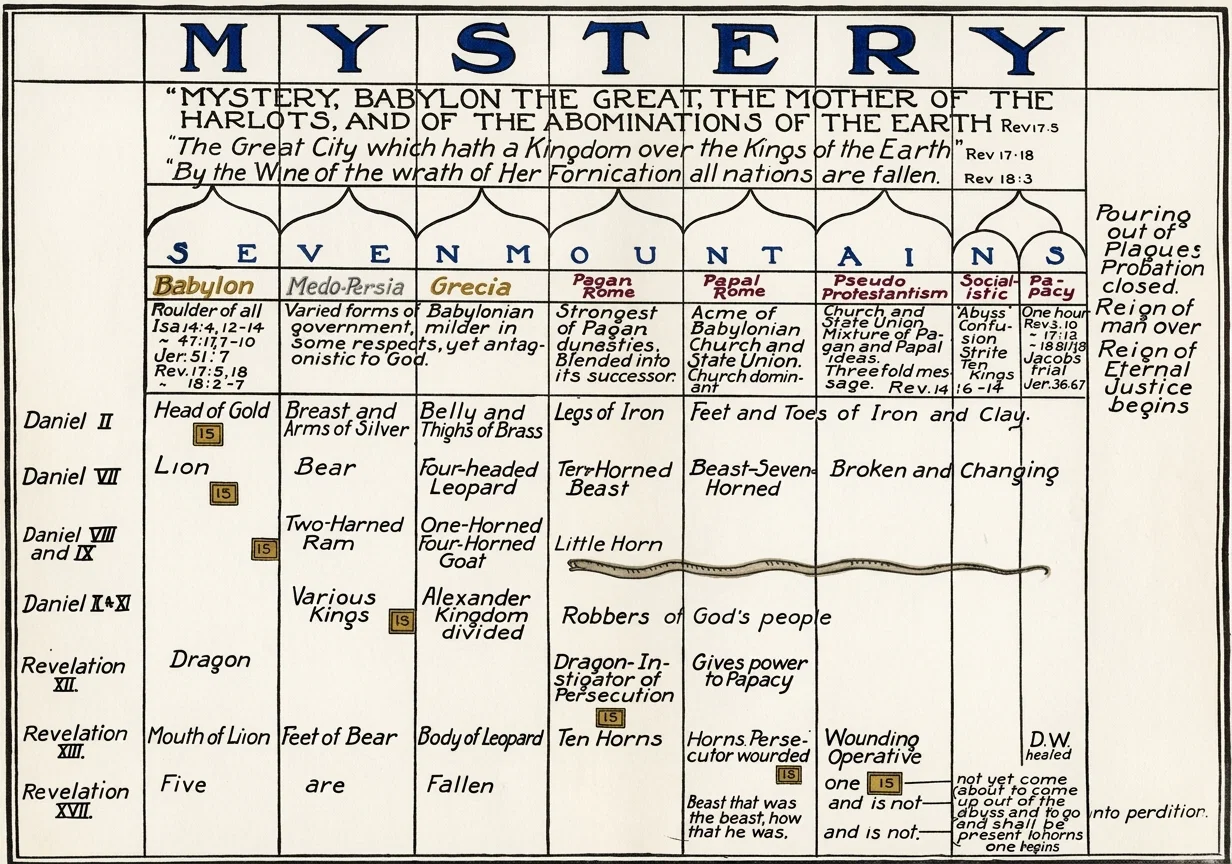
SPECIAL study was given to chapter 17 in our issues of July 18 and 25, out of the order of the chapters in the book. It may be well to note some of the principal points covered in our previous study, in connection with our diagram.
1. The Messenger
The one who revealed these things to John was one of the seven angels that had the seven plagues. What the angel had to reveal did not follow the plagues. The plagues precede Christ's coming, yet Christ's coming is revealed in Rev. 14: 14, before the plagues are described. We are given the particulars of the outpouring of the plagues. Then previous to that outpouring, altho revealed after, there is given a review of that great beast-system which shall deceive the whole world, and upon which these plagues shall fall, just as there is given in the first five verses of the 14th chapter a view of the redeemed of the last generation, and then follows the great threefold message, which shall develop that class. Then, too, the 18th chapter, which is a part of the 17th, sends forth a message to God's children, calling them out of Babylon, lest they receive of her plagues. When the plagues have been completed, Babylon is no more, and God's wrath is filled up in these seven plagues. Rev. 15: 1. Therefore, the plagues must follow Revelation 17 chronologically; first, because that reveals the entire career of Babylon; and secondly, it points out the judgment which will be visited in the plagues.
2. The Message
The great message which the angel brings to John is the revelation of the judgment upon "the great harlot that sitteth upon many waters;" and in order that he may see the justness of that judgment, the career of that great harlot and her connection with the kings of the earth were first shown. The message itself includes both chapters 17 and 18, for it is not until the close of chapter 18 that the consummation of that judgment is complete. God would have us understand in this message, at the very beginning of this revelation, that the judgment comes upon that system that has ruled over many peoples, that has had to do with the kings of the earth, that has corrupted the kings of the earth and made them drunken with the wine of her fornication. The time when the prophecy was given is, of course, when John was upon Patmos, in the very close of the first century; but the time when it applies logically precedes the work which the angel reveals — the judgment. And it is well to note right here that this revelation to John was not for his sake. Of course he ever found comfort in the wonderful fact that out of all the discords, the troubles, the tumults, the persecutions of earth, God would gloriously deliver His people. That assurance was ever given to the prophets, but the truth which he proclaimed was especially for those who should meet these things hereafter. The earliest phases of the church did not meet the greatest persecutions; they came later. And not until the very last generation does all the fulness of these prophecies burst upon the world; and the generation, above all others, which needs the truth revealed not only in the revelation itself but in the entire Word of God, is the last generation, whom Satan will endeavor to destroy by his "lying wonders" and "all deceivableness of unrighteousness." As he uses every art which he possesses to destroy souls, so God will meet his every deception by the truth which has not only saved His people from deception in the past, but truth for this special time, which will meet all his combined deceptions upon the world. And thus the revelation of Jesus Christ is for this generation, and the great message given to John was not for his time, but for our time.
3. The Revelation of the Harlot
God would have His people clearly identify this great apostate. Her career has been long. From the time of Babylon of old until God's last fiat shall be pronounced against her has apostasy continued, and during all these ages she has been enthroned. It is the enthronement of apostasy in the place of God which has constituted the beast through all the past. It is only these governments which God has presented before us as beasts. He has placed before us, in different periods of earth's history, the great persecuting, dominating, controlling governments of earth. The dynasties, or powers, of earth which have especially molded the world, begin with Babylon. The very beginning of these powers is indicated not only in the beasts of Daniel, but of Revelation. The Babylonian idea has been manifest in them all, and this has been fostered and fed, propagated and preserved, by apostasy, which has assumed to control men's consciences and set itself against the free truth of God. Therefore, Revelation 17 gives us a different view from Revelation 12 and Revelation 13. Revelation 12 shows that back of all these persecuting powers is the master mind of Satan. Revelation 13 reveals that [[FIGURE]] Satan works through various dynasties, represented by heads upon the composite beast. These heads are the chief, active, visible agents to execute the evil. But Revelation 17 reveals more. It shows us that Satan's active agent in controlling the powers of earth is enthroned apostasy. So it was in Babylon of old. So it was to a mild extent in Medo-Persia, in Grecia, in pagan Rome, and in papal Rome to the very fullest extent.
We wish to repeat again what we have so often said, that in all this we are not condemning nor in any wise stooping to personalities. Roman Catholics are like all other men. Those who uphold the Papacy are like all other men, and it is not the men of whom we are talking. Many who have been connected with the Roman Catholic Church through all the centuries have been sincere, earnest, devoted, self-sacrificing souls, and we have no doubt that there are many such still, the same as in all other religious bodies. But the system makes men. Honest, devoted, earnest souls yielded to error become the most zealous in the promulgation and propagation of that error; and thus when the Church of Rome, with its tremendous power and system of religion which appealed to the human heart, became connected with the State, so as to control the State, it became the worst of persecutors, because the logic of the system demanded it. Therefore, that His people may see that system in its fulness, God revealed its character to us, during the time of the greatest triumph of the Papacy, during the wilderness period. That wilderness period is presented before us in the 12th chapter, verses 6 and 14. During that period the true church of God is presented before us as a persecuted woman, one that flees to the fastnesses of mountains and desolate places of the earth, and is there hidden by the Father from persecutions7which would otherwise utterly sweep her away. And yet during that time millions of her children perished for their love of liberty.
But during that same period apostasy was enthroned, represented by a corrupt woman sitting upon this monstrous beast, guiding and controlling it at her will. There was revealed the Babylonian character. That long period of twelve centuries was permitted of God to be a great object-lesson to all the world that the union of Church and State was evil and only evil, and could produce evil and only evil to the governments of the earth. God would have His people understand that those same principles, that same "wine of fornication," would produce the same thing constantly, wherever it was allowed to manifest itself.
4. The Name of the Apostasy
We will already see by what we have studied that this great system of apostasy is denominated Babylon, that Babylon began just after the Deluge — that is, that was the first great public manifestation we have of it in the world. Back of it all it began in heaven, where Lucifer brought confusion into the kingdom of God. Isa. 14: 4, 12. It began in the earth when man rebelled against God's plan and God's Word, when He declared that they should scatter abroad upon the face of the earth, and multiply and replenish, and build up from its desolation happy homes. But apostasy said, Nay, but we will build us a city and a tower, and we will make us a name, lest we be scattered abroad; and they builded the city and the tower, and they named it Bab-il — the Gate of God. See Gen. 11: 1-9. But God named men's folly, then and there, Babel — confusion. God has stamped upon all the dreams of men contrary to His Word, "Babylon — confusion." That system of confusion, rebellion, apostasy, not having life within itself, has ever sought the power of the State, and that union of religion with the State is deemed fornication. And all who follow that plan are children of the great mother of harlots and the abominations of the earth. In the dreams of men it has seemed that such union would work out happiness, order, better governments; but all the history of the past has demonstrated that it has worked ill.
5. The Predicted Restoration
The prophecy points out that this phase of the beast which was shown to John during that wilderness state, when apostasy was riding in triumph, drunken with the blood of the saints and of the martyrs of Jesus, would be restored again. That beast passes under seven great general phases, represented by seven heads. They do not exist contemporaneously, but consecutively. This is shown by verse 10: "Five are fallen, the one is, the other is not yet come." It is the head that gives character to either man or beast. Therefore the beast under each head was a different beast in individual character, tho having the same general tendencies in them all, because all were guided or controlled, to a greater or less extent, by apostasy, Babylon. Under the Babylonian head the beast was Babylon; under the Medo-Persian it was the Medo-Persian beast, characterized by the religion of that power in all its various modifications. Grecia followed. Then came pagan Rome, in which the State dominated all religion; then papal Rome, in which the ecclesiastical power dominated the State. During the period of 538 to 1798, the beast was the papal beast, and that, it is declared, was restored. "The beast that thou sawest"—that is, during that mighty triumph of apostasy—"was, and is not." In the time of the application of that prophecy, that phase of the beast was past, and at that very time it is about to come out of the abyss and to go into perdition. The time of the application of the prophecy, therefore, is after 1798, when the power of the Papacy to dictate sentences against heretics was over. But the beast still exists. There is no time of its career from its beginning that the BEAST is dead. That is composed of the powers of earth. But the beast under that papal phase was slain. In the words of Rev. 13: 3, "I saw one of his heads as it were wounded to death;" it was an absolute slaying. The beast existed, but that phase had perished. This is not difficult at all to understand, when we will ever keep in mind that the beast is composed of a union of Church and State. No church is represented by a beast in and of itself. God has not so represented the Roman Catholic communion. No State of itself is a persecuting power, unless it is connected with religion. Those two combined make the beast. When the power to define and dictate punishment for heresy was taken away from Roman Catholicism, that head of the beast perished. A different form of persecution was then manifest, embodying, however, just as truly the persecuting element, altho not in so severe a form, because not so united, as existed previously. As Mr. Bryce clearly puts it in his "Holy Roman Empire," page 333, in speaking of the régime which followed the overthrow of the power of the Papacy: "IN ALMOST EVERY COUNTRY THE FORM OF DOCTRINE WHICH TRIUMPHED ASSOCIATED ITSELF WITH THE STATE, AND MAINTAINED THE DESPOTIC SYSTEM OF THE MIDDLE AGES, WHILE IT FORSOOK THE GROUNDS UPON WHICH THAT SYSTEM HAD BEEN BASED. It was thus that there arose national churches WHICH WERE to be to the several Protestant countries of Europe THAT WHICH THE CATHOLIC CHURCH HAD BEEN TO THE WORLD AT LARGE."
We see the same principles working under a different head. That phase of the beast exists now in the territory of the beast, the old world. Standing here in this generation, the church of God, symbolized by John, may receive that message of the angel, "The beast that thou sawest WAS, and IS NOT; and IS ABOUT TO COME UP out of the abyss, and to go into perdition." We have been told many times that the world will never see persecution again. But the prophecy declares that the persecuting element will be restored, controlled by the same power which controlled it in the Dark Ages; and therefore the next sentence, "And they that dwell on the earth shall wonder, they whose name hath not been written in the Book of Life from the foundation of the world, when they behold the beast, how that he was, and is not, and shall come."
It was in 1872 that Bismarck, the German Iron Chancellor, succeeded in barring the Jesuits from the German Empire. He little thought, says a Catholic writer, that but a few years would pass when these laws would be abrogated. In a short time those laws were repealed. Bismarck went to Canossa, and, in the words of the "Catholic Mirror" of March 26, 1904, "They [the Jesuits] were not only permitted to return, but gladly welcomed. The power that Bismarck raved against is now the hope of the empire. The Social party has been making rapid strides, and has attained such proportions that the established order trembles under his demoniacal influence. To stem this tide, and to counteract the baleful influence of such a vast spread of opinion, these brainy men, clear in their logic and determined and steadfast in their purpose, faithful followers of Ignatius of Loyola, have been allowed to return." And we were further told that the kaiser, "since he ascended to the throne, has availed himself of every opportunity to manifest his good will toward the holy see and her faithful children."
Since that time Socialism has grown apace, and the power and influence of the Papacy has also grown. Europe has become for the last fifty years a seething political caldron, with the iron imperialism and the clay democracy, Socialism, struggling for the mastery. Discontent reigns everywhere. A striking example we had of it the other day. The wonderfully marvelous show of the coronation was hardly over before England was almost on the very verge of starvation, brought about by the discontent of the laboring masses; and that discontent reigns throughout Europe. The war budgets of the various countries and the heavy burden of royal houses, with the numerous dependents, have galled beyond endurance and well-nigh broken the backs of an overburdened people. Under such conditions as these, Socialistic propagandists flourish. Their growth is hidden at times by prominent public affairs, but they are making tremendous progress. For a score of years thoughtful and observing men have been talking of a French Revolution on a scale before which that of 1793 will pale into insignificance, in which not only a tenth part of the great symbolic political city will be involved, but the whole European camp shall be given over to the red hand of a great international mob, goaded to madness by long years of oppression and injustice, fancied and real. During all this time the principles of the Papacy have been taking strong hold. They have not always been called papal. In some countries, like France, there has been very strong antagonism to the Papacy and some of her principles. She has pressed too hard upon France and Spain and Portugal, and these are almost in revolt against the Church of Rome; but in the Protestant countries themselves there is a strong sentiment developing more and more that there should be religion by law. These are more notably manifest in connection with the Sunday question. And when we come to the real test of the matter, the one power which will dominate above all others will be the Papacy.
No people can exist without religion. There may be infidel propagandists. The people of France, revolting from the traditionary church of long centuries, founded an infidel State, and yet the infidel State must perforce set up the Goddess of Reason. And so, whatever revolution may sweep over Europe, however infidel it may be in its inception, according to the prophecy of God's Word it will again elevate into power the beast that was and is not.
6. The Seven Heads
These have already been named in the previous part of this study. It may be well to enumerate8them again: Babylon, Medo-Persia, Grecia, Rome pagan, Rome papal, apostate Protestantism, Rome papal restored.
7. The Ten Horns
Just previous to the restoration of the Papacy, will be formed another confederation in Europe. It is not for us to say just how it will be brought about. It is not for us to say just how many revolutions may precede it. It did not take long to change Brazil from an empire to a republic; it did not take long to change Portugal from a kingdom to a republic; it would not take any longer to change any of the other powers of Europe from a kingdom to a republic, when revolution was ripe and the time was ready.
These ten horns wear no crowns like the horns of chapter 13. They are confederated kingdoms. They do not act separately, like the horns represented in the 7th chapter of Daniel, three of which opposed the little horn, and were plucked up by the roots. During all the long centuries of papal triumph, there never was a time when all the civil powers of divided Rome gave her unfeigned obedience and were together enlisted to support her. As before remarked, three of the ten horns of Rome, which were developed between the years 351 and 476, were overthrown before the Papacy could be established. But when the ten horns of Revelation 17 come into power, they are united. The confederation of the world is involved in them, and they 'have one mind, and they give their power and authority unto the beast,' to a union of Church and State, which will restore the beast which John saw in the wilderness state. But that restoration of power, like that of old, is antagonistic to God's plan, and their efforts will develop into war against God and His truth. 'These shall war against the Lamb, and the Lamb shall overcome them, for He is Lord of Lords, and King of Kings.' And yet revolution will again follow. These ten horns, hoping to purchase peace and quiet for their confederated kingdoms, restore the old régime; but that restoration does not bring peace. The earth in its rebellion against God is ready for that for which she has been sowing all the centuries; the angels are commissioned to pour out the plagues.
For one brief hour this united authority exists. For one brief hour apostasy will say, 'I sit a queen, and am no widow, and shall in no wise see mourning.' Rev. 18: 7. For one terrible hour during this enthronement of apostasy God's children will meet such temptations and terrors as they had never before met, with a confederated world against them. But the promise is to them, 'Because thou didst keep the Word of My patience, I also will keep thee from THE HOUR of trial, that HOUR which is to come upon the whole world, to try them that dwell upon the earth.' Rev. 3: 10. Their names are in the Book of Life, they are not deceived by the world-wide triumph of apostasy, and therefore they can not yield to it. With the world against them, they stand trusting in God and in His Word. At the end of that one hour period the plagues are poured out; and three times over we are told, as we will learn more in the study of the 18th chapter, all the power and riches and glory shall come to naught. God in His wisdom has permitted the universe again to see that the same principles of apostasy in the new form will work out evil.
In the words of verse 17: 'For God did put in their hearts to do His mind, and to come to one mind, and to give their kingdom unto the beast, until the words of God should be accomplished'—until probation was over, until the last soul was gathered in. Then, when the plagues fall, 'the ten horns which thou sawest, and the beast, these shall hate the harlot, and shall make her desolate and naked, and shall eat her flesh, and shall burn her utterly with fire.'
History is full of such demonstrations. It is worship one moment, it is savagery the next. We have read of brutes of men who one moment were worshiping some paramour of their choice, the next moment in blind rage they take her life. These are illustrations of what will be seen in the closing years of earth's history: the kingdoms of earth, drunken with fornication, have bowed before the harlot of apostasy, have yielded their adoration, their riches, their power, but finding no deliverance, and on the other hand meeting with naught but evil, the result of the deception of their unholy alliance, they turn against the one they have worshiped, and destroy her.
Such is the awful picture that is presented before us. It is time now, reader, to make our decision for God and His truth. Looking down the long centuries in holy vision, one prophet was shown the 'multitudes, multitudes in the valley of decision,' when 'the great day of the Lord' was 'near in the valley of decision.' And God asks the children of men to decide for Him and His truth, utterly regardless of any course which the world may take; and through that same prophet and in the same connection He declares that amid the awful calamities of the closing days of sin, 'Jehovah will be a refuge unto His people, and a stronghold to the children of Israel.' Joel 3: 14-16.
The State and Papal Religion
which the State dominated all religion; then papal
were repealed. Bismarck went to Canossa, and, in the words of the "Catholic Mirror" of vious part of this study. It may be well to enumerate
Not Appointed unto Wrath
By T. E. Bowen
For God hath not appointed us to wrath, but to obtain salvation by our Lord Jesus Christ, who died for us, that, whether we wake or sleep, we should live together with Him. 1 Thess. 5:9, 10.
THIS is a precious scripture; glorious possibilities are held out to every struggling son and daughter of God in these few words.
What a comfort to think that, notwithstanding all our unworthiness, our failings, our sins, we are not appointed to wrath! There is something far better in the mind of God for us than this. Not that all will escape the wrath; but now, in the day of salvation, God Himself, the Son, and all heaven are working to accomplish something infinitely more glorious—even our salvation. We are not appointed to obtain the wrath, but to win the salvation. It is in God's heart to give us the salvation. If we miss this and get the wrath, it is because we have missed God's appointment for us. He, therefore, will not be responsible for such an outcome.
How to Obtain Salvation
No one need miss his way in obtaining salvation. It is made clear and plain just how each one of us may actually obtain it. "Not appointed us to wrath, but to obtain salvation by our Lord Jesus Christ." It is by Him, the Lord Jesus, the appointment is made. It is through Him that we obtain salvation. Let us not clutter up this simple, open way by imposing restrictions not mentioned here, by which the coming of the sinner directly to Jesus is made difficult. No saint, no priest, no Virgin Mary stands between the seeker for salvation and its Giver. There is but one door, one fountain for sin and uncleanness, one name given under heaven among men whereby we must be saved—the Lord Jesus Christ. It all comes by Him. And that we may all go to Him, listen to His wonderful invitation as He stood almost for the last time in the temple and cried, "If any man thirst, let him come unto Me, and drink." John 7:37.
What It Cost
This salvation to which we are appointed cost something. It is without price for us, so that the poorest may gain it; but Jesus must die to make it possible for us to obtain it. "Who died for us?" The glorious Prince of Life, heaven's honored Commander, even the One whose voice brought worlds into being, was sacrificed for us, poor, lost, wandering sheep upon sin's barren desert. The Son of God died, not knowing that He ever would again see life—all for us. "How could He? And what for?" are questions that spring to our lips. These are anticipated by the next words of the apostle, "That, whether we wake or sleep, we should live together with Him."
Yes, it was all the joy before Him of making it possible that—
We Might Live with Him
that induced the Lord to leave His glorious home above to come in among us as one of the race. The last recorded prayer with His disciples expressed this same cherished desire of His heart: "Father, I will that they also, whom Thou hast given Me, be with Me where I am; that they may behold My glory, which Thou hast given Me: for Thou lovedst Me before the foundation of the world." John 17:24.
Being with Jesus is synonymous with obtaining salvation. He who can be with Jesus and behold His glory, has obtained eternal salvation. Jesus is not in Joseph's tomb; He is alive and will be alive forevermore. Hence those who can be with Jesus, will have obtained the gift of immortality, that they may live with Him.
While waiting for this—
Touch of Immortality
some have fallen asleep. Such are not excluded nor prerewarded; they are simply waiting the time when the rest, who are awake, can with them also be changed, in that supreme moment when the touch of immortality is given to the redeemed host of earth. See 1 Cor. 15:51-55. Those who have slept and those who are alive receive this change to immortality together. "For this we say unto you by the word of the Lord, that we which are alive and remain unto the coming of the Lord shall not prevent them which are asleep. For the Lord Himself shall descend from heaven with a shout,9with the voice of the Archangel, and with the trump of God: and the dead in Christ shall rise first: then we which are alive and remain shall be caught up together with them in the clouds, to meet the Lord in the air; and so shall we ever be with the Lord." 1 Thess. 4:15-17.
Thank the Lord, whether we wake or sleep, we are all going home together. Those who are alive that day will not prevent those who have been sleeping in Jesus. Neither have those who have been sleeping gone on ahead of those who at that time shall be awake. God says He has provided a better way than this, and that better way is that we shall all go home with Jesus together. Let us believe it, and comfort one another with this better way. "And these all [Abraham, Isaac, Jacob, and all the other worthies], having obtained a good report through faith, received not the promise; God having provided some better thing for us, that they without us [the living] should not be made perfect." Heb. 11:39, 40.
We Shall See Him
By Mrs. M. C. Sollars
By Mrs. M. C. Sollars
Could I catch a glimpse of glory
Where the bright-robed angels are,
Up above the starry heavens,
Far beyond each shining star,
Where the angels veil their faces,
Bowing low before the throne,
Crying "Holy, holy, holy!
Thou art holy, Thou alone!"
Could I hear one loving message,
From the lips which know no sin,
Catch a glimpse, however fleeting,
Of the happiness within;
Could I touch those golden harp-strings,
Join the song as angels sing,
Ah! methinks my earth-bound spirit
To its home would fain take wing.
We shall see them, hear their voices,
Touch those harps with skilful hand,
Sing among the blessed immortals,
With the bright celestial band.
The Spanish Inquisition
By G. W. Caviness
By G. W. Caviness
HAVING lately found the history of the Spanish Inquisition written by one of its secretaries, Don Juan Antonio Llorente, I thought it might be interesting to take a view of this institution from the standpoint of a Roman Catholic. Of his ability to write the history, he says:
In order to write an exact history, it was necessary to be an inquisitor or a secretary. Only so could one have access to the bulls of the popes, the ordinances of the kings, the decisions of the councils of the Inquisition, the original processes and papers in their archives. Perhaps I am the only man who to-day has all these requisites.
I was secretary of the Inquisition of the court of Madrid in the years 1789, 1790, and 1791. I knew the institution sufficiently well to be able to characterize it as being vicious in its constitutions and laws in spite of the apologies written in its favor. From that time I set myself to gather together documents, taking notes and data, and copying literally the most important. My constancy in this work and that of acquiring as many books and papers not printed as I was able to have at hand and at a considerable cost in the testaments of the inquisitors and of other deceased persons, furnished me a copious collection. Finally I obtained a great many more in the years 1809, 1810, 1811, on the occasion of the suppression of that tribunal.
Having given the sources from which he was able to write his history, he proceeds to tell something of the manner of the working of the Inquisition. We here transcribe what he says:
Having spoken with some Roman Catholics in Paris and London, I heard them say that the existence of the Inquisition is useful in Spain for the conservation of the purity of Catholicism, and that France would be happier if she had the same institution. They are very much in error who believe it to be sufficient to be a good Catholic in order to be free from the jails of the holy office, because on account of the secret system nine out of every ten prisoners are strong Roman Catholics, but through the ignorance or malice of the informers, they have been persecuted under the supposition of being capable of being heretics in the opinion of an ignorant friar, considered wise by the common people because of having studied scholastic theology. The Inquisition conserves and fortifies hypocrisy, punishing only those who refuse to be hypocrites; but it converts no one, as was seen in the case of the Jews and Moors baptized without true conversion, in order that they might remain in Spain. The former perished in the flames, the others passed over to Africa at the expulsion of the Moors, as much Mohammedan then as before the baptism of their grandfathers.
To preserve the purity of Spanish Catholicism by means of flames and the expulsion of three million souls among the three classes, there was need only for hangmen, laws, and judges to apply them, without Inquisitorial apostolic priests by the grace of the pope. I hope that they may be undeceived and come out of their error, when they read this history and know the institution which is not as yet well known.
I am an apostolic Roman Catholic, and I yield to no inquisitor in the purity of my faith nor in my desire to see Spain happy. But this does not hinder my believing that my country would be better if the Inquisition should be turned over anew to the charge of the bishops only, as it was for many centuries; for in my opinion it would be more in conformity with the Sacred Scriptures, from which it is evident according to the expression of the apostle Paul, "The Holy Spirit" (and not Peter nor the popes) charge the bishops to govern the church purchased by the blood of our Lord Jesus Christ.
From the foregoing paragraph it will be evident that the writer did not entirely agree with the idea of the pope’s supremacy, but thought the affairs of the church should be left in the hands of the bishops.
As to the number of victims, I will cite two paragraphs showing what happened within a few years; but as the whole system was largely a secret affair, it will be evident that no figures, even those given by the secretary, stating what was done in Spain, would give any adequate idea of the uncounted numbers that perished under this diabolical system.
Our historian says:
From the calculation made in chapter four taken from the data of the inscription in Seville, and with preference taking the more moderate extreme, we learn that in five years of the rule of Adrian there were in Spain 24,025 punished by the Inquisition; to wit, 1,620 burned in person, 560 in effigy, 21,845 made to pay penance, the whole at the rate of 324 of the first mentioned each year, 112 of the second, 4,369 of the third. If we add the year 1523, which may be counted as an interregnum until the inscription of Seville made in 1524, we may say that in the forty-three years of the first four Inquisitor-generals there were 234,506 victims; to wit, 18,320 burned in person, 9,660 in effigy, 206,526 compelled to pay penance, a monstrous number, altho greatly reduced, and which falls very far short of the truth.
From reading his history, it seems evident that many Catholics suffered under the system. And no doubt it was on this account that the institution was abolished; for when such terrible power was given an inquisitor, he did not fail to use it against any enemy or rival, Catholic or Protestant. The fatal results of the Inquisition are clearly seen in all Catholic countries where it was in operation. The honest and the sincere were almost annihilated; and hypocrites, bigots, and those without conscience were left.