News Items on Prohibition, Russia, Tracts, and More
Page 2
The Youth’s Instructor
Oct 19, 1915
Review and Herald Publishing Assn. · Takoma Park Station, Washington, D. C. · Oct 19, 1915
News Items on Prohibition, Russia, Tracts, and More
Ten States have been added to the prohibition list during the last year.
Russia’s cosmopolitan population consists of one hundred and forty races.
The Review and Herald Office, from January to June inclusive, sold 319,792 tracts.
A new cotton picker has been perfected which will pick, it is claimed, not less than ninety per cent of the cotton.
Should a Chinese son or daughter be guilty of using abusive language to parents or paternal grandparents, and should the parents make complaint to a magistrate that they themselves heard such language, the delinquent is liable to death by strangulation.
The Missouri Conference contemplates establishing a school. Business men of Columbia, Missouri, offer to donate ten thousand dollars for the school if Columbia is selected as the site, so writes Elder J. S. Rouse, president of the Missouri Conference.
Mr. and Mrs. Feng Chin Tung have come to this country to continue their studies. Mr. Feng Chin Tung is a graduate of Princeton University and the son of a millionaire shipbuilder. He will study political science at Harvard, while his bride will enter the New England Conservatory of Music.
The remnant of the Grand Army of the Republic on September 29 passed up Pennsylvania Avenue, Washington, D. C., in review before President Wilson. Twenty thousand veterans are said to have taken part in the exercises that celebrated the passing of fifty years since the triumphal march of the Union Army over the same ground at the close of the war.
The Germans have devised a battle aeroplane that is said to be superior to any other. This dual-tractor, twin-engine type has all but driven its enemy from the sky. The machine is a biplane of seventy-foot-wing spread. It has two separate fuselages, in each of which is installed a 100-horsepower motor, and between these an armored nacelle which mounts machine guns. It maintains a six-hour patrol safely out of firing range at a height varying between 4,000 and 8,000 feet. While awaiting the appearance of prey, it sweeps the sky in broad circles. Then it swoops down like a hawk and gives battle.
The entire Holy Land has been converted into a Turkish armed camp, or series of armed camps. Armed airships and aeroplanes are continually flying over Bethlehem. The English, French, and Russian convents at Jerusalem have been converted into barracks. The roads between that city and Jericho are being reconstructed so as to render them available for use by armored motor cars. Soldiers are maneuvering every day on the Mount of Olives and Golgotha, which are torn up in every direction by trenches. Long columns of buffaloes driven by peasants are hauling carts loaded with powder, projectiles, and other military supplies; and the railroad from Damascus to Medina has almost entirely suspended the conveyance of pilgrims to and from the holy places of Islam, and is being monopolized by the transport of war supplies.
Despite the confusion occasioned by the war, there will be no interruption of the plans for the seventh Interdenominational Medical Missionary Conference to be held in Battle Creek, Michigan, November 2-5. Dr. Harlan P. Beach, of Yale University, will preside at the conference. The program includes addresses on mission topics by speakers of broad experience in home and foreign fields, among them Rev. Wm. Axling, Japan; Rev. Frank L. Brown, general secretary of the International Sunday School Union; Rev. J. H. Franklin, Baptist Board of Foreign Missions; Dr. F. C. Stephenson, Canadian Methodist Board; Dr. Henry Porter, Syrian Protestant College, Beirut; Rev. J. P. McNaughton, Turkey; and others of equal prominence and experience. The meeting will be held under the auspices of the Battle Creek Sanitarium.
The United States is not setting the pace for the whole world in the matter of irrigation. In fact, it must be confessed we have started rather late to do what other nations consider almost elementary work. India is blessed with the most extensive irrigation system there is. The Assuan Dam, at the first cataract of the Nile, Egypt, is the very largest structure of its kind, and yet in India they are constructing a dam and storage system on the Kistna River which is planned to be fully ten times the size of the Assuan Dam. The reservoir created will be seven hundred miles long and two hundred feet deep. It is said that over forty million inhabitants of India are saved from starvation by its irrigation system. Spain, Italy, France, and even China, are well advanced in this art.—The Christian Herald.
On September 29, wireless telephony from the Atlantic seaboard to Hawaii, a distance of 4,600 miles, became an accomplished fact. This last triumph of science came but a few hours after Theodore N. Vail, president of the Bell Telephone Company, had talked by wireless from Washington to Mare Island, near San Francisco. The distance over which this wireless communication was held is greater than the distance from New York to London, New York to Paris, or from New York to many other important points, such as Rome, Vienna, and Berlin.
Despite the serious conflict now waging in Europe, it is said that the people in the warring countries were never more restless, thoughtless, and gay. Editors urge them to play tennis, to go to theaters and other places of amusement, in order to prevent the depression that might otherwise take possession of them. One man on a recent visit to London desired very much to see a certain play; but so great were the crowds at the theater each day that, though he tried for one week, he failed to gain admission.
Request for Youth's Instructor and Little Friend Copies
Notice
Mrs. A. F. Hamblin, Box 193, Lake Arthur, Louisiana, would like clean copies of the YOUTH'S INSTRUCTOR and Little Friend for missionary work. Postage prepaid.
A Trip to Shanghai and Return
By C. L. Butterfield
C. L. BUTTERFIELD
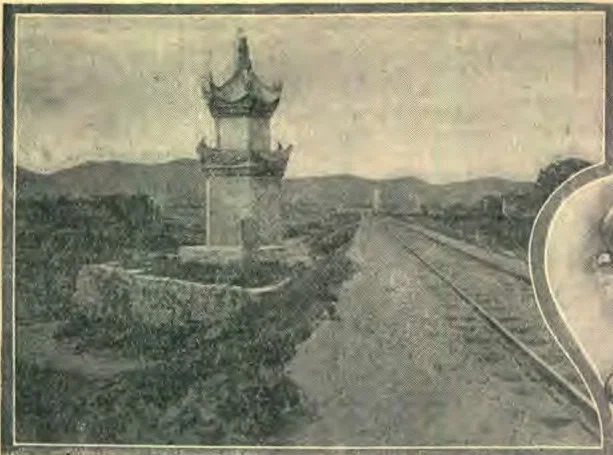
ALONG THE RAILWAY IN CENTRAL CHINA
TEMPLE OF HEAVEN IN MANYO, CHINA
For more than a year the workers of this field had been looking forward to the Division meeting to be held in Shanghai. First, it was set for the fall of 1914, and then on account of the war it was postponed indefinitely, then set for May 1-15. Elder A. G. Daniells, on his tour of the Orient, and accompanied by Elders J. E. Fulton and R. C. Porter, visited Korea the fore part of April, and attended the annual meeting then in session. We greatly appreciated their instruction and counsel.
One week after the meeting closed, the two ordained Korean brethren,—Chyong Mun Cook and Ne Keun Ok,—together with all of the workers from America, except Elder and Mrs. W. R. Smith, started for the general meeting in Shanghai. There are two lines of travel between Seoul and Shanghai—one to the north by rail, and the other to the south by rail and steamer. The cost being the same, it was decided to go by the northern line, and to return by the southern. It was the first time the Korean native workers had ever been outside of Korea, and the other workers had been here from five to nearly seven years without a change; so the long ride through new country was pleasantly anticipated. It is nearly two thousand miles from Seoul to Shanghai. We took a second-class car, which costs about one cent a mile fare. There were twenty-one in the party.
We left Soonan in the afternoon, and at 8:30 P. M. we passed out of Korea into Manchuria. It was an all-night’s ride from there to Mukden,—170 miles,—and there was only one-half car in second class, and enough Chinese and Japanese to fill it, but we were there, too. It was not pleasant, to say the least; and it was the hardest part of our whole trip. We were met in the morning by Elder B. Petersen and Brother O. J. Grundset, who saw that we lacked nothing the two days we spent there. Most of the first day, Friday, was spent in sight-seeing. On Sabbath we spoke to the Chinese believers in their little chapel. There were about thirty keeping the Sabbath at that time, although when I was there five months before there was not a Sabbath keeper in that great city.
Sunday morning, with Elder and Mrs. Petersen, and Mr. and Mrs. Grundset, we left Mukden at ten in the morning for Peking, arriving there at six the next morning. There being so many of us, the railroad authorities kindly gave us a first-class sleeper all for our own use, even though we had second-class tickets. The trip was much enjoyed; but as we passed through large cities and populous farming districts, and knew that there was not one person with a knowledge of the truth in all those hundreds of miles, it made our hearts ache and cry out to the Lord of the harvest to send forth more laborers into the field.
KOREAN DELEGATES TO THE SHANGHAI, CHINA, MEETING
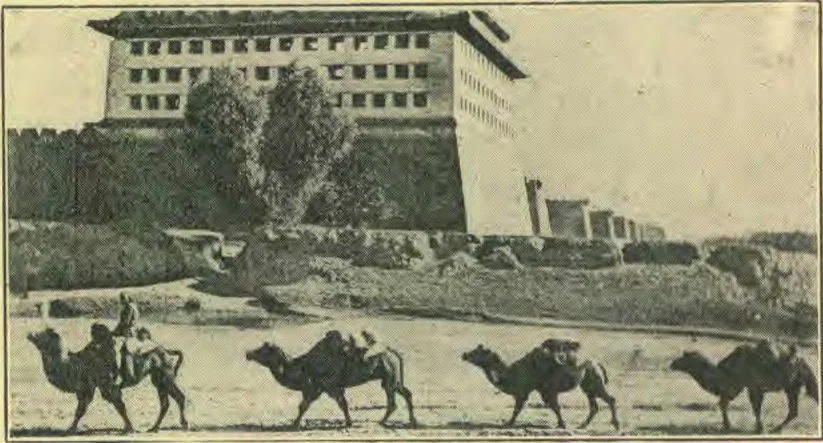
CAMEL CARAVAN, BLOCKHOUSE, AND WALL, TARTAR CITY, PEKING
Monday was spent in seeing Peking. Four automobiles took our party to the principal places of interest. It is truly a large city, but as we looked at its great walls, temples, and multitudes of people, we were sad to think that there is not one proclaiming the third angel’s message in that city, the capital of the republic of China, with its six million inhabitants. Using the language of the Indian chief when he expressed his grief at not having found the “white man’s Book,” we could say: “We visited the temple and the altar of heaven, but the third angel’s message was not there; we saw an image of Buddha seventy-five feet high, and another with a thousand hands and three heads, but the preacher of the third angel’s message was not4there; we saw them worshiping great and hideous images with lighted tapers, but there was not one among them having a knowledge of God’s last message of mercy to a dying world.” However, at the Shanghai meeting it was decided that Dr. A. C. Selmon should open up work in that city at an early date. Certainly nothing should hinder, for the time is ripe.
Leaving Peking the next morning, we passed through Tientsin, Tsinan, and other large places, arriving at Nanking Wednesday. As far as we know, it was the first time a Seventh-day Adventist had ever passed over the full length of that line. There we saw some of the most beautiful farming land we have ever seen. Broad fields stretched out as far as the eye could see. We saw a few Roman Catholic churches, and many heathen temples and pagodas, but the work of giving the third angel’s message has, as it were, been only touched in all that seven hundred miles of territory. At Nanking we had but a few hours to stop, but by taking jinrikishas we were able to see the most historic places of the city. We left at ten at night, arriving in Shanghai the next morning at seven o’clock. We were glad that our long journey was at an end, and that we could meet with the workers of the Asiatic Division in conference for two weeks, but we shall long remember our pleasant trip through northern China.
The meeting at Shanghai was a time when God drew near. Personal victories were gained, and plans were laid and requests made of the General Conference of far-reaching consequences.
At the close of the meeting, the Korean-Manchurian party, with the Japanese workers and Elder and Mrs. Daniells, took passage on the steamship “Shinyo Maru” for Nagasaki, Japan. We made a company of nearly fifty, and as Sabbath was spent on the boat, we assembled in the dining room while Elder Daniells spoke to us. Upon arriving in Nagasaki harbor Sunday morning, the Korean-Manchurian party bade farewell to Elder and Mrs. Daniells and the Japanese workers, and took train for Moji, arriving there in the evening. We at once went aboard the steamer bound for Fusan, Korea, where we arrived the next morning, after a pleasant voyage.
Three hours were spent in Fusan, and then we took the train for Keizan, the home of Elder and Mrs. R. C. Wangerin, sixty-seven miles north of Fusan. Reaching Keizan at noon, we spent twelve hours with Brother and Sister Wangerin, then took the midnight train for Seoul, arriving there in the morning. It seemed to us we had been away from home a very long time, and we were glad to be back again. Everything was in good condition, and the work in the publishing house was progressing well. The Manchurian party spent one day in Seoul and one in Soonan, and then went on to Mukden.
The trip was enjoyed by all, and will be long remembered. After the change and rest afforded us by this interesting journey, we returned to our work with renewed courage and vigor, desiring to see this gospel of the kingdom speedily given to earth’s remotest bounds for a witness unto all nations, and a people prepared for the soon coming of our Lord and Saviour Jesus Christ.
A LITTLE CHINESE BURDEN BEARER
Geographical Facts
By Edwin Tarrisse
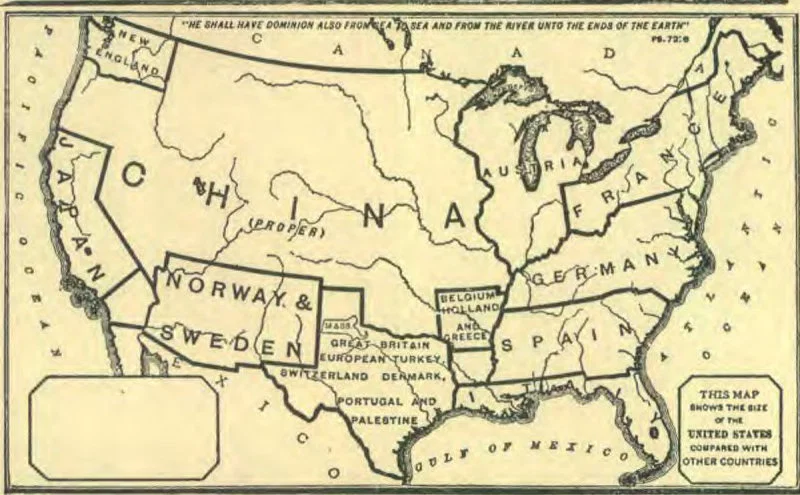
HE was an astonished Frenchman who, in response to his inquiry as to whether the United States was “as large as France,” received from an American this answer: “My State, Texas, alone is of greater area than the whole republic of France.”
An interesting way to demonstrate the size of the Lone Star State is to spread out a map of our country and stretch a string across Texas the longest way. Then, placing one end of the string at Chicago, it will be found that the other end will extend either into the Atlantic Ocean or into the Gulf of Mexico.
The largest counties in the United States are Custer (Montana) and San Bernardino (California). Each has an area in excess of twenty thousand square miles.
Within the boundaries of either of these counties might be placed the States of Massachusetts, Rhode Island, Delaware, and New Jersey.
Bristol County, Rhode Island, which is twenty-five5square miles in area, is the smallest of all our counties.
New York County possesses the greatest population, more than two and one-half million persons.
At a point about fifty miles from Durango, Colorado, one meets with an interesting geographical fact. There, by stepping a few feet in either direction, one can walk in four different States in as many seconds. These are Colorado, Utah, New Mexico, and Arizona. An almost similar fact is encountered at Harpers Ferry. There one may obtain a view of three States — Maryland, Virginia, and West Virginia.
Within one hundred miles of each other, California offers the highest and the lowest elevations in this country — Mt. Whitney, with its 14,499 feet, and Death Valley, with its 150 feet below sea level.
The longest street in the United States is Western Avenue, Chicago, twenty-two miles. Its nearest rival, also in Chicago, is Halstead Street, about two thirds of a mile shorter than Western Avenue. Halstead Street is so closely built up that many have thought it the longest street in the world. This street is traversed, above and below, by no fewer than twenty railway lines.—Edwin Tarrisse.
C. C. MORLAN
By C. C. Morlan
Dependableness
“If one asks employers what is the chief defect of a considerable number of their workers, the answer is, ‘They cannot be depended upon.’ Teachers say the same thing of a portion of their pupils. It is a common observation of many persons of all conditions: ‘They cannot be depended upon.’”
The foregoing paragraph was taken from an editorial in a recent issue of the Woman’s World. It is a deplorable fact that there are so few people in the world today who can really be depended upon; so few whose word is bond, and who can be relied upon and trusted at all times, and under all circumstances.
What is a man or a woman without dependability, one thing today and another tomorrow, with no stability of character, no resolute purpose? Such persons are a disappointment to friends and a nuisance to society.
Many do or fail to do according as they “feel like it,” but if all were to act at all times as they feel, there would be unending confusion. There can be no dependableness without fixed principles of action. Every enterprise is seeking for persons who can be depended upon, who do not change from day to day, who can resist temptation, who cannot be bribed.
The King of the universe is seeking, to finish his work in the earth, young people who can be depended upon. Young men and young women are wanted today who will be true to their trust, who have a burden for souls, and who will, if necessary, face a martyr’s death rather than violate principle and fail to perform their God-given duties. To be in the line of promotion and advancement in the world, or in the cause of God, is to follow closely the path of duty, and have dependableness in little things.
Can your Sabbath-school teacher depend upon your being on time every Sabbath? Does your school-teacher know that you will be prompt in preparing all written exercises, and always be at class on time? If you are a colporteur, can your tract society secretary depend upon you to put in full time each week, and report promptly? Or do you report when you “feel like it”? If you can be depended upon, whether you are student, teacher, colporteur, or preacher, you are the man or the woman that is in demand. If you are not to be relied upon, who wants your service? A person may be brilliant and talented, yet if he lacks stability and dependableness, every avenue of progress will be blocked for him. If he has only medium talents, backed by industry and reliability, he will be given every advantage. Such an individual is the kind that the cause of God needs today. May God help us all to be dependable.
C. C. MORLAN
The Sinner and the Song
By George Sanderson
THE daily work of a prison chaplain frequently brings him into touch with the tragic side of life. He sees the resultant desolation that constantly flows from the misdirected efforts of ill-spent living, and the terrible outpouring of anguished souls who have almost reached the port of hopelessness.
In my long career as chaplain in three of the great prisons of New York State I have witnessed many heart-rending scenes that have been a part of the results of wrongdoing. Bright-faced boys, who have made their first false step; fair-haired girls, with the marks of a sinful life already showing on their otherwise attractive countenances; men and women of mature years, whose life lines years before had parted and set them drifting on the tempestuous sea of crime, tossing them hither and yon, and finally drawing them into the great maelstrom of prison life, so easy to enter, but so hard to escape from.
But God’s saving power is not limited by crime or prison bars, and even in the corridor of a prison or the quiet of a cell the Holy Spirit frequently speaks peace to a repentant soul.6
One day, while attending to my regular round of duties on a tour among the cells, I was called to the prison office to see a lady visitor who sought an interview with one of the women prisoners. The lady had become interested in a young woman who had been seen occasionally at a meeting held in a mission where the visitor also frequently attended. When she was informed that the young woman had been charged with crime and sent to jail to await trial, she hastened to the prison to see her and offer to help her if she could.
The meeting between them was most affecting. The lady, all the sympathy of her nature aroused, took the shrinking, shamefaced girl in her arms, and pressed her closely to her breast, while the tears of both poured forth and mingled together as they fell.
“O Margaret, I cannot tell you how sorry I am to see you here!”
“Indeed, Miss E, I didn’t intend to do wrong,” said the girl between her sobs; “but somehow I gave way; and, oh, I do feel so bad about it! I have cried almost all the time since I have been here.”
“Never mind, dear, God will forgive you if you will ask him. Have you told him you are sorry?”
“I’m afraid not,” and her averted face told more impressively than words could tell that this young soul was still a prodigal, away from the Father’s house.
“Margaret, shall I pray for you? Shall we bow our heads and ask God to forgive the sin you have committed?”
But there was no response to the tender appeal. Evidently the poor girl had not come to the point where she was willing to seek God and his forgiveness and find that sure rest in his mercy.
The visitor, with her arms still twined around the girl, watched and waited for an answer to her question; but none came. Again she pleaded; still there was no response.
Then the lady closed her eyes, and bowed her head in silent prayer. Instinctively I sought the same attitude.
As we stood thus, there was a sudden stillness among the other girls, who had been watching us from a distance; and then there came, in a clear, sweet soprano voice, floating from the barred door of an upper cell, the melody and words of that old, heart-gripping hymn,—
“I have a Saviour—he’s pleading in glory,
A dear, loving Saviour, though earth friends be few;
And now he is watching in tenderness o’er me,
And O that my Saviour were your Saviour too!”
And as the sweet melody wafted down the prison corridor, many of the other girls with bowed heads softly joined in the refrain,—
“For you I am praying,
For you I am praying,
For you I am praying,
I’m praying for you.”
I have heard that old—yet ever new—hymn sung in churches, in hospitals at the bedside of the sick, in prayer meetings and revivals, but never where it sounded so impressive, so real, as it did when it came floating down to us from the sweet singer whose identity was unknown.
The effect on the young girl was almost electric. With heartbreaking cries she flung herself into the arms of her friendly visitor, sobbing out her repentance and calling on God to wash away her guilt.
Right there we all knelt on the prison floor of stone, and prayed the prayer of the publican, “Lord, be merciful to me a sinner.”
Again came the words of the song from the unknown singer:—
“To me has been given sweet peace like a river—
A peace that the friends of this world never knew;
And Christ is the Author, and Christ is the Giver,
And O that his peace might be given to you.”
And the poor soul, kneeling in deep contrition, sought and found that peace before the visitor left her. But she was not alone in finding the loving Saviour. Many of the other girls who had watched the strange scene were also saved through the melody of that old song; and they, too, could say, “I have a Saviour, a dear, loving Saviour.”
Margaret’s further stay in the prison was of short duration. When she was arraigned in court, she confessed her crime; but the judge was lenient, and she was placed on parole. Work was found for her, and a home provided, where she is surrounded by loving friends. She is now one of the active workers of the little mission where she first met her faithful friend, and God is graciously blessing her ministry of love among his wayward ones.
“God moves in a mysterious way,
His wonders to perform.”
—Rev. George Sanderson, in Christian Endeavor World.
Each Cross Bears Its Own Calvary
Our crosses are hewn from different trees,
But we all must have our Calvaries.
We may climb the height from a different side,
But we each go up to be crucified.
As we scale the steep, another may share
The dreadful load that our shoulders bear:
But the costliest sorrow is all our own,
For on the summit we bleed alone.”
The Night Before
By W. J. Hart
In his “Reminiscences of the Civil War,” Gen. John B. Gordon tells of the time when he was at Winchester, in the valley of Virginia. His command “was lying almost in the shadow of a frowning fortress in front, in which General Milroy, of the Union Army, was strongly entrenched with forces,” which General Gordon had been fighting all the afternoon. Though astounded at the order to storm the fortress the next morning, there was nothing to do but to obey. He says: “As in the night I planned the assault and thought of the dreadful slaughter that awaited my men, there came to me a calculation as to chances, which resulted in the conclusion that I had not one chance in a thousand to live through it. I wrote, with pencil, what I supposed was my last letter to Mrs. Gordon. I summoned my quartermaster, whose duties did not call him into the fight, and gave him the letter, with directions to deliver it to Mrs. Gordon after I was dead. . . . I spoke briefly to my men, and encouraged them to go with me into the fort. Before the dawn we were moving, and soon ascending the long slope. At every moment I expected the storm of shell and ball would end many a life, my own among them; but on we swept, and into the fort, to find not a soldier there! It had been evacuated during the night.” The dreaded sorrows and trials of life are sometimes shadows rather than realities.—W. J. Hart.
HENRIETTA BURDICK
By Henrietta Burdick
Friendship
ONCE a friend, a friend forever,
Be the station high or low;
If I've ever called you friend once,
I will ever call you so.
Storms may come and try to part us,
Evil tongues pollute our name,
But a friendship, true and loyal,
Rain or shine, will be the same.