INTRODUCTION.—Leaving Rephidim, the scene of their encounter with the Amalekites, the Israelites came to the desert of Sinai, distant from the former place about one day’s journey. Soon after their arrival here, occurred one of the most memorable events of the earth’s history; namely, the proclamation by the voice of God of his divine law, which it is the purpose of this lesson to consider.
Questions, with Scripture Texts, Notes, and Comments.
1. How long was it after the children of Israel left Egypt, until they came to Sinai?
“In the third month, when the children of Israel were gone forth out of the land of Egypt, the same day came they into the wilderness of Sinai. For they were departed from Rephidim, and were come to the desert of Sinai, and had pitched in the wilderness; and there Israel camped before the mount.” Ex. 19:1, 2.
2. What did the Lord say he would do the third day afterward?
“And the Lord said unto Moses, Go unto the people, and sanctify them to-day and to-morrow, and let them wash their clothes, and be ready against the third day: for the third day the Lord will come down in the sight of all the people upon mount Sinai.” Verses 10, 11.
3. What precaution was taken to keep the people from touching the mount?
“And thou shalt set bounds unto the people round about, saying, Take heed to yourselves, that ye go not up into the mount, or touch the border of it: whosoever toucheth the mount shall be surely put to death.” Verse 12.
The precise manner in which this instruction was carried out is a matter of conjecture, yet it is not probable that any visible boundary was constructed around the mountain, beyond which the people might not pass. This might have been necessary had the approach to Mt. Sinai been gradual, as is the case with most mountains, but the mountain which there is the most reason to suppose is identical with that from which the divine law was spoken, rises so abruptly from the plain that there is no difficulty in distinguishing between the two.
4. What severe penalty was to follow any violation of this order?
“And thou shalt set bounds unto the people round about, saying, Take heed to yourselves, that ye go not up into the mount, or touch the border of it: whosoever toucheth the mount shall be surely put to death. There shall not an hand touch it, but he shall surely be stoned, or shot through; whether it be beast or man, it shall not live: when the trumpet soundeth long, they shall come up to the mount.” “And the Lord said unto Moses, Go down, charge the people, lest they break through unto the Lord to gaze, and many of them perish.” Verses 12, 13, 21.
5. With what words did Moses describe this setting off of the mount?
“And Moses said unto the Lord, The people cannot come up to mount Sinai: for thou chargedst us, saying, Set bounds about the mount, and sanctify it.” Verse 23.
6. What other order indicated the solemnity of what was about to be done?
“And the Lord said unto Moses, Go unto the people, and sanctify them to-day and to-morrow, and let them wash their clothes.” “And Moses went down from the mount unto the people, and sanctified the people; and they washed their clothes.” “And let the priests also, which come near to the Lord, sanctify themselves, lest the Lord break forth upon them.” Verses 10, 14, 22.
7. What terrible things did the people hear on the third day?
“And it came to pass on the third day in the morning, that there were thunders and lightnings, and a thick cloud upon the mount, and the voice of the trumpet exceeding loud; so that all the people that was in the camp trembled.” Verse 16.
8. What caused this?
“And mount Sinai was altogether on a smoke, because the Lord descended upon it in fire: and the smoke thereof ascended as the smoke of a furnace, and the whole mount quaked greatly.” “And the Lord came down upon mount Sinai, on the top of the mount: and the Lord called Moses up to the top of the mount; and Moses went up.” Verses 18, 20.
9. For what purpose did the Lord come down upon Sinai in his terrible glory?
“Thou camest down also upon mount Sinai, and spakest with them from heaven, and gavest them right judgments, and true laws, good statutes and commandments: and madest known unto them thy holy Sabbath, and commandedst them precepts, statutes, and laws, by the hand of Moses thy servant.” Neh. 9:13, 14.
10. Who accompanied him?
“And he said, The Lord came from Sinai, and rose up from Seir unto them; he shined forth from mount Paran, and he came with ten thousands of saints: from his right hand went a fiery law for them.” Deut. 33:2.
“The chariots of God are twenty thousand, even thousands of angels: the Lord is among them, as in Sinai, in the holy place.” Ps. 68:17.
From a comparison of these texts with Heb. 1:7, it seems evident that the “fire” in the midst of which God is said to have descended, was an appearance due to the thousands of the angelic host who accompanied him. See also “Great Controversy,” Vol. 1, chap. 10.
11. Of what was this giving of the law a manifestation?
“And he said, The Lord came from Sinai, and rose up from Seir unto them; he shined forth from mount Paran, and he came with ten thousands of saints: from his right hand went a fiery law for them. Yea, he loved the people; all his saints are in thy hand: and they sat down at thy feet; every one shall receive of thy words.” Deut. 33:2, 3.
12. Where do we find the law which the Lord spoke from Sinai? Ex. 20:3–17.
13. What is the law called, which the Lord spoke?
“And the Lord spake unto you out of the midst of the fire: ye heard the voice of the words, but saw no similitude; only ye heard a voice. And he declared unto you his covenant, which he commanded you to perform, even ten commandments; and he wrote them upon two tables of stone.” Deut. 4:12, 13.
14. Did he speak anything besides the ten commandments?
“These words the Lord spake unto all your assembly in the mount out of the midst of the fire, of the cloud, and of the thick darkness, with a great voice: and he added no more. And he wrote them in two tables of stone, and delivered them unto me.” Deut. 5:22.
15. As soon as he had spoken them, what did the people say?
“And all the people saw the thunderings, and the lightnings, and the noise of the trumpet, and the mountain smoking: and when the people saw it, they removed, and stood afar off. And they said unto Moses, Speak thou with us, and we will hear: but let not God speak with us, lest we die.” Ex. 20:18, 19.
“And the sound of a trumpet, and the voice of words; which voice they that heard intreated that the word should not be spoken to them any more.” Heb. 12:19.
16. What does Paul say of the awfulness of that occasion?
“For they could not endure that which was commanded. And if so much as a beast touch the mountain, it shall be stoned, or thrust through with a dart: and so terrible was the sight, that Moses said, I exceedingly fear and quake.” Heb. 12:20, 21.
17. Upon what did God write the ten commandments?
“And he declared unto you his covenant, which he commanded you to perform, even ten commandments; and he wrote them upon two tables of stone.” Deut. 4:13.
“These words the Lord spake unto all your assembly in the mount out of the midst of the fire, of the cloud, and of the thick darkness, with a great voice: and he added no more. And he wrote them in two tables of stone, and delivered them unto me.” Deut. 5:22.
18. When will the trump of God be heard again?
“For the Lord himself shall descend from heaven with a shout, with the voice of the archangel, and with the trump of God: and the dead in Christ shall rise first.” 1 Thess. 4:16.
“Behold, I show you a mystery; we shall not all sleep, but we shall all be changed, in a moment, in the twinkling of an eye, at the last trump: for the trumpet shall sound, and the dead shall be raised incorruptible, and we shall be changed.” 1 Cor. 15:51, 52.
19. When the voice of the Lord was heard at Sinai, what took place?
“And mount Sinai was altogether on a smoke, because the Lord descended upon it in fire: and the smoke thereof ascended as the smoke of a furnace, and the whole mount quaked greatly. And when the voice of the trumpet sounded long, and waxed louder and louder, Moses spake, and God answered him by a voice.” Ex. 19:18, 19.
“The earth shook, the heavens also dropped at the presence of God: even Sinai itself was moved at the presence of God, the God of Israel.” Ps. 68:8.
20. What will take place when it is heard at the last day?
“Whose voice then shook the earth: but now he hath promised, saying, Yet once more I shake not the earth only, but also heaven.” Heb. 12:26.
“The Lord also shall roar out of Zion, and utter his voice from Jerusalem; and the heavens and the earth shall shake: but the Lord will be the hope of his people, and the strength of the children of Israel.” Joel 3:16.
On the purpose of the supernatural manifestations which attended the giving of the law from Mt. Sinai, Dr. Clarke makes this comment: “It was absolutely necessary that God should give the people at large some particular158evidence of his being and power, that they might be saved from idolatry, to which they were most deplorably prone; and that they might the more readily credit Moses, who was to be the constant mediator between God and them. God, therefore, in his indescribable majesty, descended on the mount; and by the thick, dark cloud, the violent thunders, the vivid lightnings, the long and loud blasts of the trumpet, the smoke encompassing the whole mountain, and the excessive earthquake, proclaimed his power, his glory, and his holiness; so that the people, however unfaithful and disobedient afterwards, never once doubted the Divine interference, or suspected Moses of any cheat or imposture.”
The consideration of the subject of this lesson will be quite sure to bring up again in the minds of many the query, Who was it that spoke the ten commandments from the top of Mt. Sinai? Was it God in the person of the Father, or of his Son? With reference to such a query, it is perhaps sufficient to say that inasmuch as it is not one which involves any vital point, or which any text of Scripture directly answers, it is not worth while to make it the subject of a lengthy discussion. The few Scripture passages which refer directly to the occasion seem to favor the generally accepted idea that the ten commandments were spoken by the voice of the eternal God himself. Compare Heb. 1:1, 2 with 12:25, 26.
IN BATTLE CREEK, MICH.
By M. E. Cornell
I AM thankful to God for the privilege of spending a short time here in Battle Creek. I behold greatly increased facilities and improved methods in every department, and it all speaks for the rapid advancement of the truth. How glad I am that in my lonely isolation, I have never been left to cast away confidence in the present truth. It seems brighter and clearer than ever before. I have been chastened, but not discouraged; cast down, but not destroyed. And I trust that the hard times of these years of chastening will work in me the peaceable fruits of righteousness. By God's grace, I hope to bear some humble part in the closing work, and so to redeem the time that I may at last have a place with the people of God. M. E. CORNELL.
ARKANSAS TRACT SOCIETY.
By W. G. Smith
Report for Quarter Ending Sept. 30, 1888
No. of members ............................... 120
“ “ added ........................................ 3
“ “ dropped ...................................... 7
“ reports returned ............................... 64
“ letters written ................................ 94
“ received ....................................... 27
“ missionary visits .............................. 485
“ Bible readings held ............................ 159
“ persons attending readings ..................... 331
“ subscriptions obtained for periodicals .......... 9
“ periodicals distributed ........................ 1,030
“ pp. publications distributed ................... 43,382
Cash received on T. and M. fund, $249.88; on fourth-Sabbath donations, $4.75; on first-day offerings, $16.20; on other funds, $87.50. W. G. SMITH, Sec.
CEDAR LAKE, MICH.
By I. D. Van Horn
THE appointment for the general meeting at Cedar Lake, Mich., March 14–18, is hereby taken up. Other urgent work seemed to demand that this should be done. I. D. Van Horn.
CORRECTION
THE appointment of Bro. W. W. Sharp for “Maiden Brook,” March 29-31, in REVIEW of Feb. 19, was intended as an appointment for Maiden Rock.
CONCERNING THE DESIGN AND NECESSITY OF THE MORAL LAW.
At this stage of our progress, it will be useful to recapitulate the conclusions at which we have arrived, and thus make a point of rest from which to extend our observation farther into the plan of God for redeeming the world. This review is the more appropriate as we have arrived at a period in the history of God’s providence with Israel, which presents them as a people prepared (so far as imperfect material could be prepared) to receive that model which God might desire to impress upon the nation.
1. They were bound to each other by all the ties of which human nature is susceptible, and thus rendered compact and united, so that everything national, whether in sentiment or practice, would be received and cherished with unanimous, and fervent, and lasting attachment; and furthermore, by a long and rigorous bondage, they had been rendered, for the time being at least, humble and dependent. Thus they were disciplined by a course of providences, adapted to fit them to receive instruction from their benefactor with a teachable and grateful spirit.
2. Their minds were shaken off from idols; and Jehovah, by a revelation made to them, setting forth his name and nature, had revealed himself as a divine being, and by his works, had manifested his almighty power; so that when their minds were disabused of wrong views of the Godhead, an idea of the first, true and essential nature of God was revealed to them; and they were thus prepared to receive a knowledge of the attributes of that divine essence.
3. They had been brought to contemplate God as their Protector and Saviour. Appeals the most affecting and thrilling had been addressed to their affections; and they were thus attached to God as their almighty, temporal Saviour, by the ties of gratitude and love for the favor which he had manifested to them.
4. When they had arrived on the farther shore of the Red Sea, thus prepared to obey God and worship him with the heart, they were without laws either civil or moral. As yet, they had never possessed any national or social organization. They were therefore prepared to receive, without predilection or prejudice, that system of moral instruction and civil polity which God might reveal, as best adapted to promote the moral interests of the nation.
From these conclusions we may extend our vision forward into the system of revelation. This series of preparations would certainly lead the mind to the expectation that what was still wanting, and what they had been thus miraculously prepared to receive, would be granted—which was a knowledge of the moral character of God, and a moral law prescribing their duty to God and to man. Without this, the plan that had been maturing for generations, and had been carried forward thus far by wonderful exhibitions of divine wisdom and power, would be left unfinished, just at the point where the finishing process was necessary.
But, besides the strong probability which the previous preparation would produce, that there would be a revelation of moral law, there are distinct and conclusive reasons, evincing its necessity. The whole experience of the world has confirmed the fact, beyond the possibility of skepticism, that man cannot discover and establish a perfect rule of human duty. Whatever may be said of the many excellent maxims expressed by different individuals in different ages and nations, it is yet true that no system of duty to God and man, in any wise consistent with enlightened reason, has ever been established by human wisdom, and sustained by human sanctions; and for reasons already stated, such a fact never can occur.
But, it may be supposed that each man has, within himself, sufficient light for reason, and sufficient admonition from conscience, to guide himself, as an individual, in the path of truth and happiness. A single fact will correct such a supposition. Conscience, the great arbiter of the merit and demerit of human conduct, has little intuitive sense of right, and is not guided entirely by reason, but is governed in a great measure by what men believe. Indeed, faith is the legitimate regulator of the conscience. If a man has correct views of duty to God and men, he will have a correct conscience, but if he can, by a wrong view of morals and of the character of God, be induced to believe that theft, or murder, or any vice, is right, his conscience will be corrupted by his faith. When men are brought to believe, as they frequently do believe in heathen countries, that it is right to commit suicide, or infanticide, as a religious duty, their conscience condemns them if they do not perform the act. Thus that power in the soul which pronounces upon the moral character of human conduct, is itself dependent upon, and regulated by the faith of an individual. It is apparent, therefore, that the reception and belief of a true rule of duty, accompanied with proper sanctions, will alone form in man a proper conscience. God has so constituted the soul that it is necessary, in order to the regulation of its moral powers, that it should have a rule of duty, revealed under the sanction of its Maker’s authority; otherwise its high moral powers would lie in dark and perpetual disorder.
Further; unless the human soul be an exception, God governs all things by laws adapted to their proper nature. The laws which govern the material world are sketched in the books on natural science; such as gravitation, affinity, mathematical motion. Those laws by which the irrational animal creation is controlled are usually called instincts. Their operation and design are sketched, to some extent, in treatises upon the instincts of animals. Such is the law which leads the beaver to build his dam, and all other animals to pursue some particular habits instead of others. All beavers, from the first one created to the present time, have been instinctively led to build a dam in the same manner, and so their instinct will lead them to build till the end of time. The law which drives them to the act is as necessitating as the law which causes the smoke to rise upwards. Nothing in the universe of God, animate or inanimate, is left without the government of appropriate law, unless that thing be the noblest creature of God—the human spirit. To suppose, therefore, that the human soul is thus left unguided by a revealed rule of conduct, is to suppose that God cares for the less and not the greater—to suppose that he would constitute the moral powers of the soul so that a law was necessary for their guidance, and then reveal none—to suppose, especially in the case of the Israelites, that he would prepare a people to receive, and obey with a proper spirit, this necessary rule of duty, and yet give no rule. But, to suppose these things would be absurd; it follows, therefore, that God would reveal to the Israelites a law for the regulation of their conduct in morals and religion.
But, physical law or necessitating instinct would not be adapted in its nature to the government of a rational and moral being. The application of either to the soul would destroy its free agency. God has made man intelligent, and thereby adapted his nature to a rule which he understands. Man has a will and a conscience; but he must understand the rule in order to will obedience, and he must believe the sanction by which the law is maintained, before he can feel the obligation upon his conscience. A law, therefore, adapted to man’s nature, must be addressed to the understanding—sanctioned by suitable authority; and enforced by adequate penalties.
In accordance with these legitimate deductions, God gave the Israelites a rule of life—the moral law—succinctly comprehended in the ten commandments. And as affectionate obedience is the only proper obedience, he coupled the facts which were fitted to produce affection with the command to obey; saying, “I am Jehovah, thy God, which have brought thee up out of the land of Egypt, out of the house of bondage”—therefore, love me and keep my commandments.—Philosophy of the Plan of Salvation.
News of the Week.
FOR WEEK ENDING FEB. 23.
DOMESTIC.
—A slight shock of earthquake was felt Tuesday at a number of towns in Indiana. Windows rattled, and a rumbling sound was heard.
—The city council of Charleston, S. C., has ordered all bar-rooms to be closed in that city from 12 o’clock Saturday night to the same hour on Sunday night.
—News has been received from Missoula, Montana, that the Flathead Indians are on the war-path, and settlers in the Flathead Lake Valley are in great danger.
—Both houses of the Arizona Legislature Friday passed the bill making train-robbing in the Territory a capital crime. The bill, having been signed by the Governor, becomes a law.
—Since Chinese immigration has been prohibited, the Chinese laundrymen of California have combined to advance the price of washing, no longer fearing competition from their countrymen.
—It is reported that 400 settlers on what is known as the Litchfield River Land Estate, in Iowa, are to be evicted during the first week in March. Much excitement prevails among the settlers.
—Twelve months ago there were scarcely twenty electric roads in operation in this country, and about as many more projected. “Now,” says the Electrical World, “there are over fifty roads, and nearly seventy more are building or under contract.”
—At Plymouth, Pa., John Powell’s squib manufactory was wrecked by two explosions. The employes were eating luncheon at the time, and eleven young women and one man were killed, the bodies being mangled and charred in a shocking manner.
—About fifty newspaper editors and publishers met Tuesday at Harrisburg, Pa., and framed a law on libel, which they will present to the legislature for action. One clause provides that a newspaper shall be given a chance to retract any article regarded as libelous before action against it is brought or maintained.
—The House bill providing for the taking of the eleventh census has been passed by the Senate, and it is probable that the measure will be approved by the President without delay. The schedules of inquiries are to be the same as those of the tenth census, with such changes of subject-matter and modifications as may be approved by the Secretary of the Interior. An increase of about thirty per cent over the population in 1880 may be reasonably looked for in 1890.
—The bill incorporating the Nicaragua Canal Company, after passing both houses of Congress, has now become a law, through the signature of the President. The bill authorizes the incorporators to construct, equip, and operate a ship canal, either entirely through the territory of Nicaragua, or in part through the territory of Costa Rica, and otherwise to exercise such powers as have been conferred upon the Nicaragua Canal Association. The company is to have a capital stock of $100,000,000, and is authorized to increase it to $200,000,000.
—An important meeting was held a few days ago at Philadelphia by the leaders of the labor organizations. The object of the meeting was to unite the interests of all organized labor. A resolution was unanimously adopted to this end. One sentence of the resolution states that the time has come when the trade unions, knights of labor, and all others, should clasp hands and march together for the advancement of the working classes. Mr. Powderly was instrumental in getting a committee appointed to prepare an address for distribution throughout the country favoring such a movement.
—Times have changed very considerably in Arkansas since thirty years ago. At that time negroes were put up there and sold at auction to the whites. Now white men are put up and auctioned off to the negroes. This was the experience of J. M. Chatworthy, of Helena, who was fined fifty dollars for drawing a pistol on a negro; and not having the money to pay, he was put up at auction Tuesday, Feb. 19, by the negro constable, in accordance with the law there in force, which provides that the debtor shall be kept by the purchaser the number of days required to pay the fine at seventy-five cents per day. In this case seventy-two days’ service will be required.
—Both branches of Congress, on Feb. 20, agreed to the favorable report of their conferees on the Territorial bill admitting the four Territories of Montana, North Dakota, South Dakota, and Washington to the statehood of States. On Washington’s birthday President Cleveland affixed his signature to the bill. Under the provisions of the bill, the delegates to the conventions in each of the proposed new States are to be elected on the Tuesday after the first Monday in May next, and are to meet on July 4. It is made the duty of the President to admit the four new States by proclamation, if the Constitutions formed are ratified at an election to be held on the first Tuesday in October. Each of the new States is to be entitled to one representative in Congress, except South Dakota, which is to be entitled to two.159
—The furnace men of the Tennessee Coal, Iron, and Railway Company at South Pittsburg, Tenn., have struck against a reduction of ten per cent in their wages. Over 2,000 men are out of employment.
—Some time ago several cattle belonging to a farmer named Sutton, in White River Township, Ind., were bitten by a mad dog, and later attacked with rabies. They were killed and their bodies burned, but before they were entirely consumed, the dogs in the vicinity had a feast. Now nearly every dog in the neighborhood is showing signs of hydrophobia, and they are being slaughtered rapidly.
FOREIGN.
—A new French cabinet has been formed, with M. Tirard at its head.
—It is announced that a copyright bill will be introduced in the Dominion Parliament that will tend to exclude American works.
—Hippolyte, the Haytien rebel, who was reported to have been killed some weeks ago, is said by passengers on the steamer “Kongalf,” which arrived at New York Monday, to be still alive.
—Near St. George, Ontario, Wednesday evening, three cars of the St. Louis express train fell through a bridge 100 feet in height. Eight persons were killed and twenty-six wounded. Some of the latter are not expected to survive.
—Herman Kempinski, a naturalized citizen of the United States, has been recently arrested in Russia, and sentenced to Siberia for alleged treasonable utterances against the Russian Government, and evading the military service required. The case will be laid before the authorities in Washington.
—The celebrated case of the London Times against the Irish leader, Mr. Parnell, and the Irish National League, in which the former endeavored to prove the existence of a conspiracy on the part of the latter against the Government, seems to have been completely broken down by the exposure of forgery and perjury on the part of the Times’ principal witness, Richard Piggott, under cross-examination in the court-room in London, Feb. 21, 22. Immediately after this, the witness fled, and is supposed to have committed suicide in Madrid.
RELIGIOUS.
—The legislature of Arkansas has passed a memorial to Congress, asking the defeat of the Blair Sunday bill.
—The Pennsylvania Railroad has resolved to discontinue on its lines all Sunday freight-trains except those containing live stock or perishable merchandise.
—A bill was introduced into the Senate of Colorado, on February 11, to exempt persons from liability, under the State Sunday law, who recognize another day as the Sabbath.
—Cardinal Gibbons and the American bishops have written the pope that $8,000,000 has been collected for the Roman Catholic university to be located at Washington, D. C.
—There are now in the United States and Canada about 140,000 Sunday-schools, with nearly 1,300,000 teachers, and about 10,000,000 pupils who are using the International lessons.
—A meeting was held February 16, in Savannah, Ga., under the auspices of the Evangelical Alliance, with reference to the Sunday-rest question. Petitions were circulated for signatures to secure the passage of laws “for the protection of the Sabbath.”
—It is said that the pope is so well satisfied with the designs for a colossal statue of himself that he has ordered a copy of the original, which is to be placed in the Vatican museum, and several reduced copies, one of which is to be erected in his native town, Carpineto.
—A wealthy man, whose identity is not disclosed, has subscribed $300,000 for the establishment of a Christian university at Nankin, China. Mr. Arthington, of Leeds, England, has offered $75,000 for the beginning of mission work among the Indian tribes in the valley of the Amazon.
—The National Reform Association will celebrate its quarter-centennial with a National Conference in connection with its annual meeting in Pittsburgh, April 23–25. Eight sessions will be held. Delegates are invited from all W. C. T. U. organizations, Sabbath Associations and committees, Y. M. C. Associations, etc.
—There are some opposers of the prospective National Sunday law who can render their most effective aid to the opposition by keeping still. An example of this class is Paul Grottkau, the anarchist agitator of Chicago, who recently delivered a violent address in that city, denouncing the legislation contemplated in the Blair Sunday-rest bill.
—The tendency of the Anglican ritualists toward Catholicism is exemplified in a noteworthy manner by the erection in St. Paul’s Cathedral, London, of a painting of the “Blessed Virgin Mary,” as also by the erection at Brighton Beach of two memorial windows to Bishop Fisher and Chancellor Thomas Moore, the martyrs of the Anglican “Reformation.”
—The Czar has, during the past five years, devoted a sum of at least £60,000 to the erection of a beautiful church at Jerusalem, not far from the Holy Places, as a memorial to his mother. His brothers have provided the rich fittings and furniture between them, and the church, which was consecrated by Mgr. Nikodim, Patriarch of Jerusalem, will become a fresh gathering-place for Russian pilgrims to the Holy City.
—The Independent gives a chapter of what it calls “Sectarian Appropriations,” which were made last year in the city of New York. The total amount appropriated during the year to the charitable and benevolent institutions was $1,142,332.61. The non-sectarian, private and public institutions received $510,092.38. The sectarian institutions received a larger sum than the non-sectarian; to wit, $632,130.23. The Roman Catholic institutions received the large sum of $541,325.60.
—A determined movement is on foot in Cincinnati to close the theaters and liquor shops on Sunday. A committee of five hundred has been formed for the purpose of enforcing the laws against violation of the “Sabbath,” and securing legislation reforming the present system of impaneling juries for the trial of offenders against the Sunday laws. The committee disclaim any intention of entering politics, but will merely assist in the election of such candidates on the tickets of the regular parties as will pledge themselves to the securing of a better observance of the “Sabbath,” particularly by closing places of amusement on that day.
Obituary Notices.
“Blessed are the dead which die in the Lord from henceforth.”—Rev. 14:13.
STILSON.—Died at Montezuma, Iowa, Feb. 19, 1889, Bro. Beman W. Stilson, aged 64 years and 11 months. Bro. Stilson was born at Owego, N. Y. At the age of fourteen years he gave his heart fully to God, was baptized and united with the Baptist church at Owego. He lived some years in Potter County, Pa. In 1862 he moved to Montezuma, Iowa, and united with the Baptist church at Grinnell. In 1865 he moved to Wright County, Ia., and was there ordained a Baptist elder. He afterward spent a few years in Virginia, where he preached some. He accepted the present truth at Montezuma in 1881, and up to the time of his death was elder of the S. D. A. church at that place. He was twice married, and was the father of eleven children, seven of whom, together with his companion, survive to mourn their loss. Bro. Stilson will be sadly missed by the little company at Montezuma. The funeral services were conducted by the writer, at the Methodist Protestant church at Montezuma. T. F. CRANE.
IRISH.—Mary S. Adams, wife of George Irish (deceased), died of consumption, at the home of her daughter, in Centralia, Ill., Feb. 1, 1889, aged sixty-five years. She was a life-long Christian, and died in the full hope of immortality beyond the tomb. Her remains were carried to her old home in West Genesee, Allegany Co., N. Y., and interred beside those of her husband, who died eight months before her. She was a member of the Third Seventh-day Baptist church of Genesee. She was an earnest advocate of the truths of the third angel’s message, though a member of the S. D. B. church. N. W. IRISH.
FOWLER.—Died in Springwater, Waushara Co., Wis., Dec. 10, 1888, Sarah J., wife of F. M. Fowler, in the fifty-sixth year of her age. Sister Fowler was born in the State of Ohio, Sept. 14, 1833, and with her parents, John and Phoebe Littlefield, removed to Wisconsin in 1850. She, with her husband, embraced the third angel’s message in 1874. She joined the Fremont church, of which she remained a member until her death. Words of hope and comfort were spoken to a large and appreciative congregation, from Job 14:14. May her husband and five children be prepared to meet her in the resurrection morn. P. H. CADY.
PUTNAM.—Died of consumption, at the home of his father, W. W. Putnam, at Battle Creek, Mich., Feb. 14, 1889, W. F. Putnam, aged forty-seven years. Deceased was born in New Vineyard, Maine, Jan. 10, 1842. At the age of seven he was left without a mother’s care. When sixteen years of age, he professed religion, was baptized, and united with the Free-will Baptist Church. At the age of nineteen, he, with two older brothers, responded to the call of President Lincoln for 75,000 men, and served through the entire war. Afterward he married, and settled in Holbrook, Mass. There being no Free-will Baptist church in that place, he united with the Methodists, where he retained a membership until he embraced the third angel’s message last summer. He came to Battle Creek last spring, where, on examination, it was found that consumption had marked him for its victim. While here, he began the observance of the seventh-day Sabbath, and after a stay of three months, returned to his home. In January his father removed him to Battle Creek. Two weeks after his arrival, he closed his eyes in death, leaving an assurance that he died at peace with God and all men. He leaves a wife, one son, a father, and two brothers to mourn his loss. The funeral services were conducted by Eld. U. Smith. W. W. PUTNAM.
Travelers' Guide
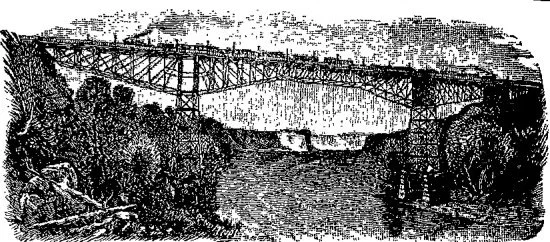
Michigan Central New Cantilever Bridge, Niagara Falls.
MICHIGAN CENTRAL
“The Niagara Falls Route.”
EAST.
Mail.
Day Express.
N. Y. Express.
Atlantic Express.
Night Express.
Kal. Accom'n
Local Pass'gr.
STATIONS.
Chicago
am 5.00
am 9.00
pm d 3.10
pm d 10.10
pm d 9.10
pm 4.40
Michigan City
7.23
11.03
4.54
12.23
11.27
6.57
Niles
8.37
pm 12.10
5.49
1.51
am 12.54
8.20
Kalamazoo
10.20
1.40
6.58
3.55
2.27
pm 10.00
am 7.10
pm 5.30
Battle Creek
11.15
2.18
7.33
4.25
3.15
pm 7.55
6.25
Jackson
pm 1.20
4.15
8.40
6.15
4.45
9.35
8.20
Ann Arbor
2.43
5.37
9.41
7.50
6.00
10.40
Detroit
4.10
6.45
10.48
9.20
7.30
11.50
Buffalo
am 3.35
am 6.16
pm 4.55
pm 8.05
Rochester
6.50
9.15
8.00
11.45
Syracuse
9.30
11.35
10.15
am 2.15
New York
pm 7.00
8.50 am
7.20
11.15
Boston
10.00
10.50
9.15
pm 2.50
WEST.
Mail.
Day Express.
Chicago Express
Pacific Express
Evening Express
Kal. Accom'n
Local Pass'gr.
STATIONS.
Boston
am 8.30
pm 3.00
pm 9.15
New York
10.30
6.00
11.30
Syracuse
pm 7.40
am 2.10
am 9.00
Rochester
9.45
4.20
11.30
Buffalo
am 12.15
6.15
pm 1.30
Detroit
am 7.30
9.11
pm d 1.20
d 1.10
pm d 3.00
pm 4.00
Ann Arbor
8.55
10.40
2.24
11.35
8.15
5.40
Jackson
1.13
11.45
3.27
12.54
10.55
7.10
am 6.25
Battle Creek
pm 12.09
pm 1.16
4.38
2.15
am 12.27
8.52
7.55
Kalamazoo
12.50
1.55
5.15
3.07
1.20
pm 9.45
am 4.45
8.40
Niles
2.27
3.20
6.24
4.32
3.07
6.40
Michigan City
3.48
4.35
7.32
5.43
4.32
8.03
Chicago
5.10
6.40
9.30
7.45
7.00
10.20
O. W. RUGGLES,
General Pass. & Ticket Agent, Chicago.
O. E. JONES,
Ticket Agent, Battle Creek.