The Youth’s Instructor, Vol. 67, No. 23.

The Turks are anxious for America to be made the mandatory for all Turkey

The Youth’s Instructor

Jun 10, 1919

Review and Herald Publishing Assn. · Takoma Park Station, Washington, D. C. · Jun 10, 1919

The Turks are anxious for America to be made the mandatory for all Turkey

Foreign-born people in the United States total 40,000,000. Half of these, as well as many native-born, need Americanization.
Since the war closed, the majority of the Moslem women of Constantinople have renounced the face veil, which they had previously worn whenever they appeared upon the street.
Forty-five States have ratified the prohibition amendment. Connecticut was the first State to fail to ratify. She has the habit of voting unfavorably on Constitutional amendments.
Germany is to be required to pay $25,000,000,000 indemnity, France receiving $12,500,000,000; England, $7,500,000,000; Belgium, $1,800,000,000. The remaining $3,200,000,000 will be divided between Italy and Serbia.”
Buildings constructed for the American Expeditionary Force in France, placed end to end, measured 452 miles. They would line both sides of a street from New York to Boston, or from London to Paris, omitting the channel crossing.
A nonstop trip from Macon, Georgia, to Washington, D. C., was made on May 7, by a Martin bombing plane. It carried a bale of cotton, which is to be relayed to Lowell, Massachusetts, by aeroplane, manufactured into cloth, and returned by air route to Macon.
Orders have been issued by Edward F. Albee, president of the B. F. Keith Circuit, prohibiting vaudeville performers in the Keith theaters from making slurring remarks about the work of the Y. M. C. A. overseas. He classes such remarks as un-American, un-Christian, and a reflection upon our gratitude for the work the Y. M. C. A. has done and is doing for our brothers and sons overseas.
Army aeroplanes and captive balloons are to patrol parts of the national forests in various States this summer to watch for forest fires and to help fight them. The flying fields at San Diego, Riverside, and Arcadia in Southern California are to be used by the aircraft, and the air service is considering other places in the West and in the East, including one near the White Mountains in New Hampshire. The aviators will report fires by wireless, and may fight them with chemical bombs. Thus are the implements of war turned to purposes of peace!

The Korean Revolution

REPORTS of the Korean revolution having reached the outside world, through conflicting sources, some biased one way and some the other, the readers of the YOUTH'S INSTRUCTOR will no doubt be interested in an account of some of the things which have taken place in Korea as noted by one who is on the ground and is therefore somewhat familiar with the situation.
In the early days of March a large number of Koreans from all over the peninsula gathered here at Seoul to witness the burial ceremonies of the late Prince Ye, ex-emperor of Korea. Many Koreans to whom the Japanese yoke was galling, together with scholars who are attending the schools, seized upon this as a proper occasion to strike for independence. Whereupon a number of the leaders of this party got together and issued a manifesto, declaring the independence of Korea. This was signed by thirty-three of the most influential men of the society, most of whom were members of religious organizations, the larger part being members of the “Chün-tō-kyō,” a native spiritualistic organization. Some Buddhist priests were also parties to the breach of order.
On Saturday afternoon the fifth of March, everything being in readiness, with the streets of Seoul full of people who were watching a practice parade of the funeral ceremonies, thousands of copies of this manifesto were rapidly circulated among the people. At one o'clock, when we left the city church, everything was quiet, although there were thousands of people upon the streets. The result of the circulation of the manifesto was instantaneous. Mobs formed, and people by the thousand began to yell “Mänsä” for Korea (Korea for ten thousand generations). Except for the noise and the throwing of some stones, the mobs were quite orderly.
It is probable that Japan was not altogether in the dark as to the uprising, because three warships had arrived at Chemulpho, hundreds of marines being dispatched to Seoul. These with the regular encampment of soldiers were rapidly spread over the city with guns and fixed bayonets. It is also reported that machine guns were not lacking. The police force, thus backed, began rounding up the conspirators and chief instigators.
Almost simultaneous with the trouble in Seoul, uprisings occurred all through the northern provinces, and soon spread over the entire peninsula. Nor was the distribution of the manifesto limited to the capital, but was scattered throughout all the large cities.
Japan's excellent police force was vigilant, and thousands of arrests followed. It is claimed at this time that more than six thousand arrests have been made, and still every day is active with arrests following the daily manifestations in different parts of the country. The Koreans being unarmed, have offered more of a passive resistance than otherwise; however, at this writing a number of Japanese police have been killed, and perhaps a hundred Koreans.
The revolution has been well organized, each night a paper being issued, which keeps the people thoroughly informed as to the trend of events. The police so far have been unable to locate the place of publication or to intercept its circulation, which is done at night, evidently by couriers.
A few evenings ago a demonstration took place near our mission station. The shouting began soon after nightfall, and continued for hours. There were large companies assembled on all sides of us. One party would yell for independence of Korea, and their cry would be answered by a party from another direction. Thus back and forth the wild cries for freedom were hurled, until the night was filled with shouts that were passed from company to company and re-echoed by the hills. We, here at the compound, wondered among ourselves what would be the result of the night's performance, and whether if the people could see beforehand the harvest of human life, they would be deterred. This affair resulted in many arrests, the loss of an ear for one man, and two deaths.
Foreigners have been respected by both parties. At this writing only an isolated case of foul treatment being meted out to a foreigner has come to my knowledge. This man was an English missionary who while out in the country found himself unwittingly near a demonstration. The police mistook his presence as evidence of guilt, whereupon he was beaten and taken to jail. He was later released with apologies.
It seems unfortunate that Christians are getting mixed up with the trouble. The people were enjoying prosperity. Taxes have been low, and life and property were most secure. I suppose Korea has never witnessed such a reign of prosperity as she has had the past year. Crops were good throughout the peninsula; and never before were such good prices received for rice and other produce. Many of the prosperous farmers are put to their wit's end to spend their money. As they use no furniture, they have nothing to buy but food and clothes, and there is not much variety in either of these commodities. Of the first there is little else besides rice, seaweed, and fish, and silk and cotton goods compose the other. Thus the people have taken to traveling. Every autostage and every train is loaded to its limit. On two itinerating trips this past winter I was compelled to walk long distances because the stages were unable to carry more. The railway has recently put on another express train. There were already two express trains each way daily besides three mixed trains that carried passengers, yet all were loaded, and people were standing in the aisles.
Thus to those who are familiar with the special gospel message for this time, the reasoning from cause to effect is simple, for was it not “fulness of bread, and abundance of idleness” that brought about the downfall of the cities of the plain?
Our work here in the peninsula has suffered little, our people generally taking no part in the trouble. At Soonan we were compelled to close the school for a time. Three of the teachers and a good many of the students were thrown into jail. However, all have since been given their liberty with the exception of two of the teachers. I do not fear that our work will suffer. These troublous times, from which this country has been shielded for the past few years, thus breaking over the land, will help our people to sense the spirit of the age and realize that we are rapidly approaching the end.
(Concluded from page two)
E. J. URQUHART.

FATHER—

ROGER ALTMAN
The glare of day had softened. In the west A crimson glory lingered where the sun Short time before had slipped behind the hill. The warm and winelike air of early spring Caressed the buds of resurrected green, And fondled them with sighs of ecstasy.
The nobleman of Israel paced his roof And pondered on the past. His steady gaze Turned always toward the south. In fancy’s eye He pictured Egypt’s banquet halls of mirth, Her gay festivity, and empty joy.
“My son,” he murmured, “O my well-beloved, Hast thou forgot the shelter of thy sire? Doth not thy Jewish heart at times grow soft, And yearn for glimpses of thy father’s face? The fig tree close beside the southern wall Is green again. The vines around the door Put forth their baby leaves. Would thou wert here! How well do I recall the day he left. In hot blood and with boastful words he cast His boyhood home away, forsook my board, And with his patrimony bolstered, girt A gaudy mantle round his goodly form, And took the Egypt road.”
He raised his eyes And gazed far down the white and winding trail. How often had this youngest son of his Climbed to the roof and watched the caravans That tinkled down to Egypt, counting, too, The camels as they labored up the hill, And, by the huge red stone, turned out of sight.
The father looked there now, and strained his eyes Of threescore years to see that rugged stone, Behind which he had seen his best-loved son, The idol of his being, disappear.
The sunset glory in the western sky Was slowly fading. Still the father gazed, His heart athrong with sacred memories And yearnings, his old eyes bedimmed with tears. “My boy, my boy, where is he? . . . Who is that Rounding the corner by the landmark stone? Some wanderer indeed. See how he limps
Upon his weary feet, and mark the droop Of shoulder, the exhausted, listless way He plods along. I’ll ask him in. See, now He straightens up in pride and dignity, Half hesitating. Nay, I know that form, That graceful carriage, that familiar pose; Surely it is not he,—look at those rags! It must be he! Mark ye that comely head? Father of Abraham, it is my son. Make haste, my withered bones, leap down these stairs, And carry me in haste to meet my boy. My son was dead. He is alive again. My heart’s delight was lost, but now he’s found.”
The twilight folds were deepening into gloom, The saffron in the western sky had gone. No more the breezes sighed among the trees, And over all brooded tranquillity. Upon the shoulder of the nobleman The prodigal had faltered out with tears, Repentance. Folded in his father’s robe, Together they went home, beneath the Syrian stars.

Our Youth as Pioneer Missionaries

W. A. SPICER
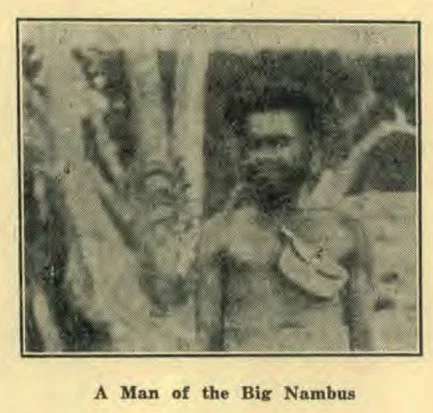
THE only photograph I saw of the Big Nambus people, of the New Hebrides, showed a savage-looking face, with nearly naked body. The name of this people, Big Nambus, is the name of a grass out of which they make the only piece of clothing worn.
I thought again of our young people as missionary pioneers as we bade good-by to Brother and Sister N. Wiles as they turned their faces toward that northwestern corner of Malekula, where the Big Nambus people live. Our friends were young—seeming almost like boy and girl setting out for one of the most trying posts on our missionary frontier line. But they are tried workers, having served one term among this same wild people. (Mrs. Wiles, by the way, was once a little Battle Creek girl, daughter of Elder and Mrs. E. S. Butz.)
Wait a few years, and see if there do not come to us stories of transformations wrought among these islanders who have welcomed these young missionaries back to their villages.
I met a brother who was engineer on the mission launch “Melanesia” when it first visited the Big Nambus coast. The Solomon Islanders in the crew had come of raw enough stock, but our brother said that even these men of the Solomons drew the line at the Big Nambus. “Big Nambus man no good,” said they. They kept close eye upon the men who came down to the launch.
“I saw one of our crew meet one of the Big Nambus,” said our engineer brother. “It was a formal meeting. Our man walked up to shake hands with the stranger. First our man put out his left hand, catching hold of the gun that the other carried, then with his right he shook hands with him. This ceremony of new friendship over, our Solomon Islander backed off, continued walking backward until at a good distance, keeping his eye every instant upon his new acquaintance. ‘Big Nambus man no good; he one bad man,’ he insisted.”
But these are the people who begged us to help them find a better way, and whose good intentions have stood a severe test. While Brother and Sister Wiles were off on furlough, attending the union conference, the bushmen came down and did some violence to traders, I believe. The French authorities sent in a punitive expedition, and some Big Nambus people were killed. These people, notwithstanding they had suffered for the crime of their cannibal neighbors, held to their desire to have the white missionary come, and when Brother Wiles arrived alone, to spy out the land, he was urged to bring his wife and settle among them, assured that they would keep them safely from the bushmen cannibals on their border, and that the Big Nambus people would listen to the teaching.
At the farewell meeting at the union conference session, Brother Wiles said: “In a few days’ time we shall sail again for the New Hebrides, and, as you know, our work is somewhat hard. We are not yet able to report fruit for our labor. The people are in heathenism and great darkness. As we planned to go back and again take up our work, it was with some misgivings as I thought over the situation; but after the good instruction we have received here, and all that we have heard of the onward march of God’s message, the text comes to me with renewed force, ‘I am with you alway, even unto the end of the world.’ My courage is strong to go forward in the Lord’s work. I believe that soon out there among the Big Nambus and other tribes of which we have heard, we shall see glorious results for the Lord. We shall see a people gathered out as a result of the teaching of the good old Book.”
A Man of the Big Nambus
His reception on his return to that people was surely a token that the Lord had indeed gone before our young friends in their perilous and yet glorious quest.
Is it not wonderful that our young people, in the fear of God, may go out into any dark region with the “good old Book,” and lo, as the years pass, souls are born again into the kingdom of God, and this cause is represented in that previously barren waste by the fruitage of believers praising God for the truth even as we ourselves do?
There is no other work like this for the consecrated youth. Let us turn their eyes toward the unentered fields.
“With such an army of workers as our youth, rightly trained, might furnish, how soon the message of a crucified, risen, and soon-coming Saviour might be carried to the whole world!”
S. S. “Tango Maru,” Strait of Manipa, East Indies.

Bolivia and Its Indians

ACCORDING to an estimated census, the population of Bolivia is 2,500,000 persons. Fifty per cent, at least, of this population are Indians.
Around the large centers of Bolivia, such as La Paz, Oruro, and Cochabamba, the Indian is semicivilized, but in the interior he is wild and savage, living in the most rude and insanitary manner.
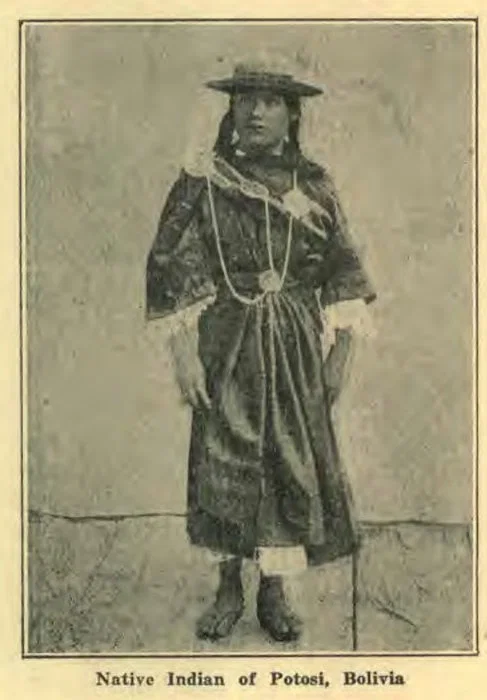
Native Indian of Potosi, Bolivia
The Indian is generally of a peaceable disposition, very humble when with the white people or with his patrón. But history and experience tell us of times when his patience and his good nature have been exhausted; because to-day, as in times past, the Indian is an object of exploit and antipathy on the part of all or nearly every one who has any dealings with him. In many respects, he is in abject slavery. On the large farms he has to work fifteen days for the patrón, or owner, to one day for himself.
The Indian is illiterate and superstitious, not having had the privilege of attending school.
Little or no interest is taken by the people of the country in the uplifting of the Indians. Few seem to care any more for them than the value they represent in money to their patróns. It is as a Bolivian gentleman, statesman, and diplomat has said: “It is no exaggeration to say that the present condition of the Bolivian Indian is a national disgrace and a terrible indictment of the good name of the republic. It is, therefore, a sacred duty on the part of every good Bolivian to look for the means of doing away with this disgrace, and converting into active forces the thousands of Indians who today are a millstone around the neck of a civilized society.”
If we who enjoy all the blessings and bounties of life, neglect to do our part in the uplifting of the Indian, we may find that it will be not only an “indictment of the good name of the republic,” but a terrible indictment of the neglect of our sacred duty.
When treated kindly, the Indian reciprocates quickly; when taught, he learns readily; when treated for infirmities, he convalesces rapidly.
In Bolivia, there are several tribes of Indians, the principal ones being the Aymaras and the Quechuas. Among these we desire to establish schools.
A Quechua Indian, an owner of property, already has offered us a sum of money to help begin work among them; but we are waiting for some of our friends to add a little more to this sum before we can open the school.
Near La Paz we are planning to open a mission station for the Aymaras.
The accompanying photograph will give a good idea of the appearance of this people.
May the Giver of every good gift bestow a liberal heart to every one that reads of the distress of the Bolivian Indian. W. R. POHLE.
La Paz, Bolivia.

The Fragrance of Religion

A GENTLEMAN once mailed some orange blossoms to a friend living in a country town in the East. The mail bag was filled with the fragrance, so that people came to the postmaster, and said: “Postmaster, my letters yesterday were fragrant with orange blossoms. Where did the perfume come from?”
Think of it; just one little envelope of orange blossoms, and the delicate perfume had lavished its fragrance upon the letters about it; had shared with its neighbor letters in the bag, and perfumed them all.
Is this not a parable of the true Christian life, the life that is fragrant with good deeds, that perfumes and blesses the lives of others?
You will remember that when Mary lavished the precious ointment upon the Master, the record says, “The house was filled with the odor of the ointment.” Mary could not lavish the ointment upon Jesus without lavishing its fragrance upon all those gathered in the house.
Did you ever receive a letter from some Christian friend, and did your heart grow warm as you read it, and did you stop to analyze your feelings, and say: “Why, what is there heart-warming about this simple letter? There is not a word of preaching in it.” Then you answer your own question, and say: “Why, this letter is just saturated with the fragrance of religion, with the personality of my friend, and with the spirit of Jesus Christ.”
You may have known some shut-in of whom you could well say: “The house was filled with the fragrance of her Christian life.” There have been some such lives whose fragrance and power have been wonderful inspiration to other lives.
Religion makes fragrant and sweet-smelling lives, and places as well, that have been foul and ill-smelling, defiled with sin. There is nothing so penetrating as the fragrance of real religion; it will not be denied; it steals into the closed avenues that once led to the hearts of men; it works its way through the litter of careless living and the rubbish of selfishness. Is the heart’s door closed? If so, under the door it steals to awaken new longings and hopes in every heart.
Alas for the professing Christian in whose heart and life the fragrance of religion is missing. Here is an artificial rose. It has beauty, form, color; but, alas, there is no fragrance. What is the matter? Why, there is no life in that rose, you say. True, there are genuine roses without fragrance; but there are no genuine Christian lives without fragrance—no life, no fragrance, in the professing Christian. — G. W. Tuttle.

How to Make a Singing Locust

THIS is a locust year. In many parts of the United States the kind that appears every seventeen years has come round again. The “locust” that you can make out of an empty wooden spool, a piece of stout paper, a six-inch stick about the size of a pencil, and a horsehair sings like the real locust that makes the air resound with his strident voice on hot summer days.
A Singing Locust
A Singing Locust
Tie the paper firmly over one end of the spool, as shown in the illustration; then make two pinholes through the paper. Through the holes insert the ends of the hair from a horse’s mane or tail, preferably one that is not less than twelve inches long; then push both ends of the hair through the spool, tie them together and draw them gently back to the top of the spool. A twig from a tree will serve as the stick. Peel off the bark for about an inch near the end, and on the peeled surface loop the horsehair. When you have moistened the peeled part of the stick, whirl it rapidly so that the spool flies in a circle, and the result will be an exact reproduction of the shrill notes of the locust. With practice you can produce the familiar singsong and gradual dying-away effects until the imitation is perfect — or until your mother asks you to stop. — Youth’s Companion.

Strong Friendships a Valuable Asset

WHAT is more helpful to a woman in the busy world of affairs today than strong, true friendship?
Because we are judged by the company we keep, because our character is invariably affected by the friends to which we attach ourselves, it becomes nothing short of a tragedy when we fail to put the proper valuation on our friendships.
Of course we ought to be courteous and kind to all, but not with all do we need to be on terms of intimacy. We all know the type of girl whose affections spread themselves out over a large and promiscuous number. She takes up with all kinds of companions, without much consideration as to their fitness or worth. We hear her spoken of as a “hail fellow well met,” because she makes a boon companion of every passing stranger. In other words, she aims to be friendly with everybody, yet a real friend to none.
You will find that her friends are mostly of the fair-weather type that forsake her when she really needs a friend.
There is also another type of girl who selfishly chooses her friends according to their usefulness to her. In order to achieve some personal gain she is often willing to endanger her reputation and include in her list of intimates persons whom she morally distrusts.
In my opinion the basis of all real friendship should be a community of interests. Friends should be chosen because they have sympathy with us in our best efforts and highest thoughts, because of their trustworthiness, and because they believe in us and inspire us with strength for greater endeavor.
To feel that there are those around us who believe in us unreservedly, who would be disappointed if we should fail, proves a powerful stimulus. Can any money measure the value of such a friendship?
Real friendship is never a one-sided affair. One cannot receive all and give nothing in return. If you are stingy with your praise and your helpfulness, if you lack generosity and cordiality, you cannot expect to call forth these qualities in others.
Therefore in the choice of our friends let us remember that no friendship is worth the name which does not elevate and which does not help to strengthen character. This is the highest function of friendship. — Mary Caldwell Hamilton, in New York Sun.

The Garnish of Gems

WOULDST have the sparkling gems, friend? The stones so rich in hue, Wouldst wear them in a diadem? Well, then, if thou art true, There’ll come a time when Eden Shall not be far away; ’Twill be our home — Jerusalem, Lighted by God’s own ray. Of gold its streets, just think, friend, And gates of pearl — divine! Garnished its foundations With precious gems that shine; Wouldst like to feel the touch of them, Those stones so rich and rare? — The Jasper, with its soft green tone, Veined by a red with care; Sapphire, glorious sky blue; Calcedony, purest white; Emerald, green as grass; Sardonyx, fleshy light; Sardius, ruby red; Chrysolite, brownish gold; Beryl, bluish sea green; Topaz, canary cold; Chrysoprasus, palest yellow; Hyacinth, violet pink; Amethyst, prettiest lilac; — Just our rainbow, come to think.
INA L. AUSTEN.

He Is Blameworthy Who Wastes His Hour

He is blameworthy who wastes his hour.— Marcus Aurelius Antoninus.

Praying Souls Become Prevailing Saints

“PRAYING souls become prevailing saints.”
Continue reading: Other Glimpses into the Past