The Youth’s Instructor, Vol. 49, No. 20.

CRATER LAKE

The Youth’s Instructor

May 16, 1901

Review and Herald Publishing Company · Battle Creek, Mich. · May 16, 1901

CRATER LAKE

IV

As Seen from Victor Point
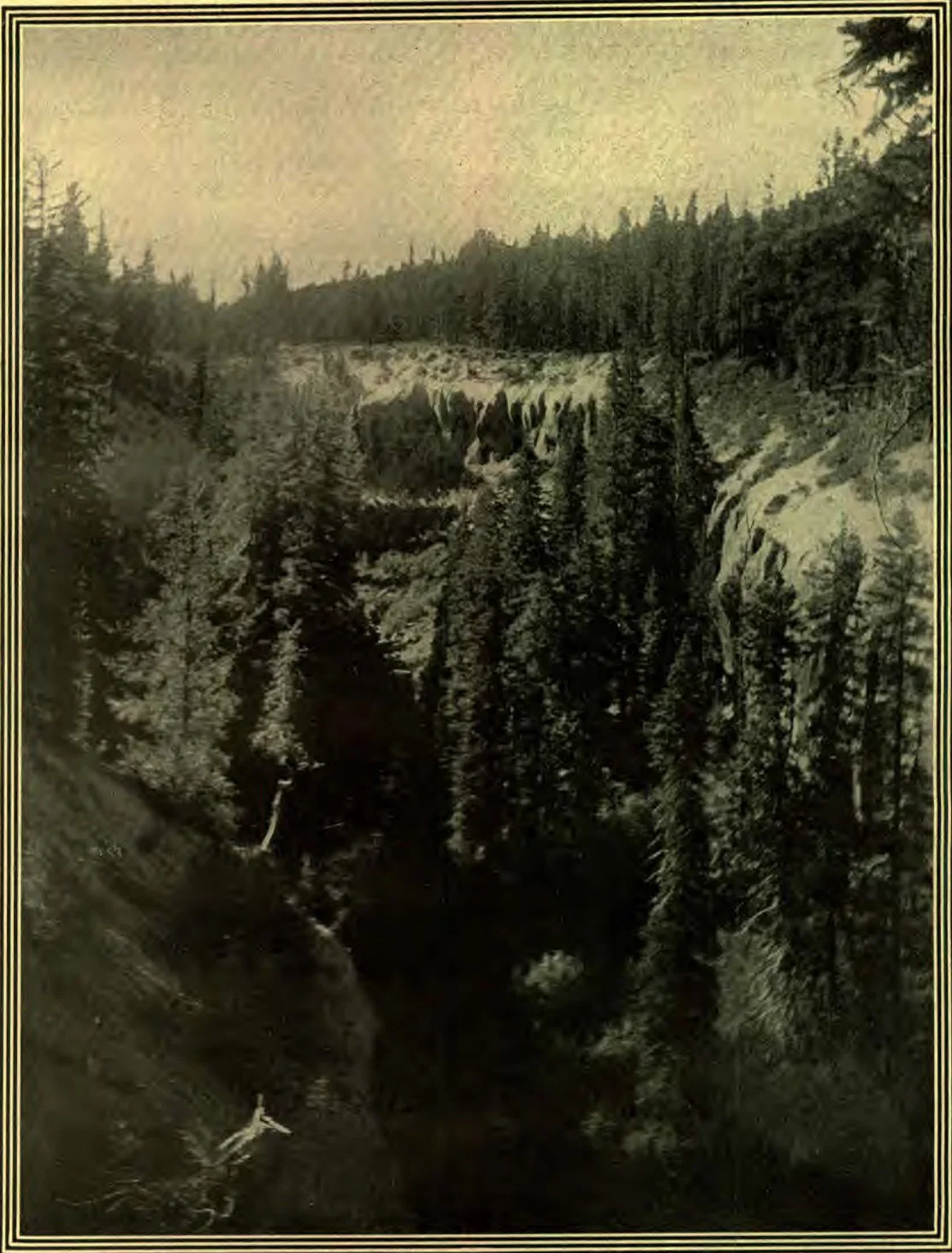
The distance from the foot of Mt. Mazama to the rim of Crater Lake is three miles, and in that distance it is necessary to ascend about fifteen hundred feet. Five hundred feet to the mile is a fairly steep grade for a loaded bicycle, though I would not have minded it much if the mosquitoes had permitted me to pass in peace. But the southern slope of the mountain is thickly covered with a forest of alpine hemlock and fir, with little undergrowth. This forest is dark and damp, and makes a favorable breeding-place for mosquitoes. The larva feed upon the decaying vegetable matter in the stagnant water, while the adults stand as armed soldiers ready to repel all animals that invade their domain.
Between the mosquitoes and my wheel I had a hard time; but at last I saw the clear sky between the tree-tops ahead, and knew that my long journey was nearly ended.
When I reached the opening, I found myself at the edge of a long, narrow plateau, covered with grass and bedecked with wild flowers; while beyond and to the right and left I could see the rugged mountains and bare cliffs that make up the rim of the lake. I left my wheel, and walked across the plateau to Victor Point, and there for a long time stood spellbound by the glorious panorama spread out at my feet.
At the foot of the cliff on which I stood the water was shallow, and as green as the grassy plateau behind me. But farther from the shore, as the depth increased, the water gradually lost its yellow until it became a deep blue, looking much like the “bluing” water in which the thrifty housewife rinses her white clothes. Away in the distance the blue tint also disappeared, and at the opposite shore the lake looked like a mirror of the finest polished glass, reflecting a flawless image of the bare rocks and forest-clad mountains with which it was surrounded.
Never had I seen a place where distances were so deceptive. It looked to be not more than two hundred feet from where I stood to the surface of the water, but it was nine hundred and fifty. Wizzard Island, which lies just opposite, seems not more than a good stone’s-throw from Victor Point, but it is fully two miles. One who did not know the length of the lake would probably call it half a mile: it is between six and seven. Llao Rock, the great, bare cliff beyond Wizzard Island, from whose summit (according to Indian tradition), the spirit of the lake used to hurl the venturesome traveler who dared look upon its enchanted waters, appears to be several hundred feet high; but in reality it falls little short of two thousand feet.
ALONG THE ANNA CREEK CANON
Along the southwestern shore, between projecting cliffs, were many gentle slopes supporting magnificent groves of hemlock and fir. It was early in August, but in many of these groves, and in some other places along the southern shore, were still great drifts of snow, from each of which ran a stream, adding its mite to swell the water of the lake.
Along the southeastern shore are many unique and striking formations of solid rock. Some are tall and slender, like the spires of a church. In others the imagination can easily trace the resemblance to different animate and inanimate objects. The most striking of these, and, indeed, one of the most interesting features of the lake, is called the Phantom Ship. This is an island of solid rock, whose sharp, pinnacled top rises over one hundred feet above the surface of the water. It lies in the shadow of a great cliff, and is so far from Victor Point that its resemblance to a ship can not be seen without the aid of a glass.
Still another prominent feature of the lake, or rather of its rim, is a serrated, rocky crest coming up from the south to the very rim of the lake. This is called Cathedral Spires, or Castle Crest, the latter being the generally accepted name.
I stood for hours drinking in the beauty and grandeur of my surroundings, and did not turn back to find a camping-place until the lengthening shadows reminded me that it was preparation day, and that I was not yet ready for the Sabbath.
J. EDGAR ROSS.

Speak to the Earth and It Shall Teach Thee

“SPEAK to the earth, and it shall teach thee.”

WATER CHANGED INTO WINE

III

“Mine Hour is Not Yet Come.”—The mother of Jesus was anxious to have a miracle performed as soon as she discovered the need of wine, but she was bidden to await the hour of divine choice. True, it came soon, the waiting was not long; but whether brief or lengthy, we must await the will of Providence. A most essential and important part of our obedience and service to God lies in not doing, as well as in doing. On this occasion, Mary must wait, even after she had discovered the need of wine, before she was permitted to behold the miracle that was to produce it. So in our own experience, we often recognize defects of character, and discover besetments of temperament, and at once we go with our need to the Lord, asking that they be immediately removed; but not always does the answer come without delay; often we must wait for the hour of deliverance,—the hour determined by divine wisdom. Then, and not until then, will these things be changed, transformed, or removed from our experience. “They that wait upon the Lord shall renew their strength.” Isa. 40:31.
The Saviour said, “Mine hour is not yet come.” Christ would do nothing before the time, and nothing after the time: infinite punctuality characterized his life-work. The same unerring accuracy with which the Master hand guides the great astronomical systems in their ceaseless march through space, characterized the performance of his every act when here on earth, even down to the smallest.
The Christian must not run ahead of the angel of Providence. Impetuosity and blind zeal will not guide and control the servants of God; neither should a spirit of indifference and carnal security be permitted to settle down over the heart of him who professes to represent God in the earth. When tempted or urged prematurely to enter upon any work, or put forth any effort for God, let us follow the Saviour’s example, and do nothing before the time, but say, as did he, “Mine hour is not yet come.” On the other hand, what shall we say if we have slept at our post of duty while the hour of opportunity has come and gone? When the hour of opportunity arrives, how important that we should be prepared to grasp it, to act without delay, to “strike while the iron is hot.” The watchword of the overcoming Christian must be, “Do the right thing at the right time.”
“Whatsoever HE SAITH Unto You, Do It.”—From Mary’s experience in going to Christ we may learn a great lesson. It is not necessary for us to go to God, telling him how we should be saved, or how our sins are to be forgiven, or in any way to specify what our Christian experience shall be. Our attitude should be that of a humble servant, a confiding child, waiting for his command, with a willing mind to do whatever he bids. When Mary had received with humility the lesson that Jesus sought to teach her, she at once turned to the servants, and sought to impart to them that which she had just learned, saying, “Whatsoever he saith unto you, do it.” How beautiful it would be if every Christian would learn lessons so willingly, and teach them to others so quickly!—if all would so soon discover their mistakes, and so soon warn others of the pitfalls, that they fall not therein.
The mother of Jesus did not suggest to the servants that they all cease their work, and in idle expectancy await the commands of the Master, but while they were going about their work, serving tables, removing dishes, bringing food, or bearing the cup, her word to them was: “Whatsoever he saith unto you, do it.” A beautiful lesson for us! While we go about our daily work, doing with all our might whatever our hands find to do, as unto the Lord, let us listen with a careful ear to hear what saith the Spirit; and then, “whatsoever he saith” unto us, let us perform it. “Let every man abide in the same calling wherein he was called.” 1 Cor. 7:20.
“WHATSOEVER He Saith unto You, Do It.”—It is not enough simply to be willing to do, to want to do, to plan to do, but “whatsoever he saith,”—that is the important part,—the very thing he says, the very way he says it, and at the very time he speaks it,—that is the meaning of genuine obedience. There is a lesson in this for those who would interpret Jehovah’s commands to mean almost anything they choose. An example is the seeking to substitute the observance of the first day of the week for the Sabbath, in the face of the direct command to observe the seventh day. Said David, “I made haste, and delayed not to keep thy commandments.” Ps. 119:60. Implicit obedience to the requirements of Heaven, just as far as they are known, is the only safe course for the Christian. By the aid of the Holy Spirit we shall seek to understand just what our individual duty is, and then, by the grace so freely given, endeavor to walk in the light.
“Whatsoever He Saith unto YOU, Do It.”—Here we learn the lesson that God speaks to us personally, and he expects, in return, personal obedience. That which he speaks to us, he expects us to perform. We can not work by proxy; we can not believe by proxy; neither can we obey by proxy. To undertake to be saved by proxy will simply mean to be lost in the end. Our obedience to divine light should be personal and prompt. We should obey without hesitation, knowing that eternal power and infinite grace are bound up in every divine requirement. Our loving Commander asks us to do only those things which are for our greatest good and eternal welfare. The commands of God are really divine promises.
Another beautiful lesson we may get from this thought is that when we quickly and implicitly yield obedience to the Father’s requirements, we are at once freed from all responsibility. As obedient servants, we free ourselves from all possibility of future censure or blame; the responsibility reverts to the Master, whose command we made haste to obey. And again, one can never become a leader in this life until he has first learned to be led; we are not fit to command others until we ourselves have learned to obey. W. S. SADLER.
(To be continued)

CHARACTER-BUILDING

God gives us strength, reasoning power, time, in order that we may build characters on which he can place his stamp of approval. He desires each child of his to build a noble character, by the doing of pure, noble deeds, that in the end he may present a symmetrical structure, a fair temple, honored by man and God.
In our character-building we must build on Christ. He is the sure foundation,—a foundation which can never be moved. The tempest of temptation and trial can not move the building which is riveted to the Eternal Rock.
He who would grow into a beautiful building for the Lord must cultivate every power of the being. It is only by the right use of the talents that the character can develop harmoniously. Thus we bring to the foundation that which is represented in the Word as gold, silver, precious stones—material that will stand the test of God’s purifying fires.
In our character-building Christ is our example. He placed himself at the head of the human race to show us how to live in a way that God can approve. He is the only one who has lived a perfect life, who has formed a pure, spotless character. He has shown us what it means to be a perfect human being. He has shown us what God is, and what we are to become,—godlike in character.
God does not ask us to carry forward the work of character-building in our own strength. We are not sufficient of ourselves to think anything of ourselves. The Holy Spirit is our efficiency in this work. When we think ourselves capable of molding our character aright, we deceive ourselves. Never can we in our own strength obtain the victory over temptation. But he who trusts in Christ, and submits to the guidance of his Spirit, will grow daily into the likeness of God. His growth will be proportionate to his dependence on the Spirit’s help. Such a one in every time of difficulty will turn, and not in vain, to the One who has said, “Come unto me, . . . and I will give you rest.” On the one side is the all-wise, all-powerful God, infinite in wisdom, goodness, and compassion; on the other his frail, erring creatures, weak, sinful, and absolutely helpless. God proposes to make them laborers together with him in the building of character, and all his mighty power is at their disposal as they co-operate with him.
It is one thing to assent to a truth, and another to practice it; one thing to admire the grace of Christ, and another to make that grace our own, reflecting in spirit and person the divine likeness. Many who profess to be children of God are a continual reproach to him because of their unconsecrated lives. They talk about sanctification and holiness. When there is a revival in the church, they mourn over their unchristian lives. They make many good resolutions, but they fail to carry them out. Their goodness is as lasting as the frost before the morning sun. Their words are many, but the Holy Spirit is not with them.
He who would build a strong, symmetrical character, who would be a well-balanced Christian, must begin at the foundation. He must crucify self. He must give all and do all for Christ; for the Redeemer accepts no divided service. Daily he must learn the meaning of self-surrender. He must study the word of God, getting its meaning, and seeking to carry out its precepts. Thus he may reach the highest standard of Christian excellence. There is no limit to the spiritual advancement we may make if we are partakers of the divine nature.
To be one with Christ, to build a character like his,—this is the high ideal set before us. Let us look earnestly at this ideal, and then strive to reach it. In the councils of love, provision was made to enable us to do this. We may be more than conquerors through him who has loved us. If at times we fail, let us not become discouraged, but try again, looking always to Jesus. Thus we shall become changed into his image.
The Christian has the mind that is in Christ. His hopes and aspirations are pure and noble; for he is growing up into Christ. In his daily life he reveals the fragrance of Christ’s character. Day by day God works with him, perfecting stroke by stroke the character which is to stand in the day of final test.
MRS. E. G. WHITE.

The Infinite Worth of the Single Soul

The sense of the infinite worth of the single soul, and the recoverableness of a man at his worst, are the gifts of Christ.—Drummond.

B. O. WITHALL

WHEN God commissioned Moses to lead the Israelites out of Egypt, Moses doubted his ability to do it, and God said to him, “What is that in thine hand?” Moses answered, “A rod.” God made it into a serpent as a sign to Moses of what he could accomplish through him.
When young men and women to-day are wondering what they can do in the world, and doubt their own ability to take part in God’s work, he says to them, “What is that in thine hand? What talents have you that I can use to my glory?”
God can take your talents and use them, and will give you the reward. He says, “Son, daughter, give me thine heart.” Let us make a complete surrender of ourselves to him.

B. O. WITHALL

AT EVENING TIME IT SHALL BE LIGHT
At evening time! just when the shadows lengthen Across the sky; Just when the sun dips, and the zephyr breezes Moan wistfully, And the day pales before approaching night — Just then, at evening time, it shall be light.
At evening time, when little birds are chanting Their vesper hymn; When yon fair shore, beyond the surging river, Grows faint and dim; When ghostly visions mock the failing sight,— Then, at the evening time, it shall be light.
Light! though the darkness like a falling mantle Foldeth thee round; Light! though through all the valley, strange and lonely, No path is found: Though sound and sense may fail, and doubts affright, Still, at the evening time, it shall be light.
O trembling soul! be glad: earth has no sorrow But heaven can heal; The garish sunbeams ofttimes hide more beauty Than they reveal. Beyond yon gathering storm the sky is bright; Fear not! at evening time it shall be light.
Fear not to pass into the twilight shadows: Thy God is nigh. His rod and staff shall guide thee through the valley; Fear not to die. Lift up thine eyes to Zion’s holy height; There, at life’s eventide, it shall be light.
“It shall be light.” The Lord himself hath spoken, The truth is sure; His gracious promise never can be broken; It must endure. Death, to the Christian, is not cheerless night: It is but eventide — it shall be light. —Lucy A. Bennett.

DOES IT PAY TO SERVE GOD?

This question is best and most easily answered by asking another,—Does it pay not to serve God?
Let us look at the matter first from a national point of view, taking ancient Israel as an example. When her people kept the commandments and statutes of the Lord, they were abundantly blessed,—their enemies “were smitten before their face;” the great Jehovah himself cared for their land; his eyes were always upon it from the beginning of the year even unto the end of the year; “the rain came in due season, the first rain and the latter rain,” that they might gather in their corn, their wine, and their oil, and have grass in their fields for their cattle, and might eat and be full. The pestilence did not come near their dwellings; they were not smitten with consumption, or fever, or inflammation; blasting and mildew did not fall upon their vineyards or grain fields, nor a curse upon the increase of their kine and the flocks of their sheep; but they were placed high above all nations in praise, in name, and in honor.
But how was it when they “served not the Lord with joyfulness and with gladness of heart, for the abundance of all things,” but turned aside from his commandments, and went after other gods and served them?—Powder and dust came down from heaven instead of refreshing rain; the olive cast its fruit, and worms ate their grapes; their cattle and their sheep were violently taken away, and were not restored; and they themselves were smitten before their enemies, and were carried captive to a far land.
As it is with nations, so it is with individuals.
“The blessing of the Lord, it maketh rich, and he addeth no sorrow with it.” Not that good people have no sorrow, but the Lord adds none to the riches that he gives—it is all blessing. The wicked may seem to prosper, but the day of reckoning will come sooner or later, as it did to Israel. Their latter end is shame, confusion, and loss.
Ah! it pays to serve God: it pays to keep his laws, for it makes a man—a woman—one that all men can trust, pure, clean, honest, to the heart’s core; invincible in the right; a savior and not a destroyer of men.
It pays to serve God, for instead of “the righteous judgment” that no evil man may escape, there is eternal life and an enduring crown: true esteem, true glory here, and everlasting fame and glory hereafter. MRS. S. ROXANA WINCE.

A BUSINESS MAN’S COMPLAINT

STANDING by the desk of a business man who employs quite a number of lads, says a journalist, I saw a boy of about fifteen come in and apply for a situation. The boy was well dressed, and by demeanor and accent indicated that he belonged to a good school. Without taking off his hat, or appearing to notice anybody who was present, he demanded, in a sharp, unpleasant voice: “Say, mister, are you advertising for a boy?”
The business man looked at him for a second and answered: “I want an older boy than you.” “What?” “I want an older boy than you,” answered the merchant in a somewhat louder voice. “Oh,” answered the lad, as he swung around and walked out.
“That,” said the merchant to me, “is a sample of the manner of a modern schoolboy. In my business, you know, we depend almost entirely on politeness, quickness, and adaptability of the young fellows we have behind the counter. My customers ask me why I change my boys so often. Certainly it is not to save money, for I would be willing to keep them if they were worth keeping. The first thing they ask me is what wages I pay, and the next what hours they will have to work. They never think about me or my business; all they want to know is how much money they can get out of me. Apparently they give me no credit for being able to teach them a profitable trade; they regard me only as a taskmaster, who is to be made to pay the highest price, give the shortest hours, and accept the lowest quality of service.”—Christian Youth.

SIMPLE ARITHMETIC

If you add, my dear, to some one’s joys, Pray tell me what you do. Do not look puzzled, the answer is plain — The joys are doubled for you! — Adelbert F. Caldwell.

Politeness as the First Step to Success

POLITENESS is the first round in the ladder of success.

INSECT METAMORPHOSIS

ONE of the most noticeable peculiarities of insects is their metamorphosis, or change of form. Nearly all insects pass through this peculiar change, there being commonly three distinct stages.
In the first stage the insect is usually a crawling, worm-like caterpillar, and is called a larva. This Latin term means a “mask,” or “cover,” the idea being that the insect is not in its true or perfect form, but is covered by a dress that will soon be laid aside. When this is done, it is called the imago, meaning the exact image of the parent insect.
In the second stage, this worm-like caterpillar is wrapped in a special covering prepared for the purpose. While it is thus wrapped up, it is in its sleeping state, and is called a pupa (the Latin for baby), because it appears somewhat like a baby wrapped up and asleep in the cradle.
Some of these baby insects sleep a long while in their snug beds, or cocoons, while others change in a short time. The common house-fly remains in its bed only a few days, while the cicada, or “seventeen-year locust,” remains in its covering about sixteen years before it changes to the perfect adult stage.
The larvae of different insects have different names. Commonly the larvae of hard-winged insects are called “grubs,” while the larvae of moths and butterflies are called “caterpillars.”
Various names have also been applied to the pupa, such as “chrysalides,” “aurelia,” and “cocoons.”
In the adult stage, insects eat very little, as they have then attained their growth. But not so with the larvae; they are voracious eaters, and it is in this stage that the insects injurious to vegetation do the most damage. As an example of these may be mentioned the potato-beetle and the army-worm, which are so destructive to growing crops.
The rapid growth of the larvae causes them to cast their skins several times before they attain their full growth, even as larvae. The silk-worm sheds its skin three or four times during its growth.
When about to enter the pupa stage, each larva seeks an appropriate resting-place for its chrysalis. Some burrow into the ground, and spin a silken lining for the walls of the earthy cave in which they are to spend their long period of rest; while others roll themselves up in leaves, or crawl to some secluded spot, and attach themselves to a twig or leaf, and there construct a silken home called a “cocoon.”
The silken thread of which the cocoon is constructed is furnished by a pair of minute glands near the mouth of the insect. These glands excrete the liquid silk, which is wound around outside until the body is entirely covered, with the threads cemented together, thus forming a compact wall around the pupa.
It now sheds its skin for the last time, and is prepared for its long sleep through the winter months. When the warm spring days return, it prepares to leave its winter quarters; its wings begin to form, and at the proper time it leaves its home, spreads its wings, and flies about—not, however, to eat the leaves of plants as it did in the preceding summer, but to visit the flowers and sip the nectar found there, and also to select suitable plants upon which to deposit its eggs.
Some insects, such as grasshoppers and locusts, go through an imperfect metamorphosis. They are produced from eggs, without wings, but have them formed gradually while they are in a state of activity. The careful study of insect life furnishes one of the most interesting sources of information. And no thoughtful student of the habits of ants, bees, and many other members of this lower world, can fail to see in them an intelligence that reflects the wisdom and providence of the Creator and upholder of all nature.
A. W. KELLEY.

COLORED DIAMONDS

THE mention of diamonds makes every one think of a translucent, white gem; but not all diamonds are white. The most beautiful of all precious stones is the red diamond. It surpasses the ruby in beauty, and is exceedingly rare. A few specimens are on record, one of which, weighing ten carats, was bought by the emperor Paul of Russia for one hundred thousand dollars.
Dark-blue diamonds, differing from sapphires only in quality and in the beautiful play of colors peculiar to the diamond, are handsome gems. Besides the Bismarck and Hope diamonds, there are only two known specimens in the world that can be properly called blue diamonds. Black and rose-colored diamonds are also rare, while the green varieties are not so uncommon. The grass-green is scarce, and when it does occur, is more brilliant than the finest emerald.
There are several varieties of green-tinted diamonds at the Museum of Natural History at Paris; but the best-known specimen is at Dresden, and is considered one of the five paragons of its kind.
The most perfect collection of colored diamonds is in the Museum of Vienna, and is in the form of a bouquet, the different flowers being composed of diamonds of the same color as the blooms represented. These stones were collected by one Virgil von Helmreicher, a Tyrolese, who had passed many years in Brazil among the diamond-mines.
In early times the diamond was worn rough, or polished only on its upper surface. It was in this form that it was used to decorate temples, goblets, and crowns. Such stones are still infinitely preferred to any others by the natives of India. Many of the jewels presented to the Prince of Wales during his Indian tour were in an uncut state.
Among historic diamonds, one, the “Pigott,” has gone out of existence. The story of its destruction is a tragical one. It was said to be worth two hundred thousand dollars. The diamond came into the possession of Ali Pasha, who always wore it in a green silk purse attached to his girdle.
He was wearing it when he was wounded by Reshid Pasha. Knowing that his wound was mortal, he immediately retired to his divan, gave orders that his favorite wife should be poisoned, and then delivered the diamond to Captain D’Anglas, with the order that it should be crushed to powder in his presence. His command was obeyed, and the beautiful gem utterly destroyed. — Selected.

HOSPITALS

This word comes from the Latin hospitalis, an adjective which originates from the noun hospes, guest; and so there is hospitium, the place in which the guest is received, from which the French obtain hospice. In fact, our English word “hospital,” while coming from the Latin, is an adoption, by us, of the French “hospital,” now written hôpital. This word “hospital” was rewritten hôpital many centuries ago, say Littré, and by easy gradations came in the abbreviations “hostel” and then “hotel.” Now the three words, though from the same source, are used to convey different meanings, “hospital” implying an establishment for the temporary reception of the sick or hurt, for medical or surgical treatment; the second, “hospice,” to places for the permanent reception of the sick, infirm, or poor, or incurables; and the last, “hotel,” for the reception of guests, as dwellers, transient or permanent, for a compensation.
The word “infirmary,” which originally meant a place, or room, set apart in a monastery or similar establishment for the use of the sick, injured, or infirm members, is now often used in the sense of a hospital, or establishment for the treatment of the sick.
There is no evidence that the ancients possessed hospitals, or, in fact, that they existed prior to the introduction of Christianity. It is not believed that the Bethesda of the New Testament was anything more than a collection of sheds built around the pool. The Greek for hospital does not appear in use earlier than the fourth century A. D.
The earliest mention of a hospital is the one founded by Valens in Cæsarea, 370-380 A. D., and the other built at Rome by Fabiola, a Roman lady and a friend of Jerome. In all probability both of these were more almshouses than hospitals.
The real origin of our modern hospitals is the infirmaria of the monasteries. In these, managed by an infirmarius, not only were the sick treated, but the aged, the blind, and the weak and infirm were housed and cared for.
The earliest record of English hospitals is the two founded by Lanfranc, archbishop of Canterbury, in 1080, one for ordinary diseases, and the other for leprosy. The great movement in the erection of hospitals did not take place, however, until late in the eighteenth century.
W. S. CHAPMAN.

THE LILAC

The sun shone warm, and the lilac said, “I must hurry and get my table spread; For if I am slow, and dinner is late, My friends, the bees, will have to wait.” So delicate lavender glass she brought, And the daintiest china ever bought, Purple tinted and all complete: And she filled each cup with honey sweet. “Dinner is ready!” the spring wind cried, And from hive and hiding, far and wide, While the lilac laughed to see them come, The little brown-jacketed bees came—hum-m! They sipped the syrup from every cell, They nibbled at taffy and caramel; Then, without being asked, they all buzzed: “We Shall be very happy to stay to tea!”
— Clara Doty Bates.

A KINDRED SPIRIT

O, THE blessing it is to have a friend to whom we can speak fearlessly on any subject, with whom one's deepest, as well as one's most foolish, thoughts come out simply and safely! O, the comfort, the inexpressible comfort, of feeling safe with a person, having neither to weigh thoughts nor measure words, but pouring them all right out just as they come, chaff or grain together, certain that a faithful hand will take and sift them, keeping what is worth keeping, and then, with the breath of kindness, blow the rest away!—Dinah Mulock Craik.

TRANSFORMED

THE pear-tree and the cheery-tree were dressed in snowy white, But the tardy little apple-tree was in a sorry plight; For it couldn't boast a blossom, and it wasn't fine at all, And the doleful little apple-tree felt very, very small.
But Spring, the fairy of the world, still lingered on her way, And she waved her magic wand around, and magic words did say; And with an answering blush and smile, the happy apple-tree Came blooming out in pink and white, the prettiest of the three.
—The Outlook.

THE STOOPING TREE

A Parable for Young Learners

Once upon a time a tiny maple tree grew in a garden. It had a slender stalk and two delicate green leaves, that waved like pretty banners from the stem. The parent tree, which had dropped the seed from which this baby-tree grew, stood not very far away; and now and then it rustled its leaves in a pleasant whisper, giving the baby-tree good advice and encouragement.
Now it happened that the little tree took root, and grew in a spot where many other things had come up before. The owner of the garden took little care of it, and the wind planted many seeds that came up just as they pleased, anywhere. In this spot, all about the little tree, there was a tangle of wild cucumber vines,—the sort, you know, that put out such odd little curling fingers to catch anything near.
The little tree was very curious to see what was going on about him, especially close to the ground. There was no trellis or lattice for the vines, and they were crawling around everywhere. The tree bent its head to see what was going on, leaning lower and lower toward the creepers, to see what they were about.
“Hold up your head,” cried the parent tree near by, watching the baby-tree.
But the little one paid no attention.
“Stand straight!” came the cry again, but just now the little tree was bending lower to watch the vines; and so it went on, till finally the green leaves came just within reach of the little curling fingers, and suddenly they reached out and caught hold of the tips of the leaves. The tree thought this very interesting, but the parent near by called out, “You’ll never grow straight if you bend over like that. Straighten yourself now.”
“I can do it any time,” was the answer. “I want to lean over a while first, and then I’ll straighten up.”
But the curling fingers held fast to the leaves, and drew them down farther and farther; and by and by, when the baby-tree grew tired of bending over, and wanted to straighten up, behold, it could not be done. He could not unclasp the tendrils at all. There were too many now, and they held on tight.
“I knew it would be so,” sighed the parent tree, rustling its leaves in a sorrowful way.
And there stood the little tree with bent head and crooked stem. When it could stand straight, it did not, and when it wished to, it could not. When at last the autumn came, and the vines drooped and grew faint with cold, so that the clasping fingers could hold on no longer, they let go, but the once upright little stalk was now bent so much that it could not straighten itself at all.
Now a tree should be straight. It must grow toward the sky, you know, and be always looking up. The little tree had nothing to do with the straggling vines below, and should not have bent down toward them, allowing itself to be caught and held.
How is it about little children who are growing in life’s garden? Ought they not to grow toward heaven, too?—Yes, they should always be upright, never stooping to do what they are told not to. The trouble is, that when one stoops to something that is forbidden, the wrong thing is apt to take hold, and hold fast, and by and by there will be a little crook. Oh, do stand straight, and grow upward!—Happy Hours.
Continue reading: UNCLE JOHN'S STORIES