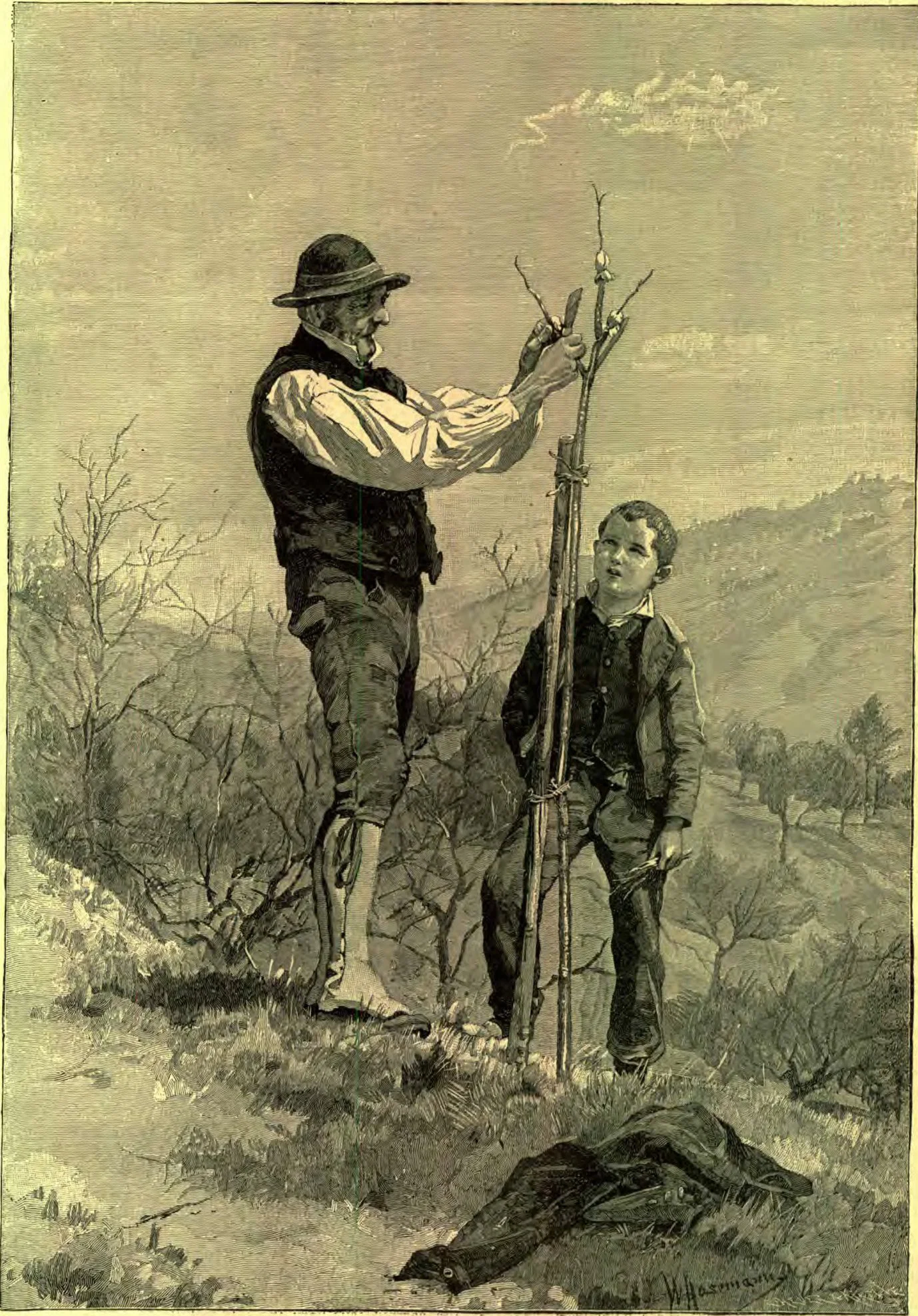
Good Uncle John is tall and strong,
And old and very wise;
His comrade is both short and young,—
That's little Harry Brice.
And as they work the trees among,
With open ears and eyes,
He listens oft, as tale or song
Falls from his uncle’s willing tongue.
He tells of heroes strong and bold,—
Wild beasts they did not fear,—
And singers sweet, whose harps could hold
A magic for the ear;
Of saints who roamed through heat and cold;
O’er deserts lone and drear;
Of kings who reigned in days of old,
And sat on wondrous thrones of gold.
But when the sun sinks in the west,
And stars shine out anew,
He begs the tale he loves the best,
So tender and so true.
Then lying on the earth’s warm breast,
With face toward the blue,
He listens with untiring zest
To this one, more than all the rest:—
“WITH OPEN EARS AND EYES”
THE FRUITLESS TREE
In a very pleasant vineyard,
Stood a well-loved tree,
Green and thrifty, full of promise,
Fair and good to see.
Hedged about and well defended,
Nurtured carefully and tended,
Love and care on it expended,—
Naught was left undone.
Came the Master of the vineyard,
When the tree was grown,
Seeking fruit at harvest season,—
Seeking—finding none.
Said the Master, “Long I’ve waited,
Hoping still to see it freighted
With some fruit, e’en though belated,
But I wait in vain.
“Cut it down; why mars it longer
The vineyard of my choice?”
“Spare it yet another season,”
Plead the gardener’s voice:
“Let the sun of heaven bless it:
Let the tender winds caress it:
Let me dig about and dress it,
Ere thou cut it down.”
ELIZABETH ROSSER.
NOTES ON MEXICO
By Mrs. D. A. Fitch
PERHAPS some of the INSTRUCTOR readers think, as I once did, that Mexico is “low down” in every way. But that is a mistake. Physically, many sections of the country are much higher than parts of the United States. The city of Guadalajara is more than five thousand feet above sea-level, and Mexico City, the capital of the republic, has an altitude of seven thousand feet.
Being so near the equator, very warm weather would naturally be expected; but at this altitude we seldom hear complaints of the heat. Summer and winter are much alike, except that the winter is the dry season. From June till October, alternating showers and sunshine constitute the rainy season. Owing to the clearness of the air, the skies appear of a deeper blue than at home.
During the winter just past there have been occasional white frosts. The mornings are cool, but the sunshine soon makes us forget that we are not enjoying a fine September day in the Central States.
The purity of the air makes this an ideal home for some, but the great altitude is not good for others. As in other high altitudes, water boils at low temperature, thus requiring longer time for cooking foods. It also renders the keeping of canned fruit exceedingly difficult.
When a physician from one of our Northern sanitariums visited us in January, he was asked, “Of what month at home does this climate remind you?” He answered, “It must be the thirteenth, I am sure; for we really have nothing to compare with it.” Mrs. D. A. FITCH.
10. In the earthly sanctuary the ark and the mercy-seat were hidden by the veil. Are they still hidden? Heb. 10: 19, 20; note 6.
NOTES
1. The sanctuary contained two rooms. The first one was called the “holy place,” and was about thirty-six feet long, and eighteen feet wide. In this first room were the table of showbread, the golden candlestick, and the altar of incense. The second room was known as the “most holy place,” and was about eighteen feet square. In the most holy place there was only one piece of furniture—the ark. The two rooms were separated by a beautiful veil, or curtain, of “blue, and purple, and scarlet, and fine twined linen, of cunning work.” There were woven into this curtain, with threads of gold, figures of angels, representing the angels of God, who are engaged in the work of the temple in heaven.
2. Every morning and every evening the high priest offered incense upon the incense altar. While he was burning incense, the people were gathered in front of the sanctuary for prayer. Luke 1: 10. The fire which burned the incense was holy fire; that is, it was kindled by the Lord himself. It was at this altar that Nadab and Abihu were slain by the Lord, because they took common fire with which to burn the incense. There was one other service connected with the altar of incense. When one had sinned, a part of the blood of his sin-offering was sometimes brought and put upon the horns of this altar. In this way his sin was taken before the Lord and forgiven.
3. The altar of incense was the altar of prayer. When the blood was put upon the horns of the altar, it was put there with the prayer for forgiveness of the one who had done wrong. When the incense was offered, it was offered with the prayers of the people who were gathered outside. It was the altar that stood nearest to God; it stood close to the veil, just a little way from the ark, where God’s presence was. In heaven there is also an altar of incense, and it, too, is an altar of prayer, standing close to the throne of God. With the incense are offered the prayers of God’s children. The incense on earth was a type of the true incense in heaven, which is the righteousness, the goodness, of Jesus. When we pray, the angels bear our prayers, and there they are mingled with the righteousness of Jesus, and are pleasing to God. The fragrance of the goodness of Jesus makes our prayers acceptable. We are told that Jesus takes our poor, broken prayers, and puts them into beautiful form, so that they may be heard by our Father, and be answered. In the earthly sanctuary the incense was burned every morning and every evening, showing that God desires his people to pray at least twice a day. But though we pray often during the day, the incense will always mingle with our prayer; for the fire on the altar always burns, the cloud of incense always fills the temple of God.
4. There was a place connected with the ark, called the “side.” Deut. 31: 26. The two tables of stone, on which were written the ten commandments, were placed in the inside of the ark, while the golden pot of manna and Aaron’s rod that budded were probably put in the “side,” where the “book of the law” was kept. We are told in another scripture that there was nothing in the ark, that is, inside the ark, under the mercy-seat, but the “two tables of stone.” 1 Kings 8: 9.
5. The ark and mercy-seat were types of God’s throne in heaven. At each end of the mercy-seat there was a golden cherub, or angel, and between the cherubim the Lord’s presence was seen. So in heaven the Lord sits between the cherubim. Ps. 80: 1. Under the mercy-seat, whereon God’s presence rested, was his law. In heaven “righteousness and judgment”—God’s law—are the foundation of his throne. Ps. 97: 2. God’s law was covered by the mercy-seat, and therefore did not put the sinner to death. The mercy-seat in heaven, where Jesus is now159seated, covers the broken law, and saves us. Heb. 4: 16. God does not deal with us according to our sins, but, because of the mercy he has provided us in Jesus, he treats us better than we deserve. Ps. 103: 10, 11. There will come a time when there will be no more mercy to offer, and then the wrath of God will fall upon the world. That time is near at hand. Are you ready for it?
6. Jesus has opened a “new and living way” for us; and by faith we can now enter in “within the veil.” Heb. 6: 19.
HOW TO MEASURE THE CHEST
Every boy should develop his chest if he wishes to grow up into a strong, healthy man. Every boy should also know how to measure his chest from time to time, so as to keep a record of his development; and here is the only accurate system, which is in use in all the recruiting offices of the United States army:—
Strip to the waist. Hold your arms above your head, the tips of the fingers touching. Have the measurer put a tape around your chest under the armpits.
Inhale and exhale naturally. Let your arms fall easily by the side. The tape will slip down to the maximum girth of the chest. This is the mean chest. Exhale all you can, still keeping your arms by your side. This is the minimum chest. Inhale and inflate all you can, in the same position. This is the maximum chest.
The difference between the minimum and maximum chest is called the “mobility.” A mobility of over three inches in a man of medium height is considered good; below two and one-half inches it is poor.
Artificial movements of the arms or muscles interfere with proper measurements.
Having made the above measurements, record them in your dairy, and then repeat the measurements on the first of each month, for one year. By that means you will have an accurate and instructive record of your muscular progress.—Golden Days.
BEREAN LIBRARY STUDY
Revelation 22: “Thoughts on the Revelation,” pages 716-727
(May 19-25)
The Garden of Eden.—In the first two verses of this chapter we recognize the garden of Eden, with its river and tree of life. It is situated in the “broad place” in the city of God. As the tree of life was the center of interest in the garden of Eden in the beginning, so in the city it is a center of importance. Each month throughout eternity, the redeemed will gather in the city of God, and eat of its life-giving fruit. Isa. 66:22, 23; Rev. 22:1, 2.
No Night There.—Verse 5 refers to the city, where the glory emanating from the throne of God is always brighter than the sun. Outside the city there will be day and night, not like our nights, dark and dreary, but beautiful beyond our imagination. As long as the earth revolves, there will be day and night; for they were established in Eden before sin entered. But at that time the moon will shine as bright as the sun does now, and in an atmosphere perfectly pure the stars will glow with increased radiance. The contrast between day and night then will be as marked as now; for the day will be seven times brighter than at present.
How Can We “Keep the Sayings” of Revelation?—To keep the sayings is to let them become a part of ourselves,—so woven into our character that we can not be separated from them. They are living principles; and if they are woven into our character, we shall have eternal life, and live with the truths of Revelation. Upon such, a blessing is pronounced. God grant that each one who has taken part in this study the past winter may keep the sayings of the prophecy of this book, and reveal them anew in his daily life. Thus the thoughtless, who will not study the book of Revelation in the Bible, may read and study it in the Christian's life, and so be drawn to the Saviour.
“Quickly.”—After the decree given in verse 11, which marks the end of probation, the Saviour says, “Behold, I come quickly.” In this space of time designated as “quickly,” the seven last plagues will be poured upon the earth. There will be intense suffering everywhere, but God will protect his waiting people.
“Come.”—Wonderful word! in it are bound up infinite power and might. Whoever hears that word, and, like Christian when he left the City of Destruction, shuts his ears to all voices from the enemy, will find it powerful enough to carry him safely through to the city of God. “Come,” was all the Saviour said to Peter that stormy night on Galilee, and there was power in the word to enable him to walk on the foam-capped billows. Heaven has given the invitation, “Come;” and all who will believe, and go forward regardless of circumstances, will reach the city of God. If you, like Peter, look at your surroundings, and begin to sink, cry out for help at once; and the same Jesus will immediately put forth his hand, and uphold you. Matt. 14:28-31.
Whosoever Loveth and Maketh a Lie.—Many who would not tell a lie themselves will laugh when others tell one. They enjoy hearing others tell what they know is false, but hide behind the fact that they would “never tell a lie.” All such need to remember that those who love a lie are cast out of the city of God with those who make a lie. We need to watch our words, lest we be found among that unfortunate number. It is not necessary to speak in an audible voice in order to make a lie. Any act or look that will lead others to form a false conclusion “maketh a lie” just as verily as spoken words. “So speak ye, and so do, as they that shall be judged by the law of liberty.”
SELF-PRONOUNCING S.S. Teachers' Reference Bible
By Editor
Contains the Celebrated Teachers' Helps, comprising nearly 400 pages. Also a complete series of fifteen new maps.
DESCRIPTION
Imperial Seal Binding. Tuck Edges, known as “Divinity Circuit,” Rounded Corners, Full Red Under Gilt Edges.
We offer this Bible, postpaid, for only six new yearly subscriptions at 75 cents; or twelve new six months' subscriptions at 40 cents.
We will also send it, postpaid, with the INSTRUCTOR one year for $2.25. For 20 cents extra we will stamp your name in gold upon the cover. Address—
THE YOUTH'S INSTRUCTOR, Battle Creek, Mich.
MY PART
Not mine to count the cost of right,
Its gain or loss, its boon or bane;
But mine to do with fearless might
What God through conscience maketh plain.
Not mine to judge another’s deed
In phrase severe and harsher thought;
But mine with constant care to heed
What action by myself is wrought.
Not mine by certain sight to walk,
In sure success from day to day;
But mine, whate’er my plans may balk,
In faith to find or win a way.
— Selected.
PARTS OF HIS WAYS
Is the title of a new nature-study book now in preparation by M. E. Cady, of our Healdsburg, Cal., school. As its title indicates, the book is designed to “mark the footsteps of the Creator in his vast creation,” and show “his way in the sea,” “his way in the whirlwind,” and “his way in all the works of his hands.” In order best to carry out this design, the book is written in a simple, descriptive style, adapted to all classes of readers. There will be about six hundred pages, and nearly five hundred illustrations. An illustrated Announcement will be sent free to all who will send name and address to M. E. Cady, Healdsburg, Cal.
PRINCIPLES OF TRUE SCIENCE
THIS is the title of a compilation of Testimonies on the subject of science and nature. It consists of 332 pages, bound in red leather, so that it is very durable, and is also of convenient size to carry about.
Only a small number of these books were printed, so that the price is higher than it would otherwise be. It will be sent to any address, postpaid, for one dollar. Christian workers and teachers should avail themselves of the opportunity of procuring this book, as it contains the principles of true science, which will enable them the more readily to discern between the science which is in harmony with the Bible and science which is according to the world.
In order to secure a copy of this work, it will be necessary for you to order at once, as the edition is very small, and several of the books have already been taken. It is especially adapted to the use of teachers in our church schools. All orders should be addressed to M. E. Cady, Healdsburg, Cal.
1916 Cumming St., Omaha, Neb
By W. S. Dann
LADY agents wanted everywhere to sell health garments and other first-class articles. No trash. It is easy and pleasant work, for some of the goods are sold in nearly every house. I pay you for getting me agents. W. S. DANN.
1916 Cumming St., Omaha, Neb
Baby’s First Wardrobe.
HYGIENIC PATTERNS.
Complete outfit based on healthful principles—22 Neat Patterns—together with everything needed to clothe baby healthfully and happily, with full instructions for making, and an illustrated booklet on baby's care and clothing. All sent in plain envelope for 50 cents in stamps or silver.
If interested in the best books, patterns, materials, garments, and accessories for children, send a stamp for information, or remit for patterns to—
Mrs. F. M. Kellogg, 36 Washington Ave., Battle Creek, Mich.
Our Premium Testament
By Editor
As an aid to daily Bible study, and to memorizing the Scriptures, there is nothing better than a pocket-edition. We have secured a beautiful Vest-pocket New Testament, size 4 x 2¾ in., that we offer, postpaid, with the INSTRUCTOR one year, for only $1.00. Well printed, in ruby type, as shown; Flexible Covers, Round Corners, Red under Gold Edges,—a splendid little book.
ST. MATTHEW. 13.
42 The queen of the south shall rise up in the judgment with this generation, and shall condemn it: for she came from the uttermost parts of the earth to hear the wisdom of Solomon; and, behold, a greater than Solomon is here. 43 When the unclean spirit is gone out of a man, he walketh through dry places, seeking rest, and findeth none. 44 Then he saith, I will return into my house from whence I came out; and when he is come, he findeth it empty, swept, and garnished. 45 Then goeth he, and tak-
50 For whosoever shall do the will of my Father which is in heaven, the same is my brother, and sister, and mother.
CHAPTER 13.
3 The parable of the sower and the seed; 24 The parable of the tares, 31 of the mustard seed, 33 of the leaven, 44 of the hidden treasure, 45 of the pearl, 47 of the dragnet. 53 Christ is contemned of his own countrymen.
THE same day went Jesus out of the house, and sat by the sea side. 2 And great multitudes were gathered together unto him, so that he went into a ship, and sat; and the whole multitude stood on the shore.
This offer is made to both renewals and new subscribers. Address—
THE YOUTH'S INSTRUCTOR,
BATTLE CREEK, MICH
GRAND TRUNK R'Y. SYSTEM.
Taking Effect Dec. 16, 1900.
Trains leave Battle Creek.
WEST-BOUND.
No. 9, Mail and Express, to Chicago. 12.15 P. M.
No. 1, Chicago Express, to Chicago. 8.30 A. M.
No. 3, Lehigh Valley Express, to Chicago. 3.50 P. M.
No. 5, International Express. 2.17 A. M.
No. 75, Mixed, to South Bend. 8.30 A. M.
Nos. 9 and 75, daily, except Sunday.
Nos. 1, 3, and 5, daily.
EAST-BOUND.
No. 8, Mail and Express, East and Detroit. 3.45 P. M.
No. 4, Lehigh Express, East and Canada. 8.22 P. M.
No. 6, Atlantic Express, East and Detroit. 2.10 A. M.
No. 2, Express, East and Detroit. 6.50 A. M.
No. 74, Mixed (starts from Nichols yard). 7.15 A. M.
Nos. 8 and 74, daily, except Sunday.
Nos. 4, 6 and 2, daily.
W. C. CUNLIFFE, Agent,
BATTLE CREEK
NOTES AND COMMENTS
ACCORDING to the Indian Witness there are one hundred millions of persons in India whose annual income does not exceed five dollars. It is difficult for those not acquainted by personal observation with the situation to understand the full meaning of such a statement.
NOTES AND COMMENTS
A Victory for Sanitation.—At the beginning of April there was not a single case of yellow fever in Havana—something that has never happened before in the whole history of the city. This remarkable result has been brought about by the sanitary measures enforced by the American government.
Another Labor-Saving Device.—A new machine for pasting labels on tin cans has recently been perfected. The cans roll down an inclined plane, and each on its way picks up a pasted label. One of these machines will paste labels on ten thousand tin cans in an hour, or one hundred thousand in ten hours,—an immense gain over the records of the most expert hand-pasters.
The English Language in German Schools.—By a recent command of the German emperor, the study of the English language is made compulsory in the German schools, while French which has heretofore been compulsory in that country, is placed among the elective studies. As, more and more, the English-speaking peoples are concerned in the world’s commerce and industry, some knowledge of the language is indispensable to at least the officials of the great nations.
Work of Snakes and Wild Beasts in India for One Year.—According to the government report there were killed by snakes in India, during the year 1899, no fewer than 24,621 human beings. This number was much larger than that of several preceding years, the increase being due, it was thought, to the floods, which drove the snakes to the higher lands, where the dwellings are numerous. During the same year 2,296 persons fell a prey to wild beasts, tigers being responsible for 899 of the victims, and wolves, leopards, bears, elephants, hyenas, crocodiles, and other wild beasts for the remainder. The number of cattle destroyed during the same year by snakes was 9,449, while 89,238 were killed by wild beasts. As we compare this land, with its unfavorable climate, its terrors of serpents and wild beasts, its dreadful plagues and frequent famine, with our own beautiful country, truly we should praise God anew for the comfortable homes, abundant food, and great opportunities he has given us. But we have a duty to India as well as to all the other nations that wait to hear the message of life. And this duty is an individual matter. It can not be laid off on the church in general, or the company, or the missionaries who leave home and friends to spend their lives in carrying the gospel to these people. No; our duty will never be done by any one unless we do it. It will always, to our eternal loss, remain undone, unless we do it. It may be only a little that we can do, but God expects us to do that little; and if we really wish to know what it is, he will tell us.
FOR EVERY DAY OF THE WEEK
Sunday:
The best way for a man to get out of a lowly position is to be conspicuously effective in it.—Dr. John Hall.
Monday:
Any religion whose secret springs do not exceed its surface waters, will evaporate in the burden and heat of the day.—Elizabeth Charles.
Tuesday:
“Not mighty efforts, but a willing mind,
Not strong but ready hands,
The vineyard’s Lord demands:
For every age fit labor he can find.”
Wednesday:
He who will trust God fully can have whatever God is ready to bestow. And God is ever ready to bestow on such a man whatever it is best for one who trusts God fully to have from his loving hands. Who would have more than this? Why should any one have less?—Sunday School Times.
Thursday:
“As year unto year is added,
God’s promises seem more fair,—
The glory of life eternal:
The rest that remaineth there;
The peace, like a broad, deep river,
That never will cease to flow;
The perfect, divine completeness
That the finite never know.”
Friday:
“It requires pluck to be patient. Perhaps you don’t believe this, but just try it the next time a tedious task is before you, or a wearisome pain to be borne. Patience isn’t a tame, colorless virtue. It is born of courage and will power. There is a pluck to bear as fine as any pluck to do.”
Sabbath:
“Be thou strong and very courageous, that thou mayest observe to do according to all the law: . . . turn not from it to the right hand or to the left, that thou mayest prosper whithersoever thou goest.” Joshua 1:7.
“Five barley loaves, and two small fishes,”—just a lunch for a hungry boy! What were they, indeed, among so many? as the incredulous disciple asked. So little a thing! Yes, but God often uses little things, as when, on that day so long ago, he commanded the hungry multitude to be seated on the grassy hillside, while he showed them how great a very little thing may become with his blessing.
It may be a very small work that you have to do. Perhaps you yourself may be no older than the little lad who listened to the Master on that eventful day so long ago, and of no more importance than was he among the five thousand. But that makes no difference. If you are willing to give all you have, cheerfully, whether it be service, or bread, or whatever it may be, to the Master, he will use the gift to his glory. Think if the little Jewish lad had sought a secluded corner, and refreshed himself with the food he had had the forethought to provide,—the multitude would have been fed, perhaps, but he himself would have missed a blessing, and we should have missed the inspiration of his unselfish example.
There is a place for boys and girls in the Master’s work. He wants them all. Will you let him have you?
QUITE A PROPOSITION
“Caleb Cobweb,” a genial writer of the Christian Endeavor World staff, has something to say in a late number about slang. He does not say he is talking about slang, but he makes it very plain,— so plain that no one who has had his sense of propriety rudely shocked by hearing slang drop from lips where he had expected only the fine gold of correct speech, will have the least difficulty in recognizing the subject:—
“If a young man has undertaken a task too severe for him, he has undertaken ‘quite a proposition.’ If a schoolboy is defeated by a problem in algebra, he has ‘struck a pretty tough proposition.’ If a lawyer has been appointed executor of a large estate, he has ‘a big proposition’ on his hands. If some incongruous subject is introduced into the conversation, ‘that is another proposition.’ In short, in the popular slang of the minute, ‘proposition’ answers for anything in the universe, from a treatise on sociology to a new piano.
“To-morrow, ‘proposition’ will be discarded, and some other word will become the multum in parvo. It may be ‘artichoke.’ It may be ‘tergiversation.’ It may be ‘assemblage.’ No one knows, and it will make little difference.
“The essential fact is that people are saved the necessity of thinking. To be sure, we might say ‘thingum-bob’ for everything, but that would not sound smart; and we must sound smart, whether we are or not. Therefore it is necessary for us to adopt as our word-substitute some syllables that are not so familiar as thingum-bob—something not used for the purpose by our little brothers and sisters. ‘Proposition’ sounds as if it meant something, and thingum-bob does not; therefore it shall be ‘proposition’; that is, until it becomes too common, and then let us change to ‘artichoke’ or ‘assemblage.’
“What is the use of bothering our brains about the exact words, anyhow? That ancient nation, the Chinese, often makes the same word answer for half a dozen different and widely differing meanings; and why should not we follow in their enterprising footsteps? To be sure, they pronounce each word in half a dozen different ways; but that would tax our brains too much—it would be too hard a proposition.”