Your ShelfYour Projects

Signs of the Times, Vol. 28, No. 22.

THE ROMAN PANTHEON
Earlier text: LIBERTY OF CONSCIENCE IN RUSSIA

THE KING OF DENMARK.

[W. E. Curtis, in Chicago Record Herald.]
KING CHRISTIAN of Denmark is called “the father-in-law of Europe,” because his children and grandchildren occupy and will inherit so many thrones. He has six sons and daughters. Frederick, his first-born, the crown prince of Denmark, married the daughter of the king of Sweden and Norway; Alexandra, the eldest daughter, is queen of England; George, his second son, is king of Greece and married Olga, the cousin of the czar of Russia; Dagmar, the second daughter, was the wife of Alexander III. of Russia, and is now dowager czarina of that empire; Thyra, the third daughter, is the wife of the Duke of Cumberland and Brunswick, heir to the throne of those kingdoms, which he would already occupy had it not been for the objections of the late Prince Bismarck; Waldemar, the youngest of the Danish princes, married Marie, daughter of the Duke of Orleans, pretender to the throne of France. No such combination of royalties ever centered before in a single family.
Christian, the grandson of the king and heir apparent to the Danish throne, married the Princess Alexandrine of Germany, and they have a son, Frederick, who was born two years ago last March. Charles, another grandson, is the husband of the Princess Maud of Wales, daughter of the King of England. Charlotte, a granddaughter, is the wife of Prince Carl of Sweden, and there are five grandchildren unmarried.
King Christian is also famous for the simplicity of his life, his democratic manner, his physical vigor, and his great age. He is now eighty-four years old. His golden wedding was celebrated in 1892. His wife, the late Queen Louise, died in September, 1898, at the age of eighty-one, and altho her loss affected him deeply, he is perhaps still the most vigorous old man in Europe, without a pain or an ache, and with very few gray hairs. The other day he said to his valet, who offered to assist him in dressing,—
“When I grow old, you may help me; but as yet, thank God, I am able to help myself.”

NOT LONG.

My life is long—not so, the angels say, Who watch me waste it, trembling whilst they weigh Against eternity my lavished day.
My life is long—Christ’s word is different; The heat and burden of the day were spent On Him, to me refreshing times are sent.
Give me an angel’s heart, that day nor night Rests not from adoration, its delight Still crying, “Holy, holy!” in the height.
Give me the heart of saints, who, laid at rest In better paradise than Abraham’s breast, In the everlasting Rock have made their nest.
Give me Thy heart, O Christ! who thirty-three Slow years of sorrow countedst short for me, That where Thou art, there Thy beloved might be. —Christina Rossetti.

CANDID

THE reporter who lied to the Chinese minister at Washington, Wu Ting-fang, about his salary, no doubt deluded himself with the thought—if he gave the matter a thought at all—that it was a “white lie” that would hurt nobody. But let us see the sequel:—
On the first occasion when he called to interview the minister, he was asked what salary he received. “One hundred and fifty dollars a week,” glibly replied the youth. “It is too much. It is altogether too much. It is altogether too much,” said the more candid than polite Wu Ting-fang. “You are not worth more than twenty-five dollars a week.”
The Chinese minister, it is said, learned later, through other newspaper men, that the reporter had not spoken the truth, and that, instead of one hundred and fifty dollars a week, he received but sixty. Consequently, when he again presented himself at the Chinese legation for information for his paper, he was curtly dismissed by Wu Ting-fang with these words: “You lied to me about your salary. If you will lie about such a thing as that, you will lie about anything. I do not trust you. I have nothing to say to you. I want to revise my former estimate of your value. Instead of being worth twenty-five dollars a week, you are not worth anything, sir.”—Success.

FOR “EUCHRE” MOTHERS.

A CERTAIN mother in one of our small cities was very fond of playing “progressive euchre.” One evening she received a fine silver cup for being the most successful player in a group of her society friends. She was much delighted with her success, and, on showing it to her family the next morning, her son, in his early “teens,” said, “Huh! I can beat that, for I made ten dollars at the pool table last night!” Immediately the eyes of the mother were opened in more senses than one; for, in the first place, she had no idea that her son had thus been spending his time, and, in the next place, partners in sin, how could she condemn him? It taught her a lesson once for all.—The Presbyterian.

Laces

I prefer PEARLINE to other soap powders. I like PEARLINE for washing lace collars and embroidered and lace doilies, which I do, myself, at home, not trusting them to the washerwoman.
Mrs. Rev. J. L.
One of the Millions.

CHICAGO IN LESS THAN 3 DAYS

From San Francisco at 10 a. m.

Chicago, Union Pacific & Northwestern Line

DOUBLE Drawing-Room Sleeping Cars, Buffet, Smoking and Library Cars, with Barber. Dining Cars—meals a la carte. Daily Tourist Car Service at 6 p. m., and Personally Conducted Excursions every Wednesday and Friday at 8 a. m. from San Francisco. The best of everything.
R. R. RITCHIE
617 MARKET ST. GEN. AGENT PACIFIC COAST PALACE HOTEL SAN FRANCISCO OR S. P. COMPANY'S AGENT
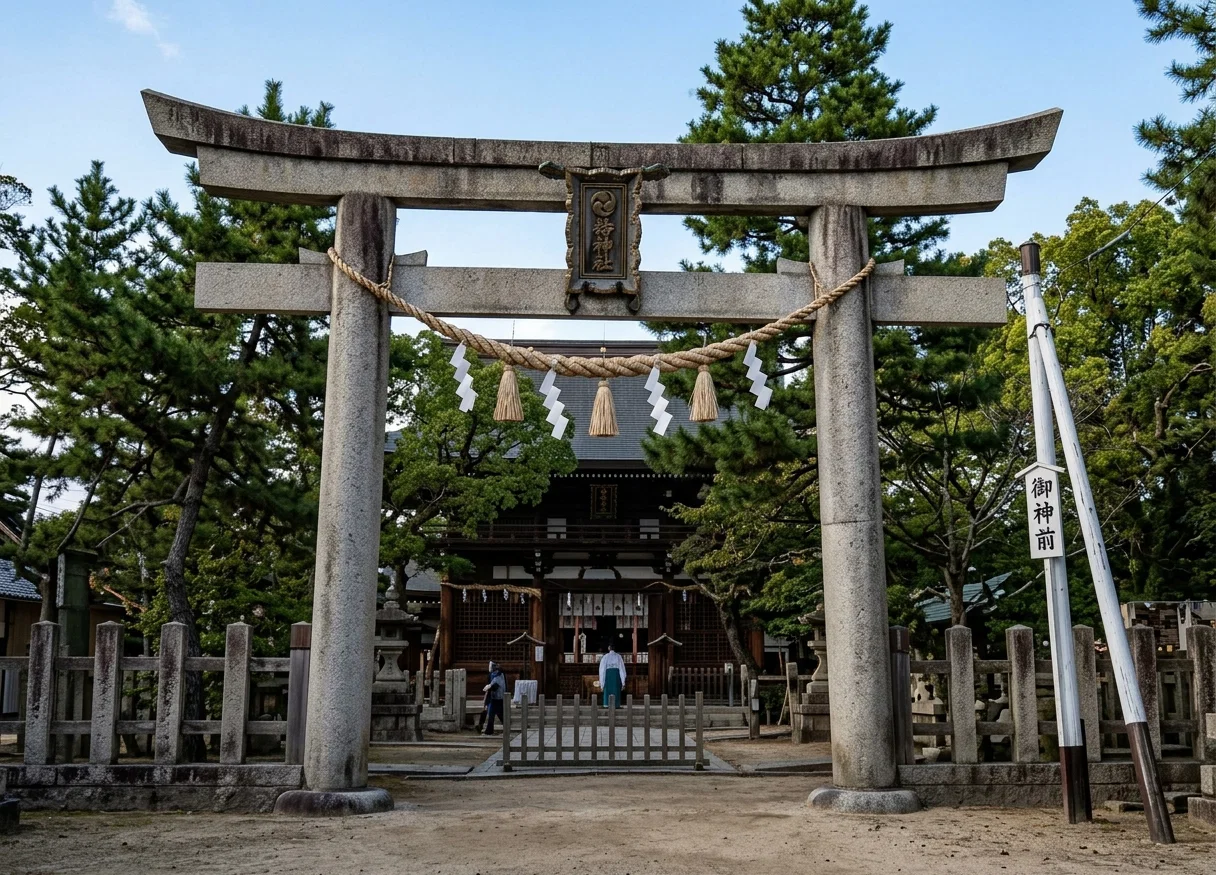
Entrance to an Ancient Castle.

CHRISTIANITY IN JAPAN.

JAPAN has made wonderful progress in a very short time, and has undergone a great change. Half a century ago Japan was almost unknown to other nations; now she is coming up to be the foremost nation of Asia, and is claiming equality with the powerful nations of to-day. The Japanese are active, ambitious, and progressive; and so since they began to have intercourse with civilized nations, they have been making energetic efforts to improve in every direction, pushing out to learn and adopt whatever is thought profitable.
The reader may wonder why the Japanese, being so progressive, and so willing to make their own all learning and arts of civilization, are so conservative in religious matters. But there are many influences that tend to make the progress of Christianity in Japan very slow. The Japanese have not much creative genius; but they have an excellent ability to adopt from others what is good and profitable, and to improve it and make it their own. In ancient times, when Japan subdued Korea and made it tributary, and invaded a part of China, she brought in, as a result, Chinese civilization. She called in Chinese scholars, artists, and artisans, and she sent students to their country to be educated.
With Chinese science and art came Chinese religion; for Buddhism came also. Its first convert was the crown prince. Shintoism (the religion of the gods), founded on the Japanese mythology, and making the emperors descendants of the sun goddess, is the original religion of Japan. So when Buddhism first entered, it had to contend with the established religion; but as the noble prince was at its head, it soon found its way to the hearts of the common people. Thus Chinese civilization and religion were imported into Japan.
When, fifty years ago, Japan was awakened from her slumbers by the visit of Commodore Perry, she freely opened all her seaports to foreign nations. Then the nation began to struggle with many difficulties and perplexities; and the people, in their attempts to adapt themselves to the new conditions, have made many social revolutions in rapid succession. Where now is the Japan of the samurai (soldier caste), with their cued hair and with two swords by their sides? Now it is only to be imagined. The Japan of four castes,—soldier, farmer, artisan, and merchant,—is gone, and the premiership is now open to the ambition of every youth. The government has sent and is sending many students to Europe and America. And Japan, that twelve hundred years ago imported civilization from China, is now learning of the civilized nations of to-day, and is earnestly pressing into the ranks to be counted with the great nations of the world.
Entrance to a Shinto Temple.

Christianity Misunderstood.

This being the case, as Buddhism entered with Chinese civilization, it would seem the natural course for Christianity to enter with the tide of Western civilization. But unfortunately Japan had long misunderstood Christianity; and when Protestant missionaries first came here, they had to meet a strong antipathy and bitter prejudice. The common people hated Christianity as a pest, believing Christians to be magicians and sorcerers, and the government checked the propagation of the new faith.
There is nothing in Japan so misunderstood as Christianity. But there is a reason for this. A little more than three hundred years ago, Catholicism, under its famous missionary Xavier, entered this country. Nobunaga, who was then regent, favored the new religion. He donated to it, and built a large temple, which he named the South Barbarian Temple; and it is said that in a short time there were 400,000 adherents of the Catholic doctrines.
But the Catholic priests aspired to grasp political power, and the next regent, Hideyoshi, became very suspicious of their intentions. About this time a Portuguese ship was wrecked near the coast, and some sailors were rescued. Hideyoshi treated them kindly; and when he asked them how Portugal became so great a nation, one of them answered, either intentionally or carelessly, that their country sent missionaries first, and after turning the minds of the people, took their country. This confirmed the suspicions of Hideyoshi, and he determined to suppress Catholicism; but he died in the attempt. Tokugawa, the regent succeeding him, pursued the same policy toward Catholicism; and its adherents—men, women, and even children—were killed with cruel tortures, such as burning and crucifixion. Japan had many martyrs, for whom the Catholic Church takes glory. Some leading men, fearing the same fate, openly rebelled against the government. This intensified the hatred of the government, and made it more bitter. Small metal crosses were made; and to test their faith, people were allowed to tread upon them. If any dared not trample on them, the government knew they were “Kiristan,” as Christians were called; they were then persuaded to change their faith, and if they would not be persuaded, were killed. When a man wished to hire a maid or a servant, a certificate was given him, stating that she or he was not “Kiristan.” By such means the government long sought to root up this unwelcome faith; and the idea that “Kiristan” is a hateful thing permeates the mass of the people.
Catholic priests seem to have made a liberal use of science to do wonders in the sight of the ignorant people. Even now, in the country, where civilization is not so far advanced as in the centers of learning, when the people see some strange thing which they can not understand, they say, “That must be Kiristan magic.”
Japan is surrounded by water; and the people, having an adventurous spirit, would have entered into close relations with European nations long ago, but for the “Kiristans.” Fearing their influence, the government took a shut-door policy, strictly forbidding people to build large ships. The idea was cherished that Japan was a god-favored nation, and the strongest in the world. And being thus ignorant of the outer world, it is no wonder that Japan was very much astonished, when, half a century ago, a greater power than she called upon her, and pressed her to open her ports.
The government knew no difference between Catholicism and Protestantism. And when Japan opened her seaports to other nations, what to do with the Christians became a difficult question to solve, for Protestant missionaries were soon on the ground. At first the government posted up notices everywhere, telling the people that Christianity was positively forbidden; but these notices were reluctantly taken down for fear of incurring the ill will of other nations. With close intercourse with other nations and a better understanding of them, the fear of Christianity vanished; but the prejudice against it is not dead yet.

A Decline.

For the purpose of propagating the truth, Christian schools were built everywhere, and they were filled with ambitious students, thirsting for the European learning. Christian workers were very hopeful, and their work flourishing. When I started for the United States thirteen years ago, I remember that every church had a very good attendance. And I soon heard that the popularity of Christianity was so great that the churches had overflowing audiences, while many stood outside to listen. Compared with that time, the churches have all experienced a very sad fall.
One reason for the great change is that the Japanese have a tendency to go from one extreme to another. Much, I think, is to be imputed to errors of missionaries, who, elated with their apparent success, were too busy working for the conversion of the whole nation to give the necessary care to individual believers. Then when Japan conquered China, she became vainglorious, and thought in her heart, What is the help of God? We can be a great nation without Him. And whereas Japan once thought she must become a part of Christendom to be reckoned with the civilized nations, she now feels that she has many reasons to be proud of the name heathen. For these reasons Japan has thrown aside Christianity.
S. HASEGAWA.
(To be continued.)

THE BEST WE HAVE.

CHRIST wants the best. He in the far-off ages Once claimed the firstling of the flock, the finest of the wheat. And still He asks His own, with gentlest pleading, To lay their highest hopes and brightest talents at His feet. He’ll not forget the feeblest service, humblest love; He only asks that of our store we give to Him The best we have.
Christ gives the best. He takes the hearts we offer, And fills them with His glorious beauty, joy, and peace. And in His service, as we’re growing stronger, The calls to grand achievements still increase; The richest gifts for us on earth, or in the heaven above, Are hid in Christ. In Jesus we receive The best we have.
And is our best too much? O friends, let us remember How once our Lord poured out His soul for us, And in the prime of His mysterious manhood Gave up His precious life upon the cross! The Lord of lords, by whom the worlds were made, Through bitter grief and tears gave us The best He had.
—The Interior.

Fearless Loyal Hearts

“GOD wants no cowards in His ranks, So let your colors fly; He calls for fearless loyal hearts Who dare to do or die.”

THE SECOND EDITOR.

It has come to me that “our missionary society” is largely a Samson shorn of strength. The intelligent, efficient effort of its individual members is the mighty leverage of the whole society. “The press,” its right hand, is truly a world-mover, and the second publishers (our missionary society) plays no small part. The first publisher pays the printer’s bill, and you pay the publisher; his and your obligations to each other cease there. The open question now is, Will you pigeon-hole the paper, or destroy it? Or will you become its second publisher, without a printer’s bill, and double its touch with humanity?
The Lord says of His Word, “It shall not return unto Me void.” Whatever has quickened you is the vibrant force of His Word, and it may do the same for some one else; pass it along. Remember, too, only one-seventh of the rain of manna kept two days, and two days only. “God is not dead, Frederick,” as grand old Sojourner Truth expressed it. So do not clip and hoard first-page articles and fine poetry.
“The bird with the broken wing Never soared so high again.”
God commends a clean, sound, whole burnt-offering. My ways are not your ways, the Almighty says. Man lives to die; the Lord kills to make alive. Euclid multiplies to increase; He divides (loaves and fishes) to multiply. The divine pattern is, To keep anything, give it away. Your neighbor, and the stranger in the ‘broad way,’ may not know your (first) editor, but may know you. Whatever in the paper has quickened you, may, by a little underscoring with red ink (you being its “second editor”) call attention to it, and quicken some one else; the underscoring being your soul’s Amen to a great, uplifting truth. “Let there be light”—a host of “second editors.” H. C. WELTY.
And the editor says, Amen.

Our Work and Workers

Union College, College View, Neb., reports that this year it is paying expenses.
Pastor Wm. Covert has been chosen vice-president of the Lake Union Conference.
The address of the Welcome Visitor and the Ohio Tract Society is Academia, Knox Co., Ohio.
The West Australian mission field has been organized into a conference, with Pastor J. Pallant as president.
An excellent ten-days’ meeting at Newark, Ohio, is reported in the Welcome Visitor by Brother B. L. House.
Pastor W. A. Colcord recently baptized five persons at Gatton, Queensland, and another at South Brisbane.
The General Conference summer school for teachers begins June 12 at Berrien Springs, Michigan. No expense, except for board and books.
There are 800 Sabbath-keepers in Brazil. An industrial school and several church-schools are in operation, and they are planning to establish a printing plant in connection with the industrial school.
There are two organized companies of commandment-keepers in Wales. One of these is at Cardiff, the metropolis; the other is at Swansea, another large town, and in each the membership is about twenty.
At Bundaberg, Queensland, Australia, a little company of Sabbath-keepers has been raised up under the labors of Brethren F. L. Chaney and Arthur Smart. A neat little church building has been erected.
A lady in New York City has advanced $5,000 to be used in opening a health restaurant in that city. She feels sure that the right food will be served, and correct health principles maintained, under S. D. A. management.
At Karmatar, India, Sisters Black and Orr are conducting a school, orphanage, and medical work. Dr. Ingersoll comes from Calcutta twice a month for special work; at other times Sister Black prescribes for patients, and the older students assist in giving treatments.
A new church building is to be erected on one of the principal streets of Toowoomba, Queensland. The site is a beautiful one, overlooking the whole city, a thriving place of 19,000 inhabitants, and the largest city on the railroad line between Brisbane and Sydney.
According to a report from F. I. Richardson in the May number of the Missionary Magazine, there are thirteen companies of commandment-keepers in Jamaica, with a membership of 198 and 112 awaiting baptism. They are erecting eleven church buildings on the island.
A lady from Texas who was a patient at the Boulder, Colo., Sanitarium, last winter, gives this pleasant description of the place in the Keene Industrial Educator:—
Things are getting green here in spite of the snow. It does not get cold here as it does in Texas when it snows. This is the prettiest country I ever saw. The loveliest mountains and canons, creeks, irrigating ditches, plains, lakes, and also the University and Chautauqua grounds, and all of Boulder City, with its forty-eight oil-wells—all are in sight from the sanitarium; and when the mountains and everything are covered with snow, and the moon and stars are shining, and the city is lighted with electricity, it is the loveliest sight I ever saw.
At a recent meeting of the Southern Publishing Association the following officers were elected: President, Geo. I. Butler; vice-president, C. P. Bollman; secretary and business manager, W. O. Palmer; treasurer, W. J. Stone; other members of the board, R. M. Kilgore, R. L. Pierce, L. A. Hansen.
The New York Indicator gives this item: “A Jew who heard Sister White speak recently in New York City became very much interested, and through his influence the committee that furnishes lectures to enlighten the Jews, made arrangements with Sister Geisel, a physician from the Sanitarium, to deliver five lectures, and for this service they pay her $100.”
The first camp-meeting in West Australia was held at East Perth, March 7 to 19. There were thirty-five new tents erected on the ground. Pastors G. A. Irwin, president of the Australasian Union Conference, and Robert Hare, editor of the Bible Echo, together with D. H. Kress, M. D., were in attendance. The meetings were of a good spiritual character. The occasion was both profitable and enjoyable, and the interest was good to the close.
A letter from Brother Walter Harper, who is canvassing in Utah, states that he has taken over a thousand orders in three months, the value of the books amounting to about $2,500. He says, “I am selling some ‘Patriarchs,’ ‘Steps to Christ,’ and other books in foreign tongues. In most of this lot of orders Good Health goes one year. Later the Signs will be sent.” Brother Harper adds that “only God’s grace and power could have wrought such a success.”
The church-schools can do a good work. This has been demonstrated by Brother Philip Conway, who has been teaching in Oklahoma. He says:—
Nearly all my students will be in the [canvassing] work this summer. This causes my heart to rejoice. Our closing exercises encouraged the brethren greatly in church-school work. The program consisted of a series of subjects covering the Gospel story from the fall of Lucifer to the new earth. The people rejoiced as they listened; and even the outsiders came to me and said it was just grand. I see more than ever the necessity for church-schools and the object that God has in establishing them.

TWO AND TWO.

Two ARE better than one when they are both well-disposed toward each other and toward the truth. If a long journey is to be made, or a difficult lesson to be mastered, or a hard task to be performed, two are better than one. They will encourage one another with mutual sympathy and friendship. They will drive away the dreadful feeling of loneliness which robs the strong man of his strength. They will support one another in time of struggle, and strengthen one another under heavy burdens. The strength of two is more than double the strength of one.
When two are well matched, each one is the complement of the other. Each will possess valuable qualities and capabilities which are lacking in the other. One furnishes cool judgment, the other throbbing impulse. One has a poetical imagination, the other a logical reason. One may be a powerful speaker, the other a sweet singer. One may be a masterly organizer, the other a tireless worker. It was so with Peter and John. They are often mentioned together in the New Testament. Peter was a fiery evangelist; John was a warm-hearted brother. Peter was the embodiment of zeal and strength; John, of love and wisdom. One was the right hand, the other the left. One furnished brains, the other heart. Neither was sufficient without the other.
When God has serious business for men on the earth, He usually sends them forth two and two. So He sent forth Moses and Aaron. Paul and Silas were companions during a large part of their missionary career. Luther had his Melachthon, John Wesley had his brother Charles, Dwight L. Moody had his friend Ira D. Sankey. There was true philosophy in the method of the early Methodist itinerants. They were sent out two and two. Usually one was a man of experience, while the other was a young man of superior energy and force. It is a hard lot when one must stand alone. This sometimes happens. There was a time when Paul stood alone, toiled alone, suffered alone. That is a pathetic passage in which he relates his experience under such a trial, “At my first answer no man stood with me.” Few men can stand alone. They falter and faint under the burden. But when a good man is supported by the strong arm, the tender sympathy, the constant fellowship, the unswerving fidelity of a true yoke-fellow, his strength is as the strength of ten.—Christian Advocate.

THE SIGNS OF THE TIMES

CORONATION NUMBER

Ready June 5 Order Early

EACH SHOULD LIVE FOR SOMETHING.

LIVE for something, have a purpose, And that purpose keep in view; Drifting like a helpless vessel, Thou canst ne’er to life be true. Half the wrecks that strew life’s ocean, If some star had been their guide, Might have long been riding safely, But they drifted with the tide. —Robert Whitaker.

PUBLICATIONS WANTED.

LITERATURE for jail distribution. Address, Mrs. G. E. Prindle, Muscogee, I. T.
CLEAN copies of the SIGNS and any of our other periodicals, also tracts. Address, post-paid, A. J. Pickering, Flora Vista, New Mexico.
CLEAN copies of the SIGNS and our other periodicals, also tracts of all kinds. Address, post-paid, Walter A. Erb, 420 S. Second Street, Clarksville, Tenn.
ENGLISH tracts on the Sabbath and second advent and late clean SIGNS. Can use a large number of the latter. Address, post-paid, L. F. Elliot, 1422 E. Main Street, La Fayette, Ind.
CLEAN copies of the SIGNS, Review, Good Health, and Instructor, for missionary work, at the Soldiers' Home. Address, post-paid, E. P. Shaffer, Soldiers' Home, Los Angeles Co., Cal.

REDUCTION OF FARE FOR THE PETALUMA CAMP-MEETING.

The California Northwestern railroad will grant reduction of fare to those attending the Petaluma camp-meeting. Reduction is good from June 1 to 25, 1902, on the certificate plan.
We will send certificates to the various churches and to all who send for them. Pay full fare at your home station and have the agent sign the certificate. When you reach the camp-ground have the secretary of the meeting sign it, and then you can return home at one-third the regular fare any time before June 25, 1902.
Please remember that you can not secure any reduction of fare unless you secure a certificate and have it signed by your ticket agent where you buy your ticket, and by the secretary of the camp-meeting. M. H. BROWN.

NOTICE OF ANNUAL MEETING.

THE Fifth Annual Meeting of the California Medical Missionary and Benevolent Association, for the purpose of electing four or more members of the Board of Directors, and transacting such other business as may properly come before the meeting, will be held at Sanitarium, Napa County, California, Wednesday, June 18, 1902, at the hour of 12 o’clock M.
ALONZO T. JONES, President.
E. E. PARLIN, Secretary.

LESSON 10.—JUNE 8.—THE COUNCIL AT JERUSALEM.

Lesson Scripture, Acts 15:22-33, R.V.
22 “Then it seemed good to the apostles and the elders, with the whole church, to choose men out of their company, and send them to Antioch with Paul and Barnabas; namely, Judas called Barsabbas, and Silas, chief men among the brethren; 23 and they wrote thus by them, The apostles and the elder brethren unto the brethren which are of the Gentiles in Antioch and Syria and Cilicia, greeting: Forasmuch as we have heard that certain which went out from us have troubled you with words, subverting your souls; to whom we gave no commandment; 24 it seemed good unto us, having come to one accord, to choose out men and send them unto you with our beloved Barnabas and Paul, men that have hazarded their lives for the name of our Lord Jesus Christ. We have sent therefore Judas and Silas, who themselves also shall tell you the same things by word of mouth. For it seemed good to the Holy Ghost, and to us, to lay upon you no greater burden than these necessary things; that ye abstain from things sacrificed to idols, and from blood, and from things strangled, and from fornication: from which if ye keep yourselves, it shall be well with you. Fare ye well. 30 “So they, when they were dismissed, came down to Antioch; and having gathered the multitude together, they delivered the epistle. And when they had read it, they rejoiced for the consolation. And Judas and Silas, being themselves also prophets, exhorted the brethren with many words, and confirmed them. 33 And after they had spent some time there, they were dismissed in peace from the brethren unto those that had sent them forth.”
Golden Text.—“Stand fast therefore in the liberty wherewith Christ hath made us free.” Gal. 5:1.

SUGGESTIVE QUESTIONS.

(1) After the council over the controversy at Antioch, what did the leading men at Jerusalem decide to do? Verse 22. Note 1. (2) To whom were the letters sent by these men addressed? Verse 23. (3) What had the brethren at Jerusalem heard? What did they say concerning the report? Verse 24. Note 2. (4) What is said of the sentiment of the council concerning the decision? Verse 25. (5) What did they say of the labors of Paul and Barnabas? Verse 26. (6) What special messengers were sent to Antioch with those who had come from there? Verse 27. (7) What indorsement was given to the unanimous decision of the council? Verse 28. Note 3. (8) What was especially enjoined upon the Gentile brethren? Verse 29. Note 4. (9) When the delegates returned to Antioch, accompanied by the messengers from Jerusalem, what did they do? Verse 30. (10) What was the effect of the letter upon the brethren? Verse 31. (11) What office did Judas and Silas hold in the work? Besides witnessing to the epistle from Jerusalem, what did they do? Verse 32. (12) After tarrying for a time, where did they go? Verse 33. Note 5.
Besides the notes, read the article of the same title as the lesson, in the fore part of paper.

NOTES.

1. The progress of the church had developed two classes of believers, which were becoming so partisan in sentiment as to menace the work of the Gospel. These two classes were: (1) Jews, and Gentile proselytes who had accepted the Jewish customs and expectations; (2) Gentiles who had accepted Christ without ever having acknowledged the Jewish religion. A bitter controversy had grown out of the contention of some Jewish teachers that God had recognized their religion in the past, that Christ Himself had observed their customs, and therefore all Christians should do the same. It was a magnanimous concession on the part of Paul and Barnabas, who led out in opposition to this doctrine (altho themselves Jews), to be willing to lay the matter before the brethren at Jerusalem, whose opinion their opponents claimed to represent.
2. The discussion at Jerusalem, according to the record in the fore part of the lesson chapter, seems to have been decidedly one-sided, and the result a complete victory for the Gentile contention. The apostles at Jerusalem utterly repudiated those teachers who had claimed to represent their views at Antioch.
3. The decision of the council was also ratified by the Holy Ghost, therefore we may deem those things “necessary” to-day that were pronounced necessary for Christians of that time. Not that abstinence from the acts specified will of itself work salvation, but that it is essential to harmony with the will of God, a good example to the world, and spirituality in the church.
4. It does not follow that because these certain things are mentioned, they constitute all that Christians should abstain from. But these were prominent Gentile customs to which weak converts might incline, and by which they might be overcome; besides they were customs especially repugnant to the Jews and to righteousness, and would be a constant hindrance to religious and social harmony. It was worth while for the Gentiles to concede something to Jewish prejudice merely for the sake of harmony, if for nothing else (Rom. 14:15-21); and it was well to set a good example to Gentiles (1 Corinthians 8).
5. In this reference of a warm dispute to the brethren at Jerusalem, we have illustrated the doctrine that “where no counsel is, the people fall; but in the multitude of counselors there is safety.” Prov. 11:14. This matter consumed considerable time. The delegates walked from Antioch to Jerusalem—300 miles—and back after the council. Then the brethren who were sent from Jerusalem to confirm the decision had to return after their mission had been performed. But all the time and labor were more than repaid in the restoration of harmony, and the establishment of a basis of peace in the church. Thus the purpose of the enemy to permanently divide the young church was thwarted, and all the brethren were greatly encouraged. It was time and labor well spent, and was an example to the church for all time. If the Holy Spirit were allowed to lead in deliberations over disputed points, differing opinions would often be more happily reconciled.
Continue reading: LESSON 11.—JUNE 14.—DAVID'S RESPONSE TO THE PROMISES