Your ShelfYour Projects

Review and Herald, Vol. 92, No. 58.

Reigning With Christ
Earlier text

C. L. BUTTERFIELD

Korea

C. L. BUTTERFIELD

TEACHERS ATTENDING INSTITUTE AT SOONAN, KOREA, LAST WEEK IN AUGUST
The last week in August we had a teachers' institute at Soonan. All our teachers but one were present, and some others were with us. The institute was marked from the first by much of the Spirit of God. There seemed to be but one desire, and that was to be right with God, so as to become workers who 'needeth not to be ashamed,' and to lead the students in their Christian experience. Different ones read papers on various subjects that had been assigned to them. Both the papers and the discussions which followed were right to the point, and I have never seen any class of workers stand more firmly for the principles we hold than did they.
Plans were laid for strengthening the four schools we have,—the Soonan school and three primary schools in the country,—that these may do the very best grade of work. It is impossible for us to establish more schools, but we feel that we must make what we have a success.
The regulations for establishing schools now are such that we cannot comply with them. A school cannot be started without a government permit, and in order to get a permit a legal corporation must first be formed, and then the school must in every way conform to the government schools. The teaching of the Bible and the holding of religious services of any nature are forbidden. And as the government schools are open on the Sabbath, ours would have to be, too, if established now. However, the schools that we have can run as before for a period of ten years, beginning with April 1, 1915. We had made application for five or six other schools before the present regulations went into effect, or before we knew anything about them, but the permits were all held up until after the first of April, and then they could be obtained only as already stated.
Although we are now limited in our school work, we are not discouraged, for we know that God is with us, and he will enable us to train a class of young people for the proclamation of the third angel's message in Korea.

F. B. ARMITAGE

Zululand

F. B. ARMITAGE

I HAVE just returned from a short trip in northern Natal. There was an urgent call from a native girl there who has been keeping the Sabbath for two years. She has tuberculosis and cannot live long, and was very anxious to be baptized before she became too weak. I spent one week there, and found the work progressing. I visited Brother Birkenstock's family, at Hlobane, then went to Brother Swartz's, where there are a few faithful natives.
I also visited the new company where James, one of our native evangelists, has been working during the past four months. A good beginning has been made at this place, as ten persons have taken a firm stand for the truth. They have given up their tobacco and native beer, and are enduring much opposition. James is teaching a school, and all the believers have begun to learn to read. It did look good to see those aged mothers struggling to learn to read. One of them told me that if she could only learn enough to be able to read God's Book, she would be satisfied. There seems to be quite an interest among the heathen to learn the truth.
Several are attending school, and I think will soon be with us. If all goes well, we shall have a strong church there. I had the pleasure of baptizing three at N'gotha, and should have baptized two at another place, had not the weather turned bitterly cold.

Why Thanksgiving?

“WHEN the frost-tinged, golden leaves Come sailing to the sod, And autumn walks the dappled plain With rustling sandals shod,”
then we observe Thanksgiving Day. The name is exclusively American, but its history is parallel with that of God’s chosen people from the time they were first recognized as a nation. Its purpose has been the same through all the ages; and as Israel of old observed the Feast of Tabernacles, so we, at harvest time, turn for a little season from the commonplace, and render special praise and tribute to our Creator and Redeemer, “from whom all blessings flow.”
As a nation we are grateful for the peace and plenty of the past year. We have prospered, while our neighbors have been at war. “The extraordinary circumstances of such a time have done much to quicken our national consciousness, and deepen and confirm our confidence in the principles of peace and freedom by which we have always sought to be guided,” says President Wilson in his Thanksgiving proclamation.
And as individuals what a debt of gratitude we owe! Every moment of every day has been crowded with blessings for you, for me. Thanksgiving in reality cannot be a day; it must be a habit,—a habit so firmly fixed that it will lead us to give thanks for “blessings in disguise” as well as those which come to us arrayed in the mantle of good things. The next time you feel discouraged, “try praising.” Is it not true that we do not glorify God as much as we ought, nor recognize with due gratitude his gifts?
A visitor in northern Michigan tells of visiting the famous Calumet and Hecla copper mine. It was about five o’clock in the afternoon when the company arrived at the mouth of the mine, and the guide asked them to stand still and listen. There was silence for a moment, “and then, coming from the earth beneath their feet, faint sounds were heard. They grew stronger and more distinct as the men waited, seeming like the weird melodies played by the wind on telegraph wires. Nearer and nearer they came, mingled with the creaking of machinery, and resolving themselves at last into the familiar notes of ‘Nearer, my God, to thee.’ In a moment the cage reached the top of the shaft, and the day shift of Welsh miners, who had been singing their way up from a depth of hundreds of feet, stepped out, and, baring their heads, joined in the doxology, and then quietly turned homeward. ‘They do this every night when their work is done,’ said the guide. ‘It is their expression of praise and thanksgiving.’”
Among all the gifts which God has given us, the gift of his only Son for our salvation stands preeminent. An examiner in a school for deaf-and-dumb children asked the question, “Who is Jesus Christ?” A little girl wrote in answer, “He is my very own Saviour.” How true this is and how grateful we should be! Many of us know all about Jesus,—how he came to earth, and lived, and died,—but shall we not claim the fullness of this proffered blessing, and thank God that he is our “very own”?
And so let us on this Thanksgiving Day express gratitude— “For all that God in mercy sends, For health and children, home and friends, For comfort in the time of need, For every kindly word and deed, For happy thoughts and holy talk, For guidance in our daily walk— For everything give thanks!”
LORA E. CLEMENT.

The Blessing She Missed

SUCH a busy day as she had spent! With untiring labor she had toiled since the break of day; and, weary in body and mind, she had seated herself for a few moments of rest.
She could not relax even now; there was so much to occupy her thoughts. The interruptions had been more than ordinary, and they had vexed her spirit. Scarcely had she begun her common round of duties when little Margaret had come to her with a bleeding finger. She had given one glance to assure herself that the wound was trivial; then she had sent the child away, denying her the sympathy she asked.
An hour later she had come upon Margaret sitting upon the lower step of the porch, nursing the hurt finger and sobbing softly to herself. She was not often so coldly unsympathetic, and she almost relented now; but the silver must be polished, and the parlor dusted before eleven o’clock, and there was not a moment to spare, even on her baby daughter.
It seems singular that Mrs. Greenough should have been taken worse that day of all days, one of the busiest days in the round of duties. Friends had sent for her just after the dining room furniture had been removed to the side porch. No one could have seen the end; if she had known, she would have left the work and gone, but she had thought the evening would do just as well. Now it was too late. Mrs. Greenough had fallen asleep, and the busy housekeeper shed tears as she reflected that she had not seen her.
Of all days, it had seemed the hardest to bear. Edward had said she was sacrificing her life to no purpose, when he came in at four o’clock and found her still busy. He said it was not his will that his wife should become a domestic. This had angered her, and she had answered him bitterly. He had gone out immediately after, and she had not seen him since. She had heard of wives who had broken up their homes by such actions as this. She began weeping, and the next moment her tired brain relaxed and she was asleep.
A wonderful vision came to her: Christ was coming, and it was not known at whose home he would stop. Was ever such honor known? Everything must be in readiness,—he might pause at her door! She had garnished and slaved for hours, till her exhausted powers would no longer bear the strain. Then he stood before her, and her eyes fell before the look of mingled sorrow and reproach on his countenance.
“Enter, O Master!” she cried.
“Nay,” was the answer. “Three times this day have I knocked at your door, and you opened not unto me.”
“Nay, Master, all day long have I toiled here, and have not seen you.”
“Ah!” was the sad reply, “dost thou remember Margaret’s tears and thy lack of sympathy? Hast thou forgotten the saint who passed away, and whose desire it was to see thee? Dost thou forget thine anger with thy husband, the protector who cares for thy well-being? Inasmuch as thou hast denied them, erring one, thou hast denied me.”
She started from her dream, to find Edward beside her and Margaret kneeling at her feet.
“What is it, Annette?” he said, eagerly.
“The Christ came and could not enter. I was so filled with selfish ambition. O Edward, forgive me! Margaret, show mother where the wound was, that she may kiss the spot. Oh, that I should have forgotten that even a cup of cold water, offered in his name, is given unto him!”—Sara V. Du Bois, in the Christian Intelligencer.

Thanksgiving

For the hay and the corn and the wheat that is reaped, For the labor well done, and the barns that are heaped, For the sun and the dew and the sweet honeycomb, For the rose, and the song, and the harvest brought home,— Thanksgiving! Thanksgiving!
For the trade and the skill and the wealth in our land, For the cunning and strength of the workingman's hand, For the good that our artists and poets have taught, For the friendship that hope and affection have brought,— Thanksgiving! Thanksgiving!
For the homes that with purest affection are blest, For the season of plenty, and well-deserved rest, For our country extending from sea unto sea, The land that is known as the “land of the free,”— Thanksgiving! Thanksgiving!
Selected.

Home Life Department

Conducted by Mrs. I. H. Evans, Takoma Park, Washington D. C.
Assisted by Miss Lora E. Clement
Through the columns of this department, hints will be given on all matters pertaining to the home life. Short articles and letters are solicited from home makers, telling of their everyday experiences,—their joys and sorrows, their failures and successes.

Parents and Teachers

MRS. A. H. MC CAULEY
The problem of cooperation between parents and teachers is one of vital importance, but in many of our church schools it has never been satisfactorily solved. The problems of the teacher differ from those of the parent; and in order that they may work together intelligently, for the good of the children, each must understand the viewpoint of the other. In some places, parents' meetings have helped to bring about a better understanding, and it is certain that the friendly acquaintance of parents and teachers is imperative if the best results from school work are to be obtained.
Nothing is of greater importance to boys, fathers and mothers than the education of their children. We are told that God has appointed the church as a watchman to have a jealous care over these younger members of the household of faith, but too often the church does not realize the situation. Even the parents fail to realize the magnitude of the trust committed to them in the training of their boys and girls. The consecrated teacher is set to help parents in this work, but the whole responsibility should not be shifted to his shoulders. The parents and the teacher should work together.
Only consecrated men and women, who love children and can see in them souls to be saved for the Master, should be chosen as church-school teachers. The children should be taught to make the Word of God the rule of their lives. The conditions they must meet in the world demand a strong will to stand for the right, and a keen mind that can grasp problems quickly. To many, education means a mere knowledge of books; but we believe that “the fear of the Lord is the beginning of wisdom,” and that the object of true education is “to restore the image of God in the soul.” This training should begin in early childhood, when the character is most impressionable.
The habits formed in early years, more than natural endowments, decide whether a person will be victor or vanquished in the battle of life. Youth is truly the sowing time, and determines the character of the harvest in this life as well as in the life to come.
Parents should cooperate with the teacher not only on the questions of studies and discipline, but in laboring earnestly for the conversion of the children. The spiritual atmosphere of the home will be carried into the schoolroom. If parents seek to reach a higher standard, their children will unconsciously follow in their footsteps. As parents we should earnestly seek the Lord, that we may not prove a stumblingblock to those who are looking to us for guidance. The spirit of criticism should be banished from our hearts and homes.
Teachers as well as parents should seek for the wisdom which our Heavenly Father is ever ready and willing to give. As food is necessary to the physical development, so the mind must be nourished and directed. To place young children in the care of a teacher who is not fully consecrated to God and devoted to his work, is a great mistake. More harm than good will result from such association.
Shall we not pray earnestly in our churches and at the family altar, that God will direct and guide in the church school work, that parents and teachers may more fully cooperate with the divine purpose in the education of our children and youth? In so doing we shall be laborers together with God.

Shiny and Bill-Jack

A BEAUTIFUL mother of a beautiful boy, whom she calls Shiny, has an original idea for teaching the little fellow self-control. As in all affectionate, emotional children, the tears lie near the surface, and he is inclined to come to mother oftener than is good for him for sympathy and comfort. When the hurt is real, or the trouble very great, he gets sympathy in abundance; but when the cause is slight, and he has wasted good tears, the program is different.
On the nursery wall upstairs the mother has pinned two pictures, one of a field full of daisies, where the sun shines and the birds sing; in the other picture, the rain pours, the birds are gone, and the flowers droop their heads. A little boy, cut out of paper, dressed spick-and-span, is always pinned to his place in one of these pictures. When Shiny is happy, the little paper doll, whose name is Bill-Jack, is kept pinned in the sunshine picture. But when Shiny comes in with a grievance and tears that are not necessary, he must himself march straight upstairs and take poor little Bill-Jack out of the sunshine picture, and pin him in the one where the rain pours.
So great is Shiny's love for Bill-Jack, that he can't bear to have him run the risk of getting his new clothes wet and muddying up his new shoes, so he goes reluctantly up the steps, and seldom gets farther than the top before his tears change to smiles, and he flies down to mamma for a hug and a kiss—which means her approval of another victory over himself.—Addie C. Webb.

The Luxury of Doing Good

THE luxury of doing good surpasses every other personal enjoyment.—Gay.

Two Questions of Form

What Shall We Say?

The following query from a puzzled man came recently to the desk of the editor:—
“Will you be kind enough to tell our sisters, through the Home department, how to speak of their husbands? I read in a letter from Mrs. Blank recently that ‘Brother Blank’ (her husband, presumably) was going to do thus and so. Some preachers’ wives speak of their husbands as ‘Elder’ or ‘Pastor’—and some ‘professoresses’ say ‘Professor.’ Many physicians’ wives always say ‘the doctor.’ Then, too, there are women who speak of their husbands by the initials of their names; as, ‘C. F.,’ ‘W. W.,’ etc. The men seem to have some perplexity over this matter, as well as the women. A gentleman of my acquaintance always speaks of his wife as ‘Sister.’ A long time ago Abraham got into trouble by doing that, but he probably had a better excuse than this brother.
“How is it, anyway? Perhaps you will tell all the good wives how to refer to his majesty the husband.”
The foregoing was submitted to an authority on matters of social form, Eleanor H. Phillips, A. B. This is her reply:—
“When a woman is speaking of her husband to intimate friends, either hers or his, she uses his Christian name.
“When she is speaking to acquaintances and strangers, she uses the form Mr. Blank or my husband.”
“When a woman wishes to introduce her husband formally to a lady, she may say,—
“Mrs. A, may I present my husband to you?”
Under no circumstances does she refer to his title, as Judge, or Doctor, or Professor.
A gentleman (Mr. A) introducing his wife does not say, “My wife, Mrs. A.” If presenting a gentleman, he will say, “Mr. B, may I present you to my wife?”
In making introductions, it should always be borne in mind that “unless a clergyman claims the use of the title Doctor, he is spoken to and of as Mr.”

How Shall I Sign My Name?

Many married women are puzzled to know the correct way to sign social correspondence and business letters. The laws of good form decree that a married woman shall sign business letters thus:—
Yours truly, Allison A. Canby (Mrs. J. H. Canby).
Friendly correspondence and social notes are signed as follows:—
Very sincerely yours, Allison Ann Canby. (Mrs. John H. Canby.)
In this case, the explanatory words, in parentheses, are necessary only when the person to whom one is writing does not know one’s married name.
MRS. I. H. E.

News and Miscellany

Notes and clippings from the daily and weekly press
— For the second time in two years, Ohio voters rejected a State-wide prohibition amendment to the Constitution. Estimates show that the proposal was defeated by a majority of at least 40,000. Last year's majority against prohibition was 84,000.
— On October 21 the voice of an experimenter in Washington was thrown into the ether from the naval radio towers at Arlington, Va., and was heard simultaneously by listeners in Paris and Honolulu—5,000 miles apart. Surely the wireless telephone has come to stay.
— Statistics given out by the United States Public Health Service show that Americans spent $50,000,000 last year for face powder, rouge, freckle lotions, and other “beautifiers.” The figures issued show that within the last ten years the use of cosmetics has more than doubled, with a population increase of less than twenty-five per cent.
— The general public is warned to “keep well,” for America is said to be facing a drug famine. The United States, according to a New York manufacturer, depends upon Europe for seventy-five per cent of its supply. Europe is otherwise occupied this year, and on the shipment of many of the needful medicines there is a strict embargo.
— When Congress meets in regular session on Monday, December 6, it will not be the same body that adjourned on the fourth of March. In that first Congress of Mr. Wilson's administration the Democrats had a majority of 147 in the House. The Sixty-fourth Congress has a House Democratic majority of only twenty-five, but in the Senate it has increased from ten to sixteen.
— A series of charred oaken ribs projecting out of a mud flat on San Francisco Bay is all that remains of the frigate “Independence,” the oldest ship in the United States Navy, which was burned recently for the copper in her hull. The ship was sold by the Navy Department for $3,515. Her career began in 1812. Once the old frigate was America's first flagship and carried seventy-four guns on its three decks. Later it was retired from actual service, and was stationed at Mare Island as a receiving ship. Three years ago it was put out of commission.
— Norbert Wiener, nineteen years of age, has been appointed an assistant professor in philosophy at Harvard University. In this capacity he will be called upon to instruct men who are his elders. As a boy of thirteen he earned a degree of bachelor of arts from Tufts College. Too young to enter Harvard, the prodigy became a graduate at Cornell University, and in 1912 went to Harvard, where he gained a degree of master of arts that year, and was declared a doctor of philosophy the following year, when he was seventeen years of age. For the past two years young Wiener has been a traveling fellow of Harvard at Cambridge University, England.
— The United States is suffering from a dollar-bill famine, according to United States Treasurer John Burke, who recently declared that notwithstanding the fact that $14,664,000 in one-dollar bills had been furnished to the subtreasuries, there is a demand for this variety of currency which the Treasury has not been able to meet. Approximately $9,456,000 in two-dollar bills has been issued to help meet the demand.
— The village of Osborn, in Greene County, Ohio, has voted to go out of existence for the good of the Great Miami valley, and in the year to come it will be cleared of all its houses and shops, churches and schools, for a retaining reservoir to be built within three years, in order to prevent any future floods like those of March, 1913, which did $200,000,000 damage and caused the death of between twenty-five and thirty persons in Dayton. Nine counties are included in the Great Miami conservancy district.
— The general education board, one of John D. Rockefeller's philanthropic enterprises, has announced gifts totaling $375,000 to four colleges, and the provision of funds for a number of novel experiments in the field of education. The latter, which inaugurate a new departure in the activity of the board, include a scientific study of the Gary, Ind., scheme of public school education and of the Hampton Institute system, the results of which the board intends to make available for general use throughout the country.
— The controversy over the possession and ownership of the manuscript copy of the will of Martha Custis Washington, the wife of George Washington, has been happily settled. It will be recollected that the precious historical heirloom was taken from the courthouse at Fairfax, Va., during the war. The story is that a colonel of the Union Army, whose headquarters was in the courthouse, found his men shoveling a pile of papers into the stove to build a fire. He stopped them, and on examination discovered the will. It was among his papers when he died in 1892, and thirteen years later his daughter sold it to the late J. Pierpont Morgan, in whose collection it has been ever since. This historic document will soon be placed in a fire-proof vault at Mount Vernon, Va.
— Anthony Comstock, secretary of the New York Society for the Suppression of Vice, who died September 21 in Summit, N. J., had gained a world-wide reputation by his crusades against obscene pictures, books, and plays. He possessed the sturdy qualities of a reformer, had the courage of his convictions, and knew no fear when he was in the midst of a campaign against vice of any kind. He fought not only the publication of obscene pictures and literature, but lotteries, policy games, and the operations of all types of swindlers. He was bitterly hated and was denounced as a crank, but he kept to his policy unswervingly to the end. The act of Congress which makes it a felony to send obscene matter through the mails was drafted by Mr. Comstock. He made more than 3,600 arrests while serving the government as post-office inspector, and, it is said, seized over 155 tons of printed matter. His career has been a positive influence in the purification of American life.
— The United States Supreme Court began its fall term with 662 cases on the docket. The decisions in several big antitrust cases, which have been carried to this tribunal for a review of the findings of the lower courts in various States, will determine to a large extent what the future policy of this administration will be with reference to the filing of suits for dissolution of big corporations.
— The Pope is reported as planning to send a special representative, with an autograph letter and a gift, to attend the wedding of President Wilson and Mrs. Norman Galt. His Holiness is believed to be under the impression, however, that there is to be a state ceremony, and the possibility is suggested that he will abandon the idea of the special representative when advised that the wedding will be private.
— The five-year program for new construction in the navy and for increased personnel which the President will submit to Congress this winter, has been made public in detail by Secretary of the Navy Daniels. It calls upon Congress to appropriate this year $217,652,173, an increase of about $68,000,000 over the current naval appropriation. It asks Congressional approval for a five-year scheme of new construction, munitions, and aviation, with a total cost of $502,482,000. Mr. Daniels will ask Congress to provide this year for an increase of 11,500 men for the navy, 7,500 sailors, 2,500 apprentice seamen, and 1,500 marines.
— An aerial army, according to the news dispatches from Paris, is no longer romance, for France now has such an army in divisions and squadrons, with battle aeroplanes, cruiser aeroplanes, scout and torpedo planes, all armored heavily and carrying cannon and rapid-fire guns. The great battle planes, which are new inventions, are 130 feet wide from the tips of the planes, are built to protect their crews from rifle fire, are armed with three-inch guns, and carry a crew of twelve. The dispatches state that a number of these great air machines are now completed, and the French expect them to take an important part in the fighting in the future.
— There have been numerous temporary obstructions of the Panama Canal since the opening in the earlier part of the year. It has been possible to clear the passages with dredging for a day or two, and traffic would be resumed. There has now occurred a slide, in the Gaillard Cut, which closes up the canal for an indefinite time. Vessels, about 100, which had arrived at the mouths have been compelled to transship cargoes by the Panama railway, or have turned their prows to round Cape Horn. The area of the slide is equal to about 175 acres, the greatest in the history of the canal, and amounts to about 10,000,000 cubic yards. It will require several months to remove the slide so as to make possible resumption of traffic. Colonel Goethals has withdrawn his resignation as governor of the Canal Zone, and will devote his time to improving conditions as related to the causes of the slides. The endeavor will be to cut back the tops of the hills so as to lessen the pressure on the sides, and thus reduce the sources of the slides. When the canal is reopened, Colonel Goethals declares that it will be with an assured permanent channel.

BARGAINS IN BIBLES

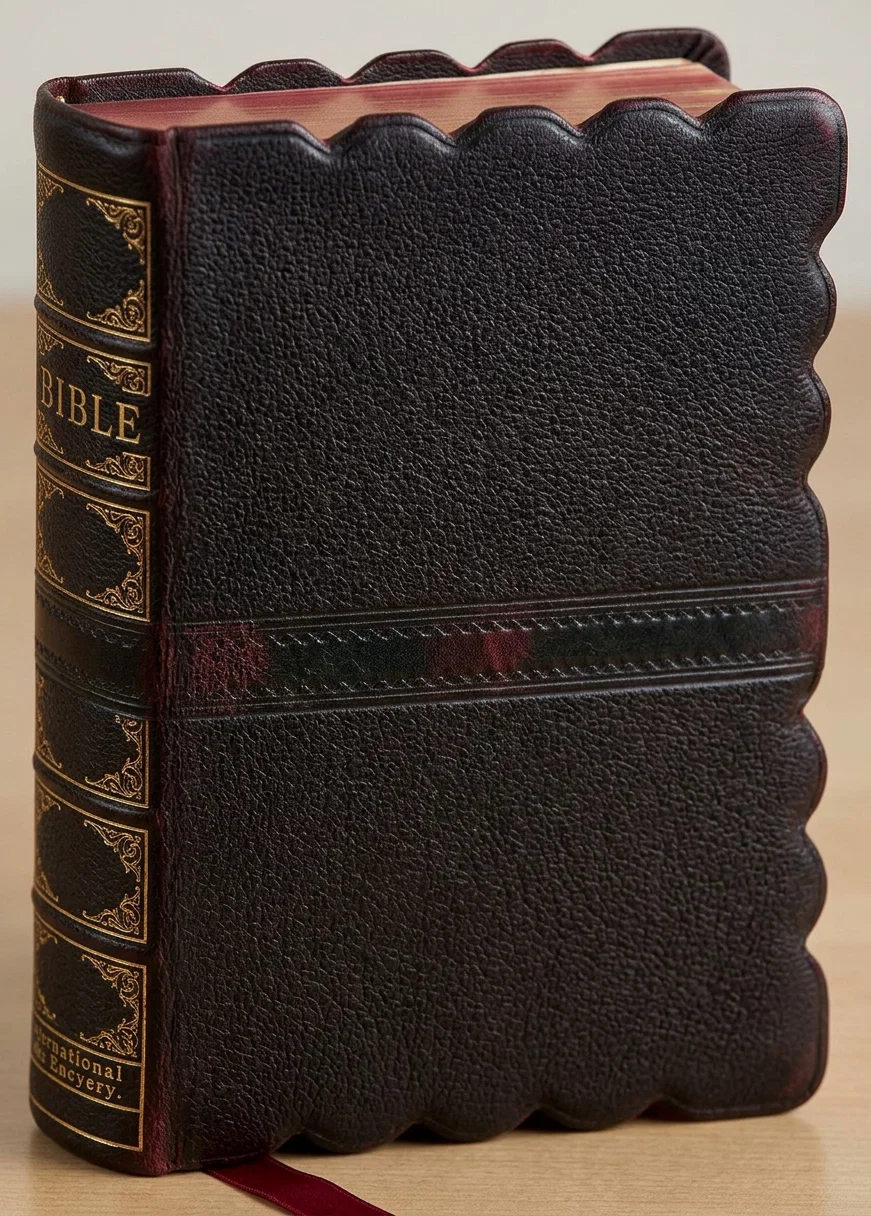
We have on our bargain counter several Bibles which we will sell at greatly reduced prices. They are in good condition, and at the prices stated are the best bargain in Bibles which we have ever offered.
Regular Price         SPECIAL PRICE No. 1.   Light-weight Morocco     $4.00     $2.40 postpaid No. 2.   Heavy-weight Morocco      5.00     3.00     “
These Bibles are self-pronouncing, are printed on India paper, from bold-faced minion type, have divinity circuit, leather lining, red under gold edges, references, and maps. . Supply limited; order at once, with remittance.
Review and Herald Publishing Association Takoma Park Station, Washington, D. C.

The Most Complete Library of Protestant Literature Ever Offered in 4 Volumes
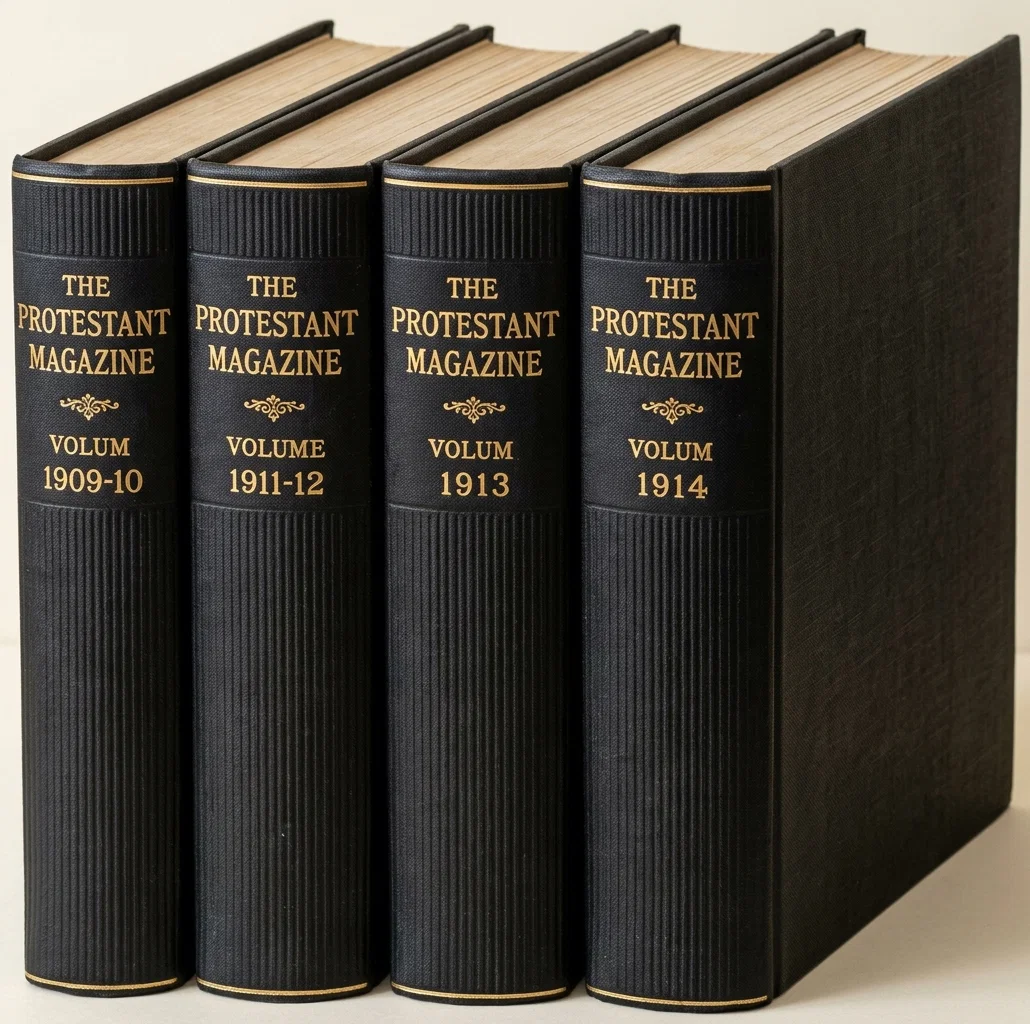
Every true Protestant should have in his possession authentic and reliable information with reference to the history, doctrines, and practices of the Roman Catholic Church. Perhaps in no other way can one get in so small compass this valuable information, which is the result of years of research by the editors of the “Protestant Magazine.”
The complete bound volumes of the
Protestant Magazine
1909-14
Substantially bound in black cloth
A storehouse of Protestant information that will be a valuable addition to any library.

A BRIEF DESCRIPTION OF THESE VOLUMES

Vol. I — 1909 1910 — The Protestant Platform, Papacy in Prophecy, Papacy in Politics, Origin of Papacy, Readjustment of History, Rome Warns Protestants, the Triple Crown, Roman Catholic Justification, Essence of Catholicism, Roman Catholic Prisons, Current Extracts, etc.
Vol. II — 1911 1912 — The Pope as God, Development of Papacy, Peter the Rock, Making America Catholic, Roman Peril, The Mass, Bulls and Encyclicals, President Taft and Thanksgiving, Infallibility, Rome and Marriage, The Reformation.
Vol. III — 1913 — Rome and the Bible, Heresy and Persecution, The Great Convent Tragedy, A Priest’s Repudiation of Romanism, Rome Imprisons Missionaries, Censorship of the Press, Freedom of Speech, The Mass.
Vol. IV — 1914 — A Call to Protestants, Pan-American Mass, The Mask Removed, Protestant Protest, Americanism Versus Catholicism, Burning the Bible in the Philippines, Religious Liberty and Maryland, Ireland and Catholicism, Governor Sulzer and Catholicism in Politics, Rome in Mexico, Penance in the Philippines, etc.
Current Notes and Comment in Each Volume.
THIS COMPLETE LIBRARY, REGULAR PRICE, $7.00
$6.00 SENT POSTPAID TO ANY ADDRESS $6.00 ON THIS OFFER FOR
Protestant Magazine, Washington, D. C.

NOTE THESE WRITERS AND THE IMPORTANT ARTICLES TO BE FOUND IN

LIBERTY MAGAZINE

For Current Quarter

A greater combination of timely and important subjects by these well-known writers has not been found in any one magazine, and deserves the hearty support of our people in the circulation of this number of Liberty.
Why Sunday Laws Are Wrong  Elder A. G. Daniells The Pope, the Powers, and Peace  Dr. P. T. Magan Judge Cooley on Religious Liberty  Elder G. B. Thompson A Door Opened for Equal Christian Liberty  Elder C. Santee An Oklahoma Court Nullifies Constitutional and Statutory Guaranties  Elder C. S. Longacre Origin of the State  Elder C. B. Haynes Compulsory Prayers  Elder C. M. Snow Duty of the Federal Government, etc.  Governor Patterson The 14th International Lord's Day Congress  Elder C. P. Bollman
There has never been, perhaps, a more threatening aspect to the cause of civil and religious liberty than now. Catholicism, the Lord's Day Alliance, and various reform movements are clamoring for laws of suppression. Shall we not circulate this important magazine just now? How many copies will you order?
50 copies, $2.00  20 copies, $1.00
ORDER THROUGH YOUR TRACT SOCIETY
THE LIBERTY MAGAZINE  Takoma Park Station, Washington, D. C.

LIFE AND HEALTH

Can You See The Change? JANUARY of the NEW YEAR Will again bring to you AN OLD FRIEND UNDER ITS OLD NAME

"LIFE AND HEALTH"

In response to the expressed preferences of many of our subscribers, and to the statements of our agents that they have not been able to make the large sales that they formerly made, Health and Temperance will hereafter be published under its old and popular name, LIFE AND HEALTH. Send in your subscription for 1916, as a New-Year's greeting; and order 50 or more copies to sell. The editor says, “Every number during 1916 a seller.” Order through your tract society.
Life and Health - - - Washington, D. C.
Continue reading: Second Sabbath Readings Notice