OF the death of Rachel we read, "And it came to pass, as her soul was in departing, (for she died) that she called his name Benoni: but his father called him Benjamin." Gen. 35:18. See also 1 Kings 17:17-23; Job 11:20, margin.
This is one of the "scriptures in which the term 'soul' is supposed to be used in a manner to show that it is a separate entity in man, immortal in its nature, and able to exist as well out of the body as in" it.
The Hebrew word here translated "soul" is nephesh, and is defined by Mr. Parkhurst, the lexicographer, as follows:
As a noun, nephesh hath been supposed to signify the spiritual part of man, or what we commonly call his soul. I must for myself confess that I can find no passage where it hath undoubtedly this meaning. Gen. 35:18; 1 Kings 17:21, 22; Ps. 16:10, seem fairest for this signification. But may not nephesh in the three former passages, be most properly rendered breath, and in the last, a breathing or animal frame?
In agreement with the foregoing, others render the verse as follows:
And it came to pass in her giving up the ghost (for she was dying), that she called his name, The son of my pain; but his father called his name Benjamin.—The Septuagint Version with an English Translation.
Again:
But she breathing out her life—for she was dying—named him Son-of-my-anguish, but his father called him Benjamin.—Ferrar Fenton's Translation.
Once more:
And just as she was departing (for she died) she called his name Son of my sorrow; but his father called his name Benjamin.—Charles Thomson's Translation.
Take another:
Before her death, Rachel gave birth to a second son. With her parting breath she named the child Benoni, "son of my sorrow." But his father called him Benjamin, "son of my right hand" or "my strength."—"Patriarchs and Prophets," page 206.
Then again:
"As her soul was in departing." Heb. . . . in the going out of her soul, or life. Gr. . . . in her sending out her life. The language legitimately implies no more than the departing or ceasing of the vital principle, whatever that be. In like manner, when the prophet Elijah stretched himself upon the dead child, 1 Kings 17:21, and cried three times, saying, "O Lord my God, let this child's soul come into him again," he merely prays for the return of his physical vitality.—Bush's Notes.
It would seem that this collation ought to settle it forever in the mind of the unprejudiced reader that the expression, "As her soul was in departing," does not teach that there is in man a separate entity, immortal in its nature, and capable of an intelligent existence apart from the body. And where is the scripture that does teach such a doctrine?
When He Will
A BRILLIANT Oxford student was giving himself to the Wesleyan Missionary Society for African service. His tutor remonstrated: "You are going out to die in a year or two. It is madness." The young fellow (who did die after being on the field only a year) answered: "I think it is with African missions as with the building of a great bridge. You know how many stones have to be buried in the earth all unseen to be a foundation for the bridge. If Christ wants me to be one of the unseen stones lying in an African grave, I am content."—Selected.
Church Federation
By Our Own Correspondent
ORGANIC union of Protestantism, Catholicism, and Spiritualism in one vast denomination, which has been predicted by the proprietors of this journal for more than thirty years, is nearer a reality to-day than ever before. Speeches made from the pulpits of the White Temple and First Presbyterian Church in Portland on the night of July 9, near the close of the international missionary convention of the Christian Church, founded by Alexander Campbell, show that this denomination, at least, is ready for the union of Protestantism and Catholicism. No mention, however, was made of Spiritualism; and it is probable that many church-members would now shrink from the thought of uniting with the demoralizing practise of necromancy.
But right here let us sound a warning. The almost universal yet unscriptural belief that the soul is immortal and goes to heaven immediately at death, is preparing the way for the reception, by many, of other unscriptural doctrines propounded by wicked spirits who will mask themselves in the form and features of departed loved ones. In order to be prepared for these almost overmastering delusions, all ought to have a thorough knowledge of the Scriptures for themselves, that they may "be able to quench all the fiery darts of the evil one."
What Hinders Christian Union
The Rev. William Bayard Craig, of New York City, spoke at the First Presbyterian Church on "What Hinders Christian Union." The sermon was one of four delivered on the night of July 9, the Rev. John H. Boyd, pastor of the church, Finis Idleman, of Des Moines, Iowa, and the Rev. Peter Ainslie, president of the Christian Union Commission of the Christian Church, being the other speakers.
A part of Mr. Craig's speech was in substance as follows:
I feel that the conversion of the world to God and righteousness is halted by the divisions of Christendom. Intemperance is flaunting itself in our faces because the followers of the Lord Jesus Christ are divided in effort and in faith. Christian people hold the balance of power in this land; but we don't exercise it, because we are divided. It does seem as if all occasion for division among the Protestant bodies is past. Things are occurring now in Constantinople, among the old churches there, of which I am not now at liberty to speak, but which show progress toward unity, and will be known in due time. These could not have happened three years ago.
Glad for Even Roman Catholic Influence
The Catholic's hope of salvation for himself and his loved ones depends on the church. With what wonderful fidelity he clings to it as the most precious thing on earth! If you lived in New York City, in the midst of a people almost wholly given to idolatry, you would be glad for any influence which would help to stay it, even Roman Catholic influence. I went into a church in New York City, where every man was holding a lighted candle in his hand. I asked a priest what they were doing. He said they were renewing their baptismal vows. I went away thanking God that these men could be gathered together in that wicked city, to renew their vows to God in the way in which they had been trained. But while I thank God, I am not prevented from going away and preaching a religion free from forms and ceremonies.
Mr. Craig went on to say that a "provincial spirit hinders Christian union;" and regarding the conscience, he said that "an ignorant, ill-informed conscience is the most tyrannical thing in the world." He spoke of Paul, before his conversion, conscientiously murdering the Christians, said the Roman Catholic conscience needs to be set free, and in the same vein referred to the librarian of the British Museum, who, said Mr. Craig, declined to open a letter from his wife "on his Sabbath."
Has Mr. Craig forgotten, when he speaks of the Catholic religion as salutary, the St. Bartholomew massacre, or the horrible cruelties of the Inquisition? Has he forgotten the heretics burned at the stake? Has he overlooked the prophecy of Revelation 13, which says the image of the papal organization "exerciseth all the power of the first beast before him, and causeth the earth and them which dwell therein to worship the first beast, whose deadly wound was healed"? The beasts, of course, represent governments, as they do also where used figuratively in the book of Daniel. The "deadly wound" spoken of was received by the Papacy in 1798, when the French general Berthier took the Pope prisoner, and diminished his power over the kings of the earth.
"Coquetting with Other Congregations"
The Rev. Mr. Boyd, who has recently taken the pulpit of the First Presbyterian Church, expressed himself as heartily in favor of union. He said:
I venture the assertion to-night, we have done more coquetting with other congregations than any other single church in the land. Why, the young Presbyterian miss used to sit up with the Episcopalian young man till after midnight, talking over the matter of union. We have kept a committee on union, and the flag of union has been floating at the masthead of the Presbyterian Church for the last twenty-five years. During the past few years we have received into our bosom the great Cumberland Presbyterian Church. In fact, you are standing to-night on a broad platform, gentlemen. The pulpit of this church represents a breadth that is inclusive of all the Christian church you represent.
We recognize you as the children of God. If any of these ministers want to come into the Presbyterian Church, they can come with their ordination papers, and we will not question them. I welcome you, and pray God's blessing on the great movement in which this meeting is to have a place.
The Rev. Mr. Ainslie said, in part:
Ever since the church's establishment, there have been in every generation sincere voices lifted up in appeals for the union of the church of Christ, and especially since the great division attending the sixteenth century Reformation. In the very beginning of that period, conferences were held between Roman Catholics and Reformers and between the various bodies of Reformers. John Calvin in 1553 wrote Archbishop Cranmer that if necessary he would cross ten seas to bring the separated churches of Christ into one body.
Forces That Have Worked for Federation
Proposals have been made from the time of George Calixtus, who advocated going back to the creeds of the first five centuries as the doctrinal basis, down to Alexander Campbell, who advocated the abolition of all human creeds as tests of fellowship and the return to Christ in name, in ordinances, and in life. World conferences have been called from the time of the Reformers in Scotland in 1560 down to the Episcopalians and the Disciples in America in 1910. Books and tracts have been sent forth, pleading for a united church, from Richard Baxter's "True and Only Way of Concord of All Christian Churches" down to numerous volumes of this year's publication. Organizations among Protestants have been started looking toward a closer fellowship, from the Evangelical Alliance of England in 1846 down to the Federal Council of the Churches of Christ in America in 1908. Individual efforts have been numerous, reaching back to the brilliant correspondence between the Protestant philosopher Leibnitz and the Roman Catholic orator Bossuet down to this day.
The international Sunday-school lessons, the Young Men's and Young Women's Christian Associations, the Christian Endeavor Society, the Student Volunteers, the Laymen's Missionary Movement, and the Men and Religion Campaign among Protestants, and temperance organizations among Protestants and Roman Catholics, are unconsciously making great contributions to the solution of this problem. Union prayer services are joining into brotherhood the souls of those who pray together; and sometime in the calendar, and somewhere on the road, I know not when or where, the scarred, divided, imperfect church will find the way to the united fellowship of all believers; for these and other influences are sweeping away the barriers.
Union Should Not Be in Name Merely
True, Christ's followers will be united in one common belief in the great principles enunciated by the Son of God. And Christ says, "He that is not with Me is against Me." There may be union in name; but unless the lives are in accord with Christ's Spirit, unless His professing followers obey His commandments, they are none of His. "What concord," asks Paul, "hath Christ with Belial?"
Christ said He came to fulfil the law, and the prophecies concerning Him. That holy law is as binding now as it ever was; and when men substitute for it a human system of pardon, or the worship of images, which it condemns, or Sunday, the first day of the week, as a rest day in the place of the Sabbath, the seventh day, they are none of His. How then can He unite them to Himself, if they do not obey His commandments? The Gospel is the "power of God unto salvation" from the transgression of the law, and it is the duty of Christ's followers to preach it to every creature in the world. True unity can only be found in Christ.11
Many things aside from church union occupied the attention of the big convention. The American Christian Missionary Society, the Foreign Christian Missionary Society, the Christian Women's Board of Missions, and the Brotherhood of Disciples of Christ, met in annual session during the convention week, beginning July 4. A great banquet, at which four hundred were seated at the long tables in Woodmen of the World Hall, was one of the features of the convention. After the banquet the men marched in a body to Grace Methodist Church, and listened to addresses.
The needs of the Orient were emphasized. One speaker said that Peking is now the student center of the world.
The women's mission board decided to erect a hospital and rooming house for Chinese and Japanese in San Francisco, and a mission house in Portland for the same class, as soon as it can secure the funds.
America and Religious Liberty
The Rev. John L. Brandt, of St. Louis, spoke of the religious liberty enjoyed by Americans, and said that "since the United States Constitution was drafted, 200,000,000 persons in Europe have arisen from a state of barbaric cruelty to constitutional liberty."
The convention sounded a ringing note against the liquor traffic, war, and divorce, passing a resolution against these. The fact that public school-teachers in the Philippines have been compelled, as stated by one of the convention speakers, to desist from teaching in the Sunday-school, called forth a resolution to memorialize President Taft, the Chairman of the United States Senate, and the Speaker of the House of Representatives in Congress, requesting that they use their influence against this.
The Rev. R. A. Abbott, of St. Louis, in the White Temple, on the night of July 4, spoke from Matt. 28:19, 20, the commission of Christ to His disciples to go into all the world and preach the Gospel of the kingdom to every creature.
Personal Adornment and Christianity
Mr. Abbott said some very good things about the way in which outward adornment may detract from the worship of the Master. On this subject he said: "I sometimes think we lose the consciousness of Christ in the very apparel, the flowers, ornaments, and monuments; in the seeming glory with which we worship Him. Jesus refrained from the dress of the rabbis, wearing the humble clothing of the peasant, perhaps on purpose that He might reach the people."
There is no doubt that Christ wore the dress of the common people that He might reach the common people, the very ones who needed Him; and we read that these same common people "heard Him gladly." Mark 12:37.
There were other statements made by Mr. Abbott which are not as fully in harmony with Scripture as that regarding outward adornment and the "putting on of apparel." We regret that Mr. Abbott did not see whither his statements would lead, if followed to their logical conclusion. What he said, briefly stated, was this:
Matthew Arnold said religion is morality touched by emotion. But if it were only that, long ago there would have been no religion in the world. Nor is religion the soul's answer to a categoric imperative.
Religion in its higher ranges is not the soul's bowing in a broken obedience to the fiat of a law. True religion is not a life shaped by a line upon line, precept upon precept. Religion is not living by an ideal. That has made more people vituperate truth than anything else.
Emerson said to hitch your wagon to a star. I have a great quarrel with him, for there is no wagon, no star, and no hitching. When we live simply by ideals there is no heart and force in our religion.
By Principle or Not
I don't believe religion to be living according to principle. How we hang on that—let's build our lives by principle! Nobody ever did, can, or will live by principles.
This is religion: not to live by precept, not to live by an ideal, not to live by a principle, however true, but to live every day by the personal consciousness of the guidance and leading of the Lord Jesus Christ. We do not live by a cold truth held out to us, but by a personality, not far from us, but standing by us, molding our very thoughts, master of our lives, controlling our souls, keeping us with a passion that burns out the evil, causing us to undertake the tasks that look to the prudent outside world as if they were the very madness of men, making us heroes, who die not for a cause but for a Christ. This is religion: "Lo, I am with you."
It is the church's duty to know Christ as real, and to lean upon Him. He is not the Christ of the theologians, but the Christ of the people; not the Christ of the great painter, but of the toiler, who carries the burdens of the world. He is the Christ of the man who plows in the furrow and who goes to the mass.
In the din of strife, the atmosphere of contention, in the hour when we lay stress on ecclesiastical ideas, we lose Jesus Christ. Men look to this church or the other church, and forget that the great thing is not the church at all, but Christ. If we go out and say, "Believe on the church," men will miss Jesus Christ, and forget He came to the world as a personal Saviour.
Christ Taught Principles
It is true that Christ came into the world as a personal Saviour of men; for He said, "I came not to judge the world, but to save the world;" and in another place, "I came not to call the righteous, but sinners to repentance." To repent is to turn about, to forsake sin. And "sin is the transgression of the law." Jesus said, "On these two commandments," love to God, and love to man, "hang all the law and the prophets." Religion, then, if it be the religion of Jesus Christ, consists in obeying God's law given to Moses by Christ Himself on Mount Sinai.
It is true that "the great thing is not the church, but Christ," who said: "I am the vine, ye are the branches." "As the branch can not bear fruit of itself, except it abide in the vine; no more can ye, except ye abide in Me." It is also true He is the Christ of the people, and not alone of the theologians; for the invitation is, "Whosoever will, let him take the water of life freely." Rev. 22:17.
But to say that the religion of Christ is not living according to principle, that it is not obeying "the fiat of a law," and not living by an ideal, is not true in the light of the teaching of Christ Himself and of the Bible. In the very text which Mr. Abbott used as a basis for his sermon, Christ commissioned His disciples to teach all nations to observe whatsoever He had commanded the disciples, and promised His presence with His servants always, "even unto the end of the world." Christ's commands are the law of God; for He says of His disciples, in His prayer to His Father, "I have given them Thy Word." All Christ's commands, then, are in perfect harmony with the Ten Commandments, which Moses received not only as a rule of life for the Jews, but for all the world. These commandments are as binding upon mankind to-day as they were the day they were thundered from Sinai's summit.
Mr. Abbott is right when he says, "Nobody ever did, can, or will live by principles" alone; for the carnal heart "is not subject to the law of God, neither indeed can be." But the principle embodied in the law serves to bring us to Christ, to show us the need of a Saviour. Paul said, "I had not known sin, but by the law;" sin being "the transgression of the law." Paul saw where his life was faulty; but he found himself unable to live in accordance
with the law, and he cried out in his despair, "O wretched man that I am! who shall deliver me from the body of this death?" Adam bequeathed his sinful nature to all his posterity; "and so death passed upon all men, for that all have sinned." Paul said, "The strength of sin is the law." Why? — Because when the life is compared with the law, the sin is revealed.
Paul said he found in Christ deliverance from his sinful nature, "the law of sin and death" in his body, which was bequeathed to him by Adam; and David said, in his prayer to Jehovah, "Thy Word have I hid in mine heart, that I might not sin against Thee." God's Word is His law. It was failure on Adam's part to bow in obedience to the divine will, that plunged humanity and the world into death, and, except for the atoning blood of Christ, into despair. Christ said, "I came . . . to save the world;" and, "I have given you an example, that ye should do as I have done to you."
The Rev. D. Y. Donaldson, of Kansas City, Missouri, speaking on behalf of the delegates in response to an address of welcome by the Rev. W. B. Hinson, pastor of the White Temple, expressed himself as strongly in favor of church union. Upon this point he said:
We realize more than ever before that the religion of Jesus Christ can not be reduced to mere form and ceremony. The Christian religion must be kept in the spirit of the Master, it must be gentle as well as strong. Our religion must make itself manifest in the consecration of the life of the Christian. This sort of Christianity finds its greatest joy in fulfilling that command of the Master who said to go into all the world and preach the Gospel to every creature. Such a religion will find delight in song, prayer, and sacrament, but will find its greatest delight in the sacrifice of service, in carrying the Gospel to the end of the world.
The World Waiting for United Christendom
We believe the world is waiting to hear the message of a united Christendom. Too long has Christ been denied because of the strife and division within the church. We have been called to the kingdom to plead for the restoration of a united church. How great should be our joy to know that this appeal is being made not only by the Brotherhood of the Disciples of Christ, but from this pulpit and from every other pulpit in the land where Christ is glorified, that the same appeal is going forth, and that the appeal is finding an echo in the hearts of all who love the Lord. . . .
We need to look deeper into these great problems of the kingdom, to search for the fuller truth, that we may walk in its unerring light.
Five notable issues are before the church: "An inspired Bible or no Scripture; a divine Christ or no Saviour; a Scriptural baptism or no baptism; a united church or no world conquest; a religion of service or no religion." If our coming together shall deepen the emphasis of these fundamental truths, and contribute to bringing to the service of Christ in their fulness our powers,—shall result in fuller coöperation among our brethren, and hasten the universal reign of Christ on earth,—then we shall be worthy of the hearty welcome given us.
It ought not to be difficult to bring about harmony among Christ's servants; for His commands are plain. But if these commandments must be sacrificed to gain harmony, then let there be no joining of hands; for "what fellowship hath righteousness with unrighteousness? and what communion hath light with darkness? And what concord hath Christ with Belial? or what part hath he that believeth with an infidel?"
Let us not sacrifice the truths of the Gospel for the sake of temporary unity, which in the end will mean disruption; for "if a house be divided against itself, that house can not stand."
FRANK A. COFFIN.
LETTERS TO A YOUNG MAN
By L. P.
BY A YOUNG MAN
VII. Science and the Bible—How Shall You Relate Yourself to Each?
MY DEAR ROBERT,—
I have chosen for to-day's letter a subject that fairly bristles with difficulties, so much so that I can hardly hope to treat it at all frankly without rendering myself misunderstood. But I will at least make the attempt; and if I fail this time, perhaps I may set myself right in some future letter. In taking up, then, the subject of science and the Bible, let me first say that I mean by science what men have discovered, or think they have discovered, concerning the outward, visible world in its various manifestations, more especially what they have been pleased to denominate natural laws, and the immediate facts growing out of the same. It is hardly necessary to add that by the Bible I mean the inspired Word of God, the book in which He has been pleased to reveal Himself to us by means of human language.
It is sometimes said offhand that science and the Bible must agree; but this would not necessarily be so unless men's knowledge of the outward, visible world were allowed to be complete and infallible, and likewise their interpretation of the Bible. This much we can say, however,—that, regarded absolutely, God's works and God's Word do and must agree; and the nearer perfect our knowledge of both, and of the peculiar field occupied by each, the more manifest this will become.
This harmony between the revelation of God in nature and the revelation in the form of literature, was believed to exist in Old Testament times, and also by the early Christian church. The same belief was prevalent during the Middle Ages, and the Reformers of the sixteenth century took no exception to it; indeed, they rather affirmed it on the whole, tho not always in the same terms. Only in the last century has the idea become prevalent that science and revelation are necessarily antagonistic. What are the causes of this radical change of views?
The causes are various, and they grow out of the general situation. In the first place, science has made immense strides in the last century. Especially large have been the stores of knowledge gained by laboratory methods of investigation. So remarkable and far-reaching have been the results in the biological sciences, that men view with wonder and admiration what has been done, and think that the deeper mysteries of creation, if not explained by what is now known of biology, yet may in time be so explained. The progress in the sciences has had to do with the material side of life; so also the great mechanical inventions of the age; and these together have tended to draw men's minds away from the spiritual. It has been eminently a scientific age. The men who have stood in the van of progress have been making scientific discoveries; and the men entrusted with spiritual truth, instead of emulating in their own field of activity the zeal of their brethren, have rather stood and looked on and admired. Some, on the other hand, have been inclined to regard with jealousy the prestige of the men who have delved deep into the mysteries of nature, and have attacked them, oftentimes in a narrow, querulous spirit.
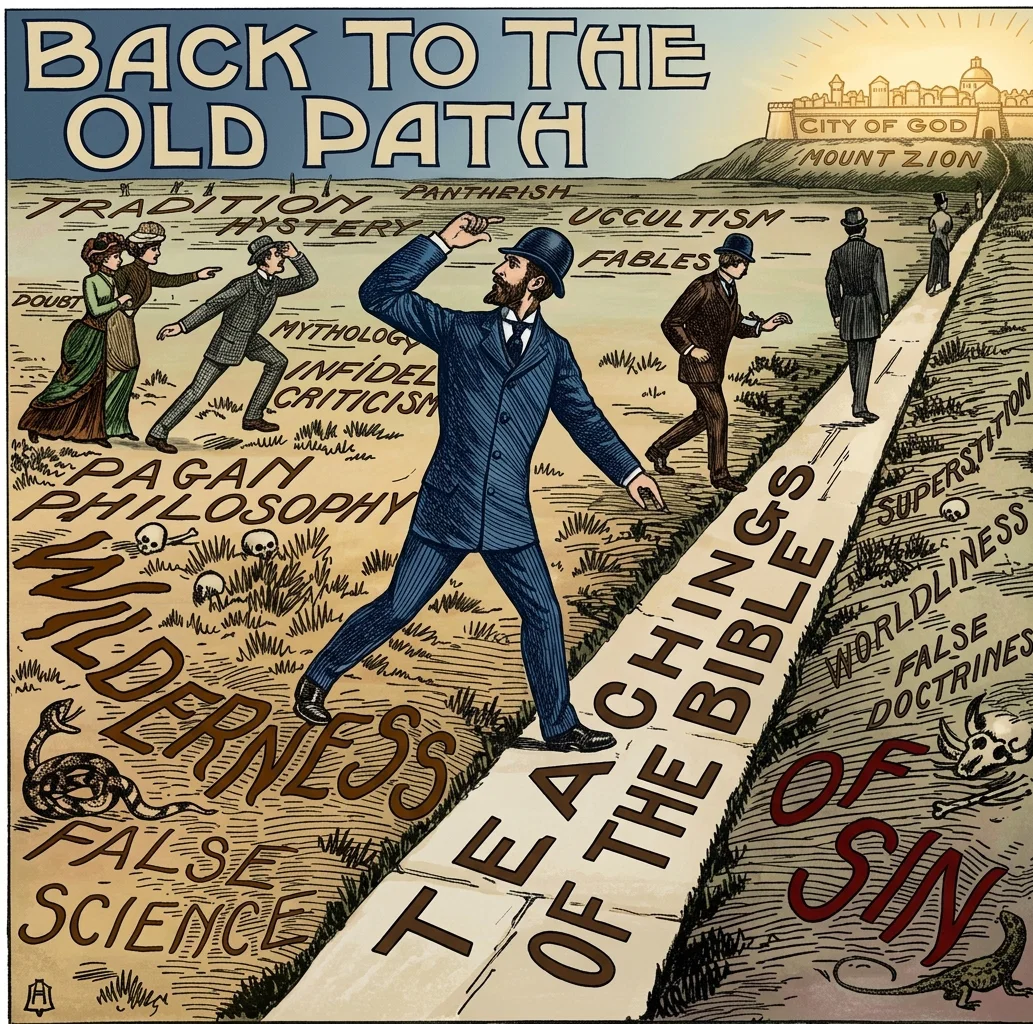
It seems to have been overlooked by many persons engaged in this controversy, that the Bible and the book of nature have each a large and legitimate field of operation, and rightly viewed, one does not overlap the other. Science, speaking broadly, has to do with what is outward, temporal, and visible to the natural eye. The Bible, on the other hand, makes its chief appeal to the soul; it touches hidden mysteries; it reaches beyond the confines of time and space; it deals with the eternal.
Yet, while the two do not overlap, in many ways the one supplements the other. Thoughtful study of the Bible at once shows it to have this supplementary character as regards science. It lays down no large scientific principles in the strict language of science, but rather uses the things of nature as illustrations of spiritual truths, and with the obvious purpose that man, as he sees these objects of the outer world, may be reminded of the eternal truths of which they may be regarded as types and reminders. Thus we have the words of our Saviour: "Consider the lilies how they grow: they toil not, they spin not; and yet I say unto you, that Solomon in all his glory was not arrayed like one of these. If then God so clothe the grass, which is to-day in the field, and to-morrow is cast into the oven; how much more will He clothe you, O ye of little faith?" Likewise also the discoveries of science tend to enlarge and deepen our impressions of God. To take one instance, how have the discoveries of astronomers enlarged the meaning of those beautiful words of the psalmist: "When I consider Thy heavens, the work of Thy fingers, the moon and the stars, which Thou hast ordained; what is man, that Thou art mindful of him? and the son of man, that Thou visitest him?"
But men are not satisfied with letting God's two books supplement and explain each other. The scientist would explore every field by laboratory methods, he would penetrate into the very presence of Deity, and impose upon the Creator of the universe a mechanical obedience to what he is pleased to call natural laws, more blind and unreasoning than he would subscribe to himself. The clergyman, on the other hand, is exceedingly likely to impose his view of the teachings of the Bible upon the scientist, and in so doing unnecessarily to interfere with the latter's legitimate researches into natural phenomena.
An illustration will help to make the matter clear. When Columbus sought men and means with which to demonstrate his belief in a round earth, he was strongly opposed by various members of the clergy of that day on the ground that the Bible plainly upheld the generally adopted view of a flat earth. When the facts emerged, the clergy found that it was not the Bible that was at fault, but man's too literal interpretation of the Bible, and their ignorance of poetic diction.
To be sure, the situation is more complicated to-day; for scientists, unfortunately, do not confine themselves, as Columbus did, to what would seem to be their legitimate field, but they have in many cases made a frontal attack on the whole Christian faith, arguing in general that the things that are not susceptible of laboratory demonstration are not to be believed by right-minded persons, and that the book of nature is the only book that gives a reliable knowledge of God, either in the physical or the spiritual realm. It is this attack on the main principles of Christianity that we Christians must meet, and that with vigor and decision. Here there is absolutely no room for compromise. It is our duty to insist upon the reality and overwhelming importance of spiritual truth, and to assert the pre-eminence of the spiritual faculties, which chiefly separate man from the beasts. We may rightly insist that human science is confined to comparatively narrow limits, and can not in any wise supply the place of the Bible, which deals with the hidden things of the Spirit, which feeds man's higher nature, and reveals to him God, and heaven, and immortality.
Sometimes Christians make the mistake of thinking it a sin for the scientist to push his researches as far as possible in the realm of nature; as if knowledge itself were essentially sinful, and ignorance something God is particularly well pleased with. This is of course a mistake. On the other hand the scientist is on dangerous ground when he applies himself so exclusively to his special field of inquiry as to crowd out the time that should be given to the cultivation of the spiritual faculties. He thus becomes a spiritual cripple, one who is blind and can not see afar off by the eye of faith. Darwin, a man of many noble qualities, and far more humble and teachable than some of his avowed disciples of to-day, expressed late in life sincere regret that he had given himself so exclusively to his scientific studies, and had not kept in touch with other and more spiritual aspects of life.
Some men, of whom Gaussen, the Genevan professor, was perhaps the most prominent, have undertaken to prove that the Bible has anticipated modern science in many important discoveries, and is completely in harmony with all its findings. I do not care at this point to go into that matter, but would only put the question which naturally arises: If that be true of the science of to-day, what about the science of to-morrow,13which may in some important particulars be contradictory to the science teaching of to-day? Science is a shifting thing, as every one knows; but the Bible, which unfolds spiritual truths, has to do with that which is permanent and enduring.
But I must bring this letter to a close. I have touched on most of the things you asked me about, but on some of them very lightly. The subject is one that lends itself better to a quiet talk than to a letter. In general, if I were trying to sum up the matter, I should advise you to keep your mind open for all the scientific facts that come your way, but be chary of adopting wholesale the theories, which are often found to rest on a very slight foundation of fact. Study the Bible, moreover, as the Word of God to your soul, the lamp to your feet, the light to your path, and make its principles a part of your every-day life. Do this, and you will derive the full benefit from both, without doing violence either to your intellectual convictions or to your spiritual life.
I am, as ever, sincerely yours,
L. P.
What Is Noble?
By Charles Swain
What is noble? — Is the saber
Nobler than the humble spade?
There's a dignity in labor
Truer than e'er pomp arrayed.
He who seeks the mind's improvement,
Aids the world in aiding mind.
Every great commanding movement
Serves not one, but all mankind.
What is noble? — That which places
Truth in its enfranchised will,
Leaving steps like angel-traces,
That mankind may follow still.
E'en tho scorn's malignant glances
Prove him poorest of his clan,
He's the noble who advances
Freedom, and the cause of man.
—Charles Swain.
Room in Heaven
By James Clarence Harvey
SHE was a little, old woman, very plainly dressed in black bombazine that had seen much wear. Her bonnet was very old-fashioned; and people stared at her tottering up the aisle of the church, evidently bent on securing one of the best seats, for a great man preached that day. The house was filled with splendidly dressed people who had heard of the fame of the preacher, of his learning, his intellect, and his goodness; and they wondered at the presumption of the poor old woman. She must have been in her dotage, for she picked out the pew of the richest and proudest member of the church and took a seat. The three ladies seated there beckoned to the sexton, who bent over the intruder and whispered something; but she was hard of hearing, and smiled as she said gently, "O, I'm quite comfortable here, quite comfortable."
"But you are not wanted here," said the sexton pompously; "there is not room. Come with me, my good woman; I will see that you have a seat."
"Not room?" said the old woman. "Why, I'm not crowded a bit. I rode ten miles to hear the sermon to-day, because —"
But here the sexton seized her arm, shook it in an underhanded way, and then she took the hint. Turning quietly to the ladies, who were spreading their rich dresses over the space she left vacant, she said gently, "I hope, my dears, there'll be room in heaven for us all." Then she followed the pompous sexton to the rear of the church, where in the last pew she was seated between a girl in threadbare garments and a shabby old man.
"She must be crazy," said one of the ladies. "What can an ignorant old woman like her want to hear Dr. — preach for? Those people are so persistent! The idea of forcing herself into our pew! There's Dr. —. Is he not grand? What a stately man! You know he has promised to dine with us while he is here."
He was a commanding looking man; and as he looked over the vast crowd of worshipers gathered in the vast church, he seemed to scan every face. His hand was on the Bible when he beckoned to the sexton, who mounted the steps, to receive a mysterious message. And then the three ladies in the pew were electrified to see him take his way the whole length of the church, to return with the old woman, whom he placed in the front pew. The great preacher looked at her with a smile of recognition, and then the services proceeded.
"Who was she?" asked the ladies as they passed the sexton at the door. "The preacher's mother," was the reply.—James Clarence Harvey.