Your ShelfYour Projects

Signs of the Times, Vol. 38, No. 31.

Question Corner
Earlier text: 1. What is Spiritualism defined to be?

LETTERS TO A YOUNG MAN

BY A YOUNG MAN

VII. Science and the Bible—How Shall You Relate Yourself to Each?

MY DEAR ROBERT,—
I have chosen for to-day’s letter a subject that fairly bristles with difficulties, so much so that I can hardly hope to treat it at all frankly without rendering myself misunderstood. But I will at least make the attempt; and if I fail this time, perhaps I may set myself right in some future letter. In taking up, then, the subject of science and the Bible, let me first say that I mean by science what men have discovered, or think they have discovered, concerning the outward, visible world in its various manifestations, more especially what they have been pleased to denominate natural laws, and the immediate facts growing out of the same. It is hardly necessary to add that by the Bible I mean the inspired Word of God, the book in which He has been pleased to reveal Himself to us by means of human language.
It is sometimes said offhand that science and the Bible must agree; but this would not necessarily be so unless men’s knowledge of the outward, visible world were allowed to be complete and infallible, and likewise their interpretation of the Bible. This much we can say, however,—that, regarded absolutely, God’s works and God’s Word do and must agree; and the nearer perfect our knowledge of both, and of the peculiar field occupied by each, the more manifest this will become.
This harmony between the revelation of God in nature and the revelation in the form of literature, was believed to exist in Old Testament times, and also by the early Christian church. The same belief was prevalent during the Middle Ages, and the Reformers of the sixteenth century took no exception to it; indeed, they rather affirmed it on the whole, tho not always in the same terms. Only in the last century has the idea become prevalent that science and revelation are necessarily antagonistic. What are the causes of this radical change of views?
The causes are various, and they grow out of the general situation. In the first place, science has made immense strides in the last century. Especially large have been the stores of knowledge gained by laboratory methods of investigation. So remarkable and far-reaching have been the results in the biological sciences, that men view with wonder and admiration what has been done, and think that the deeper mysteries of creation, if not explained by what is now known of biology, yet may in time be so explained. The progress in the sciences has had to do with the material side of life; so also the great mechanical inventions of the age; and these together have tended to draw men’s minds away from the spiritual. It has been eminently a scientific age. The men who have stood in the van of progress have been making scientific discoveries; and the men entrusted with spiritual truth, instead of emulating in their own field of activity the zeal of their brethren, have rather stood and looked on and admired. Some, on the other hand, have been inclined to regard with jealousy the prestige of the men who have delved deep into the mysteries of nature, and have attacked them, oftentimes in a narrow, querulous spirit.
It seems to have been overlooked by many persons engaged in this controversy, that the Bible and the book of nature have each a large and legitimate field of operation, and rightly viewed, one does not overlap the other. Science, speaking broadly, has to do with what is outward, temporal, and visible to the natural eye. The Bible, on the other hand, makes its chief appeal to the soul; it touches hidden mysteries; it reaches beyond the confines of time and space; it deals with the eternal.
Yet, while the two do not overlap, in many ways the one supplements the other. Thoughtful study of the Bible at once shows it to have this supplementary character as regards science. It lays down no large scientific principles in the strict language of science, but rather uses the things of nature as illustrations of spiritual truths, and with the obvious purpose that man, as he sees these objects of the outer world, may be reminded of the eternal truths of which they may be regarded as types and reminders. Thus we have the words of our Saviour: “Consider the lilies how they grow: they toil not, they spin not; and yet I say unto you, that Solomon in all his glory was not arrayed like one of these. If then God so clothe the grass, which is to-day in the field, and to-morrow is cast into the oven; how much more will He clothe you, O ye of little faith?” Likewise also the discoveries of science tend to enlarge and deepen our impressions of God. To take one instance, how have the discoveries of astronomers enlarged the meaning of those beautiful words of the psalmist: “When I consider Thy heavens, the work of Thy fingers, the moon and the stars, which Thou hast ordained; what is man, that Thou art mindful of him? and the son of man, that Thou visitest him?”
But men are not satisfied with letting God’s two books supplement and explain each other. The scientist would explore every field by laboratory methods, he would penetrate into the very presence of Deity, and impose upon the Creator of the universe a mechanical obedience to what he is pleased to call natural laws, more blind and unreasoning than he would subscribe to himself. The clergyman, on the other hand, is exceedingly likely to impose his view of the teachings of the Bible upon the scientist, and in so doing unnecessarily to interfere with the latter’s legitimate researches into natural phenomena.
An illustration will help to make the matter clear. When Columbus sought men and means with which to demonstrate his belief in a round earth, he was strongly opposed by various members of the clergy of that day on the ground that the Bible plainly upheld the generally adopted view of a flat earth. When the facts emerged, the clergy found that it was not the Bible that was at fault, but man’s too literal interpretation of the Bible, and their ignorance of poetic diction.
To be sure, the situation is more complicated to-day; for scientists, unfortunately, do not confine themselves, as Columbus did, to what would seem to be their legitimate field, but they have in many cases made a frontal attack on the whole Christian faith, arguing in general that the things that are not susceptible of laboratory demonstration are not to be believed by right-minded persons, and that the book of nature is the only book that gives a reliable knowledge of God, either in the physical or the spiritual realm. It is this attack on the main principles of Christianity that we Christians must meet, and that with vigor and decision. Here there is absolutely no room for compromise. It is our duty to insist upon the reality and overwhelming importance of spiritual truth, and to assert the pre-eminence of the spiritual faculties, which chiefly separate man from the beasts. We may rightly insist that human science is confined to comparatively narrow limits, and can not in any wise supply the place of the Bible, which deals with the hidden things of the Spirit, which feeds man’s higher nature, and reveals to him God, and heaven, and immortality.
Sometimes Christians make the mistake of thinking it a sin for the scientist to push his researches as far as possible in the realm of nature; as if knowledge itself were essentially sinful, and ignorance something God is particularly well pleased with. This is of course a mistake. On the other hand the scientist is on dangerous ground when he applies himself so exclusively to his special field of inquiry as to crowd out the time that should be given to the cultivation of the spiritual faculties. He thus becomes a spiritual cripple, one who is blind and can not see afar off by the eye of faith. Darwin, a man of many noble qualities, and far more humble and teachable than some of his avowed disciples of to-day, expressed late in life sincere regret that he had given himself so exclusively to his scientific studies, and had not kept in touch with other and more spiritual aspects of life.
Some men, of whom Gaussen, the Genevan professor, was perhaps the most prominent, have undertaken to prove that the Bible has anticipated modern science in many important discoveries, and is completely in harmony with all its findings. I do not care at this point to go into that matter, but would only put the question which naturally arises: If that be true of the science of to-day, what about the science of to-morrow, which may in some important particulars be contradictory to the science teaching of to-day? Science is a shifting thing, as every one knows; but the Bible, which unfolds spiritual truths, has to do with that which is permanent and enduring.
But I must bring this letter to a close. I have touched on most of the things you asked me about, but on some of them very lightly. The subject is one that lends itself better to a quiet talk than to a letter. In general, if I were trying to sum up the matter, I should advise you to keep your mind open for all the scientific facts that come your way, but be chary of adopting wholesale the theories, which are often found to rest on a very slight foundation of fact. Study the Bible, moreover, as the Word of God to your soul, the lamp to your feet, the light to your path, and make its principles a part of your every-day life. Do this, and you will derive the full benefit from both, without doing violence either to your intellectual convictions or to your spiritual life.
I am, as ever, sincerely yours,
L. P.

What Is Noble?

What is noble?—Is the saber Nobler than the humble spade? There's a dignity in labor Truer than e'er pomp arrayed. He who seeks the mind's improvement, Aids the world in aiding mind. Every great commanding movement Serves not one, but all mankind.
What is noble?—That which places Truth in its enfranchised will, Leaving steps like angel-traces, That mankind may follow still. E'en tho scorn's malignant glances Prove him poorest of his clan, He's the noble who advances Freedom, and the cause of man. —Charles Swain.

Room in Heaven

SHE was a little, old woman, very plainly dressed in black bombazine that had seen much wear. Her bonnet was very old-fashioned; and people stared at her tottering up the aisle of the church, evidently bent on securing one of the best seats, for a great man preached that day. The house was filled with splendidly dressed people who had heard of the fame of the preacher, of his learning, his intellect, and his goodness; and they wondered at the presumption of the poor old woman. She must have been in her dotage, for she picked out the pew of the richest and proudest member of the church and took a seat. The three ladies seated there beckoned to the sexton, who bent over the intruder and whispered something; but she was hard of hearing, and smiled as she said gently, “O, I’m quite comfortable here, quite comfortable.”
“But you are not wanted here,” said the sexton pompously; “there is not room. Come with me, my good woman; I will see that you have a seat.”
“Not room?” said the old woman. “Why, I’m not crowded a bit. I rode ten miles to hear the sermon to-day, because —”
But here the sexton seized her arm, shook it in an underhanded way, and then she took the hint. Turning quietly to the ladies, who were spreading their rich dresses over the space she left vacant, she said gently, “I hope, my dears, there’ll be room in heaven for us all.” Then she followed the pompous sexton to the rear of the church, where in the last pew she was seated between a girl in threadbare garments and a shabby old man.
“She must be crazy,” said one of the ladies. “What can an ignorant old woman like her want to hear Dr. — preach for? Those people are so persistent! The idea of forcing herself into our pew! There’s Dr. —. Is he not grand? What a stately man! You know he has promised to dine with us while he is here.”
He was a commanding looking man; and as he looked over the vast crowd of worshipers gathered in the vast church, he seemed to scan every face. His hand was on the Bible when he beckoned to the sexton, who mounted the steps, to receive a mysterious message. And then the three ladies in the pew were electrified to see him take his way the whole length of the church, to return with the old woman, whom he placed in the front pew. The great preacher looked at her with a smile of recognition, and then the services proceeded.
“Who was she?” asked the ladies as they passed the sexton at the door. “The preacher’s mother,” was the reply.—James Clarence Harvey.

Questions and Answers

The Question Corner

of this paper is a feature of ever increasing interest, and is greatly appreciated by our readers.
The following is only one of many testimonials that might be presented:
“I have received, and I am still receiving, so many consistent answers to puzzling questions through the SIGNS, that I always peruse the Question Corner of your valuable paper the first thing I do when I open it.”
How is it with you?
How would you like to see these questions and answers in book form?
That is just what we have. The most important of the matter that has appeared in this department for the past seventeen years has now been compiled into a book, very carefully selected, and arranged according to subject.
The book is—
Questions and Answers
and contains over 250 pages and almost 300 questions and answers, with textual and topical indexes, substantially bound in cloth, and is worth about $1.25.
It is not for sale, tho, but is a premium of this paper, and is certainly making a host of friends.
The first edition of 3,000 has now been passed through the bindery, and is going out rapidly,— from 50 to 90 each week.
Have you secured a copy?
The premium offer is an extremely liberal one, and you should lose no time in taking advantage of it.
For $2.00 we will send you this paper one year and one copy of the book.
For example —
The paper, one year ....$1.75
Value of book ............ 1.25
Total ....................$3.00
Special, the paper and book, $2.00
Or for $3.50 we will send you the paper for two years and one copy of the book free.
Or for $3.50 we will send the paper one year to two addresses, and one copy of the book to you free.
Papers and books may be sent to separate addresses.
Send your orders at once to our nearest depository, or to —
Signs of the Times
Mountain View, Cal.

Land for Sale

On very easy terms, in beautiful Sonoma Valley, in one, two, three, and six-acre tracts. This property adjoins land that has been donated for church and church school buildings, soon to be erected. For further information, address G. Ritz, Sonoma, California.

For Sale

An attractive, well-built little home at edge of one of the best residence sections in Mountain View, ten minutes’ walk from Pacific Press. Two corner lots facing east, with lawn, fruit-trees, ornamental trees, roses, etc. House has three large rooms, besides bathroom, large closet, and a screened-in outside sleeping room (which is really the fourth). Has a nice front porch, good cellar. Kitchen is buffet; hot and cold water. Stationary wash tubs on back porch. Rooms well arranged for convenience, for much air and sunshine. A large oak-tree stands in center of inside lot, adding much to the beauty of the place. An ideal little home, located so as to give excellent surrounding view, including that of mountains. Address, if interested, Box 172, Mountain View, California.

Overland Limited

IN THREE DAYS SAN FRANCISCO

Overland Limited

TAKES YOU To Chicago
ACROSS GREAT SALT LAKE AND HIGH SIERRA BY DAYLIGHT
Luxurious High-class Equipment Electric Lighted Throughout
Pullman Drawing-room Stateroom Vestibuled Sleeping-cars Careful and Attentive Dining Service Parlor Observation-car with Library and Cafe Ladies’ Reading-room Gentlemen’s Smoking-room Daily News Bulletins Latest Papers and Magazines
Southern Pacific

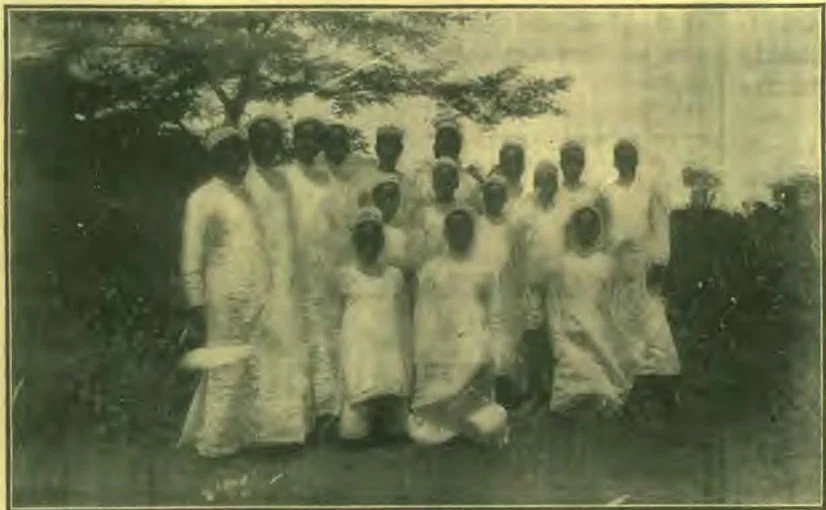
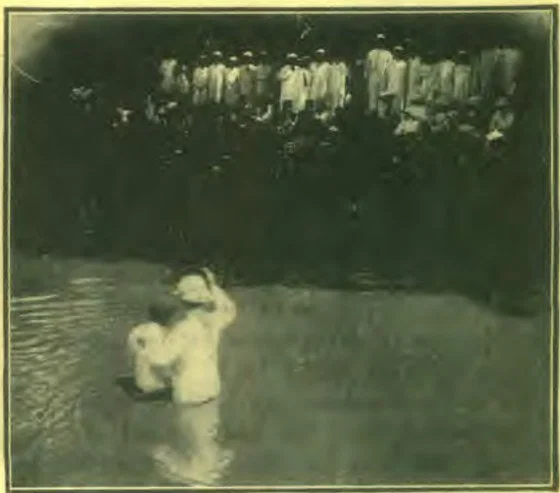
First-Fruits in Kisumu, Southeast Africa

Four and a half years ago work was started among the Kavirondo people. To-day there are eight workers connected with the two stations here. The first work was started at Gendia, and a little over two years later the station at Wire Hill, about fourteen miles to the southeast, was opened.
Sunday, May 28, we had the privilege of reaping the first-fruits of our work here. We gathered on the banks of a small river about a half a mile from the Gendia station for baptism. Brother Carscallen officiated. Sixteen of the boys followed their Lord into the watery grave. Ten of these were from Gendia, and six from Wire Hill.
After the baptism, as we all took part in the ordinances of the Lord’s house we felt that the Lord had been very near to us, and we felt more than repaid for all our efforts which had been put forth to save these people. Most of those who went forward have been with us between two and three years, and appear to be thoroly grounded in Christ. The trials they have already withstood because of their desire to follow the Lord, and the change in their daily life, show that they were ready for baptism.
This too is only the first-fruits. Already we are planning for baptism at the end of the year, when we are expecting between twenty and thirty more to follow these. Surely this ingathering of souls has filled the workers here with thanksgiving. But still we need the help of the prayers of all God’s people, that these dear souls may be kept, since they live in the midst of heathen darkness.
Mr. and Mrs. J. D. Baker.

Our Work and Workers

Words of cheer come from our great mission fields; but they are also words of need. It is common—it is almost the invariable rule—for our correspondents who are bearing great burdens in the mission field to say nothing of themselves or their own needs or deprivations, but they tell the needs of others. For instance, there is before us a private letter from a devoted young wife, who is pouring out of the abundance of her sweet, fresh life in one of the largest mission fields.
But not a murmur, not a thought for self, but a great full-hearted sympathy for each and all of her fellow workers, some of whom are spending their whole time in the midst of such squalor and insanitary surroundings as would not be tolerated in Chicago’s worst. But there is no complaint, no rebellious feeling indulged, just a deep heart-longing that the missionaries and workers may have better quarters. Our Chinese papers are printed in almost impossible conditions, in Chinese alleys, where in the hot, humid summer stirs not a zephyr of fresh sweet air, and the thousand stenches make life intolerable. Does it not move our hearts? God bless them—the dear young wife, the strong, patient young man, and all their fellow workers. And may God help us to appreciate that we have the privilege of being stewards for Him in this matter.
THE recent California camp-meeting, in Oakland, on the border-line of Berkeley, was a most excellent meeting, and the largest held for several years. The sermons were clear, strong, pointed, searching, spiritual. Many renewed with clearer conception their consecration, and there were many conversions. Thirteen were baptized; other candidates were referred to home churches. All branches of the work were considered, and several thousand dollars was raised for foreign and home mission work.
Candidates Ready for Baptism at Our Kisumu Mission
There were present the following ministers from other conferences: E. E. Andross, representing the union conference; A. J. Haysmer, the North American Negro Department; S. Mortenson, the Swedish work of North America; J. H. Behrens, president of Central California Conference; C. L. Taggart, president of Northern California-Nevada Conference; B. L. Howe, W. M. Healey, L. C. Warren, and others, besides those residing in the conference. Mrs. E. G. White, altho fourscore and six years of age, spoke several times, with power and freedom. This is the first great meeting since the division of the conference into three, and it fully demonstrated the wisdom of division, which ought to have taken place years before. Pastor E. W. Farnsworth takes the presidency of the conference under happy auspices in many respects. May it be a blessed year.
At the conclusion of a series of tent meetings at Muskegon, Michigan, six persons were baptized and taken into the church at that place; five new converts were recently baptized at Wolf Lake by Elder D. P. Wood; and Sabbath, July 8, six were baptized at Mt. Pleasant.
ELDER W. D. PARKHURST recently baptized three persons in the Whitebreast River, near Osceola, Iowa, and two persons have been baptized at Council Bluffs.
ON a recent Sabbath, the Swedish church of New York City had the privilege of seeing three souls follow their Lord in baptism.
A LETTER from Elder W. A. Spicer, secretary of our Foreign Mission Board, written at the beginning of our General Council in Europe, says that “the meeting was the largest gathering ever held by Seventh-day Adventists in Europe, and especially the largest council that was ever held. There have been some meetings held in America which were larger, but no gathering of this kind. There were about 2,000 present at the opening meeting of the tent.”
AT Riverside, California, a company of five adults followed their Lord in the ordinance of baptism, and a church of nineteen members was organized on June 17. Twelve of these were baptized recently as a result of a tent effort conducted in Farmington.
TWENTY-FIVE souls followed their Lord in baptism at the close of the camp-meeting held at Bozeman, Montana, and it is reported that several more went forward in baptism a few days later.
FOUR have been added to the church at Saginaw, North Dakota, and several have been baptized at Kief and Williston. Quite a number of Russians have also been baptized in that conference.
AT the camp-meeting at Holbrook, Nebraska, baptism was administered to three persons, and six others plan to be baptized at their home churches.
ELDER M. J. ALLEN baptized nine persons at Hamilton, Ontario, July 8, and one other was added to the church at that place.
AS a result of a series of tent meetings at New Orleans, Louisiana, eight souls have been baptized, and others are interested.
TEN adult persons have accepted the truth as a result of a series of meetings conducted at Johnston, South Carolina.
DURING a recent visit to Goldfield, Nevada, Elder F. I. Richardson had the pleasure of baptizing four persons.
FOUR souls have been baptized at Grove, Kentucky, where a church was recently dedicated.
DURING the Wyoming camp-meeting, Elder H. E. Reeder baptized four persons.
THREE persons have given their hearts to God and were baptized recently at Redding, California.
SEVEN German people have been baptized in Chicago, and two persons at Springfield, Illinois.
AS a result of meetings held at Young, New South Wales, six persons have been baptized.
IN the face of much opposition, six have taken their stand for the truth in Petone, New Zealand.
THREE souls were baptized Sabbath, July 1, and united with the church at Fresno, California.
Baptizing in Kisumu, S. E. Africa
TWENTY-NINE persons were baptized at the close of the New York camp-meeting, at Rome, New York, and nearly a score at the close of the meeting held at Dunkirk, New York.
FROM Iowa comes news of the baptism of eight young persons at Mt. Pleasant, and three at Oakland. Four have also accepted the truth at Cedar Rapids and four at Glenwood.
AT the camp-meeting at Harvey, North Dakota, sixty-one persons were buried with Christ in baptism, and a number of others were to be baptized later at their home churches.
AT the close of the Adelphian Academy, Holly, Michigan, seven students were baptized. At Shelby twelve persons have recently united with the church by baptism.
ELDER A. J. VERRILL reports five baptisms at Dyer Brook, Maine, and three persons went forward in this ordinance recently in the Portland church.
A CHURCH of eight members has been organized at Horace, Kansas, and five are keeping the Sabbath who it is expected will soon unite with the church.
AT San Marcial, New Mexico, five persons have been baptized, and two at Las Vegas.
JUNE 11, thirty-four souls were baptized at the camp-meeting at Seattle, Washington.
EIGHT persons have been recently baptized at Aledo, Illinois, and eight at Peoria.
THIRTY-EIGHT persons were baptized at the close of the Massachusetts camp-meeting.
ELDER L. H. PROCTOR reports the baptism of seven adults at Elmira, New York.
ELDER J. W. McComas recently baptized six candidates at Eagle Grove, Iowa.
ELDER D. T. Fero baptized six at Lodi, California, on Sabbath, July 8.
NINE persons were baptized at the camp-meeting at Norwich, Connecticut.
FOUR additions to the church at Skowhegan, Maine, are reported.
THREE have taken their stand for the truth at Syracuse, Nebraska.

By His Grace

I can not raise the dead, nor from this soil Pluck precious dust, nor bid the sleeping wake, Nor still the storm, nor bend the lightning back, Nor muffle up the thunder, nor bid the chains to fall From off creation's long-enfettered limbs. But I can live a life that tells on other lives, That makes the world less full of anguish and of pain; A life that, like a pebble dropped upon the sea, Sends its wide circles to a hundred shores. May such a life be mine! — Horatius Bonar.

A Magazine of Merit

Signs of the Times readers will be interested in the September number of the Signs of the Times Monthly. One article will be of special interest:
“Saying ‘Peace! Peace!’ Planning War! War!” by the editor. A vivid word picture of the intensity of the times and conditions.
“The Genesis of the Human Race,” by J. O. Corliss, is the first of a series of articles on this absorbing subject. You ought to follow them.
“What Is the Danger in the Use of Milk?” by H. F. Rand, M.D. Dr. Rand shows results of some recent investigations and experiments along this line, and they merit your careful consideration.
“The Six Days of Creation,” by J. B. Dimbleby. These studies in definite creation events will be continued in the same interesting style, showing the testimony of science as to what occurred on the first six days of creation week.
“How We Are Saved,” by George B. Starr. A candid answer to a serious question.
A number of others, all full of good, sound truth. Something of worth and quality in current events comment.
If the agent doesn’t call on you, send ten cents to the publishers for the September number.
Mountain View, Cal.
PUBLISHED WEEKLY
PUBLISHED WEEKLY

Mrs. Stuttle’s HOME SERIES

These three books by Mrs. L. D. Avery-Stuttle furnish to the parent a much-needed help in the instruction and entertainment of their children.

Making Home Happy

Pictures before the reader in interesting story form the relations that should exist and the lines of influence that should be guarded and cultivated in every home. (200 pp.)

Making Home Peaceful

Is the sequel to the above, and every one reading the first book will want to learn more about “Deacon Beardsley’s” family, and how an unhappy home was made peaceful. (227 pp.)

Those Bible Readings

While especially suited to the needs of the young, there is an attractiveness in the arrangement and presentation of these readings that will hold the interest of all, old and young. (206 pp.)
These books are beautifully bound and may be obtained singly at 75 cents each, or the entire set of three for $2.00.
Pacific Press Publishing Assn.
Mountain View, California
Portland, Ore. Calgary, Alberta Kansas City, Mo.

Wanted: Clean Copies of Adventist Periodicals

WANTED.— By W. D. Ayers, Coburg, Kentucky, clean copies of the SIGNS OF THE TIMES, Review and Herald, Youth’s Instructor, and Watchman, for missionary purposes.

Wanted: Clean Copies of Church Papers

WANTED.—Clean copies of all our papers for L. D. Miller, 514 Union Street, Greenville, Mississippi.

The LORD'S DAY

A Brief but Comprehensive Treatise covering the History and Doctrine of the Sabbath and Sunday

The LORD'S DAY

The Test of the Ages
Controversy from Creation to the Present. Truth supported by Scripture, Historical Fact, and Argument. A Multum in Parvo on the Sabbath Question. Illustrated; 128 pp.; price 10 cents post-paid.
PACIFIC PRESS Mountain View, Cal.

The Great Second Advent Movement.

By J. N. Loughborough. A late revision of the old book “Rise and Progress of Seventh-day Adventists.”
This book forms a most interesting and instructive narrative on the subject indicated by its title. Commencing with the early experiences of the Advent movement of 1843 and 1844, the writer, who has been actively engaged in proclaiming the doctrine since 1849, here presents a graphic account of the struggles and difficulties through which the pioneers were safely carried by their unwavering faith in God and their unfaltering loyalty to the cause they had espoused. Due attention has been given to those agencies which, in the providence of God, have aided in building up and preserving the work represented by this people. Illustrated, 480 pages. Cloth, $1.25.
Address this office.
Continue reading: Education: Principles and Practice for Every Reader