A Fleshless Diet From a Biblical and Christian Standpoint
By D. H. KRESS, M. D.
D. H. KRESS, M. D.
THE Bible nowhere states in so many words that men should not eat flesh; it nowhere states that men should not use tobacco or drink whisky; but it lays down principles which will lead men to forsake tobacco and everything else that is injurious. In regard to what we should eat, the Bible command is, “Eat ye that which is good.” There are certain foods which the Bible pronounces good, and there are those which are pronounced evil.
After man was created, he was placed in the garden, and lest he should put forth his hand and eat that which was not good, God said, “Behold, I have given you every herb bearing seed, which is upon the face of all the earth, and every tree, in the which is the fruit of a tree yielding seed; to you it shall be for meat.” This was the meat given to mankind by the Creator, “and God saw everything that he had made, and, behold, it was very good.” Gen. 1:29, 31.
Man was good, and the food created for him was good. This, then, is the proper food above all foods, created to be received with thanksgiving by them who believe and know the truth, for it is sanctified (set apart for man’s use) by the word of God. True science agrees that all the food elements needed by man are to be found in these simple and natural foods, and in a purer form than it is possible to obtain them elsewhere.
There are two other foods which may be classified as natural foods—milk and eggs. One forms the natural food for the young mammal, the other for the young bird. Both are, therefore, natural foods, and may be used by man, but even these are more or less subject to disease, and not so well adapted for man’s use.
It is true, flesh may be used as a food, for it contains food elements; but it contains in addition uric acid poison and other impurities and body wastes, which make it impossible to term it a good food. In addition, disease itself frequently lurks in it, for few animals are free from disease.
When the Lord took the children of Israel out of Egypt to lead them to the land of Canaan and establish them there a healthy and holy people, he attempted to wean them from the use of flesh food. It was accordingly withheld, and food which was most conducive to health and to the development of a righteous character was provided for them. “But with many of them God was not well pleased.” They lusted after flesh, and would have it at any cost. Their desire was granted, but it brought with it disease and leanness of soul. The apostle Paul, in referring to this experience, says, “Now these things were our examples, to the intent we should not lust after evil things, as they also lusted.” 1 Cor. 10:6.
Had the children of Israel submitted to God’s plan and not lusted after evil things, the statutes regulating the eating of flesh would never have been necessary. God had to take short steps by their side. He could lead them no faster than they were willing to follow his instruction. When they were determined to eat flesh, statutes were given them that they might differentiate between the more harmful and the less harmful, or between clean and unclean animals.
It is true Christ fed the multitude on bread and fish. He gave them their accustomed food; he merely took what they had and multiplied it. Forced reforms are of no benefit. Reforms must be the outgrowth of conviction and education in order to be a blessing. Food to be of value must appeal to the mind as well as to the organs of digestion. He gave to this multitude what they longed for, probably the only food that would satisfy them. Inferior food with a satisfied mind, is better than the best food with discontent. God grants us permission to-day, as he did to Israel anciently and to the multitude, to eat what we desire, but he still desires all to become intelligent on the food question, and to eat “that which is good.”
Wahroonga, N. S. W.
What the Mothers Do.
By Mary L. C. Robinson
PLAYING with the little people
Sweet old games forever new;
Coaxing, cuddling, cooing, kissing,
Baby's every grief dismissing,
Laughing, sighing, soothing, singing,
While the happy days are winging—
That is what the mothers do.
Planning for the little people
That they may grow brave and true;
Active brain and busy fingers,
While the precious seedtime lingers,
Guiding, guarding, hoping, fearing;
Waiting for the harvest nearing—
That is what the mothers do.
Praying for the little people
(Closed are eyes of brown and blue),
By the quiet bedside kneeling
With a trustful, sure appealing;
All the Spirit's guiding needing,
Seeking it with earnest pleading—
That is what the mothers do.
Parting from the little people,
(Heart of mine, how fast they grow!)
Fashioning the wedding dresses,
Treasuring the last caresses;
Waiting, then, as years fly faster,
For the summons of the Master—
That is what the mothers do.
—Mary L. C. Robinson, in Sunday School Times.
Take the Children to Church
“SHOULD little children be taken to church?”—Certainly. Begin early and keep it up constantly. “But suppose they do not understand anything about the service?”—No matter about that; take them. The habit of going is a good one. Besides, the very atmosphere will benefit their natures. “But suppose they disturb others?”—That will be your fault; nevertheless take them. “But suppose they cry and act wilfully, and are very naughty?”—That is no excuse for leaving them at home. It may show several unpleasant things, but keep on taking them.
It may possibly show (1) that they inherit from you a fretful disposition; (2) that in your eagerness to make them look pretty you have dressed them uncomfortably; (3) that they may be ill from lack of sleep or from improper feeding; (4) that they are so full of life and exuberance of spirits that they must be in action. This last is very hopeful. Whatever be the case, do not fail to take them Sabbath after Sabbath, year in and year out. In some cases sit near the door, and step out with a child for a few minutes rather than have others annoyed.
“But some people say they were taken to church so much when they were young that they now dislike church.” Ten times more dislike church because they were not taken when young. This excuse for neglect is probably manufactured, and is not given in sincerity. Take all the children to church.—Selected.
A Child’s Teeth
A CHILD’S teeth should receive attention as soon as they are through. While the child has only liquid food, the ordinary mouth-washing will answer, but as soon as he begins to take solid food of any kind, there will be trouble if care is not exercised. The softest of tooth-brushes should be used on the teeth, and one that is very narrow. Clean the little teeth carefully twice each day, brushing up and down as well as across the teeth. When there are double teeth, be careful to have the child open his mouth far enough to brush across the crown, as there are many little crevices here in which the food may hide. See that every particle of food is dislodged, especially the foods that form a pasty mass in the mouth, such as crackers, cereals, etc., for it is the tiny portions of this kind of food which lodge in and between the teeth, causing decay. It is not necessary to use tooth washes, powders, or pastes to clean the teeth of children; water will suffice. Never use extremely cold or hot water. Decay begins from the outside of the tooth, not inside, and good sound teeth depend largely on the every-day care of the mouth.—Harper’s Bazar.
The General Meeting in Finland
By L. R. CONRADI
L. R. CONRADI
SEPTEMBER 29 the writer set out for an extended tour in Russia. There were to be no less than five general meetings in that empire, besides our visit to the city of Tiflis, in Trans-Caucasus. This would take us from the extreme north14to the extreme south, and from the far western to the very eastern border, of European Russia.
Our first Sabbath away from home was spent with the Berlin church. I found their neat and centrally located chapel well crowded. They were having their quarterly meeting at the time. Elder Frauchiger baptized sixteen, who had recently accepted the message. The Berlin church is the largest we have in the German Union; it contains a membership of three hundred and thirty-eight.
Sunday and Monday were spent in Dantzig and Konigsberg. At the latter place I met Elder Oblander, from whom I learned that the church there had also celebrated baptism the previous Sabbath, and now numbers eighty-three.
October 3 I crossed the border at Wirballen, and reached St. Petersburg next morning, making a distance of five hundred miles from the border, or one thousand one hundred and forty-five miles from Hamburg. Elder Wildgrube met me at the train. For the first time in my experience I rode with him right up to his lodging, took my valise in my hand, and accompanied him up the stairs to his dwelling. (Formerly he would always go ahead with the luggage, and I would quietly come in later alone, that I might not be observed.) We spent the day in careful counsel about the arrangements for the coming meeting, without fear of molestation, for the day of greater freedom to our work had arrived.
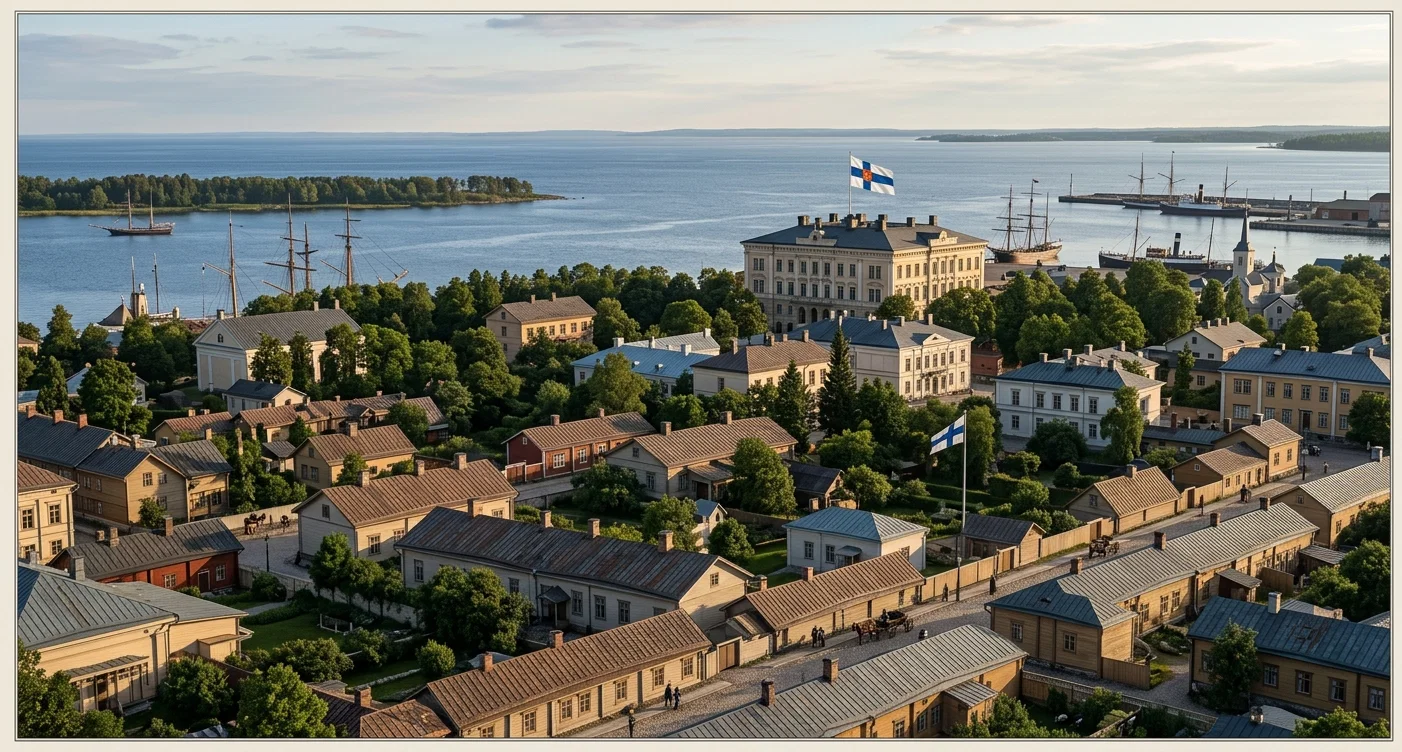
As evening drew on, I left the city for Vasa, or, as the Russians have renamed it, Nikolaistadt, which is situated nearly five hundred miles northwest of St. Petersburg. When I reached my destination at midnight, the fifth, Elder F. Anderson, in charge of the Finnish Mission, Brother Jens Olsen, treasurer of the Scandinavian Union, and Brother A. Boettcher, manager of the Helsingfors publishing house, met me at the station. Their meetings were already in progress. Vasa is quite a thriving seaport, nicely laid out, and contains about 15,600 inhabitants.
This is the first time we ever held a general meeting so far north in Europe, or, in fact, anywhere else, showing the advancement the work has made toward the polar regions. The meetings were held in the Firemen’s Hall. As many as three hundred attended our evening services.
We were glad to welcome at this time Elder Oberg and Brother O. Anderson, both of Sweden, who had recently arrived to join the force of workers in this field. God has richly blessed the work in Finland the past year; the prospects now are brighter than ever before. Of the one hundred Sabbath-keepers in this mission, about fifty were able to come to the meeting,—an excellent meeting it was, too, and all the workers seemed of good courage. We were glad to learn that quite a number had been baptized the past year.
One of the most encouraging features of the work here is the rapid growth of the publishing work. The Finnish paper now has a circulation of five thousand, and is more than paying its way. Recently our brethren in Helsingfors have published the book on “Revelation,” translated from the German into the Finnish, and during the first two months the canvassers sold over six hundred copies, a record they had never been able to make in the sale of any other book. The Helsingfors house is now getting out a Swedish edition.
GENERAL VIEW OF VASA
We were glad to notice among the canvassers some native Finns. Although we have now been laboring many years in Finland, yet our efforts have been almost wholly confined to the 354,000 Swedish-speaking people of the land, and we have done comparatively little for the 2,381,000 Finns. The Swedes are scattered in the towns along the coast. At this meeting, definite plans were laid to enter work among the Finns of the interior. As the canvassing work has been attended by such good results, we feel encouraged to believe that the preaching of the word will bring forth fruit. Elder F. Anderson was unanimously chosen as director of the Finnish Mission. He is assisted by one minister, and three other evangelical workers. Brother Jens Olsen, who had come up from Copenhagen to audit the books, reported everything in good shape, and the business growing. Sunday night I spoke to a large congregation upon our missions in general, and the people donated liberally to the work in German East Africa.
So far as the political situation is concerned, the only change we saw was that the Russian government had dismissed the Finnish militia, and in their stead sent ten thousand Russian soldiers into the country. This was the first real sign we had that the government entertained serious fears of trouble. Hidden depots of arms had been discovered among the islands. We little dreamed that a few weeks later the Russian governor would be a prisoner in the hands of the citizens, and would be obliged to flee from the country in a man-of-war. The train was crowded with emigrants, mostly promising young men bound for America to escape the military service.
As we had but recently published a Russian edition of “Steps to Christ,” in the city of Helsingfors, I secured about five pounds of Russian literature, and carried it over the border with me on my return to St. Petersburg. The snow had already begun to fall during the night—the first signs I saw of the approaching winter. Passing the border safely, I was again in the city of St. Petersburg the night of the tenth.
During this trip I had quite a long conversation with an intelligent gentleman, well acquainted with the situation in the Russian empire. He said that before the Russo-Japanese War, the masses hardly ever read a newspaper, but during the war the people became so interested that they would go to the trains and beg the passengers for newspapers giving them the latest news. Thus, people who could scarcely spell the words out, would secure the paper, and try to decipher the news. As a result, there has been a great demand for literature, and a mighty awakening among a people who have been slumbering so long. What this gentleman said, I soon found confirmed. There has been a wonderful change all over Russia. Everybody was demanding literature that would give them information and make them intelligent. This very thing ought to impress upon us the fact that now is just the time for us to circulate literature that will bring the third angel’s message to the one hundred and thirty-five millions of human beings inhabiting this mighty empire.
Huahine, Society Islands
By B. J. CADY
B. J. CADY
HUAHINE is the fourth island in size in the Society group, and lies in the leeward division, about twenty-eight miles across from Raiatea and Tahea. Instead of being one island, it is really two, but separated by only a narrow, shallow strait, across which people can easily wade. As viewed from the sea, it appears to be all one island. While Raiatea is larger and more compact, the surface of Huahine is very irregular, divided and broken, and it has a number of very deep bays. There is not nearly so good a supply of fresh water as on Raiatea and Tahiti.
THE NATIVE VILLAGE OF MAEVA ON HUAHINE
We came to Huahine four weeks ago, and as the Lord has opened the way for us all along, in helping us to get here, in furnishing us a comfortable house to live in, and in giving us the good will of the people, we believe that he surely has a work for us to do, and we are glad that we are here. These people have more simple manners than do the natives of some of the other islands, and do not appear so proud. There is but little prejudice. We need wisdom and grace to so present the truth to them that some, at least, may see its importance and be constrained to obey.
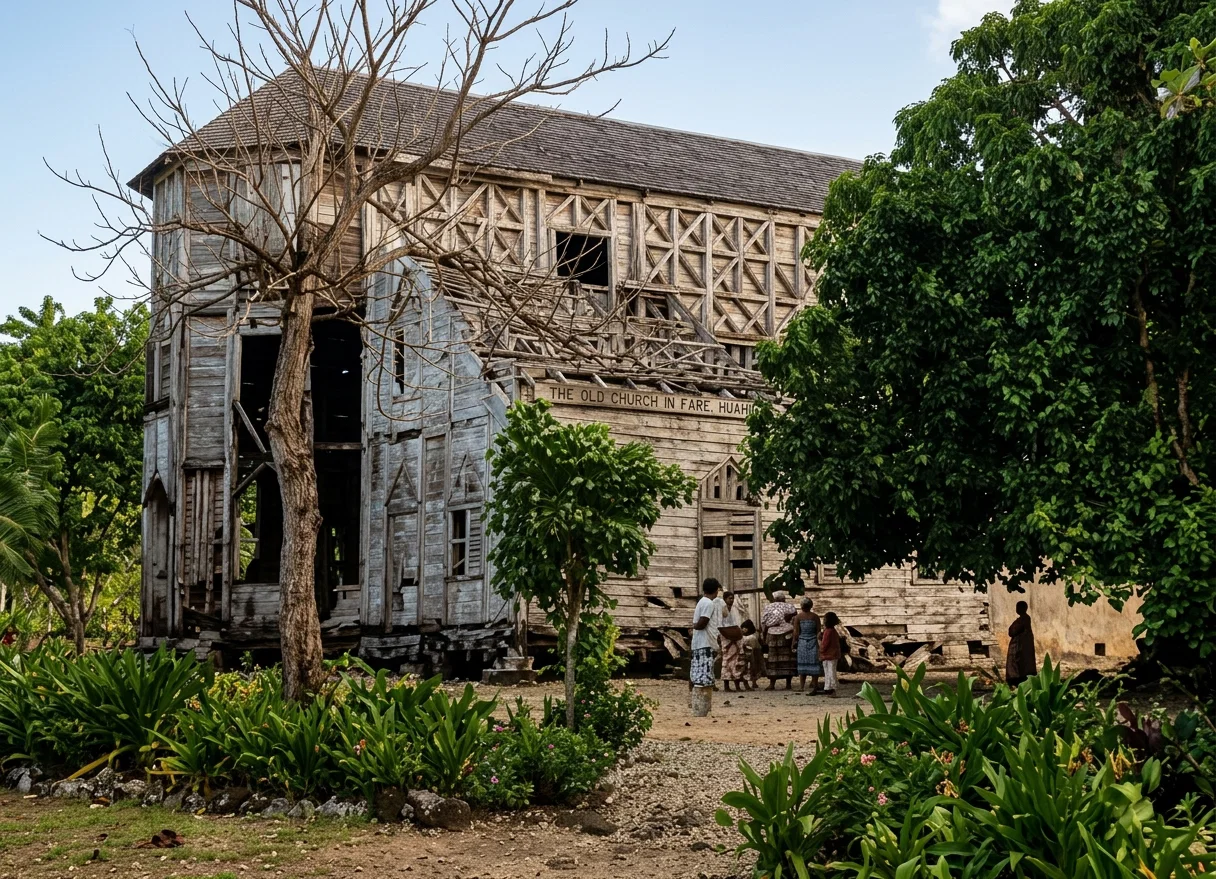
THE OLD CHURCH IN FARE
Huahine boasts of eight church buildings, erected to accommodate the people in the various districts, not the different denominations, for as yet there is but one religion here strong enough to have a church. The natives know nothing of the Presbyterian, Episcopalian, and Congregational creeds.
In these islands, no difference is made between these religions; they are only designated as Protestant. The present leaders of this people are missionaries of a society in France, and they call their church the Protestant, to distinguish it from the Catholic, which religion was early introduced into Tahiti by the French. The church in this town of Fare, which is the principal settlement, is shown in an accompanying picture. It is large, and was once a fine building, but is now in an advanced state of decay. Though the thatched roof has decayed and fallen in in many places, leaving the rafters bare, and letting the sunshine and rain in, they still use it for their meetings, and have no other building for that purpose.
There are two ministers, one for each division of the island, with many deacons to assist them. We have had some interesting visits with the minister in Fare. It has been only a few months since he came from their ministerial school in Tahiti, where he has spent four years. He has treated us very kindly, and, like his people, he thinks our religion is the same as theirs, the Sabbath being about the only difference. We invited him to come and study with us the points of religion upon which we differ, so he appointed a certain evening at seven o'clock. As he wished to be able to discuss these matters unmolested, and so did not want a crowd of curious spectators, we sent many away that evening while waiting for him to come. We waited till after nine o'clock, and thinking he would not come, retired. Soon after, I was awakened by a rapping on the door, and upon opening it, found the minister and his wife, and two of their relatives. He had come at this late hour to fill his appointment. We talked with him until after midnight, showing to him from the Bible that we are living in the last days of this world's history, and also that Saturday is the Sabbath of the Lord, and the day he would have us observe. In a mild way, he took the position that we were wrong, but all he could say in regard to this not being the time of the end was to ask repeatedly, “Where is a text that says that this is the time of the end?” We told him that the Lord does not name the year, but only gives many signs by which we may know that we are near the end, and we read him scripture after scripture describing conditions which now exist on the earth, and which the Lord plainly stated would be in the last days. He also took the stand that Sunday is the seventh day. The Tahitian name given by the early missionaries to Sunday means Sabbath, and they have no other name for the day. According to the names given at the same time to the other days, Thursday is the fourth day, Friday the fifth day, and Saturday the preparation day. So this man claimed to believe that Sunday was the real seventh day, although the leader of his church, in a book he has edited in the native tongue, calls Sunday the first day, and says they keep it because Christ was raised on that day. We hope to have more talks with this minister.
The native people have very little order and system. They can lie down and sleep anywhere and at any time, neither do they have regular times for eating. We have company at all hours of the day, and sometimes they come before we get out of bed in the morning. Our most frequent visitors are the children. There is no school for them just now. In fact, they have only a few weeks of schooling during the year. And as they have no training at home, they are left to grow up as they may. We often feel impressed with the thought that they are indeed as sheep without a shepherd, and our hearts go out in love and pity for them.
We are trying to sow the seeds of truth at every opportunity, for we know not where it might find a lodgment in good soil and grow and bear fruit. It seems as if there must be some honest hearts on Huahine, and we purpose to do our part of the work, trusting that God will give the increase.
News From Haran—6
By Z. G. Baharian
Z. G. BAHARIAN
OUR sixth trial was on May 8. The clerk was commanded to read a letter, the manuscript of which was given us to review. It was from Brother G. Tatarian, Adrianople, to Brother A. Ouzounian, Adana. This letter was among Brother Buzugherian’s writings when his room was searched. The objectionable part was the following words: “My attention was called to the place where you are. The people, you say, are all Mohammedans. Well, light shone to them that sat in darkness.” Brother Ouzounian was a carpenter, and in summer would go to Moslem villages to work. This he had written to Brother Tatarian, who also in return expressed his joy, seeing that he might be a light to them. From these words the Moslem members of the court saw more clearly that we had a desire for Mohammedans, also, that they might be Christianized. When Brother Buzugherian was asked concerning these words, he opened his Bible, and read Matt. 4: 12-16, and explained that all who are without Christ sit in darkness, and that when a Christian goes to them with the light of the Bible, light shines on them.15This explanation added to their anger, seeing that we believe and say that Mohammedans are a people sitting in darkness.
The presiding judge then handed another letter to the clerk, to be read. It was written by me several years ago, to Brother Buzugherian. In it I had said: “I am sowing seeds in Constantinople. Would that I had seen the fruit, also.” The president asked me what seeds I sowed. “This is a dark word,” he said; “it may be that you sow seeds of corruption, to corrupt the people against the government.” To this I replied that I am a minister of the gospel, and sow only the seeds of the gospel. Then I opened my Bible, and read to them the parable of the sower, showing that the seed is the word of God, and the preaching of the word is to sow seeds. As there are seeds of corruption to corrupt, so there are seeds of truth to revive. As I was residing in Constantinople, I was there sowing the seeds of truth, I being a minister of the gospel. “What is the fruit,” the president inquired of me, “you desire to see?” I answered, “To see the people obey the truth.” “Did you have any fruit in Constantinople?” “Yes,” I answered, “and I would like to have much more.” “Why do you use such dark words which can be taken in a political sense, also? Why do you not write simply that you preach the word of God?” To this I answered that I had used the Bible allegories, especially to the one who was a preacher, just as I am. It is well known among the Christians that the seed is the word of God. Ask it of any Protestant child, and at once he will tell you. If I had written my letter to a Mohammedan who did not know our Bible expressions, surely I would have used simple language.
Then the president handed the clerk another letter to read. It was from Brother Guy Dail to me, written Aug. 11, 1904. Brother Dail had sent it to Aintab, not knowing that I had been arrested and sent to Ourfa. My father got the letter, and sent it to me at Ourfa; but he made a mistake in addressing it, so it fell into the hands of the general attorney, and was delivered to the court. It was read, but contained nothing political, simply some Christian communionship and my financial standing. This letter was taken as a testimony that I had correspondence with Europe. It was true that I had, but it was not against the government. I explained our relation with Hamburg, the office of Brother Dail, and why we correspond with each other. The time was up, and our trial was deferred to another day.
Aintab, Turkey.
Indiana
By B. HAGLE
APRIL 4 we began work in Medaryville, and after laboring there nearly three months, a church of twenty-two members was organized. Brother J. F. Steele assisted in the work at this place.
I was then called to Royal Center to join Elder J. C. Harris in a tent effort. We were at this place about three months. A few embraced the truth, and a church of eleven members was organized. It was then time for our annual camp-meeting, and surely it was a feast of good things to my soul. Since the camp-meeting I have visited several places.
In Logansport, where there has been a company of believers for a number of years, but no organization, a church of thirteen members was organized. Elder W. J. Stone officiated at each place. December 3 a meeting was appointed to consider the matter of erecting a church building in Logansport. There were only a few present, but the Spirit of the Lord came into the meeting, and seven hundred and twenty-five dollars was donated for the work. They expect to build in the spring.
We held a two-weeks’ meeting with the church at Lafayette, and the blessing of the Lord rested upon this effort, and some who had not attended meetings for years came. Some united with the church, and an elder and a deacon were elected. The ordinances were celebrated, a privilege they had not had for some time.
We next visited Walkerton, where we held a two-weeks’ meeting. This church had been neglected, and only six met on the Sabbath. God came very near, and a general revival was experienced. Some backsliders returned, and two for the first time took their stand for the truth. One united with the church; an elder was elected, the ordinances were celebrated, and we believe there are better days for the church.
The third angel’s message was the theme in all these places. We met with plenty of opposition in each place, but the Lord has promised to be with us unto the end; we took him at his word, and were not disappointed, for he has promised to take the weak things to confound the mighty. Praise his holy name.
B. HAGLE.
Jamaica
By A. N. DURRANT
CLARENDON.—Another conference year will soon be in the past, but we can say that it has been a profitable one, for which we thank and praise our Heavenly Father. The message is onward, penetrating the dark corners, and sounding over mountains and plains. The accessions this year are none the less than other years, and the spirituality of the churches seems reviving, even though here and there we find some sleeping. The lessons on the tithing system have been a blessing to us here, waking up nearly all to the responsibility of giving to the Lord his own.
In this parish, about forty have accepted the truth this year; but there is not one finished house of worship here, hence the companies at Moores, Waterlane, and Portland are anxious to build. In a place where a laboring man gets only twenty-five cents a day (sometimes seventy-five cents a week), toiling in the burning sun from six in the morning until six in the evening for the support of a family, it means much to build.
Four sisters of the last-mentioned company were fined $2.28 last July for Sunday work, being maliciously prosecuted.
The tent we have been using here is no more; and as Brother Hall, my former coworker, is now on the island of Grand Cayman, I go from place to place, while I await another helper, and a tent if one can be procured.
We have given up Brother Tanner to the Mission Board for Hayti, and will support Brother Hall in the Caymans, and we are also looking to the Turks Island group. As these islands are dependencies of our government, we feel that they are also dependent on us for present truth.
Three weeks ago two nurses, Brother Manful and his wife, came to Kingston to give house-to-house treatments. Brother Manful counseled with a leading physician of the city, who assured him that if any of our doctors would come here and start sanitarian work, laying out a few thousand dollars, the16institution would prosper; he also said that he would send patients there. He has visited one of our sanitariums in the States. As Brother Manful had not sufficient money to start the work, he was forced to return. Shall the higher class of people who are prejudiced against going to our churches and tent-meetings die without hearing of deliverance from sin and bad habits? Will not some of our brethren come to their rescue now?
A. N. DURRANT.
Sabbath-Keeper on Turks Island
ELDER J. B. BECKNER reports one Sabbath-keeper on Turks Island. He says they want to send a man there, as they understand that the people are stirred up over the Sabbath question. Truly, the Lord is going ahead of us in nearly every place.
Chile
By E. W. THOMANN
COPIAPO.—About four and a half months ago I left Valparaiso, accompanying Elder Westphal on a visit to our people in the northern provinces of Chile. We had precious experiences. Several new workers began to labor in the Master's cause, and in different places we could bury precious souls with Jesus in baptism. At Antofagasta we organized the little company into a church, and one brother, who formerly worked farther north, came there and was ordained as elder. The other brother, who was working principally for this company, offered himself as a self-supporting missionary to Bolivia. We accepted the offer, and we hope the Lord will use the earnest efforts of this young brother and his wife to his glory.
Besides my editorial work, I took over four hundred subscriptions for our missionary paper, the Señales de los Tiempos, and also sold over one thousand single copies. One day I sold ninety-eight single copies, besides taking some renewal subscriptions. At another time I took eighty-one subscriptions and sold ninety-three single copies and two Bibles in four days. In another town I took over forty subscriptions in two half days in the railroad shops.
Doors are wide open for our literature now. We should have one hundred colporteurs and canvassers where we have only one. I am not tired of the work, but I need help, for I can not properly look after all branches of the work.
E. W. THOMANN.
South Africa
By Thomas H. Branch
PLAINFIELD MISSION, CHOLO.—The twenty-ninth day of August marked the close of our three-years' service at this station; and as we take into consideration all the work,—the changes, the blessings, the failures, the disappointments, and yet the successes,—we can but say, “Praise God, from whom all blessings flow.” In these past three years there has been much sickness with the fever, but there have been only two deaths—that of our late Brother Watson, and a native child. While we have been made sad at the cutting short of the work of our colaborer, we believe that he will come forth at the first resurrection, and receive his reward with the “Well done,” for God alone knows why he permits these afflictions. We are willing to labor and trust in the Lord, knowing that the work is his.
The past three years have been years of blessing—just the very best that the Lord could do for us; and to the very best of my ability, the third angel's message has been given to the people. We have gone by twos, fours, and sixes to the villages with this message, that there might not be one who should not hear of our dear Saviour's soon return to this earth. These oft-repeated visits to the villages have resulted in a marked change in the village life,—cleanliness of habits in their dress and in their huts,—and in a better attendance at the church services.
Some of the village boys have left off the old customs of life, with dancing and beer drinking, and even go with the mission boys on Sabbath to visit other villages, and help with the services. This is a great deal to praise the Lord for, when we think from what depths of sin these young men have come. There are a goodly number who are able to read the Bible. There have not been any great pretensions made on their part as to conversion, yet there is that slow, steady searching of the Scriptures. It is true, “There are many coming and going, yet few are entering in.”
Our school work is still moving on nicely. Some of our village pupils are leaving the school, as this is the time to gather the hut-tax money. There are only about twenty-two boys staying at the mission, and attending school. I am still giving Bible lessons every night. The boys and women attend, and I can see that the boys are taking more interest in their studies than usual. They are helping one another more, by studying together.
I have been very busy, reroofing all the houses on the station, as the rains of last year left the roofs in a weakened condition. I am clearing out some of the trees around the mission, and getting things generally in shape, as it is time to prepare to plant again. We raised very little last year—about twelve tons of corn, and twenty sacks of peanuts, and some beans and potatoes. We have had enough to feed our boys, and I think I shall be able to sell some of the corn, by being careful and economizing, as we are in need of material aid, and feel that we must try to help ourselves all we can.
God is certainly blessing in many ways. Our health is very good, and our courage is strong in the service of the Master. The general health of the natives in our schools is good. The mission cattle are doing well, and I think soon they will be of some income to the estate. I am not paying my boys large salaries. That is why I do not have so many of them. While they know neither the true use nor value of money, they have a greed for it, and when they get it, it soon goes, like that of the prodigal son, in riotous living.
I have been giving the boys a series of lessons on the tithing question, and I am glad to report that some of them are seeing the light, and are paying their tithe. They come bringing their one, two, or three pennies, according to their wages. This is quite a bit to them, when we consider that they receive from thirty-six to seventy-two cents a month.
We were all made very happy the first day of September, when we received our first news from the General Conference. It did our souls much good to read the good reports of the work far and near. We are sure that the meeting had its significance, and I believe that a greater impetus will be given to the message. Truly, we are living in the last days, and that part of the work which remains to be done must be executed with great diligence. Pray for us, and the work here, that all that we do may be wrought in God.