The Bible contains many instances of fasting and prayer. Prophets, patriarchs, and apostles have in this manner sought the Lord at different times. Our Lord and Saviour himself fasted and prayed. This mode of seeking the Lord was especially resorted to in times of great distress, or under other peculiar circumstances, when either a people or an individual felt a deep sense of sin, and made earnest work in repenting and turning to God. The Lord exhorts his people thus to seek him: “Therefore also now, saith the Lord, turn ye even to me with all your heart, and with fasting, and with weeping, and with mourning.” Joel 2:12.
It may be interesting to note a few instances where seeking God by fasting, with prayer, was resorted to: “So the people of Nineveh believed God, and proclaimed a fast, and put on sackcloth, from the greatest of them even to the least of them.” Jonah 3:5. And the result of this effort is recorded as follows: “And God saw their works, that they turned from their evil way; and God repented of the evil, that he had said that he would do unto them; and he did it not.” Verse 10. On a certain occasion, Jehoshaphat, the king of Judah, proclaimed a fast. “And Jehoshaphat feared, and set himself to seek the Lord, and proclaimed a fast throughout all Judah. And Judah gathered themselves together, to ask help of the Lord: even out of all the cities of Judah they came to seek the Lord.”
Among individual cases, that of the prophet Daniel stands out prominently: “And I set my face unto the Lord God, to seek by prayer and supplications, with fasting, and sackcloth, and ashes: and I prayed unto the Lord my God, and made my confession.” Dan. 9:3, 4. In all cases where men individually or collectively have thus sought the Lord, their supplications have been heard, their sins pardoned, and God’s power manifested in their deliverance.
But fasting, as well as other exercises of religion, has been put to a wrong use. Men have engaged in it thinking thereby to merit the divine favor. The Pharisees sought in this manner to make a parade of their religious fervor before men, and thus have themselves thought very pious. This is nothing but hypocrisy, and an abomination before the Lord.
Christ has given us instruction as to how we shall conduct ourselves in fasting, as well as in praying and almsgiving: “Moreover when ye fast, be not, as the hypocrites, of a sad countenance: for they disfigure their faces, that they may appear unto men to fast. Verily I say unto you, They have their reward. But thou, when thou fastest, anoint thine head, and wash thy face; that thou appear not unto men to fast, but unto thy Father which is in secret: and thy Father, which seeth in secret, shall reward thee openly.” Matt. 6:16-18.
No worship performed to be seen of men and merit their praise, can be acceptable to God; but when we seek him with contrition of heart, and an earnest longing after his righteousness, we shall not be turned away empty-handed. The present time demands earnestness. Never were we more needy of God’s favor and blessing. The perils of the last days are fast increasing about us, and we are in the greatest danger of being so blinded by sin and love of the world as not to discern clearly the subtle workings of Satan; but if God’s people will now awake and seek him with earnestness of heart, we shall see his salvation.
Daniel prayed, fasted, and confessed his sin, and the sin of his people. God answered, and worked deliverance. It was an urgent matter with Daniel, for he continued for three full weeks. Then the angel brought this comforting message: “Fear not, Daniel: for from the first day that thou didst set thine heart to understand, and to chasten thyself before thy God, thy words were heard, and I am come for thy words.” Dan. 10:12.
God is just as ready to hear now, and will answer his people to-day as freely as in the past, if only we seek him with all the heart. “Ho, every one that thirsteth, come ye to the waters, and he that hath no money; come ye, buy, and eat; yea, come, buy wine and milk without money and without price. Wherefore do ye spend money for that which is not bread? and your labor for that which satisfieth not? hearken diligently unto me, and eat ye that which is good, and let your soul delight itself in fatness.” Isa. 55:1, 2. O. A. O.
THE FALL OF SATAN
By Stephen N. Haskell
THE ORIGINAL COUNCIL BETWEEN THE FATHER AND THE SON.—NO. 2.
THE FALL OF SATAN.
The council between the Father and the Son beginning before angels were created, it was exclusive of all created intelligences. It was hid in God, and would be revealed by Christ in creation and in the manifold works of God, to meet man in his varied conditions.
Satan was not satisfied that Christ should “be in such close conference with God, and he be uninformed as to the result of their frequent consultations. God informs Satan that this he can never know, that to his son will he reveal his secret purposes, and that all the family of heaven, Satan not excepted, were required to yield implicit obedience.” (“Facts of Faith,” p. 38.) To this Satan would not consent, and concerning his fall we read: “For thou hast said in thine heart, I will ascend into heaven, I will exalt my throne above the stars of God.”
Satan himself was the “day star.” (See margin of Isa. 14 : 12.) And he said, “I will exalt my throne above the stars of God: I will sit also upon the mount of the congregation, in the sides of the north: I will ascend above the heights of the clouds; I will be like the Most High.” Isa. 14 : 13, 14. Again: “Thus saith the Lord God; Because thine heart is lifted up, and thou hast said, I am a God, I sit in the seat of God, in the midst of the seas; yet thou art a man, and not God, though thou set thine heart as the heart of God.” Eze. 28 : 2.
Christ being above the law, was the only one in all the universe of God who was like God in nature, the only one who could redeem man, and the only one who was in the secret counsel of God. Because Satan could not ascend to this position and sit in the council concerning the purposes of God in the creation of this world, he sought by force to gain admission into God’s private council-chamber, where none might be but the Father and his Son Jesus Christ. Satan was envious of Christ, and gradually assumed command which devolved on Christ alone. The result was, he was cast out of heaven. But the council between the Father and the Son continued, notwithstanding Satan had rebelled, and was cast out of heaven. “Christ had been taken into the special counsel of God in regard to his plans, while Satan was unacquainted with them. He did not understand, neither was he permitted to know, the purposes of God.” (“Spirit of Prophecy,” Vol. I, p. 18.) Here was the cause of Satan’s rebellion in heaven. When he “learned the purpose of God, he was envious at Christ and jealous because the Father had not consulted him in regard to the creation of man.” (“Spiritual Gifts,” p. 36.) He secured many sympathizers among the angels by first dropping the seeds of disaffection, and then gradually enticing them to follow him. Was he not “the anointed cherub that covereth”? Had not God said, “Thou sealest up the sum, full of wisdom, and perfect in beauty”? And “Satan exultingly pointed to his sympathizers, comprising nearly one half of all the angels, and exclaimed, ‘These are with me! Will you expel these also, and make such a void in heaven?’” (“Spirit of Prophecy,” Vol. I, p. 22.)
Such was Satan’s reasoning. But the crisis came when the angels were summoned to appear before God, and the decision was rendered that the rebellious ones should be cast out of heaven. “And there was war in heaven: Michael and his angels fought against the dragon; and the dragon fought and his angels, and prevailed not; neither was their place found any more in heaven.” Rev. 12 : 7, 8. The final judgment was not passed upon him, but he was removed from his position, and cast out of heaven: “God spared not the angels that sinned, but cast them down to hell, and delivered them into chains of darkness, to be reserved unto judgment.” 2 Peter 2 : 4. Again, “The angels which kept not their first estate, but left their own habitation, he hath reserved in everlasting chains under darkness unto the judgment of the great day.” Jude 6. In the council between the Father and the Son, the place of punishment and the time of judgment were therefore provided for the devil and his angels, in case sin should enter the universe of God.
S. N. H.
TO CORRESPONDENTS.
By G. C. T.
95.—Where can I get a good, plain history of Sunday origin? T. W.
The best book of the kind of which we have any knowledge is the “History of the Sabbath,” published at this Office. If the correspondent had sent his name, we would be glad to forward him a catalogue, which would give him the name of several books and tracts on the same subject. By application to the REVIEW AND HERALD, such a catalogue will be sent to any address. The price of the book in pamphlet form is seventy-five cents; cloth, $2.00.
96.—Is it proper for a church clerk, in making out a quarterly report to the conference, to include those members that were received or dropped at the last quarterly meeting? or should it include only the changes made during the quarter? L. W.
That would depend upon which quarter the quarterly meeting pertained to. If the quarterly meeting is at the close of the quarter, then the transactions of that meeting would be included in the report to the conference secretary. If the quarterly meeting marked the beginning of the new quarter, then its transactions would come in the next report. We think that the latter is generally the case, and that the report which is presented to the conference would be similar to the one presented to the church at the quarterly meeting, which would appropriately represent the work and the business of the quarter, including the previous quarterly meeting, but not the last.
We suppose our correspondent means James 1:13. The first text states that Christ was tempted in all points like as we are; the second one says that God cannot be tempted with evil. There can be no temptation of the divine nature. It has no inclination to do wrong, and necessarily repels every wrong suggestion. Not so with human nature. Human nature is subject to the power of temptation; and Heb. 4:15 refers to that wonderful condescension of the divine nature when it temporarily took upon itself human weakness, and became subject to temptation. The text in Hebrews refers to Christ in his earthly capacity; the one in James refers to the Deity as such.
98.—How is it that the Salvation Army people are doing so much good, and not living out the message? Is God going to cast them off? or do they keep every day right? E. R.
We notice this question more particularly because, while it is not a very agreeable one to entertain, it involves a principle which all should understand. It is not our business to condemn other people. We should be very careful how we say that such and such people cannot be saved. God has not given us the prerogative to decide those things. These matters are in the hands of the Judge of all the earth, who will certainly do right. We may decide for ourselves as to whether we can conscientiously or safely pursue a certain course, but we may not condemn other people for not standing where we do. God’s people are not limited by denominational lines. It is the Spirit of God and of Christ in the heart and in the life that identifies the real Christian, rather than his peculiar faith or practise. “As many as are led by the Spirit of God, they are the sons of God.” On the other hand, “if any man have not the Spirit of Christ, he is none of his.” Wherever there is a man or woman who possesses the Spirit of God, there we find a child of God, no matter to what church he may belong, or whether he belongs to any or not; and although a man may be a Seventh-day Adventist, keeping the Sabbath, and doing every other outward duty very religiously, if he have not the Spirit of Christ, he is none of his. Our acceptance with God is a personal matter, and depends upon the relation we sustain to Jesus Christ. We should look upon our fellow men from this standpoint, and should leave the matter of judging to Him whose duty it is. It is for us to decide our own duty before God; it is also our privilege and duty to induce others to see what we believe to be right, and what God requires of them. Having done this, we must leave the work with him, and with those for whom we labor, always preserving in our own hearts the spirit of love, charity, and consideration for others. There are many honest-hearted Christians in the Salvation Army, as there are in other churches and denominations. And in every church, in every state, and in every nation, even in the dark places of the earth, God has his precious jewels, and he knows every one of them. He has made it our duty and privilege to show them the truth. This we may do best by living it out, and exhibiting in all that we do and say the spirit of the Master.
99.—I am puzzled by Deut. 14:21, which reads, “Ye shall not eat of anything that dieth of itself; thou shalt give it unto the stranger that is in thy gates, that he may eat it; or thou mayest sell it unto an alien: for thou art an holy people unto the Lord thy God.” Was this intended for Israel only? Please explain. I. E. C.
It is noticeable in God’s dealings with men that he takes them where they are, and from that standpoint educates and elevates them. He does not lift them out of their low condition by main force, but seeks to do so by moral force. At the time when this language was written, it was doubtless customary for those nomadic tribes to eat the flesh of animals which died of disease. Years ago, when the Western country was new, I have often seen Indians taking the bodies of animals that had died of sickness, and using them for food. While a youth, I have given them permission to take such animals, at their earnest solicitation, and they considered it a great favor. It probably would have been more Christian-like to have given them a good live sheep, but I did not think much about that in those days. The Lord did not want his people to eat such things, but there was no way in which he could consistently restrain other people from doing so; hence he told his people not to eat them, but gave them permission to give such animals to those who did eat them, though they were not commanded thus to dispose of them; they were simply permitted to do so. The influence of their refusing to eat such objects would be to teach the surrounding nations the folly of doing so; thus in a little while the practise would be removed by the very process which God always seeks to employ in overcoming evil practises; viz., education and enlightenment. G. C. T.
A FEW DAYS AT HEALDSBURG COLLEGE.
By G. B. Douglass
Having recently accepted the truth as held by Seventh day Adventists, after having been a Baptist for about twenty-five years, and a minister the larger part of the time, I esteem it a pleasure to relate some impressions received during a short visit to the above-named college and college home.
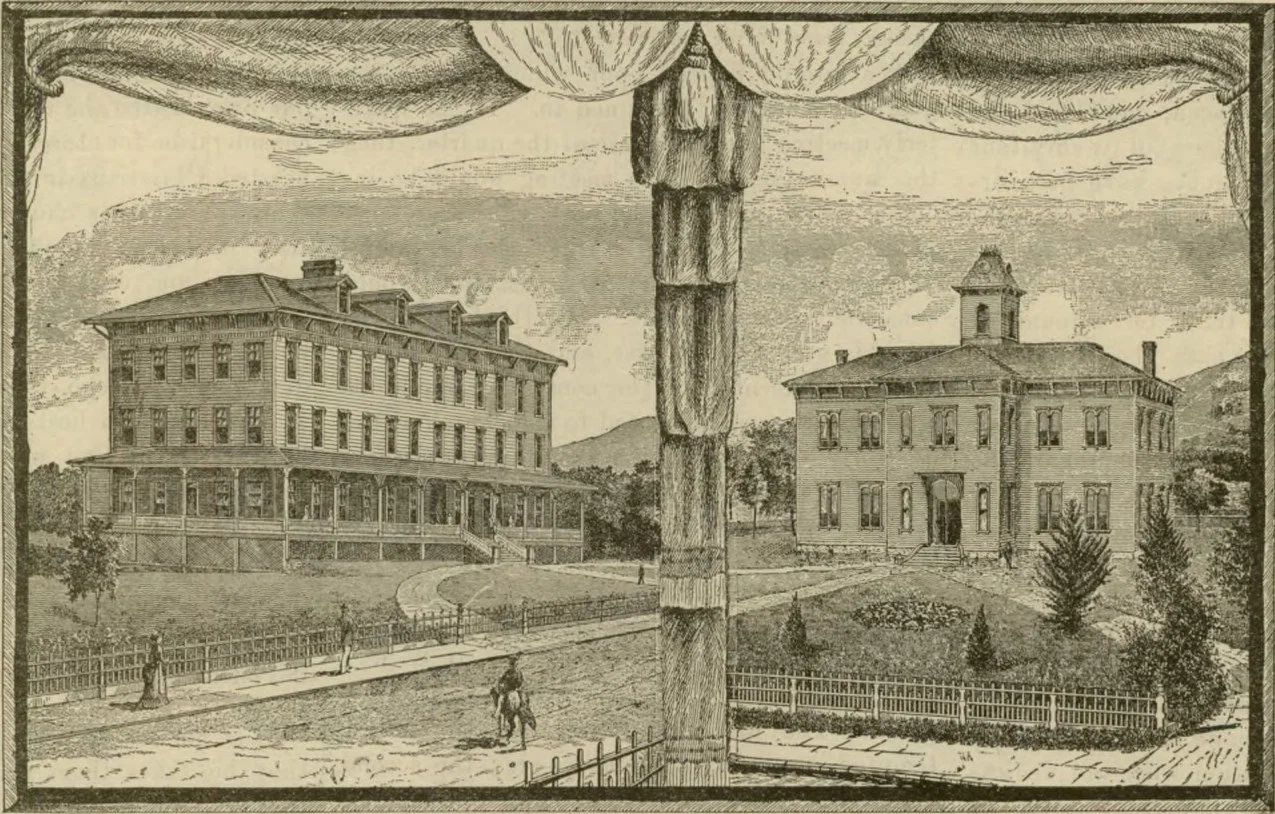
HEALDSBURG COLLEGE AND BOARDING HALL.
It has been my privilege to visit denominational colleges in other States in the past, and in visiting this one I have found myself contrasting the differences, plainly observable, between it and others. In the first place, all the faculty, and most of the students, are earnest, humble, consecrated Christians, each striving in all of his words and actions to manifest the Spirit of Christ. This produces an effect at once noticeable and pleasing, to a degree never before witnessed by the writer in any institution of learning. While the rules are strict, and the management insists that they be faithfully carried out by all concerned, the admonitions are so kindly, mildly, and quietly given that it seems a pleasure to heed them. In all my experience with institutions of learning in the past, I have never visited one where the faculty seemed to work in such harmony, and where the management had everything under such complete, harmonious control.
Lectures are given by different members of the faculty from time to time, frequently on moral and religious subjects, and an effort is made to inculcate religious thought and practise in all the daily duties of the students, not simply in a formal and routine way, but in the belief that religion is nothing if not practical, ministering to the highest personal development. In all the recitation rooms visited by the writer, the same dignity and high-toned decorum were observable, but so manifestly in the spirit of the Master as to take away all formality and stiffness, making the whole recitation a pleasure to both instructor and pupils. The management has certainly attained a great success in this direction, no doubt by untiring effort; for it is a well-known fact that there can be “no excellence without great labor.” It may be accounted for, in part, however, from the fact that the institution is not a reform school, and young people too incorrigible to be governed at home are not wanted; and if such a disposition should be developed in a student, he would be sent home.
The courses of study consist of the preparatory, Biblical, normal, scientific, and classical courses; besides a primary department, where pupils are prepared for the preparatory department. Music, both vocal and instrumental, is taught all along through the different courses in some form, so that all may learn at least to sing, and those who wish, may become accomplished musicians.
But I must turn now to the Students’ Home, presided over by President Howe, ably assisted by other members of the faculty. The week I spent in the Home was one of the best of my life, not only for the many new truths I learned from the instructors in the Bible course of study and the college library books, but from daily intercourse with the teachers and the students of the Home, who share it as one family, with mutual interests and aims. There seems to be a studied care on the part of all to make the Home life attractive and efficient in the cultivation of those habits which distinguish the refined Christian man and woman.
Soon after the morning worship, breakfast is served in the dining-room below. After breakfast, all make preparations for college recitations, some beginning as early as eight o’clock. At nine o’clock all are required to be at chapel service, after which the time is occupied in recitations in the different class rooms until 1:30 P. M., when recitations are over for the day. Students then return home, and at two o’clock dinner is served, consisting of three courses, and from forty to sixty minutes are occupied in eating. The cooking is all done on scientific principles, and only the very best hygienic foods are used, so that students are assured of healthful living. A few minutes of recreation are given after dinner, when all are expected to spend one and a half or two hours in domestic or manual labor of some kind in connection with the home or college premises. These requirements are made in consideration of the low rates of board and tuition, and for the benefit of the general training it affords. Twelve hours of such labor is required of each student, every week.
After working hour is over, each student can use the time until evening worship as he likes, never visiting the town, however, without permission of the president. At 6:15 the bell rings for evening worship, when all are expected to be in attendance. Then follows the “silent hour,” after which all retire to their respective rooms for study. No talking above a whisper is then allowed in any part of the building, the study hour being continued until 9:30, when all lights must be put out, and the students retire to rest.
I do not feel like closing this article without stating that this college has no endowment, and hence is dependent upon its patrons and friends for its funds. I do not conceive of any way by which one could provide a more lasting benefaction to his fellow man, or more highly honor his Maker, than by contributing of his means to advance the cause of higher Christian education in such a school. Healdsburg College has a greater number of students in attendance this year than last, but I certainly feel that all Adventists and their friends in California should rally to its support, and double the number for the next college year.
In conclusion, allow me to say a few words concerning the social affairs of the College Home. Besides the holidays, when all the pupils are permitted to take an outing and enjoy the day together, the students of the Home are permitted, three or four times a year, to give a reception to the other college students and their friends. These are usually very pleasant and happy affairs. I had the pleasure of attending one on Monday night, beginning at seven and closing at ten o’clock. After the guests had been received by the president and his wife and the preceptress and other managers of the Home, and some time had been spent in social converse, a short musical and literary program was rendered, interspersed with about five minutes of social conversation between the selections, which made the evening pass off very pleasantly. Indeed, the writer does not remember ever having spent a pleasanter evening since becoming a Christian, and certainly not since embracing the third angel’s message. The Spirit of Christ seemed to be manifest in every face, and it was indeed “good to be there.” May the blessing of God continue to rest upon Healdsburg College, and those who have been called to conduct its work.
G. B. Douglass.
CANADA
By J. B. Goodrich
I HAVE visited, since January 29, the churches at the following places: Beecher's Falls, East Angus, Fitch Bay, Dixville, Mar's River, South Stukely, Waterloo Bethel, and Montreal, and I came to Belleville March 18, and stopped until April 9. We had some excellent meetings. Some new converts took hold to obey the Lord, and obtained his blessing. We had the usual amount of opposition, but God gave the victory.
PETERSBURG, ONT.—I was here from April 9–27. We had some good meetings here, and some victories were gained. I was invited to speak in a mission hall two miles out of the city, and held three services there. There are some here who seem interested in the truth as the result of studying “Bible Readings for the Home Circle.” May God help them to obey.
BELLEVILLE.—May 1–5 I was here. Some more converts decided to walk in the light, and thirteen were buried with Christ in baptism, and were raised up, I trust, to walk in newness of life. I thank God, and take courage for what my eyes have seen and my ears have heard so recently in connection with the third angel's message. Some will obey in the midst of bitter opposition; the message must go. I organized a church here of sixteen members. An elder and a deacon were ordained, and the Spirit of Christ was with us, and we could praise God for some drops of the latter rain. It only makes us long for more. To God be all the praise!
I have taken two subscriptions for the REVIEW.
J. B. GOODRICH.
MICHIGAN
By M. C. Guild
CHASE, LAKE CO.—February 16 I closed a three-weeks’ meeting at Adalaska, Presque Isle county. The blessing of God rested upon our work, and five precious souls took a decided stand for the truth. Our brethren at this place are putting up a substantial house of worship, which they expect will be ready to dedicate soon. I spent one day very pleasantly with Professor Brownsberger and his family, near Cheboygan. They are clinging to the truth, and planning to do what they can to advance the message.
At Freedom, Cheboygan county, I held meetings one week. The little company there remain faithful, and I left them rejoicing in the blessed hope. It is now two months since I came to Chase. Brother E. I. Dryer came and labored with me for one month, and his help was much appreciated. There has been a good attendance here all through the meetings. Eight adults have taken a stand for the truth, and part of these gave their hearts to God for the first time. There are now seventeen who keep the Sabbath and meet with us here, though some live at quite a distance, and can come only occasionally. We hope to effect a church organization here.
I have received much of the rich blessing of God this past winter, for which I praise his holy name.
M. C. GUILD.
CALIFORNIA
REDLANDS AND BEAUMONT.— On Sunday, the 12th inst., Elder Knox and I closed a two-weeks’ tent effort at Redlands. We left a Sabbath-school of eighteen members. Elder Knox went to Los Angeles. I came to Beaumont, pitched the tent, and was joined by Brother Baxter Howe. Our meetings began the 17th inst. The attendance has not been large, but we are of good courage in the Lord, and glad to sow the seeds of truth. J. G. Smith.
OAKLAND.— In the Oakland district of California, some work has been done since my last report. We have been putting forth efforts in several of the suburban towns of Oakland the past year. The results are that we have organized a church, as already reported, in Alameda. This church is adding new members to her numbers, of such as shall be saved. In Berkeley, several have taken their stand, but one has gone away and others are going, so that I fear we shall not be able to organize there. We have some deeply interested ones in East Oakland, where we have been carrying on meetings for some time. The members of the Oakland church are doing considerable work in distributing reading matter. Elder M. C. Wilcox is expected to commence a series of discourses tonight on the “Plan of Salvation.” The writer has taken up briefly the book of Romans in Sunday-night discourses at the Oakland church. Pray for the work here. H. F. Courter.
THE WORK IN QUEENSLAND.
By T. Whittle
THE direct work of spreading the message in the colony began with canvassing, about six years ago. The result was soon seen, when isolated Sabbath-keepers began to spring up here and there. In 1893 some canvassers visited Rockhampton, and found a number keeping the Sabbath from reading “Thoughts on Daniel and the Revelation.” They requested Bible readings, and soon there was a company of twenty-three Sabbath-keepers, who had never heard a minister. Owing to their urgent appeals for ministerial help, the Australian Conference decided to open up the Queensland field by tent work, and the first series of tent meetings in Queensland began in Rockhampton in August, 1894, Elders Starr and Hickox conducting them. Out of these meetings a good, substantial church was organized, numbering over fifty members. A number of additions have since been made, and the Rockhampton church is regarded as a thriving one.
To the north of Rockhampton, in Townsville, a small company of Sabbath-keepers meet, and still others are scattered away north of them. After closing the work in Rockhampton, the tent was moved to Toowoomba, a large inland town among the mountains, to which the people resort to escape the excessive heat of the Queensland summer. Here a prolonged effort was made, but the results were not so decidedly favorable as in Rockhampton. A church of twenty-three members was organized toward the middle of 1895. From Toowoomba a move was made to Ipswich. This is the largest town in Queensland outside the capital, Brisbane, and contains some fourteen thousand inhabitants. It is called the “city of churches,” and not without reason, as it certainly is the strongest religious center in Queensland. Owing to this, the prejudice against the work was strong from the start, and the results have been comparatively small, judging by numbers. A company of ten adults meet on Sabbath, in the home of one of the brethren. At the present time, no preaching is being done in the colony, the ministers having been called to other fields for a season; but it is planned to hold a camp-meeting in Brisbane in August of the present year, and to follow the work up with a good force of workers in the city and its suburbs.
There can be no doubt but Queensland is a favorable field to work in, in some respects. The people are not poor, and while prosperous, they have not that pride which frequently attends prosperity. While easy of approach, those who profess religion are so imbued with the lax, careless spirit of the times, that though many admit the truth, they do not see its importance, and so cannot be brought to a stand. Truly there are multitudes in the valley of decision. May God help his servants to be faithful, and to blow the trumpet with no uncertain sound, that the people may be aroused from the spirit of slumber that has taken hold upon them.
T. WHITTLE.
TENNESSEE RIVER CONFERENCE.
By Chas. L. Boyd
ALONG the different lines of our work the prospect seems encouraging. Our canvassing agents are doing well. Our churches are doing some missionary work, and laying plans to do more. A commendable zeal is manifest among some of our young people, to fit themselves for places of usefulness. I was at Cross Plains a week ago. A good interest was manifest there. Brother W. S. Kinney was ordained church elder. Brethren Reed and Beardslee have gone to Murfreesboro with a tent, and it is expected that Elder F. D. Starr and the writer will soon go out with another tent. The prospect for good crops is favorable. Barley is headed, and will soon be ready for harvesting. Prices are low, but while this works against the producer, it is favorable for the consumer.
CHAS. L. BOYD.
NORTH DAKOTA.
By J. F. Gravelle
AFTER the close of our good institute at Vilas, S. Dak., in the last part of March, I spent a few days at my old home in Bridgewater. From there I returned to Fargo, N. Dak., to labor in Bible work, where I had worked during the winter. On my return home I found the little church doing a good work for the Lord. All were of good courage, and those that had taken hold of the truth during the winter were rejoicing in the precious truth and the glorious appearing of their Saviour. April 20 Elders Nelson and Fredrickson made us a good visit at Fargo. They remained with us a few days, and held several meetings. The Lord came very near with his Holy Spirit, as his servants presented the precious truths from the word of God.
There was a good outside interest. Our church was well filled each night. On one evening there was no meeting given out, as there was other work to do; but as evening came on, the church was quite well filled, and Elder Fredrickson preached to them, and there was a deep interest.
On Sabbath, April 25, Brother Nelson spoke from John 1:36, “Behold the Lamb of God.” Following the sermon, we celebrated the ordinance of the Lord’s house. There was a marked manifestation of the presence of the Spirit of the Lord with us. Several outsiders were with us through our quarterly meeting, and some were deeply moved, and took part with us in our social meeting. Our church at Fargo was much refreshed, and all felt that it was good to be there. On Sunday we had a business meeting at the missionary society, and arrangements and plans were made to do a large amount of missionary work this summer; and a liberal donation was made to finish the church. One united with us, and three more await baptism in a few days. There is a good interest among the outside people here, and we trust that many more will take hold of the truth soon. From here Brethren Nelson and Fredrickson go to Grand Forks to look after the work there. We praise the good Lord that the work is onward, and we want to keep pace with it, and at last have the overcomer’s reward. Brethren, we earnestly ask for your prayers, that the Lord may bless his work here.
J. F. GRAVELLE.
IOWA
By J. W. Adams
MASSENA AND EUREKA.—These churches were visited by Elder Olsen the 24th and 25th. Brother Moody and the writer have labored in this vicinity for some time. While the work has gone very hard in Massena and its vicinity, we are glad to say the Lord is working for the Massena church. We spent a very small proportion of the time at Eureka, but as a result, a number have accepted the truth. Elder Olsen baptized twelve willing souls, and others would have gone forward if they had not been deprived of the privilege by their friends. This church was organized last winter with eight members. We see the results of proper organization. J. W. ADAMS.
MISSOURI
By Edwin L. Richardson
ARNICA.—For a few months I have been in this vicinity, presenting the third angel’s message to the people. Large congregations gathered at first to hear the truth, but when God’s Sabbath was presented, opposition arose, especially by the ministers of this place. I kept on holding meetings until one of the ministers called for a discussion, and I agreed on the proposition. When the people saw that the opponent could bring forth no proof, a good many turned to our side, but did not have the courage to obey.
As a result of my meetings and discussion, from fifteen to twenty decided to obey the truth and keep God’s Sabbath. A great many would obey if it were popular; others would if their relations and friends did; while a few said they were getting ready to obey. I have been trying to get some one here to organize the Sabbath-keepers into a church, but have not succeeded thus far, although I expect some one before long. I am of good courage. We must work while it is day; for the night is soon coming, when none can work.