“AFTER these things the Lord appointed other seventy also, and sent them two and two before his face into every city and place, whither he himself would come.” The disciples were to precede Christ, and prepare the way before him, as John had preceded and prepared his way. They were to preach the kingdom of God. They were to go two and two, and in this way pass over a large territory. The Lord was taking his last journey from Galilee toward Jerusalem. The disciples were not only to preach the kingdom of God, but were to heal the sick, and prepare the field for the coming of the great Physician. They were to proclaim his divine character, and awaken an interest in the minds of the people, announcing him to be the Messiah, and giving publicity to his work and mission.
These disciples were enjoined to salute no man by the way. They were not to enter into formal salutations that would open a way for controversy. The life of Christ was drawing to a close. They were to prepare the way for the last work that he was to do in person for the inhabitants of the world. He sent them forth empty-handed, to depend upon the hospitality of those whom they should meet. They were in no way to disguise their humble origin. As they mingled with the people, they were to sit with them at their tables, to go with those who should invite them, to pay no attention to caste or position. Their one object was to proclaim the Gospel to every man, no matter what might be the nation or character of his hearers. “And it came to pass, as he went to Jerusalem, that he passed through the midst of Samaria and Galilee. And as he entered into a certain village, there met him ten men that were lepers, which stood afar off.” This circumstance happened just on the outskirts of5the village. The ten men were a most distressing spectacle. The law prohibited a leper from entering towns or villages, and lest any one should come unexpectedly upon them, they were to utter the mournful cry, “Unclean! unclean!” These lepers were made up of Jews and Samaritans, and the prejudice that existed between them was broken down by this terrible malady, and, doomed to death, they associated together. The lepers were not ignorant of Jesus. They had heard of his wonderful works of mercy, and how he had healed those who were in the same condition as they were themselves. Recognizing the great Teacher and Healer, they raised their voices in a pitiful wail of distress, and cried out, “Jesus, Master, have mercy on us.” They were cut off from society, and presented themselves to Jesus as subjects of pity. His heart was stirred with divine compassion, and he said to them, “Go show yourselves unto the priests.” When they heard this word, they believed that it meant their restoration, and they hastened to obey. They knew that Jesus understood the law and how their disease had excluded them from society. It was necessary for a cleansed leper to have the testimony of a priest that he was clear of his plague, and to have his permission, in order again to associate freely with his fellow-men. They hastened to obey the word of Jesus; “and it came to pass, that, as they went, they were cleansed.”
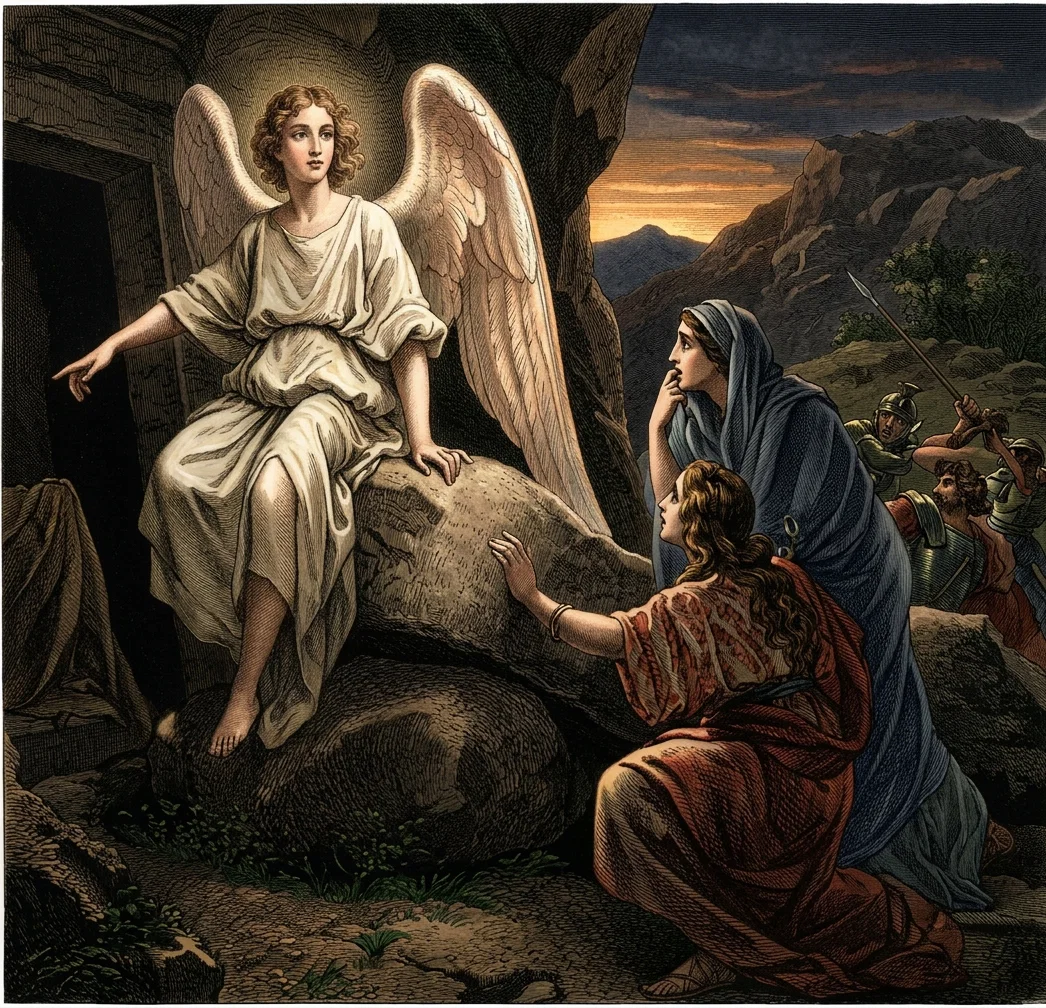
THE OPENED GRAVE.
Jesus was a helper to the helpless, a friend to the needy. He had daily manifested compassion and love for the human race. While he received the lowly, the sick, the poor, and the afflicted, he presented principles to the Pharisees, scribes, and rabbis that condemned their pride, their selfishness, and self-glorying. These bigoted teachers were filled with envy because the masses turned away from their instruction to listen to Jesus. They spoke evil of Christ and of his doctrine. They had it in their hearts to destroy him, but they knew not what they could do, because the people were very attentive to hear him. The greater good he wrought for the people, and the more they were led to glorify God on account of his mighty works, the more desperate and determined his enemies became. They said among themselves, “Perceive ye how ye prevail nothing? behold, the world is gone after him.”
Those who thought themselves righteous and in need of nothing, rejected the word of Christ, yet the poor and afflicted received his assurances. The ten lepers went on their way in obedience to his command, and they knew that a great change had taken place in themselves, and that they were healed. Their faith had been tested by Christ’s direction; but they did not defer a moment to act upon his word. If there was any prospect that they might be healed, they would make the venture. The tones of his voice had thrilled their hearts, and inspired them with hope, with faith and confidence. They were not only cleansed, but made entirely whole. Divine power had wrought a new creation.
When they presented themselves to the priest, he declared that they were free from every taint of leprosy. One of the number was filled with joy and thankfulness, and determined to return and to find the wonderful Healer, in order to give him thanks for the restoration. He came rejoicing at every step, and with a loud voice he glorified God. When he came into the presence of Christ, he fell upon his face, and with an overflowing heart expressed the love and gratitude which he felt. This man who returned to give praise to Christ was a stranger, a Samaritan. His nation was despised and hated by the Jews. Christ had healed of the leprosy men who were Jews, but none of the nine returned to glorify God on behalf of his work for them. This Samaritan believed in Christ as the Redeemer of both soul and body. He made manifest the fact that he was more susceptible to the grace of God, and more appreciative of divine love, than were the other nine. Jesus called the attention of his disciples to the fact that he was a Samaritan, and said: “Were there not ten cleansed? but where are the nine? There are not found that returned to give glory to God, save this stranger. And he said unto him, Arise, go thy way; thy faith hath made thee whole.”
The disciples of Christ, as Jews, had been educated to hate the Samaritans, and this was a lesson that would be of great benefit to them in their future experience. Jesus would have them understand that there were many precious souls among the Samaritans who would not refuse to come to the Gospel feast. This Samaritan that had returned to give praise to God was no mean citizen, and he would prove an effective witness for Christ. After the resurrection and ascension of Christ, he would bear decided witness that Christ was the Son of God. He would repeat the story of his restoration, and with a heart full of intense love and interest, he would say to those with whom he came in contact, “Will you believe in Jesus?” It was testimonies of this kind that turned men from the established teachings and endless repetitions and worthless traditions of the scribes and Pharisees. Unlearned men testified to the power of Christ, and spoke boldly of the grace of God, and their glowing testimonies were placed in sharp contrast to the heartless, exacting ritual of the Pharisees. And the people were constrained to say that these men had been with Jesus, and had learned of him.
(Concluded next week.)*
RESURGAM
By Helen Hunt Jackson
THE fool asks, “With what flesh? in joy or pain?
Helped or unhelped? and lonely, or again
Surrounded by our earthly friends?”
I know not; and I glory that I do
Not know; that for eternity’s great ends
God counted me as worthy of such trust
That I need not be told.
Out to the earthward brink
Of that great tideless sea,
Light from Christ’s garments streams.
Believing thus, I joy, altho I lie in dust.
I joy, not that I ask or choose,
But simply that I must.
I love, and fear not; and I can not lose,
One instant, this great certainty of peace.
Long as God ceases not, I can not cease;
I must arise.
—Helen Hunt Jackson.
THE DAY OF LIFE.
By Eliza H. Morton
BY ELIZA H. MORTON.
When the morning fresh and dewy
Dawns with golden light,
And the flowers lift their petals
Sweet and pure and bright,
Let the heart expand while singing
Happy songs of glee,
Like the whisperings of the forest
Or the surging sea.
When the sun has reached the zenith
And its rays are strong,
And the day is hastening onward,
Tho it seemeth long,
Let the hands be ever ready
Some good deed to do,
Let the life be pure and lovely,
Ever faithful, true.
When the banners of the sunset
Are unfurled on high,
And the beauty of the gloaming
Touches earth and sky,
Let the Spirit, holy, blessed,
Fill the soul with fire,
Till the glory seemeth ever
Nigher and yet nigher.
Soon, O soon, the day eternal
Love-lit eyes will see;
All the shadows dark and gloomy
Will forever flee,
Pains and heart-aches all forgotten,
Bodies glorified,
With our precious, precious Saviour
Ever to abide.
North Deering, Me.
GLORIFYING GOD.
By Wayland Hoyt
WHEN we are exhorted in Scripture to glorify God, it does not mean that we are to attempt to add to, or to imagine that we can add to, the already sumless glory of the infinite God; it means that we are to display his glory, to become the surfaces, so to speak, striking on which it shall go reflected forth.
The wavelet can not add to the glory of the sun, but it can so catch and scatter the sunlight that the benign radiance shall seem more beautiful. The flash of the diamond does not make the sun more luminous, but, opening its clear heart to the entrance of the sunbeam, it does so fling it out that you have a new joy in the sun’s effulgence.
She was not a very pleasant member of the family. She was fretful, complaining, irritating, set on a ministry of uncomfortableness. They sent her away to boarding-school. It was a good riddance. But there the Lord met her, and she became a genuine Christian. Getting home, she was seen to be another person—patient, cheerful, kind, beautiful, with a steady service of usefulness. A skeptical cousin looked at her askance for some time, attributing the change to any reason but the right one, and sure the old unpleasantness would soon display itself. But it did not. So he asked her the cause of the transformation. The reply was, the grace of God had given her another sort of heart. He said to himself, “I don’t believe that God has anything to do with it, tho she thinks he has.” And he set himself to trying to be as good as she. But where she all the time succeeded, he failed; until, at last, certain she had some help he missed, and giving his skepticism to the winds, he sought and found what new heart and power of continuance had come to her.
I am sure you see plainly that, while that Christian maiden did not add to the measureless sum of God’s glory, she did manifest forth and commend his glory, and so did, in the most real way, in the precise way in which the Scripture means, glorify God.—Wayland Hoyt, D.D.
The Church-Fair Plan
“AND now, brethren, let us get up a supper and eat ourselves rich,” said a witty Presbyterian elder, in keen satire on the church-fair plan, when his church was proposing indirect methods of raising money for new and necessary expenditures. “Buy your food,” he said, “then give it to the church. Then go buy it back again. Then eat it up, and your church debt is paid.”—Sunday School Times.
The Lasting Power of Influence
“THE great thing about influence is that it sets in motion forces that will never stop.”
ETERNAL LIFE AND IMMORTALITY.
ETERNAL life is the life of God, the life given by the “eternal Spirit,” the life which operates only in harmony with God’s immutable law. God’s law is the law of man’s life. Nay, more, it is the law of his own life, the expression of his own character, everlasting and immutable as his throne. Those who know righteousness are those who have God’s law in their hearts. See Isa. 51:6, 7. Therefore the law “was ordained to life,” to life without end. Death had no part or place in its object. “In the way of righteousness is life, and in the pathway thereof there is no death.”
Man was created upright, and pronounced by his Creator “very good.” He was in harmony with God’s law, the expression of God’s character, the law of God’s endless life. That man might live the righteousness of God he was given the power of the endless life of God, or eternal life. But he held this by faith. This was so of necessity. While man was “holy and without blame” before God, he had not yet perfected character. He was not righteous in the sense of having a righteous character. He had not developed character under test. Faith includes absolute and willing submission to God. Anything less than this would be in opposition to God’s law. The life of God could, therefore, be held only by faith, by a perfect harmony with the law of God. As soon as unbelief came in, man disobeyed. He departed from God’s law in purpose, and God’s life could not operate contrary to God’s law.
The straight perverted becomes crooked. Good perverted becomes evil. God’s law perverted becomes sin. Life perverted becomes death. So when man transgressed the law of life, the perverted law in him became the law of sin and death. Therefore says the apostle, “The commandment which was ordained unto life, I found to be unto death.” Man by sinning set his will against God’s will, and found naught but destruction and death in his course. By thus doing he cuts himself off from the source of life. When, therefore, man sinned, he lost eternal life.
But while possessed of eternal life when he came pure from the hands of his Maker, he was not immortal. Immortality means incorruptibility, genuineness, deathlessness, that which is not corruptible. Such is God in his very essence: “Who only hath immortality” (1 Tim. 6:16), that is, inherently, in his very nature. But while man’s nature was pure, it was capable of being corrupted. Had he been immortal, he would never have known sin or death. Were he mortal, he had also sin, for mortality is a consequence of sin. Man was, therefore, neither mortal nor immortal. He possessed a pure and innocent nature, and was a candidate for immortality.
The condition, as before stated, was faith. The choice rested in his will. The power to do was in the life of God in his holy law, responsive ever to faith. But man sinned and thus perverted the law of God in him, and lost eternal life. By faith through and in Jesus Christ man may again connect with God’s life, and place himself in the channel of its working, so that life may bring forth fruit in him. “He that believeth on the Son hath everlasting life; and he that believeth not on the Son shall not see life.” John 3:36. “He that hath the Son hath the life; he that hath not the Son of God hath not the life. These things have I written unto you, that ye may know that ye have eternal life, even unto you that believe on the name of the Son of God.” 1 John 5:12, 13, R. V. Says the regenerated Paul: “Christ liveth in me; and the life which I now live in the flesh I live by the faith of the Son of God.” Gal. 2:20.
If man thus choose God’s will, if he let God’s life infuse him, if he constantly and forever submit to the eternal law of God, the law of righteousness and life, he thus perfects a righteous character, a character incorruptible. By enduring all tests, he is purged from all corruptible elements, and builds into his character the incorruptible commands and promises of God, the words of life. And when that character is perfected, and the judgment of God of which his law is the rule, shall so declare, then God shall place upon man the stamp of the incorruptible character—immortality.
Immortality is, therefore, the seal of man’s character. It is the outward expression of the character that is within. It declares that as the physical man will know no decrepitude, age, or death, because of the change wrought by the power of God, so the character within is fitted, has been perfected under test by the same power, so that it will never more sin, because its will is eternally set to do the will of God alone. Man can not sin, because he will not, eternally will not. The moral fiber of his character has been wrought in the workshop of heaven; the chords of his whole being are forever attuned to the music of the eternal law.
All this being true in the very nature of the case, we are not surprised to read in the word of God, contrary tho it be to false and popular theology, that God “only hath immortality” (1 Tim. 6:16); that man, instead of possessing it here, should seek for “glory, and honor, immortality” (Rom. 2:7); that it is not in man of himself, but comes alone through “Jesus Christ, who hath abolished death, and hath brought life and immortality to light through the Gospel” (2 Tim. 1:10); that instead of man possessing immortality here, it will be given only when Jesus Christ shall come the second time, and then “this mortal must put on immortality,” fulfilling the expression, “Death is swallowed up in victory.” 1 Cor. 15:51–55.
This view, the Biblical, Gospel view, gives no man opportunity to glory in men; for all is of God through Jesus Christ. The law is of him, the life is of him, the righteousness is of him, the mercy, the goodness, the power, the glory are all of him; and to him every soul that knows his life and receives the boon of immortality will ascribe endless praise. “Thanks be to God for his unspeakable gift.” Reader, will you not choose life, that you may live?
A TEST OF GENUINENESS.
God’s Touchstone.
We prize most those things which will endure test, which are proved to be genuine. So God’s people are a tried people, those who endure. In his plan life and immortality are dependent upon righteousness, and righteousness upon faith. By choosing, believing, receiving, and submitting to God we have life. By rejecting these we sin, and choosing sin we choose death.
But the great deceiver has persuaded man to believe that he is immortal and will live forever, whether a sinner or saint. A something conscious survives all material death and destructive agencies. To all eternity the pains of hell or the torments of the damned will not shorten or curtail the existence of one miserable sinner. And yet man is a material being, of the earth earthy; and, being sinful, subject to death. Here are the two—character and claim. God declares that only in righteousness is life; only in living connection with God is continued existence possible. On the other hand, a false theology and a false science, inspired and fostered by the father of lies, claim that man lives in and of himself. Out of this blossom other errors, as, for instance, Universalism, Spiritualism, eternal misery, etc. The test now between the two, character and claim, is not multitudes, but God’s word. The final test will be by fire.
In speaking of the work of the Christian ministry and its results in the souls affected by it for good or ill, the apostle says:—
“Every man’s work shall be made manifest; for the day shall declare it, because it shall be revealed by fire; and the fire shall try every man’s work of what sort it is.” 1 Cor. 3:13.
The same fact is set forth in Rev. 14:10, 11, where it is said of those who reject the Gospel:—
“The same shall drink of the wine of the wrath of God, which is poured out without mixture into the cup of his indignation; and he shall be tormented with fire and brimstone in the presence of the holy angels, and in the presence of the Lamb; and the smoke of their torment ascendeth up forever and ever; and they have no rest day nor night, who worship the beast and his image, and whosoever receiveth the mark of his name.”
The word “torment,” both noun and verb, comes from the Greek words basanos and basanizo, and are defined by the standard Greek lexicon of Liddell & Scott as follows:—
Basanos, the touchstone [Latin, lapis Lydius] a dark-colored stone on which pure gold, when rubbed, leaves a peculiar mark. 2. The use of this as a test; generally, a test, trial whether a thing be genuine, solid, or real. 3. Inquiry by torture; tormenting labor, torture of disease. Matt. 4:24.
*Basanizo, to rub upon the touchstone; hence, of things, to put to the test, prove, to investigate scientifically. 2.7Of persons, to examine closely, cross-question, to question by applying torture, to torture, rack.*
From the above definitions it will be seen that the root meaning of the term is to test or try by words or torture. The idea of torment, or of causing pain, is not a necessary element in the original meaning of the word, but is wholly a derived one. Test or trial is the primary meaning; and the use of the word in the Scriptures must have correspondence to the original and proper use of the word.
God’s great touchstone by which the final test between the false and true is to be made is fire, the burning glory of his presence, which shall set on fire the earth. “The fire shall try.” “Our God is a consuming fire.” “Whom the Lord shall consume with the spirit of his mouth, and shall destroy with the forthshining of his presence” (literal rendering). “Our God shall come, and shall not keep silence; a fire shall devour before him, and it shall be very tempestuous round about him.” “She [great Babylon] shall be utterly burned with fire; for strong is the Lord God who judgeth her.” “And fire came down from God out of heaven and devoured them.” These are a few of the utterances which speak of God’s last great test of claim and character. To this the prophet also refers:—
“The sinners in Zion are afraid; fearfulness hath surprised the hypocrites. Who among us shall dwell with the devouring fire? who among us shall dwell with everlasting burning?” Isa. 33:14.
And he answers: “He that walketh righteously and speaketh uprightly.” The claim withers and is consumed by devouring fire, carrying with it all who have trusted in it. The character endures the flame, even as the three Hebrew Christians endured the fiery furnace, because Christ was with them.
The “torment” (testing) is forever; the test is final. Sin and all identified with sin are forever destroyed, and the tested jewels of God’s casket abide forever in the presence of his joy.
Reader, God in mercy, veiling his glory, desires to come into your heart now, that he may purge you of sin. Will you let him in? He would have you choose his presence now, that you may endure the presence of his unveiled glory when he comes. Let us entreat you, choose him now; choose him forevermore. Let the sin be put away and destroyed, that you may not be destroyed with it in his presence.
Not to Do Mine Own Will
“Not to do Mine Own Will.”—There is an idea quite prevalent that Christ came to organize a new government, to present a new plan, to supersede all the past, but all this Christ expressly disavows. He declared through the psalmist, before he came, “Lo, I come; in the volume of the book it is written of me, I delight to do thy will, O my God; yea, thy law is within my heart.” Ps. 40: 7, 8. When he came, his language was the same: “My meat is to do the will of Him that sent me, and to finish His work.” John 4: 34. “I can of mine own self do nothing; as I hear, I judge; and my judgment is just; because I seek not mine own will, but the will of the Father which hath sent me.” Chap. 5: 30. “For I came down from heaven, not to do mine own will, but the will of Him that sent me.” Chap. 6: 38. And so also Christ says of those who profess to be his servants and are not: “Not every one that saith unto me, Lord, Lord, shall enter into the kingdom of heaven; but he that doeth the will of my Father which is in heaven.” Matt. 7: 21. Of this class who profess but do not, he says, “Then will I profess unto them, I never knew you; depart from me, ye that work iniquity.” Verse 23. Iniquity is lawlessness, or breaking of law, and the law referred to is the law of God, the will of the Father. Christ, therefore, taught the integrity and immutability of God’s law, both in precept and example, even to jots and tittles (Matt. 5: 17-20); and we are enjoined to walk in his footsteps (1 John 2: 6). He, therefore, also taught no new doctrine, but the same everlasting Gospel which issues in obedience to the same immutable law.
THE ALL-SUFFICIENT LIFE.
By Ellet Joseph Waggoner
“Blessed be the God and Father of our Lord Jesus Christ, who hath blessed us with every spiritual blessing in the heavenly places in Christ; even as he chose us in him before the foundation of the world, that we should be holy and without blemish before him in love; having foreordained us unto adoption as sons through Jesus Christ unto himself, according to the good-pleasure of his will, to the praise of the glory of his grace, which he freely bestowed on us in the Beloved; in whom we have our redemption through his blood, the forgiveness of our trespasses, according to the riches of his grace.” Eph. 1: 3-7, R. V.
“In Him.”—Notice that everything is in Christ. In him we have “all spiritual blessings.” “For how many soever be the promises of God, in him is the yea; wherefore also through him is the Amen, unto the glory of God through us.” 2 Cor. 1: 20, R. V. In him we were chosen, and in him we are accepted. In him we have forgiveness of sins. In him we become sons, and in him we are made “holy and without blame.” “For in him dwelleth all the fulness of the Godhead bodily. And ye are complete in him.” Col. 2: 9, 10.
“In Him was Life.”—According to the most critical Greek text, John 1: 3, 4 reads, as is indicated in the margin of the Revised Version, “All things were made by him; and without him was not anything made. That which hath been made was life in him; and the life was the light of men.” That is to say, everything exists by virtue of his life. “By him were all things created; . . . and by him all things consist.” Col. 1: 16, 17. “As the Father hath life in himself; so hath he given to the Son to have life in himself.” John 5: 26. That is why he is the “wisdom of God, and the power of God.”
“Saved by His Life.”—Christ is, by virtue of his kinship with man, “a merciful and faithful High Priest in things pertaining to God, to make reconciliation for the sins of the people.” Heb. 2: 17. But he is made priest according to “the power of an endless life.” Heb. 7: 16. He is “the Author of life” (Acts 3: 15, R. V., margin), and therefore he is “the Author of eternal salvation unto all them that obey him.” Heb. 5: 9. “If, when we were enemies, we were reconciled to God by the death of his Son; much more, being reconciled, we shall be saved by his life.” Rom. 5: 10. Here is continuation, not contrast. In his death, Christ gives his life to us. The reception of that life reconciles us to God. If the reception of that life reconciled us when we were enemies, much more will the holding fast the life save us now that we have become friends.
The Redemption in Christ Jesus.—“All have sinned, and come short of the glory of God; being justified freely by his grace through the redemption that is in Christ Jesus; whom God hath set forth to be a propitiation through faith in his blood, to declare his righteousness for the remission of sins that are past.” Rom. 3: 23-25. This is the same as the text first quoted: “In whom we have redemption through his blood, even the forgiveness of sins.” “The redemption that is in Christ Jesus,” is “the remission of sins that are past,” or the forgiveness of sins. And this is accomplished by his blood.
Forgiveness by His Life.—The blood is the life. “Flesh with the life thereof, which is the blood thereof, shall ye not eat.” Gen. 9: 4. “For the life of the flesh is in the blood; and I have given it to you upon the altar to make an atonement for your souls.” Lev. 17: 11. Therefore when we read that we have redemption, or the forgiveness of sins, through the blood of Christ, we know that it means that we have forgiveness through his life. “The redemption that is in Christ Jesus,” is the life that is in him. He “was delivered for our offenses, and was raised again for our justification.” Rom. 4: 25.
“The Lord Our Righteousness.”—In the days to come, when Christ shall be King over all the earth, “this is his name whereby he shall be called, THE LORD OUR RIGHTEOUSNESS.” Jer. 23: 6. This righteousness is his life; for “as by the offense of one judgment came upon all men to condemnation; even so by the righteousness of One the free gift came upon all men unto justification of life. For as by one man’s disobedience many were made sinners, so by the obedience of One shall many be made righteous.” Rom. 5: 18, 19. His obedience and righteousness become ours when we receive his life.
Justification Is Righteousness.—A friend has forwarded to me a severe condemnation of a statement made some time ago, to the effect that to justify means to make righteous. The criticism was based on the fact that “Grove’s Greek Lexicon” does not so define the Greek word from which justify is translated. Opening Liddell and Scott’s Greek Lexicon, I find the very first definition of the word in question is “to make righteous.” But that is only by the way. Appeals to Greek lexicons do not edify people. It was stated that “being justified” means “being made righteous,” because that definition is patent from the reading of the English Bible. In addition to what has already been presented, read the following:— “Being justified by faith, we have peace with God through our Lord Jesus Christ.” Rom. 5: 1. But peace is for those only who love and keep the commandments, which392are righteousness. See Isa. 48: 18; Ps. 119: 165, 172. Moreover, “with the heart man believeth unto righteousness.” Rom. 10: 10. We are “justified freely by his grace through the redemption that is in Christ Jesus,” through faith in his blood, because his righteousness is declared “for the remission of sins that are past.” Justification is therefore the forgiveness of sins.
Forgiveness Makes Righteous.—But to be forgiven is to be made righteous. Forgiveness is not an imaginary thing, but is real. If I forgive a fellow-man, it makes no difference in him; the effect is only upon myself. But when God forgives us, he continues the same, but the forgiveness effects a change in us. It takes away the sin. But when sin is taken away, righteousness must take its place. A new life—the righteous life of Christ—is given in place of the old life of sin.
Forgiveness and Cleansing.—The same precious truth is taught in the oft-quoted words of John: “If we confess our sins, he is faithful and just to forgive us our sins, and to cleanse us from all unrighteousness.” 1 John 1: 9. Note that the forgiveness and the cleansing are immediately consequent upon the confession. When we confess, we are forgiven and cleansed. We have already seen that we have forgiveness of sins through the blood of Christ (Col. 1: 14), and we read also that “the blood of Jesus Christ his Son cleanseth us from all sin” (1 John 1: 7). So we find that forgiveness and cleansing are really one and the same thing, wrought by the appropriation of the life of Christ. The life of Christ is all righteousness, and so its reception cleanses from all sin; but nothing less than the life of Christ can cleanse a single sin.
One, Undivided Life.—Christ has but one life. He needs but one, for the one is so infinite that it comprehends everything. “He that spared not his own Son, but delivered him up for us all, how shall he not with him also freely give us all things?” Rom. 8: 32. He laid down his life, and he took it again, because it was a perfect life. He needed not, as we do, to change his life. One life such as his is all-sufficient, and that is why we exchange our life for his. Having it, we are saved by it. And Christ’s life is undivided. He is not parceled out into fractions, so much to each believer. Each believer receives the whole of Christ. “Of his fulness have all we received.” John 1: 16. “Unto every one of us is given grace according to the measure of the gift of Christ.” Eph. 4: 7. And since a single sin can not be removed from the soul except by the life of Christ, it follows that in the forgiveness of sins we have the richest gift that heaven can bestow,—the gift by grace, “the gift of righteousness.” Rom. 5: 15, 17. Being made righteous by faith, we have peace with God through our Lord Jesus Christ.
“Grow in Grace.”—“What!” exclaims one, in astonishment, “do you mean to say that there is no ‘higher life,’ no ‘second blessing’? Is a man never to advance beyond the point where his sins are first forgiven?”—Yes, most certainly. But the “higher life” is the life in Christ, and there is none higher, and this life is given to us in the forgiveness of sins. To be blessed with “all spiritual blessings in heavenly places in Christ Jesus,” and to be raised to “sit together in heavenly places in Christ Jesus” (Eph. 1: 3; 2: 6), is as high a life as mortals can aspire to. As to a “second blessing,” the man who is content with it is as much to be pitied as is the man who is content with a first. Rather accept the continuous blessing of the endless life of our Lord. “Of his fulness have all we received, and grace for [or upon] grace.” He adds grace to grace in endless succession. But all comes from the one life, which, received by faith, cleanses from sin. So a man is certainly to advance beyond the point where he was “first forgiven,” but it is continual forgiveness—continual righteousness applied—by the one life. Growth is the law of the Christian life. But we are to grow in grace, not grow into grace. Grace is the only soil which promotes spiritual growth. Notice the statement, “Being justified by faith we have peace with God.” It is not enough that we were at one time justified, but it must be kept up. The blood of Christ cleanseth from all sin. It is not momentary, but continuous.
“The Knowledge of Christ.”—“But grow in grace, and in the knowledge of our Lord and Saviour Jesus Christ.” 2 Peter 3: 18. The trouble with so many people is that they do not know the value of the treasure which they have received. They receive Christ, and are blessed; then, by reason of not increasing in the knowledge of him, they are conscious of a great lack, and so hastily conclude that the gift which they have received is not great enough, and that God must have another in reserve for them—as though God had any greater gift than Christ, or that when he gave Christ, he made some reservation. No; with him he freely gives us “all things.” If we have received Christ, our part is to study him, that we may know that in him all our wants are supplied.
“Wherefore I also, after I heard of your faith in the Lord Jesus, and love unto all the saints, cease not to give thanks for you, making mention of you in my prayers; that the God of our Lord Jesus Christ, the Father of glory, may give unto you the Spirit of wisdom and revelation in the knowledge of him; the eyes of your understanding being enlightened; that ye may know what is the hope of his calling, and what the riches of the glory of his inheritance in the saints, and what is the exceeding greatness of his power to usward who believe, according to the working of his mighty power, which he wrought in Christ, when he raised him from the dead, and set him at his own right hand in the heavenly places.” Eph. 1: 15-20. E. J. W.