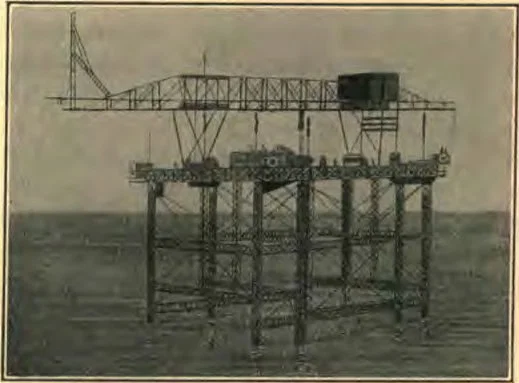
Taking slow, awkward steps, this structural steel staging walks into the water to the position where its services are required, and moves around as the work progresses, regardless of the roughness of the water. The first “walking” stage was used at Peterhead, a fishing port north of Aberdeen, Scotland, for the blasting of ten thousand cubic yards of granite, the North Sea along this coast rarely being sufficiently calm for boring from barges.
As shown in the accompanying illustration, the staging was used instead of temporary false work for building a pier extension in Whitby harbor. It consists essentially of two independent structural steel frames, one within the other. They are so arranged as to move independently, and to act as a support, one for the other, in moving. Each frame has four legs, or spuds, that rise independently of each other.
THE “WALKING” STAGING
The “walking” operation is simple. The legs of the inner frame are raised, in which condition, carried on rollers resting on the outer frame, the inner frame is hauled forward by tackles also attached to the outer frame. The spuds of the inner frame are then lowered again, and those of the outer frame raised, which, in turn, is carried on rollers resting on the inner frame, this operation being repeated until the staging reaches the desired location.
The structure can move sidewise as well as forward or backward, but the sidewise steps are limited to only five feet, while forward or backward, the step is ten feet. The spuds are each operated by an independent motor, this independence of action being made necessary by the varying depths of bottom. The overhanging gantry is carried on the outer frame, while the plant necessary for construction work is mounted mainly on the inner frame.
These stages are said to have traveled distances of three thousand feet over sand bottom. A ten-foot step can be completed in fifteen minutes, if the crew is experienced.— Popular Mechanics.
Ambergris: Origin and Uses of a Valuable Substance
Ambergris
FORMERLY there was much mystery surrounding the origin of ambergris, that most valuable substance; but now it is pretty generally agreed that it is nothing more or less than a “morbid secretion,” due to a disease of the liver, of the sperm-whale. The whales which yield ambergris are invariably sickly and emaciated animals.
In ancient times this substance was known as amber, a name also applied subsequently to the fossil gum, now commonly so called. In order to distinguish between the two, one was called amber gris (gray) and the other amber jaune (yellow). So, we perceive, the word ambergris means simply gray amber. As in the8case of the fossil gum, pieces of it were found from time to time on the shores of the sea, where they had been cast by the waves.
For many hundreds of years ambergris has been employed in sacerdotal rites of the church, and with fragrant gums it was formerly burned in the apartments of royalty. To some extent, it was used as a medicine and as a flavoring for certain dishes. Nowadays ambergris is utilized almost exclusively by perfumers in the preparation of fine scents, being first converted into a tincture by dissolution in alcohol.
Some six or seven years ago there was stolen in California a lump of ambergris said to have been valued at thirty thousand dollars. One of the finest and largest pieces of ambergris obtained in modern times was sold in London in 1891. It weighed about one hundred sixty-three pounds and brought fifty thousand dollars. — Harper’s Weekly.
The Sin of Omission
We can be guilty of the sin of omission as well as the sin of commission.
Government Monopolies
The French government is confronted with a peculiar difficulty. Just now, when it needs all the money it can get for working men's pensions and other reforms it is threatened with the loss of one of its important revenues, that derived from the match monopoly. It might be supposed that tobacco and matches, in spite of their comparatively recent introduction as luxuries, had become necessities to so large a proportion of the population that a government which monopolized both was in possession of an assured income. Every cigar and pipeful involves the use of a match, probably more than one if they are of government manufacture, besides those that are used for the ignition of better things than tobacco, such as candles and kindling-wood. But the match is in danger of losing its own monopoly. The electric light, whether suspended from wires or carried in the pocket, requires no match, and self-lighting attachments of spongy platinum or some cheaper material are being put on gas-jets.
The most recent and dangerous rival of the match is, however, the new cerium alloy of iron, which, on being struck or even gently scratched, gives off a shower of brilliant sparks. The pocket cigar lighters now made in Germany for the use of the new metal are hardly larger than a match-box, and rarely require to be replenished. No poisonous phosphorus, no scratching on walls or trousers, no blowing out in the wind, no sulphurous odor, no danger of fire from matches thrown down. It is a curious reversion to the older form of striking a light, the use of flint and steel, except that the flint is replaced by cerium-iron. Such cases of atavism are not uncommon in the history of invention. The earliest bicycles had two wheels of equal size. These were abandoned for the high wheel with a little wheel trailing behind or running in front, but in a few years we restored them to their former equality. The first cars propelled by engines used the common highway, and now, after having run on rails for half a century, they come back to the road.
The match should celebrate its centenary in 1927, but it begins to look as if it would not live to see it. At any rate, the French government, alarmed at the threatened extinction of the match, is making violent efforts to prevent the invasion of this rival from over the Rhine. It is against the law to sell the cerium lighters or even to own them, and strangers who openly display the new playthings are liable to get into trouble. Nevertheless, it is impossible to keep them out altogether. They are surreptitiously slipped into one's hand on the boulevards like indecent post-cards.
The search for matches at the French frontier has long been one of the vexations of the tourist. Last summer the custom-house officers found a dozen matches in the pocket of an American tourist, and imposed a fine of a franc apiece for them, a rate of $2.40 a dozen. He tried to throw them away, but that was against the law. To give them to the inspectors, it seemed, was bribery; to burn them on the spot, arson. So he paid his fine, and then demanded the matches, saying that he had to have them in France. “Why?” asked the judge. “To light the French matches with,” was the reply.
The bather who wants to take a bottle of sea-water must first get a government permit. One would think that there was enough water left in the ocean. One might object that France does not own all the salt water of the world anyway. But there is the danger that the bottleful of water might be evaporated, and so salt obtained which had not paid the government tax. A French woman who kept a small tobacco shop was recently arrested and fined for selling cigarettes not made of tobacco. They were not sold with intent to deceive. They were presumably less injurious, being free from nicotine. But their use would cut down the government revenue. The raising of tobacco is restricted to certain localities in France; and in Spain, where it is also a government monopoly, it is almost all imported, notwithstanding there is an abundance of good tobacco land in Spain. But if it were grown freely somebody might roll up a leaf and smoke it on the sly.
In the United States the manufacture of matches and tobacco is also practically monopolized, but there is this difference, that the government does not get the profit of the business.—The Independent.
Two Questions
TYPEWRITER to the pencils said,
“Now will you tell me, please,
Why, when I have no doors nor locks,
I have so many keys?”
“We do not know,” the pencils said;
“It’s queer as quadrupeds!
But can you tell us why we wear
Our rubbers on our heads?”
— Saint Nicholas.
When the Idol Breaks
WHEN Mahmud, the great Mohammedan conqueror of India, had taken one of the cities of Gujarat, he proceeded, as was his custom, to destroy the idols. There was one in the principal temple, fifteen feet in height, an ugly thing, which the priests and devotees besought him to spare. “Break the others,” they entreated, “but leave us this one. See, it has no beauty.” But he was deaf to their entreaties, and, seizing a mallet, he struck it one blow, when, to his amazement, there rained down at his feet a shower of gems and pearls,—treasures of fabulous value that the crafty priests had hidden within it. Self is an ugly idol, and many of us plead for it to be spared us; but it holds the hidden treasures of our life, which ought to flow down at the feet of the conquering Saviour.—“The Spirit-Filled Life,” by John MacNeil.
To-Day Determines To-Morrow
“To-day determines to-morrow.”
What a Song Did
THE following is a true story, and goes to show what power music has:—
“We were off Cape Hatteras on a Charleston steamer one Sunday evening in August. The first mate was a tall, fine-looking, middle-aged man. I was chatting with him at the starboard gunwale, while a group of well-bred young men, returning to Charleston from their summer vacation, were singing, ‘In the Gloaming,’ ‘John Brown’s Body,’ and ‘The Sweet By and By.’ As they came to the chorus of the last song, the mate stopped talking, and joined in the singing. When through, he said, ‘Nothing takes hold of me like sacred music.’ And then, amid the swish of the waves, he related to me the following incident:—”
“When a very little fellow, I did something which deserved severe punishment. My mother took me on her lap, and talked to me kindly, then made me kneel down by her side while she prayed for me, and then the family joined with her in singing, ‘All Hail the Power of Jesus’ Name!’ to ‘Coronation.’”
“At the age of twenty-eight, I found myself in New York, after a trip around the world, a rough sailor. One evening I was going up-town with a number of my shipmates for a night of pleasure. Near St. John’s Park, I heard, from a church we were approaching, the first strains of ‘All Hail the Power of Jesus’ Name!’ With the vividness with which lightning reveals objects in a dark night, that scene in my Massachusetts home, unheeded for more than twenty years, came back to me. The admonition, the prayer, the swelling tones of old ‘Coronation,’ my sainted mother—was this the way that prayer was being answered? Like a flash, my mind was made up. ‘Boys,’ I said, ‘I’m going into this church.’ They jeered and taunted and coaxed, but all to no purpose. I left them, and walked in. The house was packed. They led me to an extra chair in front of the pulpit, and facing that vast congregation. Under other circumstances I would sooner have faced the cannon’s mouth, but, upborne by the flood-tide of such memories and the exaltation of the swelling chorus, ‘Crown him, crown him, Lord of all!’ I forgot all about the faces before me. ‘From that hour,’ he added, in a voice hardly audible above the noise of the waves, ‘I have tried to lead a new life—a life worthy of my manhood, worthy of my mother.’—Washington Herald.
What Adversity Is For
A SMALL girl who had been promised the privilege of climbing to a neighboring hilltop where her brother delighted to go, drew back in dismay when she came in sight of the steep and rough ascent.
“Why, there isn’t any smooth path up! It’s all bumpy and stony,” she exclaimed.
“How would we ever get up if it wasn’t?” demanded the more experienced brother. “The stones and hummocks are what we climb on.”— Kind Words.
Bravery Conquers Prejudice
By J. N. Quinn
A WOMAN of Southern birth, and of an aristocratic temperament, accompanied by her only child, boarded a steamer for a trip down the Mississippi River. The boy began to run up and down the deck, thoroughly enjoying himself. The vessel lurched, and to the mother's horror the boy was thrown overboard. She uttered a cry of agony, fearing the death of her boy. Scarcely had the little chap reached the water, when a black form sprang after him, and with a few powerful strokes reached the struggling boy. Both rescuer and rescued were hauled on board the ship. The mother held the hand of the black man in hers, and with tears rolling down her cheeks, thanked him. The mother love surmounted the training of a lifetime, and, although the skin of her boy's rescuer was black, it did not prevent the expression of heartfelt gratitude. The human heart is full of prejudices, but when the love of Christ takes possession, these all disappear, and all men are looked upon as God's children,—the many still prodigals from the Father's house, the believer at home, secure in the Father's keeping, and enjoying the fulness of the provision of the Father's grace.
J. N. QUINN.
Playing With a Snake
THERE was a man among the Florida lagoons who kept a pet rattlesnake in his hallway. He was a learned man, a literary man in a small way, and he had long lived in that hot, sand-strewn land. So had the serpent. In fact, they had lived together, the man in the house and the reptile in the cage, for nearly twenty years. This man was a tease, and the snake had an irritable temper. Every morning his master, just as he came down to breakfast, would stop and stick a finger into the cage to see the hissing, wrathful creature leap at it. For twenty years he kept up the foolish habit. His friends warned him; his wife pleaded with him; not a few scientists who visited him remonstrated. Still every morning he thrust the finger in, and every morning the snake sprang in vain, until one day the poisoned fangs clipped his finger. That evening he died.
These facts—they are facts—come bitterly home to an observer when he sees a young fellow tempting some big sin or vice, playing with it, sticking his soul nearer, nearer, nearer to its cage. The young fellow cries: “I’ll never be overcome. I can stand a glass of beer. I can keep clean and fool around uncleanliness. I can spend more money than I earn, and yet stay honest.” But some morning that young man will wake up and find that the fangs have driven home. Then will the sin he did not run away from bite like a serpent and sting like an adder. Boys, don’t keep rattlesnakes in the hallways of your souls.— The Well-spring.
The Hard Trial
By Gerald Massey
THE leaf tongues of the forest, the flower lips of the sod,
The happy birds that hymn their rapture in the ear of God,
The summer wind that bringeth music over land and sea,
Have each a voice that singeth this sweet song of songs to me:
“This world is full of beauty, like other worlds above,
And, if we did our duty, it might be full of love.”
— Gerald Massey.
Autobiography of Mike Robe (Microbe)
By Caroll H. Francis
[The following article together with the illustrations are from Home and School, a new Baptist publication.]
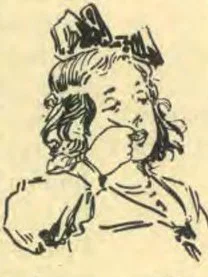
FROM my infancy I have lived in a small cave in one of Mary Jones’s back teeth. My parents preferred this location, on account of its retirement from the outer world, its freedom from sunlight, and the absence of circulating fresh air. Its general adaptability to the growth and development of their children was favorable, and food, because of its abundance, was much easier to obtain in this neighborhood.
Little Mary’s tooth-brush, of which we were all mightily afraid, seldom reached this retired locality. For that matter, we had little to fear from brushes in any location, for Mary thought she had no time to waste on her teeth. It is true, we were often threatened with extermination from floods made up of hygienic mouth washes; but as Mary seldom used these unless compelled to do so by her mother, our chances of annihilation were comparatively few.
I well remember the day that Mary, supplied with a piece of floss silk, began a general cleansing of the crevices of her teeth. My mother always laid the blame of this to her half-sister, my Auntie Sepsis (antisepsis), who had always been an enemy to all the germs and bugs of disease. She had never cared much for our branch of the family.
Our watchman, standing in his sentry-box at the top of Mary’s middle upper tooth, saw the coming danger and gave the alarm. A messenger carried the news from place to place, and in a short time we had hurried from the harvesting of the remains of Mary’s last meal to the innermost crevices of our caves. To my great disappointment, the last pickings of a chocolate bud had to be left as forage for the enemy. I hope it choked Auntie Sepsis.
Many of our friends and relatives were killed or injured. My great-uncle was caught in a loop of silk and was hung until dead. My playmate, in jumping from one tooth to another, lost his balance, falling upon Mary’s tongue. In the confusion he was swallowed before help could reach him. I shall never forget his call for help as he rapidly disappeared into the “Down and Out.”
By great good luck this attack was not followed up by other cleanings. The “rented room” sign soon disappeared, and we were again crowded for space. One morning Mary thought to rid herself of us by using a pin and a toothpick, but while my father lost an eye by the performance, the rest of us were not hurt. Our neighbors, however, in upper left tooth No. 4, gained an addition to their cave, and a new and up-to-date hotel, named the Decay House, was opened next to us.
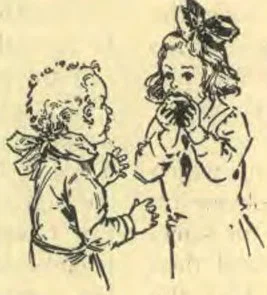
When I was two months old a stranger from a foreign land came to live with us. This is how it happened. Mary had been playing with Johnny Jones next door, who was just getting well from a sore throat. Mary, without thinking, took a bite from an apple from which he had been eating, and along with the bite came a germ from Johnny’s sore throat.
The germ barely had time to squeeze itself between two teeth before the apple was swallowed. Hard times then followed for us all. The stranger set up a poison factory in the back of Mary’s throat, giving work to other foreigners like himself. They ate up all our food, and made Mary horribly sick.
Auntie Sepsis was again called in, and such floods as we did have! Our entire population was reduced one half, for many of our folks could not swim, and life-preservers were scarce.
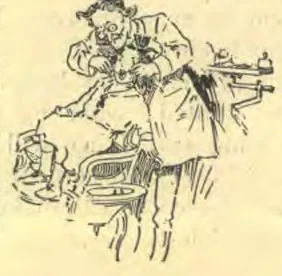
Mary finally recovered from her sore throat, but her doctor had discovered our homes in the cavities of Mary’s teeth. Then she was sent to a dentist, who squirted big streams of water at us, and dug us out with shovels, hoes, and rakes. Some of our people who always had a stubborn disposition, and who controlled the politics of our district, crawled into the teeth as far as possible and had to be drilled and blasted out, just as the Panama Canal is being made. This treatment was not enjoyed by Mary, who wriggled, squirmed, and cried until I felt seasick.
Among all the germs, I alone remain to tell you this tale. I escaped by crawling into a tiny crack which the dentist, being near-sighted, did not see.
Mary has learned by this severe lesson the value of keeping her teeth clean, and now uses her tooth-brush regularly.
My life is in constant danger. My friends11are all dead, and all their houses filled with metal. What little food I get must be swallowed on the spot, and can not be stored away; for the tooth we formerly used as a storehouse has been pulled down and a new one has been made to take its place.
I have nearly been swallowed several times, and never feel safe without a staff or parachute. I am merely a shadow of my old self, and have entirely lost my nerve. Besides, the new mouth wash Mary is using has nearly ruined my stomach.
There are now no good openings in Mary’s teeth for a young microbe, and I have to start life in a new country. Yesterday I received word that Mary’s finger nails have a growing population. Auntie Sepsis has not been heard from by them for a long time. I shall try to reach this fertile country if an opportunity offers. I will let you know later how I may succeed.—Caroll H. Francis, M. D.
—A. L. Sykes, in Youth's Companion
By A. L. Sykes
Sympathy
“Poor little girl!” the birdies say.
“See, she's dressed in the queerest way:
No smooth feathers, no pretty things,
And O, the dear, she has no wings!”
“Yes,” said the bunny, “how sad for her!
She has no ears, and no soft, warm fur;
And the way she runs on her funny feet,
Even a baby of mine could beat.”
“We wish,” said the birds, “she could stay right here,
And live in the woods and grow less queer.”
“Yes,” said the bunny, “and grow more wild.
It must be dreadful to be a child.”
—A. L. Sykes, in Youth's Companion
The Arab to His Horse
By Bayard Taylor
COME, my beauty! come, my desert darling!
On my shoulder lay thy glossy head!
Fear not, though the barley sack be empty,
Here's the half of Hassan's scanty bread.
Thou shalt have thy share of dates, my beauty!
And thou know'st my water-skin is free:
Drink and welcome, for the wells are distant,
And my strength and safety lie in thee.
Bend thy forehead, now, to take my kisses;
Lift in love thy dark and splendid eye;
Thou art glad when Hassan mounts the saddle—
Thou art proud he owns thee: so am I.
Let the sultan bring his boasted horses,
Prancing with their diamond-studded reins;
They, my darling, shall not match thy fleetness,
When they course with thee the desert plains.
We have seen Damascus, O my beauty!
And the splendor of the pashas there;
What's their pomp and riches? why, I would not
Take them for a handful of thy hair!
—Bayard Taylor.
Points of a Good Stable
MEN bring the horses in at night cool and breathing easily.
Legs well rubbed if wet or muddy, or if the horses are tired.
Head, ears, and neck well rubbed, if wet from rain or sweat.
Horses sponged under collar and saddle.
Horses well brushed, if dry.
Feet washed and examined for nails.
Eyes, nose, and dock sponged in summer.
In very hot weather, horses wiped all over with a wet sponge on coming in.
Horses given a little water, but not much, on coming in warm.
Horses watered when cool, then hayed, watered again, and grained. (In any case watered twice after coming in at night.)
Plenty of bedding, and horses bedded down all day on their rest day.
Hay and grain of the best quality.
Owner drops in often.—The Pennsylvania Society for Prevention of Cruelty to Animals.
A Fishing Excursion
NAME the following score of fishes from these puzzle clues:—
A planetary fish.
A color.
To find fault.
A lance.
A canine.
A feline.
A sphere.
A smear.
An explosive.
A weapon.
A beam of light.
Part of the foot.
Terms of sale.
A kind of tree.
A Michigan town.
A precious metal.
The source of light.
A winter pastime.
A lineal measure.
A white metal.—Woman’s Home Companion.
A Bible in a Cracker Box
THE British and Foreign Bible Society recently published an important edition of the Scriptures in the principal language of Uganda. The volume is very long, but it is only three inches wide and about three inches thick.
A peculiar reason occasioned the adoption of this form. In Central Africa the white ants and other insects rapidly destroy a book unless it is well protected. The representatives of the society, therefore, recommended that the edition mentioned be issued in a form that would fit into the tin biscuit boxes of a certain firm which are very generally used in Uganda.
This was done, and the ant-proof biscuit box is just large enough to hold this Bible, a small Bible history, and a hymnal and prayer-book.—Selected.
Testing Whether You Have the Mind of Christ
ONE way of testing whether you have the mind of Christ is to mark the circle of your sympathies. Are they home-wide, nation-wide, or world-wide?—Northwestern Christian Advocate.
The “Instructor” Band of Mercy
FROM Arpin, Wisconsin, the name of Sybil Tubbs has been received as a member of the INSTRUCTOR Band of Mercy. From Escondido, California, Miss Anderson, secretary of the young people’s society of that place, sent in the following list of names as members:—
Joseph Larson
Maud Larson
Aaron Larson
Ruth Madison
Albert Larson
Lila Hodge
Peter Nightingale
Katie Abrams
Freddie Abrams
Elizabeth Toews
Johnnie Abrams
Elizabeth Nightingale
Mable Lambert
Missionary Volunteer Reading Courses
Senior No. 4 — Lesson 17: “Story of John G. Paton,” Chapters 30-36
Test Questions
Do you think Kowia was a Christian? Why?
Locate Erromanga on the map. What missionaries were working there?
Would you consider the sandalwood traders responsible for their murder? Explain why. What other missionary was killed on this island?
How did the conduct of the Erromangans influence the Tannese?
Why was Paton so anxious to stay on Tanna? Who was his companion?
What encouraging omens appeared to cheer the missionary?
Who was Miaki?
Do you think the visit of the war-ship helped or hindered Paton? Why?
What great council did the chiefs hold? What was the result?
Why do you think Ian’s attitude toward Paton changed so suddenly?
When obliged to leave the station, where did the missionaries flee?
What remarkable deliverance came to Nowar’s village?
Note
The following items are taken from Paton’s “Autobiography:” —
“The natives have no idea of death coming to any one naturally. Everything comes by Nahak, or sorcery. When one person is sick or dies, they meet to talk it over and find out who has bewitched or killed him. This ends in fixing upon some individual, upon whom they take revenge or murder outright. Thus wars arise on Tanna; for the friends or tribe of the murdered man generally seek a counter-revenge.”
“So sad was the condition of Tanna that if a man were desperate enough in wickedness, if he killed a number of men and tyrannized over others, he was dignified with the name and rank of chief. This was the secret of Miaki’s influence.”
“Kava is a plant from which the natives make a highly intoxicating drink. The boys and girls first chew it, and spit the juice into a basin; there it is mixed with water and then strained through a fibrous clothlike texture, which they get from the top of the cocoanut trees. The men drink this freely. It does not make them violent, but stupefies them and induces sleep, like opium. Women and children are not allowed to use this beverage.”
Society Study for Sabbath, February 18
Missionary Volunteer Methods, No. 3 — Organizing a Society
Leader's Note.— It has been said that a leader is one who knows the way, can keep ahead, and cause others to follow. The success of a Missionary Volunteer society depends much on the leader being thoroughly familiar with all the plans and methods of missionary work and organization, and on his having such a spirit of consecration to the work as to command the respect of all as a spiritual guide. After a program like this, many questions may arise; the leader should be broad enough to carefully consider them all, and should have a definite idea of what is best for the particular society under his care. As a result of these programs on Missionary Volunteer Methods our societies should make a steady improvement through the year. We should endeavor to avoid sudden or rash changes on the one hand, or a lack of progressiveness on the other. Keep the ideal organization in mind, and work toward it, remembering continually that organization is an important means to an end, and not an end in itself. Far better is a poor organization with a spirit of consecration and earnest work than a perfect form without these. It will be difficult to give this program without Missionary Volunteer Series, No. 4. It can be obtained from your conference secretary or the General Conference Missionary Volunteer Department, for three cents. On topic one, it would be well to have “Messages to Young People,” Missionary Volunteer Series, No. 19; price, two cents. Two large placards published by the general department would be helpful to your society now and hereafter;—one, “General Plan of Organization” (as given in Missionary Volunteer Series, No. 4); and the other, “Training in Service.” The two will be sent post-paid for twenty-five cents. The article “Missionary Volunteers,” on page 4, by W. W. Ruble, will also be helpful in this program.
Program
Scripture drill.
Call to Organize (reading). See Missionary Volunteer Series, No. 4, pages 3, 4.
Basis of Membership (five-minute paper). See Missionary Volunteer Series, No. 4.
General Plan of Organization (five-minute talk). See Missionary Volunteer Series, No. 4.
Officers and Committees Needed in a Society (eight-minute talk). See Missionary Volunteer Series, No. 4.
Missionary Volunteers (three-minute talk). See page 4.