“HURRIET” is the Turkish word for liberty. Until the revolution its use was forbidden. Recently a patriotic play has been upon the boards in the Turkish theaters, bearing the significant title, “How It Came About.” The object of this article will be to tell how Turkish liberty came about, and to outline a few of the most striking features of the revolution.
As a rule, revolutions are not unaccompanied by bloodshed. France, polished and refined, shed blood in torrents. In Turkey, supposedly one of the most barbarous lands in the world, a practically bloodless revolution seems almost inconceivable. We have been wont to hear of the “unspeakable Turk.” Horrible massacres have taken place so often in that unhappy land that minds have become satiated with their scarlet story. We have read of Armenian massacres, and Macedonian massacres, and Bulgarian massacres in an almost unending succession. How then a bloodless revolution in Turkey—Turkey which to most Westerners has seemed the hotbed of all that is fiendish and horrible? Nevertheless such is the fact. There has been practically a bloodless revolution in Turkey.
Last week I traced the story of the rise and organization of the Young Turk party. After a period spent in “educating” the country, this party decided that physical force might be necessary, and so determined to capture the army, and started their work with the Third, or Macedonian, Corps.
This was a wise selection, as the Third Corps in question was quartered in disturbed country, and the men were greatly disaffected on account of being held beyond legal time with the colors, and besides, their pay was constantly in arrears.
It is agreed by almost all authorities that the explosion took place sooner than the revolutionists had planned. The cause of this will be discussed in a subsequent paper. The immediate cause, however, was a flattering invitation to Enver Bey, the prime mover in the plot at Salonika, to visit his royal sovereign in Constantinople. He wisely concluded that his plans had been discovered, and that he had been betrayed to the sultan. He fled to his friend Niazi Bey, the commandant of Resna. This officer had strong Albanian connections. Niazi resolved to act at once, and with a band of picked men threw himself into the hills.
Shenai Pasha was detailed to quell the mutiny. He was murdered. Osman Hydadet attempted in barracks to plead the cause of the sultan, and fell amid a hail of bullets. The Second Army Corps soon joined the Third. Between them they held districts on both sides of the Bosporus. The troops of Anatolia, which were ordered to Monastir, refused to fire on their mutinous comrades. Threatening messages were received from Adrianople.
The army at once demanded the proclamation of Midhat Pasha’s constitution of 1876. The ground was now crumbling rapidly beneath the feet of the supporters of the Hamidian régime. Messages to Yildiz from all parts of the European provinces announced that the game of absolutism was lost. Even the Albanians fell into revolt. All Macedonia was in the hands of the Young Turks. And when the vali of Monastir proclaimed Midhat’s constitution in the presence of the troops, it was felt that the game was up. Then it was that Abdul-Hamid, after a lapse of two and thirty years, proclaimed again the great statesman’s constitution.
The rest we know. In twenty-four hours the press was free. July 25 brought amnesty to political prisoners. By Saturday evening every house was decorated. Side by side with the Ottoman star and crescent was the Greek cross and stripes. The Greek newspaper Proa declared: “The whole nation was drunk, was suffering from headache (kraipale) from the intoxication of joy. Luxuriating in the boundless radiance of liberty and equality, they could only cry, in ecstasy, ‘Long live the friend of liberty, the Sultan Abdul-Hamid.’”
The members of the camarilla and ministers of state who had practised extortion began at once to leave the country. The stories of their exit are somewhat amusing. First went Habili Efendi Melhame. It was said at first that he went on a special mission for the sultan. Maybe—but he went in11his sleeping attire, and with signs of great haste. Next went Selim Melhame, minister of forests and mines. He appears to have been detested on account of his extortions.
“On August 1 it was announced that ‘the chief inspector of military schools, otherwise chief spy, otherwise chief hypocrite, Ismail Pasha,’ having presented himself at the Salamlik, on the previous day, was compelled to retire in disguise, ‘the presence of such miscreants being no longer tolerated.’ Another, ‘most dishonorable of all the spies,’ Kabasıl (Coarse Beard), Mohammed Pasha, who had caused the death of many thousands, having likewise been dismissed from the palace, had gone home on foot and in tears, whence, after saying to his family, ‘This is the consequence of my crimes,’ he took ship for Brusa, accompanied by the execrations of the populace.”—London Fortnightly, October, 1908; Art., “Constantinople at the Declaration of the Constitution,” by D. S. Margoliouth, who was an eyewitness.
One of the greatest causes of joy was the cashiering of the spies. “How large a portion of the public revenue had been annually expended on these persons will perhaps never be known; the lowest estimate placed is about a million sterling. The profession was staffed by persons of varied nationalities and social status; an Englishman is said to have practised it with success till his countrymen contrived to get him exiled. The Armenian Patriarch Ormanian was regarded by his countrymen as a spy, and they clamored for his resignation. He complained to the grand vizier of the language of the press, but was told that the press was now free. He tried to fly with a forty-thousand-pound check in his possession, but was arrested and brought back to the patriarchal palace, where he was kept a prisoner.”
But now these industrious spies were out of employment. On Sunday, August 2, they assembled at the palace door, and demanded that they be given some appointments, that they might “eat a piece of bread.” They were paid what was due them on salary, and sent on their way.
But let us turn to the happier phases of the revolution. I will record some of the scenes which took place, in the language of Englishmen who have made Eastern affairs their lifelong study, and who were on the ground at the time. Here is the record of one of these:—
“An enormous tyranny was swept away. The Hamidian despotism disappeared in a night. Its tools were prisoners or fugitives. Yet only seven lives are believed to have been sacrificed to vindicate passion. Of those one was Fehim Pasha, torn to pieces at Brusa at the end of a career infamous and insolent compared with the worst known even in connection with palace politics in the East. In Macedonia Turkish soldiers make common cause with the insurgent bands, Albanians fraternize with Serbs. With more mental reserve, and yet with as much cordiality as could be expected even in these circumstances, Bulgars and Greeks fall upon each other’s necks. Salonika becomes a picturesque and jubilant Babel, filled not with discord, but with the harmony of the garden of Eden. Brigands of miscellaneous nationality weep for joy. All the fierce figures in romantic costumes, who seemed lately in their passions and their deeds to be the nearest political approach to the limbo of hell, are seen in the streets of Salonika, as one observer puts it, ‘laughing together, dancing together, drinking endless coffees together.’ In Constantinople Turks have kissed the earth which covers the victims of the Armenian massacres, and the Armenians have suddenly acquired an interest second only to that of the Turks themselves in preserving the integrity of the sultan’s dominion. No one in the capital but was moved to the depth of the soul by the calm, serene, yet electrical temper of the crowd, incomparable in its simple dignity and self-control, perfect in its humanity. High and low warned each other against extravagance and excess, against all outbursts whether in word or deed, that might seem unworthy of the new reign of law. The first natural movements of popular vindictiveness were successfully suppressed. All the faults of the sultan’s reign were attributed to his advisers. The padishah was proclaimed the father of his people, as Louis the Sixteenth was for a time proclaimed the ‘restorer of liberty.’
“And across the Bosporus, in the Asiatic dominions of the sultan, there were scenes even more wonderful still, if that might be. Take the picture of what happened at Beirut when the new régime was inaugurated in the closing days of July. Only five years before, the city had been given over to mob violence, the Christians fled for their lives, and only the presence by chance of three American war-vessels prevented massacres. Here the most impressive feature of the present demonstration was the vehemency, the continued reiteration of the sentiment of brotherhood of Moslem and Christian, who were to live together in peace in this new era. No such utterances were ever heard before in Turkish history. Any one predicting such a possibility a month ago would have been treated as a visionary. But here were a hundred turbaned Moslem speakers ringing the changes on this theme, until we seemed like those standing in a dream. Then is described a venerable sheik, who, with green turban and flowing robes, told how, before the Hamidian tyranny, the Christian and Moslem mothers used to nurse each other’s children, and the young men called each other brethren. And now ‘again and again the Moslem speakers gave the salutation, Es salaam alaikum ya akhwy (Peace be with ye, O brethren!), which had been held from the Christians for so many years by all but the most liberal and enlightened Moslems.’ Nor was this all. Many times during the day the people pushed Christian priests and turbaned Moslems into each other’s arms, and made them kiss each other. More still. The Mohammedans, with the commander of the troops, many officers, and the military band, attended the Armenian church, and bewailed that wave of blood by comparison with which St. Bartholomew itself was but a pin-prick.”—The Fortnightly Review, London, September, 1908; Art., “The Turkish Revolution,” by Viator.
That such scenes should take place in Turkey, of all places on earth, is almost beyond belief; for Turkey has to rule over an immense variety of races and creeds. These are all more or less jumbled together in a comparatively small area. Ordinarily these different sects and races agree in nothing except their hatred of Ottoman domination. Worse than this, it is a fact that among themselves there is perpetual bitterness and strife. The Slav has ever loathed and feared the Greek. The Greek views the Slav with the most supreme contempt. The Moslem Albanian holds the Catholic Albanian as one of the most odious of mortals. And so it has been all the way through. How such a medley of peoples, so utterly at variance with one another, could ever have been brought together under the rule of the one they hate most on earth, and this without bloodshed, but in the best of spirit, is almost beyond human understanding.
Nor has the work of the revolution raveled out with time. Many feared that after the first frenzy of fraternization, old passions would arise. But foreign consuls are not reporting that murderers and violators go unpunished. The suppression of crime is the crucial test. If the Young Turks fail here, they know that the confidence of the world will be lost. Already they have hanged Turks for killing Bulgars, and Albanians for killing Serbs. Thus far they have demonstrated that they have the power to keep order. In the Turkey of to-day the peasant can cultivate his fields without fear, and gather his harvests without danger to his life. One year ago there was wholesale emigration to America; already thousands have returned. A year ago the fishermen of Lake Yenidje dared not, for terror of assassination by murderous bands, follow their calling. Now they are back in their boats. For months together during the winter of 1907-08 little children spent the hours of darkness shivering in the fields, for fear they would be attacked in their homes; now this is changed.
Such is the condition of Turkey under the new régime; and the question now arises, What will be the attitude of the Young Turks toward the great powers? and what will be the attitude of the great powers toward the Young Turks? This is the crux of the whole situation. Will the general situation in Europe be rendered better or worse by the change of affairs in Turkey? The discussion of these questions must be left for future consideration. They will be found of vital interest.
Madison, Tenn.
In Honor Preferring Another
By W. E. HANCOCK
W. E. HANCOCK
“I INDEED baptize you with water; but one mightier than I cometh, the latchet of whose shoes I am not worthy to unloose.” Luke 3:16. The multitudes were flocking to John, asking, “What shall we do?” And “the people were in expectation, and all men reasoned in their hearts of John, whether he was the Christ, or not.” Luke 3:15. Human impulse would have led John to take advantage of this disposition of the people to regard him as the Christ. But instead we behold him saying, “He must increase, but I must decrease.” Words more characteristically divine were never uttered by human lips. A life more in accord with the example of Christ, who left the glory of heaven to accept the degradation of earthly life, can not be found in the Bible than that of John's, in his resignation to so speedy a humiliation in order that Christ might increase. Of John, Jesus said, “Verily I say unto you, Among them that are born of women there hath not risen a greater than John the Baptist.”
What made John the Baptist great? Was it riches or position?—No; he had neither of these. His clothing was of camel's hair, his food locusts and wild honey, and his habitation the wilderness. His position was neither recognized nor sanctioned by any earthly organization. Even his fame was as the dew which vanishes before the rising sun, so this could not have made him great. John was comparatively a young man. He had not the prestige of a long experience as a preacher, but he had a mission and a message. He did not allow youth, inexperience, or the lack of recognition by the authorities of his nation to prevent his fulfilling the mission and his proclaiming the message committed to him.
His mission was an important one, and his message the greatest that could have been proclaimed at that time. No one recognized more clearly than John the greatness of the work of proclaiming the coming Messiah. Never did man more fully and fearlessly proclaim a message than did he. We hear him utter the most scathing denunciation against the religious leaders of the people: “O generation of vipers, who hath warned you to flee from the wrath to come? Bring forth therefore fruits meet for repentance.” The impression made by his preaching was great upon the minds of the people. It was in marked contrast to the formal teachings of the Jewish leaders. Thousands were flocking to the preacher of the wilderness to be baptized of him. Even the Pharisees were forced to take some action regarding this humble and fearless teacher. The people were willing to proclaim John the long-expected Messiah. The priests and Jewish leaders were no less anxious to acknowledge him as the Christ, if he were to be the deliverer from the Roman yoke. Vainly did they hope he might be the deliverer from earthly bondage, but little did they realize their need of the spiritual deliverance which the true Messiah came to give.
They came to John with the dignified name of authorized teachers, demanding, “Who art thou?” Contrary to their hopes and expectation, “he confessed, and denied not; but confessed, I am not the Christ.” Art thou Elias?—No. Art thou the prophet? Again he answers, No. Their anxiety intensified, and they asked, “Who art thou? that we may give an answer to them that sent us. What sayest thou of thyself?” In the answer given, the greatness of John is revealed—the greatness of true humility. Contrary to human nature, and contrary to the desires of his hearers, he gives the answer, I am not the great one whom you think I am. I am simply a voice crying in the wilderness, “He it is, who coming after me is preferred before me, whose shoe's latchet I am not worthy to unloose.” Again these words are repeated by John on the day of Jesus' baptism.
At this critical point of John's work, his true character was revealed by his attitude toward Christ, as expressed in the preceding words, by which he struck the death knell of his greatness in the eyes of the Jewish people. “Though John's mission seemed about to close, it was still possible for him to hinder the work of Christ. If he had sympathized with himself, and expressed grief or disappointment at being superseded, he would have sown the seeds of dissension, would have encouraged envy and jealousy, and would seriously have impeded the progress of the gospel. John had by nature the faults and weaknesses common to humanity, but the touch of divine love had transformed him. He dwelt in an atmosphere uncontaminated with selfishness and ambition, and far above the miasma of jealousy.”—Desire of Ages, page 179.
Henceforth we see his fame quickly decrease, and the fame of Christ increase. His disciples are taken from him, he is imprisoned, and beheaded. His career is as short as it was great. The sudden rise of the great teacher is as suddenly ended by a speedy humiliation. Never was he greater than at this time when he voluntarily resigned his greatness to the One greater, in the words, “He must increase, but I must decrease.” These words express a spiritual truth which every Christian should personally accept and make his motto.
Guatemala City, Guatemala.
The Comic Supplement
By E. C. JAEGER
E. C. JAEGER
SEVENTH-DAY ADVENTISTS have established a church-school system for a two-fold reason; first, to give their children a knowledge of God's Word, and second, to provide an education free from the errors taught in the public schools. Our schools are accomplishing the work we have purposed for them. But there is great danger that many of the parents who support these same schools, and are sending children to them, may in their homes tear down the good work done by our Sabbath- and church-schools.
I speak of the comic Sunday newspaper supplement. All the week the teacher tries to instil respect for authority, reverence for old age, and a love for truthfulness. Sunday morning comes. The father buys a Sunday newspaper. Around him crowd the children, each anxious to get hold of the “funny sheet,” as they call it. And what does the comic sheet do for them? I quote: “Instead of helping to counteract the too prevalent tendency among children to irreverence and resistance to authority, these pictures and jokes actually teach our children irreverence and lawlessness by ridiculing home discipline, by making cheap fun of old age, dignity, good breeding, and all the pieties and amenities which make the family the most sacred and important of all human institutions. It is as if we parents, by letting our children have these supplements, were doing our best to cheapen the authority of the home, to emphasize the spirit of lawlessness in our children, and to vulgarize their minds.” The standard joke in one of these supplements is an old grandpa deceived by a child or a child deceived by the grandpa, a parent being hoodwinked, or a wife playing a joke on her husband, and similar incidents.
Monday morning Mary and John go to school; they're mischievous; the parent laments; he can not see why he should have such children. Is there a reason? Look over your pile of Sunday newspaper supplements, and perhaps you may see the same mischievous joke John has tried, painted therein in some cheap, crude, and gaudy colors. As some have said, “It is beyond our comprehension that parents otherwise intelligent do not see the inroads upon the characters of their children by these infamous ‘supplements.’”
Not a single service of any kind does the comic sheet serve. It was only gotten up to increase newspaper circulation. It satisfies the pampered taste of cheap minds.
Our children should not be allowed to read the comic supplement; for, as the Outlook says, “There is probably at present no single influence that is poisoning America at the fountain-sources more than the so-called comic supplement.”
I believe that I have not exaggerated in saying what I have. I only hope that at least some may be influenced to see the matter in its true light, and to refuse to buy a newspaper that maintains a comic supplement.
Riverside, Cal.
Govern the Lips
By Edwin Arnold
(GOVERN the lips
As they were palace doors, the king
within;
Tranquil and fair and courteous be all
words
Which from that presence win.
—Edwin Arnold.
Turkey
By ROBERT S. GREAVES
ROBERT S. GREAVES
No doubt you have read of the troublous times we are having in Turkey, and of the many changes which have taken place these last days. In the capital, things have turned out much better than might have been expected, and we are all glad that the constitution is still in force. The Young Turks are manfully striving to better the condition of the empire; but there is a certain class of the Moslems who always seem ready to fall upon the Armenians, and it is only fear that prevents their treating all the Christians alike.
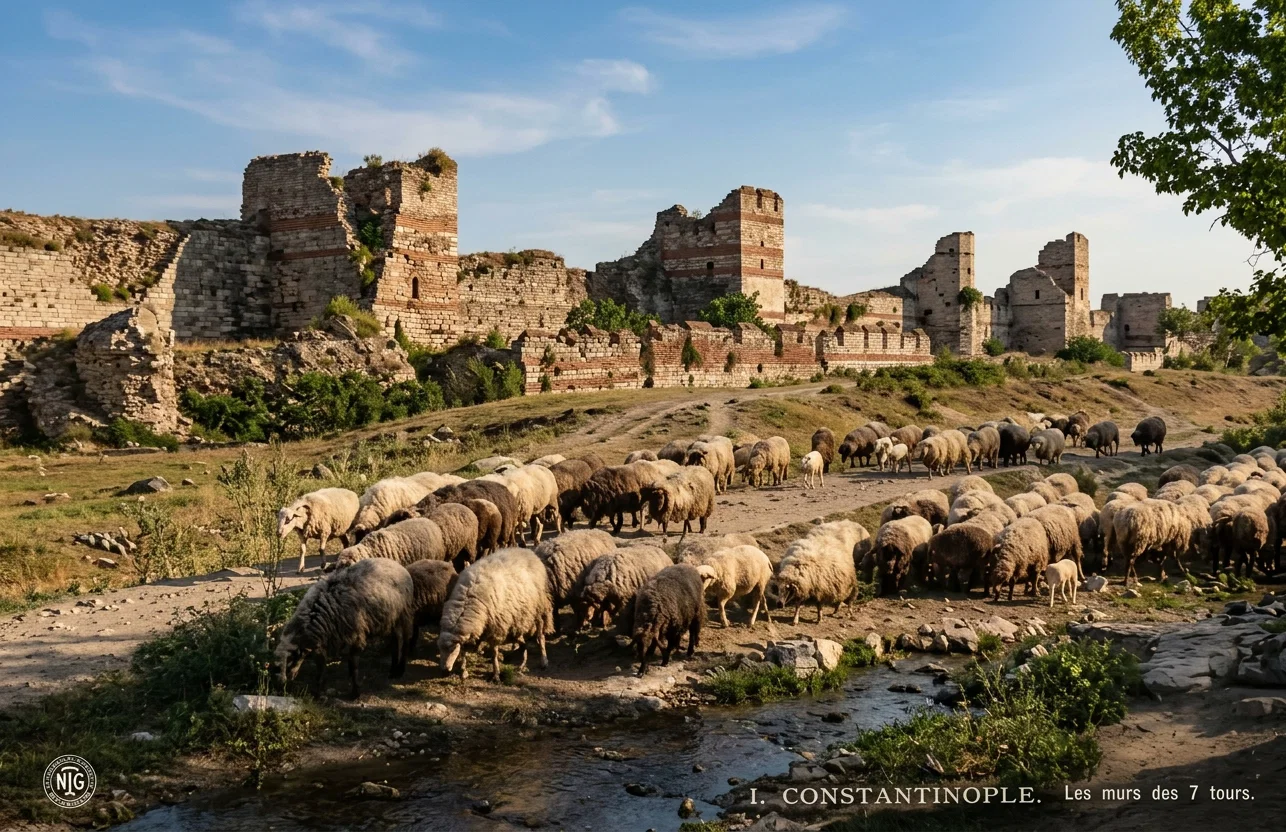
PORTION OF WALL BUILT BY CONSTANTINE, CONSTANTINOPLE
It may be true that the Armenians especially irritate the Turks by planning for their freedom; but the wholesale butchery that has lately taken place is most unjustifiable, and has only increased their desire for liberty.
In Smyrna all are heavily armed, and the former feeling of unrest is much intensified, especially as a massacre was also planned to take place here, but was discovered. Bombs were found under two of the Turkish mosques, placed there by the Turks themselves, and it was planned that the destruction of these places should be charged to the Christians. The feelings of the fanatical rabble are easily wrought upon, and I fear there would have been much bloodshed if the plan had not been discovered. In different other buildings bombs were found, and a number of hats were lying around the place. As the Turks do not wear hats, these were to be used as a sign that it was the work of the Christians. Previously Smyrna has been looked upon as a very safe place, owing to its foreign population. But, as the head of the Scottish mission work remarked to me the other day, “We have all been sleeping over a volcano, and did not know it.”
Upon the proclamation of the next sultan, the streets were draped with flags, and there was a great firing of cannon. The people also have rather a dangerous way of showing their feelings by firing their revolvers into the air, and of course the bullets fall with great force. There seems to be no law against the shooting of firearms in the streets, and lately we are often startled by hearing shots in the middle of the night, and sometimes they are fired close to the house. The feelings of the people are so wrought upon that it takes very little to cause an excitement. The other day a few drunken soldiers came running down the street, brandishing their arms. At once the women began to run, and a cry was raised, and before it could be realized what was going on, those living on the lower part of the street were closing their shutters, and the storekeepers were tumbling their goods inside their shops, in their haste to close up quickly. A little scare also caused people to flock inside the yard of the Scottish mission, and some were so fearful that they positively refused to leave, and the workers had to let them sleep in the hospital all night.
In spite of these things, we have much for which to be thankful, and so far Smyrna has had no serious trouble. Our health and courage are good; and that Power which has kept us so far, we believe will continue to keep us even unto the end. We would rather be in Turkey while under the protection of our Heavenly Father, than to be in the most-favored place in the home land without that protection. We have seen enough of this country to show us that many precious souls are here, and we believe that not only from the Greeks and Armenians, but from the Turks themselves, many bright jewels will be gathered out for the eternal kingdom. Please pray for our work here, especially that the way may speedily open for us to do a better and quicker work than we have yet been able to do.
May the Lord bless you, brethren, at the General Conference, and daily meet with you, guiding always with his Spirit of love, that wise plans may be laid for proclaiming this message in all parts of the world. We know you will not forget Turkey, even though the call for laborers is heard from every field; but what we especially need at this time is your prayers that the power of God may be made manifest; for without this, all the sending of men and money will be like putting money into a bag with a hole in it. We must have the Holy Spirit.
Smyrna.
More Help for Eastern Africa
By L. R. CONRADI
L. R. CONRADI
As the millions in Africa still in darkness ‘call urgently for help, and as we have in our mission territory on the east coast of Victoria Nyanza alone, three hundred thousand people without any missionaries except our two families, we have tried hard to secure more help. Brother A. C. Enns, who has for the last five years worked in the South Pare Mission near the coast, and who helped Elder A. A. Carscallen in opening the work, has meanwhile rejoined him and Brother J. D. Baker. The plan was that he should begin in the territory across the German border, and that the work be carried on unitedly, under the Victoria Nyanza Mission field.
On the tenth of April, the steamship “Prinz Regent,” of the German East African line, sailed from Hamburg, with Brother M. Kunze on board; he was joined by Brother B. L. Morse, at Southampton, and Brother and Sister Ernst Raessler will take the boat at Marseilles; thus there will be four new workers going out. Brother and Sister Raessler and Brother Morse will land in Mombasa, and proceed direct to Victoria Nyanza; so that the number of our workers there will be increased to six. Elder Carscallen secured the sites of the two stations we have, and also a third site, while Brother Enns will pick out the fourth. As fast as we can get more workers, we shall increase the applications for new sites.
We ought to do everything possible to send out a still greater force this fall. As we enlarge our work, it will naturally call not only for more consecrated help, but also for additional means.
Brother Kunze will proceed to Tanga, and connect with the Pare Mission. Brother E. Kotz has been there now four years, and he and Brother Enns have translated the Gospels into the Chasu language. Brother Kotz desires to see these in print as soon as possible, as14they have thus far no written or printed books whatever. The Hamburg House has gotten out a small hymn-book for them, to the great joy of the natives, and would be pleased to help them also in getting the Gospels printed. If the printing were done at Tanga, Brother Kotz would have to go there, and both his living while there and the printing would be rather expensive. Our board therefore decided that it would be wiser to have Brother Kotz take a vacation, and at the same time read the proofs while the Hamburg House is getting out the Gospels. This will be the first work our denomination has thus far done in getting out any part of the Scriptures in a tongue heretofore unprovided with any part of the Word.
We hope that our people will take a deep interest in this undertaking by contributing freely to the mission work, and that the work begun will be the means of bringing many to a saving knowledge of the truth.
Hamburg.
South Africa
By M. E. EMMERSON
M. E. EMMERSON
On coming back from the South African Union Conference, held last December, my mind was fully made up that the book work must advance in Basutoland; so, just as soon as I could arrange the affairs of the mission to safely leave it, my helper and I went out to sell some small books. We canvassed hard all day, selling only two or three books, at six cents each. “No money,” was the cry that came to our ears all day. This seems to have been the trouble in past years, as the natives have little or no cash. And yet the hills are covered with sheep, goats, cattle, and horses.
I questioned with myself thus: Why can we not sell books to the Basutos, when they have so many things we can turn to cash? So I suggested to my helper that we must use the natives’ wealth, if ever we expected to do much in the book line. He also thought the plan a good one. From the storekeeper close by, I ascertained for what chickens and skins could be cashed. The price was good, and we started out to give our new plan a trial. When the natives pleaded poverty, we told them to bring their chickens, skins, or anything they had which we could turn to money. Then some would commence to call chickens, and others would hurry away to find some skins. The first day we took in articles to the value of five dollars; that is, they actually cashed for that amount. Since that time, we have been able to place many books in the hands of the natives, and have always been able to obtain a cash value at least equal to the price of the books.
Not long after we commenced to canvass, there was a demand on the part of some for a school. Seeing there was really a good opening for this work, and realizing the importance of looking after the young, I wrote to the president of our union conference, asking that we might use two hundred ten dollars, profits from our book sales, to support a school in Basutoland during 1909. This request was granted, for which the Basutoland Mission is very thankful. Not many days after, finding we could not secure as a teacher the man for whom we had planned, I was informed by an English shopkeeper that I ought to take out a license, if I intended trading with the natives. Not being well informed in regard to the law in such matters, I thought it best to consult the assistant commissioner. So I rode twenty-five miles to Mafeteng, to see him. I laid my plans fully before him, and told him we desired to canvass all Basutoland; that the motive was not to make money, but to place our books in the hands of the natives; furthermore, that our intention was to put native canvassers into the field to sell these books. He said he did not know such a work had been done heretofore, but that it was all right, and gave me a written statement to the effect that I was permitted to sell books here at the mission, and elsewhere, without taking out a license. He told me that if it ever became necessary to obtain a license, he would doubtless secure it free for us.
This was very encouraging to me, and I went on my way homeward rejoicing. Night overtook me in a strange place, so I stopped in a native village, preferring that to the risk of getting lost in a strange country. Many of the natives could speak English. I told them that we were selling books in Basutoland that tell of the soon coming of our Lord. They were deeply interested, and I gave them a short study on the second coming of Christ. At the close, a man present said, “If I may, I will sell your books.” I answered, “If you desire to sell our books, you would better come to the mission and study some, to see if you are in harmony with what they teach.” He replied, “I am ready to go at any time.” I set a day, and he came. I found he had many points of truth held by us. After some study upon the Sabbath question, he accepted it. I felt that he was in earnest. In Sabbath meeting he expressed himself as being thankful for the truth, and in his evening prayer he thanked God for the Sabbath.
The way was now opened for both book and school work, so I left Brother Kalaka, my mission helper, to take up the school work, and took the new mission helper out to start him selling books. He did well. After spending some time with him in the field, I left him to try it alone, and returned home to see how things prospered at the mission station. While here that time, we started the school, with ten pupils, most of them small. That was three weeks ago. Since that time the number has doubled. Still more are coming. We teach them Bible, music, Bible geography, mathematics, and reading. Already some are making rapid progress, and we are much encouraged by what God is doing for us along this line.
On that visit home it was necessary to stay a few days, on account of having the mission house repaired. This took over a week, at the end of which time I went to visit my book man. I found him of good courage in the canvassing work, and hard at it. One of the first things he said was: “My brother-in-law is out selling the books, too. He has been out three days. And my two younger brothers want to canvass, as well. Can I not take them with me?”
I have employed another man to travel with me in the wagon. I have the vehicle covered nicely, and arranged so that I can hold lantern meetings. I shall visit each canvasser monthly, and gather up grain, skins, etc., which they are taking in continually for books. Just now we are getting a considerable amount of beans, corn, and wheat. While I am visiting the different canvassers, the man traveling with me will canvass by himself.
We believe there are better days for the work in Basutoland, and we ask the prayers of all God’s people, that he will continue to prosper it until finished.
Wepener, O. R. C.
Nurses in South America
SISTER LILLIAN M. VORIS reports for the little band of five lady nurses who recently landed in South America. She writes: “We like it here, and we are glad we can have a part in this work. We are all of good courage. We have a class of four German girls who have begun their nurse’s course. At present I am teaching them hydrotherapy. I enjoy it very much; and as I look into their bright faces, I ask God to help me to help them, so that they may become successful workers in this needy field. It is indeed a needy field, and there is so much to be done, so many souls to warn before Jesus comes. We five nurses are new in the field. We have not gone through the trying experiences the older workers have met, but we are anxious to acquire a good command of the language, so we may be more efficient workers.”
Begin at Once for Christ
A YOUNG man who had heard the gospel accepted Christ. A little while after this he was asked: “What have you done for Christ since you believed?” He replied, “O, I am a learner!”
“Well,” said the questioner, “when you light a candle, do you light it to make the candle more comfortable, or that it may give light?”
He replied, “To give light.”
He was asked, “Do you expect it to give light after it is half burned, or when you first light it?”
He replied, “As soon as I light it.”
“Very well,” was the reply, “go thou and do likewise. Begin at once.”—Selected.
A Lyric Sermon Every Day
By T. Starr King
If we but lived as we ought to live, and as we might live, a power would go out from us that would make every day a lyric sermon that should be seen and felt by an ever-enlarging audience.—T. Starr King.