Long ago, we might say almost as soon as the first workers came to Brazil, the question was asked, Whence shall we get workers for this great field? And then it was readily seen that workers educated in the field could work to better advantage than those who came from abroad. Persons coming from other fields, for instance the United States, must, in the first place, accustom themselves to the climate; then they must acquaint themselves with the habits and customs of the people, and, in short, become familiar with the conditions as they obtain here. And some would, perhaps, never so fully adapt themselves to all these things that they could be a blessing to the people of Brazil. Hence the necessity of having an institution where gospel workers could be trained was early felt, but to provide for this need seemed a difficult thing. First, it required means; second, where was the person who could take charge of such a school?
But the Lord early begins to prepare his agencies, and so he was beginning a work, moving upon hearts to act, who themselves did not foresee the end of their plans, to lay the foundation for a training school where perhaps it would have been least expected, and at a place which probably would not have been chosen.
THE DORMITORY
The membership of the Brusque church embraces the earliest Sabbath keepers of Brazil. Though these brethren were visited in 1894 by Elder F. H. Westphal, then laboring in Argentina, and a number of them were baptized, they were not organized into a church until after the arrival of Elder Graf, I rather think about the beginning of 1896. But as soon as these brethren had accepted the truth, they felt the need of a school where their children might be educated. Accordingly, Brother William Stein, a native German, who had also been among the first to accept the truth, was sent to Brusque to take charge of their church school. Brother Stein was succeeded by Sister A. Bruck as teacher of the Brusque church school.
By this time (1898) the Brusque church had grown in membership. Many of the members who lived at quite a distance from the church became interested in the work of the school, and desired to have their children share its instruction, so plans were laid for the erection of a dormitory that might accommodate the children of those living at a distance from the school.
The new building being planned on rather a large scale under the circumstances, seemed to exhaust the church's ability, even though our good Brother John Hettrick, who was both bricklayer and carpenter, donated most of his labor on the building; and operations had come almost to a standstill when the mission committee in the spring of 1900, seeing that the Lord was blessing Brother Lipke, who had meanwhile succeeded Sister Bruck, and who had a class of promising young people in training for the Lord's work, accepted the invitation of the Brusque church to complete the dormitory, and use the whole as a training school for Christian workers. It seemed evident to all that Providence guided in the establishment of this school, the first training school for Brazil, which was opened with but little expense to the mission.
The school is conducted on the industrial plan, each student working twenty-six hours each week, and paying $2.50 a month. For this the student receives his tuition, board, and room. The furnishing of the home is very simple and inexpensive, nevertheless it is comfortable.
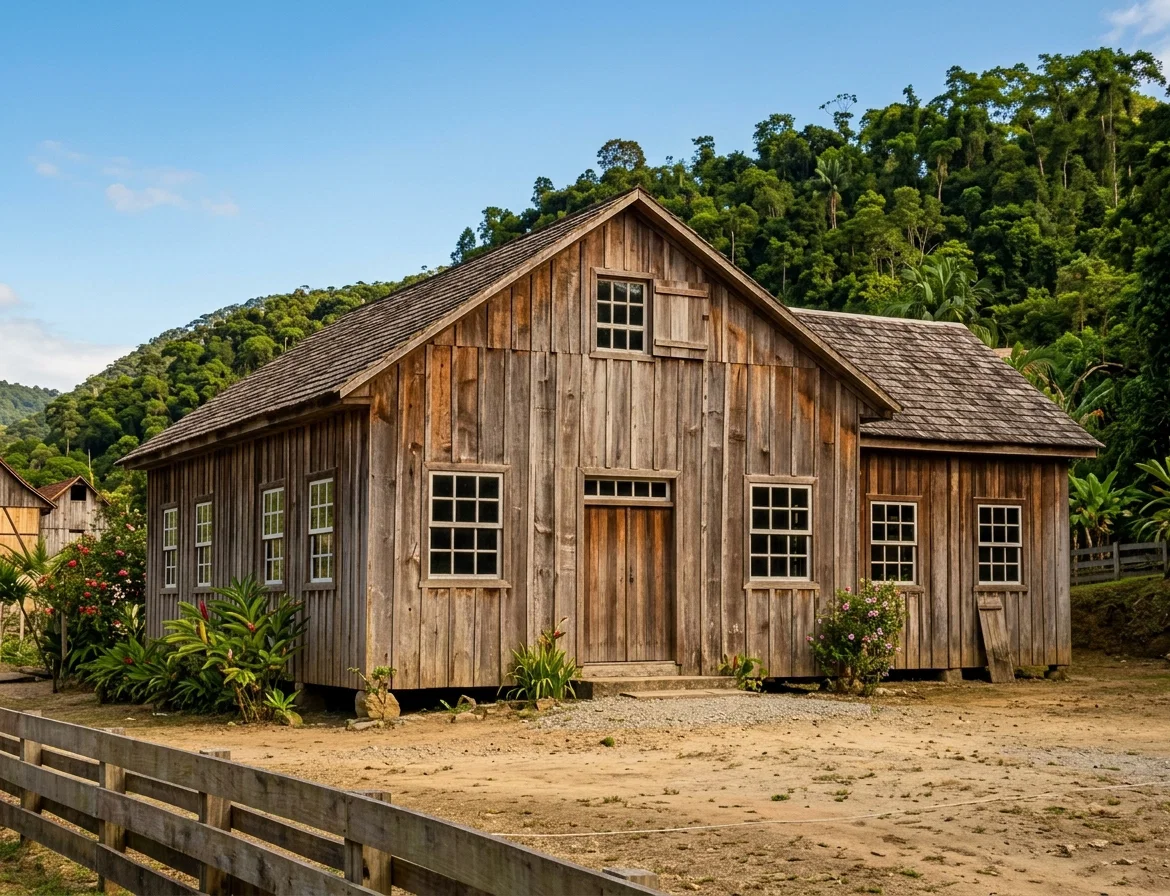
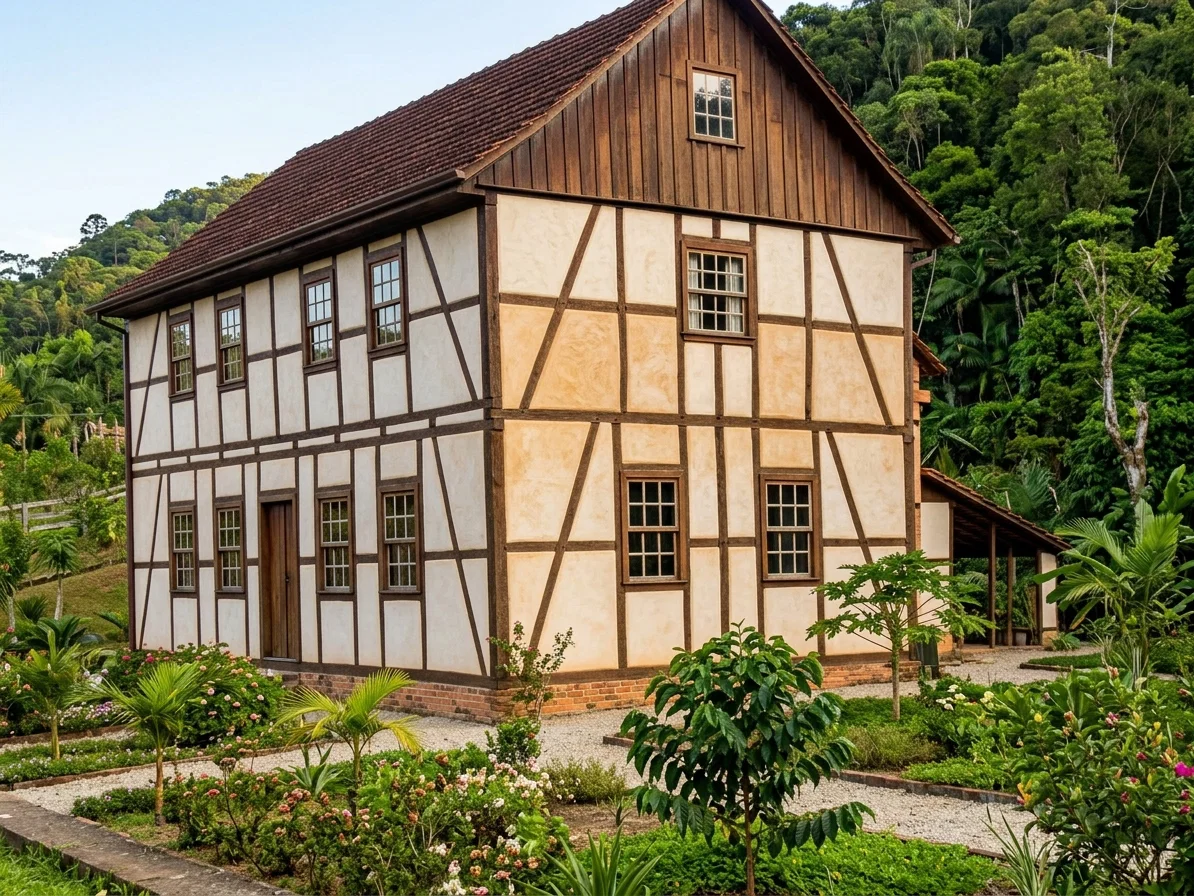
The accompanying pictures are of our school buildings. The two stand within a few rods of each other. The floor of the one-story building is divided into two parts—the front, where the church services are held, and the back for the school-room. Here in the morning a school is conducted for the children of our brethren who live in the vicinity. In the afternoon the mission school is held in the same place.13
The other building is the dormitory. The center of the first floor is the dining-room and sitting-room. At the sides and on the second and third floors are the sleeping-rooms. At the back is the kitchen, storeroom, and workshop. There are also a few beds on the second floor of the schoolhouse.
May the Lord continue to prosper and bless the school, so it may train many laborers whom he can use to his glory.
Rio de Janeiro, Brazil.
To a Missionary
By E. L. A. C.
HAST thou considered well thy purposes?
Art sure thou knowest what ’twill be
To give up all,—thy friends, thy country, home,
All that is dear and doth make sweet to thee
The cup of life? Canst thou resist their tears
Who bid thee go, and yet would have thee stay?
Canst unresentingly endure the scorn
Of those who little know, and nothing care
About the wanderings of Israel?
Canst go, and not “look back”?
And O, wilt thou
In that dark, foreign land, use all thy strength
To gather those who crucified the Lord?
And when they turn their back and laugh at thee,
Wilt thou, e’en then, preach Jesus unto them?
And when thou weary art, and sad, and faint,
Wilt thou, e’en then, be sure and never yield
Or be discouraged? Say, wilt thou submit
When laid upon a feverish couch, and none
Is there to wet thy burning lips? or, when
Thy weak and wandering reason can not find
The promises of God, to read them fresh
From the blest volume where they all are writ?
And when an awful chill comes over thee,
And thou dost think, This must be death, canst thou
Endure it, if no friend is nigh to pray
That God would take thy spirit to himself?
And canst thou then, for want of friendly hand
To do it for thee, thy own finger put
Upon thy failing eyes? And canst thou die?
Aye, die, while yet the seed which, weeping, thou
Hast sown at noon, and not withheld at eve,
Lies dormant, and seems perished in the dust?
Hast thou considered all these sorrows—yea,
And more, a thousand more, and greater still?
And dost thou bid them welcome all? Then go.
Go—and thy God be with thee unto death.
Yes, go—and thou shalt know far more of bliss
Than we who sit at home, and bless ourselves
That we have heard of God, and idly wish
Others might know the Way, the Truth, the Life.
Go to thy labors—to thy grave. Thy race,
It must be swift; but there’s a prize to win—
The battle is soon over, and a crown
Of glory is laid up for thee in heaven.
—E. L. A. C., in The Boston Recorder, 1839.
Egypt and Its Needs
By W. H. Wakeham
W. H. WAKEHAM
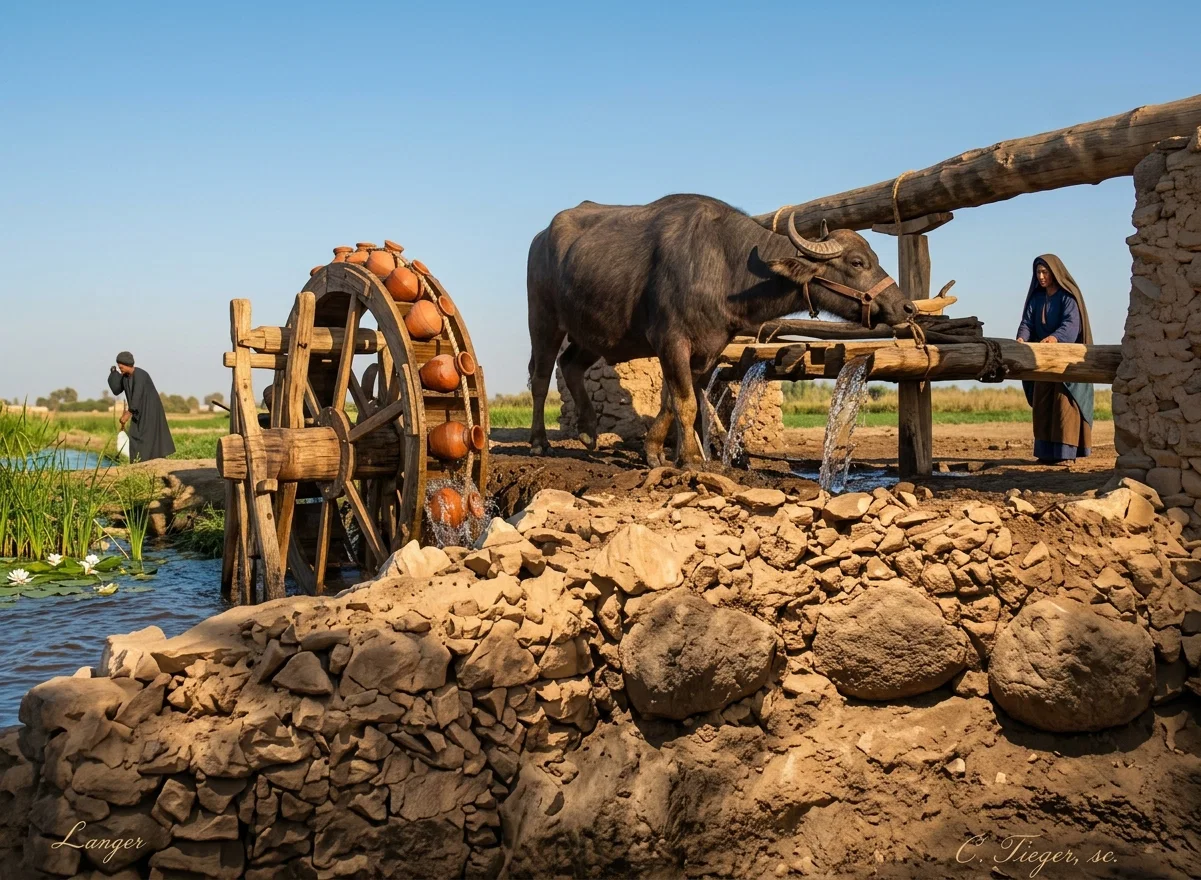
RAISING WATER FROM THE NILE
“In that day shall there be an altar to the Lord in the midst of the land of Egypt, and a pillar at the border thereof to the Lord. And it shall be for a sign and for a witness unto the Lord of hosts in the land of Egypt: for they shall cry unto the Lord because of the oppressors, and he shall send them a Saviour, and a great One, and he shall deliver them. And the Lord shall be known to Egypt, and the Egyptians shall know the Lord in that day, and shall do sacrifice and oblation; yea, they shall vow a vow unto the Lord, and perform it.” Isa. 19: 19–21.
Whatever application this scripture may have had to events in ages past, it is certainly a source of great encouragement to those who are working in Egypt to-day. The people of this country will not be left without a witness to Jehovah, the God who made the heavens and the earth. “An altar to the Lord” has been raised “in the midst of the land,” and “a pillar at the border thereof.” Egypt is now hearing of a Saviour who can deliver the people from the oppression of sin. But a much greater and more perfect manifestation of him will be seen in the near future; “for Jehovah shall be known to Egypt, and the Egyptians shall know Jehovah in that day.” The light of the third angel’s message will yet shine with undimmed luster in the “land of Ham.”
We have been in this country less than three months; but we have already seen many omens that indicate clearly that Egypt is a land of opportunity,—opportunity in many ways, but especially for the third angel’s message.
Egypt is awakening from the darkness of sin, and its consequent superstition, which for centuries has hung like a pall over the far-famed valley of the Nile. The supreme indifference of Mohammedan fatalism is breaking; and on many eager lips the question is forming, “Is it God’s will?” And we are so glad of the blessed privilege of telling them that Jehovah “doth not afflict willingly nor grieve the children of men;” that he takes no pleasure in death, but that the gospel of Jesus Christ is “the power of God unto salvation” from sin and from all its baleful effects.
No part of present truth is more necessary to the Egyptians than the principles of healthful living which God has given us. And just now there is a special awakening throughout all Egypt on the question of sanitary reforms. The cholera scourge of last year has been an emphatic lesson, which only the most obtuse can fail to appreciate. The world’s medical congress which recently convened in Cairo gave evidence of the widespread and earnest attention these matters are receiving throughout the country. Most positive evidence is given that the river Nile, almost the only source of water supply in Egypt, is the principal medium of cholera infection. Tannah, the only city in Egypt that gets its water from wells, is the only city that was not ravaged by that fatal disease. This will appear more remarkable when it is known that Tannah is the third largest city in Egypt, and that the cholera raged in all the cities and villages around it. Thirty-four thousand human victims to the reign of filth in six months, has begun to open the eyes of Mohammedans even to the fact that the Koran enjoins cleanliness. What an opportune time for those who14know the truth to carry to the people the pure, health-giving, life-saving principles of the Bible!
The native papers as well as the European press in Cairo and in Alexandria are agitating the question of how to prevent, or at least to control, the ravages of contagious diseases. One of the leading French papers of this city is ably advocating vegetarian principles. Its editor has visited our ‘Vegetarian Pension,’ and has given it very favorable mention in his paper. In a short interview with him, he expressed his willingness to co-operate with us in lifting up the standard of sanitary reform. Literature on the subject of healthful living would be welcomed now in Egypt as never before. Our American, English, German, and French health journals are gladly taken and read by many; and much more could be done in this direction if we had a good, energetic, consecrated canvasser, who could give his time to this branch of the work. He should, however, to be of the most use, understand English and French, or English, French, and German. Will not some one who reads these lines volunteer for this work in this country?
But a much greater need in this field is health literature in the Arabic tongue. About seven eighths of the population of Egypt speak that language. An Arabic health journal should be started as soon as we have money to print it, and men to push its sale among the natives. The latter we hope to develop here in the field. Health books, I am assured, would meet with a ready sale among the well-to-do natives. There is absolutely nothing of that kind in the Arabic language. We are getting out a small tract on the principles of healthful living as taught in the Bible, but we should have a bound book. The country is ripe for such a work. The devil has strongly entrenched himself here. The tobacco habit is almost universal among all nationalities, men, women, and children being addicted to its use. Intemperance of every kind abounds. But we are assured that where sin abounds, grace doth much more abound; and these conditions simply give opportunity for the mighty manifestation of the power of God.
I have been holding a series of Bible studies with a class of intelligent young men, mostly Copts, employees of the government. These young men read English some, sufficient for me to work with them without the aid of an interpreter. We have been studying with them the gospel as revealed in Genesis, and the readiness with which they give assent to the truth is encouraging indeed. Many of these have been educated in the ‘American Mission’ schools (Presbyterian), and are nominally Christian. We trust seeds of truth are being sown that will bear fruit in due time. We are planning to start a church school for the children soon, as there seems to be a demand for it. Our resources, physical and financial, are taxed to the utmost to fill all these opportunities. I am planning to go next week to Luxor to engage in labor with our native minister, Elder Awada, for the natives.
By the blessing of God, I and my family have had usually good health since coming here. Egypt has a splendid climate, especially in winter. And from what I am told by those who know, the summers are not at all intolerable. We all desire to be remembered at a throne of grace by the many readers of the REVIEW.
Cairo, Egypt.
HENRY WILLIAMS
By Henry Williams
Hayti
HENRY WILLIAMS
This country as a republic will reach a hundred years of independence in 1904; and with all these years of freedom, she is still an infant, in comparison to other nations. Since the abandoning of the presidential position by Gen. T. A. Sam in the month of May, the country has been passing through a terrible crisis—that of civil war, bloodshed now being the ruling spirit.
The rebel party is determined to put in a man as president whom they revere and hold up as a wonder for intelligence and rare principles of honesty. They believe that he is the only man capable of raising the country from the state of ruin into which it has fallen. If this belief is to be accepted as a fact, then it reflects very much upon the general advancement of this people during a century as a nation, showing educational poverty and a pitiable lack of honest characters. It has been brought to light from correspondences discovered, that the merchants are implicated in this revolution, more so than the foreign element, by loaning the revolutionists large sums of money at an exorbitant interest. But the saddest part of this wicked business is that members of the Protestant churches in this town are also among those aiding to bring about this unfortunate state of affairs. It is said that a Catholic priest with his gun was also among the rebels.
Protestantism is held in contempt. All Protestants are now abused, and a feeling of hatred is expressed against strangers, with threats to do harm. Strange, they do not make so much ado about the priests’ bad conduct. We enjoy quietness in town now, as the fighting is going on in the interior; but it is not safe to go out at night. A United States war-ship has been in the harbor for many days, watching the development of affairs.
As I am writing this report, my mind is drawn to these words of Elder L. D. Santee’s poem, “Call for Workers,” in the REVIEW of June 24: “Is there no meaning in the calls for help . . . yonder?” “Yonder” seems peculiarly applicable to this land, “where every prospect pleases, and only man is vile.”
Cape Haytien, Oct. 21, 1902.
I’ll Work for Jesus
“I'll work for Jesus, where he leads,
Whate’er that work may be;
And gladly say when I am called,
‘Lord, here I am; send me.’
I'll praise his name—he’s done for me
Far more than tongue can tell;
And well I know, whatever comes,
He doeth all things well.”
General Notes
THE tithe for the last year in the German field shows an increase of about two thousand dollars.
ELDER F. W. FIELD reports the work progressing in Japan. He writes that several of his students seem to be gaining a real Christian experience, and one is now awaiting baptism. Word comes from Wakamatsu that three more have begun the observance of the Sabbath.
BROTHER ANDERSON writes from the Matabele Mission: “I had two visitors last night, and this morning while I was waiting for breakfast, I mentioned ‘Christ’s Object Lessons,’ and explained how these books are being sold for the relief of the schools. They at once gave me their orders.”
FROM the Gold Coast of Africa Brother F. I. U. Dolphijn writes of another Sabbath-keeper—an aged brother—who longs to be baptized. We are sure that these few Sabbath-keepers, who have so long been waiting for help, will welcome the coming of the company of workers now on the way to that field.
BROTHER F. E. BRAUCHT writes that they are now reading the last proof-sheets of “Christ Our Saviour” in the Samoan language. As soon as this is completed, the book will be printed. They have also begun the translation of the first four chapters of “Patriarchs and Prophets,” and the last chapter of “Great Controversy,” and are working on “Steps to Christ.” This has been translated, but needs some further work. They look upon the literature as a strong factor in their evangelical work.
FOR several months Brother Moko has been working in the districts of Stockenstrom and Fort Beaufort, in South Africa, canvassing, giving Bible readings, holding meetings, etc. Several became interested some time ago, and have been calling for Brother Moko to take charge of their meetings, start a school for their children, etc. Five or six adult persons have been keeping the Sabbath for about three months. Brother Moko was recently at a place called Blinkwater, where fifteen decided to keep the Sabbath. These are all white people, and members of the Wesleyan Church.
BROTHER WESTPHAL writes that they are at work repairing the school building. The total damage probably amounts to six or seven hundred dollars gold. This catastrophe was a severe blow to the brethren and sisters, as they were just planning to make needed additions to the building. The brethren are taking hold nobly in the work of repairing, hauling lime, sand, and brick, and doing other work. The prospects are bright for a good attendance in the school another year. In Diamante three persons were killed by the cyclone. Brother Westphal’s home was right in its path, but was practically not damaged.
In Western Jamaica
By William Ambrose Spicer
THE work in the western district of Jamaica is under Elder J. B. Beckner's supervision. Two local and two general meetings were held with our people in this district. We spent one night at Grovetown, holding a meeting in the unfinished church building which the brethren, and sisters too, are rearing by the roadside. The foundation and floor and the framework and roof are completed, and preparations are made for burning the lime and putting up the customary Spanish walling, of stones, mortar, and possibly a finish of cement. These small cultivators have little to pay tithes upon, and in addition it means no little effort on their part to get together the timbers and materials for a substantial church building.
Thirty or more associated with us gathered in to the evening meeting, with perhaps an equal number of other listeners. Living their quiet lives on their little garden plots, these believers were glad indeed to hear of the general progress of the work, and of plans for its more rapid advancement in Jamaica. As the ranks are lining up for the final charge, you may be sure that these simple believers desire a place in the advancing columns.
One thing we may notice in any part of the world, however out of the bustling world it may be; this truth has always an influence to broaden the horizon and fire the interest of even the most retired believer. It sets people to reading and studying whose whole lives have been removed from the atmosphere of thoughtful observation and study. This truth does everybody good who receives it.
Early next morning Brother Beckner and I were off with his horse and buggy for a twenty-two mile ride to Southfield. Here the country becomes less typically tropical. Pasture land is more abundant. The dry, bracing atmosphere makes it as healthful a region as one could desire. The tendency to drought is somewhat of a hindrance in the district, but the countryside seems fairly prosperous. Everywhere in Jamaica people talk of industrial depression. Less money is in circulation than in former days. Yet all united in saying, so far as I inquired, that there is little real suffering from hunger in Jamaica. One sees little of distressful poverty. The country people seem always to have something growing that is eatable, and they have no long cold season to prepare for. Outside of Jamaica's one city, Kingston, I think I may safely say there is little of the grinding struggle for very existence such as is known in more populous lands.
At Southfield, our people have a good church building, white-walled and neatly finished. About seventy-five gathered for a long evening meeting. Two things seemed to press in as the message in such flying trips to brethren whom I was meeting for the first, and perhaps the last time,—the preparations for a speedy finishing of the work of the gospel in the earth, and the necessary preparation on our part to go to heaven and live with God and the angels in just a little from now. And everywhere the hearts of our brethren have proved receptive soil for the seeds of truth. The Southfield company is an aggressive one. They have a teacher engaged to conduct a church school this year. Another company is also starting a school. The Jamaica public school system is so under church domination and control that it is poor indeed.
At the close of our evening meeting here, quite a number of the members started on foot to Santa Cruz, eighteen miles distant, at the foot of the Santa Cruz mountains, where a general meeting was appointed for Sabbath and Sunday. Here were gathered believers from churches and companies within a radius of thirty miles. From mountain top and valley they came, walking in over the moon-lit roads, filling the little building at Santa Cruz to overflowing on Friday evening.
I need not say that those who came so intent upon sharing the blessings of the meetings were not sent empty away. It was an encouragement to all to see one another. It was the largest gathering of Sabbath-keepers that most of those present had ever seen, though we numbered only about one hundred and thirty. All were inspired with renewed zeal and courage as we studied the call of the hour, and discussed plans for bringing Jamaica more directly into the world-wide forward movement. Sunday night a large attendance of interested people in the town greatly encouraged the local company.
After the Sunday evening service we set out for Savanna-la-Mar, forty-eight miles distant, where our next general meeting was appointed to begin the following evening. The town hall was used for the three evening services. Citizens freely remarked that they had never known so quiet and respectful attention given to religious services in the public hall. Again the brethren and sisters from the surrounding churches came in, and responded well to the call of the hour.
The hearty singing in Jamaica is an inspiration in any meeting. In the prayer and testimony meetings you may recognize everywhere the ring of the true coin of the message. The truth is doing its work in the hearts of the people, and preparing believers here to stand in their place as the ranks move forward.
W. A. SPICER.
Georgetown, British Guiana.
Porto Rico
By B. E. Connerly
MAYAGUEZ.—After a safe voyage we landed in Mayaguez, January 11. We found Sister Fischer and her little daughter Ina well, and glad to welcome re-enforcements. Sister Fischer has evidently stood bravely at her post against untold obstacles. Now, instead of one, we have three Sabbath-keepers in Porto Rico. We organized a Sabbath-school the first Sabbath; and some are interested already. While studying the Spanish, we are doing some evangelistic work. We are of good courage, and are well pleased with our field. To us everything is new, and the people strange; but we realize that persistent effort and untiring zeal, under the blessing of God, will accomplish his work even in this island.
B. E. CONNERLY.
Meetings in the Southern Union Conference
By George I. Butler
IMMEDIATELY after the close of the general meetings at Graysville and Nashville, Elder Brunson and I attended the State conference at Welsh, La.
It was my first visit to that State, and to me at least it was an interesting trip. Welsh is situated in an interesting country—a large, open prairie, very level, of clayey soil, that was scarcely settled at all until a comparatively recent date. It was found that by boring artesian wells, the water rose almost to the top of the ground. Powerful pumps are employed, and small levees are thrown up to confine the water within certain bounds. Then rice is sown over a broad expanse of country, and at the proper time the powerful pumps are set running night and day, excepting Sabbaths, for months, flooding the rice from several inches to a foot or more in depth. The consequence is that great crops are raised, and when everything is favorable, large profits are realized. But alas! rice raising in this prolific field is not certain to bring a profit. There is much expense involved. Many have large tracts of land, and are badly involved in debt.
The church at Welsh numbers about ninety, and has an excellent church school. I was much surprised and pleased to find, when all were assembled, a large number of my old friends, from Vermont and Dakota and other places, with whom I was well acquainted from fifteen to thirty years ago. The meeting seemed mutually pleasant.
The conference continued for over a week. It was, on the whole, an excellent meeting. Perfect union prevailed. Elder Brunson gave a series of discourses on the grand foundation principles of our blessed religion, embracing the plan of salvation originated by the Father and the Son before the world was, involving the offering of Christ himself for the sins of the world; justification by faith; sanctification and eternal redemption. These grand themes I never heard more beautifully presented, nor more clearly and forcibly. Many expressed themselves as highly edified. Brother Brunson also held interesting and profitable Bible readings at eight o’clock each morning. On three occasions those desiring conversion or recovering from backsliding were called forward, and the Lord’s Spirit was manifestly present. Quite a number of aged brethren, who had been in the past successful canvassers, but who had become indifferent, were among those who came forward. On one occasion after an earnest discourse on the pioneer work of our glorious message, the Lord’s blessing came in with remarkable power. Many came forward for prayers, some weeping aloud, confessing their sins, and giving evidence of deep contrition. Tears flowed from many eyes. I do not recall a meeting for many years in which such deep feeling was manifest. It was good indeed to be there.
The business meetings were very interesting. Elder S. B. Horton was re-elected president of the conference for the ensuing year. The conference has16prospered. Their tithe was over two thousand dollars the past year. The other laborers were paid, and all enter upon the new year with hope and confidence.
A restaurant has been in operation for months in the business part of the great city of New Orleans. This is an enterprise that has been of deep interest to Elder Horton. It had not fully paid its way up to the time of my visit, yet it is hoped that it will do so in the future. In the largest cities of the South, enterprises are being started which it is hoped will finally result in the establishment of small sanitariums. Those who are well informed feel that the South is in great need of instruction in healthful living, cookery, etc. A desire is being felt in this great Southern field among leading, intelligent men and women for help in this direction. We as a people need to feel drawn by a sense of duty to help give the people the light on health and temperance which the Lord in his mercy has been giving us. This is not only a duty, but a great privilege. I hope to see the day not far hence when a sanitarium will be established in New Orleans, the great metropolis of the South. In all these Southern cities persons of intelligence of both sexes have been patronizing our sanitarium in Battle Creek. Let the good work go on, and light on this subject be disseminated everywhere in this great South land.
GEO. I. BUTLER.
Jamaica
By Hubert Fletcher
SWIFT RIVER.— The work is onward here. For some time no new members were added to our numbers, but January 17 two were buried with their Lord in baptism. Since then we are having quite an interest, and souls are taking their stand for the truth.
Our Sunday night meetings are well attended. A man about seventy-nine years old, also the leader, his wife, and a young preacher of a small sect of Independent Baptists, and another man past sixty years of age, have accepted present truth. Three of these were baptized February 8.
The church in this place was organized on the 8th inst., Elder W. J. Tanner presiding. Seventeen persons were taken into full membership with the church, and others intend to unite soon. Elder Tanner was elected church elder, and Sister Margaret Gray church clerk and treasurer. There is still an interest here. After the baptism we had a full house to listen to the truth for this time.
The brethren are organized into a working band. They go among the people and do house-to-house work with tracts and other reading-matter. The recent week of prayer has given quite a stimulus to this work.
Since the organization I have been to John's Hall, where we are doing aggressive work on the church building. Another new member has been added to the Sherwood Forest company. We are of good courage. HUBERT FLETCHER.