Your ShelfYour Projects

Signs of the Times, Vol. 37, No. 14.

Question Corner
Earlier text: The Everlasting Rock

Causes and Remedy

FROM time to time the SIGNS OF THE TIMES has, with no desire to criticize other denominations, with no desire to point out existing sins, set forth the trend in religious life in the Christian world. It has shown conclusively from the testimony of men in the great churches themselves that the whole drift is away from the Word of God; away from the simplicity of faith; away from the great moral standards. It mourns because of this; and yet if faithful to the Gospel and to the prophecies which have been given by the Lord Jesus Christ and His apostles, it must point out these signs of the times. That there has been increase in vigorous, virile Roman Catholicism in America during the last thirty years is admitted by nearly all. The record which has been made by Christian Science has been a marvel. Other isms, such as Spiritualism and Buddhism, have gathered thousands of converts. It seems strange on the face of it that this is so; and yet when we come to look more deeply into the matter, it is seen that Protestantism itself is lacking in that decided faith, that conviction in its preaching, that grasp of the great need of mankind, that burden for men's souls, which would win the world to its standard, and strengthen faith in the Word of God.
Not long ago the editor of the St. Louis Christian Advocate spoke of various sermons which he had NOT heard,—sermons on vital subjects, sermons which it would seem that a true pastor must preach if he wishes to save his flock. In the Christian Advocate of February 24, the matter is referred to the second time. It has elicited a great deal of correspondence.
Some ministers think that the editor of the St. Louis paper is altogether too pessimistic, and yet the New York editor is bound to feel that this minister who thus speaks is himself perhaps an exception. Some of those who write upon it declare that they preach just such sermons as the St. Louis Christian Advocate editor did not hear. That of course would be the experience of a few; but another, a layman, a business man, who is in a large city for several months at a time, away from home, visits various churches. The Advocate says that he visited successively eight out of nine of the Methodist Episcopal churches in a certain city, and *"only heard one discourse that could either comfort a mourner, convict a sinner, or help a penitent. In a large suburban town he found a similar condition; and after trying the Methodist churches two or three Sundays, he went to those of another denomination, and found but one minister who preached with any spiritual power.
*"An aged brother declares that there is a vast difference between the preaching of former years and that of to-day; that the burden of souls in the ministry in those days was the salvation of the people; that the cry of the preacher was, 'Flee from the wrath to come,' and their prayer of faith, 'Thy kingdom come.' He says he has lived where he now dwells for several years, with twelve churches in the vicinity, and with one exception there has not been a revival. He attributes it in large part to the fact of the dying out of the class-meeting, family prayer, and prayer-meeting, and the consequent worldliness which prevails. Young ministers, he observes, frequently try to imitate by language and manner some college professor or noted preacher; that a short time ago some person from another part of the country preached, and one of the members said it was the first Bible sermon he had heard for years."
Another brother who writes clearly, strongly, and with penetration, is of the opinion that the complaint of the editor of the St. Louis Christian Advocate is "undoubtedly well founded even if the indictment is not applicable to all preaching."
This last correspondent says, "I believe the problem lies deeper than the subject; for when these topics are preached upon, it is not often that they bring heartfelt conviction to the soul." And the editor closes the quotation by saying,
"Yet it seems apparent that the great problems of sin, personal salvation through Christ, the work of the atonement, the renewing power of the Spirit, do not take such a deep hold upon their own convictions as to be the ruling passions of their lives." The editor says further he thinks that the opinions of their spirituality are clipped by TOO MUCH PSYCHOLOGY of regeneration from irresponsible sources.
Some of this can be traced back to the Higher Critics, those who have so mutilated God's Word that the ministers, many of them, looking to these learned men, have lost real conviction themselves. How can they preach with conviction if they do not themselves possess it? Many of the young men who have come into the pulpit the last score of years, are those who have received this pseudo-scientific critical education in the universities and theological seminaries.
Mr. Harold Bolce showed in his articles last year, that were widely copied and commented upon, that many of the teachers in the large schools were men who were openly and unqualifiedly infidel. There were many noble exceptions to this charge; but on the other hand it was clearly shown that these teachings had permeated schools throughout the entire country, and in most cases the great molding institutions of learning. While all professors would not agree with these professors, yet at the same time the skeptical professors are retained, oftentimes very bright men, with a great show of learning and experience which they do not really possess.
It generally seems smart to the young men to hear criticism and doubt raised concerning the established ways of the past. We think that our cartoonist on this page has given something of a representation of the actual facts of the case. The great institutions of learning which are turning out the teachers and the professors, are themselves poisoned by the skeptical teachings of some of the brightest tho not the deepest men on the faculty. Because of this, isms which are considered false and misleading prosper.
Poisoning the Wells of Knowledge
The Roman Catholic Church has something positive to say. It may not be true, it may be unscriptural; but her teachers believe it, and they teach it with conviction. The same is true of Christian Science advocates, and of the heralds of Mormonism; and the great sad fact is that the people in the so-called orthodox churches are not sufficiently grounded in Bible truth to be able to meet the teachers of these various cults and beliefs. Because of this the churches are honeycombed with a decadent faith in simple Biblical Christianity.
There is a remedy for it; that remedy lies in return to the Word of God; lies in the teaching of the doctrines of that Word as they were taught by Christ and the apostles; lies in the return to the great standard of human conduct, the detector of all sin, God's holy law; lies in simple faith in that Gospel which will save from sin, and which will bring men into harmony with the government of God; lies in the preaching of the prophecies of God's Word which point out the times in which we live, and point out also all the various delusions which the children of God will meet in the closing days of the world's work. That last great reform is embraced in the great threefold message of Revelation 14,—a message so broad that it compasses the whole Word of God, the truths of which are demanded for these times. It is in these days, the apostle declares, that Satan will work with "all power and signs and lying wonders" among those who receive not the love of the truth that they may be saved. And when Satan works in that way, it needs all the great truths of God which have met his devisings and his workings in the past to meet his working now. And that message will develop a class who are ready for His coming, of whom He declares, "Here is the patience of the saints: here are they that keep the commandments of God, and the faith of Jesus." God points out the awful disease, and correctly diagnoses it. He reveals in that diagnosis the causes; but praise to His name, He also gives the remedy. The question, reader, comes home to you, and to every soul, Will you accept of His plan?

Is It Growing Better?

It is true that the manners of the world have improved wonderfully during the last two or three generations; that there is very much more veneer; that wickedness in many cases is not so open and flaunting; church-members do not openly drink as they used to at the conventional barn-raisings and logging-bees. Yet on the other hand there has come into society in general a sophistry that is doing away with all great moral standards. The world has become enlightened more than it has improved, and it is breaking the mirror rather than correcting the person. Of course the world has always been the world. The heart of the natural man has always been unregenerate, and is still. The sad thing is that the wickedness comes in through those who profess better things. And when the men who profess better things, do the wrong things, they do not confess them. Constant effort is made to prove man better, instead of admitting just what he is, and seeking God for justification; until we have, as set forth by the apostle Paul in 2 Tim. 3:1-5, a great list of sins among those that have the form of godliness but deny the power. The failing, flexible, inconsistent standards of men have in many cases religiously taken the place of the standard of God.

Wasted Agricultural Product

countries there is almost infinite waste. This has been especially manifest in America. New methods will have to be used to secure more of the product of the soil.

Catholicism in America

THE Western Watchman reports that St. Louis is 35 per cent Catholic, and tells us that the percentage of the whole is declining. Its relative strength is going backward. In the same article it states that the Catholic population of New York is 2,722,647; of Pennsylvania, 1,496,766; and Illinois, 1,433,752; while little Massachusetts, the great Puritan state, comes next with a population of 1,373,773. Ohio has in round numbers 619,000; Louisiana, 557,000; Wisconsin and New Jersey, each 496,000; California, 391,000; Kentucky, 194,000. Chicago has more Catholic churches than any other city, 187; while New York City has but 138; Brooklyn has 110; Philadelphia, 99.
There are 4,845 parochial schools, with 1,237,251 pupils. The total attendance at Catholic schools, including convents, colleges, and asylums, is 1,450,448; a net gain of 53,101 over the previous year. This does not include the seminaries and the training-schools of the various Catholic orders. There are 16,550 priests in the United States; 12,274 are secular, and 4,276 regular; a net gain of 457. Nor does it include the priests of the Philippines. The Catholics have 217 colleges for boys, and 709 academies for girls. Doubtless many of the girls in attendance at these academies are from Protestant families. 51,541 orphans are supported in 289 orphan asylums.
The Western Watchman thinks that these statistics are below actual conditions rather than above.

Coffee and Tea Drinking

DR. W. C. WHEELER, health commissioner of Kansas City, declares that "to permit a child to drink tea or coffee or to eat too much cheap candy, cookies, and cakes, is a crime. When you feed your boys and girls," he says, "on that kind of trash, you are laying a foundation for a family of weaklings who may be afflicted by nervous disorders and diseases that may finally cause their death." One of the reasons, he declares, why many children are deficient in their school studies, is because they drink tea and coffee and eat too much sweet trash. Many cases have come before him where children are mentally deficient on account of the foods they have eaten. The serious responsibility of this he charges upon the parents. He says that tea and coffee are terribly injurious to the growing child. Parents under no condition should allow their children to partake of these beverages. "Do you wonder," he asks, "that the insane asylums are being filled with the products of parents' ignorance and folly?" Certainly these words are worth heeding.

Mr. Fairbanks and the Pope

Mr. Fairbanks and the Pope.—There is still more or less discussion over the pope's refusal to receive Mr. Fairbanks after he had spoken to the Methodists in Rome. According to some of the papers that reach us, Mr. Fairbanks approved of the action of the pope, and thought that the pope acted properly in not receiving him. Mr. Fairbanks's friendliness to the Papacy seems to be more than mere courtesy. The Burning Bush of March 10, for instance, points out that "the celebrated Methodist vice-president, Charles W. Fairbanks, assisted the Catholic archbishop Quigley in dedicating the new parochial building in connection with the St. Stanislaus Polish Catholic Church of Chicago." The worst feature of the case, after all, is Mr. Fairbanks's reported attitude.

A Sunday for Tuberculosis

The National Association for the Study and Prevention of Tuberculosis asks that April 24 be set apart as a national Sunday in which preachers all over the country shall set forth the dangers of tuberculosis, and how the great white plague may be eliminated and conditions of sufferers ameliorated. We are not advising it. Just now there are so many Sundays advocated for this, that, and the other, that we wonder how the preachers can find any Sundays for the Gospel. Some association will have to recommend that one Sunday be set apart for the preaching of the old-fashioned Gospel. Really, if Christianity were truly preached, it would take in the whole man, physically, mentally, spiritually, and it would make persons intelligent regarding the care of the body; and that is what we gather that the Anti-Tuberculosis Association wants.

Volcanic

Volcanic.—March 8 it was reported that Mount Etna had begun erupting; but a report from Catania, March 24, declared that it was in a state of violent eruption, and a mighty torrent of lava twenty feet high and fifteen hundred feet wide was rolling like a river of molten steel down the side of the mountain. Earthquake shocks are heavy and numerous, and the whole mountain is torn open. Twelve new craters appeared, out of which poured floods of lava. More than fifty heavy earthquake shocks were recorded in the twenty-four hours of March 24. One little peasant village of San Leo is reported partly destroyed, and other towns were in imminent danger. At last reports, it is thought the worst is over.

A Questionable Medium

A Questionable Medium.—All astronomical phenomena are viewed through this earth's atmosphere, and in all ways measured except in distance by things earthly. There are said to be seventy-one elementary substances on this earth enumerated by chemists. Thirty-two of these, we are told, are found in the sun, with a trace of ten or fifteen more. But if these sun elements were ascertained, measured, and analyzed outside of this atmosphere, the result might be vastly different.

Rock Island Railway Wreck

The wreck on the Rock Island Railway near Marshalltown, Iowa, March 21, was a fearful thing — forty-five persons killed and thirty-eight injured. It would seem that there must be carelessness somewhere when a train would go to wreck running only thirty miles an hour in an open country.

Shiloh: the Man of Sorrows

Copyright, 1910, Pacific Press Publishing Association
By Mrs. L. D. Avery-Stuttle

Chapter VI. Rachel Weeping for Her Children
"Look thou, Varro," cried Achan, one of the most brutal appearing of the soldiers, "it hath been rumored that the house of Sylvanus hath concealed the carpenter of Nazareth, with the Babe whom we seek. Of a truth Herod will have the head of the centurion who returneth to Jerusalem not having fulfilled his command."
"Thou hast much wisdom, Achan," replied the centurion as he gave orders to return to the house of the shepherd. Instantly a score or more of soldiers broke down the outer gate, and forced an entrance. But the house was evidently deserted, save for little Perpetua, whom the rude soldiers found sleeping the sound, deep sleep of childhood, and Eliab, the patriarch, propped with bolsters upon his bed, his wrinkled hands clasped, and his trembling voice muttering a prayer.
Sylvanus and Bar-jona his guest, having heard the commotion, and missing Esther and the babe, had hastened into the street, hoping to be of some assistance to them and possibly to their wretched neighbors. A sickening fear for the safety of Esther and the babe Matthias haunted them, and Sylvanus rushed on and on in the semi-darkness of that awful morning, wildly calling their names; but his voice was lost amid the din and confusion, the babel and horror of the streets.
"Ho, grandsire, where is Sylvanus the shepherd?" cried a soldier brandishing a sword over the old man's head.
"Hush, you fellow," exclaimed Varro. "What cares King Herod for the shepherd? Verily, grandsire," he continued, "if thou wilt tell us where hideth the carpenter of Nazareth with the Babe, I swear to thee, we will take but Him only, and will depart."
"Whom seek ye?" questioned the old man, closing his dim eyes as the glare of the torch fell upon them.
"Have I not told thee that we seek the hiding-place of the Babe, whom the princes of the East called the King of the Jews? Hast thou knowledge of Him? Tell us, or we spare thee not — for all thy gray hairs!"
"The Babe? the Shiloh of Jacob? why seeketh King Herod the Babe? Will he come and worship Him also, as did the magi?"
"Verily, old man, thou hast a knowledge of this young King. Tell us what thou knowest, or of a truth thy gray hairs shall not protect thee."
"Go search the land of the Pharaohs, for the mother and her Babe. The magi have also turned into their own land again," replied the old man.
"Verily, I will stop thy lying tongue!" exclaimed a soldier, as he dealt the old man a savage blow with the back of his sword. "Where then hast thou hidden the Babe?"
"Said I not that He has gone into Egypt? Go tell the king, that the words of the prophets must be fulfilled; and verily, now, this voice of the weeping women which soundeth in mine ears is that spoken of by the holy seer Jeremiah, — it is even the voice of Rachel weeping for her children."
"Come, old man, wherefore pratest thou? Verily, because thou fearest Herod, thou hast hidden the young Child, and now thou sayest falsely that He has gone into Egypt," cried the centurion angrily, seizing a torch and applying it to the old man's quivering flesh. "It may be this flame will limber thy rebellious tongue."
"I would not deliver the young Child into the hand of Herod tho thou give me all the gold of the temple. And neither will I worship the gods of Rome. Jehovah alone is the true God, He who made the heavens and the earth. O Varro, centurion of Herod, Jehovah will protect His Son."
"What care we about the Son of thy God? See, Achan, how easily do I hush the prating tongue of this son of Abraham."
Still the trembling voice of the old man was heard once more: "O that I might have lived to see with mine own eyes Shiloh the Messiah, even as did Simeon the prophet of Jerusalem. But Jehovah knoweth best."
While he yet spake, one of the soldiers stood over him with a drawn sword; and even as he was uttering the last sad words of prayer, the shining sword of the assassin was crimson with the blood of the patriarch.
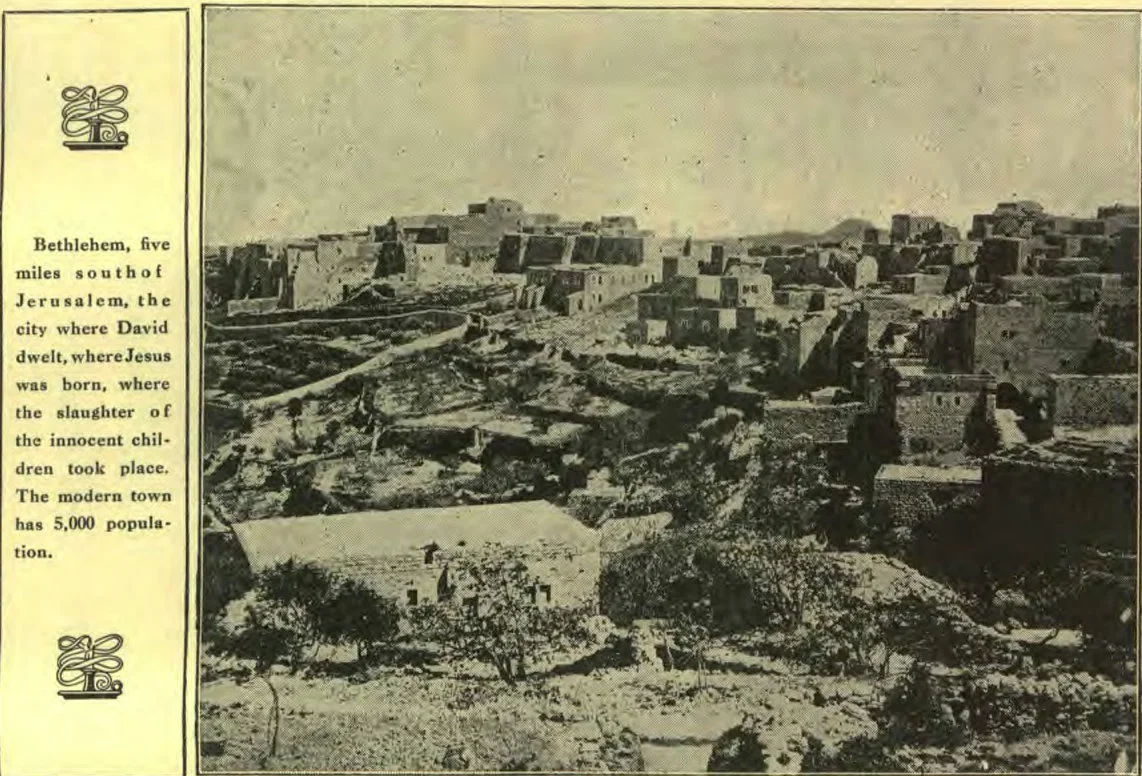
Bethlehem, five miles north of Jerusalem, the city where David Await, where Jesus was born, where the slaughter of the innocent children took place. The modern town has 5,000 population.
The rising sun glimmered faintly above the mountains of Moab and the nearer hills of Judea, as the executioners of the bloody king made their way out from the gates of Bethlehem, and hastened northward toward Jerusalem. But they had left behind them desolation and blood and agony untold. All day long little groups of white-faced women met and passed one another in dumb agony in the narrow streets, still filled with debris and confusion and awful reminders of the night of horror. Strong men moved about as if in a dream. Little children, the sad survivors of the night, ran about screaming after their mothers. The bright eyes of young men and maidens were still distended with horror. Now and again a wild shriek of a maniacal laugh rang among the hills and out over the quiet valleys.
But the aged vampire over in his palace at Jerusalem was satisfied.
From her hiding-place without the walls of Bethlehem, whither she had fled with her babe, Esther, the wife of Sylvanus, watched the soldiers disappear toward the north. But not until the last faint gleam of the burnished helmets had faded in the distance, as the morning sun shone upon them, did she venture forth.
We mark well the faces and forms of the two centurions, — Marcus, the kindly, the humane; Varro, he of the giant form, the man of blood, — for you and I, reader, will not meet them again for many days.
With a prayer of thanksgiving that her babe had been spared, Esther clasped him tenderly in her arms, and hastened homeward. Of the gruesome sights and sounds which greeted her as she entered the city, we already know. But we will follow her to her own home. At the outer gate she met Sylvanus. His garments were torn and blood-stained; and crimson drops were slowly trickling from a wound in his temple and hiding themselves in his beard.
"Everywhere have I sought thee, mine Esther; blessed be the God of our fathers that thou livest, — and the babe; else verily I should have said, 'Now hath the God of Abraham forsaken us.'"
"Nay, Sylvanus, say not so," replied the faithful woman, as they entered the silent home. "Tho He slay me, yet will I trust in Him. See, here is our sweet babe Matthias; see how he regardeth thee with his pretty brown eyes; not one brown curl from his young head hath fallen. Surely thou art a goodly child, my Matthias. And little Perpetua — thou sayest she still sleepeth? And thou too art spared to me, O mine husband!"
Without further speech, except to mention that their guest, young Bar-jona, had already started on his homeward journey toward Bethsaida, they entered the open door; for Sylvanus had not the heart to speak to her of the agony yet to come.
Anxious, first of all, doubly to assure herself of little Perpetua's safety, Esther failed to notice, in the darkened room, the quiet, blood-stained figure upon the couch. Suddenly she turned her head, and discovered the old man, Eliab, her father. With a cry of horror she approached him. Then, also, for the first time she saw the young lad, Heber, fallen prone upon the floor by the bedside, but still clasping one of the old man's hands in his own. Gently Esther raised him in her arms, and tried but vainly to pillow his dark head upon her breast. But he only shrieked and cried unintelligibly. The light of reason had fled from the gentle eyes of young Heber, the son of Sylvanus.
(To be continued)
— ✶ —

That Dangerous Hatpin—500 Eyes Sacrificed!

LET our ladies stop and think for a moment what probabilities there are of their doing a most painful and irreparable damage to their associates by wearing the prevailing hatpin.
According to Current Events, a paper having the largest circulation in the educational world, over 500 persons in this country alone have lost an eye each in the last year from this dangerous custom! Think of it! 500 eyes lost in one year in one country! Think of the severest suffering, the inestimable loss, the most painful regrets on the part of the innocent(?) offender! Could a woman ever forgive herself? It is almost too barbarous and sickening to contemplate.
Lady, who knows but to-morrow you may be in a crowd, or an automobile, a rail-car, or some carriage, and by some accident be quickly jostled or thrown against your associate, and the same accident effectively occur from your pin! It is quite possible one of your loved one's eyes may be sacrificed. Have you thought, too, that the next accident might be your own eyes? What can replace their usefulness and beauty, not to mention the suffering?
Let us illustrate this execrable destruction from the hypothesis of a peaceful village of 500 inhabitants. This happy little village this year must meekly submit to the (kind and thoughtful) women of our land coming to it and going from house to house, and with a shocking hatpin jabbing out an eye from each member, and year by year repeating the atrocity! Could words be too denunciatory, or punishment too severe?
Immediately our good sisters reply, "Why, what could we do without them? What can we have in their place?" Sad, indeed! What can the 500 persons who have each lost an eye have in their place?—Why, a staring, deathlike glass eye, of course.
"And then, my pretty and costly pins were gifts from my dearest friends!" Lamentable thought! Yes; but our eyes of untold beauty and value,—are they not a most precious gift from our dearest and greatest Friend? Can you longer ruthlessly jeopardize them?
Who doesn't shudder at seeing the sharp ends of from one to four hatpins projecting from two to six inches beyond the band of a lady's hat?
It must be a lamentable thought to a woman of heart to know she has, by wearing such a dangerous device, been the means of depriving her own or somebody's else sweet babe of one of its most lovely and precious gifts for usefulness and beauty,—the eye!
There are several devices that are efficient and perfectly harmless. Why not get them, and save yourself from possibly a most sad and everlasting blame? One device is made in nickel, silver, or gold, in the shape of a large and long hatpin held in a slotted piece of metal that is fastened to the inner part of the hat. Two are required. They are entirely free from that fierce, warlike, and blood-curdling appearance that surrounds the usual ugly pin. Whoever the man is that invented this humane device, he deserves patronage.
Now, good lady, for the sake of humanity, will you be one who will lead out against this cruel destruction, and help in this much-needed reform by word and deed?
Written by one who just barely escaped the horrible effect of "that dangerous hatpin." G. E. LANGDON.

Wanted

At Paradise Valley Sanitarium, three graduate nurses, and a strong woman to do chamber work. Apply with recommendations to H. W. Lindsay, manager, National City, Cal.

Olives

I have quite a lot of nice, large ripe olives. 5 to 25 gallons at 50 cents; 25 to 50 gallons at 40 cents per gallon, F. O. B., Chico, Cal. Satisfaction guaranteed. Are good keepers. A. E. CRIST, Chico, Cal.

Wanted

Two lady graduate nurses, Seventh-day Adventists in good standing. Also good carpenter, to work for treatment, board, and room. Garden City Sanitarium, San Jose, Cal.

LIBERTY

THE OFFICIAL ORGAN OF # THE RELIGIOUS LIBERTY BUREAU
AN illustrated, 48-page, quarterly magazine, published as an exponent and advocate of true religious liberty; defending Christianity and the rights of conscience; upholding the Bible as the infallible word of God; recognizing the church and state as ordained of Heaven for specific and distinct purposes, but vigorously protesting against the alliance of the church with the state in the attempt to advance religion and to promote the state. Price 25 cents per year. Liberal terms to agents. Address, LIBERTY, Takoma Park, D. C.

Helps to Bible Study

Helps to Bible Study. A series of Bible readings, simple and easy, designed as an aid to the personal study of the Scriptures, and adapted to the use of individuals or families; also a valuable assistant for Bible workers. 125 pages. Paper covers, 25 cents; cloth, net, 50 cents. Address this office.

Life and Health

A PRACTICAL health journal, published with a view of meeting hygienic needs in every home; teaching how to care for the health and how to preserve life; prescribing simple home treatments to assist nature in throwing off diseases rather than adding more poison by using drugs or unnatural stimulants as remedies; teaching how to avoid disease as far as possible, how to manage in the home when sickness does come, and how to combat the disease by simple remedies which nature provides.
Send for sample copy and special rates to agents. Price 10 cents per copy or $1.00 per year.
Address, LIFE & HEALTH, Takoma Park, D.C.

IN THREE DAYS

Overland Limited

TAKES YOU

To Chicago

ACROSS GREAT SALT LAKE AND HIGH SIERRA BY DAYLIGHT Luxurious High-class Equipment Electric Lighted Throughout Pullman Drawing-room Stateroom Vestibuled Sleeping Cars Careful and Attentive Dining Service Parlor Observation Car with Library and Cafe Ladies' Reading Room Gentlemen's Smoking Room Daily News Bulletins Latest Papers and Magazines

SOUTHERN PACIFIC

"HERALDS OF THE MORNING"

The appalling loss of life by murder and suicide, political and social troubles, dissatisfaction between employer and employee, strikes and fires, wars and rumors of wars—all these are of daily occurrence. What do they mean? and is there any significance to these things at this particular time? To the close observer, all these are evidences that there is a nearing social vortex into which all unsettled factions, and the world at large, will be plunged. When and how this will be brought about is revealed in "Heralds of the Morning." By appealing to the "sure word of prophecy," the author clearly shows that these conditions were to exist just before the Lord's return, and points out many other signs that the Scriptures tell us are certain heralds of the glad morning when strife shall cease, and peace and happiness reign forever. That the reader may understand these events, and be prepared for the final outcome, is our reason for calling attention to this valuable work. More than 150 illustrations vividly portray that upon which the subject-matter treats. A live book upon a live subject.
Bound in cloth, with marbled edges, $2.00.
PACIFIC PRESS PUBLISHING ASSN.
Mountain View - - - California

Should Christians Be Members of Secret Societies?

If so, why? If not, why not? How would you answer? Would you know the origin, nature, and object of secret societies? What should your relation be toward them?
All of these, and many similar questions, are answered in the 24-page pamphlet by one well qualified to write, entitled,
"Should Christians Be Members of Secret Societies?"
Price 2 Cents Each
Address orders to your Tract Society, or
Pacific Press Publishing Association
Mountain View, California

BOYS AND GIRLS WANTED

Good boys and girls are always in demand. Everybody loves them. We want both the good and those who are occasionally bad, to read the children's own paper, OUR LITTLE FRIEND. It will help them be better; it will teach them Bible truths in story form; acquaint them with animals, birds, fishes, insects, etc. Its readers will acquire a taste for good, wholesome reading. Its cost — 60 cents a year — is but a trifle when value received is considered. Send the subscription to your tract society or Our Little Friend, Mountain View, California,

AT ONCE

Continue reading: On the Way to China