Your ShelfYour Projects

Review and Herald, Vol. 75, No. 21.

WORDS OF WARNING

Review and Herald

May 24, 1898

Seventh-day Adventist Publishing Association · Battle Creek, Mich. · May 24, 1898

WORDS OF WARNING.

MRS. E. G. WHITE.
WHEN Christ sent forth the twelve, he warned them of the persecution they would receive for his sake. “Behold,” he said, “I send you forth as sheep in the midst of wolves: be ye therefore wise as serpents, and harmless as doves. But beware of men: for they will deliver you up to the councils, and they will scourge you in their synagogues.” They will do this while they apparently wish you to regard them as your friends. By the deceptive attitude which they assume to retain your confidence, they will betray you. They hide the spirit of the wolf under the appearance of the sheep. Their lips may speak words as smooth as oil, but the poison of asps is under their tongues.
The truth of Christ’s words was verified in the case of Lazarus. Those who witnessed the resurrection of Lazarus were unable to keep silence; the miracle was the burden of the conversation of thousands. God designed that there should be witnesses to give publicity to this, Christ’s crowning miracle. At the feast of the Passover, many were drawn from their homes to see and hear Jesus. “And they came not for Jesus’ sake only, but that they might see Lazarus also, whom he had raised from the dead.” Many of the Jews went away, and believed on Jesus. Those who saw Lazarus told others, and thus the news spread. Such a thing had never before been heard of. That he who had been cut off from among the living, now stood among them with the love of God expressed in his face, was the subject on all lips.
“The Pharisees therefore said among themselves, Perceive ye how ye prevail nothing? behold, the world is gone after him.” The evidences of the resurrection of Lazarus were so clear that the rulers could not resist them; neither could they frame their falsehoods so long as he stood to bear testimony against them. All the false statements of the priests and rulers, all their hatred and jealousy, could not draw the people to them as long as Lazarus was living to say: He spoke, and I was released from the bonds of death. “I live; yet not I, but Christ liveth in me.” The same omnipotent power that made the world has conquered death. And as long as Lazarus lived, his testimony could not be silenced.
“The chief priests consulted that they might put Lazarus also to death; because that by reason of him many of the Jews went away, and believed on Jesus.” As they had laid their plans to kill Jesus, so they consulted together how they might, in some secret manner, employ men to rid them of the presence of Lazarus. If he were removed, they thought, they could more easily accomplish the death of Christ. When men open the door of the heart to let Satan in as their guest, they follow his promptings, and let unbelief bear sway. They misinterpret and misapply the Scriptures; for they read the Word in the light of their own perverted imagination. While they put on an appearance of sanctity, and profess to be doing the service of God, there is no end to the crimes they will commit if circumstances but favor them.
“And ye shall be brought before governors and kings for my sake,” Christ continued, “for a testimony against them and the Gentiles. But when they deliver you up, take no thought [be not anxious] how or what ye shall speak: for it shall be given you in that same hour what ye shall speak.”
From the burning bush the Lord reproved Moses for unbelief when he pleaded his inability to speak. “Who hath made man’s mouth?” he said, “or who maketh the dumb, or deaf, or the seeing, or the blind? have not I the Lord? Now therefore go, and I will be with thy mouth, and teach thee what thou shalt say.” When the word of the Lord came to Jeremiah, he said, “Ah, Lord God! behold, I can not speak: for I am a child.” But the Lord said to him: “Say not, I am a child: for thou shalt go to all that I shall send thee, and whatsoever I command thee thou shalt speak. Be not afraid of their faces: for I am with thee to deliver thee, saith the Lord.”
The same God who gave his messages to Moses and Jeremiah will give his word to his witnesses in this generation. “For it is not ye that speak,” Christ declares, “but the Spirit of your Father which speaketh in you.” This word of the Lord has been verified in all ages, and it will be verified to the close of time in all who hold the beginning of their confidence firm unto the end. The most powerful testimony will be given in defense of the faith once delivered to the saints. The Holy Spirit is close beside those who are called to witness for truth and righteousness. He orders the testimony that is borne before earthly authorities, that the glorious truth may appear.
The history of Judas is written for our learning. He was a betrayer of sacred trusts. He had an opportunity to become converted, heart and soul, to Christ. The Saviour bore long with his perversity and defects of character. He gave no personal rebuke; he dealt with him by revealing principles of righteousness. But this was not enough. Before he left his disciples, he desired them to know the true character of Judas, and he reproved him for his covetousness in rebuking Mary for her use of the ointment.
Christ washed the feet of Judas. This was the time for Judas to confess his sin, and ask the forgiveness of Christ. This was his opportunity to accept Christ, or to shut the door of his heart against the light. The promptings of the Spirit were repressed. Judas partook of the broken body and spilled blood of his Lord, and went out from the table to betray his Master. He would not receive counsel nor reproof; he was determined to have his own way, to follow his own impulses.
We have far greater light than Judas had. We have a crucified, risen, and ascended Saviour, who ever liveth to make intercession for us. The Lord reveals to men their danger, and warns them to put away all selfishness, that they may have that faith which works by love and purifies the soul. Yet, notwithstanding this, Satan works upon human minds to do as Judas did. The deadly, groveling passions that take possession of the heart in these last days, when self once becomes lifted up, bring all kinds of evil. Those who sympathized with Korah, Dathan, and Abiram in their apostasy, brought blight and death upon themselves. So it will be in these last days. The cause of Christ will be betrayed. Those who have had the light of truth, and have enjoyed its blessings, but who have turned away from it, will fight down the Spirit of God. Inspired with a spirit from beneath, they will tear down that which they once built up, and show to all reasonable, God-fearing souls that they can not be trusted. They may lay claim to truth and righteousness, but their spirit and works will testify that they are betrayers of their Lord. The attributes of Satan they call the movings of the Holy Spirit.
“Who is among you that feareth the Lord, that obeyeth the voice of his servant, that walketh in darkness, and hath no light? let him trust in the name of the Lord, and stay upon his God. Behold, all ye that kindle a fire, that compass yourselves about with sparks: walk in the light of your fire, and in the sparks that ye have kindled. This shall ye have of mine hand; ye shall lie down in sorrow.”
There are but two classes in our world, and they are thus described in the word of God: “He that hath my commandments, and keepeth them, he it is that loveth me: and he that loveth me shall be loved of my Father, and I will love him, and will manifest myself to him.” “Blessed are they that do his commandments, that they may have right to the tree of life, and may enter in through the gates into the city. For without are dogs, and sorcerers, and whoremongers, and murderers, and idolaters, and whosoever loveth and maketh a lie.”
The warning of Christ comes sounding down the line to our time: “Then shall many be offended, and shall betray one another, and shall hate one another. And many false prophets shall rise, and shall deceive many. And because iniquity shall abound, the love of many shall wax cold.” “And the brother shall deliver up the brother to death, and the father the child: and the children shall rise up against their parents, and cause them to be put to death. And ye shall be hated of all men for my name’s sake: but he that endureth to the end shall be saved.”
Said Christ: “It is enough for the disciple that he be as his master, and the servant as his lord. If they have called the master of the house Beelzebub, how much more shall they call them of his household? Fear them not therefore: for there is nothing covered, that shall not be revealed; and hid, that shall not be known. What I tell you in darkness, that speak ye in light: and what ye hear in the ear, that preach ye upon the housetops. And fear not them which kill the body, but are not able to kill the soul: but rather fear him which is able to destroy both soul and body in hell.”
Men will have great opportunities and privileges, and great light; and they will either go forward unto the perfection of Christ’s character, or they will follow their own peculiar traits of character. Under the sway of Christ, they will be mild and teachable; under the inspiration of Satan, they will reveal a harsh spirit, and become betrayers of their brethren. They will walk frowardly, in the way of their heart. If those who have light will open the chambers of the mind, they will see as the Lord sees; they will take counsel and reproof; they will open the door of the heart to Jesus, and will welcome him in as an honored guest. Then the soul will be a temple where Christ can dwell.

IN THE SUNSHINE OF THE CROSS.

WILL C. DALBEY.
(Battle Creek, Mich.)
LIVE not in the shadow of the cross; but on the sunny side of the cross, where the Sun of Righteousness may shine into your heart.—Testimony, Oct. 27, 1894.
If there's rest within the shadow of the cross of Calvary, How much more within the sunshine is there rest for you and me! How much brighter is the sunshine, with its beams so full of life, Than is any darkened shadow, with its worry, toil, and strife!
Why not live within the sunshine, in its warm and tender light? Why stay ever ’neath the shadow, with its dark and gloomy night? Why not rise and scatter sunlight, guiding pilgrims on their way? You may lead some groping stranger from the darkness into day.
Turn your face up to the sunlight, and with Jesus e’er abide; Christ is not within the shadow — he is on the other side. In his love so warm and tender, making sunshine everywhere, Let us dwell so close beside him there can be no shadow there.
Rest no longer, then, my brother, in the shadow of the cross, But step out into the sunshine; let its beams not suffer loss; Let the light dispel the darkness that has long been in your way; Gathering shadows bring the night-time; let us dwell within the day.

THE ORIGIN OF LIGHT.

L. A. REED.
(Jacksonville, Ill.)
“In the beginning God created the heaven and the earth. And the earth was without form, and void;” but it hung amid impenetrable gloom; for “darkness was upon the face of the abyss.” The shades of night enveloped the earth, and the dawn of the world seemed not like a birth, but like a funeral. Silence, as of the grave! darkness, as of the tomb! But across that inky blackness, from the throne of God, came the words of divine majesty, “Let light be;” and light was. These few words contain the history of the creation of light, and, so far as its appearance to man is concerned, comprehend all that we know of its origin.
To ask further for the origin of light, is to ask for the origin of God; for “God is light, Lord, and in him is no darkness at all.” He dwells “in the light which no man can approach unto.” From everlasting to everlasting he is God. And from eternity to eternity, light has co-existed with God. His light has never gone out; for “in him is no darkness at all.” From his presence emanated and emanates a visible glory that shames the moon and mocks the sun. All heaven is flooded with its effulgence; and even earth, in its far wanderings from God, is not left in utter darkness.
“God is light.” Once man dwelt in the presence of God, and held converse with his Maker face to face. He reveled in the light of God; he was enveloped in its radiance; he was shrouded in its splendor. There was no chill of evening, no frost of winter. Man lived amid the warmth of summer; for he abode in the presence of God, who is a sun and a shield, — a sun to give warmth and light and life, a shield to protect from biting cold and withering heat.
How much it meant for man to dwell in the presence of God! “And God said unto them.” How full the meaning of those words, “God said unto them”! God spoke with man! He talked with him face to face! As friend speaketh with friend, so God spoke with man. There indeed was a close communion! We seek the presence of the learned of the land to-day to ask them questions, to listen to their words; but what a privilege was that! What an opportunity for study! What chance for progress! What a school! Man could question God. With a mind that knew no fatigue, in a body that never knew pain, man communed with the all-wise God!
But he was not content. He was not satisfied with God’s paradise; he must make himself a fool’s paradise. Not pleased to receive all that God could give, not content to be all that he possibly could be, he sought to be something else, different and inferior. Deluded with the fool’s bait that he could be as gods, knowing good and evil, he left all and lost all. He left God, the source of all; and immediately his light went out in a miserable darkness. Sin swept in between man and his God, and darkness became man’s awful portion.

THE HOLY GHOST AND HIS WORK.

R. A. UNDERWOOD.
(Mesopotamia, Ohio.)
The sentence quoted from the Testimonies in our last article—“All the blessings from God to man are through the ministration of holy angels”—is a wonderful statement. At first thought, we can hardly grasp this truth; but upon careful study, we find that the Bible teaches this wonderful truth.
As we review the work of the Holy Spirit, we shall see that all the work done by the Spirit is done by the angels, under the direction of the Holy Spirit, the angels simply being the agents of the Holy Ghost, carrying out the plans and purposes which the Spirit has received from Christ.
The Spirit accomplishes the change in a man when he is converted. John 16:8; 1 Sam. 10:6; 1 Cor. 6:9–11. Notice that this is done through the angels: “And he showed me Joshua the high priest standing before the angel of the Lord, and Satan standing at his right hand to resist him. And the Lord said unto Satan, The Lord rebuke thee, O Satan; even the Lord that hath chosen Jerusalem rebuke thee: is not this a brand plucked out of the fire? Now Joshua was clothed with filthy garments, and stood before the angel. And he answered and spake unto those that stood before him, saying, Take away the filthy garments from him. And unto him he said, Behold, I have caused thine iniquity to pass from thee, and I will clothe thee with change of raiment . . . . And the angel of the Lord stood by.” Zech. 3:1–5. Again: “Woe is me! for I am undone; because I am a man of unclean lips. . . . Then flew one of the seraphims unto me, having a live coal in his hand, which he had taken with the tongs from off the altar: and he laid it upon my mouth, and said, Lo, this hath touched thy lips; and thine iniquity is taken away, and thy sin purged.” Isa. 6:5–7. Commenting upon this text in “Testimony for the Church,” No. 33, page 278, the writer says: “But a seraph came to him [Isaiah], to fit him for his great mission.”
The Spirit makes intercession for the saints. See Rom. 8:26. This is done through the angels: “And another angel came and stood at the altar, having a golden censer; and there was given unto him much incense, that he should offer it with the prayers of all saints upon the golden altar which was before the throne. And the smoke of the incense, which came with the prayers of the saints, ascended up before God out of the angel’s hand.” Rev. 8:3, 4.
A comment by Mrs. E. G. White on this text is as follows:—
Let the individual Christians, the families, and the churches bear in mind that they are closely allied to heaven. The Lord has a special interest in his church militant here below. The angels who offer the smoke of the fragrant incense are ministering for the praying saints. Then let the evening prayers in every family rise steadily to heaven in the sunset hour, while these divine ministers are speaking before God, in our behalf, of the merits of the blood of a crucified and risen Saviour. The blood alone is efficacious. It alone can make propitiation for our sins. It is the blood of the only begotten Son of God, that is of value for us, enabling us to draw nigh unto God; his blood alone that taketh away the sin of the world. Morning and evening the heavenly universe beholds every household that prays; and the angel with the incense, representing the blood of the atonement, finds access to God.—“Week of Prayer Readings,” Dec. 23, 1897, page 5.
The Spirit seals the saints. Eph. 1:13; 4:30. The Spirit does this also through the angels. “And I saw another angel ascending from the east, having the seal of the living God: and he cried with a loud voice to the four angels, to whom it was given to hurt the earth and the sea, saying, Hurt not the earth, neither the sea, nor the trees, till we have sealed the servants of God in their foreheads.” Rev. 7:2, 3; see Eze. 9:3–5.
The Spirit receives the light from Christ, and gives it to his people, through prophets or otherwise. John 16:14, 15; Rev. 2:29; 2 Peter 2:1–21; etc. Notice again the one through whom this light comes to the church: “I John saw these things, and heard them. And when I had heard and seen, I fell down to worship before the feet of the angel which showed me these things.” “I Jesus have sent mine angel to testify unto you these things in the churches.” Rev. 22:8, 16.
The Spirit directs the work of the saints, and delivers them from evil. See Zech. 4:6; Acts 8:29, 39; 13:2–4; 16:6, 7. Here, again, we see that this work is done by the angels: “The angel of the Lord encampeth round about them that fear him, and delivereth them.” Ps. 34:7. “He shall give his angels charge over thee, to keep thee in all thy ways.” Ps. 91:11; see Dan. 6:22; Acts 12:11; etc.
So we might continue to show that the work done by the Spirit is always done by and through the angels of God. We are much like the servant of Elisha: we can see the visible forces that come against us, but we can not see the spiritual. Should we ask our Master the same questions he asked his master, the reply would come: “Fear not: for they [the angels of God] that be with us are more than they [the angels of Satan] that be with them.” When the Lord had opened the eyes of the servant of the prophet, in answer to the prayer of Elisha, he saw the mountains full of the angels of God “round about Elisha.” 2 Kings 6:15–17; Ps. 68:17. Would to God that our eyes might be opened, that we might see the two great spiritual forces at work in this world.
All the world is destined to be marshaled under one or the other of these spirits; and unless we know, by a living experience, the ministrations of the Spirit of God, we shall be captured by the opposite spirit.
In a recent Testimony these words occur:—
There are two parties in this world. The angels of heaven co-operate with every unselfish worker; but the angels of Satan will confuse judgment, by using elements that put stumbling-blocks in the way of those whom God would bring to an understanding of the truth. Let the heavenly messengers empty themselves of the golden oil into the golden tubes that flow into the golden bowls. Every church needs this golden oil; for their lamps are going out. If ever the anointed ones that stand by the Lord of the whole earth were needed, they are needed now.

“RESERVED UNTO FIRE.”

A. O. TAIT.
(Oakland, Cal.)
Our Heavenly Father has caused many of the occurrences of the old dispensation to be recorded for the benefit of those who live in the closing hours of time. In numerous instances the New Testament refers to the days of Noah and the flood as illustrative of last-day scenes. The apostle Peter speaks upon this subject as follows: “Knowing this first, that there shall come in the last days scoffers, walking after their own lusts, and saying, Where is the promise of his coming? for since the fathers fell asleep, all things continue as they were from the beginning of the creation. For this they willingly are ignorant of, that by the word of God the heavens were of old, and the earth standing out of the water and in the water: whereby the world that then was, being overflowed with water, perished: but the heavens and the earth, which are now, by the same word are kept in store, reserved unto fire against the day of judgment and perdition of ungodly men.” 2 Peter 3:3-7.
Men will “scoff” at the idea of this world’s ever being flooded with fire, just as they scoffed at the idea of its being flooded with water. Nevertheless, the “same word” of God that produced the flood, and that has preserved unto us a knowledge of that great event, assures us that the “heavens and the earth, which are now” will be as literally flooded by fire as they once were by water. Men scoff at it; but nevertheless it is coming; for there stands the sure word of God to show it.
When the flood came upon the old world, all the fountains of the great deep were broken up, and the windows of heaven were opened. Gen. 7:11. Thus the waters from within the earth came gushing up to unite with the water pouring down from above, and so the earth was covered with water. But that flood of water did not destroy sin: God, in the wisdom of his purposes, has allowed wickedness to continue, so that all the intelligences in the universe might see what a hideous monster it is.
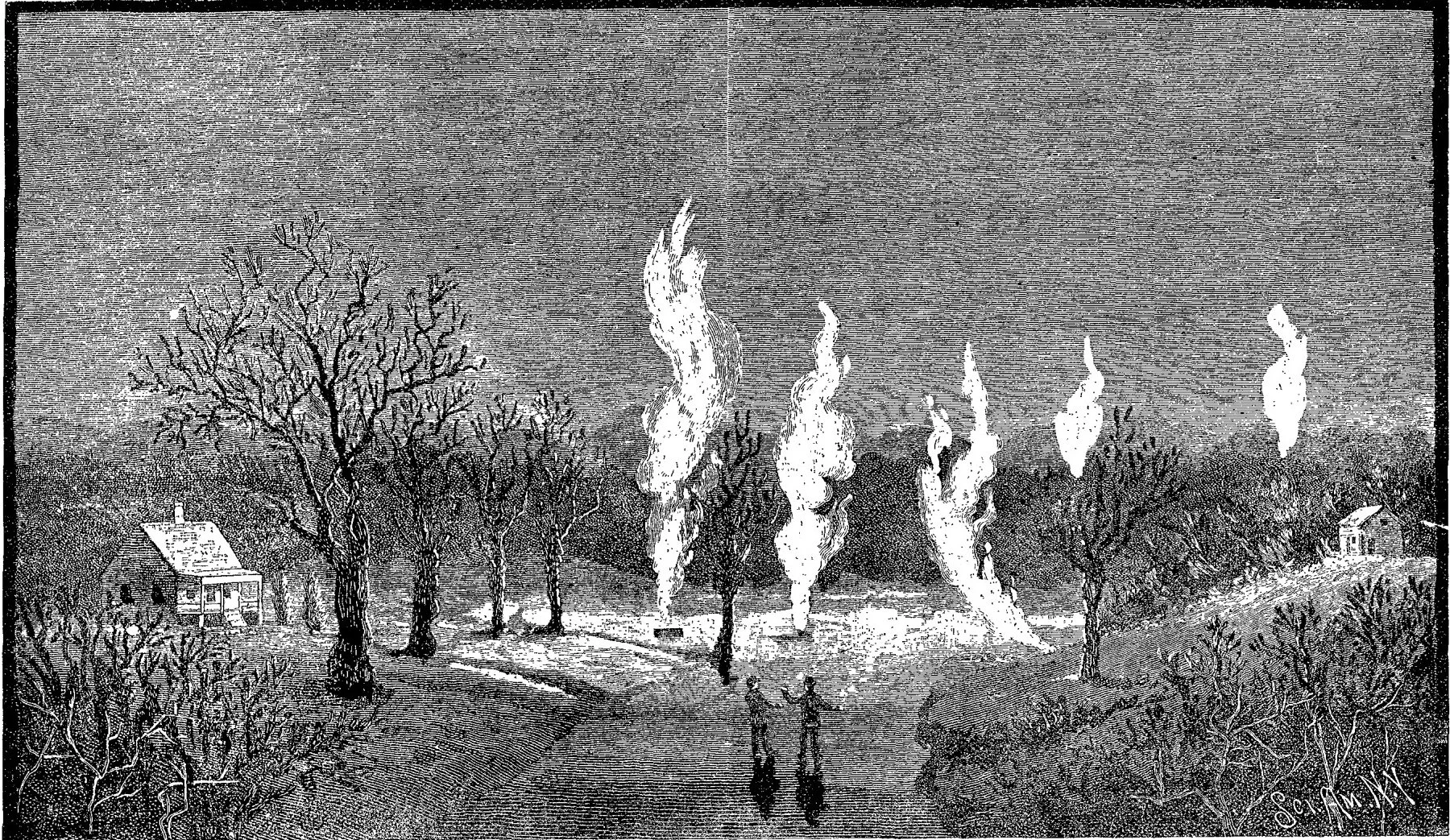
A GROUP OF BURNING GAS-WELLS IN KANSAS.
The next flood will not be of water, but of fire; and when the fire of that great day sweeps over the earth, every vestige of sin will be destroyed. The terrible work that sin has wrought will be so manifest in that time that even the wicked themselves will be forced, by their own convictions, to say that God is just and right. Sin being thus burned out by fire, it will never again be able to lift its head in all the fair and happy universe of God.
The flood by which the old world perished is set forth as an example of the future flood of fire; and as in that time the “fountains of the great deep were broken up,” and the “windows of heaven were opened,” so that water from within the earth united with what came down from above to produce the flood, even so we may expect that in the flood of fire, the flame from within will unite with that which comes from above to produce the great conflagration.
If man would only seriously consider the signs of our times, he would see, even now, how these agencies are preparing. The oil-wells and natural-gas wells so familiar to all show that the center of the earth is full of the most inflammable materials. The illustration may help the mind more readily to understand how literally this is true. There seems to be within the earth an inexhaustible supply of combustible materials. This oil and natural gas which man handles with so little thought or concern, should be an evidence to him that God has an abundance of material prepared for the oncoming flood of fire.
What momentous and thrilling themes cluster within our time! How our hearts should beat with intense action, and with what swift feet should we run to tell the world of its rapidly approaching doom,—the doom of eternal destruction! O brother, sister, do not be inactive now! Heed the Master’s call, hasten to the rescue of perishing souls, and allow God to use you in saving many from the wreck.

UNLOAD YOUR CARES.

A very beautiful thought is brought out by the French translation of 1 Peter 5:7, where our version reads, “Casting all your care upon him; for he careth for you.” The word “casting” is translated “unload.” The word “cast” might seem to bring to our mind the action of taking up something, and throwing it over on Jesus; but many times, dear friend, have you not found the cares too heavy to lift, and felt that they were crushing you with their weight? Have you ever seen a coal-cart unload? The man took out of the front of the heavy cart an iron pin, and the cart was so balanced on the axles that then, with a slight pressure on the back of the cart, it would tip up, and the whole load would slide to the ground, and the pony would trot away with a light step. You do not have to take up your burden; just take out the little pin of your endeavors to help matters, and then, with hands of faith and committal, tip up the big load and run on, remembering that “He careth for you.”— Selected.

Experimental Religion and the Witness of the Spirit

The expressions “experimental religion,” and “the witness of the Spirit,” which were almost the watchwords of our fathers, are not heard so often as they once were. But they tell what is best in our church, or in any Christian church.—Professor Thomas (Methodist).

THE CHILD AT CHURCH.

MRS. S. M. I. HENRY.
(Sanitarium.)
I am in receipt of so many questions concerning the conduct of children on the Sabbath, and as to their attendance at church, etc., that I am compelled to return to the subject, some phases of which were discussed in the REVIEW of April 12. I will not again go over the ground covered by that article, nor take space for the questions, but will try to throw light upon each point raised by my correspondents up to date.
First, as fundamental to the subject, I would say that the children should always be taken to the house of God, and kept in company with their parents; families should sit together.
The obligation to attend church services is as imperative as the necessity. “The Lord is in his holy temple;” he has proposed especially to meet his people there, and has enjoined upon them that they forsake not the assembling of themselves together, as the manner of some is. Older people go to church because they feel the need of the instruction which is there given, and to worship according to the commandment, as well as to receive a blessing according to the promise. As to the promise, we are assured that the promise of the Holy Ghost is to us, and to our children (Acts 2:38, 39); and surely the little ones have a right to all there is in God for them. Christ said, “Suffer little children, and forbid them not, to come unto me;” and wherever he is to be especially manifested, is the place to which they should be taken; for they need him to give them a fair start in life.
Habits formed in childhood exert the strongest influence over the whole future; and the habit of churchgoing, of attention to worship, of listening to, thinking and talking about, and expecting to meet God in, the truths which are taught in the sermon, is among the most wholesome of all habits.
Many parents seem to have the idea that it will be too much for the children to attend both Sabbath-school and church, and so send the little ones on by themselves to Sabbath-school, after which they return home to spend alone the hour of the church service to which father and mother have gone, thus breaking up entirely the unity of the home life, which, more or less disturbed by the work of the week, should be cemented by the closest association on the Sabbath.
The children are perfectly able to endure and enjoy the Sabbath services, provided you do not try to make them act like old people.
The restless boy, accustomed to activity during the six days, will be all the better for keeping quiet during the Sabbath-school and church hours. If, after the Sabbath-school, he should, during the sermon, grow listless and sleepy, let it be understood that he can slip quietly up to father or mother, and cuddle down for a nap, and that no one will consider it strange, since he is only a child. Tell him that sometime he will grow strong enough to keep awake and listen on to the end, as father does (if father does); but, until that time comes, he need not be ashamed to sleep like a child, even if he is a “big boy.” The ambition to be manly will help to bring him to the point where he will keep awake and listen. Allow the children the freedom which belongs naturally to those who have been well trained. If they have not been well trained, of course trouble is the result. If they have no appreciation of the privileges of the Lord’s house, do not blame them, but yourself, from whom they must learn appreciation.
There are many little expedients by which children can be given a share in the service, and which will make them love it. They should be mentioned in the prayer; a short talk, a ten minutes’ sermon to them at the beginning, a simple object-lesson, drawn from something found on the way, will all serve to engage and hold their attention. Let them be encouraged to bring something from which the minister or leader can gather an illustration. We as a people have no time for formal services, such as would inevitably exclude the children. Leave such to other churches. Very desirable would be that condition of things which would make it possible for a child, or any one else, to lift the hand during the sermon, and say, “Please, I did not quite understand you,” and have the preacher ready to reply and explain, without being switched off his track.
The child who has a bouquet, or just one blossom, a last-year’s bird’s nest, a twig or leaf, a branch from a vine, a chick from the home brood, to contribute to the pulpit resources for the day, will be sure to have a personal interest in the sermon, and to feel that he has a place in the house of God, especially if his contribution is recognized. There should always be blossoms in the church; and when flowers are abundant, let the children bring bouquets in vases or glasses, for returning which to the proper place, they will be responsible. When there is a dearth of bloom, let each child, who can, bring just one blossom or spray, which, all arranged together, will make at least one bouquet for the desk. If your minister is liable to forget the children, take him in training in a gentle spirit, and see that he does not keep on forgetting. If you give him the children to preach to, he will be quite sure to remember them.
Anything that will make a child self-conscious, or a mark of special observation, should always be avoided, whether it be in clothing, in the style of book which he carries, or in any service which he renders. If he is especially bright, and capable of doing unusual things, all the more should he be kept from making a demonstration of it. The gifts of God will keep, and be all the sweeter for having time to ripen. Do not push a child forward into prominence for the sake of getting him to church, or making him love the Sabbath-school. He will only learn all the more to love self and self only. Better keep him at home from both, than secure his attendance simply that he may be “recognized,” and allowed to show off.
The leader of a meeting should always be old enough and mature enough to be a leader elsewhere; and sufficiently consecrated, and so taught of God, that he would be a reasonably safe leader anywhere. To place any one in a prominent position, even for an hour, for the sake of saving him, is to hasten his ruin. Salvation does not come that route.
It is dangerous to manners as well as to morals, if not to life and limb, for the little people to be left alone at home. Never do it. One woman said, “I don’t like to have a lot of children with me wherever I go.” Then she should not have a lot of children. But, having them, she must choose one of two things,—either so to accommodate herself to their necessities that they shall grow up to be a blessing or she must bear the burden of the curse to the bitter end.
Peevish and fretful faultfinding with the conditions of life in which one finds herself placed, will not relieve, but will certainly aggravate, every disagreeable feature into a source of the keenest anguish; while, even if there is anguish to begin with, and it is accepted with the abundant grace which comes from above, it will resolve itself into a source of comfort.
Children left to themselves will soon forget the Sabbath. How can they remember all through the long day in which they have playfully lived a week, may be years, of history? An hour to a child is longer than a day to the grandmother; and, forgetting, they will act accordingly,—break out into noisy demonstrations, and indulge in conduct that will lead people to say, “There is a family of Sabbath-keepers for you!” and so the name of God in your home will be profaned.
In a home where only the mother regards the day, special care should be taken by her to keep the children with her, and so to lead their thoughts that they will reverence its holy hours in spite of everything that may be said or done to the contrary.

THE SLEEPY-TIME.

Look, dear! the stars are blinking, The sleepy moon is low, The little winds among the leaves Have all forgot to blow. Come, dear, and say good-night! God keep you all the night!
Good-night! Gay words for waking, Brave words for noon, are best; But loving words for the sleepy-time, When the moon is low in the west. God keep you all the night! Sweet dreams! Good-night! good-night!
— Youth’s Companion.

Economy and Good Sense in a Girl's Wardrobe

It is a truth, and a sad one, that the girl with the least money is apt to be the most extravagant. The very wealthy girl may not have to care for her own wardrobe, yet each piece belonging to it is made to do full service; and in many instances, if she has a wise mother, the girl herself must superintend the work of the maid. It is said that each of the daughters of Queen Victoria was taught, not only to sew well, but to mend and darn with great neatness, and to make over those gowns which were counted worth it. The girl whose wardrobe is not large makes her first mistake in buying cheap material, of a color that is the fancy of the moment. Instead, when only one new gown may be had during the season, it should be of a fabric that will stand wear, that will endure making over, and of a color of which neither the wearer nor the looker-on will soon grow weary. It is an extravagance to have a gown made in the extreme of the fashion, for the extreme soon goes out, and then you have a failure on your hands.—Ruth Ashmore.

Fraudulent Fruit Jellies Exposed by Massachusetts Board of Health

“The secretary of the Massachusetts Board of Health says that nine tenths of all jellies sold as ‘fruit jellies’ are fraudulent. Analysis of specimens bought in the open market demonstrated that not a trace of the fruit labeled on the outside of the jars could be found in the contents of the jars sold.”

“WHERE’S MOTHER?”

BURSTING in from school or play, This is what the children say; Trooping, crowding, big and small, On the threshold, in the hall, Joining in the constant cry, Ever as the days go by, “Where’s mother?”
From the weary bed of pain This same question comes again; From the boy with sparkling eyes, Bearing home his earliest prize; From the bronzed and bearded son, Perils past and honors won,— “Where’s mother?”
Burdened with a lonely task, One day we may vainly ask For the comfort of her face, For the rest of her embrace: Let us love her while we may,— Well for us that we can say, “Where’s mother?”
— Selected.
Continue reading: TOUCH NOT, TASTE NOT, HANDLE NOT