“AND they journeyed from Mount Hor by the way of the Red Sea, to compass the land of Edom: and the soul of the people was much discouraged because of the way.” The Lord does not remove all the difficulties and trials and hardships from the pathway of His children. He would have them learn to put their trust in Him, believing that the invisible God is their mighty Helper. The children of Israel became accustomed to the presence of the pillar of cloud, that covered them as a canopy by day, and was as a pillar of fire by night. They came to look upon the cloud as a common thing.
The Lord had fed them with the bread of heaven, yet they murmured against Him. By His power He had held in check the wild beasts of the forests, and the reptiles of the wilderness, so that they had not hurt His people; but now He removed His restraining hand, and let the poisonous serpents do as they would have done all along the way had the Lord not restrained them. The real trouble that now came upon them served to bring them to their senses, and to awaken their paralyzed thoughts as to what course to pursue. “Therefore the people came to Moses, and said, We have sinned, for we have spoken against the Lord, and against thee; pray unto the Lord, that He take away the serpents from us. . . . And the Lord said unto Moses, Make thee a fiery serpent, and set it upon a pole: and it shall come to pass, that every one that is bitten, when he looketh upon it, shall live. And Moses made a serpent of brass, and put it upon a pole, and it came to pass, that if a serpent had bitten any man, when he beheld the serpent of brass, he lived.”
Throughout the camp of Israel there were the suffering and the dying who had been wounded by the deadly sting of the serpent. But Jesus Christ spoke from the pillar of cloud, and gave directions whereby the people might be healed. The promise was made that whosoever looked upon the brazen serpent should live; and to those who looked the promise was verified. But if any one said, “What good will it do to look? I shall certainly die under the serpent’s deadly sting;” if he continued to talk of his deadly wound, and declared that his case was hopeless, and would not perform the simple act of obedience, he would die. But every one who looked, lived.
A Symbol of Christ
Jesus said: “As Moses lifted up the serpent in the wilderness, even so must the Son of Man be lifted up: that whosoever believeth in Him should not perish, but have eternal life. . . . For God sent not His Son into the world to condemn the world; but that the world through Him might be saved.” Christ is speaking to us now as certainly as He spoke to the children of Israel in the wilderness. He is the Healer of both body and soul. Our attention is now called to the Great Physician. “Behold the Lamb of God, which taketh away the sin of the world.” Just as long as we look at our sins, and talk of and deplore our wretched condition, our wounds and putrefying sores will remain. It is when we take our eyes from ourselves, and fasten them upon the uplifted Saviour, that our souls find hope and peace. The Lord speaks to us through His Word, bidding us “look and live.” “He that hath received His testimony hath set to his seal that God is true. For He whom God hath sent speaketh the words of God: for God giveth not the Spirit by measure unto Him. The Father loveth the Son, and hath given all things into His hand. He that believeth on the Son hath everlasting life.”
Reason for Hope
There is every reason why we should be encouraged to hope for the salvation of our souls. In Jesus Christ every provision for our salvation has been made. No matter what may have been our sins and shortcomings, there is a fountain open in the house of David for all sin and uncleanness. “Come now, and let us reason together, saith the Lord: tho your sins be as scarlet, they shall be as white as snow; tho they be red like crimson, they shall be as wool.” This is the word of the Lord. Shall we accept it? Shall we believe on Him?
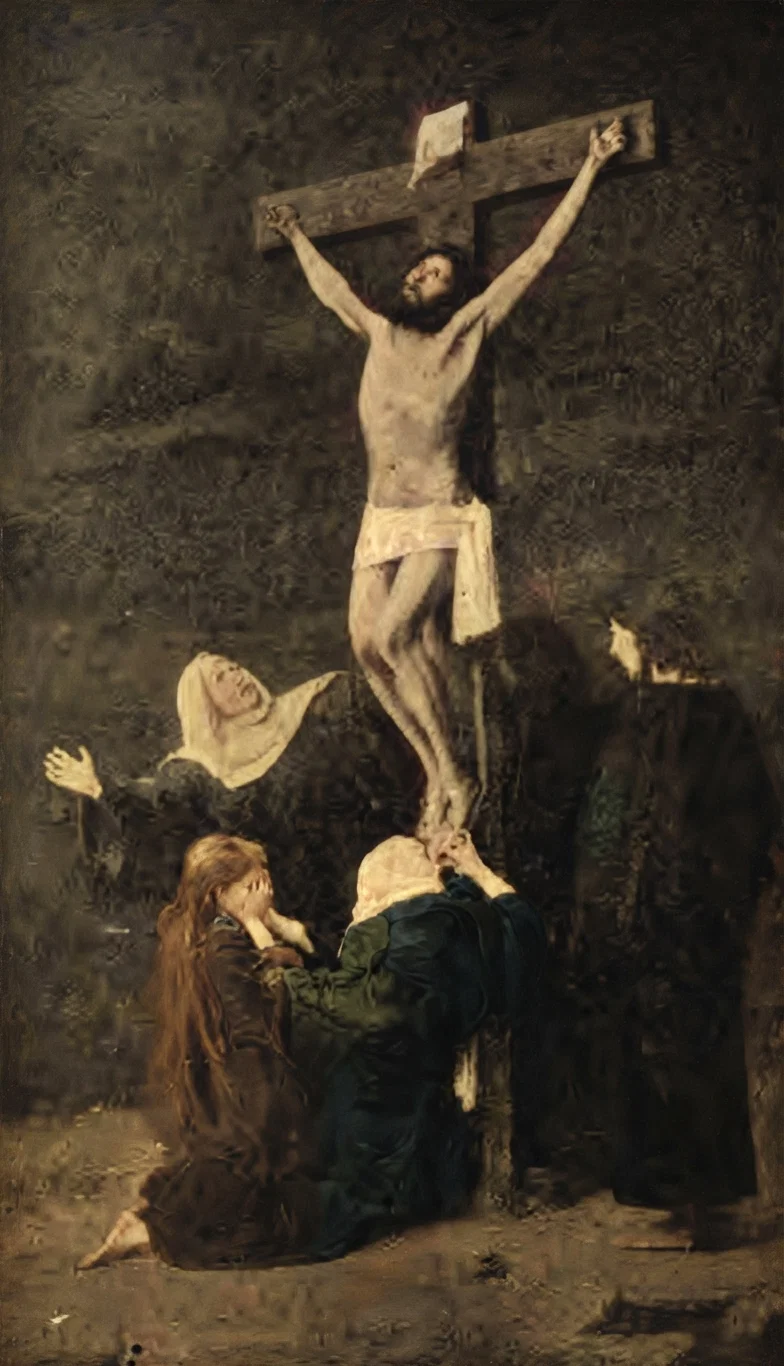
Munkacsy
Jesus Christ could die to save men, but while loving them with infinite love, He never sought to coerce men or to compel obedience, because He knew that right obedience could not be compelled.
David had been bitten by the fiery serpent,—he had been poisoned with the venom of sin,—yet hear the words that describe his experience after looking upon the uplifted Saviour: “Blessed is he whose transgression is forgiven, whose sin is covered. Blessed is the man unto whom the Lord imputeth not iniquity, and in whose spirit there is no guile. . . . I acknowledged my sin unto Thee, and mine iniquity have I not hid. I said, I will confess my transgressions unto the Lord; and Thou forgavest the iniquity of my sin. For this shall every one that is godly pray unto Thee in a time when Thou mayest be found; surely in the floods of great waters they shall not come nigh unto him. Thou art my hiding-place; Thou shalt preserve me from trouble; Thou shalt compass me about with songs of deliverance.” “The Lord is nigh unto them that are of a broken heart; and saveth such as be of a contrite spirit. . . . The Lord redeemeth the soul of His servants; and none of them that trust in Him shall be desolate.”
Sin and Crime
By H. W. Cottrell
By H. W. Cottrell
GOD’S government has its moral law, the violation of which is sin. It deals with men’s motives, thus entering the secret recesses of the soul. It directs in all questions of conscience and religion, leaving the individual free to choose his religion, or to choose to be unreligious, as he may decide for himself, and will in the last day call each to an account, that he may receive the reward of his choice.
Civil government has its civil laws, and penalties attached thereto; the transgression of which is a crime. The State is endowed with a Heaven-ordained right to punish the criminal for his crime. But the crime may also be a sin, for which he must render account to God. God will punish for sin, and the State will punish for crime.
Every candid, fair-minded person will concede that it is not a crime to work. It is a crime to kill, and it is also a sin to kill. The State determines and executes the punishment for the crime. But it is out of the purview of the State either to determine or to execute punishment for sin. God only can determine the punishment for sin. It is just as truly a crime, and just as great a crime, to kill a man on Sunday as it would be to take his life on Wednesday, but no greater. Murder is murder; and the day of the week the depredation is committed neither adds to nor detracts from the crime.
As working to earn bread is not a crime, the day upon which work is done would not determine it a crime. And inasmuch as the civil government can not punish for sin, but for crime only, leaving sin to be accounted for to God by the individual transgressor, civil government can not, by divine right, determine penalties for work performed on any day of the week.
For the State to legislate on the Sabbath question, attaching a penalty for the violation thereof, is for civil government to assume to dethrone God, be seated in His stead, and deal with and punish for sin; a work which God, and God only, can do. Let not “Cæsar” enter further the realm of conscience.
Jefferson’s Prophecy
By Thomas Jefferson
BESIDES, the spirit of the times may alter, will alter. Our rulers will become corrupt, our people careless. A single zealot may commence persecution, and better men be his victims. It can not too often be repeated that the time for fixing every essential right on a legal basis is while our rulers are honest, and ourselves united. From the conclusion of this war we shall be going down-hill. It will not then be necessary to resort every moment to the people for support. They will be forgotten, therefore, and their rights disregarded. They will forget themselves, but in the sole faculty of making money, and will never think of uniting to effect a due respect for their rights. The shackles, therefore, which shall not be knocked off at the conclusion of this war, will remain on us long; will be made heavier and heavier, till our rights shall revive or expire in a convulsion.—Notes on Virginia, Query 17.
California and Religious Liberty
By John Orr Corliss
[Mr. Corliss has been engaged in religious liberty work for many years in three continents, Europe, Australia, and America. He has appeared repeatedly before committees in Congress and in State legislatures. For several years past he has led the religious liberty forces in California. He has in every way studied the question from every side.]
IV—California's Noble Stand against Religious Legislation
MANY attempts have been made by the clergy of California to have the Sunday law reinstated, since its abrogation in 1883. They have petitioned and lobbied to the best of their ability, but until this year of grace without satisfactory results. The State legislature in 1887 gave a decided negative answer to their appeals, and they met the same fate two years later. In 1890 they put forth desperate efforts in the way of circulating petitions in behalf of a law "forbidding all Sunday traffic and work," and "all coarse and noisy amusements," but providing two exceptions. One of these was in behalf of "works of necessity and mercy," and the other for "private work" done by those who "religiously" and "regularly" rested on another day of the week.
To Revive Religious Legislation
But this petition met with no more favor at Sacramento than had other efforts, because the legislators there saw by the wording of the petition that it was an attempt to revive religious legislation. The motive was betrayed by the expression, "those who religiously and regularly observe another day." To except those and only those, from the penalty to be provided, who religiously observed another day, revealed to the lawmakers a religious test in a pretended civil statute, to enact which would commit the State to an expressed preference for and maintenance of one form of religion above all others, with a willingness merely to tolerate all others whose religion regularly forbade conformity.
Since then, each legislative session, with very few exceptions, has been besieged by Sunday-law advocates in attempts to win retainers for their cause. These trials have been regular at the last three sessions of the legislature, but without success. At the session of 1907, nearly a score of religious deputies, including one bishop, an influential editor of a denominational paper, a lawyer of some local repute, and even a Jewish rabbi, all maintained, before the committee having in charge the Sunday rest bill, that it should by all means become a law of the State.
A Step toward Church-and-State Union
Opposed to these were offered reasons why such a measure should not be placed among the California statutes. It was pointed out that the adoption of such a bill would be a long step toward the union of Church and State. Seventeen thousand petition signatures of voters against the passage of any bill of the kind were also presented, and hence the bill was adversely reported to the Assembly, and was lost.
The Last Two Efforts
In 1909 two measures were up for consideration, one providing for a common law statute enforcing Sunday rest, and the other proposing an amendment to the Constitution which would incorporate the demand for Sunday rest in the fundamental law of the State. It was hoped that at least one of these would meet with favor, but more than thirty-eight thousand legal voters this time petitioned against any such legislation. Two hearings before two separate committees were also had by both proponents and opponents of the measures. The constitutional amendment measure first reached the Assembly through a minority report of one member of the committee having had it under consideration, and this one was the reputed author of the measure. It was lost in the Assembly by an overwhelming vote, and the member whose name it bore was reported to have afterward said, with assumed gaiety: "O, I don't care much anyway. I had no interest in the bill, and now that it is lost, I might as well tell you that it was a church movement all right." But those who heard his speech in its favor well remember that he denied the church's having any part in the matter, declaring that his action was entirely free from religious influence. But other members of the Assembly were not deceived in the matter so vigorously defended, and voted for California's strongest evidence that her people are liberty-loving, and indulgent toward each other.
A Church Movement
There is good reason to believe that the church was responsible for the movement, since before the bill came from the committee, the pastor at that time of the First Congregational Church of Sacramento, the Rev. W. H. G. Temple, called together in his church as many of the legislators as would respond to the summons, and reviewed the situation before them. Speaking to the question of the Sunday bill to come before them, Mr. Temple was reported to have said:
"The question has been heatedly debated. You must disentangle argument from sophistry. It has been recognized for ages that man must have one day of rest. We do not stop harmless amusements. We ask for a day of rest. This is a Christian nation, founded on prayer. We are not Mohammedans, nor Jews, nor Buddhists. We offer religious freedom to all, but we have a right to demand that the ALIEN IN RELIGION SHALL CONFORM OUTWARDLY TO OUR CUSTOMS. When one branch of the Christian church, so small that it is insignificant, takes another day for Sunday, we have a right to make that sect conform to our practise."
Then, as if he would startle his hearers into a tractable attitude, the preacher warmly and quite dramatically exclaimed:
"Don't let us give up our God, or what expresses Him in our institutions. In the name of the wrecked lives adrift upon the ocean of despair; in the name of the shattered homes of the army of bleeding hearts; in the name of hopeful youth, of noble womanhood, and one day of peace and quiet, I ask you to see the truth and act by it."
Evidently the preacher allowed himself to go too far in his unbounded enthusiasm. Those clear-headed, sensible legislators could see from his pose and ardor that his concern about the Sunday rest was more in the interest of the church than in behalf of laboring men. The thought expressed regarding the right of the church to make any minor sect conform to the practise of the dominating power in religious observances, was a certain indication of how far he would attempt to enforce his views upon all dissenters, were the power to do so, but once in his hands.
It may be said that this particular preacher was an exception in rashness and bigotry, and that few would go to the lengths he marked out before the legislators. That may be true at present, and it is well that it is true; but even one little firebrand has been known to kindle so large a fire as to destroy large groups of homes, and sometimes many of their inmates. Likewise one such person of influence might inflame innocent minds to coöperate in a work of persecution which would gender hatred between sects, and destroy the peace and harmony of neighborhoods seven days in every week. These exceptional men are the very ones that should not be permitted by any law of the land to arouse base passions among others, and thus lead them to persecute those who, like themselves, are but exercising the right of personal belief.
Futile Attempts
Having been creditably informed that preparation for a strong effort to secure a Sunday-rest law at the forthcoming legislature of 1911 was being made by religious leaders, the Pacific Religious Liberty Association secured in a month's time more than sixty-eight thousand signatures of voters to petitions against any religious legislation in that session. This fact became known to the legislators, and they therefore steadily refused to countenance any advances in that direction. The writer was quietly informed by members of the legislature that a Sunday-rest bill had been drafted, and that several members had been approached with a view to securing some sponsor for it in the Assembly. No one, however, was found who desired to risk his reputation for wisdom and sagacity by offering a bill of that nature, and consequently none was presented.
One member did, however, on an alleged promise to his constituents, present a bill requiring barbers to close their business on Sunday. But at a hearing before the committee having the bill in hand, it was so clearly shown to be unconstitutional that the bill was not enacted into law.
It Is Not a Loss
In consequence of this past loyalty of California's sons to the principles of equity and justice in government, California is yet without a Sunday law. The State has lost no respect thereby, either; for she has as many church steeples pointing skyward, and as many worshipers in her churches, in proportion to her inhabitants, as any other State in the American Union. It is a libel upon the good morals of California's citizens to call them pagans, as has been done publicly by Sunday-law advocates, because they have not consented to oblige themselves by law to do that which it is already their privilege to do, or not to do, as best pleases them.7
This last-named privilege is admitted by Sunday-law advocates, tho in demanding such a law they base their plea on their right to a day of rest. This was their principal ejaculation at committee hearings in 1909. Their leader was then asked if he had not a perfect right to rest on Sunday without a law compelling it. He was forced to admit that he had. Had he not a perfect right also to go to church, or stay away, without being forced to do so by law? Of course he had, but he was so completely unselfish as to be acting entirely in behalf of laboring men. But if it was his privilege and right to rest on Sunday, and go to church, or not, at will, and all without law compelling it, did not every other man have the same right as himself, if he chose to avail himself of his right? He could not truthfully deny such a proposition, and it is one so self-evident that every voter in California can readily grasp it.
It is right and proper for everybody to worship God, but each should be left to do so in the way that justifies his own conscience, by which he will be held guilty or innocent in the great final accounting at Heaven's judgment-bar. All honor to the citizens of California for having thus far acted upon this principle of justice in relation to Sunday legislation.
J. O. CORLISS.
Rights of the Minority
By W. F. Martin
By W. F. Martin, Religious Liberty Secretary of the North Pacific
"CONGRESS shall make no law respecting an establishment of religion, or prohibiting the free exercise thereof." This first amendment to the United States Constitution has long been regarded by American citizens as the bulwark of religious freedom in the nation.
When the great statesmen of the Philadelphia convention wrote the Constitution, they studiously avoided putting anything therein that could be construed as governing the religious convictions of any body of people, however small.
When the conventions were called in the different States to consider the advisability of accepting or rejecting the Constitution, it was thought that religious liberty was not sufficiently safeguarded. Accordingly ten amendments were prepared, to be presented at the first assembling of Congress. They were given into the hands of James Madison, a rising young statesman from Virginia. April 1, 1789, Mr. Madison presented these amendments to the House of Representatives. No one of the amendments was considered of equal importance with the first.8Mr. Carroll said, "As the rights of conscience are, in their nature, of peculiar delicacy, and will little bear the gentlest touch of governmental hand, he was in favor of adopting the amendment."
In his great work, giving the history of the Constitution, George T. Curtiss says: "Especial emphasis was given to the first amendment. 'The minority,' they said, 'must be protected, the majority will take care of itself.'"
To protect the minority especially, then, the first amendment was adopted. Congress recognized the eternal principle that the rights of the minority, however small, are just as sacred as those of the majority. It is a sad day to any nation or people when they forget or override this great fact. Religious dominance through either the legislature or a popular vote is wrong.
True religious liberty is freedom not only for ourselves, but for our fellow men, not merely recognizing the authority of the majority, but the rights of the minority.
"Is true freedom but to break
Fetters for our own dear sake,
And with leathern hearts forget
That we owe mankind a debt?
No! True freedom is to share
All the chains our brothers wear,
And with heart and hand, to be
Earnest to make others free."
W. F. MARTIN.
The Golden Rule and Religious Legislation
By K. C. Russell
By K. C. Russell, Secretary International Religious Liberty Association
THE Golden Rule was given by Jesus in His wonderful Sermon on the Mount, and reads as follows: "Whatsoever ye would that men should do to you, do ye even so to them."
The real essence of genuine Christianity regarding our relation to each other is comprehended in this divine precept. To the extent that people have regulated their lives by this standard, the world has been made better; but when it has been disregarded, enmity, discord, strife, and every evil thing have followed.
This rule may be recognized even by those who do not make a profession of Christianity. Nevertheless, to the extent to which it is manifested in our lives it is an evidence that the Spirit of Christ is seeking to obtain full possession of the soul.
Our Relations to Our Fellows
It will be observed that this rule does not regulate our relation to God, but only our relation to one another. The last six commandments clearly define what is comprehended in the carrying out of the Golden Rule. These commandments embrace more than simply an outward observance of the same, for Jesus teaches that even hatred toward another is murder, and lust a violation of the seventh commandment. From this it will be seen that only those who have been regenerated by the converting power of God can fully bring their lives into harmony with the Golden Rule.
It would be interesting to conceive of the possible effect that would follow the application of this rule in the home. No unkind word would be spoken before the one who is tempted to speak it decides that he is willing to have it spoken to him. It requires no argument to convince any thoughtful mind that such conditions would make impossible the uttering of a harsh word or the committing of a cruel act. In short, the application of this principle would entirely change every phase of human society.
In these times, when there is such a growing demand for religious legislation on the part of many professed Christian people, it may be well for such to pause and apply the Golden Rule to such a procedure. Certainly, if such a course be contrary to this principle, every true Christian will refuse to subscribe further to the carrying out of such a program.
Examples of the Past
No true Christian will claim that the persecutions of God's people which took place in those times when the church dominated the State, were controlled by the Golden Rule. It will be remembered that for more than twelve and a half centuries the Roman Church held sway over the bodies and intelligences of most of the people of Europe. During that dark period she consigned men, women, and children, with their Bibles, and other literature, to the flames, unmindful of and repudiating their God-given rights.
This too has been true when the same conditions obtained in Protestant countries. Under such a régime, conscientious Catholics like Thomas More were put to death; and Calvin could approve the death sentence for heresy upon another Protestant, Servetus.
With the terrible chapters of past church-and-state intolerance before them, let those who advocate compulsory Sunday observance consider the Golden Rule in the light of this question: Would I be willing to have enacted a law by the civil government compelling me to observe a day for the Sabbath which would be contrary to my conscientious convictions? When this question is answered in the affirmative, then it will be demonstrated that the Sunday enforcement people are justified in their position. But no reasonable person would look for that kind of answer. No such answer will be given by an honest man.
Furthermore, when the Sunday observer can persuade himself to refrain from his ordinary work on another day than the one he observes, out of respect to those who observe that other day, then he can consistently expect others to return the compliment. But this is hardly possible, in the very nature of the case.
The Spirit Prompting It
The spirit prompting compulsory Sunday observance is unquestionably at variance with the Golden Rule. A letter received by the writer recently regarding Sunday legislation, from a prominent National Reform leader of Boston, well illustrates the point. Having written the gentleman about a certain measure pending in Congress for compulsory Sunday observance, to which I was opposed, he wrote, among other things:
"The people who go against the nature of things must either be broken in pieces or turn away from their destructive course."
It can be shown very clearly that the purpose and intent of Sunday legislation is to exalt a religious dogma of certain sects to the disadvantage of others who are justly entitled to the equal protection of the civil law. It is class legislation, and contrary to the genius and spirit of the American principles under civil government. In these respects it must be apparent that Sunday laws, or other laws of religious character, are not in accord with the principles of the Golden Rule, and therefore are not Christian.
K. C. RUSSELL.
LIMITS OF LEGISLATIVE POWER
United States Senate Report on Sunday Mails, 1829
With these different religious views [on the Sabbath], the committee are of opinion that Congress can not interfere. IT IS NOT THE LEGITIMATE PROVINCE OF THE LEGISLATURE TO DETERMINE WHAT RELIGION IS TRUE, OR WHAT FALSE. OUR GOVERNMENT IS A CIVIL, AND NOT A RELIGIOUS INSTITUTION. Our Constitution recognizes in every person the right to choose his own religion, and to enjoy it freely without molestation. Whatever may be the religious sentiments of citizens, and however variant, they are alike entitled to protection from the Government, so long as they do not invade the rights of others.
NO LEGISLATIVE DECISIONS OF RELIGIOUS CONTROVERSIES
United States Senate Report on Sunday Mails, 1829
They appear in many instances to lay it down as an axiom that the practise [of Sunday labor] is a violation of the LAW OF GOD. Should Congress in legislative capacity adopt the sentiment, it would establish the principle that the legislature is a proper tribunal to determine what are the laws of God. It would involve a LEGISLATIVE DECISION ON A RELIGIOUS CONTROVERSY, and on a point in which good citizens may honestly differ in opinion, without disturbing the peace of society or endangering its liberties. If this principle is once introduced, it will be IMPOSSIBLE TO DEFINE ITS BOUNDS.
Men Wanted
"God give us men! a time like this demands
Strong minds, great hearts, true faith, and
ready hands;
Men whom the lust of lucre does not kill;
Men whom the spoils of office can not buy;
Men who possess opinions and a will;
Men who have honor; men who will not
lie;
Men who can stand before a demagog,
And damn his treacherous flatteries with-
out winking;
Tall men, sun-crowned, who live above the
fog
In public duty and in private thinking;
For while the rabble with their thumb-worn
creeds,
Their large profession, and their little
deeds,
Mingle in selfish strife, lo! Freedom weeps,
Wrong rules the land, and waiting Justice
sleeps."
Ministers of the Gospel, Not of the Law
By W. M. Healey
By W. M. Healey
F OR God so loved the world, that He gave His only-begotten Son, that whosoever believeth in Him should not perish, but have everlasting life. For God sent not His Son into the world to condemn the world; but that the world through Him might be saved." John 3: 16, 17. Christ's mission to the world has never been to condemn, but to save.
When Adam and Eve departed from God, by refusing to obey His word, they brought condemnation upon themselves. As they saw the glory depart that enshrouded them, leaving them "naked," they remembered the words, "In the day that thou eatest thereof thou shalt surely die," and they expected death before the setting sun should mark the close of that day. When the evening shadows began to fall "in the cool of the day," Adam heard the voice of his Creator calling him. He was afraid to meet his Lord, supposing He had come to execute the penalty of death upon him. He tried to hide himself, but it is impossible to escape from the sight of that "all-seeing eye," and Adam and Eve were obliged to meet God. They were shown that God's law is immutable, and the penalty for its transgression could not be set aside.
Then our Lord took Adam's place, that the penalty might fall upon Him. Thus He was the "Lamb slain from the foundation of the world." Rev. 13: 8. The transgression, with its penalty, being transferred to Christ, Adam did not die that day. Christ did not die upon earth, that day, as a man dies, but He suffered as the Creator of man, held responsible for sin because of His apparently defective work.
Christ gave a prophetic promise that He would come a man, the "Seed" of the woman, and as man, would overcome the serpent. About four thousand years later He came, the "Seed of the woman," and the "Man of Galilee," and again pointed out the unchangeable nature of God's law, and death as the penalty for its transgression. He came to Adam as his Creator, not to condemn, but to give Himself for man's salvation. Again He has come, this time in the flesh, a man, but not to condemn, or administer the penalty of sin, but to suffer and die for man. Thus in the life and death of Christ we have the Creator and the Man, the divine and the human, "that whosoever believeth in Him should not perish, but have everlasting life."
Our Lord's Commission
Shortly before Jesus ascended to heaven, He gave a commission to the church to continue the same work He had been doing while here with His disciples. There was to be no change in the commission, for it was to reach "to the end of the world."
"Go ye therefore, and teach all nations, baptizing them in the name of the Father, and of the Son, and of the Holy Ghost: teaching them to observe all things whatsoever I have commanded you: and, lo, I am with you alway, even unto the end of the world." Matt. 28: 19, 20.
The commission was not only to teach, but to teach to "observe all things" that Christ taught. This includes the whole law of God as it then existed, for He said "not one jot or one tittle" of it should pass away. It also embraced the Gospel of salvation. When the church teaches the commandments of men in place of the commandments of God, it is no longer teaching "all things" as He commanded. And when the church goes so far as to unite with earthly powers to compel obedience to what it teaches, and execute penalties on those who refuse to obey men rather than God, then it is going directly contrary to the teaching and practise of Jesus Christ, and He has no part in that work.
The sinner sees in all nature only final death. He beholds the withered leaf, the dying bird and beast, even his fellow man appearing, as the shadow, for a little time, and passing away. If he looks into the law of God, he beholds only condemnation and death. The church is commissioned to offer him salvation and everlasting life through faith in Jesus Christ. "Who also hath made us able ministers of the new testament; not of the letter, but of the spirit: for the letter killeth, but the spirit giveth life." 2 Cor. 3: 6.
Life, Not Death
The letter of the new testament, or new covenant, kills, the same as did the letter of the old covenant. The new covenant contains the law of God. "This is the covenant that I will make with them after those days, saith the Lord, I will put My laws into their hearts, and in their minds will I write them." Heb. 10: 16. The letter of the law kills, not those who obey it, but those who disobey it. The spirit, intent, and purpose of the law are unto life.
The State of California has a law forbidding murder, with the extreme penalty of death for the one who breaks it. The spirit, intent, and purpose of that law are life, which it was made to protect, but to the transgressor it becomes a law of death. But if the governor pardons the murderer, the same law that had only death for him, now protects his life, and in him the real spirit and original intent of the law are carried out.
"And the commandment, which was ordained to life, I found to be unto death." Rom. 7: 10. The church has no commission to minister death, or punishment for sin, but to offer forgiveness of sin through faith in Jesus Christ. This pardon restores the sinner to the original intent, purpose, and spirit of the law, the giving of life. The Gospel is not opposed to the law, but it enables the law to work out its spirit and purpose in the sinner. "Do we then make void the law through faith? God forbid: yea, we establish the law." Rom. 3: 31. "Therefore being justified by faith, we have peace with God through our Lord Jesus Christ." Rom. 5: 1. "For what the law could not do, in that it was weak through the flesh, God sending His own Son in the likeness of sinful flesh, and for sin, condemned sin in the flesh." Rom. 8: 3.
It is not the work of the church to execute the penalty of the law upon the sinner, but to save the sinner from that penalty by reconciling him to God through Jesus Christ. "And all things are of God, who hath reconciled us to Himself by Jesus Christ, and hath given to us the ministry of reconciliation." 2 Cor. 5: 18.
When the church has so far departed from the law of God and the commission of Jesus Christ as to unite with earthly government to make and enforce a Sunday law, or any other religious rule or doctrine, how can she expect the presence and blessing of Jesus Christ to be with her? "Not every one that saith unto Me, Lord, Lord, shall enter into the kingdom of heaven; but he that doeth the will of My Father which is in heaven."
Arouse for Freedom!
By John Greenleaf Whittier
Up, then, in Freedom's manly part,
From graybeard eld to fiery youth,
And on the nation's naked heart
Scatter the living coals of Truth!
Up,—while ye slumber, deeper yet
The shadow of our fame is growing!
Up,—while ye pause, our sun may set
In blood, around our altars flowing!
O, rouse ye, ere the storm comes forth,—
The gathered wrath of God and man,—
Like that which wasted Egypt's earth,
When hail and fire above it ran.
Hear ye no warnings in the air?
Feel ye no earthquake underneath?
Up,—up! why will ye slumber where
The sleeper only wakes in death?
Up now for Freedom! — not in strife
Like that your sterner fathers saw,—
The awful waste of human life,—
The glory and the guilt of war;
But break the chain,—the yoke remove,
And smite to earth Oppression's rod
With those mild arms of Truth and Love,
Made mighty through the living God!
—J. G. Whittier.
First Step in Intolerance
By James Madison
(Extracts from James Madison’s Remonstrance to the Assembly of Virginia)
“It is proper to take alarm at the first experiment upon our liberties. We hold this prudent jealousy to be the first duty of citizens, and one of the noblest characteristics of the late Revolution. The freemen of America did not wait till usurped power had strengthened itself by exercise, and entangled the question in precedents. They saw all the consequences in the principle, and they avoided the consequences by denying the principle. We revere this lesson too much soon to forget it. Who does not see that the same authority which can establish Christianity in exclusion of all other religions may establish, with the same ease, any particular sect of Christians, in exclusion of all other sects?”
“The proposed establishment is a departure from that generous policy which, offering an asylum to the persecuted and oppressed of every nation and religion, promised a luster to our country, and an accession to the number of its citizens. What a melancholy mark is this bill, of sudden degeneracy! Instead of holding forth an asylum to the persecuted, it is itself a signal of persecution. It degrades from the equal rank of citizens all those whose opinions in religion do not bend to those of the legislative authority. Distant as it may be in its present form from the Inquisition, it differs from it only in degree. The one is the first step, the other is the last, in the career of intolerance.”