With the beginning of the new year, a new temperance measure was put into effect in London, England, the extraordinary nature of which shows how desperate the temperance situation in the English metropolis is realized to be. The new measure, which is called the “licensing act,” provides that any person found drunk in any public place may be arrested and prosecuted, and three convictions within a year class an individual as a “habitual drunkard.” The habitual drunkard’s name is put on a black list, and the law prohibits him from buying liquor, or any person from selling liquor to him, within the space of three years. Any intoxicated person found in charge of a child may be punished by a fine of ten dollars or a month’s imprisonment, and habitual drunkenness is made a legal ground for divorce. In addition to all this, the law is retroactive; that is, it applies to past acts which would be offenses under it; and some individuals have already availed themselves of its provisions to secure divorces.
If drunkenness in the world’s metropolis is not now speedily cured, it will certainly not be the fault of the law. It remains to be seen whether this extraordinary measure represents any real power in the possession of temperance people in London to elevate the city to their own level of living, or whether it represents the old effort of individuals to lift themselves up by themselves—the effort of the Ethiopian to change his skin, or of an evil nature to make itself good. It is one thing to enact laws, and quite another thing to carry them into effect. It is one thing to know that an act is evil, and quite another thing to have the power and the disposition to avoid that act. One thing is certain: the reforming power necessary to enforce the provisions of this law must come from outside the class of people whose intemperate conduct it is intended to curtail. It will not and cannot be furnished by intemperate persons themselves.7
In connection with this subject it is of interest to note some facts bearing on the question of the prevalence of intemperance among women in English-speaking countries. The editor of the Christian Herald (New York) has been investigating this question, having had his attention called to it by recent wide-spread assertions “in press and pulpit, that American women are becoming more and more addicted to habits of intemperance. Bishop Coleman and other men of prominence in public affairs,” he says, “have charged that the drinking habit is spreading at an alarming rate in American homes. It has even been asserted by statisticians that at the present rate of progress another decade or two would find us, as a nation, so thoroughly alcoholized that the very springs and foundations of our home life would be poisoned, and the physical and mental welfare of the coming generations placed in jeopardy.”
To obtain information from sources considered the most reliable, the editor of the Herald addressed two leading officials of the W. C. T. U., one the president of the New York State society, Mrs. Ella A. Boole, the other the president of the Illinois State organization, Mrs. Helen M. Barker. “I am of the opinion,” Mrs. Boole said in her reply, “that total abstinence is increasing among the respectable middle classes, but that fashionable women drink more in public than formerly. The custom of flavoring food with wine, sherry, and brandy seems to be increasing, and this is bound to create a liking for the drink itself. Then these are strenuous days, and women as well as men live beyond their strength. The ‘social glass,’ so common in fashionable life, food flavored with liquor, and the secret use of alcoholics for home prescription, all contribute to the appetite for strong drink, and unless efforts are made to stop any and all of these things, drunkenness among women is bound to increase.”
Mrs. Barker stated that “physicians tell us that society women are more and more using various nostrums, ‘headache cures,’ and all kinds of preparations, containing more or less of liquor, opium, cocaine, chloral, etc., as tonics, stimulants, and that among the ‘Four Hundred’ much fashionable drinking is common. This is not new, but it is dangerous.”
The Herald also quotes from another authority, May B. Goudey, a temperance leader in Massachusetts, what it regards as a “still more startling statement,” as follows:—
“I heard a public speaker, in whom I have great confidence, relate this truly appalling incident. He said that in a certain city in one of the Middle States (naming the city) an asylum had been opened for women inebriates, and that within ten days sixteen hundred applications had been received from husbands for their wives, and fathers for their daughters, until the asylum was filled to overflowing.”
The Pittsburg Christian Advocate, of January 1, also calls attention to this spreading evil. “Comparatively few receptions or parties are now given among wealthier people,” it says, “at which strong drink is not literally forced upon the guests. It is not set out in bottles or decanters as of old, but is put into the lemonade or punch. Simple, wholesome lemonade has been tabooed on such occasions. It is quite too old-fashioned and tame. It must be fired up with claret or some other thing which has a twang to it. A lady who would serve plain lemonade now would be regarded as narrow and puritanical. And these fashionable dames and maidens have come to expect their stimulant at these gatherings, and have been known to turn up their fashionable noses in disdain when they found ‘only lemonade.’ So strong drink has come to be the order of the day. And it is often so strong in the open punch-bowl as to perfume the whole house. Not long ago a Christian woman of this city remonstrated with her caterer after her reception was over for having put spirits in the lemonade without her knowledge, when he replied that he would have been afraid not to do it when all other ladies ordered it. There is no mistake about it—this is the ruling fashion. Its effects may easily be known. Women are thus being trained to strong drink, and their sons and brothers will readily follow their example.”
All these things point us to a dark prospect, but they also point us to a bright one. For as surely as they indicate that the foundations of society are giving way, so surely do they indicate that we have reached the final days of earth’s career, when the great remedy for every evil that has spread its blight upon creation is at hand; that is, the coming of Jesus Christ to set up his everlasting kingdom. We trust everything may be done which can be done by the creation of temperance sentiment and by legislation, to force back or hold in check the rising tide of intemperance; but our remedy is to proclaim with more zeal the everlasting gospel which must go to all peoples, and thus hasten the day of his glorious appearing, and the time when God’s will shall be done on earth as it is in heaven.
L. A. S.
Church and State in France
By Editor
The question whether church and state shall be separated is now agitating the minds of the people of France. A bill providing for the abrogation of the Concordat, or agreement by which church and state in France are united, is now before the Chamber of Deputies. The Concordat is the famous document drawn up between Napoleon I and Pope Pius VII, and by its terms the Catholic clergy in France are supported by the state, which in return is vested with more or less authority in the affairs of the church. The bill to abrogate the Concordat provides:—
“Article 1.—All recognized churches are to be separated from the state.
“Article 2.—From the date of the present law the Concordat and all previous agreements established with the different church officials are abrogated.
“Article 3.—The moneys devoted yearly for religious worship are to be withheld.
“Article 4.—The embassy at the Vatican is to be suppressed.”
Articles 5 and 6 relate to the formation of religious organizations by the churches, having a legal status, by means of which they may hold church property; to the method of abrogating the Concordat, and to the status of the clergy which have been maintained by state support.
“Article 7.—The moneys which will thus be placed at the disposal of the government shall be applied to the creation of a fund for the support of sick and aged workmen.”
This bill is, of course, opposed by all the papal influence which the pope, who has long feared such a measure, can bring to bear. We trust it may aid in the great work of emancipating the minds of people in France and throughout Europe from papal domination.
L. A. S
By L. A. S.
The loss of a large publishing house seems like a great calamity, but we should remember that the work of God cannot be burned by fire, nor hindered by any such element of destruction. God himself is “a consuming fire,” and fire is but one of his agencies, to do his bidding. We should remember that the cause of God never advanced more rapidly than at times when there were no great visible institutions connected with it. There is such a thing as trusting in institutions to do a work which can be done only by personal missionary effort. The institution has its place, but it cannot do the real work of advancing the message. The thing of vital importance is not institutions, great or small, but consecration on the part of those who know the truth. God could send down an institution from heaven all ready equipped for work, as he will send down the holy city, or he could rain down gold with which to build institutions, as he rained down manna in the desert; but the one thing he cannot furnish, and that we must provide, is consecration. If the loss of the institution should be the means of awakening our people to a sense of their personal, individual responsibility to spread this message to the world, so that the needed zeal on our part, which alone is what hinders the work, would be supplied, the loss would be no loss, but a great gain.
L. A. S
Extending the Triumphs of the Cross
By Ellen G. White
Mrs. E. G. White
“He that spared not his own Son, but delivered him up for us all, how shall he not with him also freely give us all things?” Rom. 8: 32.
As this wonderful, priceless Gift was bestowed, the whole heavenly universe was mightily stirred in an effort to understand God’s unfathomable love, stirred to awaken in human hearts a gratitude proportionate to the value of the Gift. Shall we, for whom Christ has given his life, halt between two opinions? Shall we return to God only a mite of the capabilities and powers lent us by him? How can we do this while we know that he who was Commander of all heaven laid aside his royal robe and kingly crown, and, realizing the helplessness of the fallen race, came to this earth in human nature to make it possible for us to unite our humanity to his divinity? He became poor that we might come into possession of the heavenly treasure, “a far more exceeding and eternal weight of glory.” 2 Cor. 4: 17. To rescue us, he descended from one humiliation to another, until he, the divine-human, suffering Christ, was uplifted on the cross, to draw all men to himself. The Son of God could not have shown greater condescension than he did; he could not have stooped lower.
This is the mystery of godliness, the mystery that has inspired heavenly agencies so to minister through fallen humanity that in the world an intense interest will be aroused in the plan of salvation. This is the mystery that has stirred all heaven to unite with man in carrying out God’s great plan.
To human agencies is committed the work of extending the triumphs of the cross from point to point. As the Head of the church, Christ is authoritatively calling upon every one who claims to believe on him to follow his example of self-denial and self-sacrifice in working for the conversion of those whom Satan and his vast army are exerting every power to destroy. God’s people are called upon to rally without delay under the blood-stained banner of Christ Jesus. Unceasingly they are to continue their warfare against the enemy, pressing the battle even to the gates. And every one who is added to the ranks by conversion is to be assigned his post of duty. Every one should be willing to be or to do anything in this warfare. When church members put forth earnest efforts to advance the message, they will live in the joy of the Lord, and will meet with success. Triumph always follows decided effort.
Christ, in his mediatorial capacity, gives to his servants the presence of the Holy Spirit. It is the efficiency of the Spirit that enables human agencies to be representatives of the Redeemer in the work of soul-saving. That we may unite with Christ in this work, we should place ourselves under the molding influence of his Spirit. Through the power thus imparted, we may co-operate with the Lord in the bonds of unity as laborers together with him in the salvation of souls. To every one who offers himself to the Lord for service, withholding nothing, is given power for the attainment of measureless results.
The Lord God is bound by an eternal pledge to supply power and grace to every one who is sanctified through obedience to the truth. Christ, to whom is given all power in heaven and on earth, co-operates in sympathy with his instrumentalities,—the earnest souls who day by day partake of the living bread, “which cometh down from heaven.” John 6: 50. The church on earth, united with the church in heaven, can accomplish all things.
On the day of Pentecost the Infinite One revealed himself in power to the church. By his Holy Spirit he descended from the heights of heaven as a rushing, mighty wind, to the room in which the disciples were assembled. It was as if for ages this influence had been held in restraint, and now heaven rejoiced in being able to pour upon the church the riches of the Spirit’s power. And, under the influence of the Spirit, words of penitence and confession were mingled with songs of praise for sins forgiven. Words of thanksgiving and of prophecy were heard. All heaven bent low to behold and to adore the wisdom of matchless, incomprehensible Love. Lost in wonder, the apostles and disciples exclaimed, “Herein is love.” 1 John 4: 10. They grasped the imparted gift. And what followed?—Thousands were converted in a day. The sword of the Spirit, newly edged with power, and bathed in the lightnings of heaven, cut its way through unbelief.
The hearts of the disciples were surcharged with a benevolence so full, so deep, so far-reaching, that it impelled them to go to the ends of the earth, testifying, God forbid that we should glory, save in the cross of our Lord Jesus Christ. They were filled with an intense longing to add to the church such as should be saved. They called on the believers to arouse and do their part, that all nations might hear the truth, and the earth be filled with the glory of the Lord.
By the grace of Christ the apostles were made what they were. It was sincere devotion and humble, earnest prayer that brought them into close communion with him. They sat together with him in heavenly places. They realized the greatness of their debt to him. By earnest, persevering prayer they obtained the endowment of the Holy Spirit, and then they went forth, weighted with the burden of saving souls, filled with zeal to extend the triumphs of the cross. And under their labors many souls were brought from darkness to light, and many churches were raised up.
Shall we be less earnest than were the apostles? Shall we not by living faith claim the promises that moved them to the depths of their being to call upon the Lord Jesus for the fulfillment of his word, “Ask, and ye shall receive”? John 16: 24. Is not the Spirit of God to come to-day in answer to earnest, persevering prayer, and fill men with power? Is not God saying to-day to his praying, trusting, believing workers, who are opening the Scriptures to those ignorant of the precious truth they contain, “Lo, I am with you alway, even unto the end of the world”? Matt. 28: 20. Why, then, is the church so weak and spiritless?
As the disciples, filled with the power of the Spirit, went forth to proclaim the gospel, so God’s servants are to go forth to-day. Filled with an unselfish desire to give the message of mercy to those who are in the darkness of error and unbelief, we are to take up the Lord’s work. He gives us our part to do in co-operation with him, and he will also move on the hearts of unbelievers to carry forward his work in the regions beyond. Already9many are receiving the Holy Spirit, and no longer will the way be blocked by listless indifference.
Why has the history of the work of the disciples, as they labored with holy zeal, animated and vitalized by the Holy Spirit, been recorded, if it is not that from this record the Lord’s people to-day are to gain an inspiration to work earnestly for him? What the Lord did for his people in that time, it is just as essential, and more so, that he do for his people to-day. All that the apostles did, every church member to-day is to do. And we are to work with as much more fervor, to be accompanied by the Holy Spirit in as much greater measure, as the increase of wickedness demands a more decided call to repentance.
Every one on whom is shining the light of present truth is to be stirred with compassion for those who are in darkness. From all believers light is to be reflected in clear, distinct rays. A work similar to that which the Lord did through his delegated messengers after the day of Pentecost he is waiting to do to-day. At this time, when the end of all things is at hand, should not the zeal of the church exceed even that of the early church? Zeal for the glory of God moved the disciples to bear witness to the truth with mighty power. Should not this zeal fire our hearts with a longing to tell the story of redeeming love, of Christ and him crucified? Should not the power of God be even more mightily revealed to-day than in the time of the apostles?
Here is My Heart
By Liedrich
Here is my heart; my God, I give it thee.
I heard thee call and say,
“Not to the world, my child, but unto me,”
I heard, and will obey.
Here is love’s offering to my King,
Which in glad sacrifice I bring,—
Here is my heart.
Here is my heart: in Christ its longings end,
Near to the cross it draws;
It says, “Thou art my portion, O my Friend;
Thy blood my ransom was.”
And in the Saviour it has found
What blessedness and peace abound,
My trusting heart!
Here is my heart: ah! Holy Spirit, come,
Its nature to renew;
And consecrate it wholly as thy home,
A temple fair and true.
Teach it to love and serve thee more,
To love thee, trust thee, and adore,—
My cleansed heart.
Here is my heart: O Friend of friends! be near
To make the tempter fly;
And, when my latest foe I wait with fear,
Give me the victory.
Gladly on thy love reposing,
Let me say, when life is closing,
“Here is my heart.”
—Liedrich.
The Reason Why
By J. O. Corliss
J. O. Corliss
Some time ago there came into my hands an editorial from a Michigan paper, contrasting the past and the present in regard to the spirit in which men meet one another’s religious differences. The writer seemed to think that the present omens are indicative of a higher state of being, because men are now willing to let others hold religious tenets unlike their own without quarreling with them.
There is such a thing as a person’s being so intensely ambitious for worldly honors as to be entirely callous regarding all forms of religious faith, even though he may join in the regular ceremonies of church service. Besides, so long as others with varying faiths do not make themselves specially noticeable, but enter just as heartily into worldly enterprises as all their neighbors do, why should others feel called upon to oppose them? The daily lives of all are so nearly parallel that they can well agree to waive discussion of minor differences which have not the least effect on the life record of either class.
But let only one person in a community hold views radically differing from those of all his neighbors, especially when those views lead him to the conscientious practice of a course which reveals serious flaws in their religious theories, and they are at once annoyed. They may not at first make a serious matter of it, but if the activity of the “singular” personage brings others to the same practice as himself, then many are just as ready to quarrel with him as were those of years gone by.
These facts tend to show that the apparent willingness to tolerate supposed heterodoxy is not because of more goodness of heart than formerly among neighbors, but because those outside of their particular church fold are as religiously inactive as themselves. They also show that definite Bible teaching is not now to be tolerated by most people. The reason is not far to seek. Positive Bible teaching fastens upon men definite convictions which call for sacrifice, and few desire such a call. When religious teachers drop out of their work what some are pleased to call dogmatic instruction, the influence is quickly felt in the decline of personal effort in behalf of others; for then faith is displaced by reason.
Men are still living who can recall that members of the various churches were once taught Christian ethics through positive tenets of faith, and the lives of those taught after this fashion testified to their goodness of heart, their deep piety, and their constant readiness to assist others who were in distress. But these traits are not so noticeable now. Many are found who, while attending to the forms of godliness, deny the power thereof in their daily walk.
Nearly all denominations have, in a measure, trodden the same path, our own not excepted, though I am happy to think that ours has not traveled so far in that direction as some of the others. It is possible that the difference seen in this is chiefly owing to the shorter time they have been on their journey. Recent incidents which have come under my observation cause me to believe that there should be an early revival of former methods of instruction. In not a few cases children come to mature years without a definite knowledge of the message which called us out of the world, and so upon leaving the parental roof, turn their feet from the path in which they had learned to walk by parental example.
I do not mean to say that all the statements of earlier days should now be rehearsed; for having lived in the truth so long, and studied it from so many standpoints, we ought to be able to clothe the definite message attractively, and yet have it retain its familiar features. There is nothing so potent to arouse our people to action as the burning doctrines of the third angel’s message. The time is not far distant when all will need to know them more definitely, in order to be strengthened for the coming conflict. Let us hasten, then, to prepare our defense.
How to Master the Truth
It would be well if all seekers after truth—all students of the Word—would speedily come to an understanding of the principle so tersely expressed by Phillips Brooks, that “not by the sharpening of the intellect to supernatural acuteness, but by the submission of the nature to its true authority,” man conquers truth; that “not by agonizing struggles over the contradictory evidence, but by the harmony with Him in whom the answers to all our doubts are folded, a harmony with him brought by obedience to him, our doubts must be enlightened.”
A grasp of this simple principle would save days and months, and even years, of fruitless and wearing “investigation.” Nobody ever comes to a knowledge of the truth by study. We must first know the truth by revelation from God, and then we spend the rest of our lives, even all eternity, in studying it.—Present Truth.
“Worn-out From Overwork”
When God lays a work on us, he will supply the means to work with and the strength needful for body and mind. But he requires that we keep our powers under control and consecrated to God. Some one eats a late supper, and goes to sleep on it, and wakes up in the morning weary and worn; he thinks he has overworked and is weary from labor, when it was the system laboring with the late and heavy supper. People professing holiness go on indulging appetite and passion; they are languid and dull, and think they are worn-out with work for God. If we will live simply and purely, God will come and touch our bodies as well as our souls; and we shall not break down with our work half done for God.—Vanguard.
The Lion and the Lamb
There is no more vivid and striking illustration of the power in weakness, which is the characteristic of the gospel, than that presented in Rev. 5: 5, 6. When no man in heaven or earth could open the sealed book, one of the elders said to John, “Behold, the Lion of the tribe of Judah . . . hath prevailed to open the book, and to loose the seven seals thereof.” In accordance with the elder's words, John “beheld, and, lo, in the midst of the throne . . . stood a Lamb as it had been slain.” There was “the Lion of the tribe of Judah.” John looked for the conquering Lion, and he beheld a slain Lamb! A more striking contrast, and greater seeming contradiction, could not be imagined; yet the two are one and the same. In the slain Lamb which is the conquering Lion, we see how God ordains strength out of the most abject weakness; and thus we have “strong consolation.”—Selected.
My Trip to the Land of the Pharaohs
By L. R. Conradi
L. R. Conradi
The distance from Hamburg to Egypt by sea is almost as great as is the distance from Hamburg to New York; but the shorter route is overland to Triest, Austria, or Genoa or Naples or Brindisi, Italy, by rail, and then by ship to Port Said, or Alexandria, taking from five to five and one-half days.
As the cholera had been raging in Egypt all summer, we did not expect so much travel in that direction; but to our great surprise, we found that all the steamers going to Egypt or to Australia and Asia via the Suez Canal, were overcrowded. We had just secured second-cabin passage on a North German Lloyd steamer from Genoa to Port Said; but later on, we were informed that while we had bargained for the last cabins, another agent had a short time before given these cabins to another party. So on my return from Scandinavia and Finland, my first work was to visit the steamship company, to find out what way we could go. They kindly offered us a place in the North German Lloyd steamer “Bayern,” from Genoa to Port Said, giving us twenty per cent reduction, third cabin.
En route to Genoa, Elder Wakeham and his family had preceded me to Friedensau, where we met, and spent Friday and Sabbath, and attended the dedication of the new dormitory building, which took place at that time. I was also glad to meet Elder H. F. Schuberth here, who had just returned from his visit in Russia.
On our way south we spent three hours in Heidelberg, and visited the famous castle there. We reached Basel, Sunday afternoon, in time to have a meeting that evening. Here, Sister A. Weidmann, a German-Swiss trained nurse, formerly of Basel, joined our party, intending to assist in our medical missionary work in Palestine.
Early Monday we left Basel, and had a most pleasant trip via Lucerne and St. Gothard, reaching Milan that evening. When we arrived at the Italian border, one of our fellow passengers, an English gentleman, had considerable difficulty with the tickets for himself and his wife. He had called for third-class passage to Milan, and they had sold him first-class, and taken the money. In vain did I attempt to help the gentleman get his tickets exchanged; it was very evident that the officials only tried to get the better of him because he could not speak their language. Later on we met at the Pyramids, and from his card I noticed that he was from Melbourne, Australia.
October 28 we left Milan, and reached Genoa at noon, and there we completed the arrangements for the passage on the steamer, which was already in port. Early the 29th we went on board, and found the third cabin overcrowded. But, after seeing the purser, we learned that the company had kept their word, and written for us to be given the best quarters possible. Accordingly, two cabins of the subofficers, located on the foredeck, were cleared for our use. On board with us was the Crown Prince of Siam, whose flag was unfurled along with the German colors, as the steamer left port. The larger number of our fellow passengers were Germans and Swiss, going to Egypt to act as hotel maids and waiters, or young merchants en route to China and Japan.
Next day at noon we entered the beautiful Bay of Naples. Vesuvius, that ever-present menace to the safety of the surrounding regions, was quiet, only a little smoke issuing from its ancient crater. As our steamer lay here until night, Elder Wakeham and I went ashore. Naples is the most populous city in Italy. A number of years11ago several Sabbath keepers lived here. If one considers the many thickly inhabited cities of Italy, he cannot but exclaim, “The harvest truly is great, but the laborers are few.”
The following morning we sighted the island of Stromboli; its volcano emitting steam and smoke, then passed the straits of Sicily, and by evening we left European soil far behind us. Early November 3 we caught the first glimpses of the low-lying coast of Egypt, where, now and then, a sand pile or a light tower arose against the horizon. By nine o’clock we were in Port Said, at the entrance of the Suez Canal, where we all landed upon the shores of Africa.
Port Said is a city of about forty thousand inhabitants. It is now becoming quite a rival to Alexandria, as all the large steamers passing through the canal stop here instead of at Alexandria. The traffic passing through the canal is steadily on the increase, but there will soon be several great rivals. That nearest completion, is the Trans-Siberian Railroad, connecting Europe with China and Japan. Another rival will be the German railway from Constantinople through Asia Minor down to Bagdad on the Persian Gulf, which will probably connect with the Indian railroads. A third rival will be the Panama Canal.
While in Finland, I saw the snow flying: In Africa we were fairly stunned by the heat, and for the first few days one had to be careful until one became accustomed to the change. The hottest summer day on the Continent could not compare with the heat I found here in November.
From Port Said we took the narrow-gauge railroad to Ismailia, where we changed to the broad-gauge for Cairo, arriving at the latter place at eleven o’clock. Brethren Passebois and Awada, and others of the mission family, awaited us at the depot, and all were cheered to see the long-promised help.
The weather in Egypt was extra hot last summer, and some of our people had suffered more or less from the excessive heat. Brother Zerr, one of our German brethren who accepted the truth in Palestine, had been overcome by the heat, and the state of his health was such that we did not think it advisable for him to remain there longer, so he took passage for Germany, where he will spend some time at our Friedensau school, further fitting himself for the work. The cholera had also worked many hardships. There were about forty thousand cases during the summer, thirty-three thousand of which proved fatal—a very large percentage, indeed. This year the Nile was also lower than it had been for decades, and there would certainly have been a terrible famine, had it not been for the newly constructed dams, of which we shall speak later.
Brother Passebois had had considerable difficulty in keeping the present building for our restaurant, and in vain had he spent a great deal of time trying to find another suitable place. Once he had bargained for a house, but when the day came for them to move in, the landlady was ill, and she refused to receive them, and had not the present landlord granted them another three months, they would have been entirely without a dwelling. This uncertainty naturally did not have the best effect upon the boarders, and they as well as we felt it one of the most important matters to secure permanent quarters for this work. Although Brother Passebois had been unable to give his whole attention to the Health Home, yet its income had been about twenty-two hundred dollars during the year, the most of which was received on board and lodging.
The workers already on the ground met with us in consultation daily, and Elder Wakeham thus became quite fully acquainted with the situation, and with the present needs of the field. We decided to continue the Vegetarian Restaurant, and, if possible, secure better quarters for it. Before we separated, suitable apartments were found in a much nicer part of the city, just opposite the British army headquarters.
Each evening we had public meetings, one hour for the Armenians, and the other for the Arabs. Among our hearers were several Mohammedans who had attended our meetings before; one of these was a teacher in the great Mohammedan university there, and they seemed to appreciate the truths presented.
As Elder Awada, our Arabic minister, and the two Armenian brethren now working in Egypt, had had but little experience in public labor thus far, we arranged for Elder Wakeham to hold meetings with them in the city of Cairo for the present, rendering them whatever assistance and advice he can. On Sabbath, the 8th, we celebrated the ordinances in Cairo.
We also spent some time in considering the advisability of issuing more publications in the Arabic. A printer, who is very much interested in our work, attended the meetings, and he has kindly consented to give us just as good rates as we could secure on the Continent; and as Elder Awada and others are well acquainted with the Arabic, we shall soon have more literature in that language. For the present, we shall print a few tracts on the prophecies, and a number of Bible readings, thus really laying the foundation of our publishing work in Egypt. This publishing will be done by the International Tract Society of Egypt.
Ecuador
By F. H. Davis
F. H. Davis
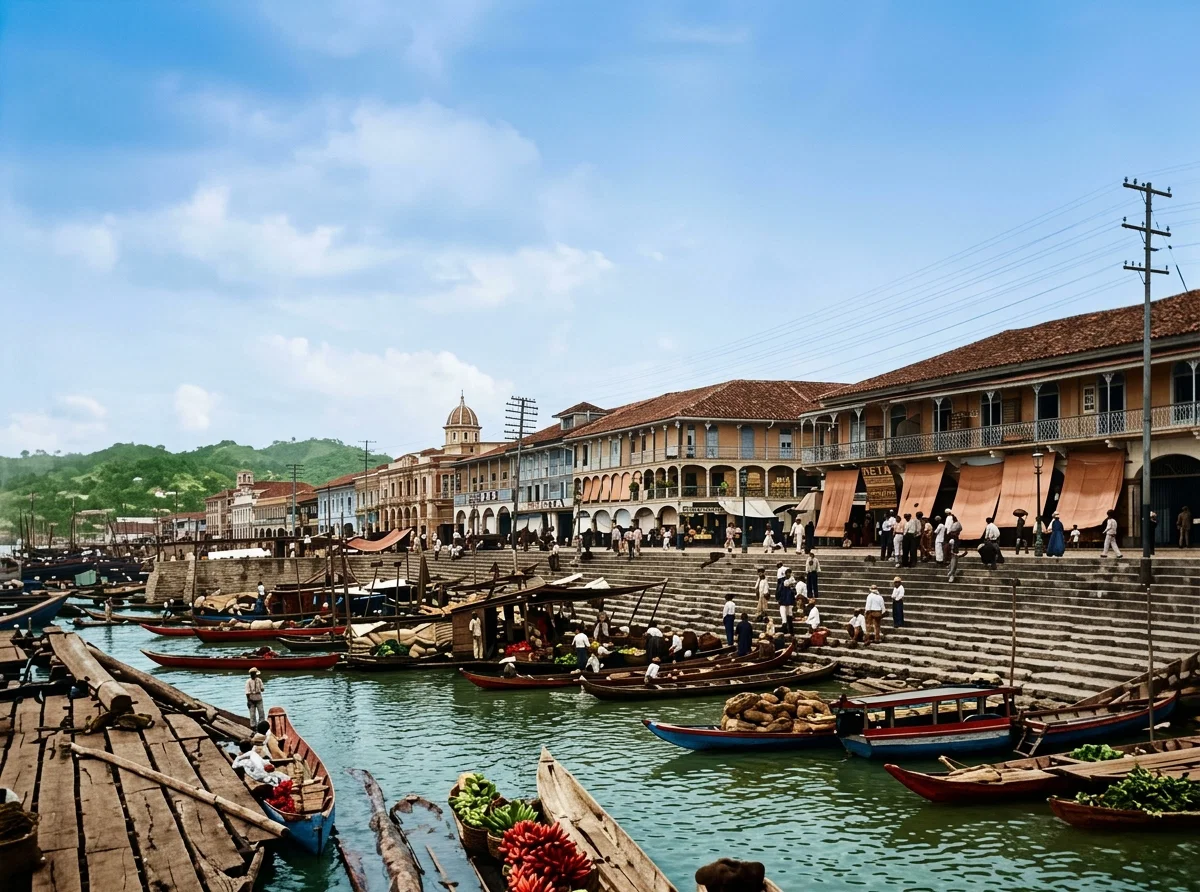
Ecuador, as all other Pacific coast republics, is Spanish-speaking. The inhabitants are a mixture of negro and Spanish. It is a rare thing to see the pure Spanish blood. Intense heat and uncleanliness of the lower class have made the coast towns very unhealthy. The writer could not help noticing the untidiness of Guayaquil, the principal seaport of Ecuador, compared with Callao, Peru, or Valparaiso, Chile, which are indeed bad enough. A Peruvian, commenting on the filthiness of the Ecuadorians, told of a foreign lady riding through Guayaquil who, on passing one of the seuch holes, had to put her odored handkerchief to her nose to counteract the bad odor. In spite of all these drawbacks, there are some nice, clean-looking people.
GUAYAQUIL, ECUADOR
Tropical fruits are cheaper in Guayaquil than in any other place on the coast, so far as I know. A whole head of red or white bananas costs only a few cents.
Ecuador, sick, and almost ruined by the black-robed priest, has opened her doors to the gospel. Other denominations have accepted the invitation, and thousands of Bibles have entered, churches have been established, and the work in general is going on. Shall we who have the precious truth hold back because this is a hot climate?
My few hours' stay in Guayaquil acquainted me with a young man who had heard the gospel, and seemed interested in the truth. Also, there came aboard our steamer a native of Jamaica who had accepted the Sabbath in Ecuador under the influence of one of his countrymen while working on the railroad. So Ecuador has borne fruit already, before we go there.
After a few days' ride, partly by mule and partly by the railway that is in construction from Guayaquil to Quito, one finds himself in the capital, which has the best climate of any city of South America. Although directly under the sun's rays, Quito is sufficiently elevated to have a temperate climate in the torrid zone.
China’s Unoccupied Cities and Villages
In China there are 1,746 walled cities. In 246 of these, missionaries are at work, leaving 1,500 unoccupied. And in only eighty-eight villages and unwalled towns have mission stations been established. This statement is a loud call for more missionaries.
Mission Notes
Brother J. W. Westphal writes that the brethren in Argentina are taking hold nobly to repair the damages to the school building caused by the cyclone, although they have little or no means at their command.
Medical Work in Tokio
Dr. S. A. Lockwood writes that the prospect for medical work in Tokio is encouraging. Through their acquaintance with our Sanitarium in America and with our health foods, a number of missionaries are interested in the health and temperance work, and have expressed a desire that an institution be established. Dr. Kumashiro, the lady physician from Nagasaki, who has been keeping the Sabbath for three years, has left a flourishing practice, that she may study with our physicians, and become acquainted with their methods of treatment. She has several patients in Tokio who will enter the health home when it is opened. Dr. Lockwood has already had the privilege of speaking in Fukuyawa to a society of English-speaking students on tobacco and alcohol, and has been invited to take up other subjects with them as soon as their examinations are over.