The Youth’s Instructor, Vol. 34, No. 9.

SWEDEN

The Youth’s Instructor

Mar 3, 1886

S. D. A. Publishing Association · Battle Creek, Mich. · Mar 3, 1886

SWEDEN

In the eastern division of the Scandinavian peninsula lies the kingdom of Sweden. It contains about as much land as Michigan, Illinois, and Iowa together. This country is thinly populated, having only 4,700,000 inhabitants. It is more than fifteen times larger than Denmark, and with but two and a half times as many inhabitants.
A large portion of Sweden is lowland, reaching only three hundred feet above the level of the sea; but some parts are so high as to be covered with eternal snows. All along the coast are innumerable small islands and rocks, that form a natural protection against the violence of the sea, and hinder enemies from making hostile invasions. Most of the soil is poor; and the people have to work very hard to get even meager crops. But Sweden was once blessed with a warm climate, as can be proven by the remains of strange animals and palm-trees found bedded in the rocks, underground. Even now, some parts of the land are slowly and imperceptibly rising, especially around Botnic Bay, where the soil seems to have been raised above the sea level no less than three feet every century.
A large portion of the country is timbered, principally with evergreens; and there are also a good many birch groves.
The evergreen woods and pretty birch groves surrounding the clear lakes, with here and there a farm-house reflected in the quiet waters, present a lovely picture. Then again, charming valleys greet the eye, presenting fair meadowlands carpeted with grass and flowers, and fields of golden grain waving in the sunshine; while red painted farm-houses dot the landscape, and here and there a white church peeps from among the green trees.
In many places we meet swift rivers and grand water-falls. Sweden is a country of blue lakes and foaming rivers. Indeed, one-tenth of its entire area is covered by lakes. It has a great many canals connecting the larger lakes, so that streams pass clear across the country from Stockholm on the east coast to Gottenburg on the west. There are about 3,000 miles of railroad, and more than 3,000 ships trade on the sea, besides the 578 steamers.
The people get their living by agriculture, lumbering, mining, cattle raising, fishing and hunting, besides in manufacture, trade, and navigation. About one-tenth of the whole area is cultivated. Considerable more grain is raised than the country needs, so that in 1880 about ten million bushels were exported. Cattle, as well as quite an amount of cheese and butter are also exported.
Sweden has an abundance of iron. It is mostly found in a wide belt stretching from the line of Norway across to the Botnic Bay. Besides this, whole iron mountains are found, such as Gellivare in Lappmarken, 600 feet high, and Taberg in Smaland, 366 feet high. Copper, silver, lead, sulphur, zinc, and other useful minerals are also found in different places.
In 1880 nearly one million tons of iron ore were brought up from the mines, of which 330,000 tons were exported. The same year 730,000 tons of iron were produced in bars and squares, besides 80,000 tons of steel and iron-ware. The previous year 1,000 tons of copper were produced, and 3,188 pounds of silver.
Fishing is carried on to quite an extent. Bears, wolves, and foxes are found, but their number is yearly diminishing. Elks are hunted and used for food, as well as fallow-deer and roe-deer, and large birds of different kinds.
The number of factories in 1879 was 2,800, and the value of wares produced by them was more than thirty-six million dollars; yet the goods imported into Sweden that year exceeded the export by nearly eleven million dollars. It is certainly a great mistake for a country to use so much liquor, beer, tobacco, coffee, and many other luxuries, that the people consume a great deal more than the country produces. If they could content themselves chiefly with the produce of their own country, they would be a great deal better off.
The prevailing religion is Lutheran, yet the people are allowed religious liberty. Public schools are found in nearly every socken, or town, besides two universities, one in Upsala and one in Lund, with about 2,000 students.
In the very early times, the people made all their tools and weapons of stone. They also buried their dead in tombs fitted up with large, flat stones, and covered them over with hills of earth. Many of these ancient tombs still remain. After a time they became acquainted with the use of lead, iron, silver, gold, glass, and ivory. From the people in Southern Europe they learned to write, but their way of writing was at first very imperfect.
The Goths, from whom the Scandinavians descended, lived in Sweden at the time of Christ. They were heathen, and their mythology was about the same as that of the Danes.
Ragnar Lodbrok and Björn Jernsida were renowned rulers about the year A. D. 800. About this time Ansgarius came to Sweden and introduced Christianity. Under King Olaf, he visited Sweden the second time, several years later.
Erik Segersall reigned 988. He conquered Denmark; and in his day, Sweden was the mightiest of the three Scandinavian kingdoms. He embraced Catholicism, and persuaded many of the chief men to do the same.
The Swedes were made up chiefly of two large tribes, between whom there was almost continual strife and war, during nearly two centuries.
Magnus Ladulas reigned over the united kingdom. He became one of the most powerful and active kings of Sweden. He was successful in establishing peace. After his time inward strife and disturbance weakened the kingdom, until the Danish queen, Margareta, obtained the crown.
The period that followed this is called the time of union, but it was really a time of strife and war about the union. This was at last entirely dissolved by the cruel massacre of many of the most noble men of Sweden, brought about by Christian II. The accused people were condemned as heretics by a clerical court. In November, 1520, commenced the massacre of Stockholm. On the first day eighty-two persons were beheaded. Men were brought right from their homes or business to the scaffold. The massacre also extended to several places in the country.
This caused a general revolt, under the leadership of Gustaf Eriksson Vasa, which exploded the union, shook the three kingdoms to their foundation, and brought about great changes in the commonwealth of the people. This man was afterwards chosen king. He favored the Reformation, which had now begun in Sweden.
Under his successors the kingdom was much weakened by internal wars, as well as by the bloody seven years' war. But Charles IX. ruled with much strength and wisdom, and brought things into a comparatively flourishing state. His successors continued to improve the condition of Sweden. Charles XII., who reigned from 1697 to 1718, brought great glory to the Swedish name by his wonderful battles, as he led his “blue boys” through Europe, and dictated laws by his sword. But his illustrious race ended with a great loss to Sweden. Not only did they lose all their possessions south and east of the Baltic, but the kingdom became so impoverished that it was threatened with entire destruction.
In 1815 Norway was united to Sweden, and three years later a French prince, Charles XIV. Johan, ascended the throne. This was brought about by the new arrangement of affairs in Europe under Napoleon I. During his reign and that of his successors, the kingdom has enjoyed peace, and has prospered in a great degree. The present king is Oscar II. He began to reign 1872.
J. G. MATTESON.
Copenhagen, Denmark.

THE SNOW-STORM.

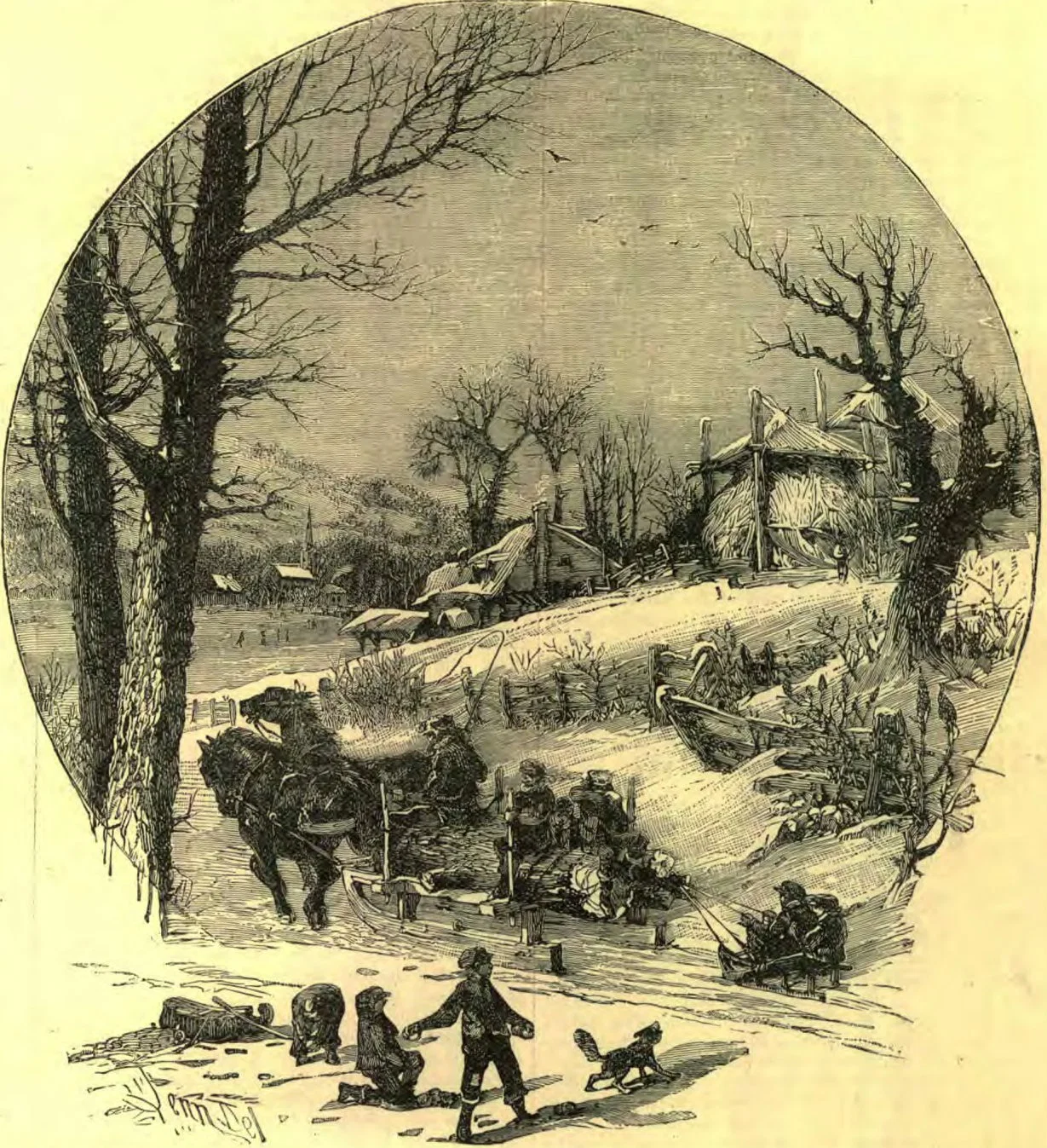
THE sun on that brief winter day Rose cheerless over hills of gray, And, darkly circled, gave at noon A sadder light than waning moon; Slow tracing down the thickening sky Its mute and ominous prophecy, A portent seeming less than threat, It sank from sight before it set.
Unwarmed by any sunset light, The gray day darkened into night, A night made hoary with the swarm And whirl-dance of the blinding storm, As zigzag wavering to and fro Crossed and recrossed the winged snow: And ere the early bedtime came, The white drift piled the window-frame, And through the glass the clothes-line posts Looked in like tall and sheeted ghosts.
Within our beds awhile we heard The wind that round the gable roared, With now and then a rude shock, That made our very bedstead rock. We heard the loosened clapboards tost, The board-nails snapping in the frost; And on us, through the unplastered wall, Felt the light sifted snow-flakes fall. But sleep stole on, as sleep will do When hearts are light, and life is new; Faint and more faint the murmurs grew; Till in the summer-land of dreams They softened to the sound of streams, Low stir of leaves, and dip of oars, And lapsing waves on quiet shores.
Next morn we wakened with the shout Of merry voices high and clear; And saw the teamsters drawing near To break the drifted highways out. Down the long hill-side, treading slow, We saw the half-buried oxen go, Shaking the snow from heads upreared, Their straining nostrils white with frost. Before our door the struggling train Drew up, an added team to gain. The elders threshed their hands a-cold, Passed, with the cider-mug, their jokes From lip to lip; the younger folks Down the loose snow-banks, wrestling, rolled. Then toiled again the cavalcade O'er windy hill, through clogged ravine, And woodland paths that wound between Low drooping pine-boughs, winter-weighed, From every barn a team afoot, At every house a new recruit.
—From Snow-Bound.

THE TRUTH AT ALL HAZARDS.

Some time after the beginning of the present century, there was living, in a busy country town in the North, a pious couple who had an only son. For this son they daily prayed to God; and what they asked in their prayers was that God would enable them to lay in his young heart, among the first lessons he should learn, the love of all things honest and good. So the foundations of an upright life were laid in the boy’s heart, and among these, very especially, a regard for uprightness and truth.
In the course of years the boy’s school-days were ended, and also his apprenticeship to a business life in the country town; and as there was no prospect for him there, he came up to England, to one of the great sea-ports, and by and by he obtained a good position in a merchant’s office. He was greatly pleased with his new office, and wrote to his father and mother that Providence had been very kind, and had opened up to him an excellent place.
But he was not there long before he was put to the test in a very painful way with respect to the lessons he had received about truth. It was part of the business of that office to have ships coming and going. And it was the rule that when the ship came into the port, its captain was to send word to the office that he had arrived, and was waiting instructions as to where to discharge the cargo; and it was the duty of the manager of the office to send back instructions to the captain as to where and when this was to be done.
A few months after this lad from the North came to the office, a ship laden with coal came in, and the usual message from the captain came; but, somehow or other, no answer was sent back to him. The captain waited a week, but still no word came back. Now that was very hard on the captain. Until the ship got free of its cargo, it had to lie idle in the dock, and all who belonged to the ship were kept idle too. So at the end of a week, the captain sent word to the office that his ship had been kept so long waiting for instructions as to where to discharge its cargo, that it had missed a good offer of a new cargo, and the office would have to pay him for the loss. The payment was called “demurrage.”
When the manager of the office got this message from the captain, he was very angry. He thought he had sent instructions as to where to discharge the cargo, or he made himself believe he had sent them. At any rate, he sent for the lad from the North, and said to him, “Didn’t I send you down to Capt. Smith with instructions to discharge his coal?”
The little lad said, “No, sir, I do not remember being sent down.”
“Oh, but I did,” answered the manager. “You have forgotten.” And there for a time, so far as the office was concerned, the matter was allowed to rest.
But the captain did not intend to rest there. He applied for his demurrage. And when that was refused, and his word that he had received no instructions was disbelieved, he took the master of the office to law. By and by his complaint came before judges in a court of law.
The day before the trial, the manager came to the lad from the North, and said to him, “Mind, I sent you to the dock with those instructions to discharge the coal.”
“But, I assure you, I cannot remember your doing so,” said the lad.
“Oh, yes, but I did. You have forgotten.”
It was a great trouble to the lad. He had never been sent to the dock. He could not say he had been sent, and he foresaw that he would have to say before the judges what would certainly offend the manager, and lead to the loss of his place. On the morning of the trial he went to the court. The manager came up to him, and said, “Now, our case depends on you. Remember, I sent you to the dock with the instructions to discharge the coal.”
The poor lad tried once more to assure the manager that he was mistaken, but he would not listen.
“It is all right,” he said hastily. “I sent you on such a day, and you have got to bear witness that I did, and see you say it clearly.”
After a little while, he was called into the witness-box, and almost the first question put to him was whether he remembered the day when Capt. Smith’s ship came in. And then this: “Do you remember during that day of being sent by the manager of the office to the dock, with a letter for the captain?”
“No, sir.”
“Don’t you remember taking instructions to Capt. Smith to discharge his coal?”
“No, sir.”
“Were you sent by the manager of your office to the coal ship that day?”
“I was not, sir.”
“Nor the next day?”
“No.”
“Nor any other day?”
“No.”
The gentleman who put the question was a barrister. He had been engaged by the manager to win the case for them. But when he heard the lad’s replies, he saw that the manager was in the wrong; and he turned to the judge, and said, “My lord, I give up this case. My instructions were that this witness would prove that a message to discharge had been sent to Capt. Smith; and it is plain no such proof is to be got from him.”
So the case ended in the captain’s favor and against the office in which the lad had found so excellent a place.
He went to his lodgings with a sorrowful heart, and wrote to his father and mother that he was sure to be dismissed. Then he packed his trunk to be ready to go home next day; and in the morning, expecting nothing but his dismissal, he went early to the office. The first to come in after him was the master. He stopped a moment at the lad’s desk and said, “We lost our case yesterday.”
“Yes, sir,” answered the lad, “and I am very sorry I had to say what I did.”
By and by the manager came in, and after a little time he was sent for to the master’s room. It was a long while before he came out. The lad was sent for. “I am going to be dismissed,” he thought to himself. But he was not dismissed. The master said to him, naming him, “I was angry yesterday, but not with you. You did right to speak the truth; and to mark my approval of what you did, I am going to put you in charge of all the workings and sales of our Glenfardle mine.”
Then he sent for the manager and told what he had said, and added, “And the young man will make his reports direct to me.”
In six months after, the manager left the office; and, young though he was, the lad was appointed to his place. Before as many years had passed, he was admitted as junior partner in the firm; and he is now at the head of the entire business—the managing partner.
Truth was the best. But I want to say that if things had turned out other than they did, and he had been dismissed, it would still have been best for him to speak the truth.—Sunday Magazine.

One Today Is Worth Two Tomorrows

ONE to-day is worth two to-morrows.

BOYS, DON'T USE TOBACCO.

I HAVE written this article wholly for the benefit of the boys; but I would like to have the girls read it too, for they can do much to keep the boys from using tobacco if they will always exert their influence against it.
But now I want to talk about this tobacco question. You do not use the filthy weed now; and hence this is just the time to fully resolve that you never will use it. Often boys begin the habit when they are no more than ten or twelve years old. How shameful it looks to see a boy of that age using tobacco! Now I will give you some good reasons for never beginning the habit.
1. Because tobacco is filthy. Look at the man who chews it. See how black and dirty his mouth is! See how stained and yellow his teeth are! How foul his breath! How stained his beard and clothing! See him spitting the filthy stuff everywhere he goes,—on the stove, on the floor, on the carpet, on the clean snow, in the cars,—all over. You cannot use tobacco in any way without becoming filthy. If the tobacco-user smokes, he pollutes the air that others breathe. Boys, do you want to go through life acting in this way?
2. Because tobacco is costly. Tobacco is of no benefit to a person; hence every cent he pays for it is a dead loss. Many a poor man has paid enough for tobacco to buy him a good farm, where he might spend his days when he was old. Let us figure a little, and find out how it is. Some men pay $25 every year for tobacco; some $40; some $100. But we will say that it only costs you $15 a year, and that you begin when you are fifteen years old. How much will you expend for tobacco by the time you are seventy?—Just $825. Now if during each year, the $15 had been put at interest, and allowed to remain until the end of the fifty-five years, it would amount to more than ten times that. Just think of that much money thrown away for tobacco! If you don’t want to lose so much, boys, don’t begin. Don’t take the first smoke or the first chew.
3. Because tobacco is unhealthful. Tobacco is a poison. It injures the teeth, it hurts the stomach, it is bad for the lungs, and often it aggravates or creates many diseases. It brings on cancer. General Grant, you know, died of a cancer made by using tobacco. This poisonous weed makes a man nervous, and injures him in many ways.
4. Because tobacco creates an appetite for strong drink. Nearly every drunkard is a tobacco-user. Why is this? Because tobacco creates a fever in the system, makes the mouth dry, and begets a desire for something stronger than water. You don’t mean to be a drunkard? Then don’t touch tobacco, for it is the first step that way.
5. Tobacco makes a man cross. Tobacco acts on the nerves and brain. It irritates them, and makes a person peevish and fretful. Then he will scold, and find fault, and act mean. We are liable to do this, anyway; so we ought not to use tobacco, and make ourselves worse.
6. Tobacco injures the memory. All agree that the use of tobacco injures a person’s memory. Persons of fifty years, and older, who have always used tobacco, complain that their memories are poor. After they break the habit, they can remember more easily. Doesn’t this show that it was the tobacco which injured their minds?
7. Because it does not glorify God. The Bible says that we should do everything to the glory of God. I Cor. 10:31. How can any one use tobacco to the glory of God? Who would think of going into heaven and into the presence of his Creator with a cigar or a quid of tobacco in his mouth?
What is the use of learning the vile habit? Nearly every one who uses it wishes he had not learned. I have heard many a man say that he would give much money if he had never acquired the habit. So don’t begin, boys. Save your money, save your health, keep clean, grow up free men, and set a good example to others. D. M. CANRIGHT.

“LAID UP IN MY HEAD.”

Daniel Webster once told a good story in a speech, and was asked where he got it. “I had it laid up in my head for fourteen years, and never got a chance to use it until to day,” said he.
My little friend wants to know what good it will do to learn the “Rule of Three,” or to commit a verse of the Bible. The answer is this: Some time you will need that very thing. Perhaps it may be twenty years before you can make it fit in just the right place, but it will be just in place sometime; then if you don’t have it, you will be like the hunter who had no ball in his rifle when the bear met him.
“Twenty-five years ago my teacher made me study surveying,” said a man who had lately lost his property; “and now I am glad of it. It is just in place. I can get a good situation and a high salary.” The Bible is better than that; it will be in place as long as we live.—Selected.

Inside Beauty: The Best Kind

Speaking of a good, but homely old woman the other day, some one remarked, “What a beautiful life is hers!” Little Fred was greatly puzzled over this for awhile, but at last he settled it satisfactorily to himself by saying, “I guess it must be inside beauty then, and maybe that is the best kind; for Susie Jacobs, who everybody says is the prettiest girl in town, never thought of doing kind things, as Granny Higgins does.” Fred was right. Inside beauty works outward, and makes even a homely old woman beautiful to those who know her. Yes, it is the “best kind.”

IMPORTANT BIBLE SUBJECTS.

LESSON 11.—THE JUDGMENT.

1. How were the sins of the people figuratively borne into the earthly sanctuary?
2. How are sins borne into the heavenly sanctuary?—Christ takes upon himself the sins of penitent believers.
3. In what other way do they find a lodgment there? Jer. 2:22; Isa. 5:6, 7.
4. For what purpose are they thus recorded? Rev. 20:12; Dan. 7:9, 10.
5. Can these records be blotted out before they have served their purpose in the Judgment?
6. Can the sanctuary be cleansed without blotting out sin records contained therein?
7. What does this prove?—That the Judgment and the cleansing of the sanctuary go on together.
8. How was the atonement made in the earthly sanctuary?—By presenting the blood of the sin-offering.
9. How will it be made in the heavenly?—Christ will present his own blood.
10. How were they removed from the earthly sanctuary?—They were put upon the head of the scape-goat.
11. How will they be removed from the heavenly?—They will be blotted from the books, and laid upon Satan, the antitypical scape-goat. (See note.)
12. Whom will Christ confess and accept in the Judgment? Matt. 10:32.
13. Whom will he deny? Verse 33.
14. Whose names will be retained in the book of life? Rev. 3:5.
15. Whose names will be blotted out? Ex. 32:33.
16. What blotting out will be done for those whose names are retained in the book of life? Acts 3:19.
17. Will these sins ever be brought up again? Jer. 31:34, last part; Micah 7:19, last clause.
18. What may this part of the Judgment be called?—The Investigative Judgment.
19. What view of this judgment was given to Daniel? Dan. 7:9, 10.
20. What scene was next opened before the astonished prophet? Verses 13, 14.
21. What was there given to Christ?
22. To what may this scene be compared?—To the coronation of an earthly monarch.
23. What now remains for Christ to do?—To take possession of his kingdom.
24. Read the description of this in Rev. 19:11–21.
25. How is the same scene described in 1 Thess. 4:16, 17?
26. What resurrection is here described?—The first resurrection. See Rev. 20:5.
27. Who are to have part in this first resurrection?—They which shall be accounted worthy. Luke 20:35, 36.
28. Where have they been accounted worthy?—In the Investigative Judgment.
29. What name has been given to Christ’s work of destroying the wicked at his second coming?—The Executive Judgment. Jude 14, 15.

A RECIPE FOR MAKING A HOLY MAN.

The Rev. E. S. Hume, writing to the Christian Weekly, from Bombay, India, says of some heathen practices there:—
“The Marwadis are the money-lenders of Western India. They are a heartless, bigoted, enterprising class. Owing to the careless habits of the people generally, in regard to borrowing money, the rate of interest is everywhere abnormally high. Twenty-four per cent is a common rate of interest, and not infrequently twice as high a rate is paid. As the result of this state of things, borrowers and lenders are always quarrelling, and cases caused by debt are among the most common which are brought into court. Naturally, ‘Marwadi’ has come to be an opprobrious name. To be called a ‘Marwadi’ is equivalent to being stigmatized as a ‘miser’ or a ‘skinflint,’ in America.”
“Strange to say, these Marwadis are, in their way, very religious. Money is their god, and money-making is their religion; but such persons need, of course, outward religious forms, and in the carrying out of these forms they are strict. This may well be illustrated by something which has recently occurred at Ahmednagar. A young man of this Marwadi caste came here a few weeks ago from a neighboring village for the purpose of being made a ‘sanyasi,’ i. e., a holy man. For a month he was daily dressed in fine clothes, and led on horseback in procession about the streets. While all of those who accompanied him walked, he rode, and was protected from the rays of the sun by a gorgeous umbrella. On both sides of him men carried and waved great fans, and a band of musicians preceded the whole company. On the last day there were a thousand persons in the procession, half of whom were women.”
“After marching about the streets as usual, they finally led the man to a large tree just outside the city, under which there is an idol of the monkey god. Here the man's fine clothes were all stripped off, and a plain white cloth was substituted for them. The man's head and face were shaven smooth, and hereafter he will be obliged to keep his head perfectly bare, but without the use of any such simple means as the razor. Once in six months all his hair will have to be pulled out with the help of pincers, or scraped off with ashes. A square piece of stiff yellow paper was then tied over the man's mouth, which he will always be obliged to wear. The object of this it would be hard for any one to guess.”
“These Marwadis, like many others here in India, believe that it is a sin to destroy animal life. As there are many small insects in the air, such a piece of paper or cloth is tied over the mouth in order that these little insects may not be drawn into the mouth with the breath, and so destroyed, and also in order that the warm breath coming from the mouth, may not be injurious to such insects as are not drawn in. For the same reason, since water is inhabited by multitudes of little insects, its use is almost prohibited, both for drinking and bathing purposes. After his meals, he will be allowed to rinse his hands in a little water, and this is the only water that he will be permitted to drink. The young man, while still a novice, will be under the special charge of an old sanyasi, whose duty it will be to instruct him in the theory and practice of their kind of holiness.”
Even the youngest readers of the INSTRUCTOR know there is no virtue in any such practices; and how glad we all feel that we have not been left to our own ways, and to trust to any merit in our own works to be made holy. While we sympathize with the millions who are thus putting their trust in false gods and false worship, shall we not also do all in our power to get the light of truth before them?

A Word to Sabbath-School Teachers

ONE word to you, teachers! You who are so often absent from Sabbath-school. Have you a good excuse? Do you realize how much harm you are doing by staying away? Your class expect you there, and when you are not present, they are disappointed. It is no encouragement for them to study the lesson, when the teacher, whose place it is to instruct them, is so often missing.
The superintendent has to supply the class as best he can, and it too often happens that the one whom he selects to fill your place, not expecting to act as teacher, has hardly looked at the lesson. The class are dissatisfied, and it is no wonder that they soon begin to stay away, too; and thus the school grows smaller, the interest wanes, opportunities for doing good are lost, and whose fault is it? Teacher! think of these things, and resolve to be punctual, and do your whole duty to the class intrusted to your care.

THE FIRST RELIGIOUS NEWSPAPER.

The readers of the INSTRUCTOR have sometimes had their attention called to the publication of newspapers in different parts of the earth, and have had the date given them when the first one was established, etc.; but how many of them can tell anything about the first religious paper published,—when, where, and by whom it was issued? Not long since I saw a fac-simile of the first copy. It bore date of September, 1808. Its pages were about three-fourths as large as those of the INSTRUCTOR. Eld. Elias Smith, a New England school-teacher, of the Christian denomination, was its editor, and I think he continued its publication till the time of his death, in the year 1846, being then seventy-seven years of age.
This paper was called the Herald of Gospel Liberty, and was published at Dover, N. H. I presume the parents of many of our readers received its weekly visits, and read it as a sheet of good religious instruction. When a youth, I lived with a family of the Christian denomination, who took the paper, and my recollection of it are favorable.
Since that time, religious newspapers have become very numerous; but whether they all supersede the pioneer sheet in excellence, is a subject for criticism.
A. S. HUTCHINS.

Curious Effect of Arctic Cold.

The same degree of cold elsewhere than in the Arctic regions would have the same chilling effect if the temperature remained as low a great length of time. A bitterly cold wave occasionally sweeps over the States, pinching us severely, yet we cannot begin to realize what one has to endure who lives in the polar regions, where the thermometer is a great many degrees below zero in the house with all the heat obtained from the lamps. The people resort to their furs for warmth; for it is so cold, in fact, that the fire can hardly keep warm enough to burn. To illustrate this, a writer in Harper's Young People relates the following circumstance:—
“Dr. Moss, of the English polar expedition of 1875 and 1876, among other odd things, tells of the effect of cold on a wax candle which he burned there. The temperature in the room was thirty-five degrees below zero, and the doctor must have been considerably discouraged when, upon looking at his candle, he discovered the flame had all it could do to keep warm.”
“It was so cold that the flame could not melt all the wax of the candle, but was forced to eat its way down the candle, leaving a sort of skeleton of the candle standing. There was heat enough, however, to melt oddly shaped holes in the thin walls of wax, and the result was a beautiful lace-like cylinder of white, with a tongue of yellow flame burning inside it, and sending out into the darkness many streaks of light.”
“This is not only a curious effect of extreme cold, but it shows how difficult it must be to find anything like warmth in a place where even fire itself almost gets cold. The wonder is that any man can have the courage to willingly return to such a bitter region after having once got safely away from it; and yet the truth is that the spirit of adventure is so strong in some men that it is the very hardship and danger which attracts them.”

A CORAL ISLAND.

People used to think the coral islands were built from the bottom of the sea; but the tiny architects which construct them, the polyps, cannot live at any great depth in the water, therefore they support their workmanship upon some rock beneath. Neither can these little builders live out of the water; but they gradually bring the framework of the island to the surface of the water, and the work of completion is brought about in another way, which Captain Chemm, of the Royal Navy, describes as follows:—
“First, the foundation is built up until it makes a break or ripple on the surface. Something is then drifted and entangled on it—maybe a log of wood, a dead tree, a mass of weed. Then birds bring their food of fishes, and leave the bones there. Sand, gravel, and broken shells accumulate around it, and it begins to appear above water.
“Seeds drifting on the ocean are next arrested in their progress. Dead wood, decayed leaves, and fish-bones form a sod. The seed, generally the mangrove, germinates, and rapidly, too, with the heat and rain of the tropics. This becomes a bush, then a tree. Its roots grasp the surrounding soil, and it becomes the nucleus of a mangrove island, waiting for some passing discoverer to name it.
“I have watched with real interest the progress of these islets from year to year—first the ripple, then the collection of leaves, sand, and shells, then the first shoot of the mangrove, then the sea-shells, the hermit crab and the surface ocean shell,—all soon to become a coral island.”

A FLOWER SHOW IN JAPAN.

In floriculture, it is said the Japanese excel the other nations. The Christian Weekly, of Sept., 1884, says:—
“The guild of florists is hereditary, and their skill and patience and secrets of cultivation have been handed down from father to son for a thousand years. The gardens about their temples are famous for the wonderful effects they produce with flowers in their season,—the plum-blossoms in February, cherry-blooms in April, the lotus in July, azaleas in summer, chrysanthemums, the national emblem, in October, camelias in December, and evergreens always.”
“The last Woman’s Missionary Advocate has an interesting account of a visit by a lady of the Presbyterian mission to a chrysanthemum show in the public gardens of Tokio. She says:—
“The flower show was a great curiosity. There were all sorts of grotesque figures of men, women, and children arranged so as to represent fairy or legendary tales in grottos. These figures were dressed entirely in flowering chrysanthemums so cunningly arranged that the pots could not be seen, and so that the flowers of different colors formed the different parts of the dress or parts of the animals. The Japanese are adepts in landscape gardening. Their taste always runs into the grotesque. One figure was an immense gilt image of Buddha, dressed in green, with a halo of yellow chrysanthemums. There was a figure of a white cat dressed in yellow, white, and red, standing in a boat of green in an artificial lake with a fish-pole, with which he had caught a fish to represent a cat-fish. There was Fuji in evergreen, with men and children in all gay colors gazing in wonder upon it, and many others that I forget. These flowers last for a month, and the children, men, and women flock to see them.”

AN IMPRISONED NEST.

A few months ago a large elm tree was cut down, and was being sawn into planks, when in its very heart was found a bird's-nest containing three eggs, in color white, with small brown spots. The shells of the eggs were quite soft, as though from age, and as the trunk of the tree was six feet and a half in circumference, it was calculated that the nest and its contents must have been in existence for a long period. Indeed, an examination of the several rings or layers of wood, which, as you know, prove the age of a tree—showed clearly that the eggs must have been hidden in the heart of the elm for quite thirty-five years. It is supposed that when the tree was very young, the parent birds had built at the junction of a bough with the trunk, that this bough had been removed by the wind, or in some other way, and that the natural growth of the wood had by degrees surrounded the nest and its contents.—S. S. Advocate.

ORIGIN OF THE AMERICAN DOLLAR SIGN.

“WHAT is the origin of the sign ‘$’ for the American dollar?” was the question propounded at a London dinner not long ago. The American consul did not know; neither did any one else. An extensive research resulted in this theory: The American dollar is taken from the Spanish dollar, and the sign is to be found, of course, in the associations of the Spanish dollar. On the reverse side of the Spanish dollar is a representation of the pillars of Hercules, and round each pillar is a scroll, with the inscription, “Plus Ultra.” This device, in the course of time, has degenerated into the sign which stands at present for American as well as Spanish dollars—$. The scroll round the pillars represents the two serpents sent by Juno to destroy Hercules in his cradle.—Christian Union.

SLATES MADE OF TREE-BARK.

In Siam, Burmah, and other Asiatic countries the boys and girls do not use the same sort of slates that are to be found in American schools. The slates there are strips of bark taken from certain hard-wood trees. The writing on this bark is rubbed out by means of betel leaves, just as slate-writing is erased with the sponge in this country.
Continue reading: NETTIE GRANT