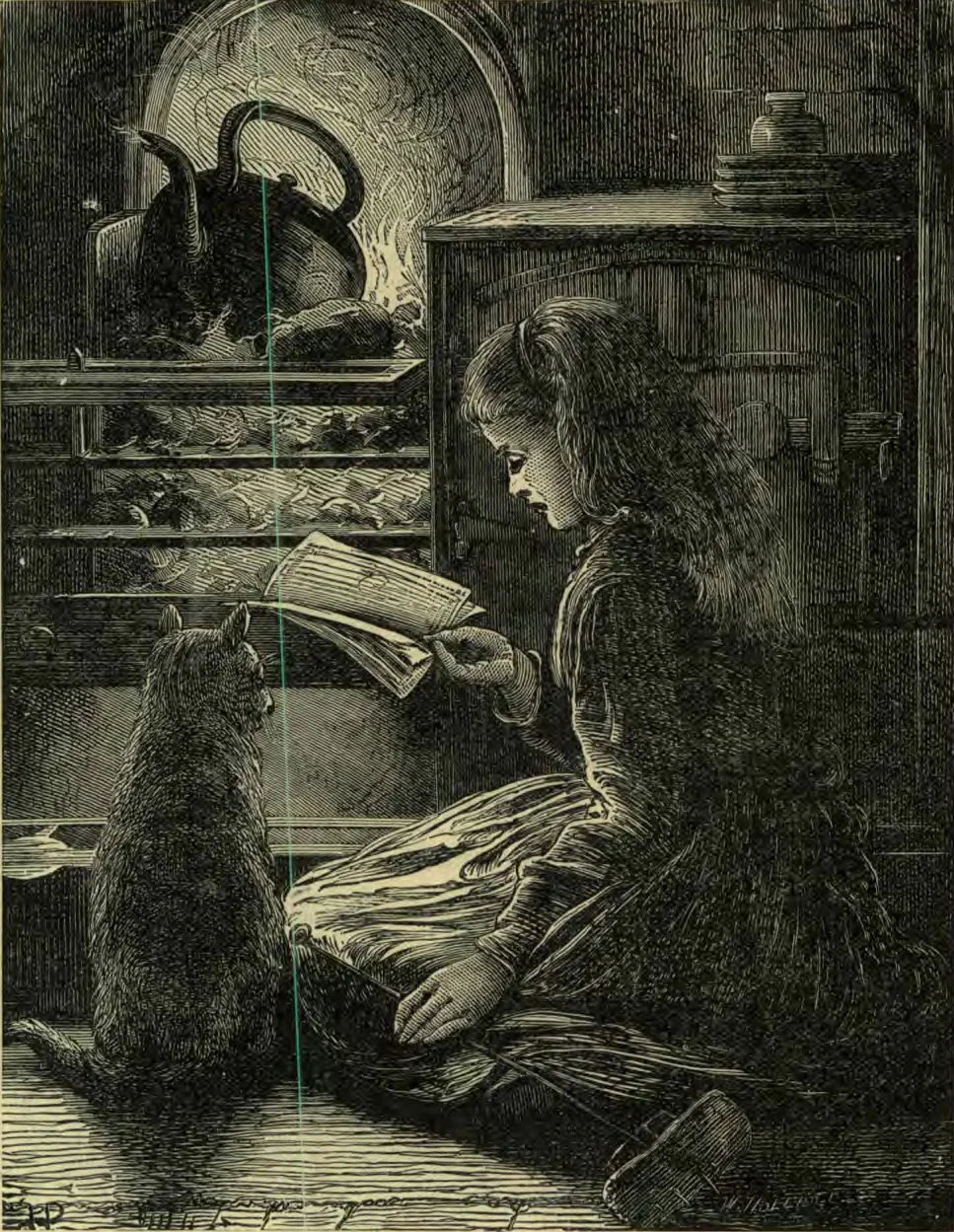
“Come, Nettie,” said a weary voice from the couch in the corner of the room. But the little girl did not stir, for she was intently reading a story book her Uncle Henry had just sent. She had dropped the bread she had come to toast, forgetting all about her invalid mother, who was waiting for her supper. The tea-kettle puffed out great jets of steam, and finally spattered some hot water down on Nettie’s hand. This roused her, and she was surprised to find she had been reading for quite half an hour, and that it had grown dark in the room.
She hastily shut the book and went to prepare the tea. Soon she returned with a tray temptingly spread with the supper. Although a child, nobody knew how to do these little things any better than Nettie. “I wonder,” said her mamma, “when you will learn to do things the minute you are told.”
“I’m ever so sorry,” said Nettie, with flushed cheeks. “I’ll try to remember next time.” And I do not doubt but that she really meant to; for she was a kind-hearted little girl, willing, and quick to learn. But she had that one bad habit of putting off things that ought to be done at once, and sometimes it caused her serious trouble.
Not long after this, Nettie’s Uncle Henry came from his city home to make them a visit. He was a very particular old gentleman in the matter of promptness. Nettie was fond of him, and tried to please him in everything. Hardly once during his two weeks’ stay did she forget to do things when she was told.
“Well, Nettie,” said Uncle Henry one morning, “how would you like to go back to the city with me for a day or two?”
“O Uncle Henry,” cried Nettie, clapping her hands with delight, “do you really mean it? May I go with you?”
“Run and ask mamma,” he replied. “We’ll abide by what she says.”
Nettie turned to the couch where her mother lay. “She’s been a good little girl for such a long while that I guess I can let her go for two days,” said mamma, with a smile.
“The train starts to-morrow morning at ten o’clock,” said Uncle Henry, “and I expect you to be ready on time.”
Be ready on time! Nettie was very sure she would not forget that part of it. Hadn’t she wanted for such a long while to go on this very visit? She went right off to lay out what she meant to wear. What a nice talk she and Uncle Henry had that evening, telling of the things they would see.
Nettie was up bright and early next morning. She could hardly eat her breakfast, she was so excited over the journey she was to take. How slowly the hours dragged along! She wondered what she could do to make the time pass more quickly. By and by she saw her book up on the shelf. She had not quite finished it; there were four more chapters to read. So she seated herself in the great easy chair by the grate, and began.
Nine o’clock came and passed, and half past nine. Twenty minutes of ten—still Nettie read on, unmindful that she had her hair yet to comb. It seemed as if the clock was in an unusual hurry just now, so fast the pointers slipped around—ten minutes of ten—five minutes—then the clock struck ten, and the little cock on top of it crew shrilly. Nettie nestled in her chair; just one page more, and she would have the story finished. At last she closed the covers of the book, and glanced at the clock. Ten! why, she thought it only struck nine.
She sprang from her chair, and rushed out into the room where her mother was, just in time to see Uncle Henry shut the door and go striding off down the street.
“O mamma!” cried Nettie, as she saw that she was too late; and burying her face in her mother’s lap, she sobbed out her bitter disappointment.
Her mamma let her cry for awhile, and then she raised the tear-stained face to hers, and kissed her tenderly. “I am very sorry for you, Nettie,” she said, “and I hope this will be all the lesson you will need to cure you of this sad fault.”
Bad habits are hard to break, and it required great watchfulness on Nettie’s part to be prompt; but though she sometimes fell back into her old ways, the lesson she learned from this disappointment proved on the whole a most effectual one, and she is growing up to be a reliable woman.
W. E. L.
Letter Budget.
HIRAM JAY WATERS writes a letter from Newaygo Co., Mich. He says: “I am seven years old. I cannot write very good, so I have ma write for me. I am much interested in the Budget. I got ma to read the letters to me, but now I can read some of them myself. I get my Sabbath-school lessons every week in Book No. 3. I have never been to day school, but ma teaches me at home. I am reading the second reader through the second time, and when I get through it this time, I am going to have a ‘Sunshine at Home.’ I have lots of fun on the ice with my sled. My brother older has skates, so he skates and draws me on my sled. But I cannot ride any more in that way now, for the snow has come down very deep, so that the large stumps in the field are all covered over. They look like great white mounds. The snow was so deep this morning that the horses could not take us to Sabbath-school; we have six miles to go. We have a nice span of ponies ma bought to take us to meeting and Sabbath-school. I feed the chickens and gather the eggs. We give one-tenth of them to the Lord. We live on a new farm, and I chop down little trees with my little ax, and draw up wood in my wagon in the summer. I like to live here better than I did in the village. My pa is a surgeon, and when we lived in the village he was gone from home most all the time; but now he stays at home and works on the farm. Last Fourth of July our house in the village took fire and burned to the ground. There were two families living in it, and only a few things were saved. It was set on fire by some boys shooting fire-crackers in the hall up stairs. I have two married brothers living close by. One has a little girl, five years old, named Ella, and the other has one three years old, named Ethel. We enjoy playing together; but now Ella has gone with her mother to Hillsdale county to visit her grandma. I will not tell you any more now, for my letter is long; but sometime I will write again. Much love to all the INSTRUCTOR family.”
You have very much to make you happy and thankful, Hiram. And all these blessings come from God, you know, and some day he may want to know how you used all the good things he gave you, whether you made others happy in return. We shall all like to hear from you again.
CARRIE HATHAWAY writes from Van Buren Co., Mich. She says: “I live in a little village which has no saloons. We have a church of about forty members, and a Sabbath-school of fifty members. Mamma is superintendent of the school now. Mamma and I belong to the church, and we hope others will join soon. Eld. Canright was here in November, and stirred us up a little. I have no brothers or sisters. Papa is not a Sabbath-keeper. Pray for us all.”
A village without a saloon ought to be a desirable place to live in, and a good place to do missionary work. Is it not owing to this circumstance that you have so large a church and Sabbath-school?
Here we have another letter from Virginia. JOHNNIE S. ROBINSON writes from Wood Co., West Virginia. He says: “I am a little boy thirteen years old. My little half-sister and I go to school together. She is seven years old, and her name is Birdie. It has only been about four months since we heard the truth preached in this place, and now we have a Sabbath-school which numbers seventy seven scholars; and we are learning the word of God very fast. I have signed the covenant, and so has my step-mother. My father has not signed it yet, but I think he will, for he thinks we have the true light; and grandma and all of my people think the coming of our dear Saviour is near at hand. I want to be a good boy, so I can live with the INSTRUCTOR family in the new earth. This is my first letter, and I would like to see it printed.”
Johnnie’s letter brings to mind what we read in Acts about the rapid spread of the truth in Paul’s time, when “so mightily grew the word of God and prevailed.” We hope your school all love the truth as well as those persons did at that time, who, for the truth, gave up all that kept them from obeying it.
THINKING OURSELVES OVER.
“PLEASE tell me, mother, what self-examination is,” said a child. “Our superintendent said something about it, and he told us to spend a little time every Sabbath practicing it—practicing what, mother?”
“Self-examination is thinking ourselves over,” answered the mother. “You know how apt we are to forget ourselves, what we did and thought yesterday, and the day before, and the day before that. Now it is by calling to mind our past conduct that we can truly see it as it is, and improve upon it.”
Self-forgetfulness is a virtue in the common meaning of the word; but it is not safe for one always to forget one’s self. A bad man never likes to “think himself over.” It is only those who aim at self-improvement who are willing to review the past, and to profit by its lessons. If we would become truly good, wise, and successful, we must “think ourselves over.” Our past mistakes must be corrected, and our lost opportunities redeemed.—Selected.
A Recipe Worth More Than Gold
HERE is a recipe worth more than gold and diamonds. You will find it by reading what the child says just below.
“Everything has gone so smooth to-day,” said a little girl; “all my lessons in school were perfect, I helped clear away the dinner things, I have learned my Bible verses, and I have most done my knitting; and it is because I feel willing-hearted to-day.”
DRIVE THE NAIL ARIGHT.
DRIVE the nail aright, boys,
Hit it on the head;
Strike with all your might, boys,
While the iron is red.
When you've work to do, boys,
Do it with a will;
They who reach the top, boys,
First must climb the hill.
Standing at the foot, boys,
Gazing at the sky,
How can you get up, boys,
If you never try?
Though you stumble oft, boys,
Never be downcast;
Try and try again, boys,—
You'll succeed at last.
Drive the nail aright, boys,
Hit it on the head;
Strike with all your might, boys,
While the iron is red.