WHEN Donald Hunter awoke on Saturday morning, the first thing he thought of was that this day was the Sabbath. He had been fully convinced the night before, after hearing the sermon of Brother Harris about the Christian Sabbath, that this was the right day to keep, and he wondered what he ought to do on the Sabbath.
After breakfast some of his young schoolmates on their way to the baseball lot hailed him, and urged him to come with them, as they were to play a regular game that day and wanted him to pitch. Standing on the back porch he told them quietly that he could not play on that day, as he now believed it was the Sabbath. They went out of the yard silently, but he heard a jeering laugh as they joined the other boys on the street, and knew he was the cause of it.
Most of the day he spent with Brother Harris and the tent master, who told him that on the following Sabbath they would begin to hold a Sabbath school in the tent. Donald was very glad for this and said he would attend it.
The largest crowd of the entire series of meetings was in attendance at the Sunday night meeting in the tent. Elder Harris had promised to speak that night on the change of the Sabbath, and tell when this change had been brought about, by whom, and the authority for it. The preacher said:
“We shall hold a criminal trial here tonight, and I am going to ask this great audience to act as the jury. I shall be the prosecuting attorney and bring the evidence before you. We shall try to convict the criminal who brought about the change in the observance of the Sabbath from the seventh to the first day of the week.
“Now in a trial it is customary to hear first the charge against the prisoner. The charge in this case which we are to try is made by the Lord, and it is this: God charges the Roman Catholic Church with having tampered with his law in changing the Sabbath.
“This charge will be found in Dan. 7:25. You will remember in our study of the prophecy of this chapter we found that the little horn on the fourth beast represented the Roman Catholic Church. Of this little horn, or of that church, the Lord says in this verse, ‘He shall speak great words against the Most High, and shall wear out the saints of the Most High, and think to change times and laws.’
“Another version makes this last expression read, ‘He shall think to change the time in the law.’ This law, of course, refers to the law of God, the ten commandments.
“This prophecy in every part has been fulfilled by the Roman Catholic Church. It has spoken great words against God in its claims to forgive the sins of men. It has worn out the saints of the Most High in the terrible persecutions of Christians during the Dark Ages. But this is not all that it would do. It would actually attempt to lay its impious hands on the very law of God, and tear from its place in the heart of that law the Sabbath commandment, and substitute another day in its place. This is God’s charge.
“This expression, ‘He shall think to change the time in the law,’ can refer to but one thing, for there is but one time mentioned in the law of God. The first, second, third, fifth, sixth, seventh, eighth, ninth, and tenth commandments make no reference at all to time. But the fourth commandment mentions time, it mentions a day, the seventh day, and declares that day to be the Sabbath of the Lord.
“It is the Sabbath commandment, therefore, to which the Lord refers when he predicts of this power that it would ‘think to change the time in the law.’ Here, then, is the definite charge made by the Lord himself that the Roman Catholic Church would attempt to make a change in the Sabbath.
“The very fact that this charge is made by the Lord himself ought to be enough to win a verdict of guilty from every member of this audience who accepts the Bible as the word of God. Some witnesses will not tell the truth, but when the Lord speaks we can always depend on his word, and we know he tells the truth. So when he declares that the Roman Church will attempt to change the Sabbath that ought to be sufficient for every person in this tent tonight.
“But we have additional witnesses to bring before this jury. Permit me to direct your close attention to their testimony.”
The speaker then read a large number of extracts and quotations to the audience from various histories, commentaries, and encyclopedias, showing conclusively that the seventh day, Saturday, is the Sabbath according to the Bible. He said that none of this testimony was from a witness who might be prejudiced in favor of his side of the case, for none of it was from witnesses who observed the seventh day as the Sabbath, but all of it was from those who kept the first day as the Sabbath. In each case he gave the name of the book, the name of its author, and the number of the page from which he read. And all the books he read from were of such a character as to be recognized by the audience as authorities on the subjects of which they treated.
“And now,” the preacher said, “we shall see if we can secure the confession of the guilty party. From now on I shall read nothing from a Protestant source. I have here a number of Catholic publications—books, catechisms, and magazines. I wish this jury to hear what the Catholic Church has to say about the charge which is made in the Bible about the change of the Sabbath. First I read from ‘A New Catechism of Christian Faith and Practice,’ written by Rt. Rev. James Belford, D. D., published in 1909, pp. 86, 87:9
“‘Question.— What is the third (fourth) commandment?
“‘Answer.— Remember that thou keep holy the Sabbath day.
“‘Ques.— What day was the Sabbath?
“‘Ans.— The seventh day, our Saturday.
“‘Ques.— Do you keep the Sabbath?
“‘Ans.— No; we keep the Lord’s day.
“‘Ques.— Which is that?
“‘Ans.— The first day, Sunday.
“‘Ques.— Who changed it?
“‘Ans.— The Catholic Church.’
“My second Catholic witness is Father Walter Drum, S. J., of Woodstock College, Maryland, and I quote from an article by him entitled ‘Recent Bible Study,’ appearing in the Ecclesiastical Review of February, 1914, Vol. 59, No. 2, pp. 230-232:
“‘The observance of Sunday thus comes to be an ecclesiastical law entirely distinct from the divine law of Sabbath observance, the prescriptions of Gen. 2: 2, 3 in regard to the Sabbath having nothing whatever to do with the law of the church about Sunday, the Lord’s day. Catholics should observe the law of the church, not by the Old Testament observances of the Sabbath, nor by the dictates of Protestants or of Jews, but by the prescription of the church herself. The author of the Sunday law is the only one who has a right to interpret that law; and that author is the Catholic Church.’
“‘Again, this writer, on page 236, says: ‘They (the Protestants) deem it their duty to keep the Sunday holy. Why?—Because the Catholic Church tells them to do so. They have no other reason.’”
Brother Harris read many other extracts from Catholic sources, all agreeing with the testimony of the two witnesses which have here been quoted. Then the preacher said:
“‘The case is closed. The testimony is all in. I want now the verdict of this jury. Will all who say that the verdict is guilty please indicate it by holding up the right hand?’ There was a stir all through the big audience, and almost instantly scores of hands were raised. Brother Harris had proved his case, and practically the entire audience was convinced that the Catholic Church had changed the Sabbath.
“‘Now will those whose verdict is ‘Not guilty,’ hold up their hands?’ asked the preacher. Two lone hands were held up in the rear of the big crowd, causing a laugh to run through the audience. But Brother Harris seemed to be expecting something of the kind, for he said:
“‘Well, that hangs the jury, and makes it impossible for us to pronounce sentence, which is just as well, for sentencing this criminal belongs to God and not to us, and it will not be long until God himself will pronounce judgment upon this anti-Christian system.
“‘Now, from what has been said, we can all see that God deliberately charges the Roman Catholic Church with the crime of tampering with the divine law in changing the Sabbath from Saturday to Sunday. The voice of history deliberately testifies to the truth of the charge. The Roman Catholic Church deliberately confesses itself guilty as charged. And thus the Roman Church stands before the world convicted of laying impious hands upon the Sabbath of the fourth commandment, the Sabbath of the Lord, and tearing from its place in the very heart of the law of God, the fourth commandment, and putting in its place a spurious and counterfeit sabbath, which is no sabbath at all, as it rests solely on the traditions of that church and not in any sense on the Word of God.
“‘It is evident, therefore, that the Protestant churches in observing Sunday, have left the true ground and basis of Protestantism, the Bible, and are following the Roman Church in accepting doctrines and practices which are not founded on the Bible. On this point Catholics can truthfully accuse Protestant Sunday keepers of inconsistency.
“‘The duty of every true Protestant is to cast away this unscriptural practice and doctrine of Sunday observance and to follow the Bible, to follow Jesus, to follow the apostles in the observance of the true Sabbath, the seventh day of the week.’”
After the meeting little crowds and groups of people gathered on the street and discussed the sermon. Donald heard many say, “Well, he certainly made out his case. He certainly proved who changed the Sabbath.” Many were silent in thought as they went to their homes. That a deep impression had been made, could be plainly seen. Donald’s father and mother were unusually silent as they returned home.
On entering the house, Mr. Hunter opened the big Bible, turned to Daniel, and lingered long in study after the others had retired. If they could have looked in just before he went upstairs, they would have seen him kneel and pray earnestly for light on this great question, while the tears ran slowly down his face.
Siam and Her King
By Frederic Dean
THE news that Siam had declared war against Germany was taken as a good deal of a joke. This little kingdom in southeastern Asia has a population of less than 10,000,000 in her entire territory.
But, although the Siamese are the most charming Asiatics in the world, more ready to smile than to smite, account must be taken of the man they call “king” and “lord”— for their ruler is the owner of their bodies and their souls.
Vajiravudh is not yet forty. He is the only Eastern monarch with a Western education. One third of his life was spent in England and Europe, and while there he did everything that any other democratic son of a democratic father could or should do. He played football at Rugby, drilled as a common soldier at Sandhurst, took his chances with the daredevils at Heidelberg, and at Oxford wrested the highest honors away from the brainiest Britishers who dared to enter the lists against him.
That he has a will of his own the following example will demonstrate: Siam is a polygamous people. The gentry of the country may have as many wives as they can reasonably support, while the king is entitled to such numbers as his royal will dictates. Vajiravudh’s father, Chulalongkorn, had between seven and eight hundred members in his household.
When Vajiravudh returned from his long sojourn in Europe his father suggested that it was high time for him to settle down, and mentioned the names of suitable ladies with whom he might begin his home. But, to the amazement of his father and the court, the young man swept away all precedent, and declared that he would wed whom he chose—“but one wife, and that one the one whom I shall love and cherish as the one woman in the world.” So far, Vajiravudh has remained a bachelor.
In Siam, the dead are not buried, but cremated. The crematory ceremonies of a monarch are full of pomp and majesty. Custom has decreed that he who is to occupy the chair of the departed ruler must light the funeral pyre of his predecessor.
At the cremation of his father, Vajiravudh was noticeably impressed. When the time came for him10to light the sacred fire, he hung back as if doubting his power of carrying out this royal order. Finally, however, he stepped to the altar, closed the heavy curtains, and remained closeted with the dead. Seconds seemed minutes to the waiting crowd— minutes, hours. But suddenly a tiny flame shot up over the top of the catafalque, the curtains were parted, and there appeared between them a new personality.
In that moment of communion with the dead the boy had become the man—the Western collegian had changed to the Eastern ruler.
This is the man who has sent word to the kaiser that his country is at war with Germany. This is the ruler who followed up his war message with the immediate “taking over” of all German shipping lying in the harbor, and the immediate arrest of all Germans and Austrians living within the radius of the sway of his scepter.
Vajiravudh means business. Siam is at war.— Frederic Dean.
For the Finding-Out Club
By Max Hill
REQUIREMENT: Identify briefly each of the persons named in the following poem.
Answers to Questions in “Instructor” of August 7
A TALE IN NOMENCLATURE
Dear reader, write in as you go
And fill the blanks to rhyme and scan
With names of writers all should know—
All English and American.
Wise Will it was who asked, “Watts in a name?”
And we may answer either grave or Gay:
A Wordsworth much within the hall of fame
For him whose torch Hazlitt some pilgrim’s way.
’Tis as we make it in this Motley world,
As Swift the Sand of time is slipping by;
As autumn leaves by foaming Brooks are whirled,
So we are tossed about—now far, now Nye.
Howe jocund does he drive his team a Field
Who turns with joy the Brown sod to the rain!
But Gray to him is every sky revealed
Upon whose foot a Bunyan gives him Paine.
The Twain are types, as he who runs may Reade,
And pity ’tis that More learn not the truth;
What Hughes and cries, what cross and weary Bede!
What galling loads we Cary from our youth!
Ofttimes hard Knox may undesIrving fall;
The Wylie foe a wicked Foxe may be;
Or train of circumstances may enthrall
And put a fellow under Locke and Key.
And thereby hangs a tale, as poets say,
The story of a wild, unhappy youth;
“Approach and read (for thou canst read) the lay”
That I shall sing, and every word the truth.
’Tis said a cross old lady ’Addison
Who quite refused to eat a bite of Crabbe;
“Chaucer,” she said, “I know it is well done,”
The while she watched with ready hand to grab.
Out from the door he shot, with Howells of fear,
The Sterne old lady too, with shaking fist;
And soon a noisy band had gathered near
With Austintatious offers to assist.
The Smith had left his forge to smolder low;
The Miller quite forgot the waiting grain;
The Cooper, too, let hoops and staves all go;
With web unbleached, the Fuller ran amain.
A canny Scott was there his part to take;
A Taylor with his goose as weapon true;
Their Holmes deserted for their neighbor’s sake,
And each advised the wisest thing to do.
The boy sped on; to North and Southey ran,
Down to the Ford whose Riley stream o’erflowed.
“Hay, come across!”—This to the ferryman,
Who o’er the stream his little boat soon rowed.
And soon the woman and her helpers six—
She had to Ascham all to Ade the search—
Raced to the stream; but he was up to tricks,
And nimbly hid and left them in the lurch.
Said he, “The folks Macaulay cross the stream,
And this old ferryman might join the Hunt;
To Ward them off, to hide would safest seem;
They’ll Marvell much,” he said with chuckling grunt.
Long time they sought, but found no Bridges there—
Like London bridge they were all fallen down;
And so through forests Green they sought with care
To find some hunter’s Lodge, or little town.
Down through the meads where long-eared Burroughs fed—
A Cowperhaps—a bleating Lamb, Mabie;
Each filled with fear as on their footsteps led,
Each hoping soon the runaway to see.
A Cable stretched across they found at length,
From it a little boat by pulley tied;
Though Smollett seemed, and slight her skill and strength,
She hoped ’twould Landor safe on yonder side.
They tried to Warner of the dangerous stream,
But she would go, despite the warning shout;
Far out she swung, then sank with piercing scream;
She hadn’t Tennyson to help her out.
A mighty shout arose; an answering Hale
Came o’er the raging waters’ roar and Noyes;
The boy appeared, too late to help.—The tale
Should be a lesson to all wayward boys.
O wilful youth and scolding age, take heed,
The moral of my story do not spurn,
But Foster all the means that upward lead
If you the way of happiness would learn.
Though hard may be the course of mortals here,
Let every Harte be brave to do and dare;
Be true as Steele, nor ever sink in fear;
Success awaits; yield not to gloomy care.
Be Thoreau in each task that comes to you;
Stowe in your mind the truth each wise man learns:
Be not a Cook that when a meal is due
Stands dreaming till the BrowningBaconBurns.
“Anon” there comes a day amidst the strife
When each must, though he Shakespeare on the Page
Whereon is written every deed of life,
What Everett was, in childhood, youth, or age.
Then humble names may rise to halls of fame,
And be the day or short or weary LongFellow of man, on high shall ring your name
Eternal in the notes of living song.
MAX HILL.
Finding-Out Club Answers and Member Results
Note
THE editor regrets not being able to increase materially the Finding-Out Club membership by the lists of answers sent in on the questions found in the INSTRUCTOR of August 14. Miss Mary H. Moore is the only person who sent in a perfect list. Those who answered every question but one correctly were: Mrs. Grace Hunt, Ruth E. Melendy, and Orie A. Johnson. Mrs. Grace Hoover is the only person who submitted a solution to Mr. Hill’s poetical assignment of August 7. Mr. Hill’s list of literary geniuses referred to in his production are given in the accompanying poem.
Courage, Truth, and Character Brings Its Own Reward
“EVERY bit of courage, every bit of truth and honest effort and patient study, brings its own reward in character. It is worth while, regardless of whatever money reward may follow. It would be worth while for us all to push forward along the right lines; it would be our high duty and splendid privilege even if we knew that all life was to be wiped out tomorrow.”
Scattering Ills and Locking Them in Our Hearts
“THE ills that we scatter on the morning breezes multiply. Those that we lock in our own hearts frequently pass into oblivion.”
The Lure of Civilization
By Charles Alma Byers
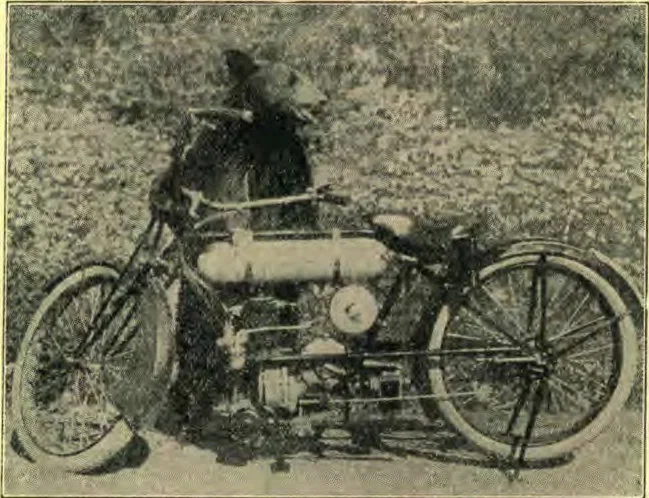
BILLY was born near a large city. His mother was an actress with a motion picture company, and Billy himself was already his mother's understudy. Some day he would be a real player, like his mother, and probably better, for he was a very apt pupil. Although only nine months old, he had learned to ride a tricycle and could get around pretty well on roller skates. There were also several other things that he had been taught to do, so that he might be useful about the studio. He liked to help in these ways, but what he liked most of all was to go automobile riding. Sometimes he was permitted to sit at the steering wheel like a real chauffeur, which seemed to please him very much, for he appeared to be quite vain. But Billy was a bear, and one can't always tell whether bears are proud or not.
“ESPYING THE MOTOR CYCLE, HE WALKED SLOWLY UP TO IT”
Billy had been reared among men and women, and had made many warm friends. These friends petted him a great deal and gave him candy and other sweets to eat. The fact that he weighed nearly two hundred pounds proved that he had a good home and that he had been well treated. Ordinarily, he seemed perfectly contented and happy, yet at times he showed just a little restlessness. Since he was a bear, wise men pronounced this restlessness “the call of the wild,” but if he had been a boy, they would have called it Wanderlust. Anyway, like little boys, sometimes he would wander away from home to see what there was in the outer world. Therefore he had to be carefully watched, although he was rarely kept tied or penned up.
One day, giving his master the slip, he strolled far off into the timber and hills, farther than ever before. He was gone for perhaps an hour before his absence was noticed. Then there was great excitement, for he was nowhere to be seen.
When they missed him at the motion picture studio, everybody was very sorry, and all began to hunt for him. They called him, they searched through the brush and in the hollows, looked into the trees, everywhere for miles around, but could find no trace of him. When night came, they had to return without him. The next day, several persons who were not working started out again. They hunted all that day and again the next, but could not find him anywhere. They began to fear that he was really lost, or that he might have been killed by some hunter.
On the fourth day Billy's master started out alone; and as he wanted to look far up the cañon, where he had not been before, he went on his motor cycle. He rode many miles, but could find no trace of his bear. Finally he became discouraged and was just ready to return home when he happened to remember Billy's fondness for automobile riding. The bear had learned to recognize the sound of the automobile horn as an invitation to take a ride. The master pressed the bulb of his motor cycle horn, and the sound echoed through the forest until it made the trees fairly ring. After a while he tried the horn again; then rode on farther, stopped, and sounded it yet again. He did this probably a dozen times. Finally he heard a rustling sound among the trees. At first he could not tell just where it came from. Then, through an open place in the brush, he caught a glimpse of a black, hairy object in a tree. He instantly recognized the object as Billy. He was looking in all directions, as if trying to locate the sound. Then he began to twist about, and finally to slide slowly down. His master knew the bear had heard the horn, but he sounded it again. Billy now let himself loose, and dropped to the ground on his hind feet.
The master was both delighted and amused. His first inclination was to rush to his four-footed friend and give him a real bear hug, but on second thought he decided to hide himself and see what Billy would do. Accordingly, he pushed the motor cycle back until it was just hidden from where the bear stood at the base of the tree, now looking all about to see where the sound had come from. Again the man sounded the horn, loud and long, and then, leaving the motor cycle standing by the roadside, hid himself in the brush, where he could see and yet be unseen. After a few seconds Billy came ambling into view. He looked first one way and then the other. Espying the motor cycle, he walked slowly up to it, sniffed at the handlebars, and then, with what seemed like a pleased look on his face, he stood up on his hind feet, putting his front feet on the frame as he had been taught to do with his tricycle. At first the master thought the bear was going to ride away, but he did not. Instead, he stood and looked for the owner, suspecting, I imagine, who it was.
In a little while Billy scented something good to eat. It was the man's lunch, which he had delayed eating, but which he had spread out in readiness a few minutes before. The bear trotted over to it and proceeded to help himself. The way he devoured it showed plainly that Billy was indeed hungry. Probably12he had been unable to find anything to eat since he left home, nearly four whole days before. Anyhow, the man did not feel like disturbing him, realizing that the bear was perhaps more hungry than he. To see the way he enjoyed it and licked his chops was both funny and pathetic.
When Billy had fully finished, his master came forth from his hiding place, and there was a joyful reunion. Their greetings over, the man mounted his motor cycle and started slowly toward home, Billy trotting along behind. When they reached the motion picture studio, which was their home, there was great rejoicing. Billy was indeed glad to get back and has never again tried to run away, although he has had many opportunities.—Charles Alma Byers, in St. Nicholas.
When the Deacon Talked in Church
We were not expecting anything unusual that day, but we got it anyway. It was time for the annual foreign missionary sermon to be preached, and the collection taken. That did not excite us any; for we had slept, I may say, through both sermon and collection many a time before. It was not the sermon either; for that did not seem so different from usual, but somehow it just seemed to come home to the deacon. And still we were not so very comfortable, for most of us had not been giving much of a collection—only just enough to look respectable when the plate was passed.
The preacher took for his text that verse about “Go ye,” and he said that everybody had to go. Now I had always thought that there was some special kind of call that comes to one here and another there, and made each one feel that he must be a missionary. But he said that was not in the Bible; that everybody was commanded to go unless he had a call to stay at home. And even if folks had a call to stay at home, they were bound to do their best to find a substitute to go for them, and to help everybody to go that could. Then he just asked us how we should feel if we had no Jesus to go to for forgiveness of our sins, for help in our trials, for strength against temptation, comfort in sorrow, for guidance in perplexity; no Jesus to tell us how to live here, and about the love of God. This was what made life so dark for the heathen, and in our gifts we were to remember the Lord’s command to us, and the heathen’s need for us to go.
Then he prayed a bit, and the choir did not sing any that day, but the organist played a soft voluntary while the collection was being taken. Old Deacon Bright got up to pass the plate on his side. The old deacon was as fine a man as you could meet in a day’s journey, as good a neighbor and as honest a man as ever lived. He had a nice two-hundred-acre farm, and a fine family, all members of the church. He had been getting considerably deaf of late years, and he sat alone in the front pew. I guess he got to kind of dreaming over the sermon, for as he rose to get the collection plate he began to talk to himself, and to do it out loud. But, bless you, he could not hear himself, for you have to shout to make him understand anything.
So, as I said, he took the plate and began to talk. As near as I remember, this is what he said: “So that ‘Go ye’ means me and every one of us, and this is the Lord’s plate, and what we put in is our substitute and shows how much we love him and how much we’d have been worth to him, seeing we don’t go ourselves.” Then he got to the back seat and passed the plate. Now, our back seats are always full of young men; and as they put their money on the plate, the old man went on: “Twenty-five cents from Sam Jones. My boy, you’d have been worth more than that to the Lord. Ten cents from David Brown, five cents from Tom Stone, and nothing from Steve Jackson. Forty cents for four boys, and every one of them could go, too. They’re worth six hundred dollars a year to their fathers and only forty cents to the Lord.”
In the next pew Mr. Allen and his family sat. Mr. Allen put on a dollar for the family, and the old deacon moved away, saying, “The price of one of your dinners down town.”
“Half of that pair of gloves you wear; almost as much as you spent for ice cream last week; a box of candy,” were the deacon’s comments as the coins fell from the hands of the judge and his family.
Then Father John Robb put in a bill rolled up. Mrs. Robb put in another, Johnny Robb a little envelope bulging with pennies, and Maggie helped the baby to put in another little bag; and the old deacon said: “God bless them!”
You may be sure we were all listening by this time, though we did not dare turn around; and there were many who were very glad that the deacon was not taking up the collection in their aisle.
John McClay’s pew came. “Worth a dollar a year to the Lord and two thousand a year to himself,” said the deacon. “Seventy-five dollars for a bicycle and twenty-five cents for the Lord don’t match, Tommy McClay.”
“Ah, Miss Eden, it looks queer for a hand with a fifty-dollar ring to drop five cents in the plate.”
“A new house for yourself and an old quarter for your Lord, Alexander Bovee?”
“You take in washing, and can give five dollars to the Lord! God bless you, Mrs. Dean. What? Minnie has some, too, and wee Robbie?”
“A check from Mr. Hay. It will be a good one, too, for he gives a tenth to the Lord.”
“Two dollars from you, Harry Atkins, is a small gift to the Lord who healed your dear wife.”
“Ah, Miss Kitty Hughes, that fifty cents never cost you a thought; and you, Miss Marion, only a quarter, when both of you could go to a mission land and support yourselves.”
“Five cents from the father and a cent from each of the family. I guess John Hull and family don’t love the heathen brothers very hard.”
“Ah, Mrs. Reed, that means a good deal to you. The Lord keep you until you join the good man that’s gone.”
“Charlie Baker, and you too, Effie—I doubt if the Lord will take any substitute for you.”
“Five cents, Mr. Donald. I doubt if you’d want to put that in the Lord’s hand.”
Then the old man came to his own pew, and his wife put in an envelope. “Ah, Mary, my dear, I am afraid that we have been robbing the Lord all these years. I doubt we’d have put Jack on the plate, wife. Jim, my boy, you’d be worth far more than that to the Lord.”
So it went from pew to pew till the old man came to the front again, and there he stood a moment, the plate in his left hand, and after fumbling in his vest pocket awhile he said: “No, that isn’t enough, Lord. You ought to get more than that; you’ve been very good to me.” So he put the plate down, and taking out an old leathern wallet; counted out some bills on the plate, and said, “I’m sorry, Lord, I didn’t know13you wanted me to go, and Jim will keep mother and me on the farm, now we’re getting old; but I won’t keep back Jack any longer; and Mary’s been wanting to go too, only I wouldn’t let her. Take them both, Lord.”
Then while the old man sat down and buried his face in his hands, Deacon Wise jumped up and said: “Dear pastor, we haven’t done our duty. Let’s take up the collection again next Sabbath.” And a chorus of “Amens” came from all over the church.
But the pastor got up, with tears in his eyes, and said: “My friends, I have not done all I could, either. I want to give more, and I will give my boy, too.”
Then we sang the closing hymn—
“Love so amazing, so divine,
Demands my soul, my life, my all,”
but it sounded different from what it ever had before.
I think the old deacon was very sorry when he found that his daydreaming had been done aloud. And one or two felt pretty hard at first, but they knew it was true. So that was what started our missionary church, and we have kept on ever since. There have been fourteen members of our young people’s society to go as missionaries in the last five years—six of our best young men, and eight of our brightest girls. Jack Bright? He married the organist, and they are on the border of Tibet, where his medical skill is winning a way for Christ. Mary Bright married the minister’s son, and they went to Africa. Two of my own boys are in the work, one in India and the other in China, and another getting ready to go. My name?—John Donald. Yes, I was the one who gave only five cents that day. What the old man said about putting it in the Lord’s hand struck me. But I hope to give the Lord a boy or a girl for every one of those five cents. — Adapted.
The Christian’s Joys
By M. E.
(Texts for November 11-17)
ONE of nature’s masterpieces hangs before me as I close my eyes to think of Psalm 92:4. The beautiful grass, still green and fresh, the flowers with their spicy perfumes, the trees in their gorgeous autumn colors, are all about us and we almost forget how these blessings help to awaken the song of joy in our hearts. Yet these wonderful works of God really do contribute a great deal to our happiness, and if we only learn to extract joy from one of them, we shall find unexpected pleasure in all.
But back to the masterpiece: It was last Memorial Day that I saw one of nature’s masterpieces in the mountains of Colorado. We were up in the Cripple Creek district, when we caught sight of Pike’s Peak. A few times I had been disappointed in old Pike as seen from certain places in the vicinity of Colorado Springs. But never again can disappointment spoil the grandeur of that old peak for me. After this when old Pike comes to view, I shall always see, towering sublimely into a sky of deepest blue, a huge dome of crystal white dazzling with a million jewels in the bright afternoon sunshine. And I shall see crouching at its base the dull, colorless foothills that once deceived my wondering eyes.
It seems almost unjust to refer to the picture, for these words fall so distressingly short of even outlining it crudely. How often I close my eyes and stand again on that enchanted spot to gaze at a picture too grand for words. Sometimes a tear drops when it reminds me of how very many beautiful things God has put in this world to make us happy, and—and how little some of us appreciate these priceless gifts.
To learn to see God’s handiwork in nature about us, will sweeten our joys and make life worth living. It will make nature a connecting link between our minds and God. It will open up before us avenues without number for leading others to think of him in whose “presence is fulness of joy.”
Yes, we all need to get close to God in order to know life’s deepest joys. You may think you have tasted them, but you have not unless you have been in “his presence.” With him is the fountain of true joy. If you and I will get so close to him that sin cannot veil his loving smile from us, we shall always have joy enough to keep our hearts serene no matter how many trials may surround us. And we shall find the joy he supplies so sweet that we, too, would rather be in the dark den of hardships alone with him, than in the sunshine of the world without him, for in the midst of trouble, he “girdeth” our hearts “with gladness.”
And there is joy not only in being with God, but in doing his will at all times. I think this is because if obedient to his will we shall do just what we will wish we had done when we reach the end of the way. The selfish life seeks to have its own way; but the unselfish life seeks to do his will. Somehow selfishness seems blind to the fact that while it sows unkind deeds with one hand it must reap grief, regret, and disappointment with the other. The unselfish life is the truly happy one; it is ever gathering from the lives of others the joy it has planted in their hearts.14
But the crowning joy of the Christian in this life comes when he gathers the fruit of close, uninterrupted association with his Master and Friend—and that fruit is leading others to Christ. The lighthouse keeper when asked if he did not get dreadfully lonely, replied: “No, not since I saved my man.” He became too interested in his work to get lonely. So the soul-winners who live close enough to God to have power to win souls find in this work so deep a joy that they will leave home, friends, and the comforts of civilization, and go into the darkest corners of earth, amid dangers and hardships untold, that they may lead others to Christ.
It hardly seems possible that he who has tasted the joy of soul-winning could ever be tempted to turn aside for what the world offers. But some are. Satan has practiced his deception for a good many centuries; and has acquired great skill. There is danger that he shall deceive the very elect. So we need to make it the first business of our lives to live so close to God that he can make us soul-winners. Each morning we need to reënforce our purpose to make this work our first business by laying all our plans at the Master’s feet, and receive from him our program for the day, lest Satan subtly usurp leadership, and rob us of the supreme joy of living—the joy of leading others to Christ.
MEDITATION.—Once I thought there were no joys for the Christian, but now I see God only eliminates those pleasures from the Christian’s program that take unto themselves wings and depart, but leave shadows—long, long shadows—of bitter regrets.
SPECIAL PRAYER.—O Father, I thank thee for the joy thou givest to thy children. Help me to learn to abide in thy presence that somehow in thine own way thou canst use my life for sending samples of thy joy to others.
M. E.
Words
O MANY a shaft at random sent
Finds mark the archer little meant!
And many a word at random spoken
May soothe or wound the heart that's broken!
’Tis a strange mystery, the power of words;
Life is in them, and death;
A word can send the crimson color hurrying to the cheek,
Or turn the current cold and deadly to the heart.
Anger and fear are in them; grief and joy
Are in their sound; yet slight, impalpable,
A word is but a breath of passing air.
— Selected.
Pioneer Missionary Alberta J. Diaz in Cuba
ONE of the pioneer missionary workers in Cuba was Don Alberta J. Diaz. The first fruit of his work was his own four-year-old sister, who listened eagerly to his words when other members of his family scorned him, and his mother refused to speak to him for months. When the mother finally yielded and Diaz led her — his mother — to be baptized, his joy so overcame him that he forgot the customary formula, and looking upward said with infinite tenderness, “Lord Jesus, this is my mother!”—Selected.