The Youth’s Instructor, Vol. 38, No. 15.

OLIVER WENDELL HOLMES

The Youth’s Instructor

Apr 9, 1890

S. D. A. Publishing Association · Battle Creek, Mich. · Apr 9, 1890

OLIVER WENDELL HOLMES.
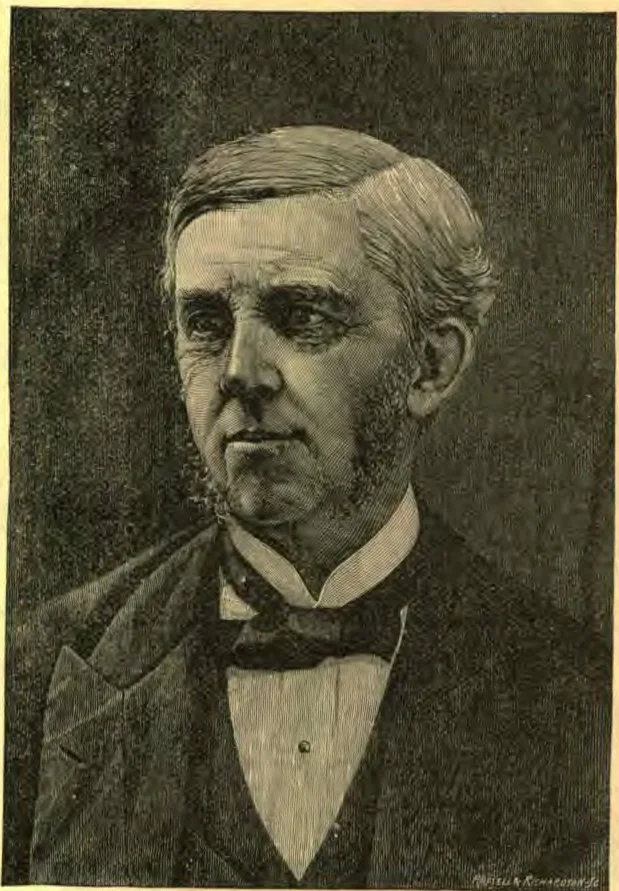
A GOOD many years ago, I cannot say exactly how many, a company of young people were making merry over a new poem by a certain young poet. The poem was called “The September Gale,” and the title certainly has a sober air, although the poem is an exceedingly merry poem.
That young poet was Oliver Wendell Holmes, and since that time he has written many merry poems to make people laugh, as well as some pathetic ones. “The Last Leaf,” which is both merry and sad, was a favorite with our beloved President, Abraham Lincoln.
Dr. Holmes (for he is a physician as well as a poet, essayist, and story-teller) was born in Cambridge, Mass., in an old house with a gambrel roof, which is still standing on the college grounds. Not long since, I walked around it; its lilac hedges were just coming into leaf.
In a little, old almanac, still in existence, this entry is made, dated August 29, 1809: “Son b.;” which means “Son born,” and it was written by his father, and that is the date of the son’s birth.
He is sometimes called our patriotic poet, because he has written so many patriotic poems and songs. The poem that first made him famous is a patriotic poem. Every American schoolboy has, sometime, to “speak” that poem; it is called “The Old Constitution,” and it begins this way:—
“Ay, tear her tattered ensign down! Long has it waved on high, And many an eye has danced to see That banner in the sky; Beneath it rung the battle shout And burst the cannon’s roar,— The meteor of the ocean air Shall sweep the clouds no more.”
The Government had made up its mind to take in pieces the Constitution, but the people said, “No! we cannot have the gallant old frigate torn in pieces,” and Dr. Holmes, then a young man, said so too in his fine verses, which were printed far and wide, and the Government changed its mind.
Dr. Holmes tells us that he wrote this poem in the white chamber of the old gambrel-roofed house, Stans pede in uno, which is Latin for “standing on one foot.” The verses are very stirring, and it is not to be wondered at that the boys like to “speak” them. It is a poem that everybody likes.
To this old gambrel-roofed house was attached an old-fashioned flower-garden, that is, a garden that had cinnamon roses, and blush roses, and garden lilies, and hollyhocks, and such old-fashioned plants. In course of time these plants disappeared, and the garden became grass-grown. And when the boy Oliver became a man, he remembered the old garden, and thought he should like to have it back again.
So he had the old-fashioned things planted over again. He remembered that when he was a boy, a row of sunflowers grew in this garden, that the yellow-birds visited, and so he had a row of sunflowers planted, to see if the yellow-birds would come back again. And, lo! when the sunflowers had grown and blossomed, there were the yellow-birds! And they flew as merrily and gracefully about the great rayed flowers as did the yellow-birds of his young days.
In 1847 Dr. Holmes was appointed Professor of Anatomy in the Medical School of Harvard University, where he remained until a few years ago.
He has written many books of interest to grown people, besides many poems which children will like, although not written especially for them. The history of a “One Hoss Shay” is as “diverting” as was “John Gilpin;” the “One Hoss Shay,”—
“That was made in such a wonderful way That it ran a hundred years to a day.”
Dr. Holmes lives in Boston, on Beacon Street, in a pleasant house which looks out upon Charles River.—Frances A. Humphrey.

DEAD TO SELF.

A YOUNG monk came one day to his father superior, and asked, “Father, what is it to be dead to self?” The father replied: “I cannot explain it now, but I have a duty for you to perform. Brother Martin died last week, and is buried in the church-yard of our order. Go to his grave, and, standing close beside it, repeat, in a loud, clear voice, all the good things you ever heard about him. After this, say all the flattering things you can invent, and attribute to him every saintly grace and virtue, without regard to truth, and report the result to me.”
The young monk went away to do his bidding, wondering what all this could mean. Soon he returned, and the father asked him what had transpired.
“Why, nothing,” replied the young man. “I did as you told me, and that was all.”
“Did Brother Martin make no reply?” asked the superior.
“Of course he did not; for he was dead,” said the monk.
The elder shook his head thoughtfully, saying, “That is very strange. Go again to-morrow at the same hour, and repeat at the grave-side all the evil you ever heard concerning Brother Martin. Add to that the worst slander and calumny your mind can imagine, and report the result to me.”
Again the young man obeyed, and brought back the same report. He had heaped unlimited abuse on the head of Brother Martin and yet had received no reply.
“From Brother Martin you may learn,” said the father, “what it is to be dead to self. Neither flattery nor abuse has moved him, for he is dead. So the disciple who is dead to self will be insensible to these things. Neither voice nor hand will ever be lifted in self-defense or retaliation; but all personal feeling will be lost in the service of Christ.”
The lesson of Brother Martin should be learned by every young Christian. “Dead to self” is the true Christian ideal. We are often exhorted to consecrate our time, our talents, our money to the service of Christ. We must add one thing more, if the work is to be complete; we must consecrate our feelings to Christ.—Rev. G. H. Hubbard.

A BOY IN THE WELL!

A BOY in the well! This was the cry which sounded through the streets on a bright summer’s evening.
The sun had gone down in purple and gold, the busy workmen rested after their day’s labor. Some asked “whose boy it was,” others, “whether the lid had not been laid over the well opening,” or “whether it had been taken off.”
But a young man sprang quickly forward, threw off his coat, and asked help of the bystanders in these words: “Never a word about the cause of the mishap, but let us see how we can save the child. That is the question.”
“That’s it,” was the answer of a dozen voices, while the well winch was set going, and many pale faces peeped over the edge of the well. One after another called out to the child; some asked if he was frightened; but to all the advice and questions no answer was heard, not a sound came forth.
“The weather has been dry, and there is little or no water in the well,” said one.
“Oh, dear,” said the boy’s mother, “it was only yesterday that I grumbled because there was so little water.”
“Let us have a lantern,” said the first man, and a lantern was lighted and brought there. But at the same moment the boy’s father was seen pushing his way through the crowd. A way was made for him. He had been at work at a neighboring farm, and returning at dusk to his home, was surprised to find the room empty, the street deserted, and all the people gathered round the well.
When he heard what had taken place, and saw his wife wringing her hands, he turned very pale. But recovering himself as much as possible, he said,—
“Stand back! Leave the child to me!” Then he carefully examined the winch and rope, and tied to the latter a couple of sacks rolled up hard. Having done this, he let it down till he felt it touch the bottom of the well.
“Now be still,” he said, looking around. And lying down with his face to the well opening, he called out softly and distinctly: “John, take hold of the rope.”
This time a faint pull was felt on the rope.
“Pull up, men,” said the man. “Steady, mates, steady.”
And leaning over the well, he said down into the dark,—
“Hold fast, my child.”
All the time the winch was wound, but the well was deep, and it seemed a very long while.
At last there sounded forth a cheer. “He is saved,” said the crowd.
“Thank you, men,” cried the father, as he lifted the boy in his arms, and carried him down the street.
The child was saved. The father’s voice had reached him. He had learned to obey, and when the well-known voice had told him to take hold of the rope, the child understood, and did it. The command was a plain one, and brought salvation to the child.
Our heavenly Father has sent his only begotten Son down to this dark world. He has given a way of salvation. “Believe on the Lord Jesus Christ, and thou shalt be saved.” This is his command. If you obey, you are saved. Will you do as the little boy in the well? Will you take hold of the rope “to-day”?—Rays of Light.

THE SECRET OF A HAPPY DAY.

JUST to leave in His dear hand Little things: All we cannot understand,— All that stings.
Just to let Him take the care Sorely pressing; Finding all we let Him bear Changed to blessing.
This is all! and yet the way Marked by Him who loves thee best: Secret of a happy day— Secret of a promised rest. —Francis R. Havergal.

THE PHONOGRAPH.

CHIEF among the many wonderful inventions of the last few years stands the phonograph. Perhaps some of the readers of the INSTRUCTOR wish to know what it is like. Although rather complicated, consisting of three hundred and thirty-six parts, it is in principle so very simple that the thought suggests itself, Why did not some one invent it before? Mr. Edison, it is said, caught the idea by accident. A telegraphic needle, while in operation, entered his finger. It was a very small occurrence, but one which led to mighty results. The inventor felt the vibration of the needle in the wound, and the thought occurred to him that if he could feel such vibrations in his finger, why could he not produce them on wax or some soft substance. The result was the phonograph; it was not a very perfect instrument at first, but Mr. Edison has improved on it several times, until his last patent is wonderful indeed.
One of the most important parts of the phonograph is a small round drum about two inches in diameter. Inside this drum is a very delicate and sensitive diaphragm made of silk or gold beater's skin, and in the latest improvement, I believe, of glass. To this diaphragm is attached a fine needle. The point, or other end, of this needle touches a small horizontal wax cylinder, about two inches in diameter and six inches long. When in operation, this cylinder is made to revolve by an electric motor, and at the same time to pass slowly from right to left; thus the needle will in time pass over the whole surface of the cylinder, so that if it touched all the time, it would leave a spiral scratch round and round it, like a fine screw. These are the main parts of the phonograph.
In order to make the phonograph work, we place a funnel, like a large speaking-tube, into the drum, with its mouth outward to collect the sound. Then we address it in a becoming manner. The sound-wave enters the funnel, goes into the drum, passes over the diaphragm, and causes it to vibrate; the needle of course vibrates also. As a consequence, the needle pricks little holes in the wax cylinder, just as the vibrations of the diaphragm make it, and just as the telegraphic needle vibrated in Edison's finger. You can talk into the machine till the cylinder is covered with little dots, round and round, from one end to the other. Then the cylinder can be removed, and a new one put in its place if desired.
We have now “taken a record.” The “record” is on the cylinder. This cylinder can be sent anywhere, or kept for years, and used many times over. It will always produce that which is pricked on it. All kinds of records can be taken,—a speech, a cornet solo, a bugle call, a piano entertainment.
A number of sounds can also be put on the same record; thus a full band can be recorded, and every instrument and sound produced, with all the harmonies. A cornet duet is a very pretty record. One person may sneeze, another talk, another cough, and another squeak, all together, and the phonograph makes a faithful record of all, and produces it altogether. Perhaps this is one of the difficulties in its way. It is too faithful. For example, suppose a speech was to be taken down; the phonograph would not only reproduce the talk, but every other sound it heard,—the buzzing of some insect near, coughing, rustling of a dress, moving the feet,—all this would come out mixed up with the speech.
To make the phonograph talk, we place our “record” (the cylinder with the needle dots made on it while we were talking), and set the motor going. The cylinder revolves, the needle enters again into the little holes, making the diaphragm vibrate just as it did before. The vibration of the diaphragm causes the air in the drum to vibrate as it did when it came in, and thus forms the same sound-wave, which rolls up the funnel, and out comes the same sound exactly that went in, sometimes, as in the case of the cornet solo, so loud that it can be plainly heard over a large hall. Thus in talking, the phonograph just reverses, and throws your words back at you. If it has done nothing else, it certainly demonstrates the truth of the sound-wave theory.
Wonderful as this invention is, Mr. Edison is working on another, which appears as incredible to us as the idea of a speaking-machine would have been to people fifty years ago. It is a far-sight machine, by which things can be seen that are happening miles and miles away, I should not like to say how far.
FRANK HOPE.

“PLAYING FOR KEEPS.”

It was marble season, and the Rocky Fork boys seemed to be possessed with a mania for playing for keeps. Miss Dane, the teacher, was troubled about the matter, and after considerable study over the best methods to stop the dangerous practice, wrote out a pledge, and asked the boys to sign it. It read:—
“We, the undersigned, do hereby promise not to play marbles for keeps, or in any other way encourage gambling in our games.”
“Think the matter over carefully, boys, and then use your own judgment about entering into such a contract,” said Miss Dane, after reading the pledge.
“Those who wish to sign may remain a few minutes after school closes.”
A shade of disappointment was visible on the teacher’s face as several of her largest and most influential scholars filed out. When the room was again quiet, she looked at the little fellows who remained, and with a smile asked them to step up and write their names.
“Are you sure you can keep it, Robbie?” she asked, as a bright little chap, who had an enviable reputation as a marble-player, took up the pen.
“Of course I can,” he answered proudly, as he wrote with a fine flourish, “Robert P. Raymond.” Miss Dane looked wistfully after him as he turned away with an air of offended dignity. She understood his weak point, and wondered if he would be able to deny himself the pleasure he had deliberately signed away.
Dan Howard was waiting outside to satisfy himself how many little cowards there were, but he was sly enough to say nothing to them just then.
“Some of them may hold out fair enough,” he said to Jim Reynolds, after the pledge-boys were out of hearing; “but Rob Raymond will break his promise before he is a day older. Do you think he would let me keep these handsome marbles I won from him this morning?” displaying a handful of coveted beauties. “They were a present from his uncle, and he cannot get them back unless he wins them fairly as I did.”
The next day, while an exciting game was in progress, Dan edged up to Robbie, and in a half whisper asked:—
“Don’t you want a chance to win back those ‘flints’ and ‘potteries’ I took the other day?”
“No, I do not,” answered Bobby. “I’ve signed, and unless you will sell them to me, you will get a chance to keep them, I suppose.”
“All right, that’s just what I wanted. I wouldn’t sell them for any amount of money, but seeing that your uncle had given them to you, I thought it fair to allow you a chance to win them back,” said Dan, pushing his hands farther into the depths of his capacious pockets.
“I wish I had won them back before I signed the pledge. What if Uncle John should ask me about them? He said he would play a game with me sometime,” soliloquized Bobby.
“Better take a hand,” urged Dan, observing Bobby’s woeful look. “Father laughed when I told him about your queer notion. He does not think there is any harm in playing for keeps.”
“But the promise, you know,” said Bobby, beginning to weaken.
“It is better to break a bad promise than to keep it,” insisted Dan. “But mind you, I’m not anxious to have you win back the beauties. They are by all odds the finest potteries I ever laid my eyes upon. I am only giving you a chance because they belonged to you. I did not venture one of them while playing with the other fellows.”
He did not explain, however, that he had made a wager to break his promise, and poor, weak, unsuspecting Bobby, took his seat without an effort to shut the tempter out of his heart.
As soon as the bell rang for recess, he went to Miss Dane, and told her he would like to have his name taken off the pledge.
“Why, Bobby, so soon! and you were so sure of keeping it,” said the teacher, in astonishment.
“I thought I wanted to sign, but I have changed my mind. You see Dan Reynolds won all the marbles Uncle John brought me from New York, and I can easily win them back if my name is taken off the pledge,” insisted Bobby.
“But, my child, taking your name off will not release you from your promise,” answered Miss Dane, gravely.
“I am going to play, and do wish you would take my name off. I do not think there is anything wrong in playing for keeps. All the fellows play that way, and I put my name down before I thought much about the matter.”
Miss Dane took from her desk the little book in which the names were written, and placing it before Bobby, said:—
“If your name must be erased, do it yourself.”
Bobby took a pen, and dipping it in the ink, drew a heavy black line across the name.
“You see you cannot take the promise away. The ugly black mark breaks it, but it cannot rub it out. It will always remain a broken pledge.”
Bobby did not answer, he did not even look at the teacher; instead, he hurried out of the door, and when he came in, flushed and excited after recess, those city marbles were all back in his pocket, and Dan was jubilant over his wager.
That night Uncle John played an interesting game with him, and when they were through, he playfully counted the marbles and expressed surprise that half the flints had not been lost in playing for keeps.
“Robbie does not gamble, Brother John,” Mrs. Raymond said proudly.
Just at that moment Bobby would have sold himself for a song. He had been guilty of several crimes, not only of gambling and pledge-breaking, but of acting a lie as well. He thought of all this after he went to bed, and could not sleep until he had made a clean breast of the whole matter to his mother. Of course she forgave him, and so did the teacher the next day when he repeated the story of his failure and repentance.
“I cannot ask you to put my name on the pledge again. The broken promise is still there to testify against me, but I mean to try to keep my word all the same,” said Bobby earnestly, after he had explained how he had changed his mind again.
A few days later Miss Dane rewrote the pledge, and all the boys signed it over again. Then Bobby’s heart was made glad; for the old one was committed to the flames, and the broken promise was blotted out forever.—Selected.

THE MASTER'S TOUCH.

In the still air the music lies unheard; In the rough marble, beauty lies unseen; To make the music and the beauty needs The master's touch, the sculptor's chisel keen.
Great Master, touch us with thy skillful hand, Let not the music that is in us die; Great Sculptor, hew and polish us, nor let, Hidden and lost, thy form within us die.
Spare not the stroke! Do with us as thou wilt: Let there be naught unfinished, broken, marred: Complete thy purpose, that we may become Thy perfect: thou, our God and Lord.
—Selected.

The Cheerful Home and Its Quiet Power

NEXT to godliness there is nothing like cheerfulness for the making of a happy home. Clouds of fretfulness and fault-finding are easily dissipated by the member of the household who enters the breakfast-room with a smiling face, a cheery “Good morning,” and words of wholesome mirth. Dreaded tasks look less difficult, and burdens of care press less heavily in the presence of such people. They radiate hope as naturally as the sun sends forth his rays. To grumblers and despondent ones who complain that there is no bright side to their lot, they have the ready reply, “Then polish up the dark one.” In the atmosphere of cheerful homes are found boys and girls like Clive Newcome, of whom Thackeray says, “I don’t know that Clive was especially brilliant, but he was pleasant.” Suppose this should be said of every member of every family in which this paper is read, during every hour of every day of the present year, what an amount of warmth and sunshine would be diffused throughout our land!—Selected.

THE ROBIN.

THERE'S a Red-breast in the tree-top, And why does he sing so loud? Why, he sees the crest, in the darkening west. Of a rising thunder cloud, He has left his weaving and building, And flown with glad, light wing, As if to say, “Ah, rain to-day! Now is my time to sing!”
Whether he likes the lightning, Or likes the wind to blow, The gusty dash and the drenching splash, I'm sure I do not know. But always before a shower, He seeks some topmost limb, And clear and long pours forth the song I call his rainbow-hymn.
Perhaps he knows how a sprinkle Will bring on the apple boughs A rosy screen and a budding green To cover his own small house.
So, “Hide it! hide it! hide it!” He calls to the rain and the tree, “Of all things best I love that nest For robins that are to be!”
—Clara Doty Bates.

BIRDS OF PREY.

There are a great many kinds of birds. They differ not only in the color of their feathers and in their size but also in their habits of living, just as a white man differs from an Indian in the way he lives.
We call those people who spend their time studying the habits of birds and animals naturalists. In order to study and talk more easily about the animals and birds, naturalists have divided them into groups, or classes, putting those that are most alike on account of their habits and form into one group, and others into another, and so on. There are the perching or singing birds, like the bluebirds, and robins, and swallows; the climbers, like the parrots, wrens, and woodpeckers; the swimmers, like the ducks and swans; and many more.
The birds of prey take the same place among birds that lions and tigers do among wild animals. They are fierce and strong. Instead of living on seeds and insects, they devour small animals and birds. Some of them eat animals that have been dead a long time. The eagles and buzzards and hawks, the vultures, and the owls belong to the birds of prey.
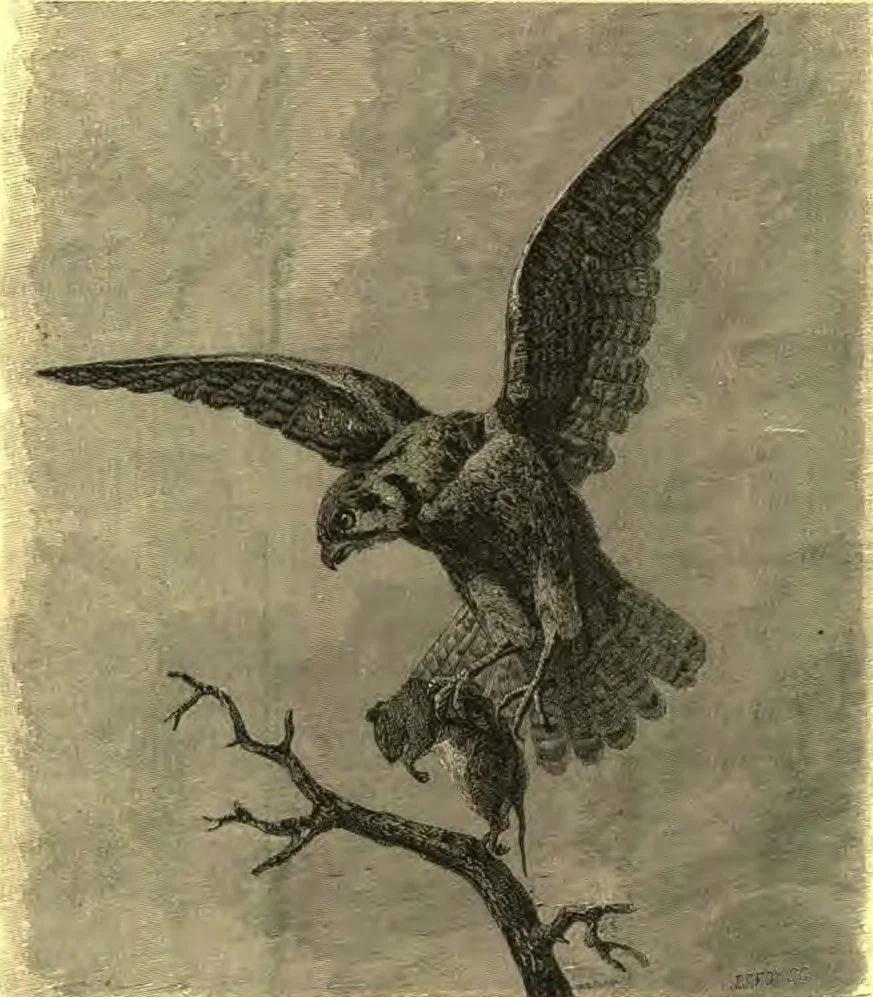
Our picture shows a hawk carrying off a poor little field-mouse for his breakfast. The sparrow-hawk is the one we oftenest see. Perhaps you have seen these birds sitting erect on some fence-stake, or broken tree, or the corner of the barn, watching for a mole, or a mouse, or a grass-hopper.
The blue-jay does not love the sparrow-hawk, and follows him, mocking his cries. The sparrow-hawk often pays the teasing blue-jay back by falling on him and eating him.
The goshawk is the largest of the hawks. Its body is about two feet long. Its flight is very rapid. It catches squirrels and rabbits with ease. It flies along the margins of fields, through the woods, or along the edges of rivers, and swoops down upon its prey. It is almost always on the wing, except when it stops to devour its food.
The goshawk builds its nest in the trees. It is one of the handsomest of the birds of prey. Its head is black, its back bluish slate color, and the rest of the feathers pure white, with bars of slate color upon them.
A long time ago, hawks were trained by English sportsmen to go with them in hunting wild-fowl. The hawks were often fond of their owners, and showed great affection for them.
W. E. L.

WHAT LIZZIE THOUGHT.

“Oh, dear,” said Lizzie, twisting a piece of string around her small fingers. Jennie was busy with a story-book, and did not look up.
“Oh, dear! I wish I could make a cat’s-cradle!” said little Lizzie, again. “I wish somebody would help me.”
Jennie did want to finish that story, but in a minute she said, pleasantly, “Well, bring the string here, then.” It seemed a little thing to do.
No one but the dear heavenly Father saw the effort it cost, unless it was little Lizzie. That evening, when mamma asked who remembered the morning verse, Lizzie said, softly, “‘Even Christ pleased not himself.’ But, mamma, I don’t believe I’d have remembered it if Jennie had not made me think of it when she gave up her story to play cat’s-cradle with me.”
Was not that a good thought to give a little sister?
—Our Little Ones.

UNCLE PHIL'S STORY.

“TELL us a story, Uncle Phil,” said Rob and Archie, running to him.
“What about?” asked Uncle Phil, as Rob climbed on his right knee, and Archie on his left.
“Oh, about something that happened to you,” said Rob.
“Something when you were a little boy,” said Archie.
“Once, when I was a little boy,” began Uncle Phil, “I asked my mother to let Roy and myself go and play by the river.”
“Was Roy your brother?” asked Rob.
“No, but he was very fond of playing with me. My mother said, Yes; so we went and had a good deal of sport.
“After a while I took a shingle for a boat, and sailed it along the bank. At last it began to get into deep water, where I couldn't reach it with a stick. Then I told Roy to go and bring it to me.”
“He almost always did what I told him to, but this time he did not. I began scolding him, and he ran towards home.”
“Then I was angry. I picked up a stone and threw it at him as hard as I could.”
“O Uncle Phil!” cried Archie.
“Just then Roy turned, and it struck him right over his eye.”
“O Uncle Phil!” said Rob.
“Yes, it made him stagger. He gave a little cry, and lay down on the ground.”
“But I was still angry with him. I did not go to him, but waded into the water for my boat.”
“But it was deeper than I thought. Before I knew it, I was in a strong current. I screamed as it carried me down stream, but no men were near to help me.”
“But as I went down under the deep waters, something took hold of me, and dragged me towards shore. And when I was safe on the bank, I saw it was Roy. He had saved my life.”
“Good fellow! Was he your cousin?” asked Rob.
“No,” replied Uncle Phil.
“What did you say to him?” asked Archie.
“I put my arms around the poor fellow's neck, and cried, and asked him to forgive me.”
“What did he say?” asked Rob.
“He said, Bow, wow, wow!”
“Why, who was Roy, any way?” asked Rob, in great astonishment.
“He was my dog,” said Uncle Phil, “the best dog I ever saw. I have never been unkind to a dog or any other animal since, and I hope you never will be.”—Our Little Ones.
Continue reading: EVA'S FAULT