Your ShelfYour Projects

Signs of the Times, Vol. 33, No. 2.

THERE IS NO END TO LOVE
Earlier text: THE GREAT SALVATION

PRAYING AND GIVING.

WE are in no mood to pray as we ought until we have fulfilled the conditions. A little while ago there was a "carnival" where I live for the benefit of a local hospital. One morning was given up to the children, and my own were much interested. When we arose that day my little five-year-old boy began to count his money that he was going to spend at the fair. I said, "Do you not think you had better put some of that in your missionary bank?"
"O no," he said, "I need it all."
"But would you not have a happier day if you shared it with the other children?"
"No, I don't think so."
"Well, let us say our prayers."
He confined his prayers that morning to our immediate family circle—father, mother, sisters, and the little children he played with.
I said, "You are not going to leave out the little children on the other side of the world?"
He replied, "Now, father, I am saying this prayer."
"But don't you think you ought to remember them?"
"I am going to the fair," was the reply.
But the lad's conscience was tender, and by and by he prayed for the other little children—"O God, bless these other children as much as Thou hast blessed me."
When he got up from his knees, he said: "Father, I think I will put some of that money in the missionary bank."
His little conscience was still sufficiently unpolluted to realize that he was in a condition to pray for heathen children only when at least he shared with them the little he had. He could not pray where he would not give.—Selected.

BE HAPPY AS WE CAN.

This life is not all sunshine, Nor is it yet all showers; But storms and calms alternate, As thorns among the flowers. And while we seek the roses The thorns full oft we scan; Still let us, tho they wound us, Be happy as we can.
This life has heavy crosses, As well as joys to share; And griefs and disappointments, Which you and I must bear. And if we may not follow The path our hearts would plan, Let us make all around us As happy as we can. —Anon.

SIN SPOILS PLEASURE.

LORD BYRON, who drank of every cup that earth could give him,—Lord Byron, with a wealth of intellectual and physical nature equal to almost anything,—just before he died, sitting among gay company, was meditative and moody; they said to him:
'Byron, what are you thinking about so seriously?'
'O,' he said, 'I was thinking of the number of happy days I have had in this world.'
'How many?' was asked.
'I can count but eleven, and I was just wondering if I could ever make up the dozen in this world of pangs and tears and sorrows.'
About this time he wrote:
'Thru many a clime 'tis mine to roam, With many a retrospection cursed; And all my solace is to know Whate'er befalls, I've known the worst.
'What is that worst? Nay, do not ask; In pity from the search forbear; Smile on, nor venture to unmask My heart, and view the hell that's there.'
Poor Byron! How different his words would have been had he known Jesus as his Saviour! He said, 'Peace I leave with you. My peace I give unto you. Not as the world giveth give I unto you.'—Religious Telescope.

HER ONE TALENT.

MARGARET E. SANGSTER tells of a woman neither young, nor beautiful, nor robust, nor accomplished, nor educated, who became a bride. She realized that she was extremely unlike her brilliant husband. “I have not even one talent to fold away in a napkin,” she said. But the husband loved her, and she loved him, and would, please God, make him happy.
“There is one comfort—I can keep house,” she said. So she planned the delicate, dainty, healthful meals, and kept the home clean, but not forbiddingly spotless. It invited the tired husband to rest, to litter it with books and papers, if it pleased him to bring work home from the office, while she sat beside him ready to smile or speak as he looked up.
The husband said one day: “There’s one talent you have, darling, beyond any one else in the world—the talent of having time enough for everything.” His home was a suburb of paradise, and he went forth to the competitions of life steadily successful in all his enterprises. And the quiet wife, who had time to love him, to share his hopes, listen to his plans, and make his life supremely happy, was an element in his success which counted more largely than even the husband knew.
It is rare to find in this hurrying world a being who works with an air of repose; who can pause to listen to another’s story; who has a heart touched to so responsive a key that sympathy in a friend’s good fortune is as ready as pity for a friend’s calamity.
This woman, who had the one talent of doing fully and blithely every home obligation, by degrees became a social power. A large class of girls each Sabbath bent eagerly around her while she unfolded the lesson to them, and upon stated occasions she entertains the poor, pale, fagged-out girls of the down-town factories, and keeps them by kindly word and helpful ministry and a Christian example, from places of temptation, for she believes it as much a Christian work to keep young girls pure as to save the poor remnant of their ruined lives after they have fallen.
Telling the life-story of this woman, Mrs. Sangster says: “Altogether, when I think of the sick beds this little woman sits by, the heartaches she soothes, the confidences of which she is the trusted recipient, the happy home-life which is hers, and the good she is doing, silently, I am quite sure her talent is bearing interest for the Master.”—Sunday-School Lesson Illustrator.

The Name of God Written Within

“UNLESS the name of God is written in your forehead,—written there because God is the center of your thoughts,—you will not be meet for the inheritance in light. It is your Creator who has poured out to you all heaven in one wondrous gift—His only-begotten Son. Will you withhold from God His own? Will you divert from the treasury the portion of means which the Lord claims as His? If so, you are robbing God, and every dollar is charged against you in the books of heaven.”

MEAT KILLS MORE PEOPLE THAN ALCOHOL.

Sir James Barr, senior physician of the Liverpool Royal Infirmary, goes behind the Metchnikoff bacillus in his search for the cause of old age. The bacillus may have all the evil effects claimed by Metchnikoff, but it would have no chance if the victim did not provide a basis by habitual excess in nitrogenous foods. It is the meat habit which lies at the root of the arterial degenerations that bring about old age. Uric acid is constantly present in excess, and at last the cells of the arterial walls—which have to be almost as continually alert and active as those of the heart—can not keep up the fight any longer. Dr. Barr thinks that excessive nitrogenous eating kills more people than alcohol. “After witnessing one of the great temperance advocates of the last century dine, I stated that he would not live three years, and he was dead within two.”
The arterial degeneration in question makes the arteries rigid instead of elastic. Apart from the fact that they are then liable to rupture, causing apoplexy (deaths from apoplexy were sixty-six in 1900 as compared with forty-nine in 1890) the arteries can not respond to the brain’s incessantly changing demands. The mind therefore becomes rigid at about fifty or sixty years of age. These facts may perhaps do more to induce us to reform than even the recently unveiled Chicago slaughter-house horrors. But probably they will only make the majority take even more of the thousand “uric acid solvents” with which the drugstores are crammed. Instead, why not eat less meat and drink more water. For men or women confined to office or home and taking little exercise the eating of meat three times a day is nothing short of a crime.

OUR DIVORCE LAWS.

A Good Illustration.

THE Census Taker.—Your name, mum?
"I don’t know."
"Beg pardon, mum?"
"I’ve been divorced. At present, my name is Mrs. Jones in this state. In several states it is Miss Smith, my maiden name, and in three states it is Mrs. Brown, my first husband’s name."
"This your residence, mum?"
"I eat and sleep here, but I have a trunk in a neighboring state, where I am getting a divorce from my present husband."
"Then you’re married at present?"
"I’m married in Texas, New York, and Massachusetts; divorced in South Dakota, Missouri, Alaska, Oklahoma, and California; a bigamist in three other states, and a single woman in eight others."—Chicago Tribune.

Age Is a Matter of Feeling

AGE . . . is a matter of feeling, not of years.—George William Curtis.

Twins.

THE silent Sorrow grows with Sin, Its quiet and unnoticed twin; And who with Sin would wish to sup, Must drain the dregs of Sorrows’ cup. —Luella Dowd Smith.

Bank of Mountain View

If you haven't already done so, why don't you drop us a postal asking us to send you a copy of our monthly paper, “The Bank of Mountain View Journal.” It is very interesting. It is full of good ideas, and it is free to you for the asking. If you live in the East, send for a copy and see how we do it in California. We still hold ourselves ready to furnish you with information about Mountain View. Write us.
Address

Bank of Mountain View

Mountain View, Santa Clara County, California

Individual Communion Cups

More convenient, sanitary; add impressiveness to ceremony. We introduced individual service, make the best and supply over 4,000 satisfied congregations. They never go back to the old way. List of users on request. Send for free catalogue. Return outfit (our expense) if not satisfied after trial Sanitary Communion Outfit Co. 64th St. Rochester, N.Y.

GRAND TRUNK-LEHIGH VALLEY ROUTE

to New York and Philadelphia—Double track—Splendid scenery—Solid trains—Convenient terminals—Excellent diners. For full particulars write Geo. W. Vaux, A. G. P. & T. A., Grand Trunk Railway System, 135 Adams Street, Chicago.

Overland Limited

Chicago 68 Hours

Electric Lighted Equipment
World’s Events Telegraphed, Train Daily
Unexcelled Dining Service
Observation---Parlor---Cafe Cars
Drawing-room---Stateroom Sleepers
Through without Change
Across Great Salt Lake and High Sierra by Daylight
Fastest Time---Most Direct Route
VIA

Southern Pacific

Wanted: Young Woman for Nursing Course

WANTED.—Young woman between 20 and 30 years of age, of good Christian character, to take the nurse's course. Exceptional opportunity for the right party. For information, address, Santa Barbara Sanitarium, 118 W. Fegueroa St., Santa Barbara, Cal.

Dependence on Others

A STATE of continual dependence on the generosity of others is a life of gradual debasement.—Goldsmith.

ORGANIZATION OF THE WEST CARIBBEAN CONFERENCE

YOU will be pleased to know that the work in Central America has developed to the extent that its organization into a conference was advisable. At a general meeting held in Bocas del Toro, Panama, September 7 to 17, what has heretofore been known as the Panama Mission Field was organized into a conference, taking the name West Caribbean Conference.
It begins with about two hundred and fifty members, six churches, and some unorganized companies. Elder I. G. Knight was chosen president and treasurer. Elder Hubert Fletcher, a native of Jamaica, was made vice-president, and was invited to begin labor in Colon or on the Canal Zone at once.
The new conference started in a most encouraging way, and everybody seemed full of zeal and courage. Financially, the masses are better off in this territory than anywhere else in Central America or the West Indies. The one great need is more workers. We need two good, competent Americans, who are willing to put aside all superfluous provincial practises, and settle down to become identified with the people in this part of the world—men who can preach a good, practical sermon, and also have ability for managing money matters; who have lost all longing for the "flesh pots of Egypt," and can sit down to their table and thank God for their food, even tho there is not a hint of American canned goods or the slightest sign of any Yankee preparation. Two good American missionaries placed in the West Caribbean Conference will soon develop the field to a self-supporting basis.
The general meetings at Bocas del Toro were splendid spiritual gatherings. The town people turned out in large numbers, and gave earnest attention. Over a dozen publicly accepted the truth the last night I was there.
Some Caribbean Fruits.
I arrived in Port Limon Friday morning, September 14. On account of small-pox in Bocas del Toro, I was detained in quarantine for five days. Upon reaching Limon I found that yellow fever had appeared in the town.
And what was worse, a supposed case developed in the very house where I took lodgings. But the health department grasped the situation immediately. They cleansed and fumigated the building, and have pronounced the place perfectly safe.
Perhaps, I should not have said anything about small-pox and yellow fever when making an appeal for workers. But my idea of a missionary is not one who is seeking only a salubrious situation or a pleasant place. There are no such places, if we do our duty. Disease lurks everywhere, and people die in all countries. I believe Central America and the West Indies are just about as safe as anywhere else. What are a few cases of small-pox or supposed yellow fever, when compared with the great epidemics of diphtheria and pneumonia that sweep the American cities every year?
A Pair of Caribbean People.
Then, again, if precaution can prevent the disasters, we are pretty safe, because every little republic and colony down this way has a full corps of competent native and American physicians, who sit up nights studying the situation, and issue sanitary instructions at regular and irregular intervals, and have under them an army of subordinates, who are kept busy sweeping streets, whitewashing walls, chasing mosquitos, and daubing kerosene oil into every hole and crevice where the little winged bearers of malaria or bacteria can possibly wriggle. One’s health is well protected in this part of the world. Not longer ago than yesterday morning I was awakened by a band of sanitaria guardia de orden publico (sanitary officers), who inquired, "Como está usted? Duerme usted bien?" (How are you? Did you sleep well?) I answered, "Bastante bien" (Pretty well). Then without further ado, a whole rapid-fire volley of Spanish questions was put to me, that so completely submerged my limited Spanish vocabulary that I could neither understand nor answer a word. I learned afterward that they were asking me such questions as: "Does your back ache? Is your throat sore? Do you feel any pains? Have you an appetite?" etc. Studying hard to think of some plan by which I might convince them that I was in perfect health, suddenly an idea came to me. I jumped out of bed upon the floor, expanded my chest, contracted the muscles of my arms, made a few hard hits at an imaginary foe with my fists, projected my tongue for inspection, jumped up and down a couple or more times, and made an attempt to turn a hand-spring. The unique spectacle of seeing a supposedly dignified Protestant preacher dressed only in pajamas, and cutting such a lot of comical capers, caused those officers of the public health to laugh long and loudly, and turn and leave me, remarking, "Señor esta muy bien" (The gentleman is very well).
A Native Home in Central America.
No one who is in a state of ordinary good health, and is willing to follow the laws of healthful living, and then trust God for results, need be afraid to come to Central America or the West Indies to work in the message. This field is ripe for aggressive work. The organization of the conference has had a good effect upon our brethren, and has created confidence in our own ranks that is pleasing and promising. Unbelievers have also concluded that we mean business, and they are looking upon us as a permanent fixture in their midst, and as a people engaged in a great and growing work.
You may look for great things from the West Caribbean Conference, because it occupies a great territory, and its members are men and women of faith. They are asking great things of God, and are attempting great things for God.
I expect to return to Jamaica next Monday. A letter received yesterday from Mrs. Strickland informs me that our oldest boy is having fever. She says the work there is onward. J. A. STRICKLAND.

A STEAMBOAT DIALOGUE IN BURMA.

Buddhist.—"Why can't a man be a Christian and a Buddhist at the same time?"
Native Preacher: "If I stood on two steamboats headed in opposite directions, and they should start up, where would I be?"
Buddhist.—"If God made man, why did He not make all alike?"
Native Preacher.—"If He had done so, how would your wife know you from me?"
Buddhist.—"I hate to change my customs."
Native Preacher.—"Then why do you not get off this steamboat, and travel as you used to do years ago?"—Selected.

UNION IN CHRIST.

The world is endeavoring to federate together. So also are many of the churches, not on the basis of the truth of the Bible, but on certain things held in common for which they wish to wield an influence that will tell on the politics of the world, and yet, the only true unifying power in the world is the Gospel of Christ. Take, for instance, the following words from the report of a missionary in Europe:
"While in the Levant we saw the Greek slaughtering the Bulgarian, the Roumanian banishing the Greek, and the Hungarian fighting the Austrian; yet wherever the genuine Gospel peace takes hold of these men we find that it unifies their various interests. They can come up together and joyfully unite in our great annual meetings where as many as one thousand people are assembled representing more than twenty-five of these nationalities, made one in heart and purpose by that one Spirit.
"We may see the Irish against the English, we may see the Scotch and Welsh pursuing their own interest, but when this blessed Gospel takes hold of them, lo, in a day they are one."
What a blessed thing it would be if nominal Christianity were seeking for that power which would thus unify its divided principles.
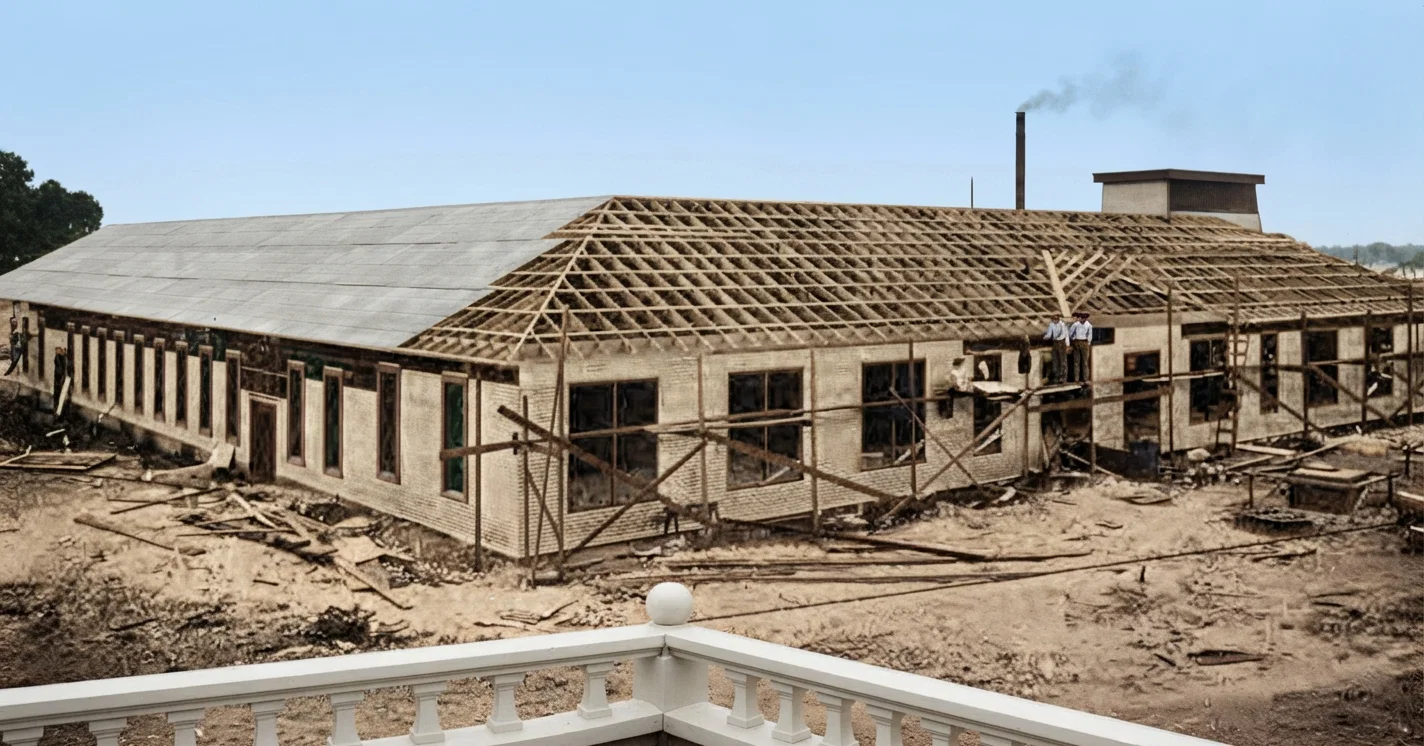
Pacific Press Building, Looking Northeast, December 7.

OUR WORK AND WORKERS.

A CHURCH of six members has been organized at Coalgate, I. T., by Brother and Sister T. J. Hickman.
BROTHER F. W. SPIES baptized thirty-one during a recent trip among the country people in North Brazil.
BROTHER A. S. BRINGLE writes that five have accepted the truth at Cedar, Kan., thru attending tent-meetings.
FIVE intelligent people have been added to the company at Melrose, Ohio, as a result of the labors of Brethren W. E. Bidwell and James Shultz.
BROTHER G. P. GAEDE, of Cleveland, Ohio, writes that a Sabbath-school of about thirty members has been organized among the Germans of that city.
A FAMILY of five took their stand for the truth recently in Williamsdale East, Nova Scotia, after a series of meetings conducted by Brother F. E. Gibson.
A SABBATH-SCHOOL of seventeen members and a company of nine Sabbath-keepers are reported from near Oak, California, as the result of the labors of Brother Wm. F. Nogle.
CALIFORNIA is making a systematic effort to place religious liberty matter into the hands of every citizen. The Special California Sunday Law Issue of the SIGNS and a number of tracts are being used.
THE UNION CONFERENCE RECORD (Sydney) reports that in the island of Fiji whole villages are accepting present truth thru the labors of the native workers. Among the converts are some from Catholicism.
BROTHER G. E. NORWOOD writes of an interesting case of a man who learned of the truth thru papers secured from a reading-rack in the depot in an Arkansas city. This is a wide field and any one, even the children, can see that the racks are kept supplied.
BROTHER H. W. COTTRELL, president of the Pacific Union Conference, has just returned from the East where he attended the General Conference Publishers' Convention and other important meetings, and on his way back spent several weeks laboring in Arizona and southern California.
ENGLISH-SPEAKING people can do a good work for their foreign neighbors by supplying them with reading-matter in their own tongue. A young German man in Los Angeles has been converted thru reading the German paper, the Hausfreund, given him by a SIGNS worker. The International Publishing Association, College View, Neb., publish papers, books, and tracts in the German, Danish, and Swedish languages. Write them for sample copies. Your tract society can tell you of papers and literature in other languages as well. You can be a foreign missionary at home by laboring for your foreign neighbors.

HE IS NIGH.

LIFT up the voice like a trumpet to sing, Sing of the Saviour, heav'n's glorious King; He shall return o'er all nations to reign— Jesus is coming, is coming again.
Signs in the moon, in the stars, in the sun, Bid us prepare for the soon-coming One; Men's hearts are failing with dread and with fear; By this we know that the great day is near.
Old Earth is heaving with anguish and throes, But who the day of the Lord's advent knows? None but the Father who dwelleth on high— Yet may we know that the Saviour is nigh.
Sing and rejoice! for He stands "at the door;" God will fulfil what He promised of yore; Naught He hath spoken can e'er pass away; This generation shall hail the glad day! THORO HARRIS.

A CHINAMAN ON CHINA OF TO-DAY.

SAID KANG YU WAU recently, the president of the Chinese Reform Association: "China is no longer in the dark ages. She has already reached the point where Japan was only twenty years ago, after years and years of endeavor. This is not because the Japanese were slow in learning, but rather because they were but pioneers. They cooked, we ate.
"We have now, for example, more than 20,000 Chinese students pursuing advanced modern courses of study. As to common schools, some 5,000 have been started in the one province of Canton. There are now 4,000,000 Chinese who can speak English. Our courts are being remodeled after the English system. The number of books we have translated into Chinese—text books, technical works, and treatises mostly—indicates how extensively the progressive movement is spreading. We have thus appropriated to our use over 10,000 American, English, and European works. The Boxer troubles are over forever."—Missionary Review of the World.

PUBLICATIONS WANTED.

ANY of our papers and tracts for missionary work. Address, J. W. Hicks, Station E, R. R. 3, Louisville, Ky.
WANTED: Sets of the SIGNS OF THE TIMES from Feb. 5, 1902 to May 7, 1902, containing articles by Prof. J. A. L. Derby on "A Lay Discursus on the Soul." Any having these papers should write before sending, to Prof. J. A. L. Derby, Takoma Park Station, Washington, D. C.

NOTICE OF THE ANNUAL MEETING OF STOCKHOLDERS OF THE PACIFIC PRESS PUBLISHING COMPANY.

NOTICE is hereby given to all whom it may concern that the annual meeting of the stockholders of the Pacific Press Publishing Company, a corporation organized and existing under, and by virtue of, the laws of the State of California, will be held at the office of the company on Villa Street, in the town of Mountain View, County of Santa Clara, State of California, on Monday, the 28th day of January, A.D. 1907, at 9:30 o'clock, A.M.
The election of the directors for the ensuing year, the advisability of amending, repealing, or adopting new by-laws, and such other business as may be necessary or proper to be transacted will come before the meeting.
No objection being offered, for good and sufficient reasons, the meeting will probably be adjourned until January 30, 1907, at 10 A.M.
By order of the directors. H. W. COTTRELL, President, H. G. CHILDS, Secretary.

ANNUAL MEETING OF THE CALIFORNIA CONFERENCE ASSOCIATION.

THE eleventh annual meeting of the California Conference Association of Seventh-day Adventists will be held in connection with the thirty-sixth annual session of the California Conference of Seventh-day Adventists, at San Jose, Cal., January 25 to 29, 1907, for the purpose of electing a board of seven directors, and transacting any other business that may properly come before the meeting.
W. T. KNOX, President, T. A. KILGORE, Secretary.

ANNUAL MEETING OF THE CALIFORNIA-NEVADA CONFERENCE.

THE thirty-sixth annual meeting of the California-Nevada Conference of Seventh-day Adventists will convene at San Jose, Cal., January 25, 7:30 P.M., at their church near the corner of Colfax and Delmas Ave., continuing until January 29, 1907.
Each church should at once elect their delegates at the ratio of one delegate for the church and an additional one for every twenty members.
A full delegation at this session is earnestly desired.
W. T. KNOX, President, E. A. CHAPMAN, Secretary.

ANNUAL MEETING OF THE PACIFIC PRESS PUBLISHING ASSOCIATION.

THE third annual meeting of the members of the Pacific Press Publishing Association will be held at the office of the Pacific Press Publishing Company in Mountain View, Cal., Monday, Jan. 21, 1907, at 11 o'clock A.M.
This meeting is called for the purpose of electing a board of seven (7) directors, and transacting such other business as may properly and legally come before the meeting.
No objection being offered, the meeting will adjourn, for good and sufficient reasons, until January 30, 1907, at 11 A.M.
M. C. WILCOX, President. E. A. CHAPMAN, Secretary.

VALPARAISO, CHILE.

[The following did not reach us till after we had published several articles on the Chilean earthquake several weeks ago. But as it contains facts not before given, we publish it, even tho it may seem to be stale. Be assured the awful calamity which visited the prosperous city of Valparaiso is not stale to those there dwelling.—ED. S. OF T.]
THE damage done to this city by the recent earthquake, August 16, may be summed up in a few words; the city as far as habitations are concerned is almost completely ruined. The whole central part of Chile suffered, many smaller cities were also shaken down. The loss of life, I think, was not less than six thousand, while the loss of property will reach about 500,000,000 Chilean dollars. Thus far the insurance companies have refused to pay any part of the loss caused by the fire.
It is safe to say that there is not one house that is not damaged or destroyed. From an outward view many seem not to have suffered, but when the interior can be seen they are nothing but masses of fallen walls. When one views the wreck, he involuntarily wonders how so many escaped with their lives. It was a repetition of the San Francisco disaster, only, if possible, the shock was much more severe here. Comparing the size of the two cities, it appears that the damage by fire was possibly less here than there. When we view the ruins of what once were magnificent houses, and the pride of those who dwelt in them, we realize the inability of man and can but exclaim, “What hath God wrought?”
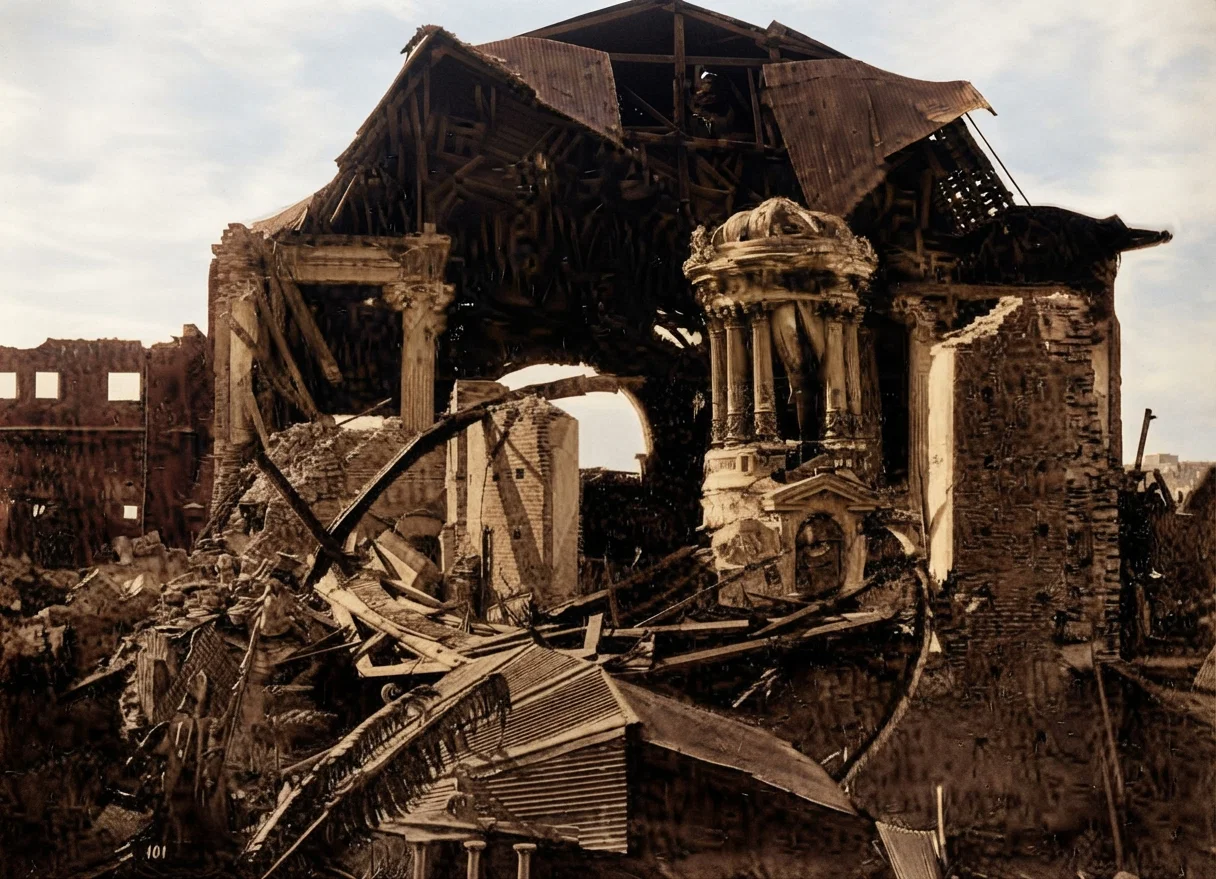
Church of Merced, Valparaiso, after the Earthquake of August 16, 1906.
It was the most terrible scene I have ever witnessed; and can only be realized by those who have passed through a similar experience. About ten minutes before eight in the evening it began. Had it come in the middle of the night the loss of life would have been appalling. We had no idea that it would be such an awful thing. Ever since our arrival in Chile there has been at intervals what are called temblors; thus we had become accustomed to them. There were three distinct, heavy shocks. At the beginning of the shaking we went to the “patio,” a small garden about twelve feet square at the back of our house. On one side was a tall building and we could not be sure but that it might fall on us. Yet, I can truly say, we felt no fear, for we knew in whom we trusted. A lamp, which was standing on the kitchen table, ignited the first thing, by a part of the wall falling on it. At the end of perhaps one-half minute came a few seconds of calm, during which time we tried to extinguish the fire, falling in this,
Mr. Steele threw the lamp in the “patio” where it could burn without damage to the house. Again we waited in the “patio” for the second shock to exhaust itself, then came a few seconds more of quiet, during which we managed to reach the street. The entrance to our house was through a long, narrow passage which was very perilous.
Scarcely had we reached the street when the third shock began. The buildings that were yet standing could be seen jerking back and forth as a dog might shake a rat; it seemed as if the earth was moving in every direction at the same time. In some parts the ground opened. In the street pandemonium reigned, dogs howled, women and children screamed; and all this, added to the crashing of falling walls, made it a night of horror long to be remembered. Immediately after the first quake, fires broke out in more than forty places, making the city appear almost like an inferno. For several days it raged until they had burned themselves out, as no means were at hand to quench them. For days the crashing of walls thrown down by dynamite could be heard.
For three days and nights we camped in the street with only the sky over us. On Sabbath I walked to the other end of the city, as we were anxious to know how our friends had fared. The city, in many parts, could not be recognized, some of the streets had been swept by the flames, and nothing remained but charred walls or heaps of debris. Others were so filled with ruins, as to be absolutely impassable. All the theaters, nearly all the churches, the jails, and all other public buildings were completely destroyed. In the Church of the “Merced” it is said that eight hundred people were killed; many are still buried under the tons of brick which fell from the towers as the people were trying to escape.
In the parks as many people as could possibly crowd in had gathered; here could also be seen the dead among the living, as there had not yet been time to bury them. On one street we saw eight bodies lying in a row on the sidewalk, some were sewn up in cloth and thrown into carts or tied on the backs of horses and taken to the cemetery, while many more were only thrown into carts and buried as quickly as possible. Two weeks after the earthquake, bodies were still lying in the street, and the work of recovering bodies from the ruins continued for a month.
All the cemeteries were greatly damaged, large tombstones and huge monuments were thrown down or moved from their base, while many graves were opened and vaults destroyed. Costly mausoleums containing the remains of wealthy persons were destroyed, and the bodies thrown in a ditch together with the poor who were killed in the catastrophe. It is impossible to give by pen an adequate description of what has happened to Valparaiso. Instead of being the beautiful city, the paradise of South America, it is a city of zinc shanties of every imaginable shape and size. The average shanty is about ten feet square, and some are less. But the people have the knack of being contented with their lot, no matter how unpromising their surroundings.
Our house burned the morning after the earthquake, tho we managed to save the greater part of our household goods. All the property of the Mission was destroyed. Now while the majority of the population are vainly looking for houses in which to live, we, without any effort on our part, had a house offered us in which we are living as comfortably as the circumstances will permit. To God be all the praise and glory, as He is worthy. MILLIE E. STEELE.
Continue reading: WARNING WORDS