In our last report to the Review we mentioned the fact that our work in Hayti was making its way into an exclusively Catholic community. Since then there have been no backward steps. Brother Isaac, our native worker, has located in this place, the town of Limbé, and has succeeded in developing a very good interest indeed. At his earnest request I left home on May 18 to make him a few days' visit. As the journey required only about four hours in the saddle, the trip was no great undertaking.
Limbé contains about five thousand inhabitants. It was never our privilege to look upon more fertile soil than we saw in the surrounding country. All about were large cultivations of plantain, fields of waving rice, and corn as fine as any we have seen in the United States, a fact that can not always be stated of tropical corn fields. But notwithstanding the many bounties a beneficent Heavenly Father has bestowed upon this section of the island, we found the town itself suffering from poverty to a greater extent than any place we have yet visited. This is to be charged to the dread monster, war.
In the revolution of four years ago Limbé figured as one of the principal battle-grounds. On account of the scarcity of money, much of the havoc of that day is unrepaired, and is everywhere in evidence in the shape of demolished and burned buildings, and bullet-pierced galvanized iron roofing. My interpreter, Brother Solon Blot, was with the government forces at the time, and was able to point out to me the exact place where he was riding, when a rifle-ball through the body put him out of action. This was the first time he had visited the place since then, and he felt to rejoice greatly that he had been spared to hear the third angel's message, and to again visit Limbé, this time as a soldier of Jesus Christ, and to assist in a better warfare.
The past year or two there has been some desire on the part of certain ones in Limbé to leave the Catholic Church. Whether or not the motives that prompted this desire were all of the best we can not say. At any rate there had been some correspondence on the question with the American Episcopal church in the island, and they had promised to send a minister "to hold mass in the language of the people, and to make arrangements for establishing a church." This minister was to have been there in May, but did not put in his appearance, although I learn he has gone over to-day (June 1). The Wesleyan pastor from the Cape has also been over, but it rained all the while he was there, and he had to come away without holding any meetings. In February Brother Isaac, in returning from a visit to his home, stopped and preached two or three sermons at Limbé. As a result some of the people became so much interested that they made him promise to return as soon as possible. He was able to fulfil his promise the first of May, and his meetings have always been well attended, even in rainy weather. When we arrived, we found him holding his meetings in the best available place he could find,—two medium-sized rooms in a private house. We never saw better attention, and we could not help noting how quickly the average listener grasped the salient points of the message. Eight have already given in their names for baptism, and others claim to be keeping the Sabbath. For the most part they are young men, and all are or have been Catholics.
A HAYTIAN LAUNDRY
Since I left, the interest has continued to grow. Brother Isaac reports that he has had to hold his meetings in the open air so that more could get within hearing. At one of these meetings he had a remarkable experience with the priests. He was speaking on the subject of the second commandment, image worship. Before he had finished, the priests, who had been listening, came forward and endeavored to break up the meeting by interrupting him. Confusion reigned for a little time, and in the midst of it one of the priests tried to cap the climax by starting the cry, "Vive Saint Pierre, notre saint patron!" (the equivalent of “St. Peter forever!”) To their consternation, however, the crowd did not follow their lead, but instead began to give as a counter-shout, "Vive les Adventists! vive les Adventists!" At this the priests became furious, and one had to be restrained from laying hands on our worker. Hearing the uproar, the commandant de la place came on the scene, demanding the cause of the confusion, whereupon a man of influence in the crowd came forward and told him that the priests were in the wrong, as they had disturbed the meeting. The official then turned to the priests with the rebuke, “What right have you to disturb these people? Does any one ever disturb your public processions?” Thus for the moment the emissaries of Rome were silenced, and the message can still be freely proclaimed to the people of Limbé.
This, however, puts us face to face with Rome. The situation is not one of our own making. We have simply stepped into the openings God's providence has made for us. What the future has in store for us we do not know. We are confident, however, that the truth will ultimately triumph, and that there are precious souls in Limbé that the Master wants to shine in his kingdom.
The indications all point to the fact that just now is the time to work for Hayti. A desire for something better than the wine of Babylon seems to be taking possession of many. It has not always been thus. Twenty-five years ago Baptists found it necessary to hold baptismal services by night in order to escape rough handling by the mob, and other Protestants had much to make their pathway difficult. We believe that in order to prepare the way for the final message the Spirit of the Lord has developed a situation favorable to the progress of our work. Many, especially of the younger generation, seem anxious to leave Rome. Among the official class the impression is gaining ground that their concordat with the papacy is a failure, and many are predicting that this government will soon be following the recent example of France in the matter of disestablishment of the church. If we had twelve workers, it is safe to say that all would find themselves abundantly occupied for some time to come. The clearness of our message and its complete consistency appeal to those Romanists who are looking for something better; and therefore when we hang up our charts and go through those prophecies that explain Rome's past, present, and future, we are always assured of a congregation of intelligent listeners; and although the conclusions to be drawn from these prophecies are anything but complimentary to Romanism, yet present conditions make it safe to preach the message in very much the same way that we do in Protestant countries. This, to be sure, is not as we expected to find it when we came. However, we are glad that it is so, and are encouraged to see that the simple third angel's message manifests the same power in Catholic Hayti that it does in other countries.
The most perplexing problem that we have to solve now is the matter of providing houses of worship for those who13accept the message. The company at Grande Rivière is very much in need of a chapel, and at Limbé this need is one that presses us sorely. Haytian currency has depreciated in value the past few years until now it approximates on exchange six Haytian dollars for one American. This fact makes it very difficult for our people here to do much in the matter of raising money. We are encouraging them to do their best to provide material, means, and labor; but with all this it is evident that before we can finish a church building, we must have some outside help. However, the leading hand of the Lord has already been so manifest in the work in Hayti that we feel sure that the Lord has a way out of this difficulty for us. Our confidence in the Lord and his message was never better than at the present time.
Later: Since writing the above, I have received a short visit from Brother Isaac. He reports that public sentiment at Limbé in favor of the truth is becoming stronger all the time. He was called before the authorities last week and shown a letter from the Chamber of Deputies at Port au Prince asking for the particulars of the Protestant work at Limbé. He was requested to write out an answer to this letter from our standpoint, which he did. Later he was told by the chief military officer of the district and representative of the president of the republic, that he had received special instructions from the government at Port au Prince to give “the fullest protection to those Protestants at Limbé.” Thus it will be seen that our work is attracting attention in the capital of the republic.
Brother Isaac also informs me that the archbishop went out to Limbé yesterday (June 5) to assist his disconcerted priests in quenching the fire of truth that has sprung up there. Whether or not his visit will bring the crisis, remains to be seen. This work is God's, and men can oppose it no further than God will permit.
Cape Haytien.
Organization of the Rio Grande Do Sul (Brazil) Conference
By F. W. Spies
F. W. SPIES
As stated in the report of the organization of the South American Union Conference, the recommendation had been made at that meeting that the Brazilian Conference consider the advisability of dividing its vast territory into several smaller parts. Accordingly, at the session of the Brazilian Conference, held at Taquary, April 14-21, it was early decided to carry out the recommendation. Brethren of the province of Rio Grande do Sul voted to organize themselves into a conference. The laborers from abroad were Elder W. A. Spicer, secretary of the Mission Board, and Elder J. W. Westphal, president of the recently organized South American Union Conference, who, by virtue of his office, acted as chairman of the meeting during the organization.
After the need and the advantages of this new step had been explained, a committee on constitution, one on nominations, one on plans, and another on credentials and licenses, were appointed, and the work of organization began. The constitution of the former Brazilian Conference was adopted, with slight changes. The nominating committee's report was accepted, and the following officers were elected: President, H. F. Graf; Vice-President, Dr. A. L. Gregory; Secretary and Treasurer, A. Pages; Executive Committee, H. F. Graf, Dr. A. L. Gregory, A. Pages, J. Lipke, and E. Schenk. Credentials were granted to H. F. Graf and Ernesto Schwantes, ministerial licenses to August Brack, and missionary licenses to John Lipke and Arthur Schwantes. On the last Sabbath of the meeting, Brother Emil Hoelzle, who had been recommended by the South American Union Conference for ordination and credentials, was set apart by ordination to the work of the gospel ministry. The service was a solemn one, and was followed by a social meeting, in which almost all took part, bearing spirited testimonies, and consecrating themselves anew to the work of the third angel's message. Each evening during the session the message was preached to the Brazilian people in their own tongue.
The brethren of the Rio Grande field entered with considerable zeal and earnestness into the plan of dividing Brazil's vast territory and organizing other conferences. They realized that they have a definite field of their own in which to work and bring the message before the people, and all seemed to be ready to do everything possible to make their conference fully self-supporting, which we hope will soon be the case.
Among the resolutions adopted was one expressing thanks to God for the prosperity and blessing that attended the work during the past conference term, and a promise of renewed consecration to this work. A vote of thanks was also rendered to our brethren and sisters of the home field, for their interest in our work that led them to sacrifice, in order to share with us the message for this time, by sending to this field men and means; and it was resolved that now, as we endeavor to make the work self-supporting, we pledge ourselves to carry it on in the same spirit in which it was begun, and for the same purpose.
The Rio Grande School becomes the property of the Rio Grande Conference; while the publishing work remains the property of the entire Brazilian field, directed by a general Brazilian committee, composed as follows: A. Pages, J. W. Westphal, H. F. Graf, F. W. Spies, W. Ehlers, Emil Hoelzle, and Dr. A. L. Gregory.
The brethren pledged greater faithfulness in paying tithes and offerings. And as in the future the South American Union Conference takes the burden of sending laborers into the as yet unentered fields, the new Rio Grande Conference manifested its interest in these fields, as also its willingness to help them, by voting to pay a tithe of its tithe, the Sabbath-school offerings, and also the week-of-prayer offerings, into the treasury of the South American Union Conference.
The importance of circulating our Portuguese missionary paper, as also the circulation of tracts and other literature, was dwelt upon, and a readiness was expressed on the part of our brethren to renew their efforts, and work in this line with greater diligence. Steps were also taken to get out at once an edition of “His Glorious Appearing,” and a number of tracts, in the Portuguese language.
The brethren of Rio Grande also adopted a resolution to the effect that they make the Portuguese language predominant in their school work; and a good degree of courage and good will was shown, indicating that the brethren will do all they can to rally the young people of the conference to attend their school.
The conference was a great spiritual blessing to our people. Especially timely were the instructions on practical Christian living, given by Elder Spicer, and the evidences presented by Elder Westphal that we are now living in the time when the Lord's work is to be finished. We believe that our people all returned to their homes greatly encouraged, and with a firm determination to press the battle to the gates.
And now that the new conference of Rio Grande do Sul has been launched on its career, may the Lord richly bless all its workers, and may the message soon be proclaimed to all within its borders!
Porto Alegre.
A Letter From Madagascar
By E. C. Chapman
E. C. CHAPMAN
THE following interesting letter reached us April 23 from a gentleman who occupies a position of influence and trust as the representative of one of the great powers in the chief seaport of the island of Madagascar:—
“DEAR SIR: Your letter of November 12 last has just reached this consulate, in which you are good enough to ask me a few questions about Madagascar, which I will try as best I know how to answer briefly, as follows:—
“At present the country is at perfect peace, the Hovas are pacified as far as I can learn, as well as the other tribes in different parts of the island, and I feel certainly more secure as to my life and property here than I would in Paris or New York. The colonial government grants the same civil and religious liberty to all foreigners who care to visit or live in Madagascar.
“The central province (the Imerina), where the Hovas reside, is about five thousand feet above sea-level, and very healthful for foreign residents. The climate is much like Southern Europe. The government of the colony has built a14number of good roads, and many new ones are in contemplation.
“Tananarivo and Tamatave are connected by a short railway and canal as far as Brichaville, where connection is made with the railway under construction by the government, which will carry one as far as Moramanga, whence Tananarivo is reached by mule wagons, automobiles, or pousse.
“One will find plenty of property for sale or rent at Tananarivo or elsewhere in the island. Business is and has been at its lowest ebb since 1903 throughout the island.
“I have been here for about eight years. I have heard of no antichristian demonstrations. From what I can learn from the members of the various mission societies, Christianity is on the increase, and they pronounce the work as progressive and hopeful for the future.
“There are a number of Protestant missions represented in Madagascar, especially English. The names of some of the missionaries follow. [List of eight.]
“The cost of living in Madagascar (I speak more especially of Tamatave) is somewhat higher than at home. Some things are cheaper, while others are more costly. It all depends on the scale on which one wishes to live, and the position he wishes to maintain.
“I should not advise any one to open up any business enterprise in the colony at present. The present depression, however, has a tendency to cheapen rents and the price of property. Should you contemplate buying any property, it could be bought cheaper at present, perhaps, than at any other time. But as far as opening up new business, I would not advise it.
“The authorities publish annually a large volume called the ‘Annuaire de Madagascar,’ which contains all sorts of information about the island. I will send you a copy if you like; it costs about $2.75, including postage.
“If this consulate can further serve your interests, you have only to command it.”
From the preceding it is evident that the way is clear for the message to go to Madagascar. We will correspond with the missionaries whose names we have obtained, but some one should go to this interesting land where the people know not of the third angel’s message. The time is certainly ripe for a move in that direction.
Cooranbong, N. S. W.
Singapore
By G. F. Jones
“Thou hast showed thy people hard things: thou hast made us to drink the wine of astonishment. Thou hast been given a banner to them that fear thee, that it may be displayed because of the truth.”
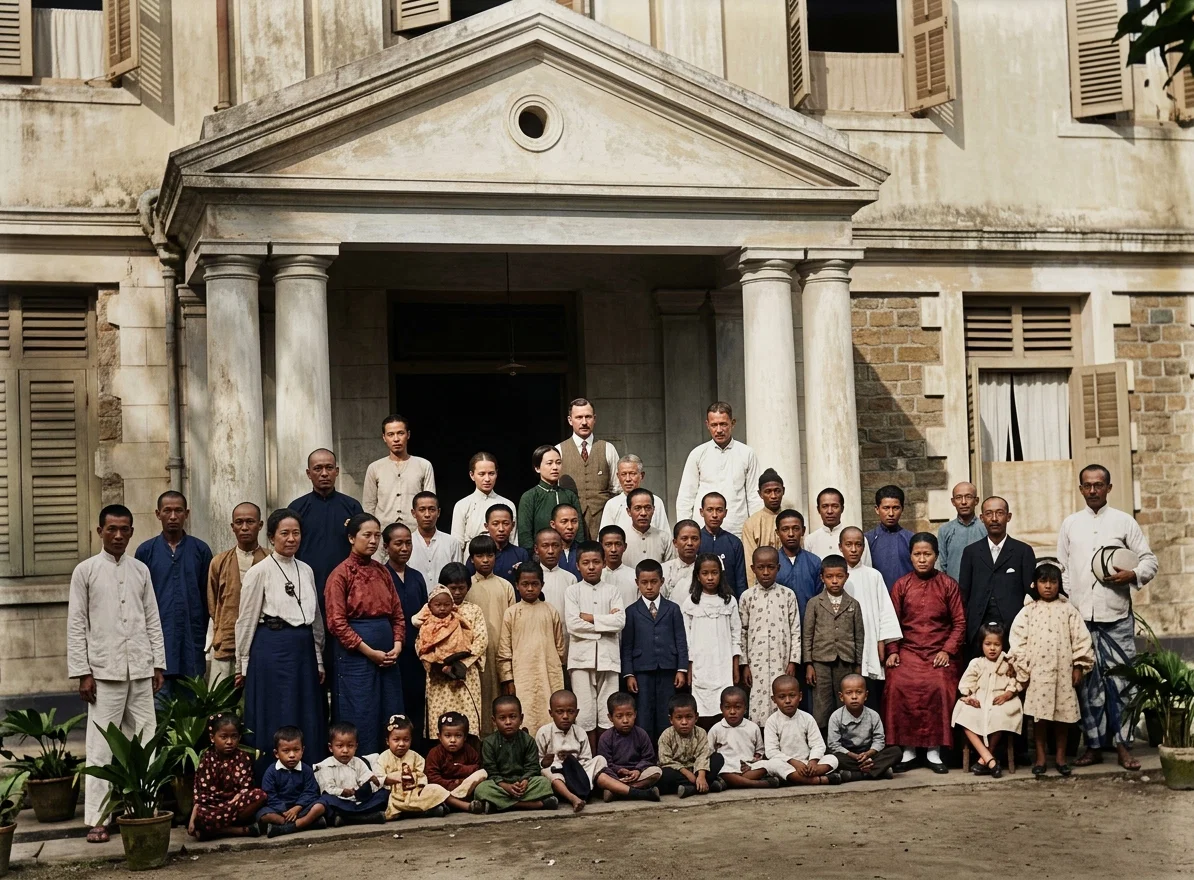
A COMPANY OF WORKERS AND OTHER BELIEVERS IN SINGAPORE
This scripture is applicable to the little company that you see in the accompanying illustration. Each face is “more precious than fine gold.” In their trials and experiences their faith has won for them “a banner . . . that it may be displayed because of the truth.” Under this banner we are united to go forth with courage and success as did the apostolic church, “conquering and to conquer.” We are confident of victory; but the battle is not yet ended, and while every step is contested, we are still marching onward. We pray that these same faces ere long will be seen dazzling with immortal brightness as they reflect the image “of Him that sitteth upon the throne;” “for we know that, when he shall appear, we shall be like him; for we shall see him as he is.” All these dear faces are daily becoming like their Heavenly Father, and if faithful, they will be numbered with the “hundred and forty and four thousand, having his Father's name written in their foreheads.”
This is the result of planting the banner in new places. A little while ago Singapore had no one to display it, but since the Australasian Union Conference sent workers, some faithful ones have been attracted to our “banner of truth,” and the good work is still going on. Alongside of this is now needed a memorial, that the finishing of the mystery of God may soon be accomplished. Such a place will represent and serve to establish our cause in the Straits Settlements. With this, a training-school must grow up where worthy young people can obtain the help they need for the severe battles that confront them. May many loving hearts be ready to give what they can to help in this needy enterprise. From Singapore the light of the third angel's message will quickly radiate through Malaysia. Singapore sits as queen of the Eastern seas, and diffuses her influence, good or bad, to all places round about her; thus we see that the work demands our best attention.
Java has already one Sabbath-keeping family that has gone from Singapore. Sister Bella Fox writes from there that they keep a small day-school, and the boys are eager for religious instruction. Bella is about eighteen years of age, and is firm in the faith, having been severely tested in Singapore. She hopes some one can go there to assist in the work, and also expresses her desire to go to our training-school in Australia. She has already passed the sixth standard in Singapore's best public school, and speaks English, Dutch, and Malay. She is a worthy girl, and had we the means, we would send her at once.
This is a good work, and if some feel like helping to prepare a good missionary for Malaysia, let them help her.
Java has about thirty millions of people, and no worker; we are sending missionary papers to a number of names there, which will arouse an interest. We have heard through our enemies that there are some persons up the Peninsula “trying to follow the Seventh-day Adventists;” if so, this is good news to us, and we hope to find them some day.
The printed page that precedes the worker everywhere is doing a mighty work. Brother Caldwell, while canvassing for “Desire of Ages,” gave us seventy addresses to which to send missionary papers, and through the15liberality of our brethren in Australia and America we have been able to supply them with the Australasian Signs of the Times, the American Signs of the Times, Youth's Instructor, Watchman, etc. “Other men labored, and ye are entered into their labors,” “that both he that soweth and he that reapeth may rejoice together.” “Behold, I say unto you, Lift up your eyes and look on the fields.”
G. F. JONES.
Villa Hatsu, 12 Dhoby Ghant, Singapore, S. S.
Mission Notes
The total number of all authorized workers in the foreign field, whether foreign or native, averages one worker to about thirty thousand persons.
A Chinese woman was dying, and a missionary was telling her of Christ. “But not for me,” she moaned. “No one would care so much for us.”
The Australasian Field
By Ole Andres Olsen
It is now about ten months since our arrival in this field, and during this time we have visited the several divisions except Tasmania. The time for the Tasmanian conference is set for the latter part of July.
Our last report was written after the New Zealand camp-meeting; since then we have attended the meetings in Victoria, West Australia, South Australia, and Queensland. We are glad to report progress in every part of the field. The largest meeting, in proportion to the membership, was that in West Australia.
The Victorian Conference added five new churches during the year; the West Australian Conference, six; the South Australian, one. There was also a corresponding growth in tithes, and offerings to missions. The Sabbath-schools in West Australia had contributed £223 3s 8d ($1,086.01) to missions during the year. This is a very good showing, and reveals an excellent interest. South Australia has added one church building during the year, and the financial condition of the conference has also materially improved.
The Queensland meeting was the smallest of all the general meetings. This conference has passed through a trying experience, caused by the long drought and general depression which affected almost every industry. Many well-to-do persons lost almost all they possessed. One instance will illustrate many others. One of our sisters informed me that before the drought, “We were well-to-do people, and when the drought came and continued so long, we spent all our money to save the stock; then finally all our stock perished, and we were left destitute.” This general depression had its effect on our work, and brought about a feeling of discouragement. Even the workers in the conference confessed to having lost heart. This was the general condition at the beginning of our camp-meeting.
But the Lord turned our captivity and gave us “beauty for ashes, the oil of joy for mourning, the garment of praise for the spirit of heaviness.” I have seldom witnessed a greater change, nor seen a more decided victory come into a meeting, than that in Queensland. The last Sabbath of the meeting will long remain in our memories, on account of the blessings received.
This conference has been backward in many ways. Up to this time no effort had been put forth to raise their proportionate amount for the establishment of our publishing work at Warburton, Victoria. Neither have they had any tent- and camp-meeting equipment, but have either had to hire or borrow from other conferences, which has caused more or less disadvantage. On the last day of the meeting they decided to change all this, and voted to begin immediately to raise a fund of £500 ($2,435),—£200 ($974) to make up their proportionate amount to the publishing work, and £300 ($1,461) for tent- and camp-meeting outfit. During the meeting over £200 ($974) of this sum was provided by the small company of believers present. Thus this meeting which began under much discouragement closed with the shout of victory and triumph. From this meeting the ministers enter the work with joy and hope, and the brethren and sisters return to their post of duty with courage and confidence. Thus better days are in store for Queensland.
After the camp-meeting I enjoyed the privilege of visiting five different places. Brother Nellis accompanying me. As we brought them the good report of the camp-meeting, all hearts were made to rejoice; and with readiness they co-operated with the recommendations passed by the conference.
We have been made glad to read the good reports that come from the workers in every part of the world-wide field. Truly the message is rising and going with increasing power and strength, and is being hastened to its final triumph and victory. In this, our hearts are made to rejoice.
While we see the message going with increased power, we also see evidences that the Spirit of God is being withdrawn, and that the judgments of God in the destruction of life and property are greatly on the increase. The terrible catastrophe that befell San Francisco is but a forerunner of what shortly will be a general experience. These things ought to stir our souls to a sense of the solemnity of this time, and of what is soon to come on the earth.
We are glad to report progress and good courage in every branch of work throughout the Australasian Union Conference. The present school year at Avondale opened under very favorable conditions, and is progressing under special blessings and prosperity both spiritually and financially. On returning from Queensland I made a brief visit to Cooranbong. It was an inspiring sight to meet in the school chapel so many bright, intelligent young people, all aglow with the missionary idea. The attendance is about the same as last year.
It was likewise very interesting to learn from Prof. C. W. Irwin, the principal of the school, that every department of the school was working even more successfully than at any previous time. The work, including the farm, the health food factory, the printing-press, carpentry, blacksmithing, tinsmithing, tent-making, and a number of other departments, is all carried on by the students, with the exception of the foremen of some of the departments; in other departments a student acts as foreman. The plan of organizing and adjusting the work is truly a marvel. It is an intensely interesting subject for study. Every face beamed with joy, and all are just as busy as bees.
The blessing of the Lord is also in our health and sanitarian work. The Sydney Sanitarium has enjoyed an excellent patronage all the year, and the spiritual interest among the helpers, as well as among the patients, is most excellent. All the premises show much improvement. The health institutions in New Zealand and South Australia are also being greatly prospered.
Since our last report we have also made some advancement in more remote portions of our field. Elder McElhany and his wife have gone to Manila, in the Philippines. Thus a permanent beginning has been made in this part of our union conference, and it must be enlarged and strengthened as rapidly as possible.
We have also the joy of having furnished additional workers for the great China mission, in the persons of Brother and Sister Allum, who were students of the Avondale School, and there proved themselves both faithful and efficient. They left us happy in the privilege of going, and our best wishes and earnest prayers follow them.
The reports from our island field are cheering indeed. The Lord is opening the way in a special manner. Especially do we feel a deep concern for the schools in the different places where native youth—and older ones too—can receive a training to prepare them to bear the message to their own people. The work at Singapore especially is being much blessed and prospered. Elder Gates, the superintendent of our island districts, is kept constantly on the move, but can scarcely begin to fill all the urgent calls that come for assistance. The island field will be a subject for careful consideration at our coming union conference.
We would also express joy and gratitude for the union, harmony, and hearty co-operation that prevail in all the different departments of our work throughout the entire field. All are of good courage, and our hearty sympathy is with the message and the work throughout the whole world. Every evidence goes to show that we are on the homeward stretch.
Our sympathy and earnest prayers go up to God for those who bear many and weighty responsibilities in the general work, especially those connected with the General Conference whose position is so responsible and taxing. May the blessing and power of the Holy Spirit be given them in large measure. The perils of the last days are here, and never before did we need the special guidance of the Lord as much as we do at the present time, that we turn neither to the right nor the left, but go straight forward in God's appointed way. The Lord himself is leading; what a comfort!
We are more and more grateful for the gift of the spirit of prophecy. How wonderfully the Lord has made provision for his work in the midst of the last-day perils. May God help us all to watch, stand fast in the faith, quit ourselves like men, and be strong in the Lord and in the power of his might, pressing forward to the final triumph and victory so nigh at hand. O. A. OLSEN.
Central America
By H. C. Goodrich
BELIZE, BRITISH HONDURAS.—I arrived at Belize, from the Bay Islands, Sunday evening. I had a rough passage, as the wind was strong. Our boat was a small, flat-bottomed schooner, made for smoother water along the coast; so in the heavy sea it rolled badly, and I was very seasick.
My trip had lasted two months. There is no regular mail service between Belize and the Bay Islands, nor with Ceiba, so we must watch for some tramp16schooner, or send our mail by way of the United States. As the weather had been very bad most of the time, I received none while I was gone, and that was one great reason for my coming to Belize.
I expect to return by the same boat, and will visit Utilla and Bonacca again, as soon as I can. While I was there last, the storm hindered me so that I could not do much. I expect to pitch the old tent again at Flowers Bay, Ruatan.
No one but the dear Lord knows the lonesomeness of the last three years; and when I read that some one would be sent soon, it was indeed cheering news. I laid aside the letters, and kneeling down, I gave thanks to the Lord, with many tears. A young man who could pick up Spanish would be better than an older one; for I feel that we ought to make every effort possible to enter the Spanish field. Brother Allen is pushing the book work among them as well as he can, and I hope to see good come of it. H. C. GOODRICH.