DOLLY, dear, you could never guess what I've been doing this week, could you? I thought not! Well, I've been choosing a vocation. That's a big word, isn't it? I don't suppose you'd guess what it means, so I'll tell you: it means the kind of work you're going to do all your life. I'm getting to be a great girl now,—I was eight years old last Sunday, you know, and I thought it was time I made up my mind what I was going to be. So I asked mama what she was going to work at, and she said she had some sewing to do in the afternoon. Then I helped do the dishes, and when mama had swept the room, I dusted, and helped set things to rights.
After the dinner work was done, mama took up her sewing, and I asked for some to do, and she gave me a towel to hem. I worked very carefully, and it took me a long time; but when it was finished, mama said it looked very well. I told her I thought I would be a seamstress, but she advised me to try some other work before deciding.
On Monday morning, when mama got ready to wash, I helped carry the water to fill the boiler. She let me rub out some of the easy pieces, too; and they did look so white and pretty when I spread them on the green grass to dry,—for I am not tall enough to reach the line. In the evening as I carried them into the house, I noticed the sweetest odor on them, and I asked mama if clothes always smelled so when they came in from out-of-doors. She said they did, and I said, “Then I think I will be a laundress.” But mama thought I'd better try something else yet.
GOING DOWN THE FIELD
Tuesday was the loveliest day,—bright and sunny, yet not too warm to work in my garden. The morning-glories and scarlet-runner beans were tall enough to need strings; the poppies were too thick; there were so many pansies in bloom that I picked a beautiful bunch for grandma; and I had to borrow papa's pruning-shears to trim my rose-bush.
Over in my vegetable garden I had to do a lot of hoeing to keep ahead of the weeds; there were tiny pods on the peas, and the beans were just pushing their pale-green elbows through the ground. The lettuce was so large that we had a bowlful of the tender leaves dressed with lemon-juice for dinner. By Tuesday evening I had just about made up my mind to be a gardener.
But on Wednesday mama baked, and I helped at that, too. Mama had set her bread sponge the night before, and she gave me a little piece of white dough and of brown. I made a tiny loaf of each, and put them in my little baking-pans. Then, while they were rising, I made two cunning little pies, one of gooseberries, the other custard, and a panful of fruit-crackers. O, how good they all looked when I took them from the oven!
In the evening I put them in a basket, with a pretty picture-card and a bunch of pansies, and took them over to lame Susy Allen. I wish you could have seen how pleased she was, 'specially as it happened to be her birthday. Wednesday night I was sure I would be a baker.
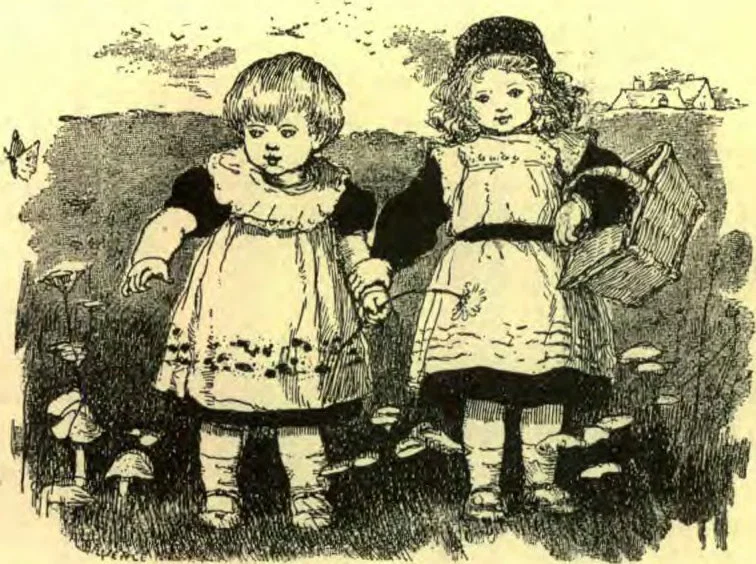
Thursday morning mama had such a headache! After breakfast she lay down; and as soon as I could, I went into her room, and bathed her head until it felt better; then I darkened the room, and went into the kitchen. I washed the dishes, and swept the floor as quickly and neatly as I could, and was just going to get my story-book down to have a good read, when I missed Nelly and Ted from the porch, where they had been playing. Looking out, I saw them going down the field, Nelly carrying a basket, and Ted stopping here and there to pick the gay wild flowers among the grass. So peeping into mama's room, and finding her asleep, I put on my sunbonnet, and went out into the field. We played around a good while; and when we came in, bringing a great sheaf of wild flowers, we found mama better, and dinner nearly ready. That day's work made me sure I wanted to be a nurse.
O, how it was raining when I got up Friday morning! Not a single speck of blue anywhere. We three children stood by the window after breakfast, and looked out at the pouring rain; and I'm not sure that there were not some drops falling inside the window as well as out.
But mama always has something for us to do; and now she asked, “Why not play school?” So I set out three dining-chairs for desks, and three stools for seats. We each had a slate and some colored pencils, and our first lesson was drawing some of the blossoms we had picked on Thursday. Then we learned to spell their names with Ted's letter-blocks, and compared their colors with Nelly's color-tablets.
Mama had cut from advertisements in a farm magazine, pictures of twelve cows and twelve hens, and pasted them on squares of pasteboard. I gave the cows to Nelly to start a dairy, and the hens to Ted for a poultry yard; then what fun they had learning to count them!
After dinner it was still raining, and we reviewed our lesson for next Sabbath. When bedtime came, I was sure I would be a teacher when I grew up.
But on Sabbath morning I told mama I didn't know what I would be; for I had tried six different kinds of work, and I liked each just as well as any other.
Then mama kissed me, and said, “Suppose that for a few years you should just be my little minister.”
And I guess maybe I will; for a minister is one who serves, and that is what I'm trying to do. AUNT BETTY.
Some Bible Trees
By Elizabeth Rosser
A MIGHTY ship upon a shoreless sea, No sail, no helm, no anchor safe had she; And yet securely o’er the swelling flood, Rode on the vessel built of —— ——.
One of twelve rods that lay before the ark, Hid from the eyes of man all through the dark, Bore buds, blooms, fruit, a wondrous sight to see. Those rods were gathered from the —— ——.
A prince, without a blemish, loved and fair, Was noted for his wealth of flowing hair; Rebellious, his great father’s heart he broke, And died at last, while hanging from an ——.
Despised because he was a publican, Although a just and honorable man, To see his Saviour he ran on before, And climbed the branches of a ————.
Cursed for its barrenness, in one short day Its beauty and its glory passed away, Blighted from inmost heart to outmost twig, It stood a marvel. ’Twas the ———— ——.
Within a city built not by men’s hands, On both sides of a crystal river stands, Beyond the toil, the sorrow, and the strife, Throughout eternity, the —— — ———.
ELIZABETH ROSSER.
A Pet Calf
By David Paulson
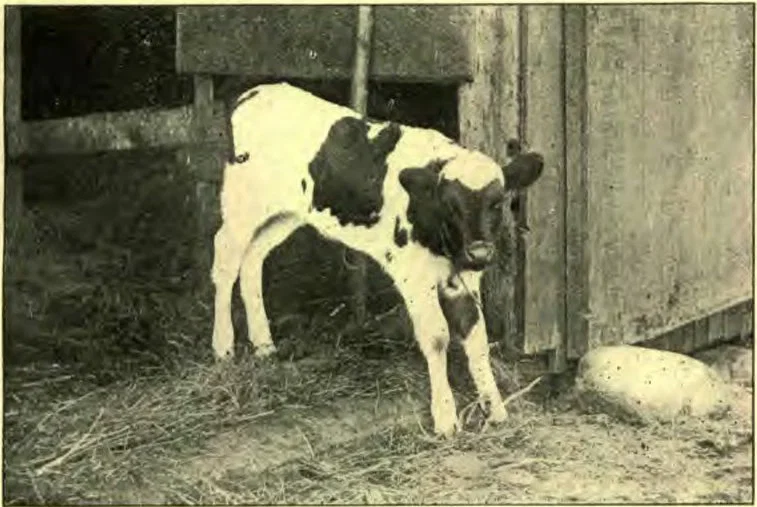
THE accompanying picture is from a photograph of a calf belonging to one of our friends in the West. The pet was sold, and the proceeds were devoted to helping our Chicago work.
This animal seemed to have been a favorite with the members of the family, but they were willing to part with it, in order that some one here in Chicago might be made a little happier.
Are there not others who are willing to part with some of their pets for the sake of helping humanity? DAVID PAULSON, M. D.
A Little Patience and Love Make Home Happy
“A LITTLE bit of patience often makes the sunshine come.
And a little bit of love makes a very happy home;
A little bit of hope makes a rainy day look gay,
And a little bit of charity makes glad a weary way.”
Healing
“He touched her hand; and the fever left her.”
He touched her hand as he only can,
With the wondrous skill of the Great Physician,
With the tender touch of the Son of man;
And the fever pain in the throbbing temples
Died out, with the flush on brow and cheek;
And the lips that had been so parched and burning
Trembled with thanks she could not speak;
And her eyes, where the fever light had faded,
Looked up, by her grateful tears made dim;
And she rose and ministered in her household.
She rose and ministered unto him.
—Selected.
Unselfishness: Lessons from the Poplar and the Maple
By Myra Goodwin Plantz
Unselfishness
HAVE you noticed the Lombardy poplar? It draws its branches up around itself so as to cast little more shade than a telegraph pole, and no bird seeks a nest under its closely drawn leaves. It is a good type of a selfish person.
Across the way is a beautiful maple. From its sweet heart, sap flows every spring, giving delicious food to its owner. Its broad branches make homes for many birds; and children play, and travelers rest, under its generous shade. When frost comes, its harsh touch only makes the maple more beautiful, with its crimson and gold. Even adversity is turned to the good of others by the maple. What a type of unselfishness!
After all, there is nothing useful or ornamental in character that is more desirable than unselfishness. There are as many types of selfishness as weeds in a garden. Some people are generous yet selfish. I remember a lady who had done great things in philanthropy. She would give away money freely, but was very careful of herself. Everything in the house must contribute to her happiness. A child hardly dared tread on the stairs if she had the headache. If a friend cared for any one who had disagreed with her, that friend was dropped.
There is the selfishness that flaunts itself in your face like the coarse mullein stock, or is so disagreeable you keep away from it as from the Canada thistle. Sometimes a boy teases his sisters, or takes the cake from the pantry, or eats the strawberries that were intended for tea; and the family learns to guard against his selfishness as the farmer against the more deadly weeds. Open-and-above-board selfishness gives its own warning, but there is another like the harmless little nettle hidden among the wild flowers; you do not recognize it until you feel its sting. This kind of selfishness makes a young lady open the car window enough to cool herself, regardless of the baby over the way who is taking cold with every breath. At the same time the young lady looks with scorn on the traveling man who has piled up his valises on the opposite seat while a lady is standing near.
There is one thing about unselfish people,—they get more than they give, as a rule, leaving out the added happiness that comes from forgetting self. It is a law of nature that giving brings its own increase. Two little springs came up side by side in the heart of a greenwood. “I shall stay here and take care of myself,” said one little rill; and it soon became stagnant and dried up with the summer heat. “I can at least water the wild flowers under the trees,” said the other brook; and it slipped through the tangled grass, out into the meadow beyond, where it was met by another tiny stream, and soon together they were turning the wheel of a busy mill.
Each one naturally has a selfish heart. Only keeping near Christ, who pleased not himself, will keep us unselfish. Is it not well, then, for us to take pains to acquire the fruits of the Spirit—the graces that adorned the life of the Master?—Myra Goodwin Plantz, in the Young People's Weekly.
Photographing a Hawk’s Nest
By Herbert K. Job
ONE day last April I took a long tramp through the woods, and found three nests of the red-tailed hawk, or hen-hawk — large platforms of sticks placed high in tall trees. For some time I had wanted a photograph of a hawk’s nest showing the interior. Usually they are in straight trees without strong, spreading limbs, which might give a chance to climb out for a side view. But one of these nests was in a huge, spreading mountain oak, affording an unusual opportunity. The tree grew from the foot of a high ledge of rock, and by climbing a small oak on its summit I could see the two large, dirty white eggs lying upon their bed of bark and hemlock twigs. But who could get up that fifty feet with a camera? I knew I could not, but I thought I might find some stout boy who could.
The first one I brought gave up after he had spiked his way ten feet up with climbing-irons. A few days later another volunteered, and after I had showed him a little about using the camera, we climbed the mountainside, and saw the great bird sail from the nest and circle overhead with angry screams. First I thought I would try to surprise the hawk on its nest, and get a picture of her. As the bird always flew before I could get anywhere near the nest, I screwed the camera up in the small oak, covered it with leaves, then withdrew, holding the end of the long tube, and lay flat behind a rock, and had the boy cover me with boughs, and go off. There I lay perfectly still, peeping through the boughs at the nest, ready to squeeze the bulb upon the return of the hawk. After much circling, she alighted on a neighboring tree. I could see her gazing intently at my covert, and I fairly held my breath as I anxiously awaited her decision. I am afraid she saw me through the boughs, for she sailed away, and did not return. I lay there over an hour, when through cramp and hopelessness, I gave it up.
Then I called the boy. Having buckled on the climbers, and slung the camera over his shoulder, foot by foot he ascended the tree. The trunk was too thick to grasp, so he had to hold on by the rough bark, in which it was as hard to get secure footing with the spikes. I feared he would give out, but he kept bravely on till he was well at the first crotch. It took then even more courage to crawl out on the sloping fork, with only empty space below him, but he did it, and reached the desired spot, a little above the level of the nest and ten feet to one side. There were the eggs, and white down clinging to the sticks all over the nest and fluttering in the breeze. Both the hawks were hovering and screaming high overhead.
Would he, though, have the nerve to stand for half an hour at that dizzy height, balancing himself with one hand, and adjusting the camera with the other? He went coolly at it, following my directions step by step. First I had him screw a bolt into the limb near his head, then take the camera from the case, adjust the clamp, and then screw clamp and camera to the bolt. Thus he went on till all was ready for a timed exposure. “Squeeze!” I shouted. The shutter clicked and the lens was open. “Squeeze!” again I called in two seconds, and another click told that the picture was taken. In the same way I had him take three more, to make sure of a good one.
Everything went well, except that after the second exposure the rubber cloth fell to the ground. There was great danger of fogging the plates without it, so I climbed down the ledge and got it, tied it around a stone, and tried to throw it up to him. I am not much of a pitcher, but my second throw sent it straight, and holding to the branch with one hand, he made a splendid catch with the other. Backing down, then, to the crotch, he climbed the other fork to the nest, and gave me an accurate description of the way it was built.
It proved very hard to get down the trunk, especially with the camera. So I coiled the rubber tube, and threw it up over the fork. With this he let down his burden, and at last got safely down himself, hot and tired, but justly proud of the difficult achievement, his first experience in photography. All four of the pictures proved good, and will give pleasant reminders of the experience on the mountainside.—Herbert K. Job, in Companion.
A Crown That All May Wear
By Edison Driver
CHEERFULNESS is a great crown, and they who wear it are kings.
Others may be richer, wiser, and more beautiful, but these are they who make the world brighter. They carry sunshine and good cheer wherever they go, and pass with a smile lightly into hearts that are barred to wealth, wit, or beauty. Those who wear the crown of cheerfulness are fitted to influence others, and to lead them to higher and better things. They make their churches seem brighter, happier, and better to worship in by their presence; they make religion a sweeter thing; and the words of God fall softer and more potent from their lips.
We should practise cheerfulness at every opportunity, till it becomes a habit. We should fight against every influence that tends to keep back the cheery “Good morning,” and its smile. Life has no time for gloom—much less a Christian life. Christ, the Great Teacher, taught no gloomy doctrine. His were the good tidings of great joy, filled with sunlight, and birds, and lilies, and little children; and his gospel is just the same to-day. True Christianity is still as bright as the morning. EDISON DRIVER.
The Tale of Miss Polly Wog Wog
By Edwin L. Sabin
This is the tale of Miss Polly Wog Wog,
Who lived in the midst of the country of Bog.
Of brothers she numbered one hundred and four;
Of sisters two hundred—or possibly more;
No matter. Whatever the total might be,
She never was lacking for playmates, you see.
So hide-and-go-seek and pom-pom-pull-away
She played in the mud and the water all day;
For water and mud were the young Wogs' delights.
They frolicked there, dined there, and slumbered there nights.
Miss Polly was vain—though we hardly would call
Her face or her figure attractive at all.
Like most of her family, be it here said,
She was seven twelfths tail, and the rest of her head.
Yes, Polly was truly exceedingly plain—
But the tail was the thing that was making her vain!
Her father cried, “Shame!” and her mother cried, “Fie!”
Her brothers said, “Goose!” and her sisters said, “My!”
And dreadful misfortunes would happen, they vowed,
To the Wog who was acting so silly and proud.
But the more they entreated and threatened and warned,
The more their advice and their efforts were scorned,
And Polly went wiggling and wriggling about—
Such airs! You would think she was some speckled trout!
But, O! she encountered a terrible fate,
Which just as a moral I'll briefly relate:
She kept growing ugly! But that's not the worst—
She swelled so that one day she suddenly burst!
And, alas, she was changed to a common green frog.
What an end to the tail of Miss Polly Wog Wog!
MEMORY VERSE: “This promise is unto . . . as many as the Lord our God shall call.” Acts 2:39.
(The chapter given as the Lesson Scripture is the lesson to be studied. Read this every day, and think over it until you know just what it teaches. Then the following notes, which should be read several times, will help to a fuller understanding of the lesson. Lastly, go over the questions carefully, and be sure that you can answer each one in the words of Scripture.)
God made Adam to be the head of the human family, that he might teach the knowledge of God to the multitude of his children. But Adam fell into sin, and his children departed from God and worshiped idols.
Then God cleansed the earth by the flood, and began again with one good man—Noah. But Noah’s children were not the servants of God, as he was, and soon men began again to worship false gods, the works of their own hands.
At the tower of Babel, God divided the human race into different families, or nations. From one of these nations he called out a man of faith named Abram, so that he might teach him, and make him the father of a race of good men, who should teach all the nations of the earth about the true God. He wanted to separate Abram from all idolaters, so that he could bring up his family to love and fear God.
When God called Abram, “he went out, not knowing whether he went.” He knew that God was leading him, so he followed on, trusting in the Lord. When he came to Canaan, God said that he would give him that land. But it was then full of wicked idolaters, and God did not give Abram any of the land. Yet Abram trusted the promise, and waited in faith for God to fulfill it.
As Abram went from place to place, wherever he pitched his tent, he built an altar, and offered sacrifices, and prayed to the Lord, and taught the people round about him of the true God. These altars were left standing; and whenever people saw them, and asked what they meant, they would hear about the God of Abram. So he was a missionary; he taught the heathen wherever he went.
In the strife between the herdsmen over the pasture-land, Abram showed his unselfish character. Being the older man, and the one whom God had called and given the land, he had the right to choose. But he did not think of himself; he let Lot have the first choice.
Lot pitched his tent toward Sodom, although he knew that the men of Sodom were very wicked—worse than those from whom the Lord had called them.
In another part of the Bible (Rom. 4:13), we are told that God promised Abram that he should be “the heir of the world.” So we see that God was talking about the whole earth, when he promised to give Abram all the land that he could see. Yet he did not give him, during his earthly life, “any inheritance in it; no, not so much as to set his foot on.” Acts 7:2–5.
Abram understood this promise of God, and he knew that it was not this present world, but the world to come, that he was to have for an everlasting home. So he looked for “a better country,” and “for a city which hath foundations, whose builder and maker is God,”—the New Jerusalem that God has prepared for the new earth.
All the promises were made to Abraham and to his seed. The seed of Abraham is the same as the seed of the woman of which we have learned; for the Bible tells us plainly that the Seed of Abraham is Christ. “And if ye be Christ’s, then are ye Abraham’s seed, and heirs according to the promise.”
Abraham is the father of all who believe; so if we believe in Jesus, we are his children, and sharers in the promise of the new earth for our everlasting home. But if we would dwell with him there, we must be willing to give up all that we have in this world,—to leave our country, our kindred, and our father’s house, if God should call us,—that he may lead us to that better country promised to Abraham and to his seed.
Questions
When the nations had departed from God after the flood, what did he do to keep the knowledge of himself in the earth? Gen. 12:1–3.
What three things was Abram called away from? Verse 1.
MEMORY VERSE: “Let now the astrologers, the star-gazers, the monthly prognosticators, stand up, and save thee from these things that shall not come upon thee. They shall not deliver themselves.” Isa. 47:13, 14.
Questions
1. When did the events described in the second chapter of Daniel take place?
2. About how long had Daniel been in Babylon at this time? See note .
3. What effect did Nebuchadnezzar’s dreams have upon him?
4. Upon whom did he call for help? For an explanation of “astrologer,” “sorcerer,” and “Chaldean,” see “Great Empires of Prophecy,” page 8.
5. What did he ask his wise men to do?
6. In reply, what did they offer to do? Note .
7. Notice Nebuchadnezzar’s answer. What did he threaten them if they would not reveal not only the dream, but the interpretation also? On the other hand, what did he promise them?
8. After they had again urged the king himself to tell his dream, what did he then know of a certainty?
9. What did he see that they had prepared for him?
10. How did the Chaldeans try to excuse their inability to tell the dream?
11. What reflection did they then cast upon the king?
12. Who only did they say could reveal the dream?
13. Yet what did they acknowledge would prevent the gods from making it known? See note .
14. How did the acknowledgment affect the king?
15. What decree did he therefore send forth?
16. Who were included among the wise men at this time?
17. What does the prophet Isaiah say concerning Babylon’s wisdom and knowledge? Isaiah 47.
18. What was to come upon Babylon because of the multitude of her sorceries and enchantments? Verses 9, 14.
19. When this trouble should come upon Babylon, who would not be able to save her?
A Sample Testimonial
“FROM the examination I have been able to give the work, I must say that there is nothing that I or any one else could say in favor of Mr. Rogers’s presentation of the Graham System that could be considered extravagant by one who has made a like examination. . . . Mr. Rogers has brought order out of chaos. . . . It is the best arrangement for the study and acquirement of Graham Stenography that I have ever seen.”—RUEL SMITH, for twenty years Official Stenographer of the Maine Supreme Judicial Court, Bangor, Me.
For a limited time we are offering our advanced course of thirty lessons by mail, including two bound text-books worth $2.15, for only $5. Our method of teaching “the best shorthand extant” by the use of “The Rogers Compendium” may surprise you.
FIRESIDE CORRESPONDENCE SCHOOL,
Battle Creek, Mich.
SOLID THROUGH TRAINS OF
WIDE VESTIBULE COACHES and PULLMAN SLEEPING CARS BETWEEN Battle Creek and Chicago, Buffalo, New York, Philadelphia, Toronto, Montreal, Boston
For time-tables, descriptive matter, and information, apply to any representative of the company.
The Fiftieth Anniversary
By Editor
With this number the INSTRUCTOR completes its fiftieth year; and as is fitting, its columns this week are filled with words of greeting, loving reminiscence, and expressions of hearty faith in, and good wishes for, its future.
Probably not one of those who worked so faithfully in preparing the early numbers of the paper had any thought that it had so many years before it. God alone knew the place it must fill, and for how long a time. But those who have noted its work during this period, who remember the pleasure derived from its regular visits, and who recognize its influence in their lives, cannot but acknowledge that the Lord had a place for this agency in his closing work in the earth, and that he directed those who began to publish the paper, and has guided those who have carried it forward.
We can look only a very little way into the future, and can tell nothing of what it holds—except by the light of the prophetic word. But that word shines as a lamp, clear and steadfast. And those who, by its light, read the meaning of the events that are so rapidly making the history of the nations to-day,—who note the increase of crime of every kind; the appalling disasters by wind and fire and flood; the frequency and horror of earthquakes and volcanic eruptions; the stupendous preparations for war in these days of lauded “peace;” the public unrest and secret fear that are laying hold of men’s hearts,—rejoice to know that these things are but the signs that show that His coming is near, who will establish the kingdom of peace, and rule the earth in righteousness.
To such the picture is not all dark. They see a brighter side,—how in every land, no matter how remote, or difficult, or attended with perils, true-hearted men and women, impelled by the fear of God and the love of souls, are pressing forward to fulfill the Great Commission. And when it is given,—when the gospel of the kingdom is preached in all the world for a witness unto all nations,—then will the end come. Till that glad day, may the INSTRUCTOR stand, as it has stood during fifty years, for the proclamation of the message of the second advent of our Lord, and may its voice be blessed in the glorious work of proclaiming the gospel of the kingdom.
The time will not be long, dear young friends. Meanwhile will you not work for the paper, treat it as a friend, pass it on to others to read, and above all pray for its success? Every one who has received the light of God’s truth holds that truth in trust, and will be held accountable for the use he makes of it. Responsibility measures with opportunity. May each one of the INSTRUCTOR readers be faithful in the high calling of God, and so do his work that he may have a part with the redeemed when the Lord shall come.
Why the Instructor Does Not Grow Old
By George C. Tenney
Fifty years does not seem like a very long time when one has lived it; and yet in the allotted period of threescore years and ten, it is a long step toward the conclusion of an earthly life. But fifty years has not told seriously on the age of the INSTRUCTOR. It is still a youthful instructor as well as an instructor of youth. Its clean, pretty face bears no wrinkles. Its greeting smile is as fresh as ever. There are no “silver threads among the gold;” no abatement of vigor or natural force; no decline of spirit or vivacity. Its original parents have mostly fallen asleep. Its contemporaries are growing old; and even the old earth, with all nature, waxes old like a garment, and is about ready to be folded away. But our beloved INSTRUCTOR still seeks the society of boys and girls, and reckons itself to be one with them.
From the standpoint of the natural feelings, there is something sad about growing old. We are apt to regard those whose hairs are white, whose knees tremble with age, with pity as we think that life with them is almost spent. But this sadness is born of earth, and does not pertain to God. With him nothing grows old. Infancy and age are not conditions of a perfect state. Therefore we do not inquire how old our Heavenly Father is, nor how old are the angels of the heavenly courts. God’s word is like himself; it is not affected by time. The promises of God have lost nothing by three or four thousand years of constant use. They are as complete, as fresh, and as powerful as ever, and even more precious as we near their consummation. Virtue and purity are immortal. Such a character as Christ manifested never can perish. “He that hath the Son of God hath life.” “The outward man” grows old and perishes; but eternal youth lives where Jesus reigns, so that the “inward man is renewed day by day.”
This is why our dear INSTRUCTOR is blessed with perennial youthfulness. Divine things or qualities do not grow old. It is a comfort to old pilgrims to realize that this fleeting, troubled state is not their life. This is the land of decay and death. Over there, when both soul and body fully bear the divine image, the unfolding of the eternal ages will ever quicken and expand the volume of an unending life. When his path begins to descend to the dark valley, the weary pilgrim does not look backward with a yearning desire to tread again the paths behind him, but sees light, life, and glory beyond.
G. C. TENNEY.
For the Ingathering
By Aunt Phebe
EVER since the tenth of June the children have been playing they were at a “summer resort,” and taking a “fruit breakfast” for their health. Of course their health is all right; but as their pretty “fad” saves cooking, and does no harm, we indulge them in it.
And now the raspberries are here, some capping the tall bushes in the garden with their tempting sweetness, and others drooping their heads like pendant corals along the rail-fences. Though we value these wild berries as my childhood fruit, and for their rare flavor and aroma, we leave them mostly for the poor and strangers who come among us, as God has told us to. Before they are gone, up in one sandy corner around the pine stumps we will go blackberrying.
Ah, God is good to us this year in all manner of fruits for the temperate zone; and so with reverent hearts we pick, and eat, and can for the winter, not forgetting to give the “first fruits” unto him, in cans labeled with name, variety, etc., to show at the “Harvest Ingathering” next fall, and then to be packed securely in light, strong barrels, and sent to our city missions, or countries where they do not raise berries yet.