Your ShelfYour Projects

Review and Herald, Vol. 92, No. 3.

Hadst Thou Been Here
Earlier text: The “Sacrifice of the Mass”

Through Siberia

(Concluded)
J. T. BOETTCHER
It took me three days to go from Manchuria to Irkutsk. My train went no farther, and the next train did not leave until morning. Brother Gnedjin and a friend of the truth were at the depot to tell me the latest news. All the men and horses had been taken, so that it was hard to get a cab. I stopped with a friend of ours and held a Bible reading.
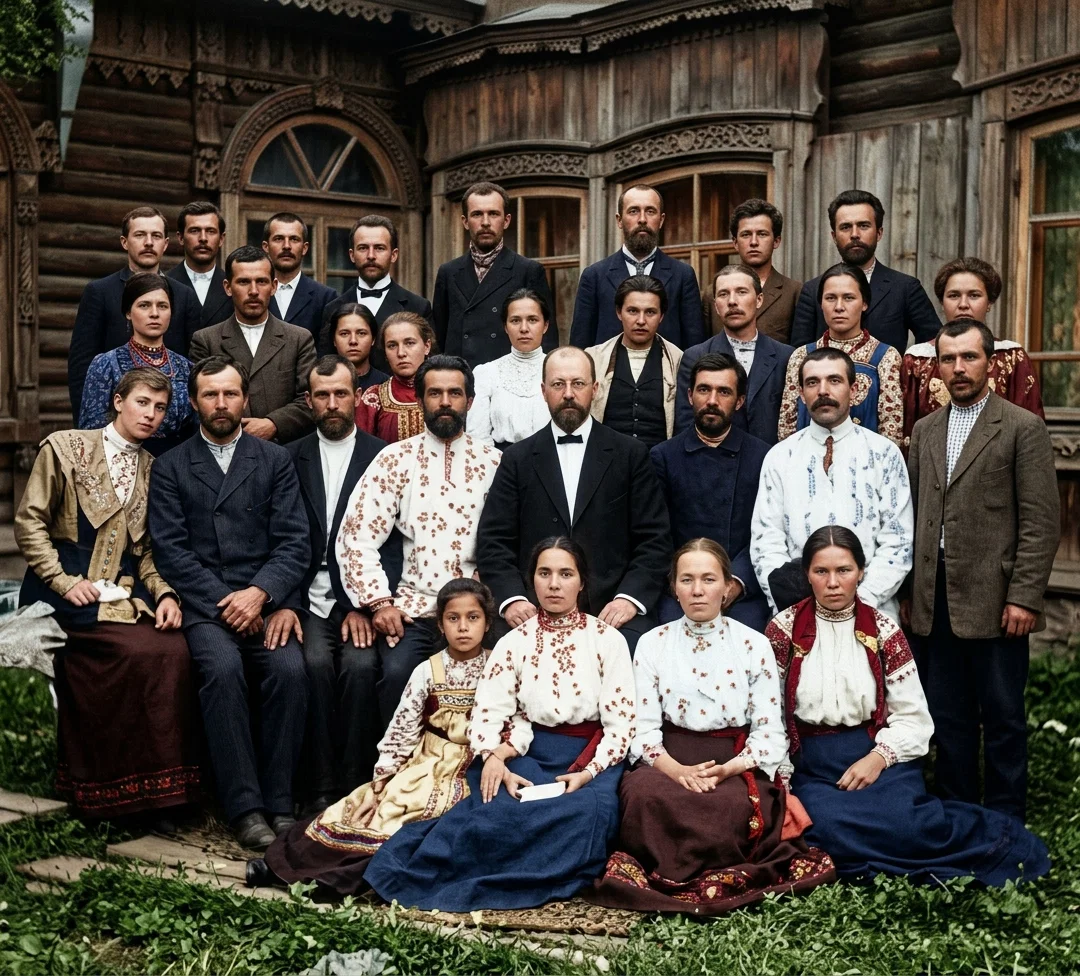
THE CHURCH OF IRKUTSK, SIBERIA
Before we reached Irkutsk an officer came through the cars and asked for the passports. He was in search of Germans.
In Irkutsk we have twenty-two members. Somehow they have permission to hold meetings as often as they please. The house was full when I spoke. One Bible worker here was imprisoned some months ago because he advertised a meeting and preached from the Bible. The meeting was closed at once. He is still in prison awaiting trial. We do not know when it will be. The superintendent was left all alone in that great field, but he was willing to do his best.
Calls are coming from many places. I will quote from a letter which Brother Gobel, the superintendent of the Amur Mission, received while I was with him:—
“DEAR BROTHER GOBEL: The peace of God be with you as from the least of your brethren Pazink and Chomenko. We had expected you to come to us either the last of May or the first of June, but you did not come. Now we ask you to tell us why you did not come to see us. We are concerned about you. Did anything happen to you, or has some misfortune befallen you? Is it because you have no money? Please let us know. We will come to get you or come to you. But there are nine of us, and we cannot all leave our homes. Please do come after harvest and instruct us in the message.”
This is one of the many letters that might be presented. During 1913 there were seventy-four members added by baptism and vote. Only four workers are being employed. This is a good record.
Monday morning, August 10, I went to the depot in Irkutsk, but was told that there was no place to be had on the train. I had to go, so I got onto the train and found myself in a compartment where were a number of children, a woman, and a Russian merchant whom I had met before. Objection was raised to this. After I had my luggage put up, I went out to say good-by to our brethren. Then I saw the Italian doctor and asked him if he had a place. He said, “Yes, and one for you, too.” I changed over quickly. The night before, the doctor was introduced by a Russian captain to the head of the police. These gentlemen caroused all night in Irkutsk, and were in a very humorous spirit. The head of the police ordered a compartment to be vacated when they came to the train, and this was done. I could see how God looked after me all the time; I felt sure he would, and so he did. I had a splendid place. We were the only two in the compartment during five days.
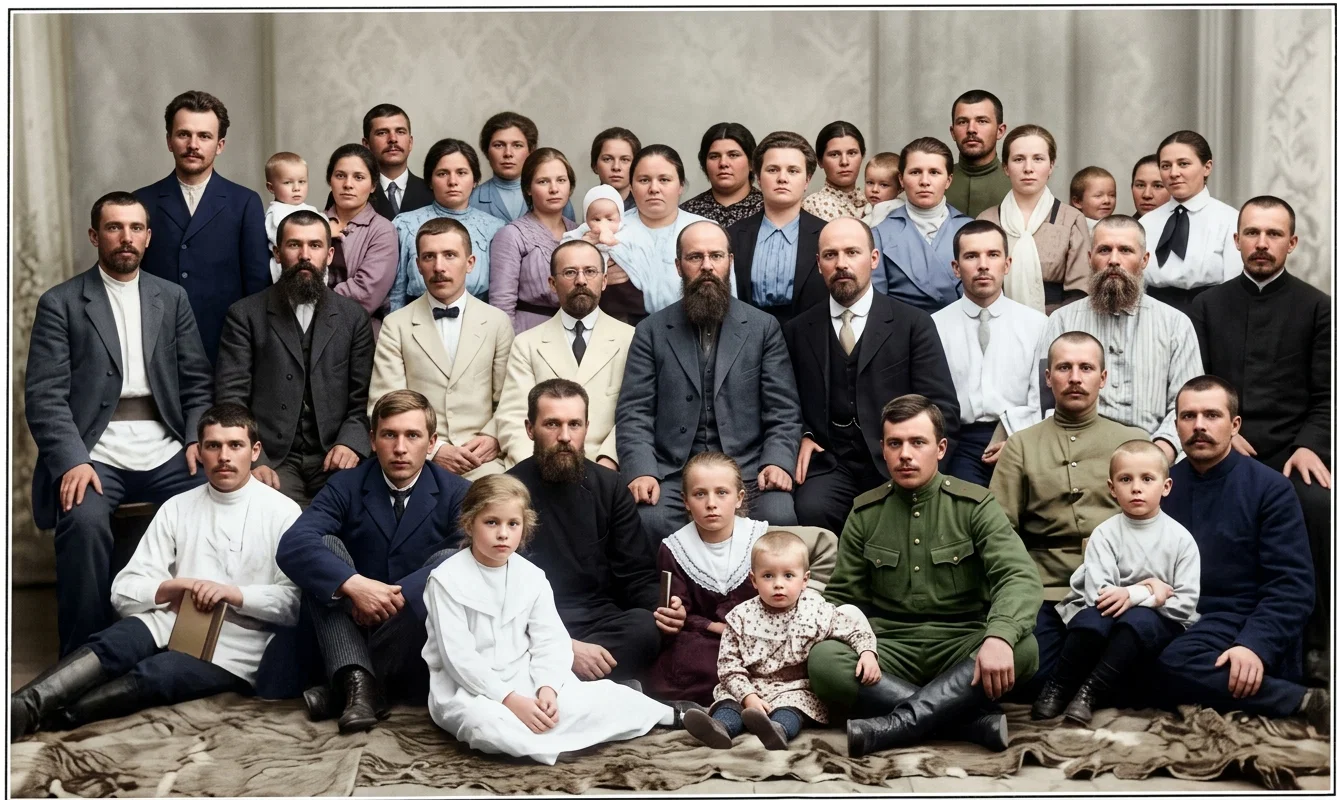
CHURCH MEMBERS IN HARBIN, MANCHURIA
Sabbath morning, August 15, I was in Omsk, where the workers from the West Siberian Mission had come to counsel with reference to their work. One of the ministers came nearly six hundred miles by team. There is only one railroad in Siberia, and that goes east and west. We had meetings every day while I was with them. The fields were white and the crops splendid, but there were no men to harvest the grain. The women had to shoulder the burden. I saw them out in the fields mowing with the scythe as men usually do. It was very touching to see the soldiers say farewell to their wives and children. They would hold on to their loved ones until the train was even in motion. War is a dreadful thing.
OUR CHURCH BUILDING OF IMAN, EAST SIBERIA
In the country around Omsk there were thousands of military tents pitched. In the city the soldiers were boarded free of charge. Nights and mornings great numbers of horses were brought to the river Irtysh to drink. Everybody knew that Russia was in earnest about the war. The stations were crowded with troop trains. All passenger trains, and even the express trains, were stopped. Only one mail train went each day, and this not on schedule time. These trains had to stop from five to thirty minutes at each station to wait for further instructions from some source. Trains and trains of soldiers went east and west. At the stations the people would come and ask for news. We gave them papers if we had them, but it was hard to get papers. I had never seen Russians so anxious to read the newspapers. One would get a paper and read aloud, while the others would stand in large groups and listen to every word as if spellbound. This war has brought the people of Russia together in one common brotherhood; Jews, Poles, Esthonians, Tartars, Lettonians, and the Russian Germans stand side by side.
Our workers were cut off from the head office, and were already without money, so we counseled together, and I promised them that we would help them from Riga as long as we could, but told them that every minister would have to do with less and cut down all possible expenses. They were willing to do this, and to stand by the work even if they should have to work with their hands part of the time. I am glad that we have such a loyal class of workers.
I had planned more meetings in west Siberia, but thought best to go back to Riga without attending the others. Tuesday, August 18, very early in the morning I went to the depot to wait for the train. The Lord again helped me to find a place. By Friday morning I was in Samara, where we have one worker. This brother was at the station to meet me. I tried to get a ticket farther on, but was unable to procure one. No tickets were to be had. I tried all sorts of persuasive methods, but without effect; so I stayed in Samara, and held meetings on Sabbath and Sunday. Sabbath I baptized a young man, and two others promised to follow their Lord. Sunday afternoon a man who was a baker promised to close his shop and keep God’s Sabbath day. I felt very thankful to God that I had had to stay.
Sunday, August 23, I prepared to go aboard a steamer on the Volga, at about 7 P. M., but it did not come until after midnight. Tuesday morning, at four, I was in Saratof, where I had a meeting with the workers and the president of the East Russian Union Conference. Some of the brethren were to go to a general meeting, but it was thought best that I should not go. After counseling about our present income, we fixed a new wage standard, cutting down the wages of all the ministers one third. If the money comes in as it usually does, we can keep going for a while. If not, we shall have to cut down still more.
Sunday, August 30, I was in Riga. I found that our bookkeeper here had gone. He and four other German brethren were sent to Orenburg.
The meetings in Riga were never better attended. The people are having most earnest thoughts. God will work good out of it all. Riga is as quiet as ever. If it were not for the newspapers, one would hardly know there is war. The first few days there was a run on the banks, but conditions are now normal again. A few builders have stopped their work, but others are still building. The prices on living articles are about the same as they were. There is a fine of $1,500 for charging more than the price fixed by law. But the greatest blessing Russia is experiencing is the law which forbids the sale of alcohol. Every shop where liquor was sold is closed. Nothing in the form of intoxicating drink is sold. There are no drunkards to be seen anywhere, no singing or shouting on the streets. One is perfectly safe to be out at any time, for all the questionable houses are shut down. Crime in many places has diminished from fifty to seventy per cent. I wish these conditions might continue.
As yet we are not suffering, but if the war continues we shall have to call for help to provide our workers with what they need for their subsistence. But we hope our churches will be faithful and come to the help of the Lord. God is ruling in the affairs of this world. Our trust is in him. We are one people, and must stand together in this closing work.
Riga, Russia.

Securing American Passports

T. E. BOWEN
RECENT changes have been made in the laws governing the issuance of passports to citizens of the United States. We give below the most important of these revisions, for the benefit of missionaries abroad who may wish to renew their passports, as well as for those who may be contemplating going to some field outside the jurisdiction of the United States:—
APPLICATIONS.—A person who is entitled to receive a passport, if within the United States, must make a written application, in the form of an affidavit, to the Secretary of State. The application must be made by the person to whom the passport is to be issued and signed by him, as it is not competent for one person to apply for another.
The affidavit must be made before a clerk of a federal or State court within the jurisdiction of which the applicant or his witness resides, and the seal of the court must be affixed.
If the applicant signs by mark, two attesting witnesses to his signature are required. The applicant is required to state the date and place of his birth, his occupation, the place of his permanent residence, and within what length of time he will return to the United States with the purpose of residing and performing the duties of citizenship. He is also required to state the names of the foreign countries which he expects to visit, and, if any such country is at war, he must state the object of his visit thereto. The latter statement should be brief and general in form, thus: “commercial business;” “to attend to the settlement of an estate;” “to bring wife and children to this country.”
Each application for a passport must be accompanied by duplicate unmounted photographs of the applicant, not larger than three by three inches in size, one to be affixed to the passport by the department and the other filed with the application. Photographs on cardboard will not be accepted.
The application must be accompanied by an affidavit from at least one credible witness that the applicant is the person he represents himself to be, and that the facts stated in the application are true to the best of the witness’s knowledge and belief. This affidavit must be made before the clerk of the court before whom the application is executed, and the witness must be an American citizen, who resides within the jurisdiction of the court. The applicant or his witness must be known to the clerk of the court before whom the application is executed, or must be able to satisfy such officer as to his identity and the bona fides of the application.
Passports are not issued by American diplomatic and consular officers abroad, except in cases of emergency; and a citizen who is abroad and desires to procure a passport must apply therefor through the nearest diplomatic or consular officer to the Secretary of State.
Applications for passports by persons in Porto Rico or the Philippines should be made to the chief executives of those islands. The evidence required of such applicants is similar to that required of applicants in the United States.
NOTE.—An applicant who expects to go to Russia, accompanied by wife and children, should inform the department to that effect, and state the names of the wife and children so that they may be inserted in the passport, to conform with the Russian regulations.
EXPIRATION OF PASSPORT.—A passport expires two years from the date of its issuance. A new one will be issued upon a new application, and, if the applicant be a naturalized citizen, the old passport will be accepted in lieu of a certificate of naturalization, if the application upon which it was issued is found to contain sufficient information as to the naturalization of the applicant. Passports are not renewed by the department, but a person abroad holding a passport issued by the department, may have it renewed for a period of two years upon presenting it to a diplomatic or principal consular officer of the United States when it is about to expire.
The application properly filled out, accompanied by one dollar and two unmounted photographs of applicant (also naturalization certificate, if a naturalized citizen), may be mailed to the Department of State, U. S. A., Bureau of Citizenship, Washington, D. C., giving the address to which the passport should be mailed, and the passport will be promptly forwarded. What is the charge of the clerk of the federal or State court for making out application we are not informed. Missionaries passing through Washington may secure their passports here by going in person to the State Department with witness, but it is desirable that application be made through courts in the vicinity of the applicant.
There are three forms of application blanks: one form for “native citizen;” one for “naturalized citizen,” one for “person claiming citizenship through naturalization of husband or parent.” An application blank and complete rules governing issuance of passports may be obtained at clerk’s office of courts mentioned above, or by addressing the writer, at Mission Board office.
Takoma Park, Washington, D. C.

Thrilling Experiences in Mexico

E. W. THURBER
All the hardships of mission field work do not fall upon the foreign worker. Many times the native also is called upon to suffer for Christ’s sake.
A short time previous to our leaving Mexico last spring, Brother Godinez, one of our native workers, came to this city, San Luis Potosi, with a bad cut on his forehead, and told us his experience. A few nights before this, four bandits, two of whom were armed with guns, came to the house about eight o’clock. One of them asked for our brother, and when he came forward asked him if he were a Protestant. On receiving an affirmative reply he demanded a hundred pesos. It was impossible to comply with this demand, and Brother Godinez told him so, which so enraged him that he felled our brother with a blow on the head with his gun, saying that he was going to kill him. Sister Godinez offered the bandits the few cents that they had in the house at the time. They cursed her, and asked if she was the wife of that Protestant. She replied that she was. They told her they would finish him, and then kill her for being the wife of a Protestant. She fell on her knees and begged them to spare him. Finally they told her to get up and they would not kill him at that time. They then took all the clothing, except what Brother and Sister Godinez were wearing, and whatever they saw that pleased them, and went away, threatening to kill Brother Godinez if he did not leave that place and stay away. They said they did not want Protestants there; that they wanted only a good class of people — Catholics.
It was found out later that the men were relatives and friends of a woman, a fanatical Catholic, who has devoted her life to the service of San Jose, or Saint Joseph.
Sometime during the summer there was a fight close to our brother’s house between two small bodies of soldiers. The bullets fell thick and fast. Nine of the soldiers were killed, and their bodies were left unburied. The roads were so unsafe at that time that Brother Godinez would climb the mountain by his house and follow along the ridge, to reach our three little companies of natives of which he has the oversight. This he did for some time, but he says that now it is quite safe in that part of the country.
Pray for this needy field, so near, and yet so foreign in all its ways. Its people are longing and struggling for better material things, and we must teach them the value of truly spiritual things.
San Luis Potosi.

Brazil

F. W. SPIES
Gleanings from our mail bag, September, 1914

Para

BROTHER RHODE, our first missionary to the Amazon region, writes:—
“We have arrived safely at Para, and like our new field of labor very much. Owing to the severe crisis that has palsied Brazil, as it were, for more than a year, and especially this section, and the further depression caused by the European war, times are hard and people very poor. But we believe the Lord has a people in this place, and we trust his help and guidance in finding them. The climate seems to agree well with us thus far.”

Pernambuco

Elder R. Wilfart, of Pernambuco, says:—
“In spite of crisis, hard times, and failure of crops, caused by the recent heavy and continued rains, the Lord’s work moves steadily on. Here in Santa Maria, also in Caruaru, souls are deciding in favor of the truth. Doors are also opening in Orobo, ten leagues away. I hope to baptize from twenty-five to thirty believers here in the near future.”

Alagoas

Coming on down along the coast, word comes from Maceio, the capital of Alagoas, from our Bible worker there, that twenty persons are attending the Sabbath meetings.

Bahia

Elder Manoel Kuempel, of Bahia, says:—
“Next Sabbath, September 5, the Lord willing, we hope to baptize five persons here in Bahia. Among these are two brethren who I believe will make workers in some capacity in the future. I shall encourage them in this purpose.”

Rio Espirito Santo Mission

From Rio de Janeiro comes the news that the series of lectures conducted at the nation’s capital at the present time are being well attended by the public, and that recently some have begun the observance of the Sabbath. The brethren are also making arrangements to begin tent work in this city of over a million.
Very good reports are also coming from the church schools at Serro Pelado and Mercury. At the former place Brother Peters and wife are conducting a good school, while at the latter place Brother Specht and wife are doing a good work.

Minas Geraes

Brethren R. M. Carter and Henrique Simao, who have been laboring in the book work in and about the city Juiz de Fora, in the state of Minas Geraes, report open doors and a number keeping the Sabbath in that section. Brother Carter writes:—
“Never had I passed a week in this work that gave me so much joy as did the last week. In our book work we found four more families keeping the Sabbath. It would certainly do you good to get acquainted with the new brethren and see their enthusiasm and zeal for the truth. We now have here, in and near Juiz de Fora, eight families keeping the Sabbath, numbering together more than thirty persons. It is a pity that there is not a minister available who can take up this work, for there are still others interested.”
NOTE.—Elder Waldemar Ehlers, who was appointed to this field, has not yet been able to return from Germany, owing to his health and to the war now raging in Europe.

Sao Paulo

Toward the close of August a second baptism took place at Santo Amaro, near the city of Sao Paulo. This time seventeen believers were buried with their Lord by baptism. Yesterday, October 3, eight more were baptized here at Sao Bernardo. Elder Boehm, who is laboring in the interior of Sao Paulo and who recently baptized seven persons, writes, “We shall soon be obliged to remove another partition in order to enlarge our meeting hall, for the membership has grown considerably of late.” Others are preparing for baptism there.

Parana

Elder Sussmann writes from Curityba, Parana:—
“The work here continues in a very promising manner. Several new Sabbath keepers have begun coming to our Sabbath meetings.” He further states that our War special, a magazine of twenty-four pages, has been a great help in gaining entrance among the better classes of people in Curityba, it being a good means of helping the people to understand the meaning of present-day events. One woman to whom Brother Sussmann talked about the truth, said, “Certainly the Lord sent you to our home.”

Santa Catharina

Elder Rockel, president of the Santa Catharina Conference, in a letter just received, states that on his last trip he baptized ten into Christ, and that, in spite of the financial crisis, the work is progressing very encouragingly in their conference.

Rio Grande do Sul

Elder Meyer, president of the Rio Grande do Sul Conference, writes that he has just completed a trip of three months among the churches, during which time he enjoyed much of the Lord’s blessing. He baptized twenty-three persons and received a number of others into church fellowship.
At present we are conducting a course of instruction for recruits for the canvassing work at Sao Bernardo. Nine candidates for this important branch of missionary effort are in attendance. We had expected more, but various causes kept a half dozen others away. The canvassing work has been fairly prosperous in spite of the present crisis, especially in Sao Paulo and Rio Grande do Sul. But in these days, when the factories have shut down or work only half time, and when the owners of coffee plantations must dismiss their help because they find it impossible financially to continue their work, the canvassers find that it requires more faith, more determination, and more effort to succeed. But they do succeed, as they go out trusting in Him unto whom has been given “all power,” and who has promised to be with them always.
Of course these conditions materially affect our various treasuries, and according to present prospects our receipts will be considerably smaller this year than formerly. Still the Lord is helping, and the workers, almost to a man, are looking hopefully at the situation, trusting the Lord to open up the way before us from day to day. Receiving, as we do, good and encouraging reports from all parts of the field, we thank the Lord and take courage, knowing that this work will triumph over all obstacles. We ask an interest in your prayers.

New Year: a Time of Joy

'Tis a time of joy when New Year rides All up the land and down; For gladdened hearts make faces glow, When New Year dons its crown, Neighbors in new-born gladness meet, And strife is buried deep, Since New Year's cheer conceals all wrong 'Neath snow, where daisies sleep.
'Tis a time of joy when New Year's bells Ring in good deeds and true; When heaven's own bliss comes down to earth, Heart comfort to renew. 'Tis a thing sublime to rise above Burdens of grief and woe, And strive with loving hearts and hands The seeds of joy to sow.
—Addison Howard Gibson.

A Life Worth Living

“THAT life is most worth living whose work is most worth while.”

MRS. C. C. LEWIS

Practical Problems of Home Makers—No. 5

MRS. C. C. LEWIS

Topics for Parent-Teacher Associations

Your card speaking of the Parent-Teacher Association has been received. I am glad that you have started this association. I believe that if you are successful in having the members perform their parts, you will have very helpful meetings. In the near future I will prepare for this department a list of suggestions for programs. I have had some other inquiries about this same matter, and think that perhaps this will be the most helpful way of answering the question. However, I might suggest a few topics for you at this time: “What Shall Children Read?” “School Sanitation;” “Recess or No Recess—the Advantages and Disadvantages of Each;” “Right and Wrong Punishments;” “How to Obtain Obedience;” “How May the School and the Home Cooperate to the Best Advantage?” Perhaps these will be sufficient.
It is not that we do not know a great deal about these subjects, but the advantage comes from studying these questions together, and thinking and praying about them. I should be glad to have a report from time to time of your meetings. This matter of parents and teachers coming together occasionally is one of much importance, and may mean a great deal to both.
As a rule, parents do not take enough interest in the school; that is, they do not visit the school and seek to understand the methods used, and realize the difficulties which teachers have to meet.

MRS. VINA SHERWOOD ADAMS

Our Little Table, and How It Solves Some Home Problems—No. 3

MRS. VINA SHERWOOD ADAMS

HERE are some suggestions to mothers who are instructing a child at home. We often hear mothers say, “I can teach my child to read, but the progression in numbers is so slow that I can’t make it interesting.” Come with me to our little table and play numbers for a while. In a half-pint fruit jar we have some beans. There are red, jet black, and brown ones. How pretty they look! We turn them out into some pie tins. You are to take the same number of beans as 1. I take up 2 red beans, place them in an even row on the table. You do the same. I then place 1 more red bean a short distance away. We all count silently and reach in our tins for enough red beans for our answer. Then I step to a blackboard or large slate on the wall and tell you, This is the way the chalk says it:—
Two and one are three.
2 + 1 = 3.
Sometime later in the day I shall place 2 + 1 = on the board, and shall ask you to work it out in beans. When several days have passed and you have learned the number relations of several groups, I shall place this on the board for you to work out with either beans, corn, or blocks:—
2 + 2 = 1 + 2 = 3 + 1 = 2 + 1 =
Select red and yellow kernels. The red may be used for your answers.
Some other day as I am doing up my morning’s work and you are fresh and bright, I shall call out occasionally to you some numbers, as 3 + 1, which you may work out in red beans, then 3 + 3 black beans, 4 + 2 brown beans, etc. After a quick glance down the rows to see if every line is correct, I shall hand you some small square pieces of paper, and this time you may tell me how the pencil tells these numbers.
Today we order our groceries. Let us tell some number stories. I shall order 2 lemons at 2 cents each. The yellow kernels are our lemons, the red ones our pennies. I shall pay the grocer — for the lemons. Now you may tell me a story about 2 apples and 2 cents, and with your corn learn if my answer is correct. Again, I see 2 windows on the south side of this room. On the north side are 3 windows. There are — windows in our room. Now you may tell me a number story about something you see. Busy mother, cannot you pare vegetables or apples and at the same time exchange a few number stories like these?
Perhaps I hear some mother say, “I’d feel foolish fussing around with corn and beans.” Well, if you would, the children would not. They thoroughly enjoy the number play, especially when the groups are placed on the board to be worked out with objects. Many a busy half hour can be spent in this way without further aid from you than simply placing the numbers on the board, and glancing to see if results are correct. Subtraction, multiplication, division, and fractions may all be taught in this interesting manner.
My first reading lesson after learning my letters was—
I go up. You go up. We go up.
I’ve never forgotten it, it was so thoroughly drilled into my mind, though the words meant nothing to me. But how different are children taught now! When a child learns the word snow or hill, by pictures and every means possible he is led to see snow or the hill as he reads. So with numbers; when he sees the symbols 2 + 1, he should see two objects and yet one other object, instead of the digits 2 and 1, which mean nothing to him unless he has caught the relation between objects and figures. Your older child who may be having a discouraging time with fractions in the fourth or fifth grade work, can be greatly enlightened as to the relative size of 1-3 and 1-6, or 1-8 and 1-4, etc., by taking him over this simple object routine. Unless the child understands these relations, fractions are merely a mechanical process which he must memorize if he ever does correct work in the subject, as I memorized my first reading lessons — lasting, perhaps, but most wonderfully uninteresting.
To mothers who may think they cannot arrange for time to instruct the wee folks in Bible or nature, let me give a thought which I read from the pen of a successful mother on a farm, “Learn what things may be slighted and what things must not be crowded out” in conducting your social and household duties. Would it not be interesting if some of you mothers who have helpful ideas on the above quotation would write them out for publication, so the rest of us could profit by your experience?
If the editor thinks my missive to you worthy of publication, perhaps I can tell you some other time of more uses we make of our little table.
Should any mother care for a set of the animal pictures mentioned in the previous article, she should send within ten days after receiving this paper, fifteen one-cent stamps for postage and material, and I will gladly prepare them for her.

My Mother’s Way

My mother had a happy way Of seeing every pretty thing. She always saw the sunset’s glow, The shadows floating cloudlets fling, A bud, a shell, a bit of moss, A dainty spray of cypress vine, Against the azure of the sky Where slender, leafless twigs entwine;
Saw tiny rainbows span the spheres Of shining dew on leaf and blade; A fragile insect’s gauzy wing, The shifting play of light and shade In sky and cloud, on bluff and plain; A dove’s smooth breast, the sumac’s glow, The “little wheels” made in the pool By sparkling raindrops falling slow.
Midst closely nibbled meadow grass She spied a daisy still uncropped; She saw a fern, a pebble bright, A feather by some song bird dropped, A flower in unaccustomed place, The touch of color on the hill From autumn leaves by frost lips kissed, Beside the way of trickling rill.
The old, sweet childhood days are gone, My mother, now a memory From out the past—the dear, dear past; Yet o’er and o’er comes back to me With all its power for happiness, The wealth of cheer and peace it brings, The influence of her blessed gift Of always seeing pretty things.
— Gazelle Stevens Sharp, in Christian Advocate.

Conducted by Mrs. C. C. Lewis, Takoma Park, Washington, D. C

Through the columns of this department, hints will be given on all matters pertaining to the home life. Short articles and letters are solicited from home makers, telling of their everyday experiences,—their joys and sorrows, their failures and successes.
Continue reading: Disguised Teaching